Spider Mites on Lucky Bamboo: Causes, Checks & Fixes
Quick answer
Spider mites on Lucky Bamboo cause stippled, dull strap leaves and fine webbing in dry air - often hidden inside braided canes. First step: isolate the plant, rinse every leaf surface with lukewarm water, then treat with insecticidal soap or neem oil per label.
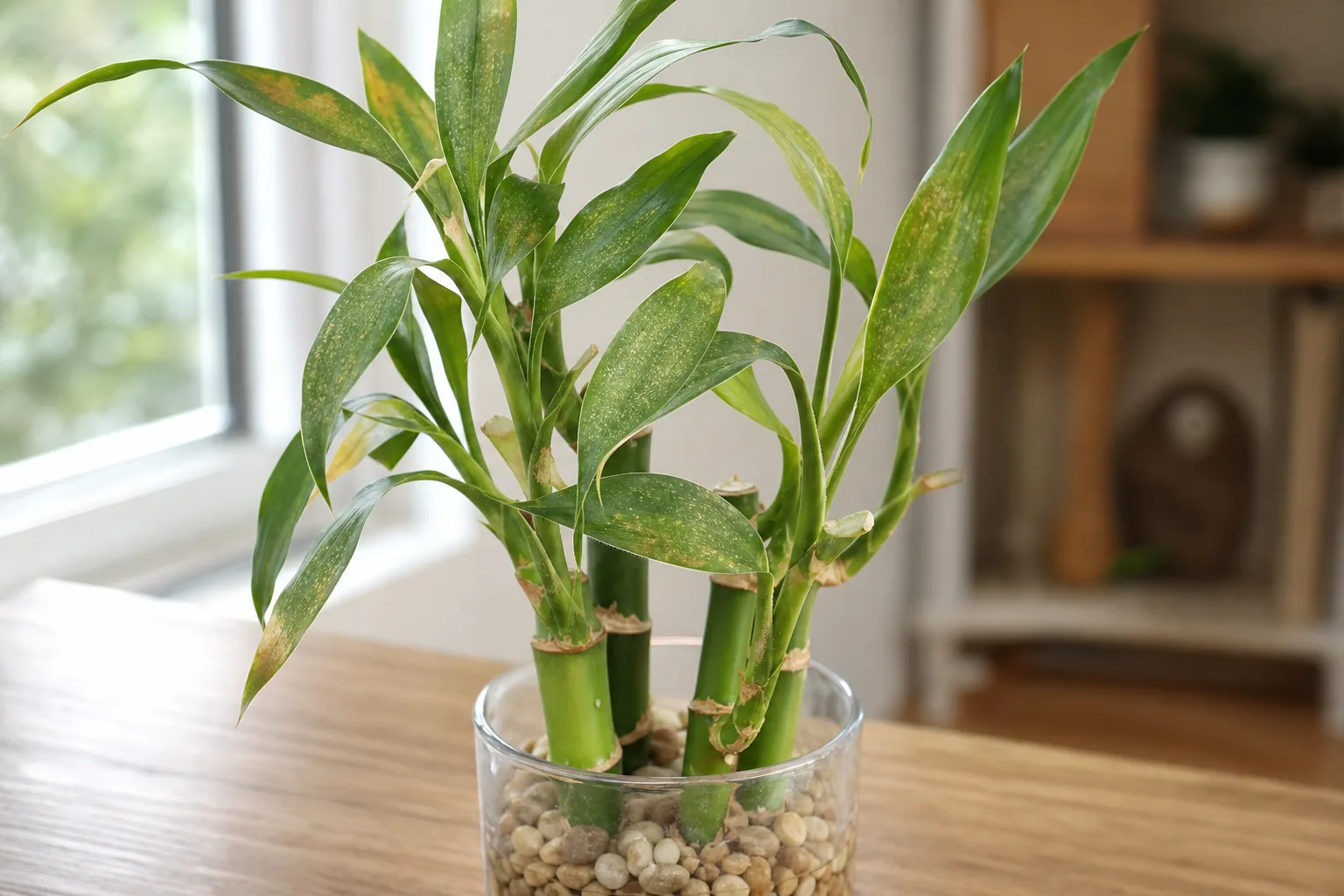
Spider Mites on Lucky Bamboo: Causes, Checks & Fixes
This guide covers spider mites on Lucky Bamboo. See also the general Spider Mites guide, watering, and light pages for this plant.
Spider Mites on Lucky Bamboo: Causes, Checks & Fixes
Quick answer
Spider mites on Lucky Bamboo (Dracaena sanderiana) thrive in warm, dry indoor air and show up as stippled strap leaves plus fine silk at leaf bases - easy to miss until webbing appears inside braided cane creases. First step: isolate the arrangement, rinse every leaf and undersurface with lukewarm water, then follow with labeled insecticidal soap or neem oil on foliage only.
This page covers spider mites on Lucky Bamboo. If margins brown uniformly without speckling or webbing, see brown tips for fluoride and water-quality damage. White cottony masses at nodes point to mealybugs. Dry leaf edges without stippling often trace to low humidity alone.
Clemson Extension lists spider mites among common pests on lucky bamboo, removable by hand, rinsing, or neem or insecticidal soap. NC State advises to monitor for mites on Dracaena sanderiana alongside mealybugs and scale.
Spider mites vs lookalikes on Lucky Bamboo
Narrow strap leaves make early damage easy to misread. Use this table before spraying:
| Sign | Spider mites | Fluoride / tap water | Mealybugs | Aphids | Thrips | Dust |
|---|---|---|---|---|---|---|
| Pattern | Pale dots across leaf face | Brown margins first, uniform band | White cotton at nodes | Soft clusters on new growth | Silvery scrape streaks | Even film on surface |
| Webbing | Fine silk at leaf axils | None | Waxy, not silk | None | None | None |
| Paper tap test | Moving specks fall off | Nothing moves | - | - | Tiny insects | No stippling underneath |
| Vase culture clue | Foliage above water line only | Often all leaves equally | Canes and roots above water | New shoots | Any strap leaf | Wipes clean |
| Start here | This page | Brown tips | Mealybugs | Aphids | Thrips | Rinse only |
What spider mites look like on Lucky Bamboo
Mites are tiny arachnids, not insects - inspect with a 10× lens. Stippling appears as pale yellow or gray dots where mites pierce leaf cells. Webbing collects at the base of strap leaves where they attach to green canes, especially in braids where airflow is poor.
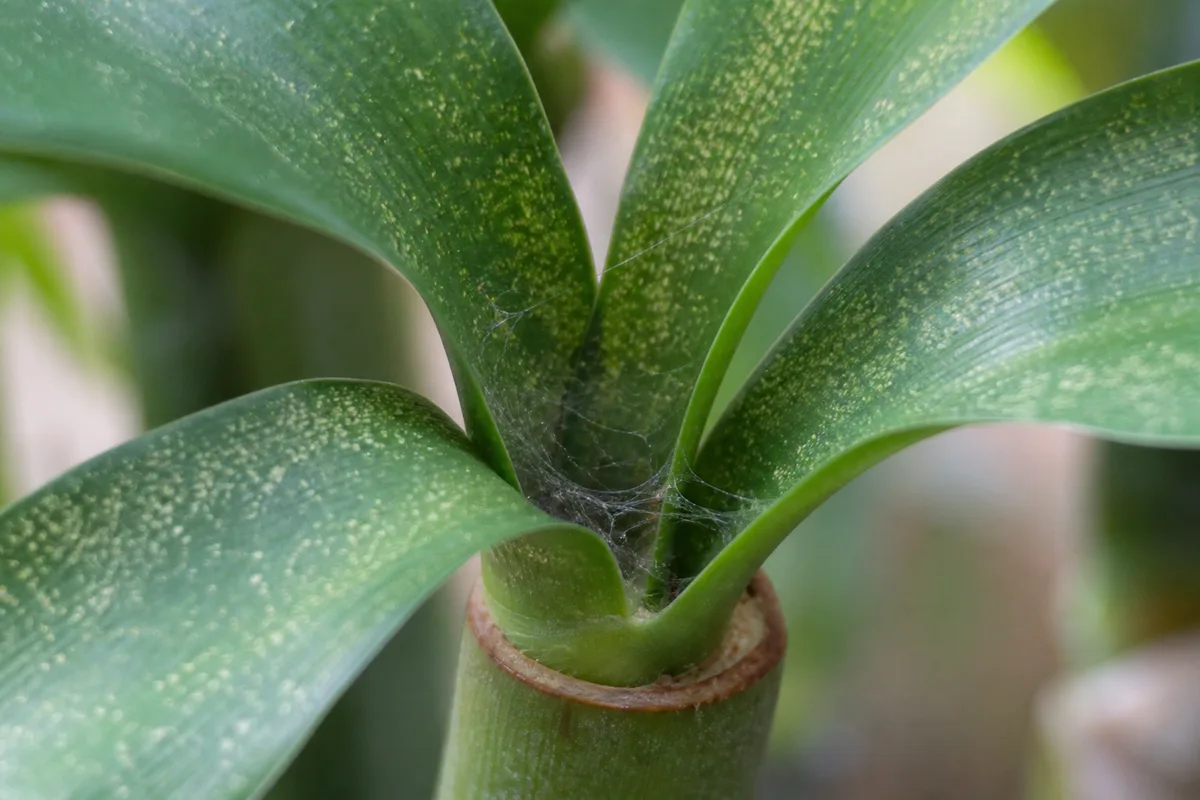
Spider Mites symptoms on Lucky Bamboo - compare with healthy tissue on the same plant.
Leaves may look dull or slightly bronzed before webbing is obvious. Severe damage causes leaf drop from lower nodes first. Unlike fluoride tip burn, mite damage is speckled across the leaf face, not confined to margins.
False spider mites are listed on Dracaena sanderiana - professional ID matters only if labeled soap and neem cycles fail repeatedly.
In water-culture displays, mites colonize foliage above the water line while submerged roots stay unaffected. That split pattern is normal for vase-grown Lucky Bamboo and does not mean the reservoir is infested.
Why Lucky Bamboo gets spider mites
Low humidity favors mites. Low humidity can cause browning of leaf tips on Dracaena - the same dry conditions that stress leaves also help mite populations explode.
Desk placements near monitors, radiators, and HVAC returns create hot, dry microclimates distinct from window-sill drafts. Office Lucky Bamboo often sits in monitor-warmed, air-conditioned air - a combination mites prefer when humidity drops.
Braided and spiral forms trap dust and webbing between canes where rinsing misses. Mites spread from newly purchased plants, bouquets, or infested neighbors on the same shelf. Lucky Bamboo in water vases is not immune - pests colonize foliage above the water line while pebbles and roots below stay pest-free unless another insect is present.
How to confirm the cause
- Tap test - Shake a strap leaf over white paper; moving specks confirm live mites.
- Webbing check - Silk at leaf axils distinguishes mites from thrips scarring or mechanical damage.
- Pattern - Speckling across the leaf face vs. uniform tip burn from tap water (brown tips guide).
- Environment - Dry air and warm room temperature support mite diagnosis; pair with low humidity checks.
- Spread - Are nearby Dracaena or other houseplants stippled too?
- Treatment response - If rinsing reduces stippling within days, mites were likely present.
First fix for Lucky Bamboo
Isolate, rinse thoroughly, then apply insecticidal soap or neem oil to foliage.
Move the arrangement away from other plants. Shower or wipe every leaf and cane crevice with lukewarm water, targeting undersides where mites feed and lay eggs. After foliage dries, spray neem oil or insecticidal soap per label - Clemson notes these pests can be removed by hand, by rinsing the leaves off, or by using neem oil or insecticidal soap.
Repeat weekly until no new stippling appears for two full cycles. Most miticides do not kill eggs, so overlapping hatch cycles require several applications at roughly five- to seven-day intervals.
Step-by-step recovery
Standard rinse-and-treat (all cultures)
- Isolate infested Lucky Bamboo from shelf mates.
- Rinse all leaf surfaces and cane joints; unbraid tight sections if webbing hides inside.
- Apply labeled insecticidal soap or neem; coat undersides until runoff.
- Raise humidity modestly near the plant - avoid soaking vase water with soap runoff.
- Re-treat weekly for three to four weeks; mite eggs hatch on staggered schedules.
- Inspect neighbors; treat if stippling appears.
- Resume weekly filtered water changes after soap residues are rinsed from foliage.
Vase-safe rinse protocol (water culture)
When canes sit in a shared water reservoir, protect the vase before you shower foliage:
- Secure the reservoir - Cover the vase mouth with plastic wrap or a bag held with a rubber band so rinse water and mite debris cannot enter. Leave foliage above the cover.
- Shower over a sink - Lay braided canes at a shallow angle. Run lukewarm water across every strap leaf, emphasizing undersides and inner braid joints. Use a soft cloth in creases where webbing persists.
- Dry foliage first - Let leaves air-dry 30–60 minutes before removing the cover so drips do not carry soap or pests into the water.
- Refresh water if contaminated - If any treatment runoff entered the vase, dump all water, rinse pebbles, and refill with filtered or distilled water per the watering guide. Do not raise the water level to wet leaves.
- Spray foliage only - Apply neem or insecticidal soap to leaves and canes above the water line. Never pour pesticides into vase water unless the product label explicitly permits hydroponic or water-culture use.
- Ventilate the room - Open a window or run a fan during indoor sprays so oil and soap fumes disperse in small offices.
Neem residue that drips into vase water is not well documented for long-term D. sanderiana root health - treat that as a reason to cover the reservoir, not a license to add oil to the water itself.
Recovery timeline
Light infestations may clear within two to three weekly treatment cycles. Braided plants with hidden webbing can take six weeks if stems are not separated for full coverage.
Damaged leaves do not un-stipple - judge success by clean new growth at nodes, not by old speckled blades greening up.
What not to do
Do not treat with undiluted household sprays not labeled for plants. Spider mites are arachnids - many insecticides kill mite predators without controlling mites, which can worsen outbreaks. Choose products labeled for mites or use insecticidal soap or horticultural oil.
Avoid oil treatments in direct hot sun - direct sunlight damages leaves on Lucky Bamboo. Do not ignore braids - inner canes harbor mites. Do not return to a shared shelf before two mite-free weeks.
Do not spray in enclosed rooms without ventilation. Lucky bamboo is toxic to pets - rinse plants where cats and dogs cannot drink runoff, and contact a veterinarian if a pet ingests treated foliage.
How to prevent spider mites next time
Quarantine new plants two weeks. Rinse Lucky Bamboo monthly in lukewarm water, working braid creases. Keep away from heating vents; moderate humidity helps Dracaena foliage and discourages mites - see low humidity for desk-placement fixes.
Dust leaves gently - mites prefer neglected surfaces. Inspect bright, indirect light placements regularly because stressed plants attract pests faster. For enclosed indoor collections, predatory mites are an option in greenhouses per UF/IFAS biological control guidance, though most desk vases respond to rinsing and soap first.
Lucky Bamboo care cross-check
Mite control fails if tap-water fluoride keeps leaves stressed while pests feed. Pair rinsing treatments with filtered water and stable humidity so new strap leaves emerge firm. Monitor for aphids and mealybugs on the same canes - mixed infestations are common on grocery-store arrangements.
Related Lucky Bamboo problems
- Brown tips - fluoride margins without speckling; often confused with early mite damage on narrow leaves
- Low humidity - dry edges without webbing; shares desk and HVAC triggers with mite outbreaks
- Mealybugs - white cotton at nodes, not silk webbing
- Aphids - soft-bodied clusters on new growth with sticky honeydew
- Thrips - silvery scrape marks without fine mite silk
- Watering - weekly filtered rhythm after treatment runoff or vase contamination
Lucky Bamboo care guides
- Overview - vase vs. soil culture hub and pet-toxicity context
When to worry
Escalate when webbing covers multiple canes and new leaves fail to open cleanly. At that point, unbraid or discard the worst stems rather than repeating surface sprays that never reach inner joints - one surviving colony restarts the infestation.
Contact your local Cooperative Extension office if firm-caned Lucky Bamboo stays stippled after four weekly soap or neem cycles and humidity improvements - persistent mites may need professional ID per NC State Dracaena sanderiana guidance.
Conclusion
Braided vase arrangements need braid-level inspection, not just a quick leaf rinse. Cover the reservoir, dry foliage before re-seating canes, and repeat treatments through egg-hatch cycles until new node growth stays clean. If stippling returns only on inner canes, separate those stems before returning the display to your desk.
When to use this page vs other Lucky Bamboo guides
- Lucky Bamboo watering guide - Use for routine moisture checks before assuming spider mites is the main issue.
- Lucky Bamboo problems hub - Browse all 41 common issues on this species.
- Leaf Drop on Lucky Bamboo - Different entry point when symptoms overlap with spider mites.
- Slow Growth on Lucky Bamboo - Different entry point when symptoms overlap with spider mites.
- Thrips on Lucky Bamboo - Different entry point when symptoms overlap with spider mites.