Drooping Leaves on Maranta Lemon Lime: Checks & Fixes
Quick answer
Drooping leaves on Maranta Lemon Lime usually mean the shallow root zone swung too dry or stayed too wet — but first rule out normal daytime leaf-lowering. First step: lift the pot and press the top 2 cm of mix before adding any water.
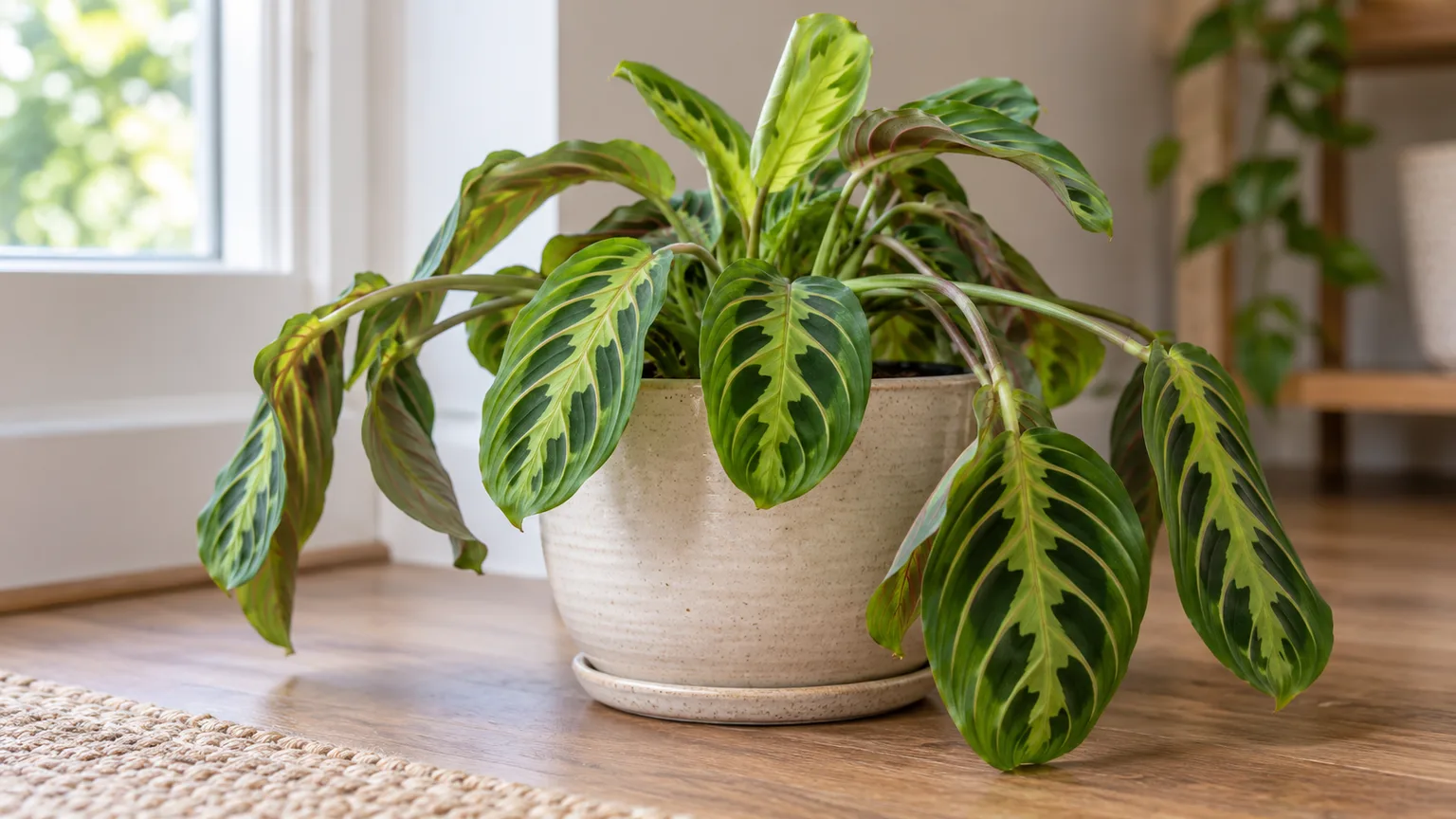
Drooping Leaves on Maranta Lemon Lime: Causes, Checks & Fixes
This guide covers drooping leaves on Maranta Lemon Lime. See also the general Drooping Leaves guide, watering, and light pages for this plant.
Drooping Leaves on Maranta Lemon Lime: Causes, Checks & Fixes
Quick answer
Drooping leaves on Maranta Lemon Lime look alarming because the whole plant seems to deflate at once — chartreuse blades hang downward, petioles lose their spring, and the usually tidy low mound turns floppy. Most cases trace back to water: either the top of the mix dried too far for this moisture-loving prayer plant, or the mix stayed soggy and the shallow roots stopped taking up water. Cold drafts and very dry air make both versions worse on Lemon Lime’s thin, pale tissue.
For how droop works in houseplants generally — cells losing internal water pressure, called turgor — see our drooping leaves hub. On Lemon Lime, the day-night rhythm is the giveaway: healthy prayer movement lifts leaves each evening, while true droop stays limp morning and night. Read that rhythm first, then check moisture, and you will rarely misdiagnose this plant.
First step: lift the pot and press the top 2 cm of mix before you water, mist, move, or feed anything. A light pot with dry mix wants a drink; a heavy pot with damp mix wants air, not water.
What drooping looks like on Maranta Lemon Lime
On Lemon Lime, droop shows in the petioles as much as the blades. Each leaf rides on a slender stalk that normally holds the blade out flat by day and cranks it upright at night. When turgor fails, those stalks go soft near the base and the blades tip downward, twist sideways, or fold along the midrib instead of lying in their usual neat overlapping shingle. The chartreuse center stripe often looks duller a day before the flop becomes obvious, and the dark-green margins may cup slightly.
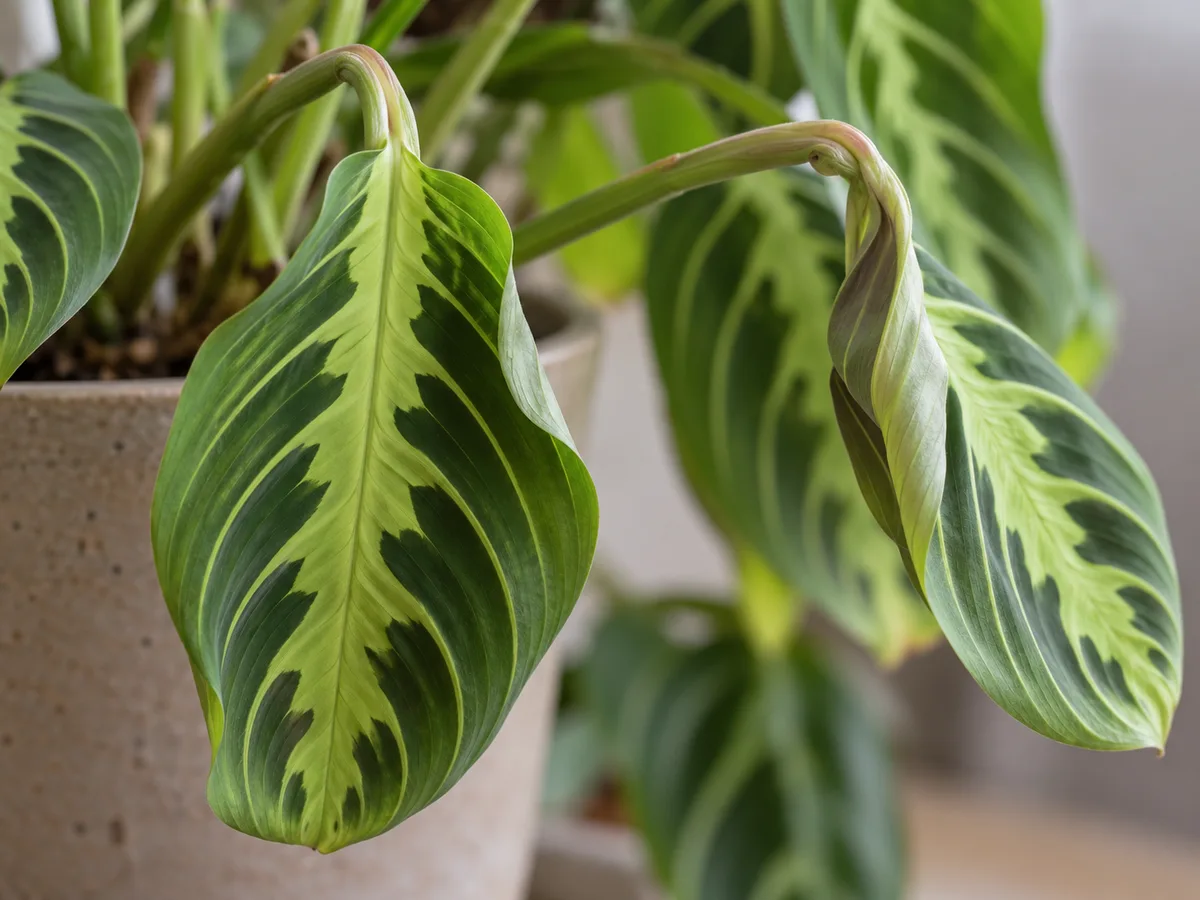
Close-up: blades hanging with soft creased petioles and a dulled chartreuse center — the limp-around-the-clock look that separates true droop from normal daytime leaf-lowering.
New growth tells the deeper story. Lemon Lime pushes leaves as tight rolled tubes from the crown, and those tubes should feel firm and keep unfurling even when older outer leaves sag a little. If fresh rolls stall, emerge pale, or collapse before opening, the problem has reached the rhizome zone and a single watering will not fix it. A plant with limp outer blades but a firm, still-unfurling center is in far better shape than one whose crown has gone quiet.
Not drooping: the normal prayer-plant rhythm
This is the section that saves more Lemon Limes than any other, because normal nyctinastic movement gets “treated” constantly. Maranta leaves are hinged at small joints called pulvini that raise the blades toward vertical after dark and lower them again by morning — the famous praying habit. In a healthy plant the evening lift is obvious: by late evening the whole mound looks perkier and more upright than it did at noon, even though midday leaves rest at a relaxed downward angle.
True droop breaks that rhythm. The leaves stay down after dark, the petioles feel limp rather than springy when you gently nudge them, and the plant looks tired rather than merely relaxed. A related trap: Lemon Lime’s pale chartreuse sections photograph and read as “washed out” in dim rooms, which owners mistake for illness. If the day-night lift is intact, new rolls keep coming, and the color is even (not blotchy or scorched), the plant is behaving normally — give it brighter indirect light rather than extra water. Only when the rhythm flattens for two full days should you work through the diagnosis below.
Why Maranta Lemon Lime droops
The 2-cm dry-out. Lemon Lime wants its mix kept evenly moist through the growing season, and its root system is a shallow mat of fine roots over creeping rhizomes — it cannot chase water deep the way a philodendron can. When the top 2 cm dries completely in a warm, bright room, those surface roots lose uptake within hours and the petioles fold. This is the most common cause, and also the most forgiving: catch it early and the plant firms up fast.
Wet, airless mix with failing roots. The mirror image is more dangerous. Soggy compost starves roots of oxygen, fine roots die back, and the remaining roots cannot move water — so leaves droop on wet soil, exactly as if the plant were dry. Wilted leaves may indicate the soil is too dry OR too wet, because rotting roots cannot take up water. On Lemon Lime this usually follows a month of heavy-handed watering, a decorative cachepot holding standing water, or a dense peat mix that never dries at the bottom. Root rot may occur with poorly drained soils, and this cultivar shows it as limp, dull foliage rather than fast yellowing.
Fluoride and hard tap water. NC State notes that Maranta leaves burn with high fluorides, and Lemon Lime’s pale chartreuse tissue shows that stress earliest — first as browning tips and dull blades, then as a general loss of vigor that ends in droop. Owners who water perfectly on schedule but always straight from a fluoridated tap often land here. Fluoride and chlorine in tap water are documented enemies of prayer-plant foliage, with rainwater or purified water as the practical fix.
Cold drafts and temperature swings. Prayer plants are warm-climate natives that resent cold air on their leaves; even a drafty entryway or a window cracked on a cool night can flatten Lemon Lime overnight. Exposure to chilling temperatures can cause dropping, wilting, or discolored leaves on tropical plants. Keep the plant above 60°F (16°C) and away from doors that open often in winter — a droop that appears the morning after a cold night, with soil moisture unchanged, is almost always chill response.
Dry air plus weak light. Lemon Lime requires high humidity — a tray of wet pebbles under the pot is the classic recommendation — and chartreuse tissue crisps fast when winter heating drops indoor humidity into the 20s. Prayer plants kept around 40–50% humidity avoid the dryness, browning, and curling cycle. Dim corners compound the problem: these understory plants want moderate to bright indirect light, and a starved plant in a dark corner transpires poorly, drinks slowly, and sits wet — which circles back to root suffocation.
How to confirm the cause at home
Work in this order; each step takes a minute and the sequence matters because watering first destroys the evidence.
- Read the rhythm. Check the plant after dark two evenings running. Blades lifting at night means normal movement or mild stress — hold off on drastic action. Blades flat at midnight two nights in a row means genuine droop.
- Lift the pot. For small pots, lifting is the fastest moisture gauge — a light pot needs water. Combine with a finger pressed 2 cm deep: light plus dry equals underwatering; heavy plus damp equals the wet-root path.
- Inspect the new roll. A firm, still-growing center leaf argues for a simple dry spell. A stalled, pale, or collapsing roll argues for root or cold damage.
- Smell and look at the base. Sour or musty mix, algae on the surface, or soft dark stems at the soil line all confirm the wet path. Turning the plant out of the pot to examine the roots confirms rot — brown, soft roots versus firm pale ones.
- Replay the last two weeks. New bagged tap water every time? A move to a darker shelf? A cold night by the door? Lemon Lime droop that follows a change is usually that change.
If the pot is heavy and wet, do not water “just in case” — that single drink is what pushes stressed roots into rot on this plant.
The first fix for Maranta Lemon Lime
First fix: lift the pot, read the top 2 cm, and correct only what you found — water thoroughly only a light, dry pot; otherwise give a heavy, damp pot air and drainage.
For the dry pot, water slowly until it runs freely from the drainage holes, let it drain fully, and empty the cachepot so the rhizomes never sit in runoff. Very dry peat-coir mix can shed water down the sides, so if the pot still feels light after watering, soak the nursery pot in a basin for 10–15 minutes, then drain. Expect visible firming within hours; that quick rebound confirms underwatering was the whole story.
For the heavy, damp pot, move the nursery pot out of any decorative cover, set it where gentle airflow reaches the soil surface, and hold all water until the top 2 cm actually dries. If the mix smells sour or stems feel soft at the base, slide the root ball out for a look: trim only clearly mushy roots with clean scissors, repot into fresh airy mix at the same depth, and resume watering lightly. Plants standing in water or in pots without drainage holes are asking for trouble — fix the container habit now, not later.
Step-by-step recovery
Once the first correction is in, stabilize the environment so the shallow rhizome mat can rebuild. Move the plant to bright filtered or indirect light — near an east window or a few feet back from a bright south window — since good light drives the transpiration that pulls water through recovering roots. Details for this cultivar’s narrow comfort band are in the Maranta Lemon Lime overview.
Raise humidity around the plant rather than on it: a pebble tray with water kept below the pot base, or a small humidifier nearby, beats misting chartreuse leaves that spot easily. Keep temperatures steady and warm, and pause fertilizer entirely — stressed prayer plants burn readily, and over-fertilization scorches Maranta foliage. Resume half-strength feeding only after two or three clean new leaves have opened.
Prune for airflow and honesty, not for looks. Leaves that are fully limp, yellowed, or crisped will not re-inflate; snip them at the petiole base so you can see whether new crown growth is replacing them. Leave any blade that still lifts at night — it is still photosynthesizing for the recovery. Full repotting can wait unless you found rot; a fresh mix refresh is covered in the soil guide when the time comes.
Recovery timeline
| Cause | What improvement looks like | Typical timeframe |
|---|---|---|
| Single dry spell | Blades firm within hours; evening lift returns the same night | Same day to 48 hours |
| Repeated underwatering | No new crisping; fresh rolls unfurl cleanly | 1–2 weeks of steady 2-cm rhythm |
| Soggy mix, roots still firm | Droop stops spreading; newest roll resumes | 1–3 weeks after drying and drainage fix |
| Early root rot (trimmed, repotted) | Crown pushes a new roll; older limp leaves shed | 3–6 weeks; old blades rarely re-lift |
| Cold-draft shock | Gradual firming with no further collapse | 3–7 days after warmth stabilizes |
| Advanced rot with mushy rhizome | Little to no new crown growth | Often not recoverable — propagate firm stem cuttings instead |
Old drooped blades are a sunk cost; recovery is judged by new growth and a stable root zone, not by coaxing every old leaf upright.
Lookalike symptoms on Lemon Lime
Droop shares a waiting room with several cousins, and the Maranta Lemon Lime problems hub lists all of them. The distinctions that matter:
- Wilting is faster and more total — the whole plant collapses within hours, usually after severe dryness or heat. Slow, days-long sag on outer leaves while the crown keeps working is drooping, not wilting.
- Underwatering is the dry-pot subset of droop with curling edges and brown tips marching in. If your pot is light and the mix is dry, read that guide for the rehydration sequence.
- Overwatering is the wet-pot subset — limp leaves on damp mix, sometimes with fungus gnats or algae. Heavy pot plus droop means start there.
- Root rot is what overwatering becomes: mushy base stems, sour mix, brown soft roots. Droop plus any of those signs escalates to the root-rot workflow immediately.
- Low humidity crisps first and droops second — brown, papery edges with curling point to air, not roots.
- Yellow leaves with droop on wet soil usually mean the roots have been struggling for weeks, not days.
When to use this page vs other Maranta Lemon Lime guides
This page is the slow-sag triage — leaves losing posture over days with the day-night rhythm flattening out.
| Pattern | Read next |
|---|---|
| Whole plant collapsed within hours | Wilting |
| Light dry pot, curled blades, crisp edges | Underwatering |
| Heavy wet pot, gnats or algae | Overwatering |
| Mushy stems, sour mix, brown roots | Root rot |
| Brown papery tips in dry heated air | Low humidity |
| Pale stretched growth in a dark corner | Not enough light |
| Routine moisture rhythm and mix choice | Watering guide |
What not to do
- Watering a heavy, damp pot “because the leaves look thirsty” — the classic way droop becomes rot.
- Drowning a hydrophobic dry pot with one fast pour down the middle; water sheets off dry coir-peat, so soak and confirm weight gain.
- Switching to ice-cold tap water straight from the faucet on a fluoride-sensitive cultivar; use room-temperature filtered, rainwater, or overnight-stood water.
- Moving a wet, drooping plant into a dark corner “to rest” — dim light slows drying and keeps rhizomes soggy longer.
- Fertilizing limp foliage to “perk it up”; salts stress damaged roots further.
- Misting chartreuse leaves instead of fixing root-zone moisture or room humidity at the source.
How to prevent drooping next time
Build the routine around the 2-cm check rather than the calendar: most healthy indoor Lemon Limes in the recommended peat-perlite-coir mix want water every 5–7 days in active growth, less in winter — but the finger test overrules the schedule every time. Full seasonal detail lives in the watering guide. Keep the nursery pot inside its cachepot only with an air gap, and empty runoff within half an hour so the shallow rhizomes never stand wet.
Light and air do the rest. Bright indirect placement keeps transpiration honest so the mix dries predictably; stagnant, dim corners keep it wet and invite the exact root suffocation that droops this plant. Keep humidity steady with a pebble tray or humidifier, hold temperatures above 60°F, and inspect the crown weekly — a stalled new roll is visible days before the outer leaves flop, which is your early-warning window.
Related Maranta Lemon Lime guides
- Maranta Lemon Lime overview — light, water, and humidity baseline for this chartreuse cultivar
- Watering guide — the 2-cm check, seasonal rhythm, and cachepot drainage habit
- Light guide — bright indirect placement without scorching pale tissue
- Soil guide — airy peat-perlite-coir mix that stays moist without suffocating rhizomes
- Wilting on Maranta Lemon Lime — fast whole-plant collapse vs the slow sag covered here
- Underwatering on Maranta Lemon Lime — dry-pot recovery and rehydration steps
- Overwatering on Maranta Lemon Lime — wet-mix droop, gnats, and drainage fixes
- Root rot on Maranta Lemon Lime — rhizome inspection and salvage when droop turns to rot
- Maranta Lemon Lime problems — browse all 16 common issues on this plant
Conclusion
Drooping on Maranta Lemon Lime is the plant telling you its shallow root zone lost balance — usually a dry 2-cm layer, sometimes a suffocated one, occasionally a cold night or fluoridated water habit behind it. Read the evening lift, lift the pot, and correct only what you found; most dry-spell droops rebound within a day, and even wet-root cases recover when drainage and patience replace extra watering. The leaves to watch are the new rolls at the crown — when they emerge firm and chartreuse-bright, the plant has turned the corner.
Related tool
Use the Plant Problem Diagnosis Tool to narrow causes for drooping leaves on this plant before changing multiple variables at once.