Mealybugs on Maranta Lemon Lime: Causes, Checks & Fixes
Quick answer
Mealybugs on Maranta Lemon Lime show up as white, cottony clusters wedged into leaf axils, stem nodes, and leaf undersides, often with sticky honeydew. First step: isolate the plant and dab every visible cluster with a cotton swab dipped in 70% isopropyl alcohol, then re-check weekly for a month.
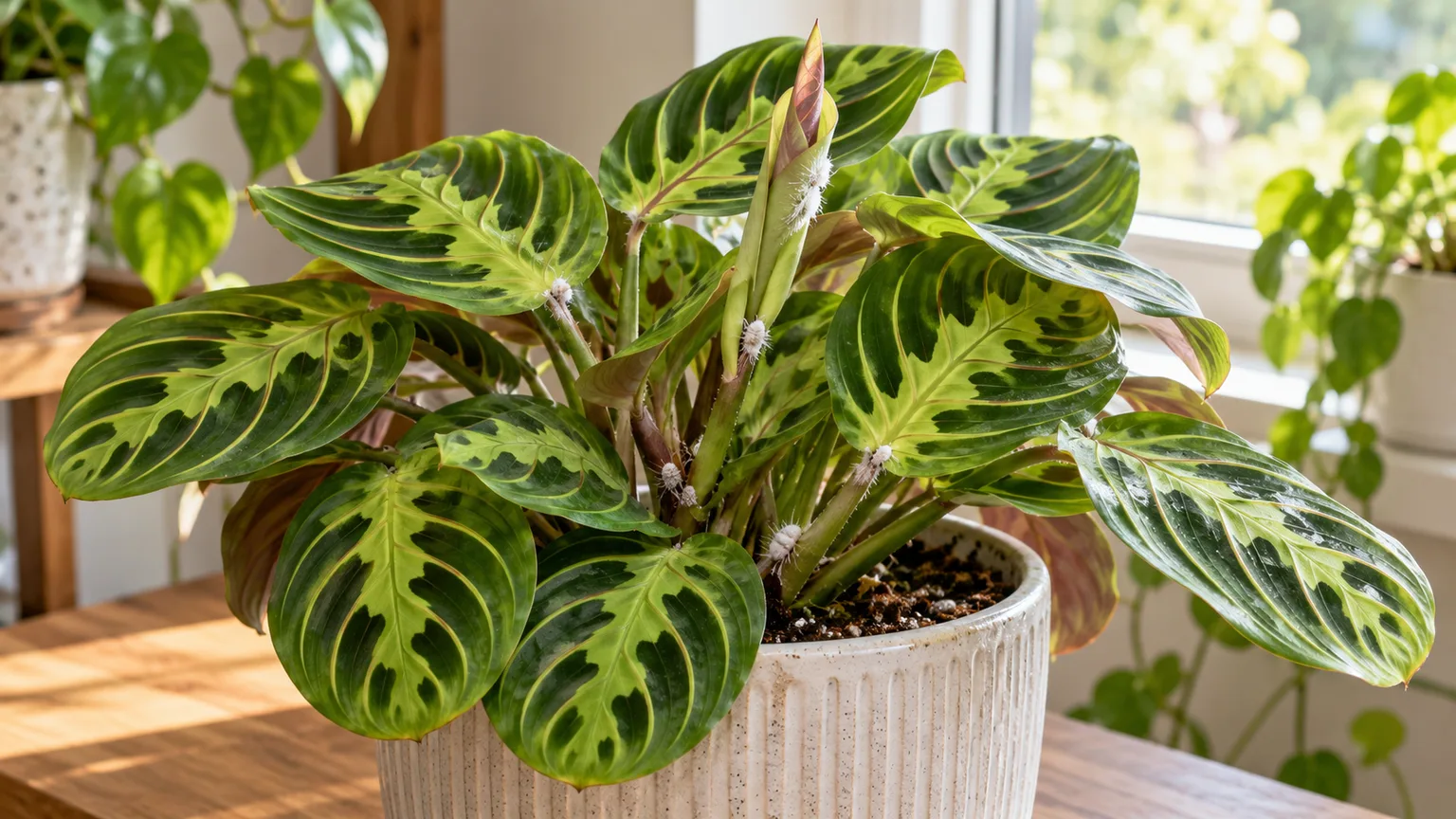
Mealybugs on Maranta Lemon Lime: Causes, Checks & Fixes
This guide covers mealybugs on Maranta Lemon Lime. See also the general Mealybugs guide, watering, and light pages for this plant.
Mealybugs on Maranta Lemon Lime: Causes, Checks & Fixes
Quick answer
Mealybugs on Maranta Lemon Lime look like tiny tufts of white cotton wedged where the leaf meets the stem, along stem nodes, and under the leaves — often with a sticky film (honeydew) on the foliage below. First step: move the plant away from your other houseplants, then dab every visible white cluster with a cotton swab dipped in 70% isopropyl alcohol. That single pass kills what you can see; the follow-up schedule below handles the crawlers you cannot see yet.
For how mealybugs behave on houseplants in general, see our mealybugs guide. On this prayer plant, the pattern is distinctive: colonies exploit the tight folds, rolled new leaves, and low rosette that make Maranta Lemon Lime so attractive — and so hard to inspect.
What mealybugs look like on Maranta Lemon Lime
On this plant, mealybugs rarely sit out in the open. The adults are soft-bodied insects about 1/20 to 1/5 inch long, coated in a white, mealy wax that reads as cotton lint tucked into crevices. Check the V where each leaf stalk meets the stem, the furled tube of each emerging leaf, the undersides of the patterned leaves, and the crowded crown at soil level. Heavy feeding shows as stunted or distorted new leaves that unfurl small and crinkled, yellowing patches, premature leaf drop, and a clear sticky residue on leaves below the colony. Where honeydew sits long enough, a black sooty mold film may follow — on Lemon Lime’s pale chartreuse bands, that dark film is especially obvious.
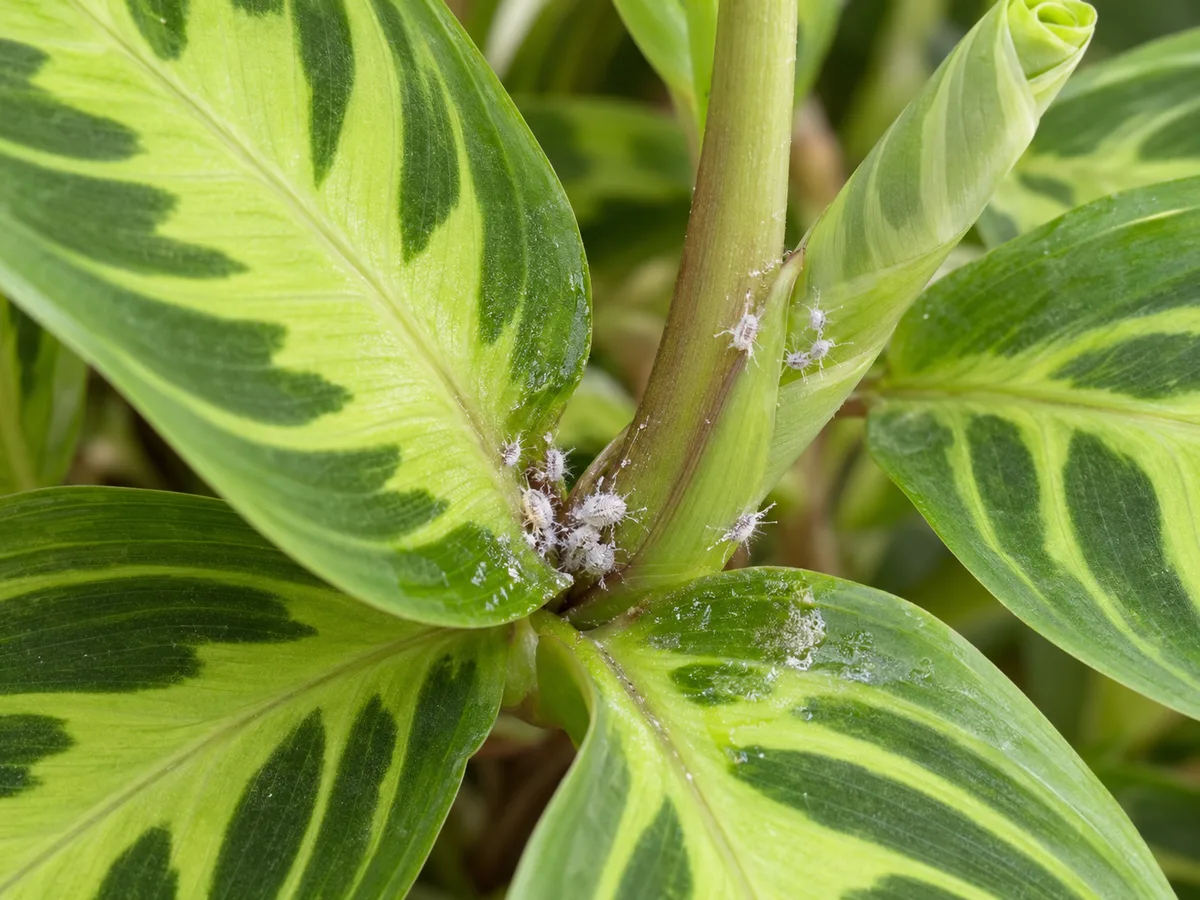
White, cottony wax tucked into a leaf axil — the classic mealybug hiding spot on prayer plants, with sticky honeydew often coating the leaf below.
Where they hide on a prayer plant’s folding rosette
This is the section that separates a Maranta guide from a generic mealybug page. Maranta Lemon Lime grows as a low, dense rosette whose leaves fold upward at night and whose new leaves emerge as tight rolled tubes — and every one of those folds is shelter. Crawlers settle first inside rolled new growth, where a casual glance sees only a healthy emerging leaf. From there they spread to petiole bases, the undersides of older leaves, and the rhizome crown just at or below the soil surface, where watering never disturbs them.
Because the plant is compact and many-stemmed, an infestation can be well established before any single leaf looks sick. Inspect by gently unrolling nothing — instead, hold the pot at eye level, part the stems with two fingers, and use your phone flashlight in each axil. Tap a suspect leaf over dark paper: crawlers show as slow-moving pale specks. Also check the pot rim, saucer, and the top centimeter of mix, since mealybugs wander when crowded and prayer plants sit low enough that crawlers reach neighboring pots on foot.
Why Maranta Lemon Lime gets mealybugs
Mealybugs find stressed or greenhouse-soft plants fastest, and prayer plants check both boxes. Nursery-grown Lemon Lime arrives with lush, tender growth pushed under warm, humid greenhouse conditions — exactly the soft tissue mealybugs prefer — and then meets a home where evenly moist soil and high humidity keep the canopy dense and sheltered. A plant already stressed by dry winter air, fluoride-burned leaf edges, or a recent move stops producing vigorous new growth, and colonies expand faster than the plant outgrows the damage.
Spread is almost always human-assisted: a new plant placed beside the Maranta without quarantine, handling several plants without checking hands, or reusing a saucer. Outdoors in warm climates mealybugs travel on ants farming their honeydew; indoors, you are the ant. One overlooked egg mass — females lay 300 to 600 eggs in a cottony ovisac, hatching over weeks — restarts the whole colony, which is why single treatments appear to fail.
How to confirm the cause
Work in this order before reaching for any spray:
- Find the cotton. Part the stems and check axils, nodes, rolled new leaves, and the crown with a flashlight. True mealybug wax smears slightly when touched with a damp swab; perlite dust and spider-mite webbing do not form discrete cottony tufts.
- Find the honeydew. Run a finger along a lower leaf. Sticky residue plus clusters above it confirms sap-feeding pests rather than a fungal problem — compare with mold on soil, which stays on the mix surface.
- Check new growth. Distorted, undersized, or sticky emerging leaves point to active feeding at the growing points. If instead mature leaves are yellowing uniformly with no cotton and no stickiness, read yellow leaves on Maranta Lemon Lime — the cause is likely watering or light, not pests.
- Check the roots. If top growth is stunted despite treatment, slide the root ball out and look for white waxy patches on roots and the inside of the pot — root mealybugs mimic root rot decline but smell normal.
- Rule out lookalikes. Distorted sticky growth with visible white tufts is mealybugs; fine stippling with webbing is spider mites; clustered soft green or black insects on new shoots are aphids.
The first fix for Maranta Lemon Lime
Isolate the plant, then dab every visible cluster with a cotton swab dipped in 70% isopropyl alcohol. Touch each tuft directly — the alcohol dissolves the waxy coating and kills the insect underneath on contact, a method consistently recommended for light houseplant infestations including isopropyl rubbing alcohol dabbing. Test one leaf first and wait a day: Lemon Lime’s thin, pale foliage can spot if alcohol pools in bright light, so work in shade and let leaves dry before returning the plant to its window.
Do nothing else on day one. No repot, no fertilizer, no full-canopy spray. This plant sulks when several stresses stack, and the swab pass alone removes the breeding adults while you watch how the plant responds. Bag the used swabs — do not compost them.
Step-by-step follow-up treatment
Eggs and crawlers survive the first pass, so schedule the follow-up before you forget:
- Days 3–4: re-inspect. Re-check every axil and rolled leaf with the flashlight. Swab any new tufts the same way.
- Day 7: soap or oil if crawlers persist. If you still find live insects after two swab passes, apply insecticidal soap or narrow-range horticultural oil to the affected areas, following the label exactly — insecticidal soap or narrow-range oil on ornamentals knocks down exposed crawlers with minimal harm to anything else. Coat axils and undersides, not just leaf tops. Keep the plant out of direct sun until dry to avoid leaf burn on the chartreuse tissue.
- Repeat weekly for 3–4 weeks. One mealybug generation spans roughly six to 10 weeks from hatch to egg-laying, so a month of weekly checks breaks the cycle. Stop when two consecutive inspections find nothing.
- Treat the root zone if needed. White wax on roots means unpot, discard the old mix, wash the pot in hot soapy water, rinse roots gently, and repot into fresh well-draining but moisture-retentive mix. Check your watering rhythm afterward — soggy recovery mix invites overwatering damage on top of pest stress.
- Quarantine a full month. Keep the plant separated until inspections stay clean for four weeks, and inspect the neighbors that stood beside it — crawlers walk.
What not to do
Do not blast a prayer plant with a forceful hose the way you might a sturdy philodendron: Lemon Lime’s thin leaves bruise, and water pooling in the crown invites stem rot. Do not reach for a systemic insecticide as a first resort on an indoor plant you touch daily — read the label, and note this plant is considered non-toxic to cats and dogs, which matters if pets chew leaves that carry spray residue. Do not fertilize a plant that is actively losing leaves to pests; feeding supports new soft growth the remaining mealybugs will colonize, and Maranta only wants light feeding in active growth anyway. And do not prune away half the rosette on day one — defoliating a slow-growing prayer plant removes the energy reserves it needs to push clean leaves. Trim only fully dead leaves, after the infestation is controlled.
Recovery: reading new rolled leaves, not old damage
Prayer-plant recovery has a specific tell: the next leaves. Damaged leaves will not smooth out, re-pattern, or lose their sooty film entirely — wipe honeydew off with a damp cloth, but judge success only by what unfurls next. Clean, flat, full-sized new leaves with crisp lime banding mean feeding has stopped. Expect the first clean leaf within two to three weeks of control in the growing season; winter recovery is slower, since Maranta stalls below about 60°F (16°C) and pushes little new growth to read.
If the crown itself is mushy or every emerging roll arrives distorted after a month of clean inspections, the rhizome is exhausted. A healthy Maranta can be divided at repotting — salvaging one clean, pest-free division with firm roots often beats nursing a fully infested clump back. When colonies refill every crevice within days despite a month of treatment, or both crown and roots are infested, discard the plant (bagged, not composted) and disinfect the pot and saucer before reuse.
How to prevent it next time
Prevention on this plant is inspection plus vigor. Quarantine every new plant for two to three weeks — most home infestations arrive this way, not spontaneously. Fold a five-second axil check into your normal watering routine: with watering every 5–7 days for evenly moist mix, you handle the plant often enough to catch a two-tuft colony before it becomes two hundred. Keep humidity high and light at bright indirect, never harsh direct sun so growth stays vigorous; a plant pushing healthy rolled leaves outgrows minor pest pressure that would finish a stalled one. Wipe leaves occasionally to remove dust and early honeydew, wash pots and saucers between uses, and if low humidity or brown tips are already stressing the plant, fix those first — stressed prayer plants are measurably more inviting to sap-feeders. For a full reset of the basics, the Maranta Lemon Lime overview and the problems hub put this guide in context.
Related Maranta Lemon Lime guides
- Maranta Lemon Lime overview — full care baseline; start here if several things look wrong at once.
- Problems hub — all Lemon Lime problems in one place when the diagnosis is still open.
- Watering — evenly-moist routine that keeps growth vigorous and inspections frequent.
- Light — bright indirect placement that avoids both scorch and the weak growth pests exploit.
- Soil — moisture-retentive mix and repotting hygiene if root mealybugs force a repot.
- Spider mites — use when you see stippling and webbing instead of cottony tufts.
- Aphids — use when clusters of soft insects sit on new shoots rather than waxy tufts in axils.
- Yellow leaves — use when yellowing has no cotton, stickiness, or visible insects.
- Root rot — use when the root ball smells sour or stems go soft at the base.
- Brown tips — use for dry fluoride-burned edges without pests.
Related tool
Use the Pest Identifier Tool to narrow causes for mealybugs on this plant before changing multiple variables at once.