Slow Growth on Norfolk Island Pine: Causes, Checks & Fixes
Quick answer
Norfolk Island pine is naturally slow indoors-often 3–6 inches per year. Stalled growth beyond that usually means too little light, cool rooms, or tight roots. Lower whorls lost to chronic dim light never grow back. Check placement and season before reaching for fertilizer.
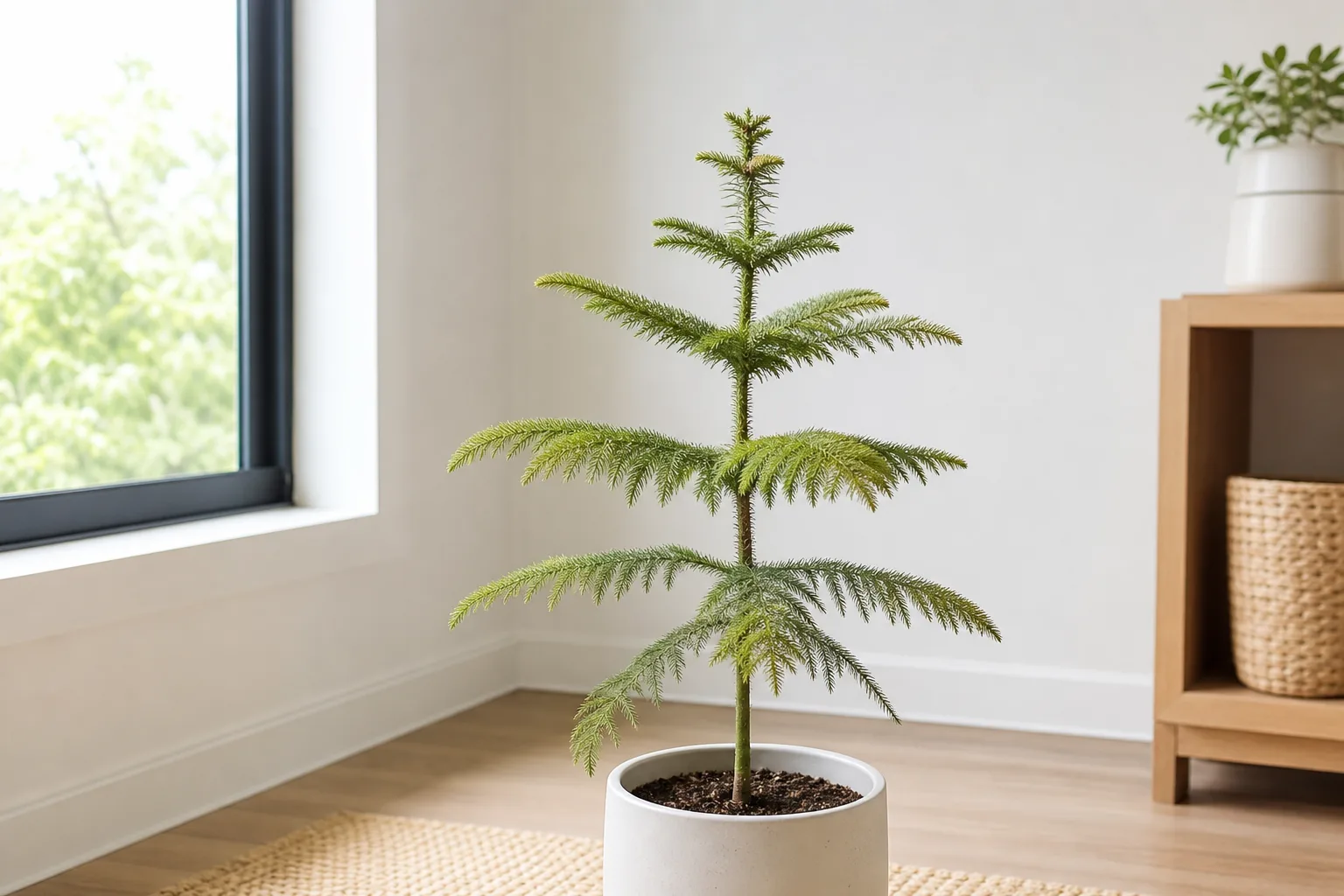
Slow Growth on Norfolk Island Pine: Causes, Checks & Fixes
This guide covers slow growth on Norfolk Island Pine. See also the general Slow Growth guide, watering, and light pages for this plant.
Slow Growth on Norfolk Island Pine: Causes, Checks & Fixes
Quick answer
Slow growth on Norfolk Island pine (Araucaria heterophylla) is often normal, not a crisis. As houseplants, these subtropical conifers typically add only three to six inches of height per year and may reach six to eight feet over many seasons indoors. That pace feels frustrating if you expect a fast-growing foliage plant-but it matches how the species behaves in containers.
Critical species note: Norfolk Island pine does not sprout replacement branches on bare trunk sections. Chronic low light that kills lower whorls leaves permanent gaps you cannot prune away later-so treat dim placement as structural damage, not just a pace issue.
Concern starts when the tree stops adding whorls entirely through a warm, bright spring and summer, or when new tiers arrive thin, pale, and droopy. On this plant, that pattern almost always traces to insufficient light, cool room temperatures, or root congestion-not hunger. Fertilizer rarely fixes a tree that cannot photosynthesize enough or breathe in tight, tired soil.
First step: assess light and season before changing anything else. Move the pot to the brightest suitable window you have-see the Norfolk Island pine light guide for foot-candle targets and window placement-note whether it is actively growing season, and watch for new branch whorls over the next four to six weeks. Only after light checks out should you inspect roots or adjust feeding.
Scope note: This page covers stalled or abnormally slow whorl production-when the tree adds little or no new tissue during active warm months. For long droopy branches reaching toward a window while some growth continues, see leggy growth on Norfolk Island pine. For dim-light pattern decline and branch drop as the primary symptom, see not enough light on Norfolk Island pine. Full species context lives on the Norfolk Island pine overview.
Case walkthrough: December display → March stall
A common pattern: the tree looks fine beside the holiday tree in December, then stalls in January once it stays in a dim living room after decorations come down. By March, lower whorls may droop while the top pushes weak pale tissue-or nothing new appears at all.
Week 1–2 (March): Audit light at midday where the pot sits. If you cannot read comfortably without a lamp, or the tree sits more than 60 cm from glass, light is inadequate.
Week 2–3: Move to the brightest east window or filtered south exposure within 12 to 24 inches (30 to 60 cm) of the pane-the placement band from the light guide. Acclimate over seven to fourteen days if coming from very dim conditions.
Week 4–6: Watch the top leader for firm green needle clusters at branch tips. A full new whorl may take four to eight weeks in spring-still slow by houseplant standards, but visibly different from a complete stall.
By mid-summer: Judge success by one new whorl per active season with evenly spaced tiers-not by comparing inches to a pothos. If nothing changes after light correction, root work, and appropriate feeding through a full warm season, inspect for root rot or hidden pest load.
What slow growth looks like on Norfolk Island Pine
Healthy Norfolk Island pine grows in distinct horizontal tiers-usually about five branches per whorl-stacked up a single upright leader. Slow-but-normal growth means a new whorl every few months during warm months, with needles staying soft, green, and evenly spaced along each branch.
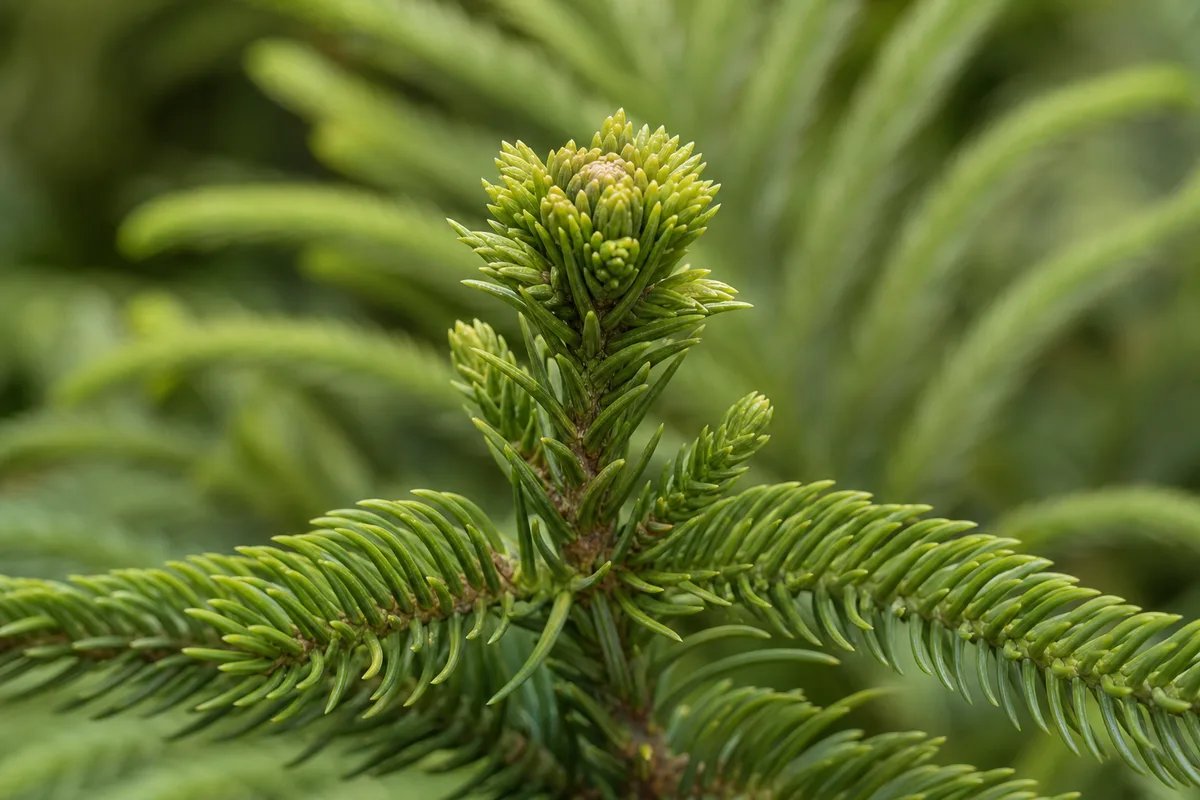
Slow Growth symptoms on Norfolk Island Pine - compare with healthy tissue on the same plant.
Problematic slow growth looks different:
- No new whorls for months during spring and summer despite otherwise stable care
- Long, droopy gaps between existing tiers instead of compact spacing
- Smaller, paler needles on the newest growth compared with older whorls
- Lower branches weakening while the top still pushes weak new tissue
- Pot weight unchanged for weeks even though you water on schedule-roots may not be taking up moisture efficiently
Because Norfolk Island pine does not sprout replacement branches on bare trunk sections, chronic low light that kills lower whorls leaves permanent gaps. Slow growth that comes with branch drop is structural damage, not just a pace issue-you cannot prune your way back to a full pyramid later.
Normal seasonal pause: Growth naturally slows in late autumn and winter when days shorten and room humidity drops with heating. A tree that holds green needles but adds little height from November through February is often resting, not failing-especially if the crown of branches looks firm and soil dries at a predictable rate between waterings per the watering guide.
How this differs from leggy growth and not enough light
All three pages connect to light, but the primary symptom and first fix differ:
| Page | Primary symptom | Growth pattern | Start here when… |
|---|---|---|---|
| Slow growth (this page) | Few or no new whorls during warm months | Tree looks compact but stalled; may hold green needles in marginal light | No new tiers for months in spring/summer despite stable care |
| Leggy growth | Long gaps between tiers, lean toward window | Active stretching; weak droopy branches but some tissue still forms | Branches visibly reach for light while spacing widens |
| Not enough light | Lower branch drop, yellowing tiers, pattern fade | Decline and structural loss, not just slow pace | Entire whorls yellow or drop after dim placement or holiday move |
Leggy growth and slow growth often share the same root cause-light-but leggy trees show active stretching, while truly stalled trees produce little or no new tissue at all. If soggy soil and tier collapse dominate, pivot to root rot instead of any growth-pace guide.
Why Norfolk Island Pine grows slowly-or stops
Several factors interact on this species. The most common indoor bottlenecks:
Naturally slow metabolism
Norfolk Island pine is a long-lived conifer, not a tropical foliage plant on a weekly leaf cycle. Even with ideal care, indoor specimens grow slowly by design. Illinois Extension notes that three to six inches per year is typical for houseplant culture, with mature indoor heights often landing around six to eight feet over many years. Expecting monthly visible height jumps will misread normal behavior as a problem.
Insufficient light
Light is the main throttle. Norfolk Island pine belongs in the medium-bright to high-light band-University of Maryland Extension lists it alongside plants that want roughly 100–1,000 foot-candles, best near east or filtered south and west windows. The Norfolk Island pine light guide targets 500 to 1,000 foot-candles at the canopy with the pot within 12 to 24 inches of suitable glass-not on a console across the room where your eyes see daylight but needles receive little usable flux.
| Placement check | What it tells you |
|---|---|
| Hand-shadow test at canopy height on a bright day | Soft diffuse shadow = moderate light; sharp defined shadow = stronger light suitable for this species |
| Pot more than 60 cm from brightest window | Likely below the intensity band for steady whorl production |
| New whorls thin or absent in spring/summer | Light probably still short even if needles stay green |
| Lower tiers shaded by furniture or upper branches | Structural self-shading can stall lower growth while top looks acceptable |
In low light, Illinois Extension reports that branches stretch long and droopy and growth slows; without acclimation, entire branches may yellow and die after a sudden move to a darker spot.
Holiday placement away from windows is a classic trigger. Many trees arrive in December looking fine, then stall or drop lower branches once they stay in a dim living room after decorations come down.
Cool temperatures and draft stress
Native to mild Pacific islands, Norfolk Island pine prefers cool-to-moderate indoor rooms-roughly 16–24°C (60–75°F) for steady growth. NC State Extension notes indoor specimens do well in a bright, cool room around 55–65°F, though most homes run warmer. Prolonged exposure below about 10°C (50°F) or cold drafts from doors and AC vents suppresses metabolic activity. The tree may stay green but add little new tissue until warmth returns.
Root-bound pots and tired soil
Norfolk Island pine has a notoriously weak root system when young. Crowded roots circling a tight pot limit water and nutrient uptake even when you feed and water faithfully. Old peat-based mix that has broken down also holds water unevenly and reduces oxygen at the root zone-growth stalls while the crown looks superficially healthy.
Repotting is only needed every two to four years for many specimens per the repotting guide, but waiting until roots spiral thickly at the surface often means years of hidden stagnation beforehand.
Chronic moisture or humidity stress
This species wants consistently moist, well-drained, slightly acidic soil-allow the top 2–3 cm to dry, then water thoroughly. Chronic underwatering forces the tree to conserve energy; overwatering in dim light damages roots and produces similar stall patterns with yellowing lower needles. Dry winter air alone rarely stops growth entirely, but it accelerates needle browning and can weaken the plant enough that new whorls abort.
Hidden pest or disease load
Scale and spider mites can sap vigor before obvious webbing or crusty patches appear. Inspect branch crotches and needle undersides if growth stalls despite good light-especially on trees that shared space with other plants after holidays.
How to confirm the cause
Work through these checks in order. Each step narrows the diagnosis before you change pots or feed.
- Season check - Is it late fall or winter? If yes, minimal new growth may be normal. Resume evaluation in March or April.
- Light audit - Stand where the pot sits at midday. Can you read comfortably without a lamp? Is the tree more than 60 cm from glass? Are lower whorls shaded by furniture or upper branches? Use the hand-shadow test at canopy height; compare results to the light guide foot-candle band (500–1,000 fc at canopy).
- New growth inspection - Look at the top leader. Are fresh needles emerging firm and green, or absent entirely? Pale, widely spaced new needles confirm light shortage.
- Branch pattern - Drooping lower tiers with a thin top suggest long-term dim conditions. Sudden yellowing of whole branches after a move points to light shock without acclimation.
- Temperature scan - Note proximity to exterior doors, single-pane windows in winter, or AC blasts. Below 50°F exposure suppresses growth quickly.
- Pot and root check - Slide the root ball partly out if the tree has not been repotted in three-plus years. Dense root mats, roots circling the surface, or water running straight through dry pockets suggest binding or exhausted mix.
- Soil moisture rhythm - Pick up the pot after watering and again seven days later. A healthy root system usually produces a noticeable weight change. Perpetually heavy pots with stalled growth suggest soggy roots; very light pots with limp needles suggest drought stress masquerading as slow growth.
- Pest scan - Check for scale bumps, fine webbing, or sticky residue on needles.
If light is clearly inadequate and the season is active, you have enough to act-no fertilizer test needed yet.
First fix for Norfolk Island Pine
Move the tree to the brightest suitable location you can offer-within 12 to 24 inches of an east window or filtered south or west exposure-and rotate the pot one quarter turn.
That single change addresses the most common correctable cause of abnormally slow growth on this species. Norfolk Island pine cannot speed up without adequate daily light; feeding a shaded tree mostly builds salt stress on weak roots per the fertilizer guide-wait until light and roots check out before any feed.
After moving, acclimate gradually if the plant came from very dim conditions. Increase exposure over seven to fourteen days rather than jumping from a back bedroom to harsh afternoon sun-sudden intensity can bleach needles. A sheer curtain or one extra foot of distance from south glass prevents burn while still beating a dark corner.
Do not repot, prune the leader, or fertilize on the same day you move it. Let the tree respond to better light for four to six weeks first.
Step-by-step recovery
Once light is corrected-or confirmed adequate-address remaining limits in this order:
- Stabilize watering - Water when the top 2–3 cm of mix feels dry, using enough volume that excess drains freely. Empty saucers so the pot never sits in standing water. Match frequency to how fast the brighter spot dries the soil per the watering guide.
- Raise humidity if air is dry - Target 50–60% during heated winter months. A pebble tray, grouped plants, or humidifier reduces needle browning that diverts energy from new whorls.
- Repot if roots are crowded - In spring or early summer, move up one pot size (no more) into fresh, slightly acidic, well-drained mix with perlite per the repotting guide. Tease circling roots gently; do not jump to an oversized container-extra wet soil around a small root ball slows recovery. Skip winter repotting unless root rot is confirmed.
- Feed lightly during active growth only - After the tree shows firm new needles for two weeks, apply balanced liquid fertilizer at half strength every two to four weeks through early fall per the fertilizer guide. Skip feed in winter and on freshly repotted or stressed trees.
- Rotate weekly - Quarter turns distribute light evenly and prevent permanent lean toward one window.
- Optional grow light - If the best window still falls short in winter, add a full-spectrum LED 30–60 cm above the top whorl for 12–14 hours daily as detailed in the light guide.
Recovery timeline
Expect subtle signals before dramatic height change. Within two to three weeks of corrected light during active season, new needle clusters at the branch tips should look firmer and greener. A full new whorl may take four to eight weeks in spring and summer-still slow by houseplant standards, but visibly different from a complete stall.
Winter improvements may show only as stable color and no further branch loss until days lengthen. Judge success by new whorl formation and needle firmness, not by measuring inches every week.
If nothing changes through a full warm season after light, root work, and appropriate feeding, inspect for root rot or chronic pest load-those problems need targeted treatment, not more fertilizer.
Lookalike symptoms
Slow growth is easy to confuse with other issues on Norfolk Island pine:
| What you see | Likely issue | Key difference from simple slow growth |
|---|---|---|
| Long gaps between whorls, lean toward window | Low light / leggy growth | Structure stretches; growth may continue but looks sparse - see leggy growth |
| Yellow lower needles + wet soil | Overwatering / root rot | Decline and smell, not just lack of height - see root rot |
| Crisp brown needle tips, no new whorls | Low humidity or salt buildup | Tips brown while overall pace stalls |
| Sudden branch yellowing after move | Light shock | Happens days after relocation, not gradually |
| No growth in winter only | Seasonal rest | Normal if spring resumes whorls |
Leggy growth and slow growth often share the same root cause-light-but leggy trees show active stretching, while truly stalled trees produce little or no new tissue at all.
Mistakes to avoid
- Fertilizing first - Salt stress on weak roots browns needle tips without speeding whorl production.
- Repotting into a huge container - Oversized pots stay wet too long and can worsen root decline.
- Pruning the central leader - Norfolk Island pine does not branch from cut tips; removing the leader ends upright growth permanently.
- Expecting summer pace in winter - Feeding through dormancy builds salts without new tissue to use them.
- Ignoring light because the tree “looks green” - Needles can stay green for months in marginal light while the tree barely grows and slowly loses lower branches.
- Stacking fixes one day - Move for light, wait, then repot or feed. Combined shocks stall recovery further.
How to prevent slow growth next time
Place Norfolk Island pine where it receives bright indirect light for most of the day, supplemented with gentle morning sun when possible per the light guide. Keep the pot within 30–60 cm of suitable glass, rotate regularly, and avoid post-holiday exile in dim corners.
Repot every two to three years or when roots circle the surface-before growth flatlines. Use slightly acidic, well-drained mix and pots with open drainage per the soil and repotting guides. Feed at half strength only during active spring and summer growth.
Track one new whorl per season as a healthy baseline rather than comparing your tree to fast-growing pothos or ficuses. With stable light, moisture, and root room, Norfolk Island pine rewards patience with a symmetrical tiered silhouette that lasts for years.
Related Norfolk Island Pine guides
| Topic | Guide |
|---|---|
| Foot-candles, windows, grow lights | Light guide |
| Watering rhythm and dry-down checks | Watering guide |
| When and how to repot | Repotting guide |
| Half-strength feed schedule | Fertilizer guide |
| Soggy soil + tier collapse | Root rot guide |
| Stretching toward windows | Leggy growth guide |
| Branch drop from dim placement | Not enough light guide |
| Species overview and care hub | Norfolk Island pine overview |
This page targets abnormally stalled whorl production on Araucaria heterophylla-distinct from stretch-heavy leggy growth and decline-focused not enough light guides. Recommendations were checked against Illinois Extension Norfolk Island pine care, NC State Araucaria heterophylla, University of Maryland indoor lighting, UF/IFAS Charlotte County, and Missouri Botanical Garden PlantFinder.
Reviewed by LeafyPixels Review Board. Author: sai-ananth.