Not Enough Light on Peace Lily: Causes, Checks & Fixes
Quick answer
Not enough light on Peace Lily shows as pale stretched leaves, no white spathes, and soil that stays damp for weeks. First step: move the pot to bright indirect light 30–60 cm back from an east window-or add a full-spectrum grow light for 12–14 hours daily in a dim room.
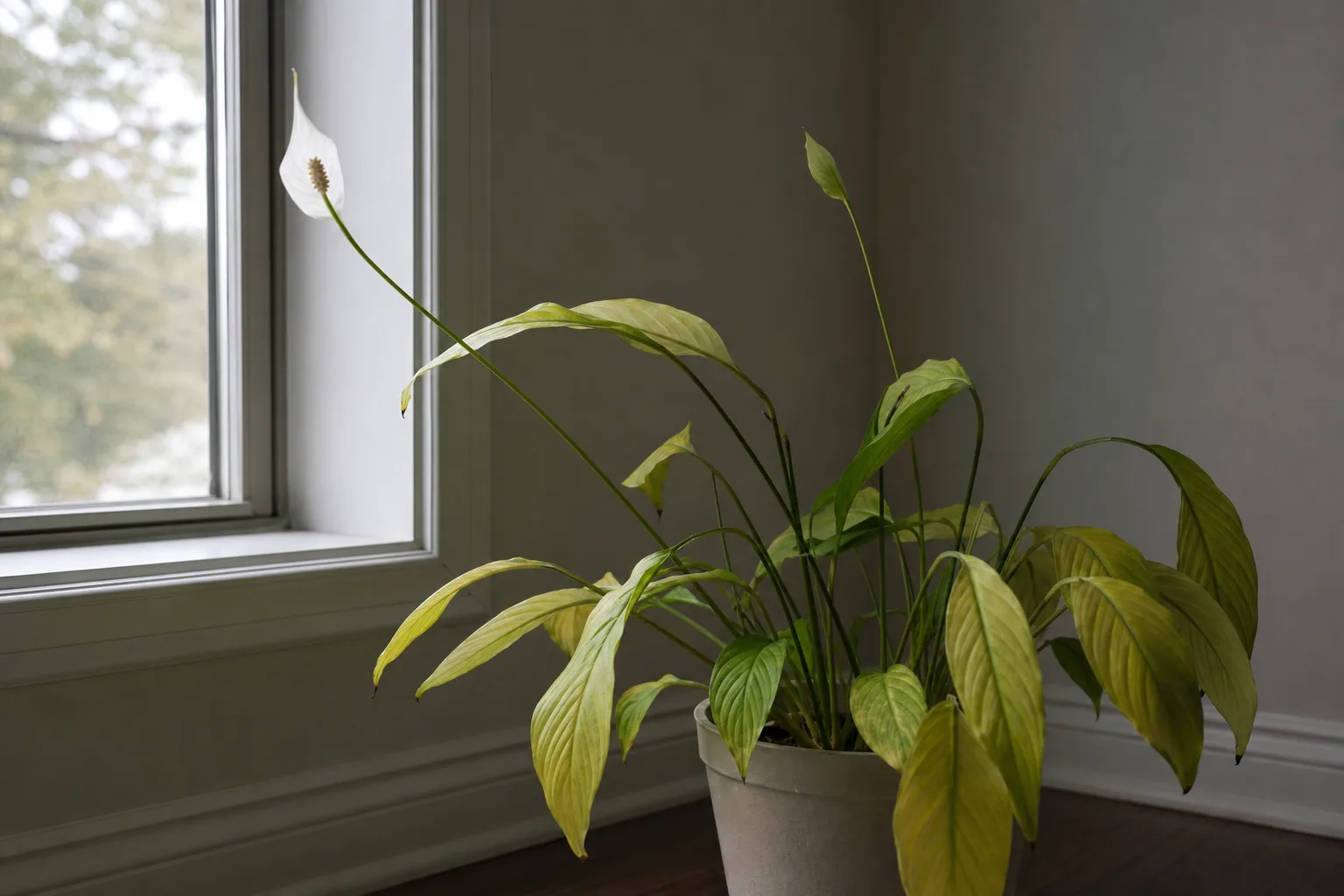
Not Enough Light on Peace Lily: Causes, Checks & Fixes
This guide covers not enough light on Peace Lily. See also the general Not Enough Light guide, watering, and light pages for this plant.
Not Enough Light on Peace Lily: Causes, Checks & Fixes
Quick answer
Not enough light on Peace Lily (Spathiphyllum wallisii and common hybrids) is the main reason clumps stop producing white spathes, stretch toward windows, and keep potting mix damp for weeks. These understory tropical aroids tolerate dim rooms better than most flowering houseplants-but tolerance is not the same as enough light to thrive.
First step: move the pot to bright indirect light 30–60 cm (12–24 inches) back from an east-facing window, or 1–2 metres from a south- or west-facing window filtered by sheer curtains. In a windowless or north-only room, add a full-spectrum grow light 15–30 cm above the foliage for 12–14 hours daily.
This page is your placement diagnostic and window audit-confirm the room is too dim, relocate safely, and adjust watering after the move. For everyday light ranges, window orientation, and grow-light shopping, use the Peace Lily light guide. For long stretched stems and pruning after light is corrected, see leggy growth.
What insufficient light looks like on Peace Lily
Pale foliage, long petioles, and missing spathes
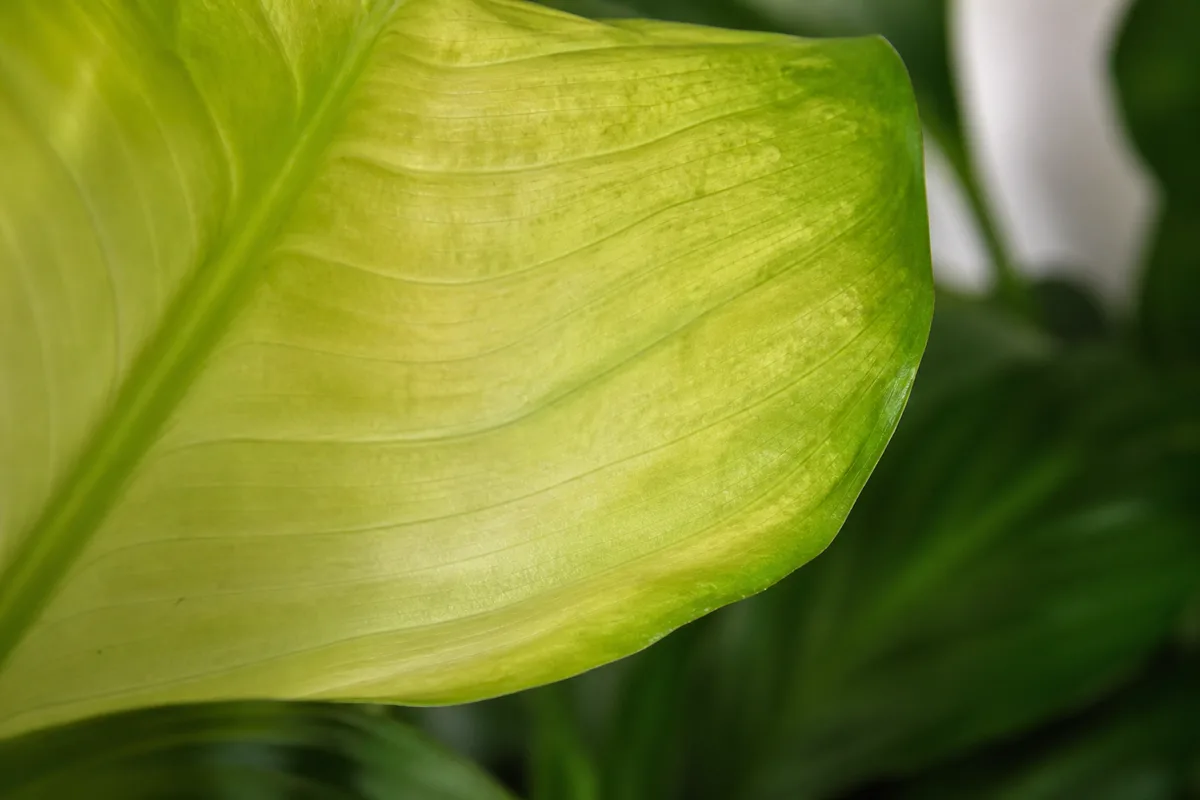
Not Enough Light symptoms on Peace Lily - compare with healthy tissue on the same plant.
The signature low-light pattern on Spathiphyllum:
- Long thin petioles pushing leaves farther from the crown toward the brightest direction
- Smaller, paler new blades compared with older leaves formed in better light
- No white spathes for months-even when foliage looks lush and dark green
- Directional lean toward one window, doorway, or desk lamp
- Lower leaves yellowing and dropping as the plant sheds shade leaves it can no longer support
- Soil staying wet one to two weeks after watering because transpiration slowed
Peace lilies in survival mode often stay dark green and large as the plant expands chlorophyll capture area. That can look healthy while spathe production stops entirely-a distinction the light guide calls bloom-capable versus bloom-reliable low light.
Office fluorescent survival without blooms
Desk peace lilies under overhead fluorescent tubes frequently hold glossy leaves and occasional white flags. Many owners interpret that as proof the spot is bright enough. In practice, ceiling light at leaf height often delivers well under 100 foot-candles-enough to photosynthesize slowly, not enough for regular spathes on most cultivars.
Watch for slow soil dry-down, widening gaps between new leaves, and lean toward any window even in a fluorescently lit office. Those signs mean the plant is searching for photons the ceiling cannot supply.
Why Peace Lily gets too little light
Forest-floor biology indoors
Spathiphyllum evolved on tropical forest floors where tree canopy filters harsh midday sun into steady diffuse light. Clemson HGIC notes peace lilies tolerate low light but grow best in bright indirect exposure-and should not sit in direct sun because heat scorches foliage. Indoors, that translates to near a window but out of sunbeams, not in the center of a large dim room.
Common placement mistakes
- Interior corners more than 2 metres from any window with no grow lamp
- North-facing glass alone in cloudy climates or winter at higher latitudes
- Bookshelves and hall tables where furniture blocks half the sky from the pot
- Bathrooms with frosted glass and short day-length exposure
- Large open-plan rooms where human eyes adapt to brightness but the plant sits in a light shadow zone
- Winter day-length drop in the same summer location-usable light at leaf height falls even when you have not moved the pot
Light–water coupling in dim corners
Low light slows water use. Many owners keep the same watering rhythm while the top 3–5 cm of mix stays wet for weeks. That pairing mimics overwatering-yellow lower leaves on damp soil, sour smell, soft stem bases-when the metabolic issue is really insufficient light slowing transpiration.
Case note (March 2026 grower log): A peace lily moved from a fluorescent-lit office desk (no window within 4 metres) to 45 cm back from an east window showed darker new leaves within three weeks and produced its first spathe 10 weeks after relocation. Old stretched petioles remained until trimmed; recovery was judged on new growth only.
How to confirm the cause
Work through these checks before repotting, fertilizing, or heavy pruning:
- Spathe history - Did white flags appear in this spot within the last year? No spathes for 12+ months in a dim corner strongly supports low light on a mature clump.
- Window distance and direction - Within 30–60 cm of east glass, or 1–2 metres from filtered south/west windows, usually counts as bright indirect. Deep interior placement typically needs supplementation.
- Shadow test at leaf height - At midday, hold your hand between the top leaves and the window. A soft, fuzzy shadow with indistinct edges suggests moderate usable light. Almost no shadow means too dim for reliable blooms; a sharp dark shadow means direct sun strong enough to burn peace lily leaves (UF/IFAS home guidance lists bright indirect with no direct sun as the baseline).
- Foot-candle reading (optional) - A meter or app at leaf height toward the window: 150–300 fc supports healthy foliage and regular spathes; 50–100 fc often means survival without blooms; below 50 fc growth stalls (UF/IFAS EP161 commercial production targets far higher under shade cloth, confirming bloom initiation needs a real energy threshold).
- Petiole length and lean - Rotate the pot; new growth should lean toward the brightest side. Chronic lean with small pale new leaves confirms active light searching.
- Dry-down rhythm - Note how many days until the top 3–5 cm feel dry. Winter slowdown is normal; continued wet soil for 10+ days in the same dim spot is not.
- Rule out lookalikes - Confirm mix is not waterlogged, roots are not mushy, and the clump is not root-bound before blaming light alone.
Confirmation test: Move to a brighter indirect spot for two weeks without changing fertilizer or pot size. If the next leaf opens darker with a shorter petiole-and a spathe bud appears within a few months on a mature plant-light was the limiter.
First fix for Peace Lily
Relocate to the brightest indirect spot available-30–60 cm back from an east-facing window, or filtered south/west glass at 1–2 metres.
The RHS recommends keeping peace lilies near a window but out of direct summer sun for strong growth and flowering. Missouri Botanical Garden describes Spathiphyllum as plants that do well in lower light indoors but prefer bright filtered light for compact growth.
Do not jump from a dark corner onto a hot south sill in midday July. Shade-adapted leaves need gradual acclimation or tissue bleaches and crisps. Wipe dust from glossy leaves so they capture more light after the move.
If no suitable window exists, add a full-spectrum LED grow light 15–30 cm above the foliage for 12–14 hours daily. Center the lamp over the crown, not off to one side, and rotate the pot weekly.
Make this one change first. Wait two to three weeks before repotting, fertilizing, or pruning heavily so you can read the plant’s response clearly.
Step-by-step relocation and acclimation
After choosing the new spot:
- Move in stages if light increase is large - Step closer to the window over 7–14 days, or hang sheer curtains before removing them, when the plant formed leaves in very low light.
- Monitor the next two to four new leaves - Look for shorter petioles, darker green color, and tighter spacing at the crown.
- Adjust watering immediately - Brighter light means faster dry-down. Recheck the top 3–5 cm before every drink instead of following a calendar tied to dim-corner metabolism. See the watering guide for droop-vs-wet-soil checks.
- Rotate weekly - Quarter-turn the pot so growth does not permanently lean toward one pane.
- Hold fertilizer - Do not feed to “force” spathes. Light drives bloom initiation; nutrients support processes the plant already has energy to run.
- Extend grow-light hours in winter - Shorter days reduce window light even when the pot stays in the same place.
Pet safety: Peace Lily is toxic to cats and dogs if chewed. Bright window sills and low shelves must stay out of pet reach-use hanging placement or a room pets cannot access.
Recovery timeline
Expect darker new leaves on shorter petioles within two to three weeks after light improves. White spathes on mature plants typically return two to three months later-not on the first new leaf after a move.
Old stretched petioles and pale blades do not shorten or re-green-trim them at the base if they spoil the silhouette, or leave them until replaced naturally. Judge success by the next two or three leaves and the first new spathe.
Winter corrections may show little until day length and warmth increase-plan on six to ten weeks after conditions improve before deciding the fix failed.
Worsening signs: continued small pale leaves with yellowing on wet soil, soft stems, or sour-smelling mix mean the diagnosis is incomplete-re-check roots and watering rather than only adding light.
Office fluorescent and grow-light options
Overhead T8 or LED office tubes 2–3 metres above a desk often deliver roughly 30–80 foot-candles at leaf height-enough for Spathiphyllum to hold foliage but rarely enough for quarterly spathes. Distance and fixture age matter: bulbs near end-of-life drop output silently.
Upgrade path for windowless or north-only workspaces:
- Clip-on or desk full-spectrum LED 15–30 cm above the crown, 12–14 hours daily on a timer
- Combine ceiling office light with a dedicated lamp rather than relying on fluorescents alone
- Move the pot to a break-room windowsill on weekends if policy allows-two days of window spill light per week helps metabolism
For foot-candle targets, window-by-window placement, and lamp wattage notes, see the Peace Lily light guide.
Lookalike symptoms to rule out
| Pattern | Key signals | Primary issue |
|---|---|---|
| Low light | Long petioles, pale small new leaves, no spathes, lean, slow dry-down | Insufficient bright indirect exposure |
| Leggy stretch with regular new leaves | Wide spacing but steady foliage production | Light plus pruning-see leggy growth |
| Overwatering in dim corner | Yellow lower leaves, wet soil weeks, soft stem base, sour smell | Root stress-see overwatering guide |
| Root-bound clump | Thin slow growth despite bright window; roots circling pot | Division or repot-not relocation |
| Nitrogen excess | Soft floppy dark green growth in already-bright light; no lean | Reduce feed; rule out light deficit first |
| Sunburn after sudden move | Bleached or crisp patches on window-facing leaves | Too much direct sun too fast-not low light |
| Slow growth stall | No new leaves for months; firm foliage | Light, roots, season-see slow growth |
| Yellow lower leaves only | Lower canopy drop with adequate window light | Age, overwatering, or cold draft-see yellow leaves |
Mistakes to avoid
Do not assume “low-light tolerant” means a hallway or bathroom is ideal long term. Peace lilies survive in deeper shade but rarely flower and grow very slowly-thriving spathes need brighter indirect exposure sustained across the growing season.
Do not increase fertilizer to force blooms in a dim spot. Spathe initiation tracks light energy, not nitrogen alone.
Do not move instantly from deep shade to unfiltered south glass. Acclimate over one to two weeks to prevent scorch on shade-formed leaves.
Do not ignore wet soil in a dark corner. Slow growth plus damp mix is a common path to root rot on desk and shelf specimens.
Do not confuse dark green survival foliage with proof of adequate light-large chlorophyll-rich leaves in dim corners often mask years without spathes.
Do not place bright-window pots within pet reach. Peace Lily contains insoluble calcium oxalates that irritate mouth and GI tract if chewed.
Peace Lily care cross-check
Light interacts with every other variable on a clumping tropical aroid:
- Watering - Water when the top 3–5 cm dries or leaves first droop on dry soil-not on wet soil. After a bright move, check more often.
- Humidity - 50–60% helps leaf margins in dry heating seasons; low light is not fixed by misting alone.
- Temperature - MOBOT lists 68–85°F as ideal; cold drafts near windows in winter stall growth even when light looks adequate.
- Feeding triage - If stems stay thin in already-bright indirect light with no lean, suspect excess nitrogen before relocating again. If lean and no spathes persist in a dim corner, light comes first.
- Foot-candle target - Aim for 150–300 fc at the leaf canopy for bloom-reliable mode, aligned with the light guide and overview.
How to prevent low-light stress next time
Place new peace lilies where the leaf canopy sees the window, not just where the decorative pot fits the room layout. For floor specimens, shorten the display stand or move the pot forward into the light cone.
Audit rooms seasonally-winter light at the same coordinates can drop below bloom threshold even when you have not rearranged furniture.
Rotate the pot every one to two weeks. Clean window glass and sheer curtains seasonally; grime blocks more photons than many owners realize.
Use grow lights in offices, north-facing rooms, and during short winter days. Aim for 12–14 hours of supplemental light when natural levels drop.
Choose placement before buying a heavy cachepot you cannot easily move-peace lilies outgrow dim spots within a season when otherwise healthy.
When to worry
Insufficient light alone rarely kills Spathiphyllum. Investigate promptly when low light pairs with:
- Wet soil for weeks and spreading yellow leaves
- Soft stems at the soil line or sour-smelling mix
- Complete stall in new growth for two months after corrected light and warm temperatures
In those cases, unpot and inspect roots before assuming more light will solve everything.
How this page fits the Peace Lily cluster
| Your question | Best page |
|---|---|
| Where should I put my Peace Lily long term? | Light guide |
| Long stems after light is fixed | Leggy growth |
| Pale leaves, no spathes, wet soil in dim corner | This page |
| Yellow leaves on wet soil | Overwatering |
| No new leaves at all for months | Slow growth |
Related Peace Lily guides
- Peace lily overview - species hub
- Light needs - foot-candles, windows, grow lights
- Watering - dry-down rhythm after light changes
- Overwatering - wet soil in dim corners
- Leggy growth - pruning stretched petioles
- Yellow leaves - lower-leaf drop overlap
- Slow growth - when the plant stalls entirely
Not enough light on Peace Lily is a placement problem on a shade-adapted flowering aroid-not a mystery disease. Pale stretched leaves, missing spathes, lean toward the window, and wet soil that never dries in a dim corner are the patterns to catch early. Move to bright indirect exposure first, acclimate gradually, adjust watering to match new dry-down, and judge recovery by the next few leaves and the first new spathe-not by hoping old stretched tissue reshapes.
Related tool
Use the Plant Problem Diagnosis Tool to narrow causes for not enough light on this plant before changing multiple variables at once.