How to Propagate Philodendron Florida Ghost
How to Propagate Philodendron Florida Ghost
How to Propagate Philodendron Florida Ghost
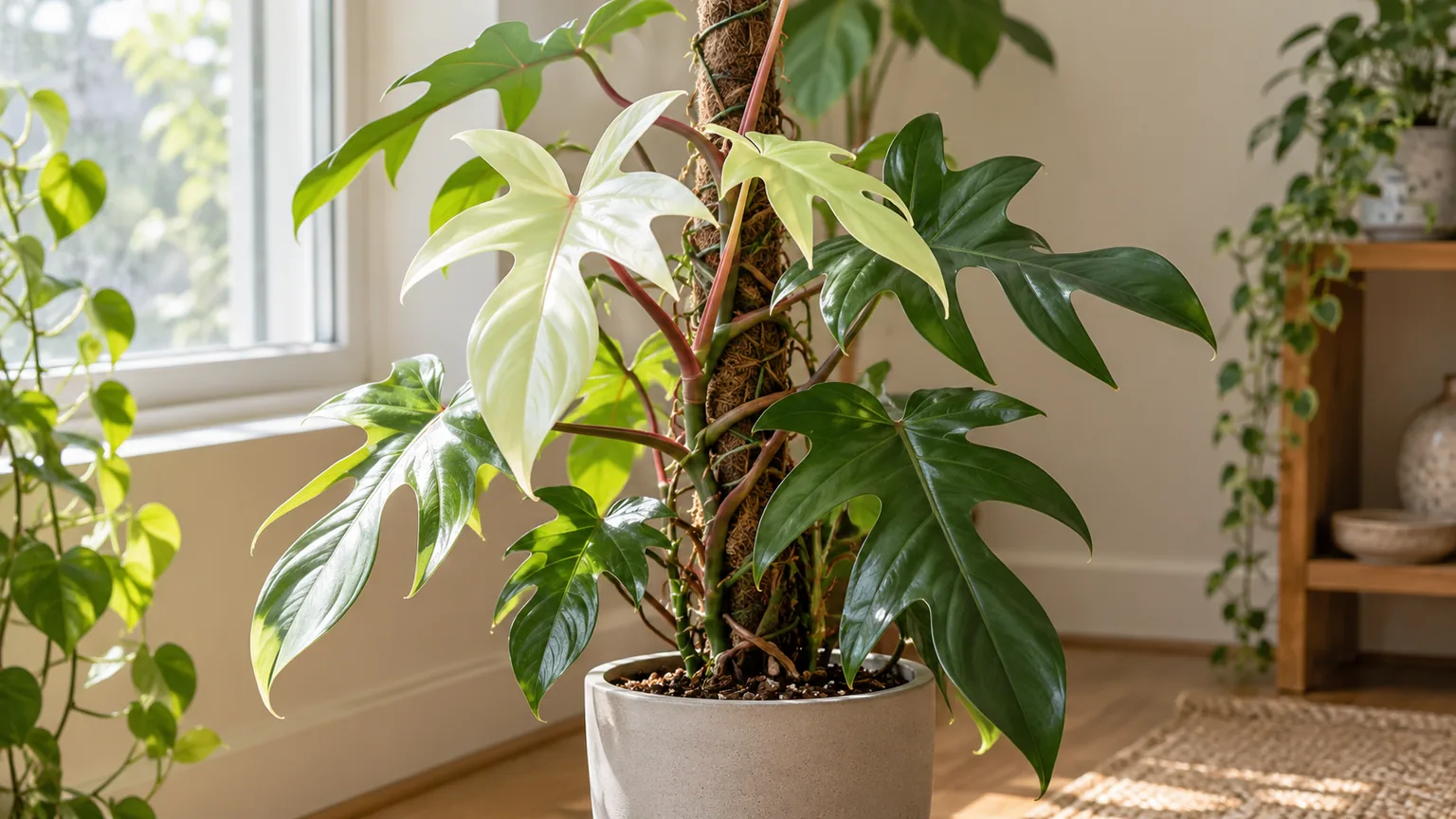
Philodendron Florida Ghost propagation at home means stem cuttings with at least one node — ideally including the newest growth point — then rooting in water, sphagnum moss, or moist perlite before potting into chunky aroid mix. Philodendron ‘Florida Ghost’ is a choice hybrid of Philodendron pedatum and Philodendron squamiferum in the Araceae family: a climbing species whose new foliage emerges pure white, then shifts lime-green and darker green as leaves age. That white phase is juvenile leaf color, not stable chimeric variegation like Pink Princess — so propagation succeeds on standard philodendron rules, but aftercare and light determine whether the next leaf on your clone still arrives pale.
The reliable workflow: take cuttings from a healthy parent in spring through early fall, select a firm node with an aerial root if present, root in bright indirect light at roughly 18–29°C (65–85°F) with moderate to high humidity, and pot up when roots reach 2–5 cm (about 1–2 inches) into the same chunky aroid mix the parent uses. Clemson HGIC notes philodendrons may be propagated at any season from stem cuttings or by air layering — formats that apply directly to Florida Ghost as a vining houseplant philodendron.
This guide covers what makes Ghost different from Pink Princess and Florida Beauty, node anatomy on climbing stems, three rooting methods plus air layering, pot-up timing, weeks 1–8 aftercare, failure signs linked to root rot risk, and sap safety when pets share your workspace.
What Makes Florida Ghost Propagation Different
Florida Ghost is not a harder plant to propagate than other climbing philodendrons — it is a different problem. Collectors worry about losing the white new-leaf show on offspring, or they treat Ghost like chimeric variegation and overthink node stripe selection. Neither framing matches the biology.
Juvenile white leaves vs chimeric variegation
On Florida Ghost, whiteness tracks newly emerging foliage on a healthy vine. Mature leaves on the same plant age green — that is normal, not reversion. The RHS Florida Ghost entry describes foliage that is pure white when young, becoming lime-green then darker green as it ages. Contrast that with Pink Princess, where stem tissue at the bud largely determines chimeric pink balance in every future leaf.
For propagation, Ghost cuttings clone the parent cultivar — you do not need pink-style stripe hunting. You do need a viable node, adequate light after rooting, and ideally an active growth tip so the first leaves on the clone have energy to unfurl pale tissue without collapsing.
Why the growth tip matters on cuttings
LeafyPixels grower notes for this cultivar emphasize including the newest growth point when taking stem cuttings. A mid-vine node without an active tip can still root, but the first leaf on the clone may emerge smaller or greener if the cutting lacks the meristem that drives Ghost’s characteristic pale unfurling. When shortening a leggy vine, the top section with the pale unfurling leaf is often your best propagation piece; the lower nodes you remove can become backup cuttings.
Pale new leaves contain less chlorophyll and are more fragile than green mature tissue — avoid direct sun on freshly unfurled white leaves during rooting and the first weeks after pot-up. Pair propagation timing with the light guide brightness the parent already tolerates.
Before You Cut: Tools, Timing, and Parent Health
Propagation succeeds when the parent plant is stable, the season supports active growth, and your tools reduce rot and sap exposure.
Gather sharp bypass pruners, 70% isopropyl alcohol for blade wipes, clear jars (water method), long-fiber sphagnum moss and a vented propagation box (moss method), or moist perlite in a small pot (perlite method). Nitrile gloves matter: philodendrons contain insoluble calcium oxalate crystals, and the ASPCA lists philodendron as toxic to cats and dogs with oral irritation, drooling, vomiting, and difficulty swallowing if chewed. Work away from pets, dispose of trimmings in a closed bin, and wash hands after handling sap.
Take cuttings only from firm stems without active rot, pest webs, or widespread yellowing. If the parent is recovering from chronic wet mix, stabilize watering first — propagation multiplies healthy plants; it does not rescue a drowning one.
Best timing is active growth: spring through early fall when warmth and bright filtered light support rooting. NC State’s Philodendron erubescens profile — a useful culture baseline for modern hybrid philodendrons — recommends 65–85°F, high humidity, and moist well-drained soil, conditions that also speed cutting roots. Winter propagation works under grow lights and stable room heat, but expect slower progress and higher rot risk if water stagnates in a cold room.
Avoid cutting immediately after repotting or a long drought. Wait until the plant pushes one clean new leaf or shows steady turgor. Many growers time propagation with pruning — the trimmed top becomes the primary cutting.
Nodes on a Climbing Ghost Vine: Where and How to Cut
A node is the swollen joint where a leaf petiole attaches, aerial roots may emerge, and an axillary bud waits to activate. That bud holds the meristematic tissue for new shoots and roots when a cutting separates from the parent. Clemson HGIC confirms philodendrons propagate from stem cuttings or air layering — each requires node tissue, not a detached leaf alone.
On Florida Ghost vines, nodes often send aerial roots along the stem — bonus rooting tissue when submerged in water or pressed into moss. Leaf-only cuttings fail. A white leaf floating in a jar without stem node tissue may persist briefly, then yellow because leaves lack the meristem for new growth.
On the cutting: cut approximately 1–2 inches (2.5–5 cm) below the node you want to root. Remove any leaf that would sit underwater.
On the parent: cut about ¼ inch (0.5 cm) above the node below your take so the donor can activate a new growth point.
Single-node vs two-node sections: A one-node cutting with one or two leaves fits most jars. A two-node section carries more reserves on long vines but is harder to stabilize; for most homes, one healthy node plus the growth tip is ideal. The RHS lists stem-tip and leaf bud cuttings for Florida Ghost specifically.
Choosing the Best Stem Section
Walk the vine before you sterilize scissors. On Ghost, prioritize vigor and tip activity over variegation stripe logic.
Strong candidates: firm internodes, visible aerial root nubs, an unfurling or recently hardened pale leaf at the tip, and no soft brown tissue at the node.
Weak candidates: mushy petioles, stems that feel hollow or shriveled, nodes with blackening after cold damage, or cuttings taken from a plant in active root rot decline unless you are salvaging clean tissue well above the failure zone.
Florida Ghost vs Florida Beauty and mislabels: Florida Beauty shows stable cream splashes on green mature leaves. Ghost whiteness is tied to newly emerging foliage that matures green. When buying cuttings, confirm identity by asking for photos of sequential new leaves aging greener — a single white leaf on an otherwise green plant is not enough proof. See the overview guide for full ID context.
Wet sticks (node segments without leaves) can work in damp moss at high humidity, but expect four to eight weeks for the first leaf — longer than a leafy tip cutting.
Method 1: Water Propagation
Water propagation is the most visible method: you watch roots form and catch rot early. UF/IFAS Gardening Solutions notes stem cuttings should sit in bright, indirect light with moist medium until new plants develop — the same light discipline applies to water jars.
Steps:
- Select a stem with at least one node and, when possible, the active growth tip plus one or two healthy leaves. Strip lower leaves that would submerge.
- Cut with sterile shears 1–2 inches below the node. Include an aerial root if present.
- Fill a clean jar with room-temperature water. Submerge the node and aerial root; keep leaves above the waterline.
- Place in bright indirect light — not direct sun, which heats the jar, grows algae, and scorches pale leaf tissue first.
- Change water when cloudy, or on a weekly preventive schedule. Rinse the jar if biofilm builds.
- Pot up when roots are 2–5 cm, firm, and white or cream — not at the first translucent nub.
Pros: Easy monitoring, minimal supplies, ideal for learning node anatomy.
Cons: Weaker transition to soil for some growers; rot if water stagnates; top-heavy tip cuttings may need a heavier vase or soft tie to a stake.
Method 2: Sphagnum Moss Propagation
Sphagnum moss suits Florida Ghost when you want stronger roots before soil, when a cutting is too short for a stable jar, or when you prefer not to leave pale tissue in standing water. Moss mimics how aerial roots grip bark on a climbing philodendron stem — moist, airy, and oxygenated at the node.
Steps:
- Hydrate long-fiber sphagnum, then squeeze until damp — not dripping.
- Nest the cutting’s node into moss inside a clear cup or vented propagation box. Aerial roots should contact moss.
- Seal partially — vents prevent mold while keeping the node humid. Clemson Extension on cuttings recommends a plastic cover to maintain humidity around stem cuttings.
- Keep at 65–85°F (18–29°C) in bright indirect light.
- Open weekly to check moisture. Remist if moss lightens; never let it stay soggy and anaerobic.
- Transplant when roots weave through moss and reach 2–5 cm — tease moss away gently.
Moss excels for wet sticks and fragile pale tips you want to watch closely without drowning the node.
Method 3: Perlite and Air Layering
Perlite method: Fill a small drained pot with moist perlite or airy aroid mix. Optional powdered rooting hormone at the cut can help slow or leafless cuttings per Clemson propagation guidance — tap off excess. Bury the node just below the surface, cover with a vented humidity dome, and keep medium evenly moist, never waterlogged. Check for gentle tug resistance after three to four weeks.
Air layering makes sense when a valuable mid-vine node should root while still attached to the photosynthesizing parent — the same format UF/IFAS describes for woody and semi-woody houseplants adapted to thick aroid stems:
- Select a node with an aerial root nub if possible.
- Wrap the node in damp sphagnum, then plastic wrap sealed at both ends.
- Mist moss weekly through a small opening without fully unwrapping.
- Sever and pot once roots are 2–5 cm and white, using chunky mix and a moss pole stake if you want climbing habit early.
How Long Rooting Takes and When to Pot Up
Timelines vary with temperature, light, season, and cutting vigor. These are indoor home ranges, not greenhouse guarantees.
| Method | First root nubs | Ready for soil |
|---|---|---|
| Water | 7–14 days | 2–6 weeks |
| Sphagnum moss | 10–21 days | 3–6 weeks |
| Perlite/airy mix | 14–21 days | 3–7 weeks |
| Air layer | 14–28 days | 4–8 weeks |
Cuttings with existing aerial roots often root on the faster end. Cool rooms below 18°C (65°F) can double these ranges. Clemson Extension suggests checking cuttings after 7–14 days by gentle tug for resistance.
Pot-up rules: Choose a 10–12 cm (4–5 inch) pot with drainage — oversized pots hold water young roots cannot use. Plant the node just below the surface. Water once, let drain, then keep mix evenly moist for the first two weeks before shifting toward the parent’s normal dry-down rhythm. Install a moss pole early if you want larger lobed leaves and shorter internodes — Ghost is a climber per RHS.
Aftercare for the First Two Months
Newly potted Florida Ghost cuttings need stability, not fertilizer pushes.
Weeks 1–2: Keep mix evenly moist but not waterlogged. No fertilizer. Maintain bright indirect light and 55–70% humidity if possible. Pale unfurling leaves need filtered brightness — not dim corners, not harsh direct sun.
Weeks 3–4: Allow the top 2–3 cm of mix to dry between waterings as roots explore the pot. Judge success on turgor and the next leaf’s color, not panic over one older green leaf on the cutting.
Weeks 4–8: Shift toward normal watering and fertilizer only after active new growth and four to six weeks in soil. Do not repot again immediately or bounce the plant between rooms — that invites transplant stress on a young root system.
If new leaves emerge small and green only, increase filtered light before assuming the cutting failed. Ghost whiteness returns when the vine has energy — see slow growth troubleshooting if progress stalls.
When Propagation Fails
Stop hoping and restart clean when you see:
- Black or mushy node — tissue is dead; cut higher on the parent or discard
- Sour-smelling water or slimy moss — bacterial overload; sterile tools, fresh medium, retry
- Stem shriveling while medium stays wet — rot or lack of oxygen; improve drainage or switch method
- Leaf yellowing with firm node — often normal energy redirect; alarming only if the node softens
- No roots after 8+ weeks in warm bright conditions — verify a true node, check temperature, try moss
A failed jar is not a failed grower — reset with cleaner material from a healthier section, ideally still carrying the growth tip.
What to Expect from Ghost Clones
Stem cuttings clone the cultivar, not a single leaf color snapshot. A healthy Florida Ghost rooted from a proper node should continue producing pale new leaves when light and humidity match what the parent needed — then those leaves age greener on the same vine, exactly as the RHS cultivar description outlines.
Do not expect every leaf on a young clone to stay white forever — mature green foliage on the same plant is correct, not propagation failure. Do expect the next one or two new leaves after pot-up to show whether your setup supports the ghost phase.
If a propagated plant never produces pale new growth despite good light, revisit identity (Florida Beauty vs Ghost vs mislabel) using the overview guide checkpoints — not another round of rooting hormone.
When to use this page vs other Philodendron Florida Ghost guides
- Philodendron Florida Ghost overview — Start here for whole-plant identity, toxicity, and quick care summary before cutting.
- Light guide — Use when pale new leaves collapse or clones stay green; propagation success depends on post-rooting brightness.
- Watering guide — Use after pot-up when mix stays wet too long and root rot threatens young roots.
- Pruning guide — Use when shortening a long vine; trimmed sections often become propagation material.
Related Philodendron Florida Ghost guides
- Philodendron Florida Ghost overview
- Philodendron Florida Ghost light
- Philodendron Florida Ghost watering
- Philodendron Florida Ghost soil
- Philodendron Florida Ghost repotting
- Philodendron Florida Ghost pruning
Conclusion
Philodendron Florida Ghost propagation is standard climbing philodendron stem cutting work with one cultivar-specific priority: include a healthy node and, when you can, the active growth tip so the clone has meristem energy to repeat the white-to-green leaf cycle. Root in water, moss, or perlite under bright indirect light, pot up at 2–5 cm firm roots into chunky mix, stake a moss pole early, and judge success on the next new leaves — not on whether older foliage stayed white. Handle sap safely around pets, stabilize the parent before you cut, and treat failed nodes as a signal to clean your method, not proof that Ghost is impossible to multiply.