Philodendron Florida Ghost Care Guide: White New Leaves
Philodendron 'Florida Ghost'
Florida Ghost philodendron needs bright indirect light, a moss pole, chunky mix, and stem-tip cuttings. White new leaves mature green. Toxic to pets.
Philodendron Florida Ghost Care Guide: White New Leaves on a Climber
Start with wateringThe most common care mistake for Philodendron Florida GhostWatering guide →Philodendron Florida Ghost care essentials
Light
Water
Every 7–10 days in summer - allow top 3–5 cm to dry. Every 10–14 days in winter.
Soil
Chunky well-draining aroid mix: potting mix + perlite + orchid bark. pH 5.5–6.5.
Humidity
Moderate to high humidity (55–70 %)
Temperature
18°C to 29°C (65–85°F)
Fertilizer
Feed lightly during active growth.
About Philodendron Florida Ghost
Philodendron Florida Ghost has a climbing growth habit. It is also known as Florida Ghost Philodendron and Philodendron Florida Ghost (v).
| Detail | Information |
|---|---|
| Also known as | Florida Ghost Philodendron, Philodendron Florida Ghost (v) |
| Growth habit | Climbing |
| Scientific name | Philodendron 'Florida Ghost' |
Philodendron Florida Ghost Care Guide: White New Leaves on a Climber
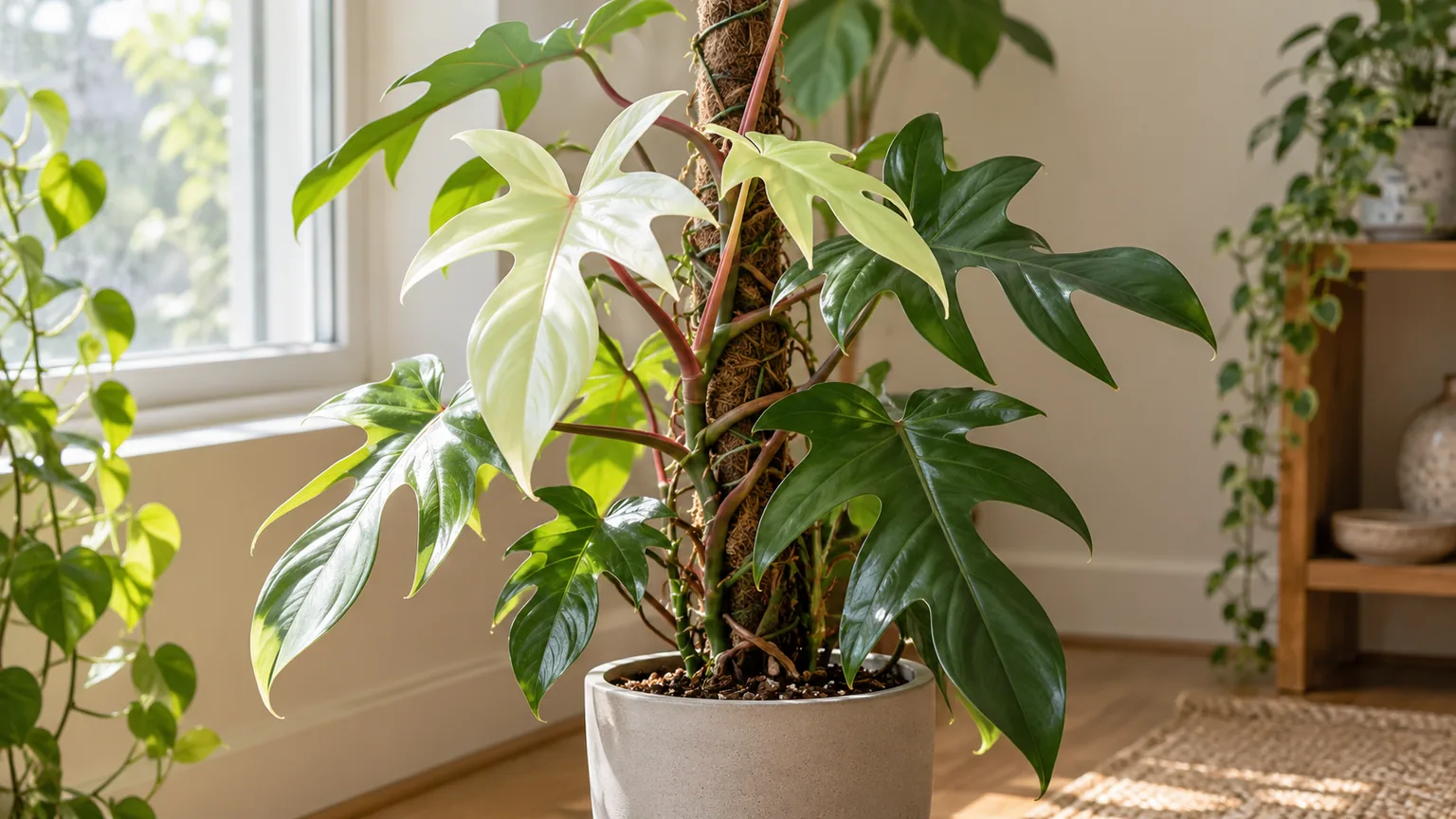
Philodendron Florida Ghost is one of those collector philodendrons people buy for a moment — a new leaf unfurling bone-white against red petioles — and then spend the next year learning that moment was never meant to last on every leaf forever. Philodendron Florida Ghost (Philodendron ‘Florida Ghost’) is a climbing hybrid whose signature is juvenile whiteness: new foliage opens pure white to cream, then hardens through lime-green to darker green as it ages. That is not the same biology as Pink Princess chimeric pink, and treating it like stable variegation is the fastest route to disappointment.
This guide is the hub page for Florida Ghost indoor culture. You will learn what the plant actually is, how its white-leaf phase works, how light and climbing support drive leaf size, a complete watering-soil-fertility rhythm, propagation and repotting basics, buying checks that separate real Ghosts from mislabeled pots, and why the plant belongs out of reach in pet households. By the end you should have a realistic framework — not a promise that every leaf stays white, but a routine that keeps new growth pale, firm, and worth the moss pole.
What Philodendron Florida Ghost Actually Is
Philodendron Florida Ghost is a cultivated hybrid in the Florida philodendron series. The RHS lists it as a choice cross between Philodendron pedatum and Philodendron squamiferum — both climbing species — and notes foliage that is pure white when young, becoming lime-green and then darker green as leaves age. Juvenile leaves are spear- to arrow-shaped; mature leaves become lobed and deeply indented along the central vein. The plant is still a rarity in trade and can be expensive, but RHS cultivation notes describe it as undemanding under glass when light, drainage, and watering align.
Hybrid Pedigree: pedatum × squamiferum
Parentage matters because both parents are vines, not self-heading rosettes. Ghost inherits a climbing habit with lobed foliage that sizes up when the stem has something to root into and climb. NC State’s profile of related hybrid climber Philodendron erubescens — useful as a cultural baseline for modern Florida-series hybrids — describes a tropical perennial in the Araceae family that climbs in nature and indoors on a moss pole or trellis, preferring partial shade, moist well-drained organic soil, and warm stable temperatures.
Indoors, Florida Ghost typically stays far smaller than its rainforest potential. RHS dimensions cite 1.5–2.5 m max height and 0.5–1 m spread under glass over 5–10 years — realistic targets when you provide support and bright filtered light rather than letting stems sprawl on a shelf.
Juvenile White Leaves vs Genetic Variegation
The white you see on Florida Ghost is an age-linked leaf phase, not a permanent pigment pattern locked into every cell like Pink Princess pink sectors. Each new leaf emerges with minimal chlorophyll, appears white or cream, then greens as it hardens — exactly as RHS describes for this cultivar. Mature leaves on the same vine should be green. Judge the plant by what unfolds at the growth tip, not by one old pale leaf in a seller photo.
Pale tissue is metabolically fragile. UF/IFAS hybrid philodendron guidance states that philodendrons with colored foliage need higher light levels to maximize their color — a principle that applies to Ghost’s white unfurling phase even though the color eventually fades. Too little light and new leaves open greener from the start with longer internodes; too much direct sun and white unfurls scorch before they harden.
Why Florida Ghost Is Not Pink Princess
Collectors often lump variegated philodendrons together. Florida Ghost and Philodendron Pink Princess sit in the same Instagram folder but answer to different rules.
Chimeric Pink vs Age-Linked Whiteness
Pink Princess is Philodendron erubescens ‘Pink Princess’ — a cultivar with chimeric variegation: pink and green cell sectors compete on the same leaf, and stem genetics determine whether future leaves stay marbled, revert green, or push weak all-pink tissue. Florida Ghost is a different hybrid with white only on newly emerging leaves that age to green. You cannot “prune back to variegation” on Ghost the way you manage Pink Princess reversion, because there is no pink stem stripe to preserve — only the next juvenile leaf at the active tip will show the pale phase.
If your Ghost’s new leaves are mostly green with stretchy internodes, that is usually insufficient light, not genetic reversion. Fix Philodendron Florida Ghost light first and read the next two leaves before you assume you bought the wrong plant.
Florida Beauty and Other Florida-Series Lookalikes
Philodendron ‘Florida Beauty’ — another pedatum × squamiferum cross in the same series — shows stable cream or yellow-green splashes on green mature leaves, not whole leaves that start white and finish green. Philodendron ‘Florida Green’ lacks the pale juvenile phase entirely. When buying, watch multiple new leaves emerge from the tip: Ghost should repeat the pale-then-green cycle; Beauty should show variegated patterning on green mature foliage.
Do not pay collector prices for a single white leaf on an otherwise plain green plant without verifying active growth at the stem tip.
Growth Habit and Mature Size Indoors
Florida Ghost is a climber, not a compact self-header. Without support, stems sprawl, internodes lengthen, and leaves stay smaller than they would on a vertical surface.
Climbing Architecture and Moss-Pole Culture
Install a moss pole, coir pole, or bark board early while stems are still flexible. Secure petioles loosely with soft ties — never strangle the stem. Climbing philodendrons produce larger lobed leaves and shorter internodes when the growing tip receives bright filtered light and the stem can root into moist moss on the pole. Clemson HGIC notes that many philodendrons are climbers whose leaves will not reach full size unless trained vertically for several years — Ghost follows that pattern.
Account for vine height, not pot position alone. A pot on a bright windowsill can still starve the moss-pole tip three feet above the sill if the room is deep.
Leaf Shape Changes as the Vine Matures
Expect spear-shaped juvenile leaves near the tip and deeply lobed mature foliage lower on an established vine — normal development per RHS. Do not panic when older leaves look nothing like the white unfurl you fell in love with; that is the plant aging, not declining.
Quick Care Summary for Philodendron Florida Ghost
Light: Bright indirect light / partial shade — brighter than plain heartleaf philodendrons so pale new leaves have energy to expand. See the dedicated Philodendron Florida Ghost light guide for windows and grow lights.
Water: Every 7–10 days in active summer growth — allow top 3–5 cm of mix to dry between soaks. Every 10–14 days in cooler winter. Always check the pot; never water on autopilot.
Soil: Chunky well-draining aroid mix — potting mix + perlite + orchid bark. Target pH 5.5–6.5. Drainage holes mandatory.
Humidity: Moderate to high — 55–70% ideal; average indoor ~50% often works if light and watering are correct.
Temperature: 18–29°C (65–85°F); protect from cold drafts below ~15°C (59°F).
Fertilizer: Monthly balanced liquid at half strength April through September; pause in winter and on stressed plants.
Support: Moss pole or trellis from early growth.
Repot: Every 2–3 years in spring when roots fill the pot.
Propagation: Stem-tip or leaf bud cuttings with at least one node — include the newest growth point.
Pets: Toxic — insoluble calcium oxalate crystals. Keep out of reach.
Light: The Main Lever for White New Leaves
If you remember one rule for Ghost, make it this: bright, filtered light at the growing tip is what repeats the white juvenile phase. Dim corners may keep the plant alive for a while — heartleaf philodendrons tolerate that — but Ghost will stretch, shrink leaves, and open greener new foliage when photosynthesis is limited.
RHS philodendron guidance recommends bright but indirect light, warns that direct summer sun scorches leaves, and notes that insufficient light causes leggy growth with fewer, smaller leaves. For Ghost, add one more layer: fresh white unfurls fail before hardened green leaves under harsh rays — acclimate slowly if you move from a dim shop to a west window.
Practical default: moss-pole tip 30–60 cm from an east window, or set back behind sheer fabric on south or west exposures. When natural light drops in winter, a full-spectrum LED grow light 30–45 cm above the canopy for 10–12 hours daily often stabilizes pale unfurls. Full placement detail lives in the light guide.
Bright Indirect Light and Partial Shade
RHS lists Florida Ghost in partial shade with bright but diffused light under glass — translate that indoors as plant-facing brightness, not “the room feels bright.” Run a soft shadow test at the top leaves: a readable shadow usually means adequate indirect intensity; no shadow at the tip means move closer or add a lamp.
Protecting Unfurling White Tissue from Scorch
White cells contain little chlorophyll to dissipate heat. Gentle morning sun through east glass is tolerable for many acclimated plants; afternoon direct beams on fresh white tissue are not. If pink-brown patches appear only on the pale unfurl while older green leaves look fine, pull back from direct sun or add sheer diffusion before you change watering.
Watering Rhythm and Root Health
Philodendrons fail indoors more often from overwatering in low light than from drought — and Ghost’s pale new leaves yellow quickly when roots sit in stale moisture they cannot use.
RHS cultivation for Florida Ghost says to allow the compost surface to become just dry before thoroughly watering, and to avoid plants sitting in water, which causes root rot. Clemson HGIC recommends keeping philodendron mix evenly moist but not soggy, never standing in water, with high humidity ideal though most homes tolerate lower levels.
LeafyPixels baseline for this cultivar: water when the top 3–5 cm feels dry — roughly every 7–10 days in summer and every 10–14 days in winter for a standard indoor pot with drainage. Soak until water runs from holes, then empty the saucer within thirty minutes.
Check-First Watering in Chunky Mix
Insert a finger or dry chopstick to the second knuckle. Cool, damp stick means wait. A pot that stays heavy days after watering signals compacted mix, oversized pot, or too little light for root uptake — fix the environment before watering again. Step-by-step workflow: Philodendron Florida Ghost watering guide.
Why Pale New Leaves Fail in Soggy Soil
Juvenile white leaves have less photosynthetic capacity while they expand. In dim, wet conditions the root system cannot balance moisture uptake with limited leaf output — yellowing on pale new tissue often means overwatering plus insufficient light, not hunger. Correct light and dry-down speed together, not fertilizer.
Soil, Pots, and Drainage
Use a chunky, well-draining aroid mix, not straight peat-heavy bagged soil that compacts into a wet brick. Home recipe: potting mix + perlite + orchid bark in roughly equal parts by volume, biased toward more bark if you tend to overwater.
RHS recommends an open, ericaceous, well-drained but moisture-retentive mix under glass, which can include fine fir bark, lava rock or pumice, and leafmould or chopped sphagnum moss. That structure matches what Florida Ghost roots expect: air at the root zone with even moisture, not perpetual sogginess.
Drainage holes are non-negotiable. Decorative cache pots without drainage are where climbing aroids rot quietly. Terracotta dries faster; plastic holds moisture longer — choose based on your habits. Recipe and troubleshooting: Philodendron Florida Ghost soil guide.
Humidity, Temperature, and Airflow
Florida Ghost prefers moderate to high humidity — target 55–70% — and warm stable rooms. NC State notes P. erubescens prefers 65–85 °F, high humidity, and protection from cold drafts — a useful baseline for hybrid climbers in the same indoor culture.
Average ~50% indoor humidity often suffices when light and watering are correct. Below that, watch crispy edges on pale unfurls and consider a small humidifier rather than misting alone — wet foliage in stagnant air invites fungal spotting. Keep plants away from radiators, cold window glass, and direct AC blasts. Gentle room airflow helps more than raw percentage alone.
Fertilizer During Active Growth
Fertilizer does not recreate white leaves — light does. Feed only to support growth once basics are right.
RHS advises liquid houseplant fertiliser monthly April through September, stopping in winter when growth slows. LeafyPixels baseline: half-strength balanced liquid on already-moist soil during active growth. Skip feeding on newly repotted, pest-stressed, or yellowing-on-wet-mix plants. Never fertilize a dry root ball — salts burn aroid roots quickly. Detail: Philodendron Florida Ghost fertilizer guide.
Climbing Support and Pruning Basics
Ghost does not need heavy pruning for shape — RHS lists no pruning required beyond removing dead leaves. Do install climbing support early and remove fully brown or collapsed leaves anytime with clean shears.
If stems kink under their own weight, stake or tie gently to the pole rather than letting nodes stretch horizontally in dim corners — horizontal sprawl in low light produces small green leaves and weak white phases. Advanced pruning for size control: Philodendron Florida Ghost pruning guide.
Propagation and Repotting Overview
Propagation: RHS propagation guidance recommends stem-tip or leaf bud cuttings. Take cuts from healthy stems with at least one node, ideally including the newest growth point so offspring repeat the pale unfurl cycle. Root in water, sphagnum, or airy mix with bright indirect light and humidity around 60%. Full steps: propagation guide.
Repotting: Repot every 2–3 years in spring when roots circle the pot or water runs straight through. Move one pot size up with fresh chunky mix; install or refresh the moss pole at repot so the vine does not wait another year for support. Do not repot on day one after purchase unless mix is failing or pests are obvious — quarantine and learn dry-down speed first. Workflow: repotting guide.
Buying Florida Ghost: Stem Tips and Identity Checks
Florida Ghost commands collector prices, and mislabeling happens. Slow down before you pay.
Confirm identity by watching new leaves emerge pale at the growth tip and age greener — not by one photogenic white leaf on an otherwise green plant. Inspect firm petioles, clean leaf undersides, and active stem tips. Avoid mushy moss, sour-smelling mix, and unrooted cuttings sold as established specimens unless you knowingly pay cutting prices.
Compare against Florida Beauty (stable splashes on green mature leaves) and plain Florida Green (no pale juvenile phase). Pay for healthy structure and repeated tip behavior, not lottery leaves.
Pet Toxicity and Safe Placement
Philodendron Florida Ghost is toxic to cats and dogs. Like other Araceae, it contains insoluble calcium oxalate crystals that cause oral irritation, drooling, vomiting, and difficulty swallowing if chewed. The ASPCA lists philodendron as toxic to cats and dogs; Clemson HGIC notes all parts are toxic if eaten with similar mouth and GI signs.
Place Ghost out of reach — high shelves, wall planters, or rooms pets cannot access — not on a coffee table because the white leaves photograph well. If ingestion is suspected, contact ASPCA Animal Poison Control at 888-426-4435 (US) and your veterinarian promptly. RHS notes the genus can be harmful if eaten and irritate skin and eyes — gloves during pruning are reasonable if sap bothers you.
Common Mistakes and First Fixes
Most Ghost problems trace to environment, not mystery disease. Diagnostic order: moisture in the pot, then light, then pests, then salts.
Yellow pale new leaves on wet mix: overwatering and/or too little light — check roots, improve light, adjust dry-down before feeding.
New leaves mostly green with long internodes: insufficient plant-facing brightness — move closer to a filtered window or add grow light; read the next two leaves.
Brown crispy patches on white unfurls only: direct sun or heat — diffuse light or increase distance.
Small leaves on a long bare stem: missing moss pole or dim tip — stake vertically and brighten the top of the vine.
Leggy stretch in winter: combine lower light with unchanged watering — reduce water frequency when growth pauses and top 3–5 cm stays dry longer.
Clemson HGIC links yellowing and dying growing tips to too little light or overwatering — the pairing that hits Ghost hardest when pale tissue cannot photosynthesize enough to justify the water you are giving.
Conclusion
Philodendron Florida Ghost is a pedatum × squamiferum climbing hybrid grown for white-to-cream new leaves that mature green — a juvenile show, not permanent variegation like Pink Princess. Give it bright filtered light at the moss-pole tip, a chunky aroid mix, watering when the top 3–5 cm dries, moderate humidity, warm stable temperatures, and a moss pole installed early. Feed lightly April through September, repot every 2–3 years, and propagate from stem-tip cuttings with the active growth point.
It is not a low-light plant, not a pet-safe plant, and not a plant whose older leaves should stay white. It is a manageable collector climber when you judge success by firm pale unfurls at the tip and honest dry-down in the pot — less panic, more observation, and enough clarity to enjoy the ghost-white moment when the next leaf opens.
When to use this page vs other Philodendron Florida Ghost guides
- Philodendron Florida Ghost overview — This hub: identity, whole-plant routine, buying, and how Ghost differs from Pink Princess and Florida Beauty.
- Philodendron Florida Ghost light — Window placement, grow-light hours, and fixing green-dominant new leaves.
- Philodendron Florida Ghost watering — Check-first dry-down workflow and overwatering recovery.
- Philodendron Florida Ghost soil — Mix recipes, pH, and drainage troubleshooting.
- Philodendron Florida Ghost propagation — Stem cuts, rooting media, and aftercare for new plants.
Related Philodendron Florida Ghost guides
How to care for Philodendron Florida Ghost?
When should you water Philodendron Florida Ghost?
Every 7–10 days in summer - allow top 3–5 cm to dry. Every 10–14 days in winter.
- Check top 2 inches - Every 7–10 days in summer - allow top 3–5 cm to dry.
- Drain excess water - Empty the saucer after watering so the roots are not sitting in standing water.
What soil works best for Philodendron Florida Ghost?
Chunky well-draining aroid mix: potting mix + perlite + orchid bark. pH 5.5–6.5.
- Well-draining mix - Chunky well-draining aroid mix: potting mix + perlite + orchid bark.
Grower notes for Philodendron Florida Ghost
What makes Florida Ghost different
Florida Ghost is a hybrid of Philodendron pedatum and Philodendron squamiferum — both climbers — and new leaves emerge pure white before hardening off lime-green and then darker green. That white phase is not stable chimeric variegation like Pink Princess; mature leaves on the same vine will be green, and that is normal. Judge the plant by the pattern at the growth tip, not by one photogenic pale leaf.
White new leaf note
Pale new leaves contain less chlorophyll — they are beautiful but fragile. Avoid direct sun on freshly unfurled white leaves and do not overwater while they harden off. Bright but diffused light gives pale tissue enough energy to expand without scorching.
Climbing support
Florida Ghost is a vine with lobed foliage that sizes up on a support. Install a moss pole or bark board early so stems do not kink under their own weight and internodes stay short. Climbing forms root into moist moss if you keep the pole damp.
Florida Ghost buying note
Confirm identity by watching new leaves emerge pale at the growth tip and age greener. A single white leaf on an otherwise green plant is not enough proof. Inspect the stem for active growth points, firm petioles, and clean leaf undersides — avoid mushy moss, sour-smelling mix, or unrooted cuttings sold as established plants.
Best placement in a real home
Ghost needs brighter filtered light than plain green philodendrons so new leaves have energy to unfurl pale tissue without collapsing. Every 7–10 days in summer - allow top 3–5 cm to dry. Every 10–14 days in winter. Humidity target: Moderate to high humidity (55–70 %). Temperature comfort zone: 18°C to 29°C (65–85°F).
First month after bringing it home
Do not repot Philodendron Florida Ghost on day one unless the mix is failing or pests are obvious. Quarantine it, learn dry-down speed, and keep care boring while it adjusts. Watch especially for yellowing on pale new leaves — that often signals overwatering in low light rather than a lack of fertilizer.
Is it pet safe?
Philodendron Florida Ghost is toxic to cats and dogs.
Toxic - calcium oxalate crystals.
Watering Philodendron Florida Ghost
Every 7–10 days in summer - allow top 3–5 cm to dry. Every 10–14 days in winter.
Soil & potting for Philodendron Florida Ghost
Chunky well-draining aroid mix: potting mix + perlite + orchid bark. pH 5.5–6.5.
Humidity & temperature for Philodendron Florida Ghost
Philodendron Florida Ghost prefers moderate to high humidity (55–70 %), though normal home humidity is usually fine. Keep temperatures around 18°C to 29°C (65–85°F).
| Detail | Information |
|---|---|
| Humidity | Moderate to high humidity (55–70 %) - normal home humidity is fine. |
| Ideal temperature | 18°C to 29°C (65–85°F) |
Fertilizer & pruning for Philodendron Florida Ghost
Use feed lightly during active growth. for Philodendron Florida Ghost.
| Detail | Information |
|---|---|
| Fertilizer type | Feed lightly during active growth. |
Common problems on Philodendron Florida Ghost
Yellow Leaves
MediumLikely cause: Common on this plant type; confirm with recent watering, light, and root checks.
Quick fix: Inspect the plant and correct the most likely care stressor before stacking treatments.
Full fix guide →Brown Tips
MediumLikely cause: Common on this plant type; confirm with recent watering, light, and root checks.
Quick fix: Inspect the plant and correct the most likely care stressor before stacking treatments.
Full fix guide →Root Rot
MediumLikely cause: Common on this plant type; confirm with recent watering, light, and root checks.
Quick fix: Inspect the plant and correct the most likely care stressor before stacking treatments.
Full fix guide →Overwatering
MediumLikely cause: Common on this plant type; confirm with recent watering, light, and root checks.
Quick fix: Inspect the plant and correct the most likely care stressor before stacking treatments.
Full fix guide →Underwatering
MediumLikely cause: Common on this plant type; confirm with recent watering, light, and root checks.
Quick fix: Inspect the plant and correct the most likely care stressor before stacking treatments.
Full fix guide →Spider Mites
MediumLikely cause: Common on this plant type; confirm with recent watering, light, and root checks.
Quick fix: Inspect the plant and correct the most likely care stressor before stacking treatments.
Full fix guide →Mealybugs
MediumLikely cause: Common on this plant type; confirm with recent watering, light, and root checks.
Quick fix: Inspect the plant and correct the most likely care stressor before stacking treatments.
Full fix guide →Aphids
MediumLikely cause: Common on this plant type; confirm with recent watering, light, and root checks.
Quick fix: Inspect the plant and correct the most likely care stressor before stacking treatments.
Full fix guide →Leggy Growth
MediumLikely cause: Common on this plant type; confirm with recent watering, light, and root checks.
Quick fix: Inspect the plant and correct the most likely care stressor before stacking treatments.
Full fix guide →Slow Growth
MediumLikely cause: Common on this plant type; confirm with recent watering, light, and root checks.
Quick fix: Inspect the plant and correct the most likely care stressor before stacking treatments.
Full fix guide →Wilting
MediumLikely cause: Common on this plant type; confirm with recent watering, light, and root checks.
Quick fix: Inspect the plant and correct the most likely care stressor before stacking treatments.
Full fix guide →Drooping Leaves
MediumLikely cause: Common on this plant type; confirm with recent watering, light, and root checks.
Quick fix: Inspect the plant and correct the most likely care stressor before stacking treatments.
Full fix guide →Low Humidity
MediumLikely cause: Common on this plant type; confirm with recent watering, light, and root checks.
Quick fix: Inspect the plant and correct the most likely care stressor before stacking treatments.
Full fix guide →Not Enough Light
MediumLikely cause: Common on this plant type; confirm with recent watering, light, and root checks.
Quick fix: Inspect the plant and correct the most likely care stressor before stacking treatments.
Full fix guide →Fungus Gnats
MediumLikely cause: Common on this plant type; confirm with recent watering, light, and root checks.
Quick fix: Inspect the plant and correct the most likely care stressor before stacking treatments.
Full fix guide →Mold on Soil
MediumLikely cause: Common on this plant type; confirm with recent watering, light, and root checks.
Quick fix: Inspect the plant and correct the most likely care stressor before stacking treatments.
Full fix guide →