Mealybugs on Philodendron Florida Ghost: Causes, Checks &
Quick answer
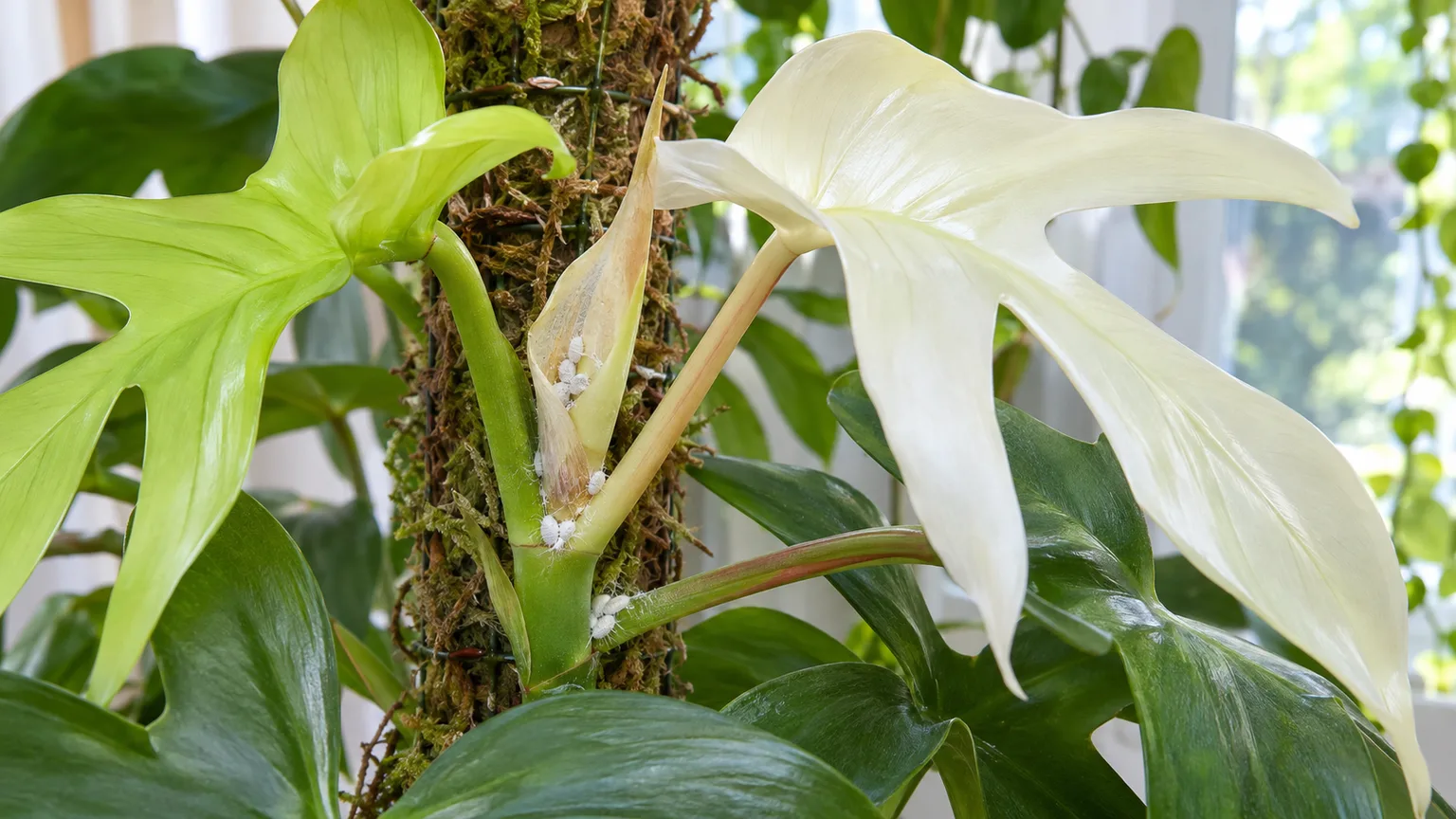
Mealybugs on Philodendron Florida Ghost show up as white cottony tufts tucked into petiole joints, cataphyll sheaths, and unfurling leaves. First step: isolate the plant and dab every visible colony with a cotton swab dipped in 70% (or weaker) isopropyl alcohol, then re-check weekly for a month to catch hatchlings.
Mealybugs on Philodendron Florida Ghost: Causes, Checks & Fixes
This guide covers mealybugs on Philodendron Florida Ghost. See also the general Mealybugs guide, watering, and light pages for this plant.
Mealybugs on Philodendron Florida Ghost: Causes, Checks & Fixes
Quick answer
Mealybugs on Philodendron Florida Ghost show up as white cottony tufts tucked into petiole joints, dried sheaths, and unfurling leaves — easy to miss on a plant whose new foliage is white anyway. First step: isolate the plant and dab every visible colony with a cotton swab dipped in 70% (or weaker) isopropyl alcohol. Then re-check the whole vine weekly for at least a month, because eggs hidden in crevices keep hatching after the adults are gone. For how mealybugs behave on houseplants in general, see our mealybugs guide — on Florida Ghost, the battle is won or lost at the growth tip and the sheath joints.
What mealybugs look like on Florida Ghost
Mealybugs are small, soft, wax-covered insects that cluster in colonies and suck plant sap, excreting sticky honeydew that invites black sooty mold. On Florida Ghost, expect white cottony blobs at the exact spots this vine offers them: where each long petiole meets the stem, inside the papery cataphyll sheaths that cling to new growth, and in the folds of a leaf that is still unfurling. Mature females are oval and segmented with waxy filaments; newly hatched crawlers are tiny, mobile, and wax-free before they settle.
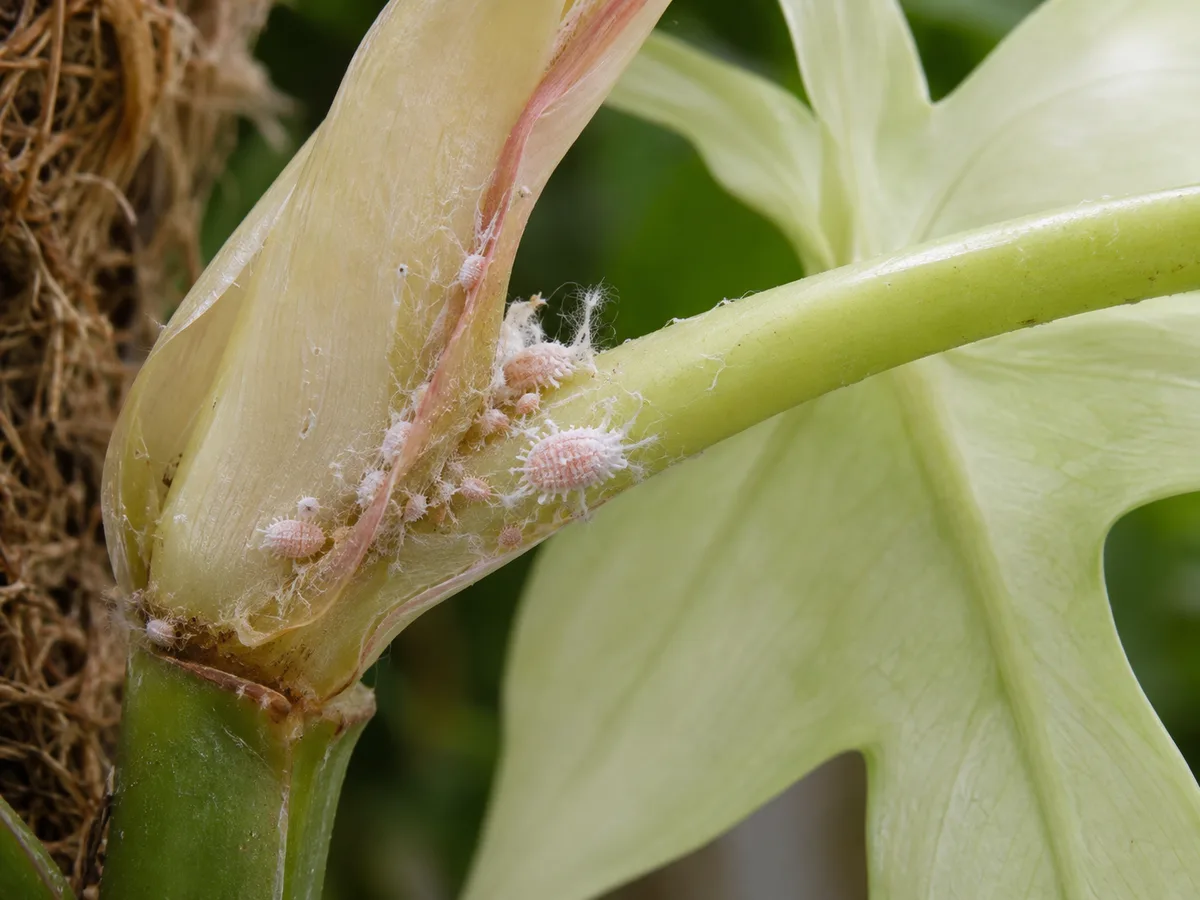
Localized waxy tufts at the sheath and petiole joint distinguish mealybugs from the plant’s naturally pale new leaves.
The tricky part is specific to this plant: pale new Ghost foliage can make a light infestation nearly invisible at a glance. Run your eyes along every joint rather than scanning leaf faces. Warning signs beyond the cotton itself include sticky leaf surfaces, black sooty film, ants trailing up the moss pole, and new leaves that emerge stunted, sticky, or distorted. Yellowing and leaf drop follow when a colony has been feeding for weeks.
Why Florida Ghost gets mealybugs
Philodendron sits on the list of houseplants mealybugs prefer, alongside pothos, aglaonema, and dieffenbachia — soft, fast-growing aroid tissue is ideal sap food. Florida Ghost adds three vulnerabilities of its own. First, it pushes tender nitrogen-rich new growth at the tip almost continuously in good conditions, and mealybugs favor exactly that soft tissue for egg-laying. Second, the climbing habit creates shelter: sheath joints, a damp moss pole, and leaves pressed against a support are the protected spots colonies prefer, such as branch crotches, crowns, and stem-leaf junctions. Third, most infestations ride in on a new plant — a cutting, a nursery pot, or a neighboring infested houseplant — and spread while the Ghost sits unquarantined in a warm, still corner.
Overfeeding makes it worse: excess nitrogen combined with steady watering pushes the flush of soft growth where mealybugs lay eggs. Review your routine against the Florida Ghost fertilizer guide and keep feeding light and seasonal rather than forcing growth.
How to confirm the cause
Work the vine systematically from tip to base:
- Growth tip and newest leaves. Peel back (gently) the cataphyll sheath around the tip and look inside folds of any unfurling leaf. Crawlers colonize here first.
- Every petiole joint. Check the top and underside of each node where the petiole meets the stem, plus the groove running along long petioles.
- Leaf undersides and midribs. Flip the largest leaves; colonies line the midrib on the underside.
- Moss pole and ties. Inspect damp moss, velcro ties, and anywhere a leaf presses against the support.
- Honeydew test. Shiny sticky film on leaves below a colony, black sooty patches, or ants confirm active feeding rather than stray fluff.
Confirm with a magnifier and the alcohol test: touch a suspect tuft with an alcohol-dipped swab. A mealybug colony smears into waxy yellowish residue and reveals oval bodies; perlite dust, pollen, or normal sheath fibers just wipe away dry. Females lay 100–200 or more eggs in cottony sacs, so one tuft means more are hiding — keep looking after the first find.
The first fix to try
Isolate the plant, then dab every visible mealybug with a cotton swab dipped in 70% (or weaker) isopropyl alcohol. This is the correct first move because it kills on contact by dissolving the waxy coating, reaches into the sheath joints sprays cannot, and avoids soaking the plant in chemicals before you know the infestation’s size. UC IPM recommends exactly this approach for houseplants, with a small patch test first to check for leaf burn.
Do the test on one older green leaf and wait a day — Florida Ghost’s pale new leaves are thin and burn more easily than mature green ones. Then work joint by joint, re-dipping the swab, and drop spent swabs straight into a sealed bag. One thorough session, not a bottle of spray, is the whole first fix.
Step-by-step recovery
After the alcohol-dab session, escalate only as far as the infestation demands:
- Rinse the vine. A day after dabbing, shower the foliage with a firm stream of lukewarm water to dislodge crawlers and honeydew. Support the moss pole so the vine does not kink.
- Prune the worst bits. Snip off leaves that are heavily encrusted, distorted, or blackened with sooty mold, cutting back to a clean node. Disinfest scissors between cuts per the Florida Ghost pruning guide.
- Treat the crawlers. Apply insecticidal soap or horticultural oil directly to remaining colonies, since these work on immature mealybugs but struggle against wax-coated adults. Coat joints and undersides; repeat per the label.
- Repeat weekly for 3–4 weeks. Eggs in cottony sacs survive every treatment, so re-dab and re-inspect on a weekly cycle until two consecutive checks find nothing. Wisconsin Extension notes that washing rarely gets everything, so periodic re-checks are essential.
- Hold fertilizer and repotting. Do not feed a stressed vine, and do not repot on day one — mealybugs on Florida Ghost live on stems and leaves, not in the mix, so repotting adds shock without removing the pest. Confirm the watering rhythm is right (top 3–5 cm dry between soaks) and leave the roots alone.
Mistakes to avoid
- Dousing the whole plant in strong alcohol. Blanket spraying burns the white new leaves. Spot-dab, patch-test, and keep solution at 70% or weaker.
- Reaching for broad-spectrum insecticides indoors. They kill the natural enemies that suppress mealybugs and fill your living room with residues; soap, oil, and alcohol plus persistence do the job on a houseplant.
- Fertilizing to “help it recover.” Fresh nitrogen grows the soft tissue mealybugs want. Resume feeding only when clean new growth is established.
- Pruning the growth tip in panic. The tip is the plant’s future — dab around it carefully rather than amputating it. Removing half the vine for a light infestation costs more than the pest did.
- Skipping quarantine. Treating the Ghost while it sits touching other plants guarantees reinfestation. Isolate until clear, and check neighbors too.
Recovery timeline
Count recovery in growth cycles, not days. The egg-to-crawler cycle means you should expect to find stragglers for 3–4 weeks even with perfect technique. Signs of progress: no fresh cotton at the joints, honeydew stops accumulating, and the tip pushes out clean, undistorted leaves. Damaged mature leaves keep their scars and sooty staining — wash what you can, accept the rest, and let new foliage replace them over the next few months. A vine that stalls at the tip or keeps producing distorted leaves after a month of weekly treatment is losing; consider the discard threshold below.
When to worry
Escalate to discarding when colonies cake multiple joints and the pole, the growing tip has stalled or deformed for weeks, or honeydew and sooty mold coat most of the foliage despite repeated treatment. Root-zone mealybugs (stunting plus white cotton on roots at repot) are especially hard to clear, and replacing the plant is often the practical answer. Bag and bin a discarded vine — do not compost it — and sterilize the pole, ties, and saucer before reuse.
How to prevent it next time
Quarantine every incoming plant for 2–4 weeks and inspect before it joins the collection — this single habit prevents most mealybug episodes. Fold a monthly joint-and-pole check into routine care: while you check whether the top centimeters of mix are dry, scan the tip, sheaths, and pole contacts. Keep the vine in bright indirect light with gentle airflow so foliage dries between waterings, feed modestly in the growing season only, and wipe leaves occasionally so early colonies never get a foothold. New cuttings deserve extra suspicion — inspect nodes with a magnifier before they touch the mother plant, following clean technique from the propagation routine.
Related Florida Ghost guides
- Florida Ghost overview — full care profile and whether this climber suits your space.
- Watering — use when leaves yellow or wilt alongside pests, to rule out root-zone stress first.
- Light — use when new growth is pale, leggy, or scorching and you need to separate light issues from pest damage.
- Pruning — use when removing infested or soot-blackened leaves cleanly at the node.
- Fertilizer — use when deciding when (and when not) to resume feeding after treatment.
Related tool
Use the Pest Identifier Tool to narrow causes for mealybugs on this plant before changing multiple variables at once.