Aphids on Philodendron Florida Ghost: Causes, Checks & Fixes
Quick answer
Aphids on Philodendron Florida Ghost cluster on the soft white unfurl at the vine tip and the undersides of new leaves, causing curling, sticky honeydew, and sooty mold. First step: isolate the plant and rinse the tip and leaf undersides with a strong stream of lukewarm water, then recheck in 3–4 days before reaching for sprays.
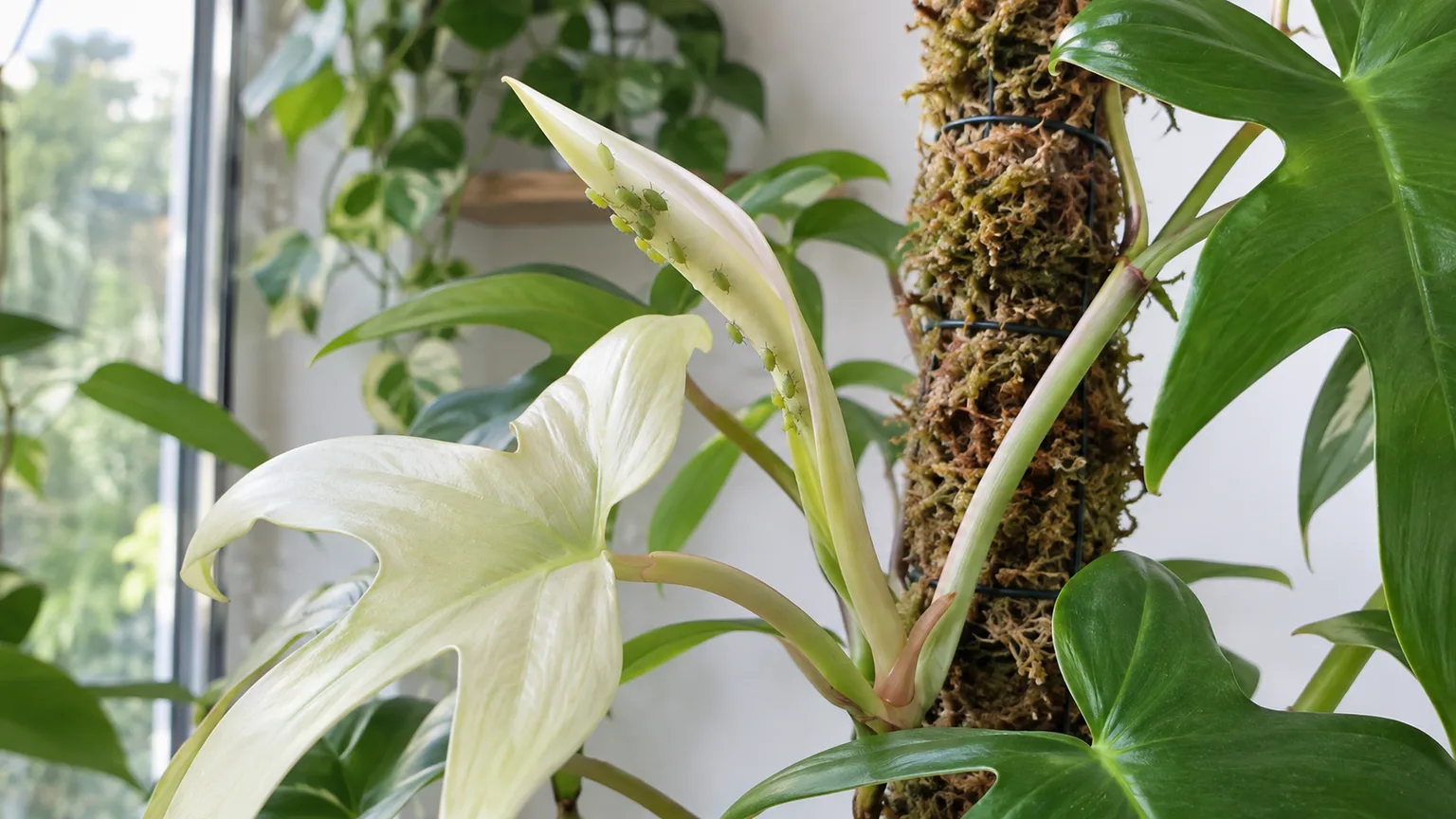
Aphids on Philodendron Florida Ghost: Causes, Checks & Fixes
This guide covers aphids on Philodendron Florida Ghost. See also the general Aphids guide, watering, and light pages for this plant.
Aphids on Philodendron Florida Ghost: Causes, Checks & Fixes
Quick answer
Aphids on Philodendron Florida Ghost almost always start at the vine tip, where the soft white unfurl and the newest leaf undersides give them tender tissue to pierce. Look for clusters of tiny pear-shaped insects, curling on the new leaf, and a sticky film on the pale foliage below. First, isolate the plant and rinse the tip and every leaf underside with a strong stream of lukewarm water, then recheck in three to four days before deciding whether sprays are needed.
What aphids look like on Florida Ghost
On this plant, aphids rarely distribute evenly. They pack onto the growth tip, the still-furled new leaf, and the undersides of the youngest expanded leaves, because that is where the softest tissue sits. Aphids are small insects with soft, pear-shaped bodies in green, yellow, brown, red, or black, sometimes with a pair of tailpipe-like cornicles that separate them from other small insects.
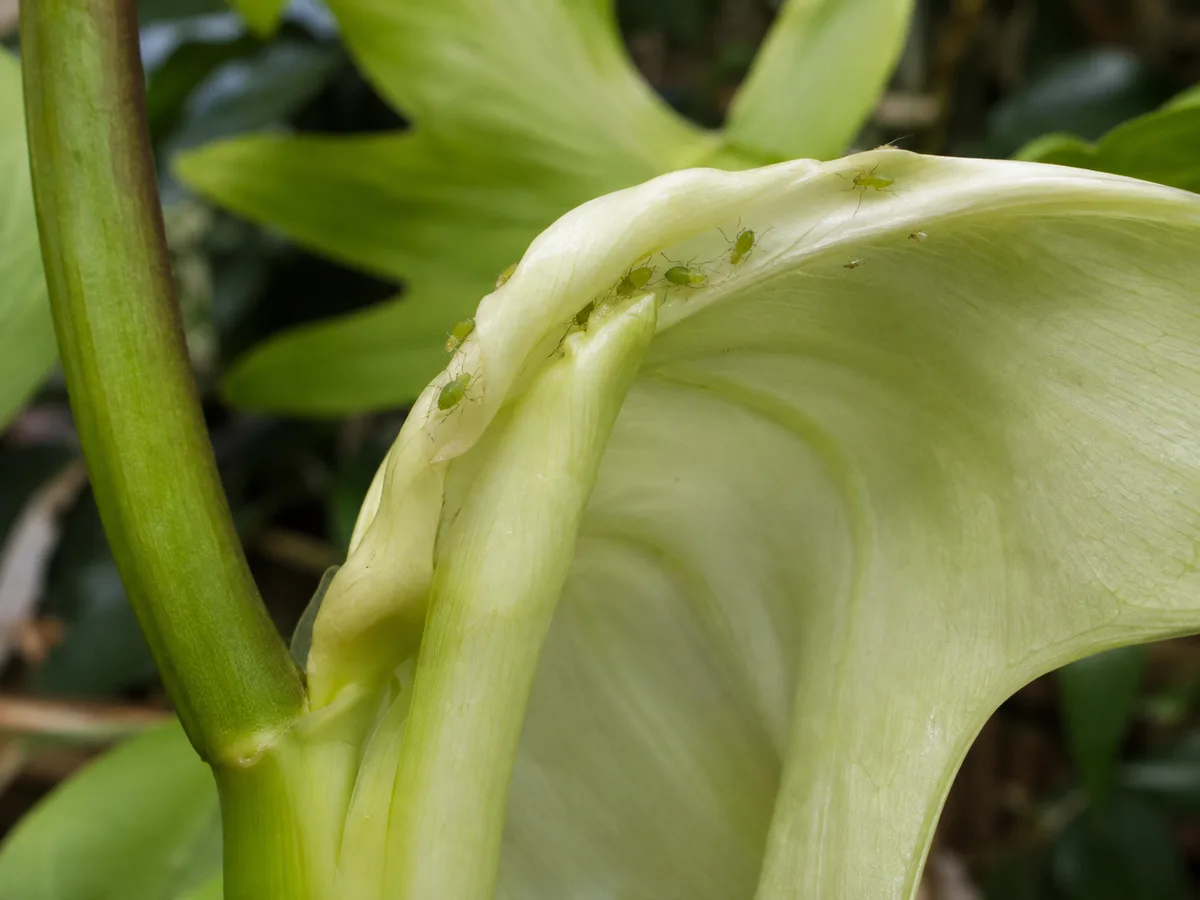
Aphids shelter along the soft edge of the new white leaf, where feeding can leave the unfurl puckered or twisted.
The white juvenile leaves make early colonies easier to spot than on a plain green philodendron, but they also hide a trap. A furled Ghost leaf is a tight tube, and aphids feeding inside it cause the unfurl to open twisted, puckered, or streaked. Because the pale tissue then hardens green with the deformity locked in, one bad week at the tip can leave a permanently crinkled leaf that otherwise looks healthy. Check the unfurl itself, not just open leaves.
Also inspect where each petiole meets the stem near the tip and the top of the moss pole. Colonies shelter in those crevices and in damp moss, then walk onto the next unfurl. If you only rinse open blades and ignore the pole surface and leaf axils, the colony reappears within days.
Why the new white growth gets hit first
Aphids feed preferentially on soft, expanding tissue, and a Ghost vine tip is nearly all soft expanding tissue. The white unfurl has minimal hardened cuticle, high water content, and cells that are easy for piercing mouthparts to tap. Colonies gather and feed on the undersides of leaves and other sheltered young surfaces, which on Ghost means the furled tube and the pale underside of each new blade.
Two common Ghost-growing habits make this worse. The first is pushing fertilizer to chase whiter leaves. Heavy nitrogen produces exactly the flush of soft tip growth aphids reproduce fastest on, and extension guidance warns that aphids build on soft, new plant growth when plants are over-fertilized. The second is a spring growth surge after winter: brighter days wake the vine tip while indoor air stays still and predator-free, so a colony founded by a single winged aphid from an open window or a new plant can explode unnoticed.
For how aphids feed and multiply in general, see our aphids guide. On Florida Ghost, the pattern usually shows up as a stalled or twisted white unfurl with sticky residue on the leaves beneath it, rather than the edge-burn or spotting that marks watering problems.
How to confirm the diagnosis
Work in this order so you do not confuse aphids with thrips, mealybugs, or fertilizer burn.
- Look at the tip with magnification. Part the furled leaf gently and check inside the tube and along the midrib underside. Aphid clusters sit still when prodded; thrips scatter quickly and leave silvery rasped patches instead.
- Feel for honeydew. Run a finger over the pale leaf below the tip. A clear sticky film that later grows a black powdery coating is honeydew with sooty mold, and feeding aphids excrete this sticky honeydew onto whatever sits beneath the colony. On white Ghost leaves the black film shows dramatically and wipes off with a damp cloth, which itself is a clue.
- Watch for ants. Indoors, a thin trail of ants commuting up the pot or pole toward the tip means a honeydew source is being farmed up there. Ants tend aphids and chase off the predators that would otherwise help.
- Rule out lookalikes. White cottony tufts in axils are mealybugs, not aphids. Fine stippling plus webbing on older leaves points to spider mites. Uniform yellowing of a hardened pale leaf with wet mix is usually overwatering in low light, not pests, so cross-check your routine in the Florida Ghost watering guide before treating.
Aphids stay active all year round indoors, so do not dismiss a winter colony as impossible. New plants are the usual indoor source, which is why quarantine matters more than season.
The first fix to try
Isolate the plant away from other houseplants, then rinse. Carry the Ghost to a sink or shower and wash the vine tip, the inside of any furled leaf you can safely open, every leaf underside, the petiole bases, and the top few inches of the moss pole with a strong stream of lukewarm water. Dislodged aphids seldom climb back, and exposed colonies can be knocked down with a strong jet of water while the honeydew washes off at the same time.
Let the plant drip-dry in bright indirect light with gentle airflow, out of direct sunbeams. A wet white unfurl in a hot sun patch scorches fast, so morning rinses that dry by midday are safest. Recheck the tip with a lens after three to four days. One rinse clears light colonies; two rinses a few days apart clear most moderate ones without any chemicals.
Prune only the worst leaf if a single unfurl is cemented shut with hundreds of aphids and distorted beyond saving. Snip it, bag it, and keep the healthy tip intact so the vine keeps growing.
If rinsing is not enough
Move to insecticidal soap or neem oil only after two thorough rinses fail or new unfurls keep emerging twisted. These products kill by smothering, so coverage decides everything: coat the colony, the furled leaf exterior, both leaf surfaces, and stem crevices until wet. Extension guidance notes these materials work by smothering aphids, which is why a light mist over the top of the plant accomplishes nothing.
Practical rules for Ghost’s pale tissue:
- Spray in the evening or on a cloudy morning, never on a white unfurl sitting in direct sun or heat. Do not treat a drought-stressed plant; water normally first and spray the next day.
- Test one older green leaf and wait two to three days before spraying the white tip, since some plants react badly to oils and soaps.
- Repeat every seven to ten days until two consecutive checks find no live aphids, a rhythm consistent with practical guidance to reapply sprays once every 7 to 10 days until the problem subsides.
- Never substitute dish soap or detergent for a labeled insecticidal soap. Dish soaps strip plant tissue and burn foliage, a warning practical growers repeat because the damage shows up as chemical-looking leaf burn blamed on everything else.
Skip broad-spectrum insecticides and soil-applied systemics for a normal indoor colony. Contact-only sprays cannot reach aphids sealed inside a curled unfurl anyway, and systemics persist in plant tissue where they can harm beneficial insects, which is why they are a last resort for severe outdoor infestations rather than a first move on a houseplant.
What not to do
Do not fertilize to “help the plant fight back.” Fresh nitrogen grows more of the exact tissue aphids want, and a stressed Ghost with a damaged tip cannot use the feed. Resume the normal half-strength growing-season schedule from the Florida Ghost fertilizer guide only after two clean new leaves prove the colony is gone.
Do not repot, take cuttings, or re-tie the whole vine on the same day you spray. A cutting taken from an infested tip carries the colony to the propagation box, and stacking repot stress plus chemical stress on pale tissue causes more leaf loss than the aphids did. One intervention at a time, then observe.
Do not blast the plant with more light to “toughen” the white leaves mid-infestation. Ghost’s colored new foliage genuinely needs higher light than a plain green philodendron, a point UF/IFAS hybrid philodendron guidance makes for colored-foliage types, but light corrections belong in the Florida Ghost light guide routine after the colony is dead, not as a same-day shock on wet sprayed leaves.
Recovery: what heals and what does not
A twisted unfurl will not straighten. Once pale tissue hardens, its shape is set, and it will simply age from white to green while keeping the pucker. That leaf still photosynthesizes once green, so leave it unless it is fully collapsed.
Real recovery shows at the tip. Within two to four weeks of clearing the colony, the next unfurl should emerge clean, open flat, and run the normal white-to-cream-to-green sequence. Sticky film should stop reappearing on the leaves below, and no new black sooty dust should form. If the second new leaf still opens distorted, you missed a reservoir, usually the moss pole top or a neighboring plant, and the inspection round needs repeating rather than a stronger chemical.
How to prevent it next time
Quarantine every incoming plant for two to three weeks in a separate spot and check its tips before it joins the collection. Most indoor Ghost infestations trace to a new plant, an open summer window near the vine, or ants finding the pot, not to the potting mix.
Make the vine tip a weekly habit. Glance at the unfurl, flip the two newest leaves, and look along the pole top every time you check whether the pot needs water. Colonies found at the ten-aphid stage rinse off in a minute; colonies found at the thousand-aphid stage cost you a leaf.
Feed for steady growth, not maximum whiteness. Light drives the pale juvenile phase far more than fertilizer does, so keep the tip in bright filtered light and feed lightly in season. Keep the moss pole snug but not swampy, wipe honeydew off leaves promptly with a damp cloth so sooty mold never establishes, and remember that Ghost is a climbing philodendron whose newest growth will always sit exactly where aphids want to be: at the top, soft, and freshly unfurled.
When to worry
Treat the situation as urgent if several unfurls in a row emerge stunted, if sticky honeydew is dripping onto furniture or lower leaves faster than you can wipe it, or if the stem tip itself turns soft and stops producing new growth. A stalled, mushy tip plus aphids can signal the colony is the least of the problems and rot or severe stress is involved. If the vine has no clean growth point left and every new leaf collapses, a healthy node cutting from lower on the stem, rooted separately after a full rinse, may outrun salvaging the tip.
Related tool
Use the Pest Identifier Tool to narrow causes for aphids on this plant before changing multiple variables at once.