Drooping Leaves on Philodendron Pink Princess: Causes
Quick answer
Drooping Pink Princess leaves usually mean roots are not supplying enough water-either the mix is dry, roots are failing in wet soil, or a long unsupported runner is hanging from gravity. Lift the pot and probe the top 3–5 cm before you water, stake, or repot.
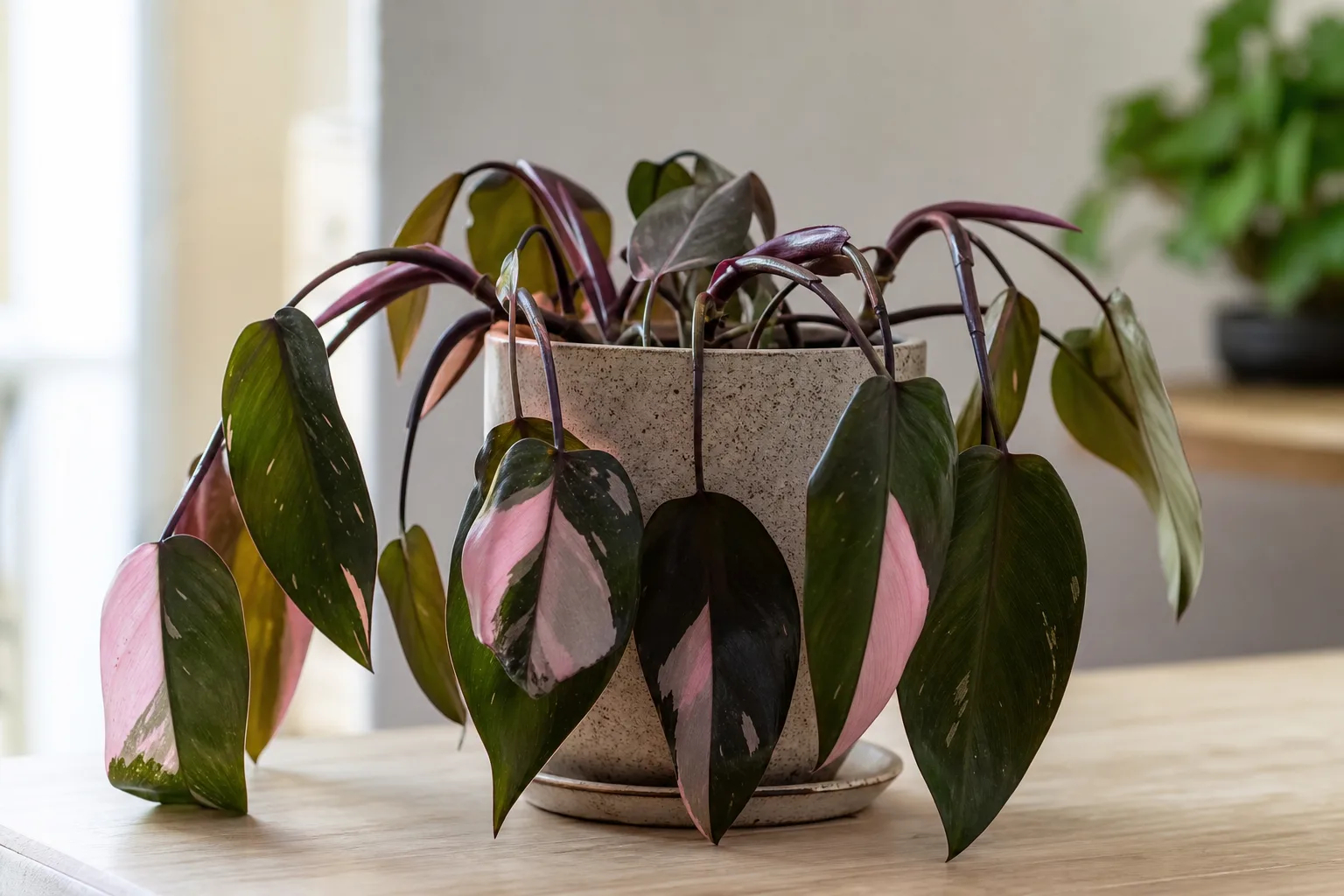
Drooping Leaves on Philodendron Pink Princess: Causes, Checks & Fixes
This guide covers drooping leaves on Philodendron Pink Princess. See also the general Drooping Leaves guide, watering, and light pages for this plant.
Drooping Leaves on Philodendron Pink Princess: Causes, Checks & Fixes
Quick answer
When a long Pink Princess runner hangs with thin marbled leaves pointing down, the first question is not “does it need water?” but “can the roots still move water-and is the vine supported?” Climbing Philodendron erubescens with variegated pink sectors loses turgor faster than self-heading philodendrons because the leaf blades are thinner and pink tissue photosynthesizes less than green tissue. Dry mix, rotting roots in wet mix, and gravity on an unstaked vine all produce a similar hang.
First step: lift the pot and probe the top 3–5 cm of mix before you water, repot, or add a moss pole. A light pot with dry mix needs water; a heavy pot with wet mix needs drying and possibly a root inspection-not another drink. If weight and moisture look normal but one long runner droops while newer leaves above it stay firm, suspect mechanical stress and support the vine.
Use this page when leaves or whole runners hang downward over days-not only when the plant suddenly collapses. For acute whole-plant collapse after a watering mistake or heat spike, see our wilting guide. For routine moisture rhythm, start with the watering guide.
What drooping leaves look like on Philodendron Pink Princess
Healthy Pink Princess holds heart-shaped marbled leaves at a slight angle from firm petioles along a climbing or trailing stem. Drooping shows as:
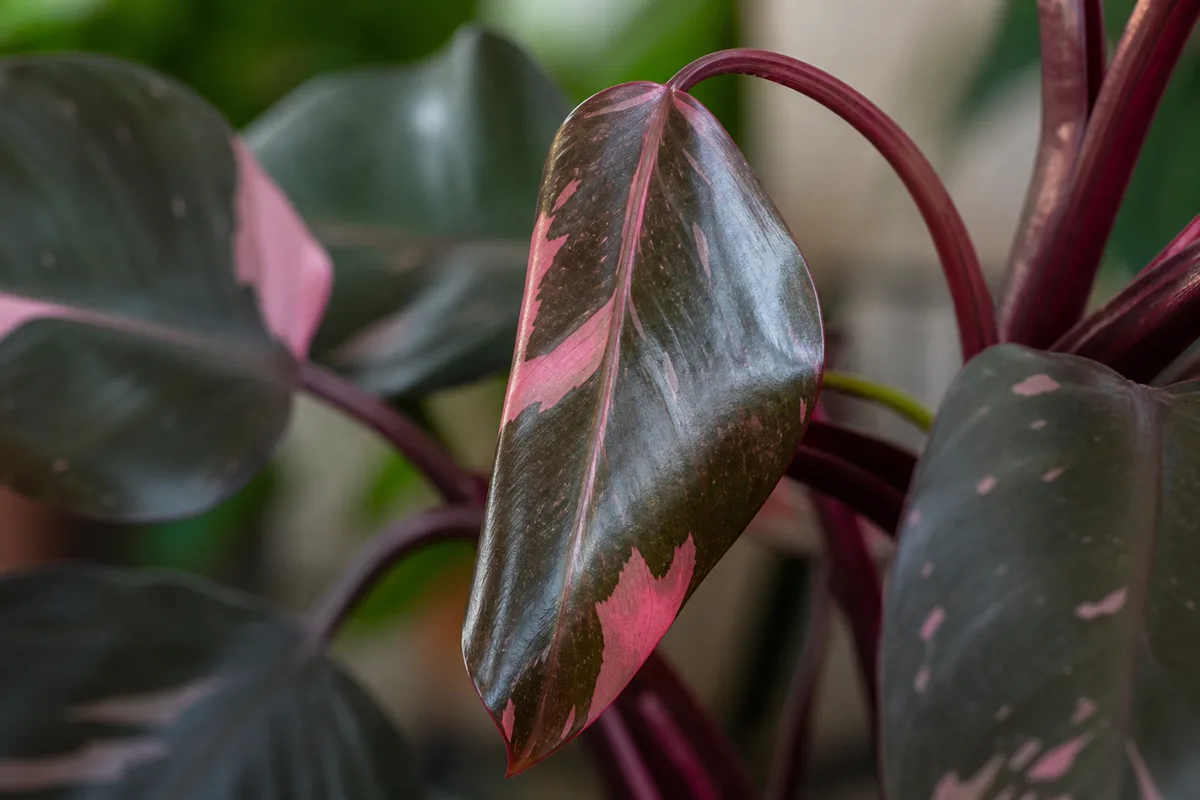
Drooping Leaves symptoms on Philodendron Pink Princess - compare with healthy tissue on the same plant.
- Limp petioles and leaf blades that hang below the horizontal instead of holding slightly upward
- Whole runners sagging while the base of the vine still looks upright-common on unsupported long stems
- Pink or white sectors flopping first on a marbled leaf while green tissue stays slightly firmer
- No immediate color change in early thirst-leaves stay dark green with pink patches but lose stiffness
- Softening at petiole bases when wet-soil root failure is involved, sometimes before lower leaves yellow
Pink Princess is a vining philodendron that climbs with aerial roots in nature. Indoors, an unstaked plant in a bright window may show gravity droop on the lowest leaves of a long runner even when roots are fine-that is different from turgor droop, where even upper leaves on a short plant feel floppy. Collectors often panic at limp pink leaves and water again; that is the classic trap when the mix is already wet.
Drooping is not the same as plant leaning toward a window-the stem bends for light while leaves stay turgid. It is also not leggy growth, where internodes stretch in dim light but tissue stays firm.
Why Philodendron Pink Princess leaves droop
Underwatering in bright, fast-drying rooms
Pink Princess in east or south windows, under grow lights, or in small nursery pots with chunky aroid mix can dry the top 3–5 cm within a few days. Wilting and drooping signal a plant getting too dry as turgor falls before leaves crisp. Thin variegated blades show the slump before a thick self-heading philodendron would.
Severe drought can damage fine roots; one heavy watering after bone-dry mix may run through without fully rewetting a hydrophobic root ball. Check our underwatering guide if dry cycles repeat.
Overwatering and root failure (wet-soil paradox)
This is the most serious cause. Overwatering can cause root rot on philodendrons when mix stays saturated, oxygen is excluded, and roots decay. Leaves droop despite wet soil because damaged roots cannot absorb water-the same paradox that drives wilting on this plant.
Premium Pink Princess pots in dense peat, oversized containers, or saucers that hold water push this pattern. Limp variegated leaves tempt owners to water again, which accelerates rot. See overwatering and root rot when bases soften or smell turns sour.
Mechanical stress on unsupported climbing vines
A long runner with heavy marbled leaves in bright light transpires at the tip faster than a short plant, and without a moss pole or trellis the lowest leaves hang from gravity alone. Providing a moss pole encourages climbing growth and gives aerial roots attachment points-often lifting the display without any moisture change.
Mechanical droop usually affects the outer end of a vine while newer leaves near the growing tip and the root zone still feel firm. Pot weight stays normal and mix moisture matches your usual rhythm.
Variegation stress and weak pink sectors
Pink and white leaf sectors contain less chlorophyll than green tissue. Under water stress, those sectors often lose stiffness first- you may see a marbled leaf where the pink patch droops while the green margin still holds. That does not automatically mean only the variegation is “sick”; it usually means the whole leaf, and often the whole root zone, needs a moisture check.
Chronic overwatering after misreading limp pink leaves is a common Pink Princess collector mistake. The plant keeps hanging; you keep watering; roots fail. Always confirm weight and depth moisture before treating variegation droop as thirst.
Repot shock and root disturbance
Pink Princess often droops for several days after repotting because fine root hairs were disturbed. Stress from recent repotting or location change can cause wilt or leaf drop while roots re-establish. Watering heavily into already-wet fresh mix after repot compounds the problem.
Match droop timing to your repot date. If you repotted within two weeks and stems are still firm, patience and stable light often beat another intervention.
Heat, cold drafts, and humidity
Pink Princess prefers room temperatures from about 65 to 85°F and bright filtered light. Cold air from winter sills or AC vents slows root function; roots in cool, damp mix absorb poorly and mimic overwatering droop. Sudden moves to much brighter light or heat registers increase transpiration faster than roots replace water.
Low humidity alone rarely droops entire leaves on Pink Princess before you see crisp brown tips on pink sectors. If whole runners hang limp without tip burn, prioritize root-zone moisture over misting.
How to confirm the cause (6-step checklist)
Work through these checks in order:
- Pot weight - Lift the pot. Light means dry; noticeably heavy means wet.
- Moisture at depth - Probe 3–5 cm into the mix, not just the surface crust. Dry there with limp leaves = thirst. Wet there with limp leaves = suspect root stress.
- Petiole base - Press where the leaf stalk meets the stem. Firm and green is reassuring; soft, dark, or mushy tissue suggests rot.
- Smell - Sour or swampy odor from drainage holes points to decay in wet mix.
- Vine support - Is one long unstaked runner hanging while upper nodes stay firm? Normal weight and moisture with end-only droop fits mechanical stress.
- Recent events - Repotted, moved windows, or started heat season? Match droop timing to the trigger.
Decision fork: Dry/light → deep soak path. Wet/heavy with soft bases → withhold water and inspect roots. Normal moisture with end-only hang on a long vine → moss pole first.
If droop persists more than 48 hours after you corrected dry or wet conditions-or wet soil never dries-unpot and inspect roots. Brown, soft roots confirm overwatering damage; firm pale roots with dry mix confirm thirst.
First fix for Philodendron Pink Princess
Lift the pot and check whether the top 3–5 cm of mix is dry or wet before you water, repot, stake, or fertilize.
That single check separates opposite fixes. Watering an already-wet Pink Princess after seeing limp pink leaves is the fastest way a recoverable droop becomes root rot. Withholding water from a dry plant lets turgor loss spread up the vine.
Do not mist, move the plant daily, prune heavily, or feed on day one. Keep philodendron away from pets during inspection; philodendron is toxic to cats and dogs if chewed.
Step-by-step recovery
Dry droop: deep soak protocol
- Water thoroughly until excess drains from the bottom-room-temperature water, empty the saucer after 30 minutes.
- If water runs straight through bone-dry mix, bottom-soak the pot in a tray of water for 20–30 minutes so the root ball rewets evenly.
- Recheck in a few hours. Thirst droop on healthy roots often improves the same day on thin variegated blades.
- Resume rhythm from our watering guide: wait until the top of the compost dries out before the next drink.
Wet droop: withhold, inspect, trim, repot
- Stop watering until the top half of the mix dries. Move Pink Princess to bright filtered light with airflow-not deep shade, which slows drying.
- If petiole bases are soft or smell is sour, unpot gently, rinse roots, and trim brown mushy tissue with clean scissors.
- Repot only if roots are damaged or mix is stale and waterlogged. Use fresh chunky aroid mix; choose a pot only slightly larger with drainage holes.
- Wait until new marbled leaves open firm before returning to a normal schedule. Let soil dry between waterings rather than keeping it constantly moist.
Mechanical droop: moss pole or trellis
- Insert a moss pole or trellis without disturbing roots if moisture checks are normal.
- Loosely tie the drooping runner so petioles sit at a natural angle-not crammed flat against the pole.
- Expect gradual lift over days as aerial roots attach; older bent petioles may not fully straighten.
Recovery timeline
| Cause | What to expect |
|---|---|
| Mild underwatering | Perking within 4–24 hours after thorough watering |
| Severe dry spell | 2–5 days; some older marbled leaves may not fully refill |
| Overwatering without rot | Improvement over 1–2 weeks as mix dries and roots recover |
| Root rot after trimming | Weeks to months; judge by firm new leaves, not old ones |
| Repot shock | 7–14 days before stems feel rigid again |
| Mechanical droop after staking | Gradual lift over 3–10 days as the vine climbs |
Damaged leaf tissue does not perfectly “uncurl”-success means new marbled leaves open firm and droop stops spreading up the vine.
Lookalike symptoms to rule out
| Pattern | Likely cause | Where to go |
|---|---|---|
| Dry/light pot, firm bases, limp blades | Thirst | Deep soak; underwatering |
| Wet/heavy pot, soft bases, sour smell | Root failure | Root rot |
| End of long vine hangs; tip and base firm | Unsupported climber | Moss pole (this page) |
| Whole plant collapses fast after water or heat | Acute wilt | Wilting |
| Stem bends toward window; leaves firm | Light seeking | Plant leaning |
| Crisp brown tips only; leaves not fully limp | Dry air | Low humidity |
Yellow lower leaves with droop and wet soil often mean advanced overwatering-fix roots before chasing fertilizer or humidity.
Mistakes to avoid
- Watering immediately because pink leaves look limp without checking wet soil first
- Repotting on day one when the only issue is a dry pot or minor repot shock
- Fertilizing a drooping Pink Princess to “perk it up”-salts stress roots that are already failing
- Misting instead of fixing root-zone moisture-surface moisture does not restore turgor in the blade
- Assuming droop always means thirst because variegation looks delicate-wet-soil droop worsens with more water
- Leaving the vine unstaked in a bright room and treating gravity hang as a disease
Pink Princess care cross-check
Drooping often means one pillar of Pink Princess care slipped:
- Light: Bright filtered sun per our light guide; too dark slows water use and invites overwatering
- Water: Top 3–5 cm dry before watering; never let pots sit in full saucers
- Mix: Chunky aroid blend with perlite and bark; dense peat holds water too long on collector-sized pots
- Support: Moss pole or trellis for vining habit; trailing display increases end-of-vine hang
- Temperature: Roughly 18–29°C (65–85°F); cold roots in wet mix droop easily
When several factors drift at once-new pot, new window, winter heat-the first visible sign is often limp marbled runners rather than immediate yellowing.
How to prevent drooping leaves next time
- Check moisture before every watering; do not water on a fixed schedule.
- Use pots with drainage; repot only one size up when roots circle the mix.
- Stake early so long runners do not spend weeks hanging under their own weight in bright rooms.
- Acclimate to brighter light gradually so transpiration does not outpace roots.
- Rotate weekly for even light so one side of the vine does not dry or transpire faster.
When to worry
Seek deeper intervention if:
- Drooping continues beyond 48 hours after you corrected dry or wet conditions appropriately
- Petiole bases soften or darken while mix stays damp
- More leaves yellow and drop along the vine
- New growth arrives small, curled, or already limp
- Root inspection shows mostly brown, mushy tissue with little firm white root remaining
Pink Princess can recover from partial root loss if enough healthy stem and root remain. If rot has climbed through most of the base, take a firm stem cutting with a node from healthy tissue above the damage as backup before the last viable section fails.
Conclusion
Drooping leaves on Pink Princess are a moisture-and-support signal, not a mystery disease. Thin variegated blades and long unstaked runners make this cultivar droop faster and look more alarming than generic philodendron advice suggests-but the diagnostic fork still starts at the pot. Lift it, probe the mix, match your first action to dry, wet, or mechanical cause, and cross-check watering or wilting if history is unclear. Firm new marbled leaves are the scoreboard; old drooped blades may stay slightly bent even after the plant is stable again.
Related Pink Princess guides
- Pink Princess overview - light, water, soil, and support baseline
- Watering guide - dry-down rhythm and pot-weight checks
- Wilting - acute whole-plant collapse and wet-wilt paradox
- Root rot - unpot, trim, and repot when bases go soft
- Overwatering - chronic wet-soil patterns before collapse
- Plant leaning - stem bend toward light vs. limp hang
Related tool
Use the Plant Problem Diagnosis Tool to narrow causes for drooping leaves on this plant before changing multiple variables at once.