Fungus Gnats on Philodendron Pink Princess: Causes, Checks
Quick answer
Fungus gnats on Philodendron Pink Princess almost always mean the soil surface stays too wet-often from overwatering, peat-heavy mix, decorative moss toppers, or low light slowing dry-down on a trailing vine. First step: let the top 3–5 cm dry completely and set yellow sticky traps while you fix the moisture problem.
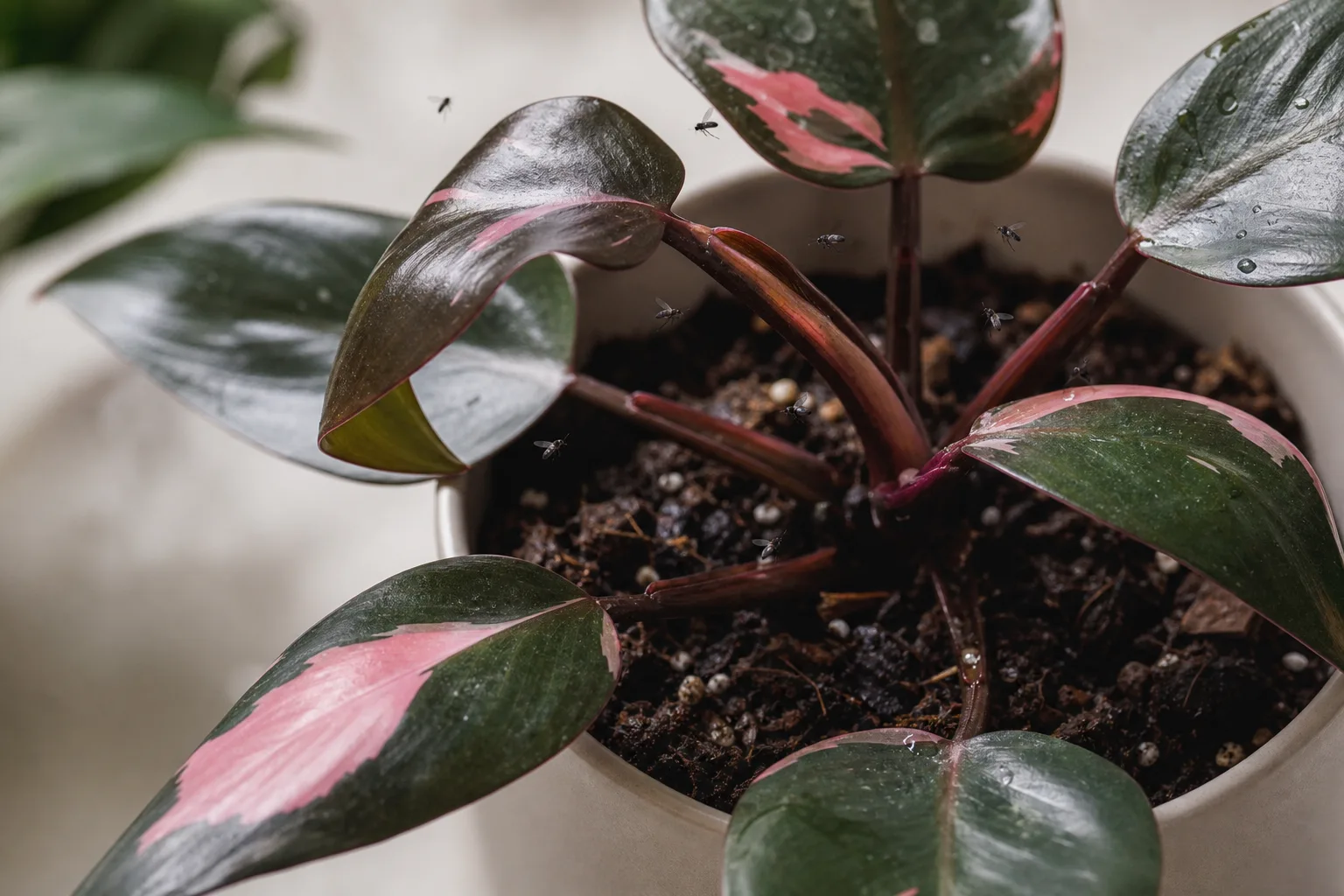
Fungus Gnats on Philodendron Pink Princess: Causes, Checks & Fixes
This guide covers fungus gnats on Philodendron Pink Princess. See also the general Fungus Gnats guide, watering, and light pages for this plant.
Fungus Gnats on Philodendron Pink Princess: Causes, Checks & Fixes
Quick answer
Fungus gnats on Philodendron erubescens ‘Pink Princess’ are a soil-moisture alarm, not a foliage pest. Adult fungus gnats do not feed on or damage plant leaves-they hover around the pot, windows, and lamps while their larvae live in the top layer of damp mix. On Pink Princess, their appearance usually means the surface has stayed wet too long, which this climbing aroid tolerates poorly over time.
First step: let the top 3–5 cm of mix dry completely before watering again, and place a yellow sticky trap at soil level. Drying the surface breaks the larval cycle because fungus gnat larvae cannot survive in dry soil. Traps catch egg-laying adults while you correct the watering rhythm that invited them.
Reviewed by the LeafyPixels Review Board. Methodology: recommendations checked against NC State P. erubescens profile, cooperative extension fungus-gnat guidance, and LeafyPixels plant-care data before publication.
What fungus gnats look like on Philodendron Pink Princess
You will notice the problem before you see damage on Pink Princess’s dark leaves splashed with pink:
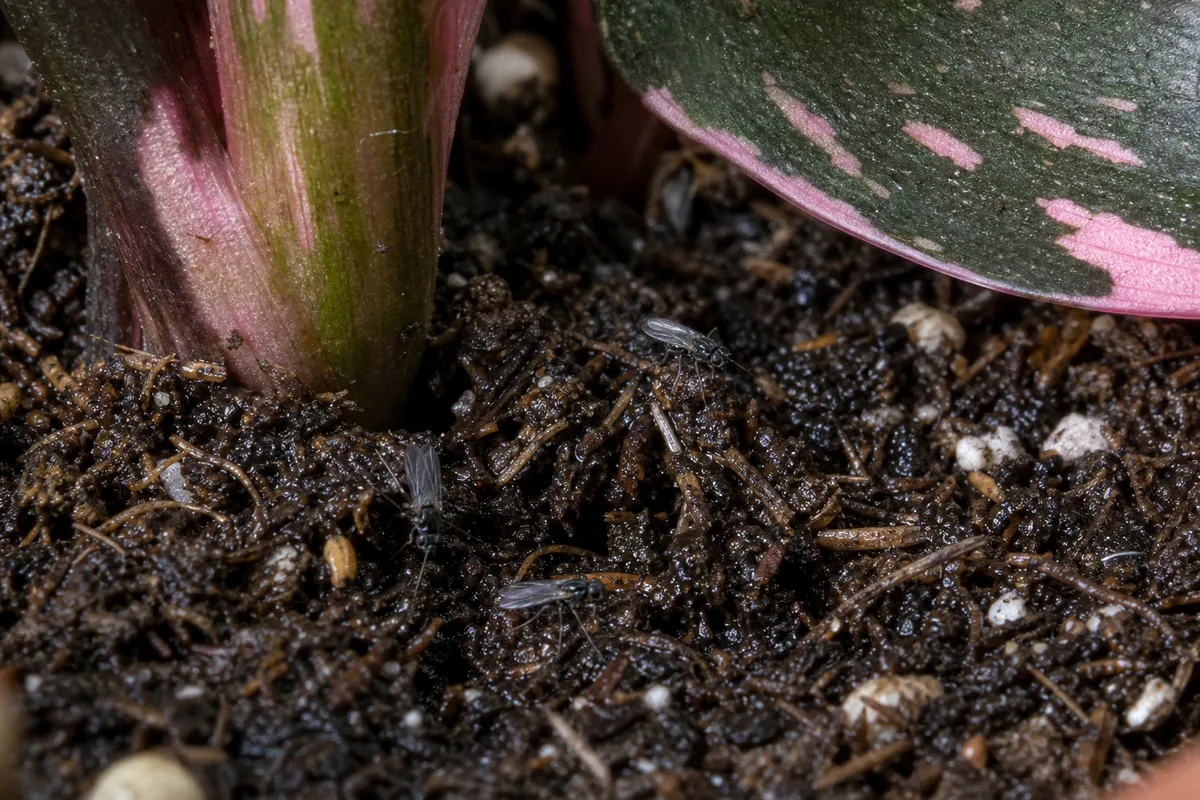
Fungus Gnats symptoms on Philodendron Pink Princess - compare with healthy tissue on the same plant.
- Tiny dark flies (about 1/8 inch long) that scatter when you water or brush the pot
- Flies rising from under trailing variegated leaves that hang over the pot rim
- More activity near windows and lamps as adults are drawn to light
- Topsoil that stays visibly damp for many days after watering
- Fine white worm-like larvae in the upper 2–3 cm of mix if you scrape the surface gently
- Yellow sticky traps near the pot collecting small gnat-like insects
Pink Princess rarely shows leaf spots, webbing, or sticky residue from fungus gnats-the adults are a nuisance fly, and larvae feed on fungi and decaying organic matter in moist soil, sometimes on root hairs when populations are heavy. Yellowing or limp variegated leaves that appear alongside a swarm usually reflect the wet soil conditions that breed gnats, not direct adult feeding. If leaves droop while the pot feels heavy, that wilt-on-wet-soil pattern often signals root stress from the same overwatering-see our overwatering guide before adding another drink.
Why Philodendron Pink Princess gets fungus gnats
Fungus gnats are not Pink Princess–specific pests-they arrive in potting mix, on new plants, or through open windows-but this collector cultivar’s typical indoor setup makes breeding easy.
Overwatering and slow dry-down. Pink Princess wants moist, well-drained soil and watering when the top 3–5 cm is dry-not a constantly wet surface. Many owners water on a fixed weekly schedule while the plant sits in low light, so the top layer never dries. Fungus gnats thrive in damp conditions, and overwatered plants are especially vulnerable.
The collector overwatering trap. Growers sometimes keep mix “slightly moist” hoping to protect pink variegation. That habit keeps the surface gnat-friendly without helping the plant-heavily variegated leaves photosynthesize less efficiently and show water stress sooner, but they do not need more frequent watering. Match water to dry-down checks, not fear of losing pink.
Trailing foliage and moss poles shading the soil. Pink Princess climbs on moss poles or trails from shelves. Leaves hanging over the pot reduce airflow across the soil surface compared with an upright rosette, so the top inch stays damp longer in the same room. Moss wrapped around a pole can drip moisture onto the mix below if you mist heavily or bottom-water without letting the surface dry.
Decorative moss toppers and cachepots. Sphagnum or decorative moss on the soil surface traps moisture exactly where larvae breed. A decorative outer pot without drainage, or one that holds runoff, keeps the inner pot sitting in stale water-the surface stays wet enough for continuous egg-laying even when you think you watered lightly.
Dense peat-based store mix. Pink Princess is often sold in moisture-retentive potting soil without enough perlite or bark. Organic, water-holding mix supports the fungi and decaying matter larvae feed on and keeps the breeding zone wet. Our soil guide covers the chunky aroid blend that dries predictably.
Low light slowing dry-down and variegation. Dim placement slows evaporation and can push new growth toward all-green simultaneously-two stress signals sharing one root cause. Bright filtered light helps the pot dry on schedule without scorching pink tissue.
Bottom-watering without surface dry-down. Bottom-watering can hydrate roots while the top layer stays soggy and egg-friendly if you never let the surface dry between sessions. Alternate methods or scrape the top centimetre if algae coats the surface.
How to confirm the cause
Work through these checks before Philodendron Pink Princess repotting guide or spraying:
- Fly behavior - Disturb the soil or water the pot. Fungus gnats rise in small clouds from the surface; fruit flies tend toward kitchen fruit, not potting mix.
- Surface moisture - Stick your finger 3–5 cm deep. If the top is wet or cold-damp while flies are present, you have a moisture-and-gnat pairing-not a separate leaf pest.
- Larva check - Scrape the top centimetre of mix onto white paper. Translucent worm-like larvae with dark heads confirm active breeding in soil. A potato slice buried overnight and lifted can also reveal larvae clinging to the underside.
- Leaf inspection - Look at variegated leaf undersides for aphids, spider mites, or scale. Gnats alone do not leave stippling, webbing, or honeydew on Pink Princess foliage.
- Pot, topper, and drainage - Confirm drainage holes are open, remove damp decorative moss if present, and check whether the plant sits in a sealed cache pot.
- Light level - Note bright indirect hours. Pink Princess in a dim corner plus frequent watering is the most common gnat pattern in home collections.
- New plant source - Recent nursery arrivals or shared shelf placement can introduce eggs in contaminated mix.
If flies appear but the top 3–5 cm dries within a few days and stems are firm, you may have a mild hitchhiker infestation rather than chronic overwatering-still dry the surface and trap adults, but root rescue is less urgent.
First fix to try
Let the top 3–5 cm of mix dry completely, and set one yellow sticky trap at soil level beside the pot.
This single pairing targets both life stages without stressing Pink Princess further. Dry surface soil kills larvae and stops new eggs from hatching; traps reduce adults that would otherwise lay more eggs every few days. Allowing the top inch of soil to dry between waterings disrupts the fungus gnat life cycle while still matching Pink Princess’s normal dry-top watering rule from our watering guide.
Do not spray leaves with insecticide on day one-gnats are not on the foliage. Do not pour hydrogen peroxide or soap drenches repeatedly before fixing moisture; they may knock down larvae briefly but will not stop reinfestation if the surface stays wet. Do not repot on day one unless mix smells sour or the stem base is soft.
Remove decorative moss toppers until the surface dries reliably. Move Pink Princess to brighter filtered light-not direct afternoon sun-so the remaining water in the pot is used faster and the surface dries on schedule.
Step-by-step recovery
After the dry-down and trap setup, follow a path based on severity.
Mild case: few flies, firm stem, no yellowing
- Water only when the top 3–5 cm is dry; empty the saucer within 30 minutes.
- Replace sticky traps weekly until catches drop to near zero.
- Scrape and discard the top centimetre of mix if it is algae-coated or stays soggy, and top-dress with dry aroid mix from our soil guide.
- Watch for one new variegated leaf over the next two to four weeks as a sign the root zone is stabilizing.
Moderate case: persistent swarms, visible larvae, damp surface for weeks
- Continue dry-top watering and sticky traps.
- Apply Bacillus thuringiensis israelensis (Bti)-the active ingredient in products such as Mosquito Bits-as a soil drench according to label directions. Bti targets larvae in moist soil; repeat applications five to seven days apart until flies decline, because Bti does not affect eggs or pupae.
- Bottom-water if you prefer: set the pot in a tray of water for 15–30 minutes so roots drink while the surface stays drier than top-down flooding-but still let the top layer dry between waterings.
- Add perlite and orchid bark to future mixes, or repot into fresh well-draining aroid blend if the current peat holds water like a sponge.
Severe case: yellow spreading leaves, sour smell, soft stem base
- Stop treating this as a gnat-only problem-inspect roots immediately. Wet anaerobic conditions may have progressed toward rot.
- Unpot, trim mushy roots, and repot into fresh draining mix in an appropriately sized pot with drainage holes. Follow our root rot guide if decay is extensive.
- Use Bti and sticky traps after repotting, but prioritize a dry-down rhythm and Philodendron Pink Princess light guide over repeated chemical drenches.
- Hold fertilizer until new growth appears. If the main vine is lost, take a firm stem cutting with a node before discarding-propagation salvage is possible when tissue above the rot zone stays firm.
Wear gloves when handling soil and cut tissue-Pink Princess sap can irritate skin, and philodendron parts contain calcium oxalate crystals toxic to pets if ingested.
Recovery timeline
Mild infestations often show fewer flies within one to two weeks once the surface dries reliably and traps are in place. Because the full life cycle from egg to adult can complete in about three to four weeks, expect up to four to six weeks of consistent dry-top watering and larval treatment before the population fully collapses.
Pink Princess’s moderate climbing growth means new variegated leaves may take two to four weeks to emerge after moisture is corrected-that delay is normal, not proof the gnats won. Trap catches dropping week over week and soil drying on a predictable schedule are the best early success signs.
If flies resurge every time you water despite a dry top layer, check whether water is pooling in the bottom of a cache pot, whether a moss topper is trapping surface moisture, or whether the mix is too dense to dry at the surface in your room’s light.
Lookalike symptoms
| What you see | Likely cause | How to tell apart on Pink Princess |
|---|---|---|
| Flies only at kitchen fruit | Fruit flies | Remove produce; if flies remain at the pot, they are likely fungus gnats |
| Strong fliers on many wet greenhouse pots | Shore flies | Rare on a single indoor Pink Princess unless you keep many constantly wet pots grouped |
| Fluffy white growth, no flying insects | Surface mold | Scrape and dry the top layer; mold and gnats often share wet-soil causes-see mold on soil |
| Sour smell, mushy roots, few or no flies | Root rot | Gnats are a clue, not the only sign of trouble-inspect roots |
| Stippling, webbing, sticky leaves | Spider mites, aphids, scale | None produce clouds of tiny flies from soil when watered |
Fruit flies - Attracted to ripening produce in the kitchen, not consistently tied to one wet houseplant pot. Remove fruit and clean counters; if flies remain only at the Pink Princess, they are likely fungus gnats.
White mold on soil surface - Fluffy growth without flying insects points to surface mold from the same overwatering habit. Scrape mold and dry the top layer; gnats and mold often share wet-soil causes.
Mistakes to avoid
- Spraying Pink Princess leaves for soil-bred gnats-adults are not living on variegated foliage
- Watering on a calendar without checking whether the top 3–5 cm is dry
- Keeping a decorative moss topper because it looks good on Instagram while the surface stays gnat-friendly
- Stopping after a few days when adult catches drop; eggs and pupae in soil continue the cycle
- Keeping saucers full or leaving Pink Princess in a sealed decorative pot that traps runoff
- Repotting into a much larger pot to “refresh” soil-extra mix stays wet longer
- Adding extra water when pink fades or leaves yellow-chronic wetness worsens both gnats and root stress
- Using neem or soap foliar sprays alone-oils and soaps do not provide long-term control of fungus gnat adults compared with drying soil and larval treatments
- Misting the soil surface or moss pole wrap hoping to “clean” the pot-added surface moisture feeds larvae
Pink Princess care cross-check
Gnat control holds only when the rest of the setup matches Pink Princess’s needs:
| Factor | Target for Pink Princess | Gnat-friendly mistake |
|---|---|---|
| Water rhythm | Top 3–5 cm dry before soak; pot feels lighter | Calendar watering while surface stays damp |
| Light | Bright filtered or indirect light most of the day | Dim corner slowing dry-down and fading pink |
| Soil | Chunky aroid mix with perlite and bark | Straight peat, moss-only long-term, or garden soil |
| Pot setup | Inner pot with drainage; saucer emptied within 30 min | Cachepot holding runoff; oversized wet pot |
| Surface | Dry top layer between waterings | Decorative moss topper trapping moisture |
| Support | Moss pole near bright light, not shading the only dry zone | Trailing leaves blocking airflow over wet mix |
Full dry-down technique, pot-weight checks, and seasonal rhythm live in our watering guide. Mix ratios and drainage testing are in the soil guide.
How to prevent fungus gnats next time
Water when the mix needs it, not when the calendar says so. The finger test at 3–5 cm depth-or lifting the pot to learn its weight when properly dry-keeps the surface from staying constantly moist.
Use pots with drainage holes and empty saucers promptly. If you display Pink Princess in a cover pot, lift the inner pot out to water, let it drain fully, then return it.
Skip decorative moss toppers on the soil surface, or replace them only after you can keep the top layer dry between waterings. Moss works for rooting cuttings; established vines need chunky mix with air pockets.
Quarantine new plants for two to three weeks with their own sticky trap before placing them beside your Pink Princess collection. Eggs often arrive in contaminated potting soil or on nursery plants.
Refresh dense store-bought mix with perlite and bark, or repot into a proper aroid blend during the growing season-not only as an emergency fix.
Keep a sticky trap in high-risk seasons (late fall and winter when windows stay closed and pots dry slowly) to catch hitchhikers early.
Remove fallen leaves and debris from the soil surface so larvae have less organic matter to feed on in the top layer.
When to worry
Treat fungus gnats as urgent when:
- Swarms increase every week despite dry-top watering and traps
- Larvae are visible in soil that never dries at the surface
- Yellow variegated leaves spread while mix stays wet
- Soil smells sour or the stem base feels soft at soil line
- New growth reverts to all-green while gnats persist-a stress signal alongside chronic wetness
- Gnats appear together with white mold, algae, and limp foliage-a pattern pointing to chronic overwatering and possible root decline
The plant may not be saveable if the entire root system is mushy and the stem base has collapsed. Take a firm stem cutting with a node before discarding if any healthy tissue remains. Severe decay follows the rescue path in our root rot guide.
Conclusion
Fungus gnats on Philodendron Pink Princess are telling you the soil surface has been too wet for too long. The flies themselves are mostly a nuisance, but the moisture that breeds them works against this climber’s need for airy, cyclical watering around its roots-and chronic wetness threatens both roots and variegation stability on a collector-grade plant. Dry the top 3–5 cm, remove damp moss toppers, trap adults, target larvae with Bti if needed, and align light and mix with Pink Princess’s real habits using our watering and soil guides. Predictable dry-down between waterings, falling trap counts, and firm new pink-splashed growth mean your Pink Princess-and its pot-are back on track.
When to use this page vs other Philodendron Pink Princess guides
- Philodendron Pink Princess watering guide - Use for routine moisture checks before assuming fungus gnats is the main issue.
- Philodendron Pink Princess problems hub - Browse all 9 common issues on this species.
- Root Rot on Philodendron Pink Princess - Different entry point when symptoms overlap with fungus gnats.