Spider Mites on Philodendron Pink Princess: Causes, Checks
Quick answer
Spider mites on Pink Princess show as fine yellow stippling on green leaf tissue and silk webbing at vine nodes-especially near grow lights or heating vents in dry winter air. First step: isolate the plant and rinse all leaf undersides with lukewarm water before applying any spray.
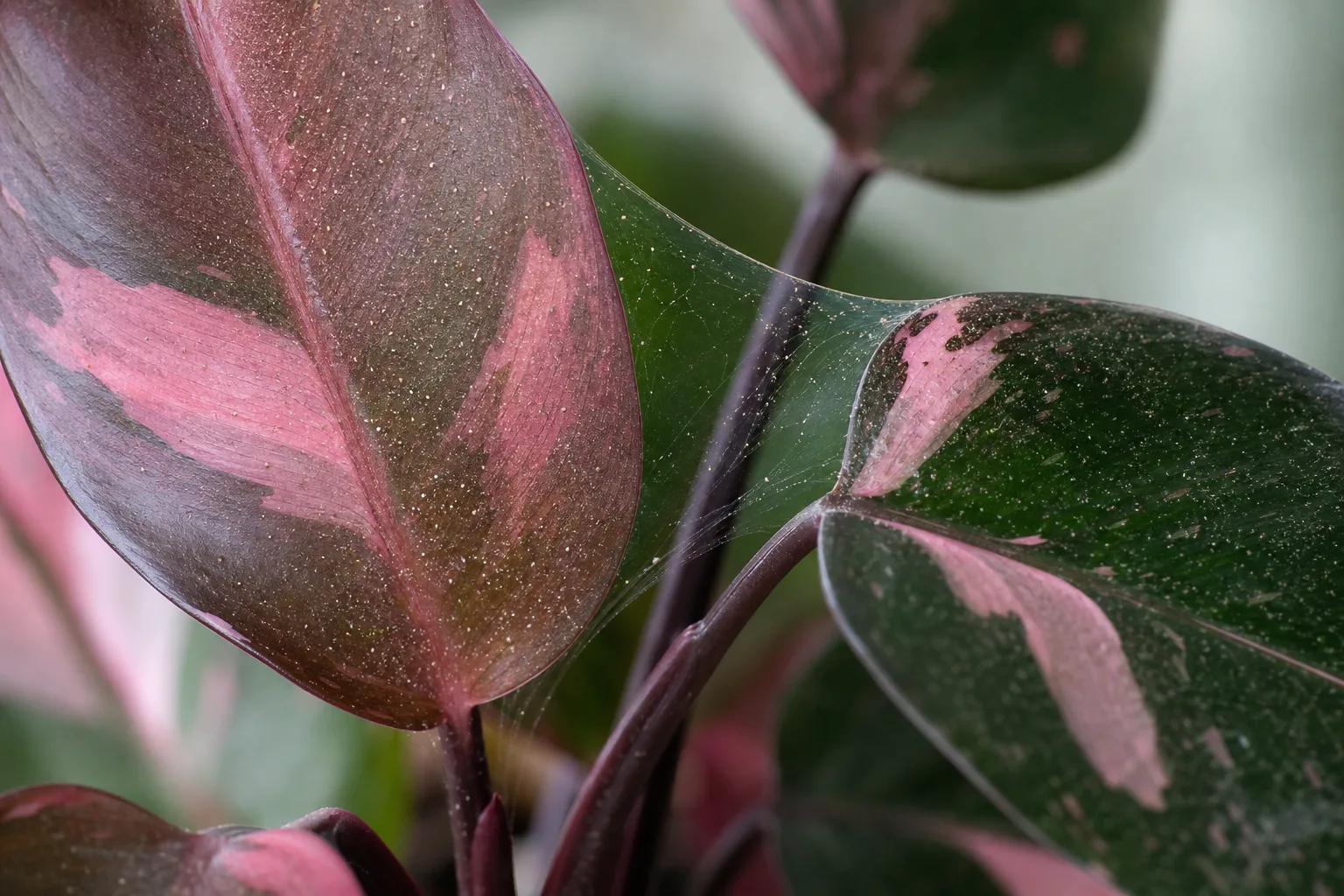
Spider Mites on Philodendron Pink Princess: Causes, Checks & Fixes
This guide covers spider mites on Philodendron Pink Princess. See also the general Spider Mites guide, watering, and light pages for this plant.
Spider Mites on Philodendron Pink Princess: Causes, Checks & Fixes
Quick answer
Spider mites are microscopic sap feeders that thrive in warm, dry indoor air-the same winter conditions that also crisp Pink Princess’s thin pink variegation and send owners searching for a humidity fix. On Philodendron erubescens ‘Pink Princess’, damage usually appears as pale yellow speckles across green leaf tissue, followed by dull bronzing and fine silk webbing tucked into vine nodes and overlapping marbled leaves.
First step: isolate the plant and rinse all leaf undersides with lukewarm water. Pink Princess climbs on moss poles with overlapping heart-shaped foliage-mites hide on undersides and in petiole axils where you rarely look during casual watering. A thorough shower dislodges adults and webbing before you confirm the pest or choose a spray. Do not reach for oil or soap until you have washed and inspected.
Routing check before you treat: If margins crisp without stippling, webbing, or moving specks on a paper tap test, the problem is likely dry air-not mites. Use our low-humidity guide for margin burn and pink-patch crisping. If you see stippling plus webbing plus moving dots, stay on this page. For the full care picture, see the Pink Princess overview.
Spider mites vs. low humidity vs. variegation fade - which guide to use
Pink Princess owners often panic when pale spots appear on marbled leaves. Three different problems can look similar at a glance:
| Pattern | What you see | Tap test / webbing | Guide to use |
|---|---|---|---|
| Spider mites | Random chlorotic flecks on green tissue; dull bronzed cast; silk at nodes | Moving specks on white paper; fine webbing between leaves | This page |
| Low humidity | Brown or tan crisp at margins and pink sectors; no random speckling | No moving dots; no silk threads | Low humidity |
| Normal variegation | Fixed pink, cream, or white marbling from leaf emergence | No movement; no webbing; pattern stable on each leaf | No treatment needed |
| Thrips | Silvery scratch marks; black fecal specks | No dense silk webbing | Inspect neighbors; treat as thrips |
| Pink fade in dim light | Overall paler pink sectors on new growth; no stippling or webbing | Clean tap test | Light guide |
The critical distinction for Pink Princess: variegation is embedded in the leaf pattern from unfurling; mite stippling is random fine dots that spread across green tissue over days and weeks. Low humidity browns edges and pink patches uniformly without the dusty bronzed look mites create on green sectors.
What spider mites look like on Philodendron Pink Princess
Early damage is easy to miss on heavily variegated foliage. The pink, cream, and white marbling is normal; mite feeding creates a separate pattern of tiny chlorotic flecks scattered across green leaf surface. As feeding continues, leaves lose their glossy sheen and take on a dusty, bronzed look. Severely affected marbled leaves may curl at the edges or drop from the lower vine.
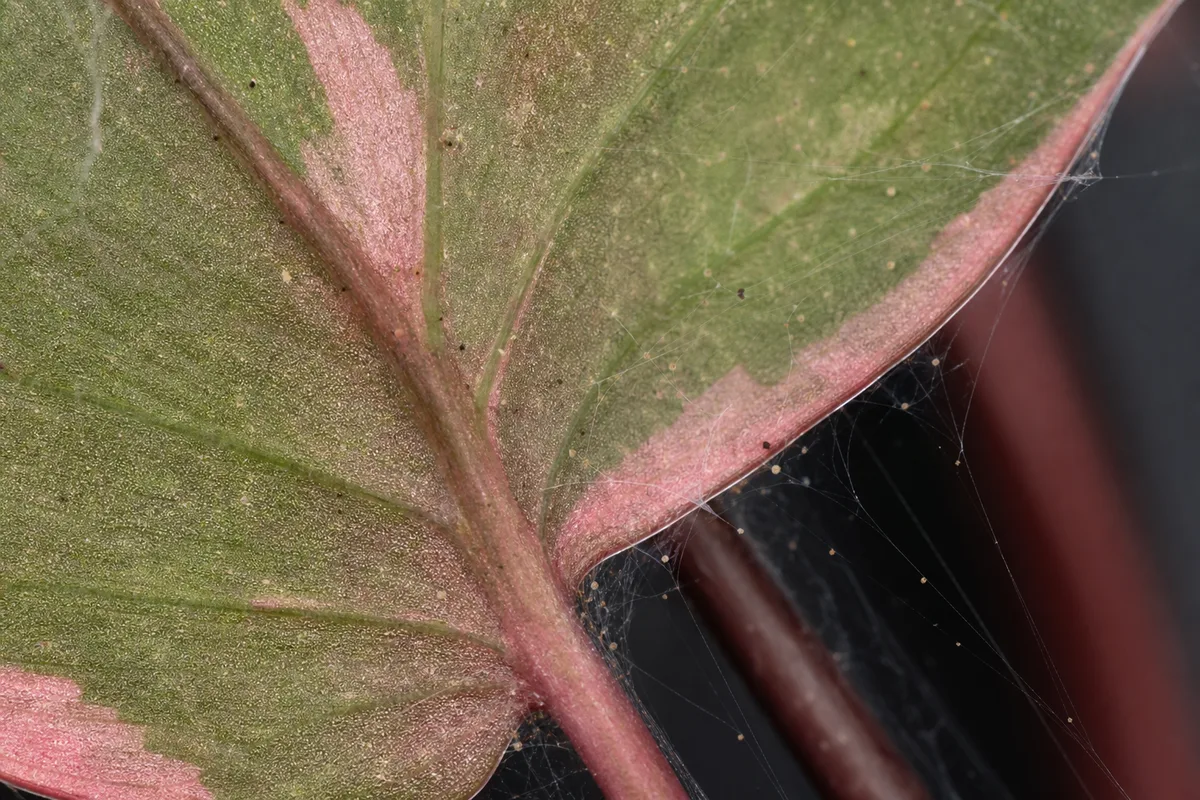
Spider Mites symptoms on Philodendron Pink Princess - compare with healthy tissue on the same plant.
Key signs specific to Pink Princess growth habit:
- Fine stippling on green sections of marbled leaves, often starting on inner or upper foliage near grow lights
- Silk webbing at leaf petiole joints, vine nodes, or between overlapping leaves along the climbing stem
- Dull, grayish cast on leaves that previously looked glossy with sharp pink sectors
- Tiny moving dots on leaf undersides-visible with a hand lens or after tapping foliage over white paper
- New growth distortion-emerging marbled leaves smaller, warped, or with broken variegation patterns
- Leaf drop on an otherwise well-watered plant with no root-rot smell or soggy mix
Pink Princess is slow-growing. A few stippled lower leaves may sit on the vine for weeks before the infestation becomes obvious on newer marbled foliage. Do not confuse normal variegation-fixed pink or cream sectors following the leaf’s marbled pattern-with the random yellow flecking mites cause on green tissue.
Pink variegation vs. mite stippling
| Feature | Pink variegation | Mite stippling |
|---|---|---|
| Location | Flat sectors on the leaf blade from emergence | Random dots across green tissue, often denser near edges |
| Texture | Smooth, glossy, part of leaf tissue | Dusty bronzed cast; tissue looks dull or speckled |
| When disturbed | No movement; pattern stable | Moving specks on tap test; webbing at nodes |
| Progression | Fixed on each leaf from unfurling | Spreads to more leaves over days in dry heat |
| Pink sectors | Normal marbling unchanged | Pink may crisp from dry air separately-check green tissue for flecks |
Why Philodendron Pink Princess gets spider mites
The twospotted spider mite (Tetranychus urticae) is the most common mite on houseplants. It prefers warm, dry environments with low humidity-exactly what many homes provide during winter heating season. Pink Princess evolved in humid tropical rainforest conditions and tolerates indoor life, but although philodendrons prefer moderately humid air, HVAC systems, heat registers, and grow lights routinely push ambient humidity much lower than the 55–70% many collectors target for clean pink edges.
Several Pink Princess–specific factors raise risk:
Vining architecture with overlapping foliage. Pink Princess grows as an upright, vining climber on moss poles-not a compact rosette. Overlapping heart-shaped leaves create sheltered pockets where warm air stagnates and mites establish colonies out of sight. Petiole axils along reddish-purple stems are prime hiding spots, especially where dried leaf sheaths still cling to the vine.
Thin pink variegation and dry microclimates. Pink sectors lack the chlorophyll density of green tissue and lose water faster in dry air. The same winter furnace cycle that browns pink margins also favors mite reproduction. Plants beside radiator registers, above heat vents, or under supplemental grow lights in enclosed cabinets get the worst of both problems.
Bright filtered light placement. Pink Princess needs bright, filtered sunlight to keep variegation crisp per our light guide. Plants on east or south window sills or under grow lights get the exposure they need but also absorb radiant heat during the day. Soil and foliage dry faster near glass and lamps, and mites reproduce more quickly in warm, dry microclimates.
Slow growth masks early damage. Because Pink Princess produces new leaves slowly, a mite colony can build for weeks before stippling spreads across enough foliage to catch your eye. By the time webbing is visible along the vine, populations are often well established.
Philodendron susceptibility. Philodendrons are among the houseplants most prone to spider mite outbreaks in collections. Pink Princess is not immune despite its popularity-NC State extension recommends monitoring philodendrons for spider mites alongside mealybugs, aphids, and scale.
Stressed plants show damage sooner. Pink Princess stressed by underwatering, cold drafts, or dim corners is less resilient. Mites are not caused by poor care alone, but a weakened vine shows stippling faster than a healthy one in the same dry room.
How to confirm the cause
Work through these checks in order before treating:
- Paper tap test - Hold a white sheet under a marbled leaf and tap the leaf sharply. Tiny moving specks that streak when disturbed confirm live mites. Static dust or mineral spots do not move.
- Underside inspection - Lift individual leaves along the vine and check backs with a 10× hand lens. Look for amber eggs, pale cast skins, black fecal specks, and the mites themselves.
- Webbing check - Fine silk threads at leaf-stem joints or spanning between two overlapping leaves point to mites, not normal plant texture.
- Pattern vs. variegation - Normal Pink Princess marbling follows the leaf’s fixed pattern from emergence. Mite stippling is random fine dots across green tissue, often denser near leaf edges.
- Environment check - Is the plant near a heating vent, grow light, space heater, or hot window? Dry warm air strongly supports mite reproduction.
- Neighbor plants - Inspect other philodendrons, pothos, palms, and figs on the same shelf or in the same cabinet. Mites crawl short distances and ride air currents to nearby plants.
- Rule out lookalikes - Thrips leave silvery scars and black specks; mealybugs show white cottony clusters in axils; aphids cluster on soft new flush. Nutrient issues cause more uniform yellowing-see yellow leaves if whole leaves pale without stippling or webbing.
If you find stippling but no mites or webbing yet, treat as a probable early infestation anyway-populations can expand rapidly within days in hot, dry weather.
First fix for Philodendron Pink Princess
Isolate the plant and rinse all foliage with lukewarm water, targeting leaf undersides and stem axils along the entire vine.
Move Pink Princess away from other houseplants immediately. Carry it to a sink or shower and spray leaf undersides with moderate pressure for several minutes. Mites and eggs dislodge with repeated washing, and disrupting webbing delays new egg laying. Let foliage dry in bright indirect light the same day-not in direct hot sun immediately after soaking.
This single step is your diagnostic and mechanical control combined. If the paper tap test showed mites, washing is the correct first response-not neem oil, not repotting, not fertilizer. Pink Princess’s climbing habit means you must angle the spray upward from below to reach inner leaves along the moss pole.
Do not apply horticultural oil or insecticidal soap in the same session as a heavy rinse unless the label allows it. Wash first, let leaves dry, then treat the next day if mites persist.
Pet and oxalate safety during rinse
Philodendron contains calcium oxalate crystals toxic to pets. Sap may cause skin irritation on contact. Wear gloves when handling damaged leaves during repeated rinse sessions, wash hands afterward, and keep the quarantined plant out of reach of cats and dogs until treatment ends.
Step-by-step recovery
Once you have washed and confirmed mites, work in this order:
- Quarantine - Keep Pink Princess separated from the collection for at least three weeks after the last mite sighting. Mites crawl and drift to adjacent plants on shelves and in grow cabinets.
- Repeat washing - Shower foliage every three to five days for two weeks. Consistent physical removal matters more than a single dramatic spray.
- Apply contact treatment - If washing alone is not reducing stippling spread, use insecticidal soap or horticultural oil labeled for spider mites on houseplants. Coat both leaf surfaces and stem joints thoroughly. Repeat at seven- to ten-day intervals for at least three cycles-eggs survive the first application.
- Treat the collection - If mites appeared on Pink Princess, inspect and treat all susceptible houseplants in the same room or cabinet at the same time. Isolated treatment on one pot often fails when neighbors still harbor mites.
- Prune only heavily infested leaves - Remove leaves coated in webbing and bronze damage to lower pest load and improve spray coverage. Sterilize scissors between cuts. Bag and discard pruned tissue.
- Raise humidity moderately - Move Pink Princess away from heat vents and grow-light hot spots. Many collectors target 55–70% for clean pink edges-a cultivar-community practice above the moderately humid air extension baseline. Higher humidity slows mite reproduction but does not replace washing and sprays.
- Hold fertilizer - Skip feeding until new marbled growth emerges clean for two weeks. See our fertilizer guide for when to resume after pest stress.
If more than half the foliage is webbed and bronzed with active mites after two treatment rounds, consider discarding the plant in a sealed bag rather than risking your full collection-especially before bringing summer plants back indoors.
Recovery timeline
Pink Princess’s slow growth means visible recovery takes patience. Expect:
- Days 1–7: Stippling stops spreading after consistent washing; live mites decrease on paper tap tests
- Weeks 2–3: No new webbing; soap or oil cycles cover hatching eggs
- Weeks 3–6: First new marbled leaf opens without stippling-your best recovery signal
- Months 2–3: Enough clean new foliage to offset older damaged leaves you chose to keep
Damaged marbled leaves do not heal. Stippled tissue stays marked even after mites are gone. Judge success by new growth quality and absence of fresh speckling, not by old leaves re-greening.
Lookalike symptoms
Normal variegation: Fixed pink, cream, or white marbling on each leaf from the moment it unfurls. No webbing, no moving dots, no progressive bronzing across green tissue.
Low humidity alone: Brown or tan crispy margins and pink-sector burn without stippling or webbing. Birkin-style tip burn pattern on Pink Princess-see low-humidity and brown tips guides. Lacks the speckled flecking mites create on green tissue.
Thrips: Silvery scratch marks and black fecal specks on leaves; no dense silk webbing. Thrips also scar Pink Princess foliage but leave a different texture.
Mealybugs: White cottony masses in leaf axils and along the vine-not stippling. Often accompanied by sticky honeydew. See our mealybugs guide.
Overwatering: Yellow limp leaves with wet heavy soil and possible fungus gnats-not dry-environment stippling with silk threads. See overwatering if mix stays soggy.
Pink fade in low light: Paler pink sectors on new growth without stippling, webbing, or moving specks. Fix placement per our light guide before treating for mites.
Mistakes to avoid
- Spraying only the tops of marbled leaves - Mites cluster on undersides and in axils. Pink Princess’s overlapping vine foliage requires you to lift leaves and spray from below.
- Stopping after one treatment - Eggs hatch on a cycle. One soap application leaves the next generation untouched.
- Treating only Pink Princess when neighbors are infested - Mites re-colonize from adjacent pots within days in shared cabinets and shelves.
- Applying oil in direct hot grow-light sun - Leaf burn on pink variegated tissue can cause permanent marbling damage. Treat in early morning or evening after washing, away from intense supplemental light.
- Confusing variegation with stippling - Treating a healthy marbled plant wastes effort and stresses clean foliage.
- Repotting or fertilizing during active infestation - Extra stress on a pest-weakened Pink Princess slows recovery. Fix the mites first.
- Ignoring the dry air source - A plant returned to the same heating vent or unhumidified grow cabinet will likely get mites again next winter.
- Using only a humidifier without washing - Higher humidity slows reproduction but does not clear an active colony. Mechanical removal and contact sprays remain essential.
Pink Princess care cross-check while treating
While treating mites, keep baseline care steady-do not stack multiple changes:
- Light: Bright filtered light per our light guide. Too dim slows recovery; direct hot sun worsens leaf stress during treatment.
- Water: When the top 3–5 cm of mix is dry per our watering guide. Mites favor dry air, but underwatering still weakens Pink Princess. Avoid soggy soil, which invites different problems.
- Humidity: Target 55–70% if you run a humidifier for variegation health-a collector practice above RHS moderate-humidity guidance. A humidifier near the quarantine zone helps more than misting leaves daily.
- Temperature: Stable 18–26°C (65–79°F). Cold drafts and heat blasts both stress recovering foliage.
- Handling: Wear gloves; keep the plant out of pet reach during repeated rinse and spray sessions.
How to prevent spider mites next time
Scout Pink Princess weekly during dry months. Check leaf undersides and inner vine leaves with a hand lens-five minutes catches colonies before webbing spreads along the moss pole.
Rinse foliage monthly in the sink during heating season. Dust on glossy marbled leaves interferes with natural mite predators and signals dry conditions mites prefer.
Quarantine new plants for two weeks before placing them beside Pink Princess. Mites often hitch home on recently purchased specimens-especially popular variegated philodendrons in mixed nursery displays.
Keep humidity steady with a humidifier rather than relying on mist alone. Moderate humidity slows mite reproduction without creating the fungal conditions that heavy misting on overlapping vine foliage can encourage.
Avoid crowding plants on shelves and in grow cabinets. Leave space for airflow and easy underside inspection along climbing stems.
When moving patio plants indoors in fall, inspect and wash them before they join Pink Princess in the same room. Outdoor summer plants often carry mite eggs into dry winter interiors.
Position grow lights so they supplement brightness without baking foliage in a sealed cabinet. The dry microclimate beside a lamp without humidification is one of the most common Pink Princess mite triggers collectors report.
When to worry
Treat spider mites as urgent when:
- Webbing spans multiple marbled leaves or encircles vine nodes
- New variegated growth emerges distorted, stunted, or heavily stippled
- Leaves drop from an evenly watered plant with firm roots
- Paper tap tests still show mites after two full treatment cycles
- Mites appear on several plants in the same display or cabinet
Pink Princess may not be worth saving if most foliage is bronzed and webbed, the vine is bare along the moss pole, and repeated treatments fail after four weeks. In shared collections with other collector philodendrons, a heavily infested plant risks the rest of your pots. Bag and discard rather than prolonging a reservoir of mites.
Related Pink Princess guides
- Pink Princess overview - full care hub
- Watering - dry-down rhythm during recovery
- Light - bright filtered placement for variegation
- Low humidity - margin crisp without mites
- Brown tips - dry-air edge burn lookalike
- Yellow leaves - uniform yellowing without stippling
- Mealybugs - cottony axil clusters
- Aphids - soft new flush clusters
Conclusion
Spider mites on Philodendron Pink Princess are a dry-air pest problem-not a mystery disease and not the same as normal pink variegation or margin crisp from low humidity alone. The climbing vine hides colonies in leaf axils and overlapping marbled foliage until stippling and webbing spread along the stem. Catch them early with underside checks and paper tap tests, isolate immediately, and wash foliage before reaching for sprays.
Routing summary: stippling plus webbing plus moving specks means mites-treat here. Margin crisp without specks or webbing means dry air-see low-humidity. Fixed marbling from unfurling means normal variegation-no pest treatment needed.
Recovery is measured in clean new marbled leaves-not repaired old ones. Keep humidity steady, scout weekly through winter, and Pink Princess’s signature pink splashes stay sharp season after season. For the full care cluster, start with the overview guide.
Related tool
Use the Pest Identifier Tool to narrow causes for spider mites on this plant before changing multiple variables at once.