Fungus Gnats on Ponytail Palm: Causes, Checks & Fixes
Quick answer
Fungus gnats on Ponytail Palm mean soil has stayed too wet too long - larvae breed in moist organic mix while adults are mostly a nuisance. First step: let the top 1–2 inches dry completely before you water again, then set yellow sticky traps at soil level.
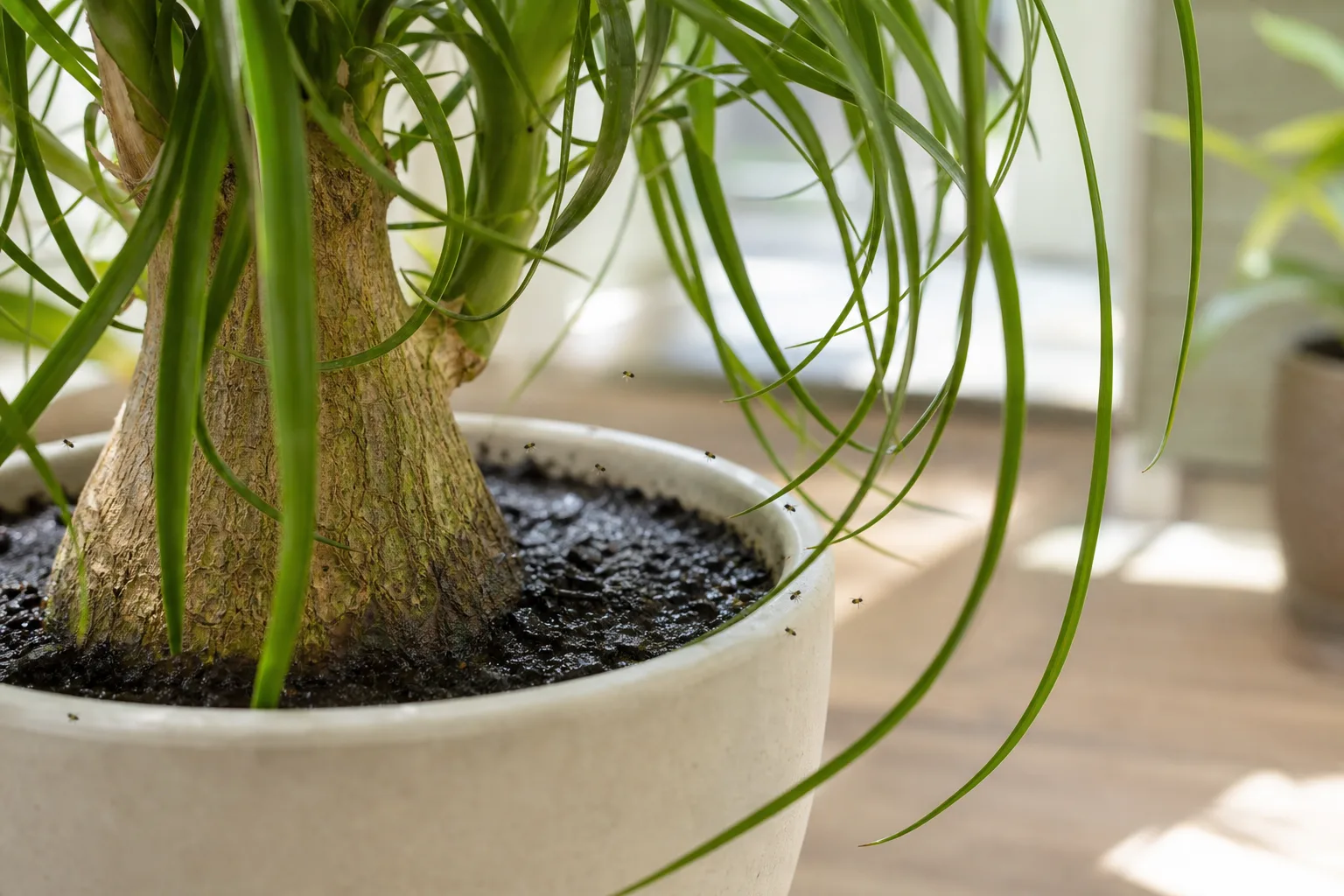
Fungus Gnats on Ponytail Palm: Causes, Checks & Fixes
This guide covers fungus gnats on Ponytail Palm. See also the general Fungus Gnats guide, watering, and light pages for this plant.
Fungus Gnats on Ponytail Palm: Causes, Checks & Fixes
Quick answer
Fungus gnats on Ponytail Palm are a moisture alarm, not a harmless fly problem. Adults are a nuisance; larvae in the top of the mix feed on fungi, organic debris, and root hairs on plants sitting in wet culture. On Beaucarnea recurvata - a drought-tolerant caudiciform that needs soil to dry between waterings - that hidden feeding stacks onto the real danger: soil that stays wet long enough to rot roots and soften the caudex.
First step: let the top 1–2 inches of mix dry completely before you water again. Do not reach for sprays, traps, or drenches while the surface is still damp. Once the upper layer is dry, set yellow sticky traps for adults and apply a Bacillus thuringiensis israelensis (Bti) soil drench only if larvae persist. For the full dry-down protocol on this species, see the Ponytail Palm watering guide.
Ponytail Palm evolved for bright light and sharp drainage in semi-arid Mexico. Gnats appear when care treats it like a tropical foliage plant that wants constantly moist peat - a common trap because the swollen caudex still looks firm while the surface mix stays wet.
What fungus gnats look like on Ponytail Palm
Adults - About 1/8 inch long, dark, mosquito-like flies with long legs. They run across the soil surface, fly up when you water or bump the pot, and collect on nearby windows. They do not bite or feed on people.
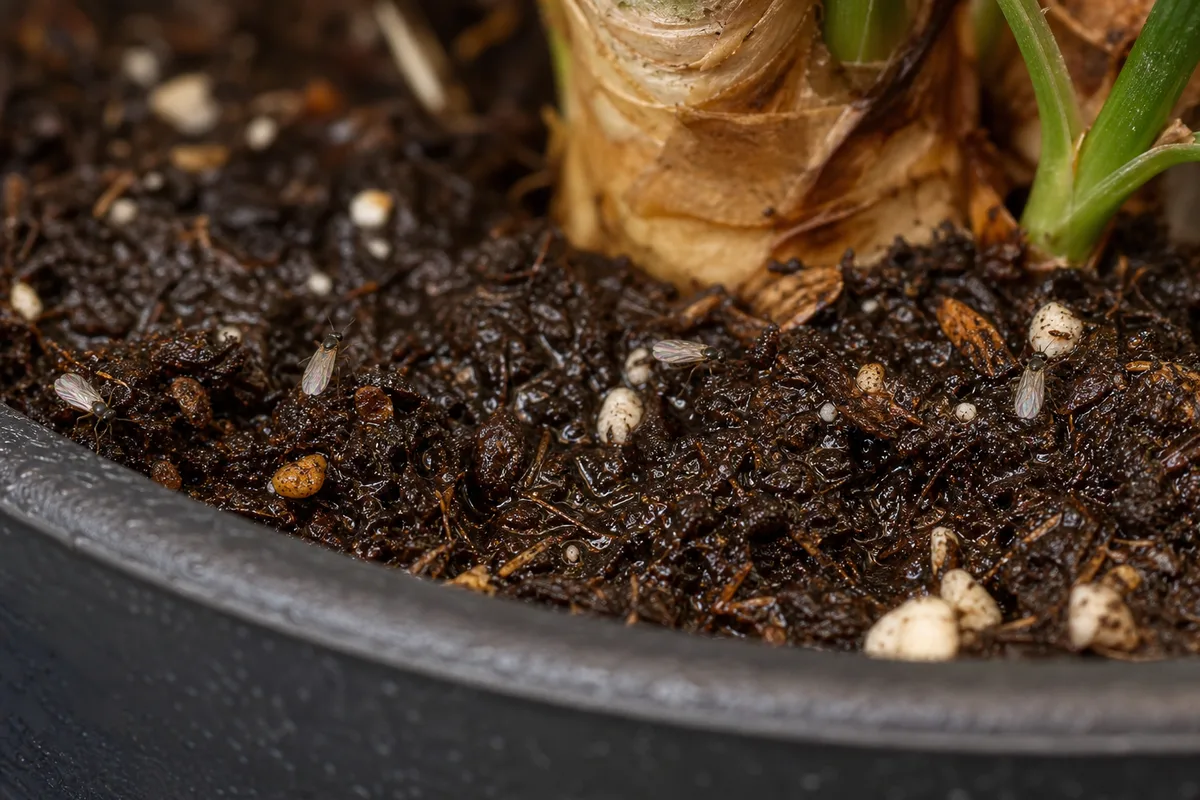
Fungus Gnats symptoms on Ponytail Palm - compare with healthy tissue on the same plant.
On the plant itself - A Ponytail Palm may show no obvious strap-leaf damage while larvae work in the top of the mix. Watch the pot rim, caudex base, and soil surface, not only the cascading leaves:
- Flies rise every time you water or tap the pot indoors.
- Soil surface stays dark and damp for many days after one watering.
- Fine translucent larvae with dark heads in the top 2–3 inches of mix (a magnifying glass helps).
- Potato test: a raw slice pressed on the surface for 48 hours may show chewed tissue - larvae confirmed in that pot (Colorado State Extension).
- Yellow sticky traps catch dozens of adults near the soil line beside the caudex.
- The pot feels heavy and cool when lifted, even though strap leaves still look green.
Caudex clues tied to wet soil - Gnats do not soften the caudex directly, but their presence often coincides with yellowing lower straps, a sour smell from the drain hole, or decorative moss trapping moisture against the base. A firm caudex on dry gritty mix with a few gnats may mean a recent overwater event or an infested neighbor pot - not active rot yet.
Because Beaucarnea recurvata stores water in its caudex, owners often underestimate drought tolerance and keep watering while the caudex still looks plump - exactly when larvae multiply in wet peat below.
Not gnats - lookalikes to rule out
| Pest or symptom | What you see | Tied to one pot? | Next step |
|---|---|---|---|
| Fruit flies | Hover near kitchen produce, not consistently one plant | No | Remove ripening fruit; cover a suspect pot overnight - gnats under mesh confirm soil breeding |
| Drain flies | Weak fliers near sinks or floor drains | No | Treat the drain if flies persist after Ponytail soil dries |
| Shore flies | Stockier than fungus gnats; often in greenhouses on algae | Sometimes | Scrape green algae from pot rim; dry the surface |
| Whiteflies | Tiny white insects on leaf undersides, not rising from soil | Yes, on foliage | Check strap bases; see pest guides if leaves cloud with insects |
| Surface mold | White or gray fuzz on wet peat, no flying insects | Yes | Scrape and dry - see mold on soil when fuzz is the main symptom |
| Root rot without gnats | Soft caudex, sour smell, wet heavy pot | Yes | Skip fly treatment; follow root rot protocol |
If flies appear only when you disturb one Ponytail pot and the surface mix stays damp, fungus gnats fit better than fruit flies or drain pests.
Why Ponytail Palm gets fungus gnats
Fungus gnat larvae need consistently moist, organic-rich surface mix to complete their life cycle. Ponytail Palm pots become perfect habitat when:
Overwatering on a drought-tolerant schedule - Beaucarnea recurvata wants soil to dry between waterings and tolerates long dry intervals thanks to its water-storing caudex. Watering on a calendar - especially in fall and winter when growth slows - keeps the surface wet while the swollen base still looks healthy. That is exactly when larval root-hair feeding matters because new roots form slowly on this species.
The “succulent” marketing trap - Ponytail Palm is sold beside cacti and labeled easy-care, which leads owners to assume it needs frequent drinks. In reality it is a caudiciform adapted to semi-arid conditions - wet surface culture is a care mismatch, not a species requirement. Gnats are telling you the root zone environment is wrong.
Heavy peat-rich houseplant mix - Standard potting soil holds moisture at the surface where most larvae live. Ponytail Palm needs fast-draining cactus mix with mineral grit per the soil guide; dense organic media stays damp in dim winter rooms.
Poor drainage habits - Saucers holding runoff, cachepots without holes, oversized pots that dry slowly, or decorative moss toppers extend the moist window gnats need. A heavy plastic pot on a cool floor can look dry on top while the center stays wet - lift the pot to judge weight, not only surface color.
Decaying organic matter - Old roots, broken-down peat, or fallen leaf debris on the soil surface feeds larvae even when you think you are watering lightly.
Introduction from new plants - Nursery pots with wet organic media can carry eggs. Gnats spread across a collection sharing the same bench or windowsill.
Seasonal indoor spike - As day length shortens and room temperatures cool, plants use less water. If watering habits do not change, growing medium stays moist and fungus gnat populations rise - a pattern that hits slow-growing Ponytail Palms hard because you may not notice stress until lower straps yellow.
How to confirm the cause
Work through checks in order so you separate gnats from rot, drought, and other pests:
- Disturbance test - Tap the pot rim. Gnats flying from the soil surface confirm breeding in that container.
- Moisture at depth - Push your finger 2–3 inches deep or lift the pot. Heavy, cool, wet mix with gnats confirms chronic overwatering habitat. Compare against your dry-down watering checks.
- Caudex firmness - Press the swollen base above the soil line. Firm = stress may still be reversible. Soft or spongy = prioritize root rot protocol; gnats are secondary.
- Soil smell - Neutral or earthy is normal. Sour or rotten odor on wet mix escalates beyond a gnat-only fix.
- Larva check - Scrape the top inch of mix onto white paper or press a raw potato slice on the surface for 48 hours. Translucent larvae with dark heads, or chewed potato tissue, confirm active breeding.
- Trap count - Rising adults on yellow traps week after week means active breeding, not a one-time hitchhiker.
- Season and light - Cool months with minimal new growth and dim placement match most indoor Ponytail gnat outbreaks tied to unchanged watering. Cross-check light needs if the pot dries too slowly.
Confirmed diagnosis - Gnats plus wet surface mix plus larvae (or repeated adult emergence from the same pot). Suspected - A few adults on dry gritty mix in bright active growth may be incidental; still audit watering before dismissing.
First fix for Ponytail Palm
Let the top 1–2 inches of mix dry completely before you water again - and hold off entirely if the pot still feels heavy and cool throughout. Colorado State Extension notes that allowing the growing medium to dry between watering, especially the top layer, is the most important fungus gnat strategy. On drought-tolerant Ponytail Palm, that dry-down also protects the caudex from the rot that overwatering invites.
After the surface is dry:
- Set yellow sticky traps at soil level beside the caudex base to catch egg-laying adults and track whether numbers fall over two weeks.
- If adults persist and you confirmed larvae, apply a Bti (H-14 strain) drench labeled for fungus gnats - soak the top of the mix where larvae feed. Repeat on a 5–7 day schedule because Bti targets feeding larvae, not eggs or adults.
- Empty saucers and move the pot off any standing water.
- Remove decorative moss or wet top dressings that keep the caudex sitting on damp organic matter.
Do not repot, prune living straps, or fertilize the same week you change watering - that stacks stress on a slow-growing caudiciform already fighting wet soil.
Step-by-step recovery
- Isolate the affected pot from other houseplants for two to three weeks.
- Adjust watering so the top 1–2 inches dry before the next drink; in cool months, extend dry intervals further because uptake slows. Follow weight and probe checks in the watering guide.
- Trap adults with yellow sticky cards at soil level; replace when coated.
- Bti drench only if larvae are confirmed or traps stay full after dry-down - follow product dilution for soil soak and repeat every 5–7 days until trap counts fall.
- Remove debris - Pull fallen strap segments and decaying surface peat so larvae lose a food source.
- Grit top layer - Replace the top inch with coarse sand or fine gravel if peat stays soggy, keeping the caudex off wet organic matter per NYBG grit top-dressing guidance.
- Resume normal watering only when the pot dries predictably: deep drink when mix is fully dry during active growth; lighter intervals in winter.
- Repot into grittier cactus mix only if infestation continues on chronically wet peat, drainage is blocked, or mix has broken down - otherwise dry-down plus Bti is enough. See repotting and soil when media failure is the root cause.
Recovery timeline
Expect 2–6 weeks for adult numbers to fall once the surface stays dry and traps are in place - fungus gnats reproduce in overlapping generations, so patience matters.
Ponytail Palm tissue recovery is slower than gnat suppression. New strap leaves may take several weeks to months to show whether roots are healthy again, because Beaucarnea recurvata is inherently slow-growing. Judge success by:
- Fewer adults on traps each week.
- Surface mix drying within a few days after watering.
- Firm caudex base that refills slightly after a proper drink.
- New straps opening without widespread yellowing.
Lower straps that yellowed from wet soil will not green up again - remove them only after the plant stabilizes. A slightly less plump but firm caudex after dry-down is normal; spongy tissue that worsens despite dry soil means rot has advanced beyond what gnat control alone can fix.
Signs you are winning - Trap catches drop weekly, no flies when you water, potato test shows no new larval feeding, pot weight drops predictably between drinks.
Signs the problem is deepening - Caudex softens, soil smells sour, yellowing climbs up the strap cascade, or gnat numbers rise despite a dry-looking surface (check hidden saucer water, moss toppers, or degraded center peat).
What not to do
- Spraying flying adults only while the soil surface stays wet - larvae keep hatching in the mix.
- Watering on the same schedule through winter when the plant uses far less moisture.
- Misting strap leaves or keeping saucers full while trying to dry soil for gnat control.
- Repotting immediately into fresh peat-heavy mix - can re-wet the root zone and carry eggs into new media.
- Fertilizing to “fix” yellow straps before correcting moisture - can burn stressed roots.
- Ignoring a soft caudex because the flies are gone - rot may already be established; see overwatering and root rot.
- Covering wet soil with decorative stones that trap moisture instead of replacing the top layer with grit.
How to prevent fungus gnats on Ponytail Palm
- Water by dryness, not calendar - Probe deep and lift the pot; light weight confirms it is time to drink per the watering guide.
- Use well-aerated cactus mix with mineral grit that dries at the surface within a few days after watering - see the soil guide.
- Quarantine new Ponytails for two to three weeks with a sticky trap before placing near other plants.
- Keep yellow traps on winter collections to catch early adult emergence.
- Refresh mix when peat breaks down and starts holding moisture at the surface.
- Bright sun speeds evaporation - weak light in a heavy pot is a common gnat setup; review light placement.
- Skip moss toppers or replace them with dry grit that does not wick moisture against the caudex.
When to worry
Escalate beyond basic dry-down and Bti if:
- The caudex base is soft or smells sour from the drain hole.
- Lower straps yellow in a spreading wave while soil stays damp.
- Gnat numbers rise weekly despite dry surface soil - check for a hidden water source (saucer, cachepot, degraded mix, moss topper).
- The plant sits in dim light with heavy mix - correct placement and substrate, not more pesticides.
- Gnats persist alongside white fuzzy mold on wet peat - treat moisture for both; use the mold on soil guide when surface fungus is the primary visible symptom.
Ponytail Palm can survive minor larval feeding when moisture is corrected quickly. It cannot survive chronic wet roots - treat fungus gnats as an early warning to dry the mix before rot sets in.
Gnats vs. mold on soil - which guide to use
Both problems usually mean the surface stayed wet too long on a drought-adapted Ponytail Palm. Choose your entry point by what you see first:
- Flying insects rising from the pot when you water → you are in the right place. Focus on dry-down, traps, and larval control.
- White or gray fuzzy growth on wet peat with few or no flies → start with mold on soil for scrape-and-dry steps; return here if adults appear after mold clears.
- Soft caudex or sour smell regardless of flies → prioritize root rot and overwatering - moisture damage has likely moved past a surface pest issue.
Many Ponytail pots show gnats and mold together on the same wet peat. Fix the culture once: dry the mix, improve drainage, and both symptoms usually fade within weeks.
Ponytail Palm care cross-check
Gnats usually mean one or more baseline conditions are off:
| Checkpoint | Target for Ponytail Palm |
|---|---|
| Light | Bright sun to full sun indoors - weak light slows drying |
| Mix | Fast-draining cactus blend with grit, not heavy peat |
| Watering | Fully dry between drinks; see watering guide |
| Drainage | Holes open, saucers emptied within 15 minutes |
| Pot size | Relatively small pots with excellent drainage |
| Season | Reduce frequency in cool months when growth pauses |
| Toppers | No decorative moss trapping moisture on the caudex |
If gnats persist on dry gritty mix in good light, inspect neighboring pots - they may be the breeding source.
Pet safety during treatment
The ASPCA lists Beaucarnea recurvata as non-toxic to cats, dogs, and horses. That addresses the plant itself - not pesticide products. Keep pets away from yellow sticky traps, Bti-treated soil, and freshly drenched mix until the surface dries. Contact your veterinarian if a pet shows persistent illness after eating plant material or licking wet treatment residue.
Conclusion
Fungus gnats on Ponytail Palm are a moisture warning on a plant built for dry intervals. Dry the top of the mix first, trap adults, and use Bti only when larvae persist - then fix the watering and soil habits that kept the surface wet. Judge recovery by falling trap counts and a firm caudex, not by whether every adult disappears overnight.
Related Ponytail Palm problems
- Ponytail palm overview - full care hub and caudex biology
- Watering guide - dry-down checks and winter interval shifts
- Soil guide - gritty cactus mix for fast surface drying
- Light guide - bright sun placement that speeds evaporation
- Mold on soil - wet-surface lookalike when fuzz is the main symptom
- Overwatering - wet-mix culture that breeds gnats
- Root rot - soft caudex escalation when moisture damage advances
- Wilting - strap droop when roots fail on wet mix
Related tool
Use the Plant Problem Diagnosis Tool to narrow causes for fungus gnats on this plant before changing multiple variables at once.