Slow Growth on Ponytail Palm: Causes, Checks & Fixes
Quick answer
Slow growth on Ponytail Palm is often normal - this species grows very slowly indoors. Worry when no new crown leaves appear for a full warm growing season while light is dim, soil stays wet, or the caudex softens.

Slow Growth on Ponytail Palm: Causes, Checks & Fixes
This guide covers slow growth on Ponytail Palm. See also the general Slow Growth guide, watering, and light pages for this plant.
Slow Growth on Ponytail Palm: Causes, Checks & Fixes
Quick answer
Slow growth on Ponytail Palm (Beaucarnea recurvata) is often completely normal. NC State lists a slow growth rate for this species, and Missouri Botanical Garden notes houseplants eventually reach 6–8 feet tall over many years - not many inches per season.
This page owns pace and health baselines: how many crown strap leaves to expect per year, seasonal dormancy, caudex firmness as a health signal, and pot-size effects on speed. It does not replace the not enough light guide for window-placement audits or the leggy growth guide for visible trunk stretch.
First step before changing water, fertilizer, or pot size: confirm light is adequate. Move to your brightest south or west window if the crown gets little direct sun. A firm caudex with one or two new straps per year in bright placement is healthy slow growth - not a care failure.
If slow growth pairs with persistently wet soil and a softening caudex, treat that as urgent crossover toward overwatering or root rot - not patience.
Is slow growth normal for Ponytail Palm?
Yes - for most indoor owners, glacial pace is the species default. Beaucarnea is a very slow-growing evergreen adapted to arid Mexican hillsides where the swollen caudex stores water and new strap leaves emerge sparingly from the crown. Wisconsin Extension notes that in containers, ponytail palms grow slower than in the ground and remain small if kept in a small pot - by design, not always by mistake.
Healthy slow pace indoors (what to expect by season)
Use crown strap leaf frequency, not trunk height, as your best growth gauge. Beaucarnea does not add woody height quickly indoors; it adds occasional fountain straps from the crown tuft.
| Season | Normal indoor pattern | When to investigate |
|---|---|---|
| Late spring–summer (warm, brighter) | Zero to two new strap leaves at crown; caudex stays firm | Zero new tips through all of spring and summer in a bright window |
| Fall | Growth slows; may add one late strap or none | Yellowing or soft caudex while soil stays wet |
| Winter (cool, short days) | Little or no visible crown growth | Mistaking dormancy for pathology - recheck in March |
| After repot | Pause 4–12 weeks while roots settle | Stall plus sour wet mix months later - rot risk |
NYBG notes that under optimal indoor conditions, specimens can take decades to reach six to eight feet. Comparing your desk plant to a fast pothos will always feel disappointing - that contrast is biology, not neglect.
Offset pups at the caudex base are another growth signal. A mature Beaucarnea that produces small side shoots is metabolically active even when the main crown looks unchanged for months.
When slow growth is actually a problem
Treat growth as abnormally stalled when all of these apply during the warm growing season:
- No new crown strap leaves for 12+ months despite bright placement
- Soil stays damp for weeks between waterings in a dim room (dim-light metabolism crossover - see not enough light)
- Caudex loses firmness, base tissue softens, or lower straps yellow while mix is wet
- You recently moved to a much larger pot and growth stopped entirely
Cosmetic slow pace alone - firm caudex, stable green straps, occasional new tip in summer - is low urgency.
What problem slow growth looks like on Ponytail Palm
Firm caudex with occasional crown strap leaves (normal)
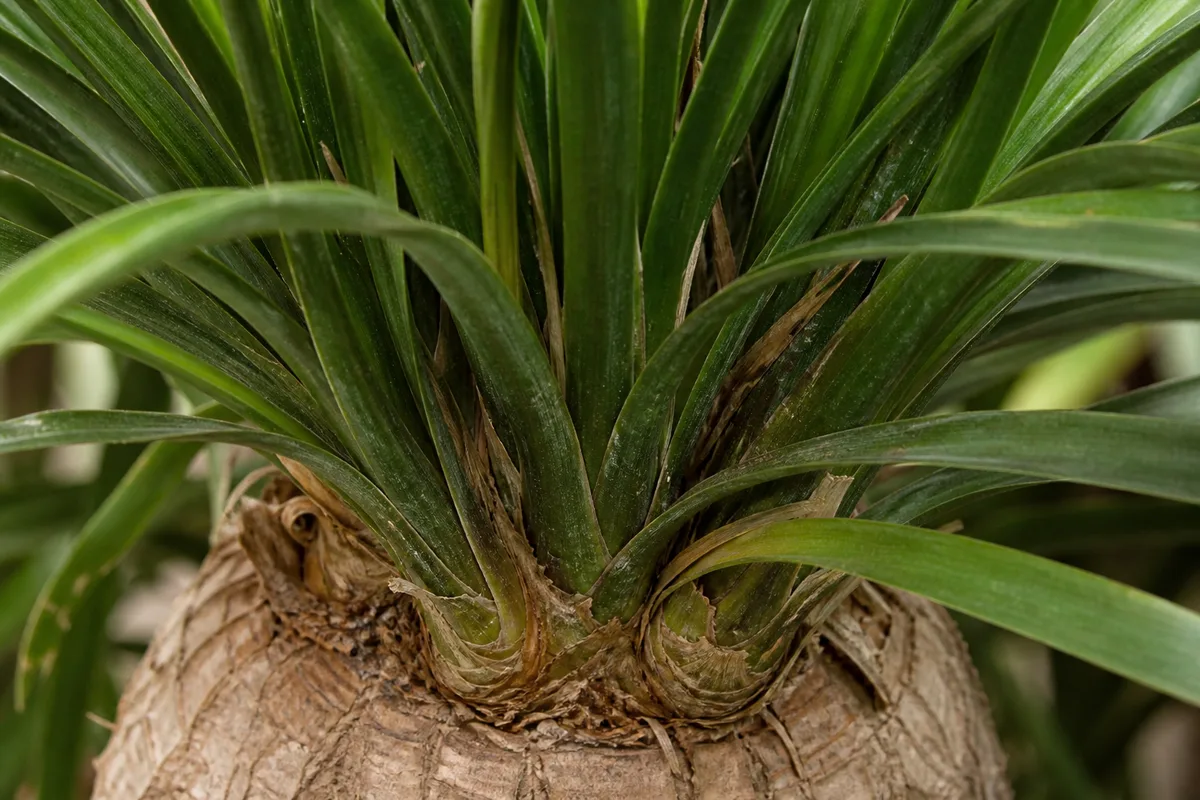
Slow Growth symptoms on Ponytail Palm - compare with healthy tissue on the same plant.
- Swollen base feels hard when gently pressed
- One or two new cascading straps per year in bright sun
- Existing leaves stay green; crown shape unchanged (not leaning or stretching)
- Pot dries on a predictable rhythm per your watering guide
This is the healthy slow pattern this page celebrates. The caudex stores drought reserves - sparse crown output with a firm base can still be thriving.
No new crown tips through warm spring (abnormal)
- Entire April–August passes with zero new straps at the crown tuft
- Plant sits in a north-facing room or far from glass
- Mix takes three or more weeks to dry after each watering
- Owner recently increased watering or fertilizer hoping to force speed
Light limitation is the most common fixable cause. Start the Ponytail Palm light guide before repotting.
Pale stretched crown (see not-enough-light / leggy-growth)
If the trunk elongates between tufts, the crown leans hard toward the window, or new straps emerge pale and widely spaced, you are past simple slow growth. Route to not enough light for placement audits or leggy growth when bare trunk stretch is already structural.
Slow but compact ≠ slow and stretching. Shape tells you which URL to use.
Wet soil and soft caudex (rot crossover)
Chronic overwatering - especially in dim corners - reduces root function and raises root rot risk on poorly drained soils. The plant stops adding crown leaves because damaged roots cannot support new tissue. Soft or spongy caudex tissue, sour-smelling mix, and limp yellow straps belong on overwatering and root rot workflows, not on a patience timeline.
Slow growth vs. leggy growth vs. not enough light
These three ponytail pages overlap but serve different jobs:
| Question you have | Start here |
|---|---|
| ”Is my growth pace normal? How many leaves per year?” | This page - seasonal benchmarks, caudex health, pot effects |
| ”Is my window bright enough? Soil stays wet; leaves look pale” | Not enough light - placement audit and early stress |
| ”My trunk is long and bare between leaf tufts” | Leggy growth - etiolation morphology |
Survival in dim light ≠ healthy slow growth. Beaucarnea can hold green leaves for years while metabolizing slowly. That is still a stall relative to species potential - but it is not the same as the compact slow pace you get in a sunny window with dry intervals.
Why Ponytail Palm grows slowly
Arid-adapted caudex biology
The elephant-foot base evolved to store water through long dry seasons. Crown strap leaves are expensive to produce; the plant adds them conservatively. UF/IFAS classifies Beaucarnea as full sun to partial shade with sharp drainage - indoor dimness and wet mix both suppress the pace further.
Winter dormancy slowdown
NC State recommends greatly reduced winter water because heated indoor air is tolerated but growth stalls in cool short-day months. Zero crown output December–February is common even on well-cared specimens. Resume auditing in late March if spring sun returns and still no tips appear by June.
Light as primary limiter indoors
This species wants full sun at the crown. Wisconsin Extension advises giving indoor plants as much light as possible. A ponytail on an interior shelf may survive but add crown leaves only once every few years - that is a light stall masquerading as species slowness.
Pot too large (wet soil stall)
Upsizing to a huge container is a common beginner mistake. Excess mix stays wet around a slow-drinking caudex, roots suffocate, and crown growth pauses for a season or more. Match pot to root ball - see the repotting guide for one-size-larger timing.
Root-bound vs. intentionally small pot
Wisconsin Extension notes plants remain small in small pots for many years - that can be intentional bonsai-style culture. True root-bound stall shows water rushing through instantly, roots circling heavily, and no new growth despite excellent light. Repot into one size up in spring only when those signs align.
Repot shock pause
Fresh repotting disturbs roots. Expect 4–12 weeks of crown pause while the plant settles - normal, not pathology. If growth does not resume after a full warm season in the new pot, revisit light and moisture before repotting again.
Cold window-sill slowdown
Drafty glass in winter drops leaf temperature and metabolism. A plant that grew in summer may sit idle beside a cold pane until warmth returns - distinguish from rot by firm caudex and appropriate dry-down.
Lookalike symptoms to rule out
| Pattern | More likely slow growth / dormancy | More likely different problem |
|---|---|---|
| Firm caudex, green straps, zero winter tips | Normal dormancy | - |
| One new strap every summer, compact shape | Healthy slow pace | - |
| Bare trunk elongating between tufts | Unlikely alone | Leggy growth |
| Pale new straps, crown leans to window | Light stall - fix placement | Not enough light |
| Soft caudex, sour wet mix | - | Root rot |
| Water runs through instantly, roots dense | Root-bound repot candidate | Repotting guide |
| Sudden limp straps after dry spell | - | Underwatering or wilting |
How to confirm the cause (inspection checklist)
Work through this eight-step audit before repotting, fertilizing, or upsizing:
- Season check - Are you judging growth during winter dormancy? Wait until late spring before calling a stall.
- Crown strap count - How many new straps appeared last summer? Zero in bright sun is abnormal; zero in winter is normal.
- Caudex firmness - Press the base gently. Hard tissue supports patience; soft tissue demands moisture investigation.
- Light at crown - South or west glass with several hours of direct sun on the tuft? If not, light is the limiter - see light guide.
- Dry-down rhythm - Does mix dry within two to four weeks in warm months? Persistently damp soil in dim rooms raises rot risk.
- Pot size vs. root mass - Oversized pot with wet center? Or roots circling and water channeling through?
- Recent repot - Pause within 12 weeks of repot is expected recovery behavior.
- Cross-check siblings - Stretch or pale lean? Leave this page for leggy growth. Wet soft base? Escalate to root rot.
First fix for Ponytail Palm
One clear first action: audit light at the crown before any other intervention.
If light is the limiter
Move the pot to the brightest south or west window. Acclimate over 7–14 days if it came from deep shade. Rotate a quarter turn weekly. Hold fertilizer until new crown growth looks healthier. Full placement detail lives on the light guide and not enough light pages.
If winter dormancy just ended
Resume normal spring watering as light increases - but do not overwater into a still-slow crown. Give the plant until June in a bright window before deciding growth is abnormally stalled.
If root-bound
When water runs straight through, roots are dense, and light is already strong, repot in spring into a pot only one inch larger with gritty fast-draining mix per the repotting guide. Water once after repot, then return to dry-down rhythm.
If pot is too large and soil stays wet
Stop watering until mix is dry throughout. Do not repot again immediately into an even larger container. Consider downsizing or refreshing only the outer mix if rot has not started. Growth may resume once roots breathe.
If rot signs present
Soft caudex, sour soil, yellow limp straps on wet mix - stop watering, inspect roots, and follow overwatering or root rot protocol. Fertilizer and upsizing will worsen decline.
Step-by-step recovery by cause
Light-limited stall
- Relocate to brightest window with gradual acclimation.
- Recalibrate watering to faster dry-down after light increases.
- Wait 4–8 weeks in warm months for the first new crown strap.
- Optional: add a full-spectrum grow light 12–18 inches above the crown for 10–14 hours daily in dark apartments (see light guide).
Oversized wet pot stall
- Allow soil to dry fully throughout.
- Reduce watering frequency going forward.
- If mix stays soggy in the center, unpot and inspect - trim any mushy roots.
- Repot into appropriately sized gritty mix only when rot is ruled out.
Root-bound stall (with good light)
- Repot in spring one size up.
- Water once deeply, then wait for near-dry soil before the next soak.
- Expect first new strap 6–12 weeks after roots establish.
Post-repot pause
- Place in stable bright light; avoid moving repeatedly.
- Skip fertilizer for one growing season.
- Judge by new crown tips, not trunk height.
Rot crossover recovery
Recovery is measured in months, not weeks. Firm up watering, improve drainage, and accept that damaged caudex tissue does not re-inflate. New straps prove success - old yellow leaves may need trimming.
Recovery timeline
| Cause | First sign of improvement | Realistic full recovery |
|---|---|---|
| Light upgrade (warm season) | Darker new strap in 4–8 weeks | Compact crown pace over 1–3 seasons |
| Winter dormancy | New tip when days lengthen | N/A - normal cycle |
| Root-bound repot | New strap 6–12 weeks post-repot | Steady summer pace resumes next year |
| Oversized wet pot (no rot) | Dry-down normalizes in 2–4 weeks | Crown tip 1–2 seasons after watering fix |
| Root rot | Rot spread stops; caudex firms slightly | Months; may not regain prior size |
Even with perfect care, structural height gain is measured in seasons and years, not weeks. Judge success by new crown strap leaves and firm caudex, not by comparing to fast-growing tropicals.
What not to do
- Do not repot into a huge container to “kickstart” growth - oversized pots stay wet and stall roots on caudiciform succulents.
- Do not over-fertilize on dry or wet stressed soil hoping to force straps - light improvement helps more than feed.
- Do not overwater to push growth when soil is already damp; dim light plus wet mix invites rot.
- Do not prune healthy straps because growth feels slow - removal does not accelerate replacement.
- Do not panic during winter dormancy; recheck in spring.
How to support healthy growth on Ponytail Palm
Provide full sun at the crown, sharp drainage in a appropriately sized pot, and deep watering when mix is dry throughout. Fertilize lightly once or twice in spring only when the plant is actively adding straps - never on stressed or dormant specimens.
Repot every few years only when roots clearly crowd the container. Accept that indoor specimens may take decades to reach six to eight feet. For full species context - caudex biology, watering intervals, and seasonal rhythm - start at the overview hub.
Ponytail palm is non-toxic to cats and dogs per ASPCA, which matters if you move a stalled plant to a brighter pet-accessible shelf during recovery.
Practical checks
Urgency check
Low when slow growth is cosmetic - firm caudex, stable green straps, predictable dry-down, and occasional summer crown tips.
High when slow growth accompanies soft caudex, sour soil, widespread yellowing on wet mix, or sudden crown collapse. Those patterns suggest rot, not normal pace - act within days, not seasons.
Best inspection order
Season and dormancy context → crown strap count last summer → caudex firmness → light hours on tuft → pot dry-down speed → pot size vs. roots → recent repot history → rot crossover signs.
Ponytail Palm care cross-check
| Baseline | Target for healthy slow growth |
|---|---|
| Light | Bright south or west window; direct sun on crown |
| Water | Deep soak when dry; reduced winter frequency |
| Soil | Gritty cactus-type mix; pot sized to roots |
| Growth signal | 0–2 new crown straps per warm season |
| Caudex | Firm; not spongy on wet soil |
Related Ponytail Palm guides
- Ponytail palm overview - full care hub and caudex biology
- Light guide - window placement, acclimation, grow lights
- Not enough light - placement audit before obvious stall
- Leggy growth - trunk stretch and etiolation
- Watering guide - dry-down rhythm by season
- Overwatering - wet-mix stall in dim rooms
- Root rot - soft caudex when soil stays wet
- Repotting - one-size-larger timing and mix
Conclusion
Slow growth on Ponytail Palm is usually normal biology, not neglect - measure success by firm caudex and occasional crown strap leaves in bright summer sun, not by trunk height. When a full warm season passes with zero new tips, audit light first, then pot moisture and size, before fertilizing or upsizing. Route stretch to leggy growth, placement doubts to not enough light, and soft wet caudex to root rot. For full species care during recovery, start at the overview hub.
Related tool
Use the Plant Problem Diagnosis Tool to narrow causes for slow growth on this plant before changing multiple variables at once.