Leggy Seedlings on Prayer Plant: Causes, Checks & Fixes
Quick answer
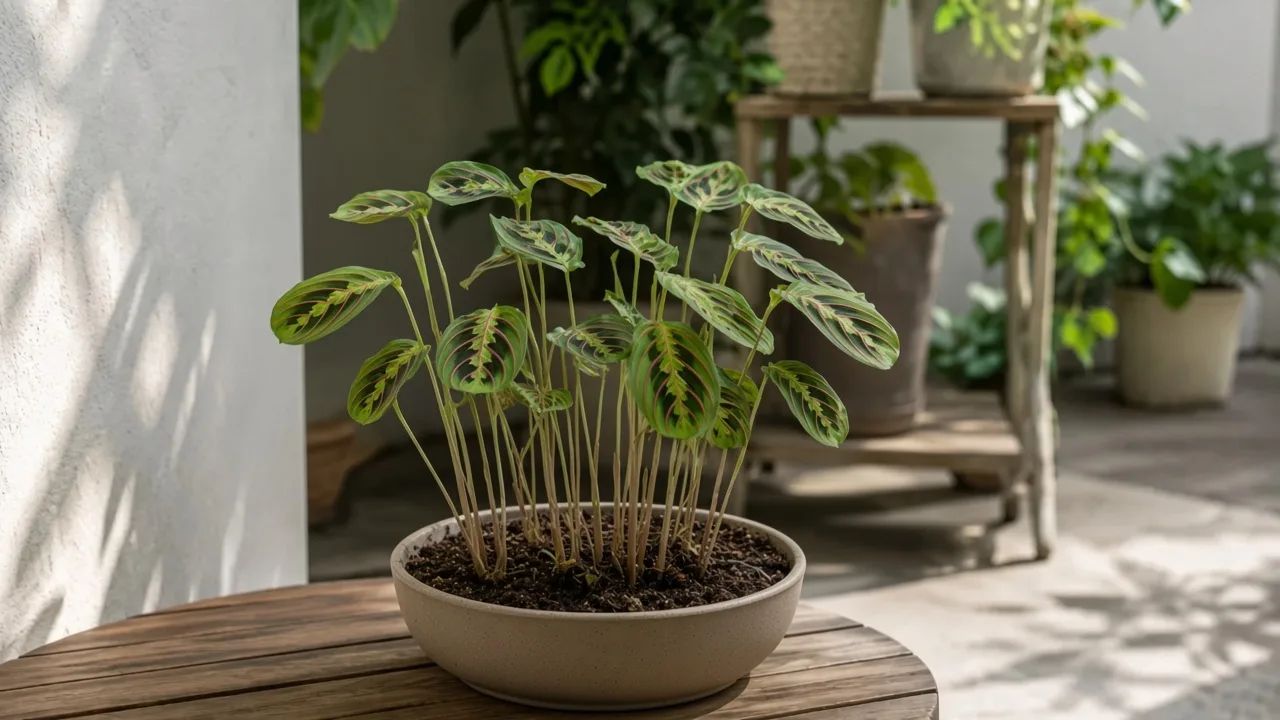
If a Prayer Plant seedling has a thin stem, small pale leaves, and leans toward a window or lamp, first move it into brighter filtered light. Keep it out of strong direct sun. If the plant is a mature Maranta with separate long leaf stalks rising from a clump, use the leggy-growth guide instead; those stalks are not seedling stems.
Leggy Seedlings on Prayer Plant: Causes, Checks & Fixes
This guide covers leggy seedlings on Prayer Plant. See also the general Leggy Seedlings guide, watering, and light pages for this plant.
Leggy Seedlings on Prayer Plant: Causes, Checks & Fixes
Quick answer
If Prayer Plant seedlings are thin, stretched, and leaning toward a window or lamp, first move them into brighter filtered light. Keep them out of strong direct sun. If what you have is a mature Prayer Plant with long leaf stalks rising from a clump, it is probably leggy growth rather than a seedling problem; use the Prayer Plant leggy-growth guide to diagnose that pattern.
The distinction matters because North Carolina State describes Prayer Plant as a rhizomatous perennial with long, sheathing petioles, so stalk length alone does not prove that the plant needs more light.
What leggy seedlings look like on Prayer Plant
True leggy seedlings look unusually tall and thin for their small leaves. Their stems may be pale, weak, and angled toward the nearest window or lamp rather than standing upright; that is a common seedling response to too little usable light, as Gardening Know How explains.
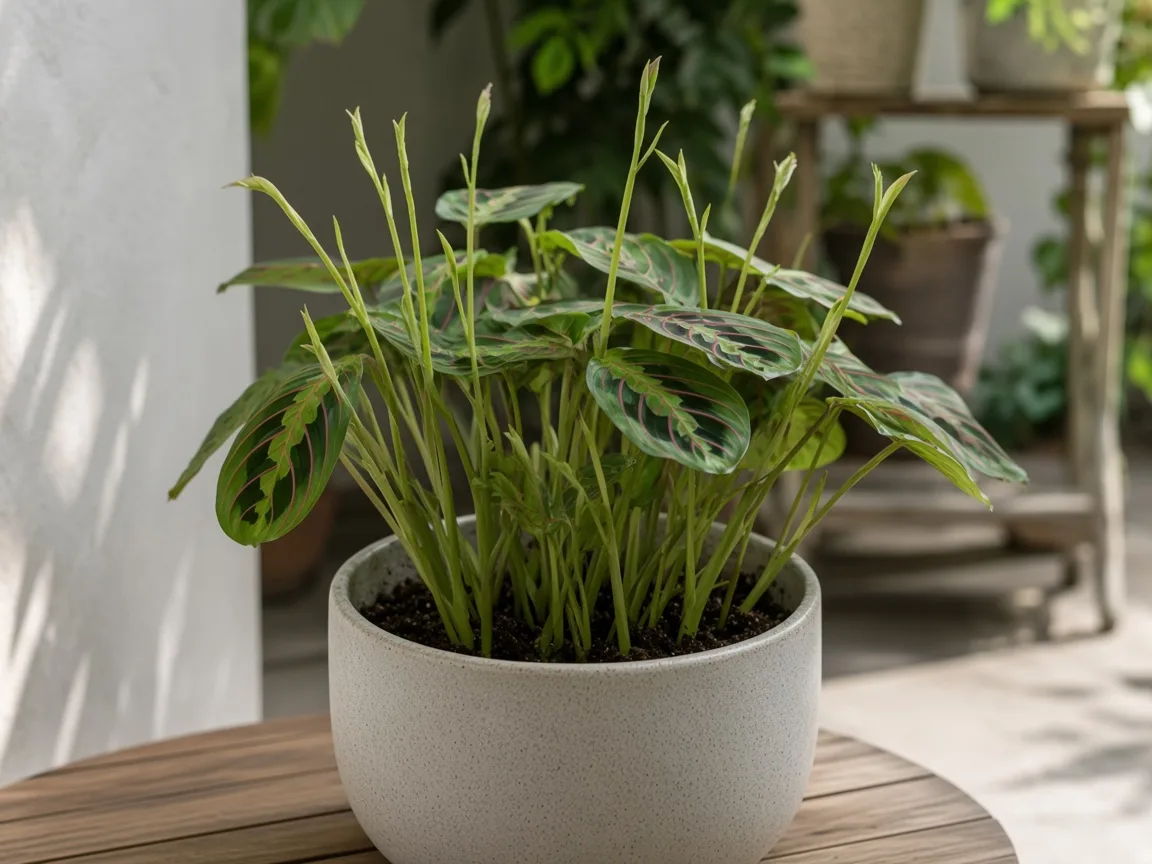
An adult Prayer Plant with long, sparse petioles. Use it as a lookalike check: a true seedling stretches along a thin stem, while mature Maranta leaves rise separately from the clump.
On a Prayer Plant, trace each leaf stalk down to where it starts. A compact group of stalks emerging separately from the base is a mature clump, not a tray of seedlings. By contrast, a thin central stem with leaves spaced along it, especially one that bends toward a light source, is a stronger sign of seedling stretch.
Check whether this is a seedling or a mature Maranta clump
Maranta leuconeura is a low-growing, rhizomatous perennial that forms a clump, rather than a plant with one woody trunk. Its broad leaves rise on their own petioles, and their nighttime folding is normal prayer-plant movement, not a sign that a seedling is collapsing; the Missouri Botanical Garden describes Maranta’s clumping habit and night movement.
Use these checks before changing care:
- Trace the stem. A seedling’s stretched section is part of one thin stem. On an established Prayer Plant, each leaf has an individual petiole leading back toward the clump.
- Look at direction. Several seedlings leaning toward the same window or lamp point to uneven or weak light. If only a mature clump leans to one side, compare it with the plant-leaning guide.
- Check the newest leaves. Compare several leaves across the tray instead of treating one long stalk as proof of low light. If the clump is otherwise healthy but has long stems, compare it with the leggy-growth guide.
For the basic seedling pattern across plants, see the leggy-seedlings symptom guide. The rest of this page focuses on how to apply that diagnosis to Maranta without exposing its foliage to harsh sun.
Why Prayer Plant seedlings stretch
The first cause to check is insufficient usable light. Seedlings can stretch while reaching for a brighter source; an indoor window may illuminate them strongly from one side while leaving the rest of the tray shaded, because window light is one-sided. On Prayer Plant, do not diagnose legginess from a long petiole alone: the evidence is the thin, weak seedling stem, a lightward lean, and continued stretched growth.
Maranta does best in bright filtered or indirect light, but strong direct sun can bleach its patterned leaves. A windowsill behind a sheer curtain or a grow light placed above the seedlings is a safer correction than moving them into an unfiltered south-facing sunbeam.
If light already reaches the seedlings evenly, check whether they are crowded or sitting beside a heater. Crowding and excess warmth can also contribute to leggy seedlings; treat them as secondary checks, not reasons to feed or repot first. For a mature plant whose leaves stay small and sparse rather than stretching as seedlings, use not enough light on Prayer Plant for a broader exposure diagnosis.
First fix: give the seedlings brighter filtered light
Change the light placement first. Move the Prayer Plant seedlings to a bright spot with filtered or indirect light, or set a grow light directly above them at the distance specified by its maker. The goal is to brighten the whole seedling evenly, not to warm or scorch one side of the tray.
If the light comes from a window, turn the tray a little at each watering so the same stems are not continually reaching in one direction. Under a grow light, keep the source above the leaves and adjust it as the seedlings grow; Harvest to Table’s indoor light advice recommends overhead lights and turning trays that lean. Use the distance specified for your own fixture rather than transferring a number from another seed-starting setup.
Make the change gradually if the seedlings have been in a dim room. Let the filtered light reach them consistently, then watch the next leaves. If those leaves pale or develop bleached areas, pull the plant back from the window or soften the exposure rather than reducing light all the way to a dim corner.
Support stronger new growth without stressing the rhizome
Do not judge recovery by whether the old stretched section shortens. Leave firm, green growth in place while the seedlings adjust, and remove only tissue that is broken or dead. Do not bury a long Prayer Plant petiole or cut the seedling back to force branching; focus on healthy basal growth from the plant’s clump and rhizome, as described in North Carolina State Extension’s propagation notes.
Keep the seed-starting mix evenly moist during growth but not waterlogged, and avoid adding fertilizer just to make a thin stem thicker. If you are unsure about moisture, compare the mix and pot weight with the Prayer Plant watering guide before watering again. A mature clump that needs refreshing is better handled through the plant’s propagation guide, which covers division and cuttings.
Lookalike patterns to rule out
| What you see | More likely explanation | What to check next |
|---|---|---|
| A seedling has a thin, elongated stem and leans toward one side | Uneven or inadequate light | Improve filtered light; compare with not enough light if the plant is already mature |
| Several long petioles rise from a compact clump; leaves fold upward at night | Normal mature Maranta form or general leggy growth | Check new growth and use the leggy-growth guide |
| A seedling is pinched, dark, soft, or collapsing at soil level | A different seedling symptom pattern | Follow Prayer Plant seedlings falling over |
| The whole mature clump tips to one side but its leaves are firm | Directional growth or an unstable pot | Compare plant leaning on Prayer Plant |
Do not respond to every weak-looking stem with more water. If the plant is actually wilted, the potting mix and recent watering matter; if it is merely elongated and firm, improve light first. For persistent lack of new leaves after the light correction, compare the separate slow-growth guide.
Recovery signs and timeline
Do not judge the light correction by the old stretched section; use new growth to evaluate it. Look for the next leaves to emerge closer together, with sturdier stems that do not keep leaning toward the same window. Give the seedlings time to make new growth, and keep the position stable rather than moving the tray repeatedly.
If new growth continues to stretch despite brighter filtered light, check whether the leaves are shaded by neighboring seedlings or whether the lamp is too far away. If stems become soft or fall at the soil line, treat that as a different problem and use the seedlings-falling-over guide. A plant that stops growing altogether after light improves may need a wider review of its pot, roots, and watering routine.
Prevent legginess on Prayer Plant
Give the seedlings even, filtered light from above or from more than one side, and thin a crowded tray so leaves do not shade one another. Keep them away from strong direct sun, which can bleach Maranta foliage, and avoid placing the tray beside a heater. When using an artificial light, follow its distance guidance and raise it as the seedlings grow rather than leaving the fixture far above the tray.
For a mature Prayer Plant, use the Prayer Plant light guide to choose a filtered position and rotate the pot occasionally so new leaves do not all face one direction. Use the soil guide if the clump stays wet for too long or the mix has compacted. Stable conditions are more useful than pruning or feeding a plant that is simply reaching for light.
When to use this page vs other Prayer Plant guides
Use this page when a true Prayer Plant seedling has a thin stem and is stretching toward a light source. If your mature Maranta instead has long petioles, start with the leggy-growth guide. If the new leaves are just small and sparse, use the not-enough-light guide; if the base is soft or falling over, use seedlings falling over.
The Prayer Plant overview explains the mature clump and normal leaf movement. Its light guide covers window placement, while the propagation guide is the better place to plan division or cuttings. See the Prayer Plant problems hub to compare other symptoms.
Related tool
Use the Plant Problem Diagnosis Tool to compare light, stem, and soil clues before changing more than one care factor.