Shankhpushpi Pruning Guide: When, Where, and How Much to Cut
Shankhpushpi Pruning Guide: When, Where, and How Much to Cut
Shankhpushpi Pruning Guide: When, Where, and How Much to Cut
First action: Walk the mat and remove only soft collapsing stems, fully yellow or brown leaves, and brittle dead runners with clean sharp scissors—finish that cleanup before you pinch healthy tips or shorten long sprawling stems for shape. Shankhpushpi (Convolvulus pluricaulis, accepted as Convolvulus prostratus) is a low, hairy, dry-land creeper; damaged tissue is usually waterlogging, shade stretch, or cold stress, not a cue to scalp the woody crown.
For whole-plant context—sun, sandy drainage, and watering rhythm—see the Shankhpushpi overview.
Reviewed by LeafyPixels Review Board · Author: sai-ananth
Quick answer
Prune Shankhpushpi (Convolvulus pluricaulis / C. prostratus), also sold as Shankhapushpi, Sankhahuli, or Sankhvel, to keep a dense prostrate mat, shorten leggy trails, clear failing stems, and tidy spent flower flushes—not to “fix” soggy roots or deep shade. Plant Science Today treats C. pluricaulis as synonymous with C. prostratus, the Ayurvedic herb sold as Shankhpushpi. Kew places the accepted species in desert or dry shrubland habitats from Cape Verde across into north-western India.
Make shaping cuts just above a node (where a leaf meets the stem), limit live removal to about one-third of the mat per session on healthy pots, and keep the sandy mix draining afterward. Pruning redirects tip growth into side shoots, but it cannot replace full sun to bright partial sun or a watering rhythm that lets the top 2–3 cm dry between drinks.
What pruning does for Shankhpushpi
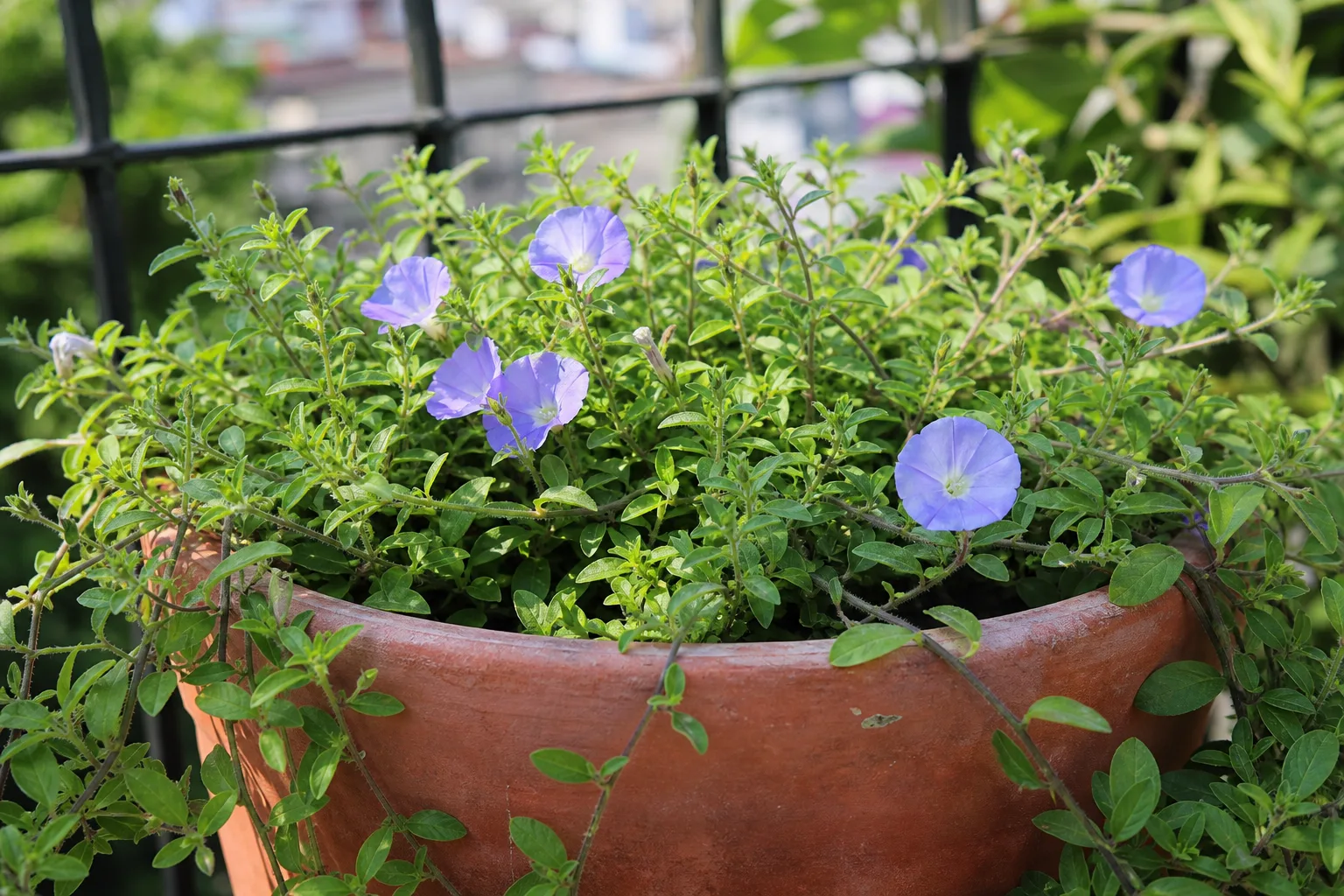
Shankhpushpi is a low, hairy, prostrate herb in the morning-glory family (Convolvulaceae), not an upright shrub. Typical pots form a mat about 10–30 cm tall with stems sprawling 15–45 cm across. Small oblong leaves sit along soft to semi-woody trailing stems; white to pale blue or light purple funnel (“conch”) flowers open along the aerial growth. Left alone on a sunny balcony, tip growth keeps racing outward. Lower sections near the rim can go bare while tips flower and trail.
Four jobs show up repeatedly:
- Cleanup removes soft crown stems, fully yellow leaves, and brittle dead runners whenever you spot them.
- Tip pinching shortens soft new growth during active seasons so the mat branches instead of forming long sparse runners.
- Runner shortening cuts trailing stems above a leafy node to pull a pot back into a fuller outline.
- Post-flower tidy lightly trims spent bloom flushes to encourage fresh shoots—without shearing the woody rootstock hard.
Pruning cannot fix chronic waterlogging. Soft crowns and yellowing leaves usually mean the sandy mix failed before the calendar did—correct drainage and light first, then cut.
Nodes, trailing stems, and where new growth starts
Shankhpushpi stems are soft when young and firm toward the crown, with leaves marking each node. Run your finger along a runner: every leaf attachment is a potential bud site. New shoots emerge from those axils after you remove the tip. Flowers also form on aerial growth, so light tip work after a bloom flush favors fresh vegetative shoots over a tangle of spent stems.
Cut between nodes and you leave a bare internode stub with nothing reliable to sprout. Cut 3–6 mm (about ¼ inch) above a healthy leaf, using sharp scissors on clean tissue, matching Clemson’s heading guidance to cut just above a healthy bud. Avoid crushing soft stems with dull blades; bruised tips collapse quickly in wet pots.
When to prune Shankhpushpi
Best season for shaping and tip work
Use warm active growth—typically spring through early monsoon in Indian climates—for tip pinching, runner shortening, and size control. Buds below a cut break fastest when nights stay warm and the plant sits in full sun to bright partial sun. After a flush of flowers, a light tidy encourages fresh shoots rather than a hard shear of the woody base.
Avoid stacking a hard cutback with cool, stagnant weather or a chronically wet pot. Growth slows when light drops and roots sit cold and soggy, so a heavy late-winter cut on a shaded, damp tray may sit longer before nodes break. Light maintenance—removing a soft stem or pinching a soft tip—is fine whenever you see firm green growth.
If you repotted within the last two to three weeks, delay heavy pruning unless you are only removing dead or soft tissue. Root disturbance plus a large canopy cut stacks two stresses on a plant that already fails in soggy mix.
What can be removed anytime
Soft collapsing stems, fully yellow or brown leaves, brittle dead runners, and clearly diseased sections can be removed year-round. Clemson HGIC advises removing dead, diseased, or injured growth before any shaping cuts. That cleanup is different from reshaping a healthy mat. Defer major cuts if the plant was just moved, newly repotted, or is yellowing from wet soil—fix drainage and light first.
What to check before cutting
Before your first structural cut, check four things:
- Node positions: New shoots break from leaf nodes, not smooth mid-internode stubs. Find the joint where a leaf meets the stem and cut just above it.
- Light quality: Shankhpushpi wants full sun to bright partial sun for most of the day. Long internodes and sparse tips usually mean weak light—improve placement before expecting a tipped plant to stay compact.
- Current stress: Soft crown bases, sour wet soil, or ongoing yellowing means delay major cuts. Pair with watering checks when the pot stays heavy.
- Crown vs runners: Trim aerial sprawling stems; do not dig into or shear off the living woody rootstock at soil level.
Confirm identity before heavy work: true Shankhpushpi is a low hairy creeper with white to pale blue or light purple funnel flowers. Evolvulus alsinoides, Clitoria ternatea, and other herbs are often sold under the same common name—pruning advice for those plants differs.
Tools, sanitation, and pet precautions
Use sharp scissors or fine bypass pruners for soft trailing stems. Dull blades crush tissue and slow healing. Wipe cutting surfaces with 70% isopropyl alcohol before you start and when moving from soft-rotted stems to healthy wood.
Shankhpushpi is not listed separately by ASPCA, but it is in Convolvulaceae. ASPCA lists related morning glories (Ipomoea) as toxic to cats, dogs, and horses. Keep pruned stems out of reach of pets that chew foliage, bag trimmings, and wash hands after handling cut material. Do not treat Ayurvedic “nontoxic” framing for human herbal use as pet safety for the live plant.
How to prune Shankhpushpi step by step
Work in this order each session:
- Remove soft, yellow, brown, or fully dead tissue back to firm green wood, or to the soil line if a stem is fully collapsed at the crown.
- Pinch or tip-cut soft leaders that have added several leaf pairs and need branching.
- Shorten long trailing runners to a lower leafy node if internodes have stretched or stems have escaped the pot.
- Tidy spent flower stems lightly after a bloom flush without cutting into the woody crown.
- Step back and check balance—pinch any runner racing ahead of the others.
Position blades about one-quarter inch above the node and make one clean snip. Soft tips can be pinched with clean fingernails if you do not crush the tissue.
The first tip pinch on a young plant
Start the first pinch once a cutting or nursery start has several leaf pairs and firm trailing tips—typically when the mat has begun to spread and tips stay plump in warm sun. Snip or pinch the top growing point just above a healthy leaf, leaving enough foliage below for photosynthesis. Within one to three weeks in strong light you should see side shoots emerging from axils below the cut.
Shortening runners for size control
When stems mat over the rim or lean toward the brightest window, cut just above an outward-facing leaf node so new growth fills gaps rather than racing farther out. Head runners to several different lengths rather than shearing every tip to one flat plane—a flat shear pushes a dense outer fringe and leaves the center bare.
Using healthy cuttings
Healthy tip wood from a warm-season prune can become soft stem cuttings rooted in a lean, well-draining medium—use the Shankhpushpi propagation guide if you want to fill gaps rather than composting everything. Do not propagate soft, yellow, or rotting tissue.
How much you can safely remove
Do not remove more than about one-third of the plant’s total leafy growth in one session during active season. That limit protects the leaf surface feeding the roots. Daily tip pinches of a few millimeters rarely approach one-third; the rule matters when you renovate a leggy mat or take many cuttings at once.
Never shear the woody crown or rootstock hard. Shankhpushpi recovers from aerial tip and runner cuts; scalping the living base often stalls the pot or invites crown rot in damp mix.
If you need a large size drop, take one-third now, wait for new tips to firm up (often two to three weeks in heat), then take another measured pass. Never scalp a stressed, shaded, or newly repotted plant down to bare stubs.
Aftercare and recovery
After pruning:
- Keep the plant in its strongest available sun—do not move it into shade “to rest.”
- Water only when the top 2–3 cm of mix are dry; do not soak the pot to “help it recover.”
- Skip fertilizer for a week or two after a hard cut; resume light feeding only when new tips are visible and the plant is drinking on its normal rhythm—see the fertilizer guide.
- Watch the crown for soft rot—remove any newly mushy tissue promptly.
Recovery timeline
Tip pinches usually show new side shoots within one to three weeks in warm full sun to bright partial sun. Harder renovation can take three to six weeks before the mat looks filled again. Cool nights, weak light, or wet soil stretch that timeline. Signs pruning worked: firm new tips from nodes below your cuts, stopped decline of remaining leaves, and a tighter silhouette. Signs you cut too hard or too late: no new buds after several warm weeks, soft crown tissue, or widespread yellowing on remaining stems.
Mistakes to avoid
- Shearing the woody crown hard — removes the living base the mat needs; trim aerial stems only.
- Cutting mid-internode — leaves a stub with no bud to activate.
- Scalping a shaded, wet pot — regrowth will be weak; fix light and drainage first.
- Stacking prune + repot + heavy feed the same day — one stress at a time.
- Ignoring soft crowns — overwatering and poor drainage cause soft stems; cleanup is not optional.
- Leaving cut stems where pets graze — Convolvulaceae relatives include toxic morning glories; bag trimmings.
When not to prune
Skip structural pruning when nights are cold, the crown is mushy from waterlogging, you just repotted, or the only problem is shade stretch you have not fixed yet. Emergency removal of dead or soft tissue is still appropriate in those cases—just do not add tip pinching and size-control cuts on top.
Related Shankhpushpi guides
- Shankhpushpi overview — full care context and growth habit
- Shankhpushpi light — sun needs before you expect dense regrowth
- Shankhpushpi watering — dry-down rhythm after cuts
- Shankhpushpi soil — sandy drainage that prevents crown rot
- Shankhpushpi propagation — rooting healthy pruning wood
- Shankhpushpi fertilizer — when to resume light feeding after a hard prune
- Shankhpushpi repotting — when to delay pruning after a pot change