Potassium Deficiency on Spider Plant: Causes, Checks & Fixes
Quick answer
Potassium deficiency on spider plant shows as yellow or brown scorch along the margins of older arching strap leaves while newer crown blades and stolon tips stay relatively green. First step: confirm edge-first burn on multiple lower arching blades—not tip-only crisping from fluoride—and review feeding history before adding fertilizer.

Potassium Deficiency on Spider Plant: Causes, Checks & Fixes
This guide covers potassium deficiency on Spider Plant. See also the general Potassium Deficiency guide, watering, and light pages for this plant.
Potassium Deficiency on Spider Plant: Causes, Checks & Fixes
Quick answer
Potassium deficiency on spider plant (Chlorophytum comosum) shows as yellow or brown scorch along the margins of older arching strap leaves on the lowest part of the rosette while newer crown blades and stolon tips stay relatively green. Potassium is very mobile in plants and deficiency symptoms show up first on lower leaves as flecking or mottling on the leaf margins—prolonged shortage leads to necrosis along those edges while the strap interior may stay greener longer.
See our potassium deficiency symptom hub and the potassium deficiency guide. On spider plant, inspect the outer edges of the oldest arching strap leaves nearest the pot rim—marginal burn there differs from fluoride-sensitive brown tips on a single blade point or magnesium deficiency with interveinal banding across the mid-blade.
First step: confirm marginal scorch on multiple older arching blades, then check for salt crust and review feeding history before adding fertilizer.
When to use this page vs other Spider Plant guides
| Pattern | Read next |
|---|---|
| Old arching blade margins yellow or scorched, new crown straps stay green | Potassium deficiency (this page) |
| Dry tan tips only, interior blade green | Brown tips from fluoride or dry air |
| Uniform pale oldest lower blades without vein pattern | Nitrogen deficiency |
| Yellow between veins on older mid-arch blades | Magnesium deficiency |
| Yellow new crown blades with green veins | Iron deficiency |
| Cupped or margin-burned newest crown strap | Calcium deficiency |
| Scorched margins right after heavy feeding | Brown tips from salt injury |
| All blades yellow on persistently wet soil | Overwatering or root rot |
| One lower blade only while a new strap pushes firm green leaves | Normal aging—yellow leaves |
What potassium deficiency looks like on Spider Plant
Healthy spider plant pushes arching linear strap leaves from a central tuft, often with white or cream variegation along the margins on common cultivars. Potassium stress breaks that pattern at the margins of older arching blades on the lowest part of the rosette, not at the newest crown strap first.
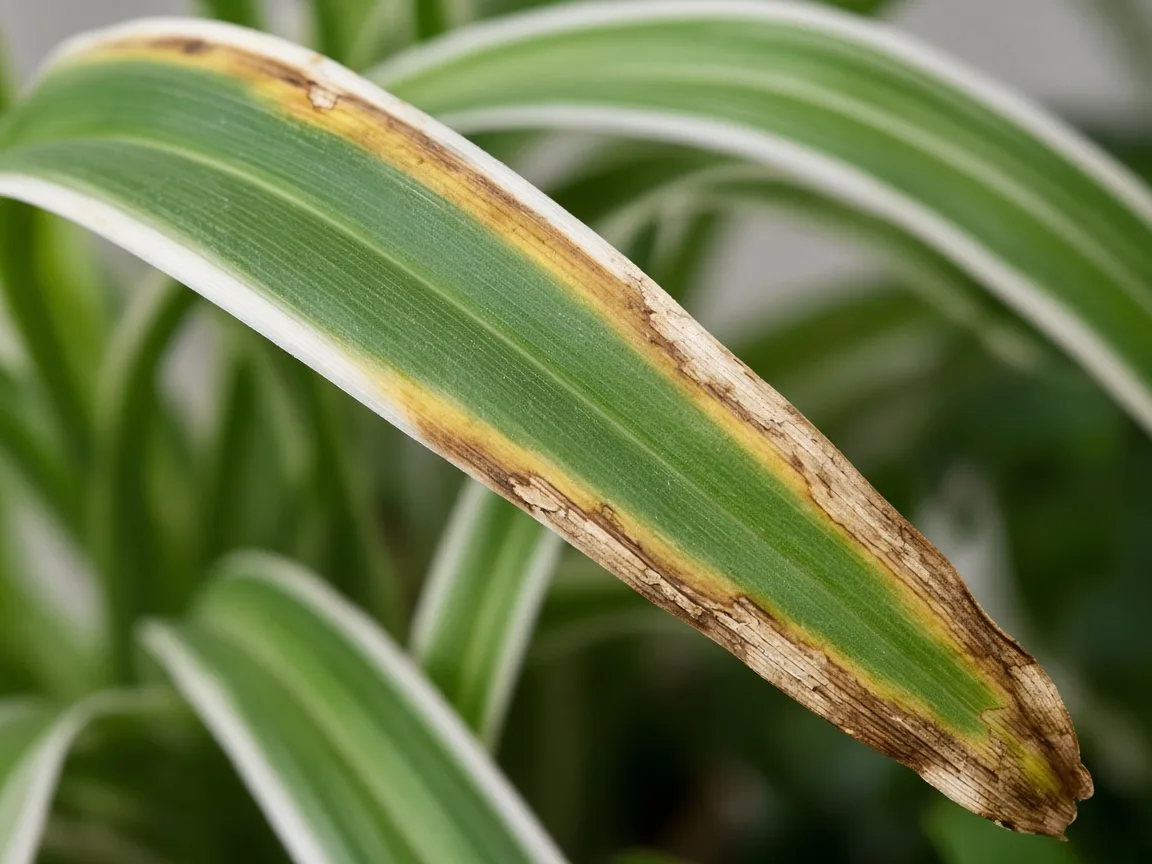
Tan scorch along the outer margin of an older arching strap leaf—the edge yellows and browns while the interior tissue stays greener, unlike tip-only brown from fluoride on a single blade point.
Typical signs:
- Yellow or tan scorch along outer margins of several older arching strap leaves on the lowest part of the rosette—the damage often starts at the edge and creeps inward
- Crisp brown marginal tissue on channeled strap blades, not soft mushy bases from rot
- Newer crown blades and stolon tips stay greener than the lowest old arching leaves for weeks or months
- Slow spread inward over months as deficiency advances—more old blades on the lower canopy gain similar edge burn
- Firm tuberous roots at soil level unlike mushy overwatered spider plant on soggy mix
- Stalled spiderette size on long stolons in advanced cases when potassium cannot support water regulation in fast-growing arching foliage
Not potassium deficiency:
- Tip-only crisp brown on one exposed blade face—brown tips from fluoride, dry air, or uneven watering
- Uniform pale washout on whole old blades without edge-first pattern—nitrogen deficiency
- Yellow between veins with green midrib bands on mid-stem blades—magnesium deficiency
- Yellow new crown blades with dark green veins—iron deficiency
- Cupped or margin-burned newest crown strap while old blades stay normal—calcium deficiency
- Marginal burn within days of a concentrated fertilizer dose—salt injury; see brown tips
- One lower blade yellow while a green strap unfurls above—often normal senescence; see yellow leaves
- Bleached patches on blades facing a south window—direct sun scald
Older leaves show chlorosis with browning of tips, scorching of margins, and brown spots near the margins in classic potassium shortage. On a fast-growing spider plant in a hanging basket, that older-leaf marginal scorch is easiest to read on the lowest arching blades nearest the pot rim.
Why Spider Plant gets potassium deficiency
Spider plant is a fast-growing herbaceous perennial with thick fleshy tuberous roots that can push several new arching leaves per month in bright indoor light. Potassium regulates stomatal function and stress tolerance through guard-cell turgor—when soil reserves run low, the plant pulls potassium from old outer strap tissue to fund the next crown blade unfurl and stolon spiderette growth.
Spider plant-specific causes:
- Never fed or skipped years — Owners treat spider plants as “no fertilizer needed” while a mother clump sits in the same depleted peat mix for two or more seasons. See the spider plant fertilizer guide for conservative feeding rhythm.
- Leached general-purpose mix — Each thorough dry-down soak per the spider plant watering guide flushes mobile potassium through drainage holes faster than owners replace it in airy general-purpose potting mix.
- Filtered or soft water only — Irrigation removes the small incidental mineral contribution tap water normally supplies unless complete fertilizer replaces what leaches during each dry-down cycle.
- Salt-blocked uptake — White crust from overfeeding or hard water limits potassium absorption even when fertilizer sits in the cabinet. UC IPM notes container plants often show deficiency symptoms when root uptake is restricted, not only when soil lacks potassium.
- Root stress limiting uptake — Chronic saturation in a cachepot prevents absorption even when potassium is present; see overwatering before feeding a waterlogged tuber clump.
- Nitrogen-heavy feed without potassium balance — Repeated high-nitrogen doses on a fast grower can skew uptake; a complete balanced formula is safer per the fertilizer guide.
Do not diagnose potassium shortage on sour wet soil with soft tubers at the base—that is root failure until you confirm mostly firm white roots.
Marginal scorch on lowest arching strap leaves
Potassium marginal scorch on spider plant looks different from the same symptom on a ZZ plant leaflet or a peace lily lance blade. A single mature arching strap leaf can show a dramatic tan band along the entire outer edge while the channeled interior tissue stays green—owners often misread that as underwatering because spider plant blades can limp slightly when very dry.
The diagnostic clue is distribution: potassium shortage hits multiple older arching blades on the lowest part of the rosette with similar edge-first yellowing or scorch. Underwatering crisp edges more often appear on the lowest one or two blades after a dry spell, then improve after a soak. Potassium marginal burn persists across several old lower blades even when watering rhythm is stable.
On variegated cultivars like ‘Vittatum’ or ‘Variegatum’, scorch sometimes shows first on the white-striped margins of older blades—those pale zones lack chlorophyll to mask early yellowing, so edge burn can look dramatic before the green center fades.
When a hanging-basket mother depletes potassium through spiderettes
Spider plant is famous for long stolons tipped with spiderettes that root while still attached to the mother. Each plantlet draws water and mobile nutrients—including potassium—from the same tuber mass supporting the crown.
A mother in a crowded hanging basket with four to six active stolons and rooted spiderettes can show potassium marginal scorch on older crown blades while stolon tips still look perky. The plant reallocates potassium upward to support new crown growth and baby plantlets, leaving the lowest arching straps to scorch first.
That pattern is plant-specific: a pothos vine without plantlets or a snake plant rosette without stolons does not show the same mother-plus-offsets drain. If marginal burn appears only after you let many spiderettes root in the same pot for a season, potassium depletion from shared tuber reserves is a likely piece of the puzzle—especially if you have not fed during active spring growth.
Trimming or potting up excess spiderettes reduces demand on the mother before you reach for fertilizer, but do not remove every stolon if you enjoy propagation—one measured feed may be enough once demand drops.
How to confirm potassium deficiency on Spider Plant
Work through these checks in order before changing multiple variables:
- Pattern on arching blades — Yellow or brown scorch along outer margins of multiple older strap leaves on the lowest canopy, with newer crown blades greener for weeks
- Feeding history — No complete fertilizer for six months or more during active growth in bright light, or only nitrogen-heavy product without balanced potassium
- Salt crust — White mineral film on soil surface or pot rim suggests salt injury mimicking deficiency; flush before feeding
- Tuber and root check — Lift the pot edge or unpot only if needed: firm white tubers and roots support deficiency diagnosis; brown mushy tissue means root rot first
- Watering rhythm — Stable dry-down per the watering guide rules out drought crisping; chronic wet mix rules out feeding until drainage improves
- Fluoride tip check — If damage is tip-only on scattered blades without full-margin scorch, read brown tips before assuming potassium shortage
Confirmed potassium deficiency means edge-first marginal scorch on old arching blades + depleted feeding history + firm roots. Suspected deficiency with wet soil, salt crust, or tip-only burn needs those issues corrected first.
The first fix to try
After confirming marginal scorch on multiple older arching blades and firm tubers, apply one measured dose of complete balanced liquid fertilizer at half strength to moist—not bone-dry—mix during active growth.
Water lightly the day before if the pot is extremely dry so roots can take up nutrients without a sudden osmotic shock. Pour until a little drains, empty the saucer, and stop. Do not feed again for four to six weeks unless new crown straps still emerge with burned margins.
This single correction lets you read the plant’s response. If margins on the next new arching blade open cleaner, potassium was likely the limiter. If scorch worsens within days, you may have salt injury—flush the pot with plain water and hold feed.
Use the Fertilizer Dilution Calculator if you are unsure how much to mix for your bottle strength.
Step-by-step recovery
After the first half-strength balanced feed:
- Wait four to six weeks — Spider plant grows quickly in bright light but still needs time to route potassium into new crown tissue
- Monitor the next two crown straps — Cleaner outer margins on new arching blades confirm progress; continued edge burn on successive new growth means uptake is still blocked
- Second feed only if needed — One more half-strength balanced dose in six weeks if new blades still scorch but tubers stay firm
- Flush salts mid-season — If you feed monthly in bright light, run plain water through until it drains freely once between feeds to prevent crust buildup
- Refresh mix at repotting — When tubers circle drainage holes, move into fresh well-draining mix rather than only top-dressing depleted peat
- Reduce spiderette load — Root or remove excess plantlets on crowded mothers so potassium supports crown blades first
- Trim only fully brown margins — Snip dead scorched edges on old blades for appearance; do not shear healthy green tissue hoping leaves re-green
Do not stack repotting, heavy pruning, and double-strength fertilizer on the same weekend—a stressed hanging-basket mother needs boring care while it reroutes nutrients.
Recovery timeline
Scorched margins on old arching strap leaves do not turn green again—that tissue is done. Judge recovery by new growth:
- Two to four weeks — Next crown strap may still show slight edge yellowing if deficiency was mild
- Four to six weeks — Second new arching blade often opens with cleaner margins after one balanced feed
- Two to three months — Lower canopy may still carry old burned blades while upper crown looks normal—that is cosmetic, not failure
- Six months+ — Severely scorched lowest blades can be trimmed once several clean new straps have replaced visual balance
If three successive new crown blades emerge with worsening marginal burn despite firm tubers and two measured feeds, suspect salt-blocked uptake or hidden root stress—not more fertilizer.
Mistakes to avoid
- Feeding bone-dry mix — Concentrated salts on dry roots burn margins faster; moisten lightly first
- Double-strength “boost” — Fast-growing spider plant does not need shock feeding; Wisconsin Extension notes heavily fertilized plants may form fewer plantlets and excess feed contributes to tip burn
- Diagnosing from one yellow blade — Single lower senescence is normal; potassium shows on multiple old margins
- Confusing fluoride tips with margin scorch — Tips only = brown tips; full outer edge on old blades = this page
- Feeding waterlogged tubers — Soft roots need dry-down and drainage, not NPK
- Epsom salt for margin scorch — Magnesium fixes interveinal chlorosis on mid-blades, not edge-first potassium burn; see magnesium deficiency
- Removing all old blades immediately — Old scorched straps still photosynthesize until new crown growth fills in
How to prevent potassium deficiency next time
Feed complete liquid fertilizer with micronutrients at half strength every four to six weeks during spring and summer active growth per the fertilizer guide. Flush the pot every few months if you use hard tap water or feed heavily.
Repot into fresh well-draining mix when tuberous roots circle drainage holes and water runs through dry channels—usually every one to two years for fast growers in hanging baskets.
If you irrigate with filtered or reverse-osmosis water to protect arching blades from fluoride, choose a houseplant formula with balanced NPK on the label—do not rely on plain water alone for seasons.
Root or remove excess spiderettes before the mother depletes the same small pot supporting six stolons.
Place hanging baskets where they receive enough indirect light per the light guide to open new crown blades regularly; a plant that never pushes new growth will not show potassium scorch—but it also will not recover visibly until light and moisture support active growth.
When to worry
Potassium deficiency alone rarely kills spider plant—it is a durable species. Act within weeks when marginal scorch pairs with:
- Wet soil for months and spreading scorch up into mid-canopy blades
- Tuber softening at soil level or sour-smelling mix
- No new crown blade for two months despite spring light and corrected dry-down
- Successive new straps opening with burned margins between veins
- Wilting spiderettes on stolons while the mother crown scorches and tubers soften
In those cases, inspect roots before assuming more fertilizer solves everything.
Related Spider Plant guides
- Spider plant overview — growth habit, light, and watering baseline
- Problems hub — all spider plant symptom guides
- Fertilizer — complete feed with micronutrients, half-strength schedule
- Watering — dry-down checks for tuberous roots
- Brown tips — fluoride and salt tip burn vs marginal scorch
Use this page when older arching blades show edge-first yellow or brown scorch while new crown growth stays greener. Use iron deficiency when new crown blades yellow with green veins, and brown tips when only leaf tips crisp on older arching blades.