Root Rot on Syngonium Pink: Causes, Checks & Fixes
Quick answer
Root rot on Syngonium Pink shows as limp arrowhead leaves on wet sour mix, dull salmon new growth, and brown mushy roots on inspection. Stop watering, unpot, trim decay to firm tissue, air-dry cuts, repot into fresh chunky aroid mix, and propagate firm stem nodes if the crown is lost.
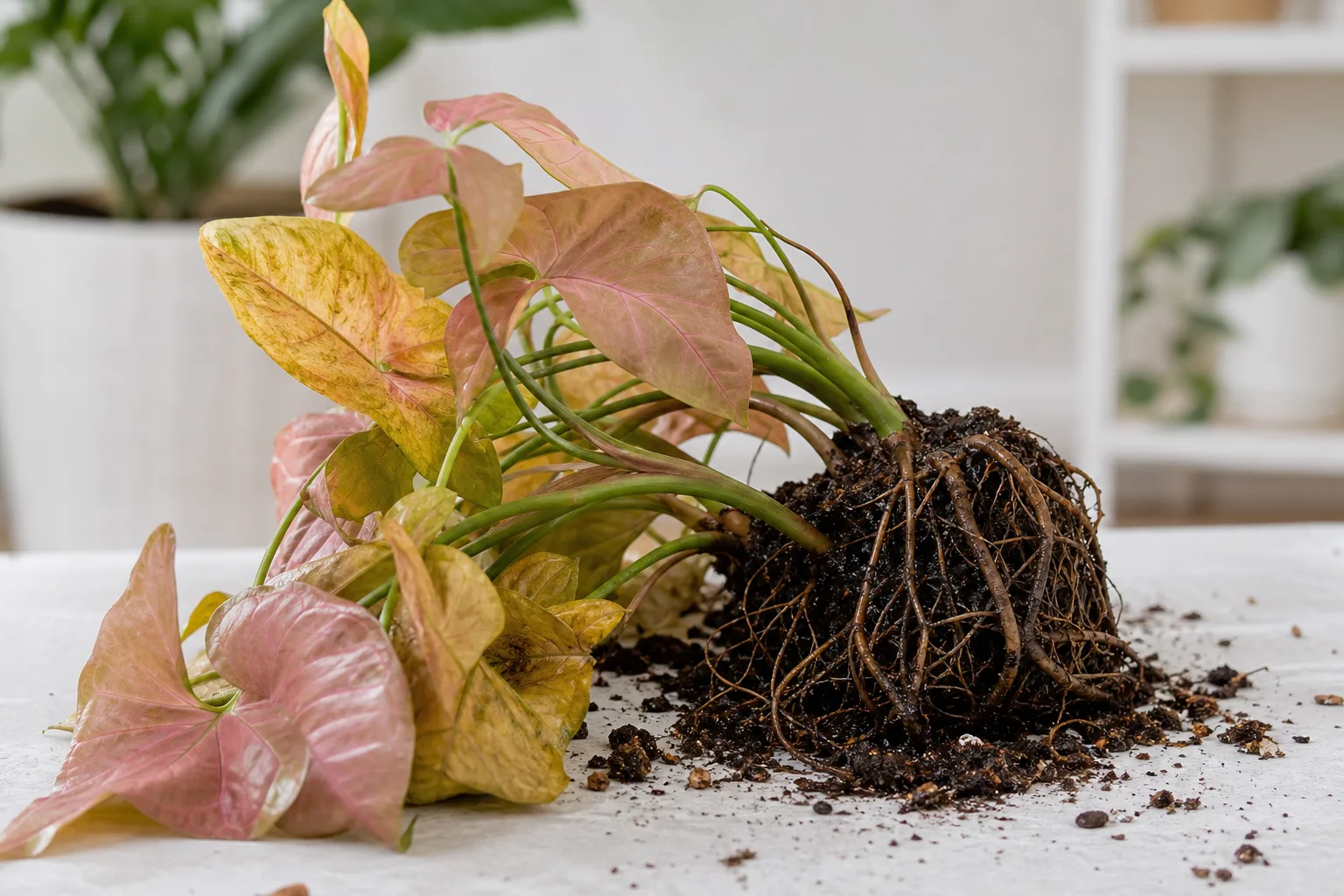
Root Rot on Syngonium Pink: Causes, Checks & Fixes
This guide covers root rot on Syngonium Pink. See also the general Root Rot guide, watering, and light pages for this plant.
Root Rot on Syngonium Pink: Causes, Checks & Fixes
Quick answer
Your Pink Syngonium leaves are limp, the pot feels heavy and cool, the mix smells sour at the drainage hole, and the newest arrowhead leaf opened dull green or washed-out salmon instead of blush pink-while soil an inch down is still damp. That combination is the root-rot trap on Syngonium podophyllum ‘Pink’: damaged aroid roots cannot move water, so soft juvenile foliage mimics thirst and pushes growers to pour again on already-saturated mix.
First step: stop all watering and unpot to inspect roots. Trim brown mushy tissue, air-dry cut surfaces two to four hours, then repot into fresh chunky aroid mix sized to the remaining root mass-not the former leaf volume.
| Situation | Root inspection | First action | Use this page? |
|---|---|---|---|
| Heavy wet pot, firm white roots, no sour smell | Optional if decline continues | Dry down, fix rhythm | No - overwatering guide |
| Wet pot, dull pink new leaves, limp petioles | Recommended if yellowing spreads | Stop water, unpot if smell or softness appears | Start overwatering; return here if roots turn mushy |
| Sour smell, brown mushy roots, soft stem base | Required | Unpot, trim, repot, propagate backup | Yes - this guide |
Root rot vs. other Pink Syngonium pages: This URL covers confirmed active decay-mushy roots, sour mix, and crown softness requiring trim-and-repot. If roots are still firm and white but the pot stays wet too long, start with overwatering on Syngonium Pink for dry-down rescue before decay spreads. For normal moisture rhythm after recovery, use the watering guide.
When to use this page vs. overwatering
The overwatering guide covers chronic wet mix with firm roots-dull pink on new growth, heavy pots, and fungus gnats before tissue turns mushy. This page is for confirmed root rot: you have unpotting evidence of brown, translucent, or slimy roots, often with sour-smelling mix and softening at the stem base.
If you are unsure, unpot once. Firm pale roots with a corrected dry-down point to overwatering. Mushy roots with a sour odor point here. The watering guide sets normal soak-and-drain care; use these problem pages when symptoms appear.
What root rot looks like on Syngonium Pink
Above ground, rot hides behind thirst signals. Lower yellow leaves appear on older nodes, arrowhead petioles hang soft, and new growth loses its blush-even though the pot feels heavy. That mismatch is the clue: wilted leaves with wet soil mean rotting roots cannot take up water, not drought.
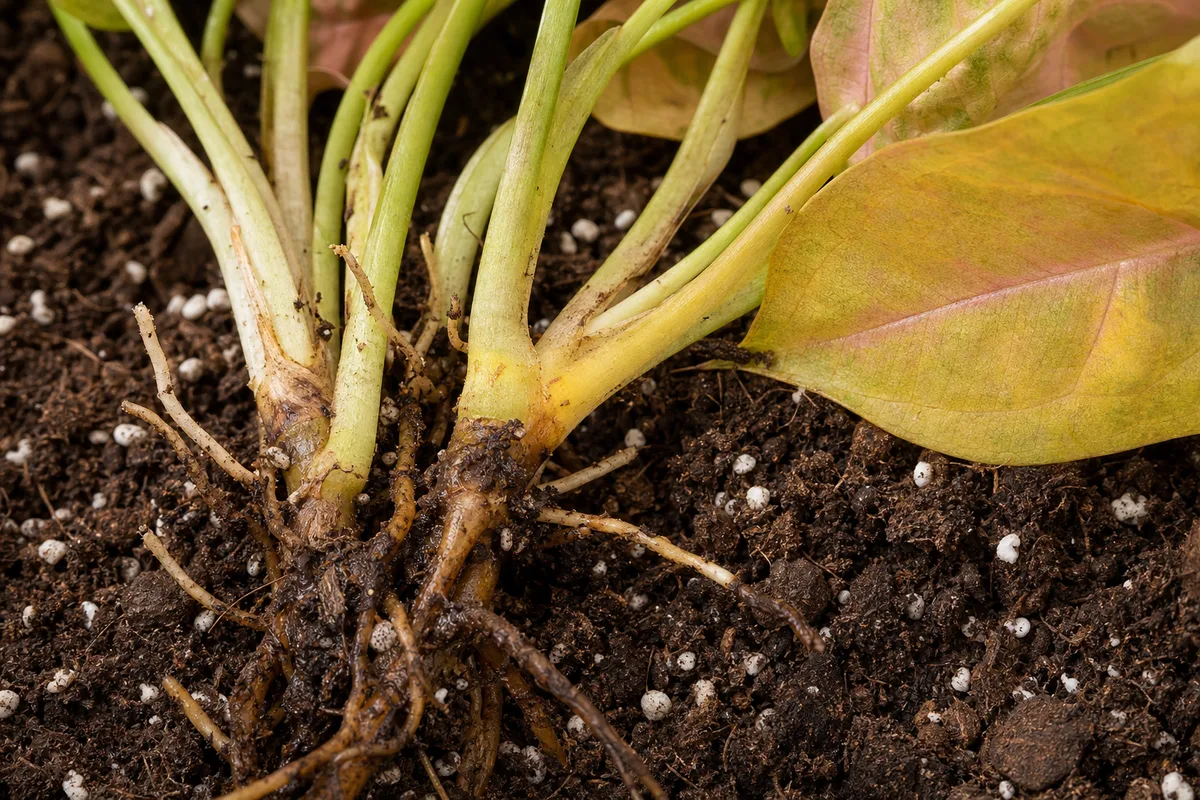
Root Rot symptoms on Syngonium Pink - compare with healthy tissue on the same plant.
Early Pink-specific signals:
- Newest juvenile leaves open dull salmon, pale green, or flat pink compared with the last few weeks of growth-often before lower leaves fully yellow
- Pink flush on emerging tips stalls or shrinks while mix stays damp
- Pot stays noticeably heavier than your “just watered” baseline for five or more days
As decay advances:
- Mix smells sour or fermented at the drainage hole
- Yellowing climbs the stem; oldest leaves drop first
- Stem tissue softens at the soil line; blackening may spread upward
- Fungus gnats hover persistently after every soak-larvae thrive in moist potting soil
Below ground, healthy Syngonium roots are firm and white or tan. Rotted roots are slimy, brown, or translucent and pull away when rinsed. Root rots develop when soil remains too wet for too long, especially in cool conditions or poorly drained containers.
Why Syngonium Pink gets root rot
Pink Syngonium is a tropical aroid in the Araceae family with thick roots built for wet-then-dry cycles in loose forest litter-not permanent dampness in dense peat. In native Central and South American forest floors, roots get periodic rain and fast drainage through organic debris with constant airflow between drinks.
Several habits push Pink Syngonium into anaerobic root failure:
- The blush-leaf trap - Soft, moisture-loving-looking juvenile foliage droops when roots fail in wet mix, which looks identical to drought wilt. Growers add water to an already heavy pot and accelerate decay.
- Calendar watering - Watering every Sunday regardless of dry-down keeps mix saturated in winter when growth slows and the pot uses water slowly.
- Low light in winter - Dim corners slow transpiration so the same summer soak lasts days longer at the root zone. See not enough light when pale new leaves pair with slow dry-down.
- Cachepots and standing saucer water - Decorative outer pots without drainage trap runoff. Water sits around the nursery pot base and keeps roots wet even when the surface looks dry.
- Oversized or dense mix - A pot much larger than the root ball holds moisture at the core while the top inch dries first, tempting another premature watering.
Pink cultivars add a visual early warning: stressed new growth often loses pigment before lower leaves fully yellow, while solid-green arrowhead forms may only show generic chlorosis at first.
How to confirm root rot (5-step inspection)
- Moisture history - Has the top inch stayed wet for five or more days? Lift the pot; a heavy cool-damp container days after watering supports chronic saturation.
- Wilting vs. moisture - Limp arrowhead leaves on wet mix strongly suggest root dysfunction. Wilting with moist soil often signals root damage, not thirst-do not add water.
- Smell - Sour or rotten odor from mix supports rot over simple underwatering (dry dusty mix, light pot).
- Stem base - Pinch tissue at the soil line. Firm green stems with wet mix may still need an unpot if yellowing spreads; soft mushy crown with wet mix means rot is advancing.
- Root inspection - Slide the plant out. Compare firm white roots with brown mushy sections. Any significant mush confirms rot and triggers trim-and-repot-not dry-down alone.
Also inspect the pinkest leaf at the tip: dull salmon or green-leaning new leaves while soil stays wet fit chronic root stress better than a single pale leaf after shipping.
First fix for Syngonium Pink
Stop watering, unpot, and trim all mushy roots-then repot into fresh draining mix sized to the remaining root mass.
Do not wait for another dry-down cycle when roots are already brown and slimy. Slide the plant out, rinse away saturated old mix, and cut soft roots with clean scissors until only firm tissue remains. Let cut surfaces air-dry on paper towels for two to four hours. Repot at the same depth using chunky aroid mix in a clean pot one size larger than the trimmed root ball-not the full foliage spread.
Plants with partial rot may be salvaged by pruning out the rotted part. Water once lightly after repotting, then wait until the top inch approaches dryness before the next soak.
Step-by-step recovery
- Unpot and discard saturated, sour-smelling mix-do not reuse it.
- Rinse roots gently in lukewarm water to see firm vs. mushy tissue clearly.
- Trim decay with sterilized scissors; remove all brown, translucent, or slimy sections back to firm white or tan tissue.
- Air-dry cut roots two to four hours so wounded tissue is not sealed into fresh mix.
- Repot into chunky aroid mix - Blend roughly 40% coir- or peat-based potting mix, 30% fine orchid bark, and 30% perlite, or follow the equal-parts recipe in our soil guide. Size the pot to roots, not leaf volume.
- One moderate soak after repot - Water lightly once so mix settles, then let the top inch approach dryness before the next drink.
- Propagate backup cuttings if more than half the root mass is gone-take firm nodes with healthy pink variegation and follow the propagation guide while the trimmed plant recovers.
Hold fertilizer until new growth appears. Place in bright indirect light-not a dim corner while roots re-establish. If larvae were present in old mix, let the surface dry between waterings and follow fungus gnat control if adults persist after the root zone stabilizes.
Wear gloves when trimming; arrowhead plant is toxic to pets if chewed, and sap can irritate skin-wash hands after contact.
Propagation salvage when the crown is lost
When the stem base above remaining roots turns soft, black, or mushy, repot rescue alone often fails. Salvage firm stem sections above the rot line while tissue is still green and pliable.
- Identify firm nodes - Look for segments with healthy leaves and no softness between nodes.
- Cut cleanly - Use sterilized scissors one node below healthy tissue; discard everything below the rot line including contaminated mix.
- Root cuttings - Place nodes in water, moist perlite, or sphagnum per the propagation guide. Syngonium roots adventitiously from nodes along the stem.
- Run parallel rescue - Continue caring for any trimmed root ball with firm tissue above soil while cuttings root-do not wait for the mother plant to collapse before taking backups.
Partial softness one node above soil may recover after trimming rot and repotting into airy mix. If softness climbs several nodes or the crown turns mushy, cuttings are the realistic salvage path.
Recovery timeline and what to expect
First few days: Do not water during initial dry-down after repot unless you misdiagnosed and the pot is actually light with dusty dry soil.
One to two weeks: Yellow lower leaves may continue to drop as the plant sheds tissue it cannot support-old blemished blades will not re-green. Watch the next emerging leaf: firmer petioles and stronger pink blush signal roots are working again.
Two to three weeks (mild rot): Plants with firm stems and less than half the root mass removed often push one normal-sized new leaf with improved pink color in bright indirect light.
Four to six weeks (moderate rot): Major trim but firm nodes above soil may take longer before new arrowhead growth resumes. Judge success by fresh pink-tinged tips and predictable pot dry-down, not vine length immediately.
Severe rot: Soft stem base climbing multiple nodes or crown failure-repot rescue often fails; rooted cuttings may show new tips in three to four weeks.
Escalate to propagation-first if decline continues two weeks after repot despite corrected light and dry-down. Pink pigment on the next one to two flushes often improves once roots heal in airy mix and you resume watering only when the top inch dries-older yellow leaves will not re-green.
Lookalike symptoms
| Pattern | Soil at 1 in. | Pot weight | Roots on inspection | Likely cause | Guide |
|---|---|---|---|---|---|
| Limp leaves, dull pink new growth | Wet, cool-damp | Heavy | Firm white/tan | Early overwatering | Overwatering |
| Dramatic wilt, crispy edges | Dusty dry | Very light | Firm, dry-looking | Underwatering | Underwatering |
| Pale pink fade, wide node gaps | Moist, slow dry-down | Moderate | Firm | Low light + wet mix | Not enough light |
| Limp leaves, sour smell, soft base | Wet | Heavy | Brown mushy | Root rot | This page |
| Mild wilt 3–7 days after repot | Evenly moist new mix | Moderate | Firm | Repot shock | Hold steady light; avoid extra water |
| Single yellow lower leaf | Normal moisture | Normal | Firm | Normal aging | Watch next two new leaves |
Do not confuse a heavy wet pot with sour smell (root rot) with a light dry pot (underwatering)-the wrong fix kills the plant.
What not to do
- Do not keep watering because soft pink leaves look thirsty when soil is already wet - That deepens root failure.
- Do not fertilize a rotting plant - Stressed roots cannot use nutrients; salts may burn pale variegated sections.
- Do not repot into standard dense garden soil or an oversized decorative pot without drainage.
- Do not resume full watering until new root growth or firm stem tissue confirms recovery - Slight dryness after repot encourages new root tips.
- Do not mist leaves to fix wet roots - Surface humidity does not aerate a saturated root zone.
- Do not ignore cachepot water - Lift the nursery pot out when watering; never let the outer pot hold standing runoff.
Keep pruned material away from pets and children. Contact your veterinarian or ASPCA Animal Poison Control at (888) 426-4435 if a pet chews trimmed roots or foliage.
How to prevent root rot next time
Build a check habit tied to your room, not a calendar date.
- Use the top-inch rule - Allow the potting surface to dry slightly before irrigating. For Pink Syngonium in bright indoor light, that usually means every five to seven days in warm months and ten to fourteen days or longer in cool dim winter rooms-full rhythm in our Syngonium Pink watering guide.
- Track pot weight - Lift the pot when you pass it. Sudden heaviness days after a soak is a faster signal than memory.
- Match light to dry-down - Bright indirect light helps the mix dry predictably. Dim corners need longer intervals between soaks, not the same summer frequency.
- Use drainage and empty saucers - Water until runoff, then discard saucer water within thirty minutes.
- Choose airy mix - Chunky aroid mix with bark or perlite dries faster than straight peat and gives roots oxygen between drinks per our soil guide.
Winter dry-down is partial top-inch dryness, not a bone-dry root ball. Reduce watering frequency when growth slows even if the room still feels comfortable to you.
When to worry
Act immediately when stems soften at the base, soil smells sour, yellowing reaches new growth while the pot stays wet, or multiple leaves collapse within days of wilting. Overwatering deprives roots of oxygen and wet anaerobic conditions rot aroid roots fast-soft blush leaves fail first while the base still looks partly green.
Brief yellowing on one old lower leaf with firm stems and neutral soil is rarely root rot. Discard the pot only if the crown shrivels, stems turn brittle brown throughout, and no nodes activate after four to six weeks-after trying propagation from any firm variegated sections that remain.
Related Pink Syngonium guides
- Syngonium Pink watering - Top-inch checks, season rhythm, cachepot protocol
- Overwatering on Syngonium Pink - Early wet-soil rescue before mushy roots
- Underwatering on Syngonium Pink - Light pot and deep-soak recovery
- Wilting on Syngonium Pink - Wet-soil vs. dry-soil wilt decision tree
- Fungus gnats on Syngonium Pink - Chronic wet mix crossover
- Syngonium Pink propagation - Stem cutting salvage when roots fail
- Syngonium Pink soil - Chunky aroid mix for prevention
Conclusion
Pink Syngonium root rot begins with waterlogged mix, not mysterious wilt. Confirm by inspecting roots-firm pale tissue with a dry-down fix means overwatering; brown mushy tissue means trim, repot, and possibly propagate. Prevent recurrence with drainage, bright indirect light, and watering only when the top inch dries. One new firm pink-tinged leaf and predictable pot weight are the signs your Pink Syngonium is back on track.