Spider Mites on Syngonium Pink: Causes, Checks & Fixes
Quick answer
Spider mites on Syngonium Pink show as pale stippling and fine webbing on arrowhead leaves, often near bright windows in dry winter air. First step: isolate the plant and rinse leaf undersides thoroughly before applying any spray.
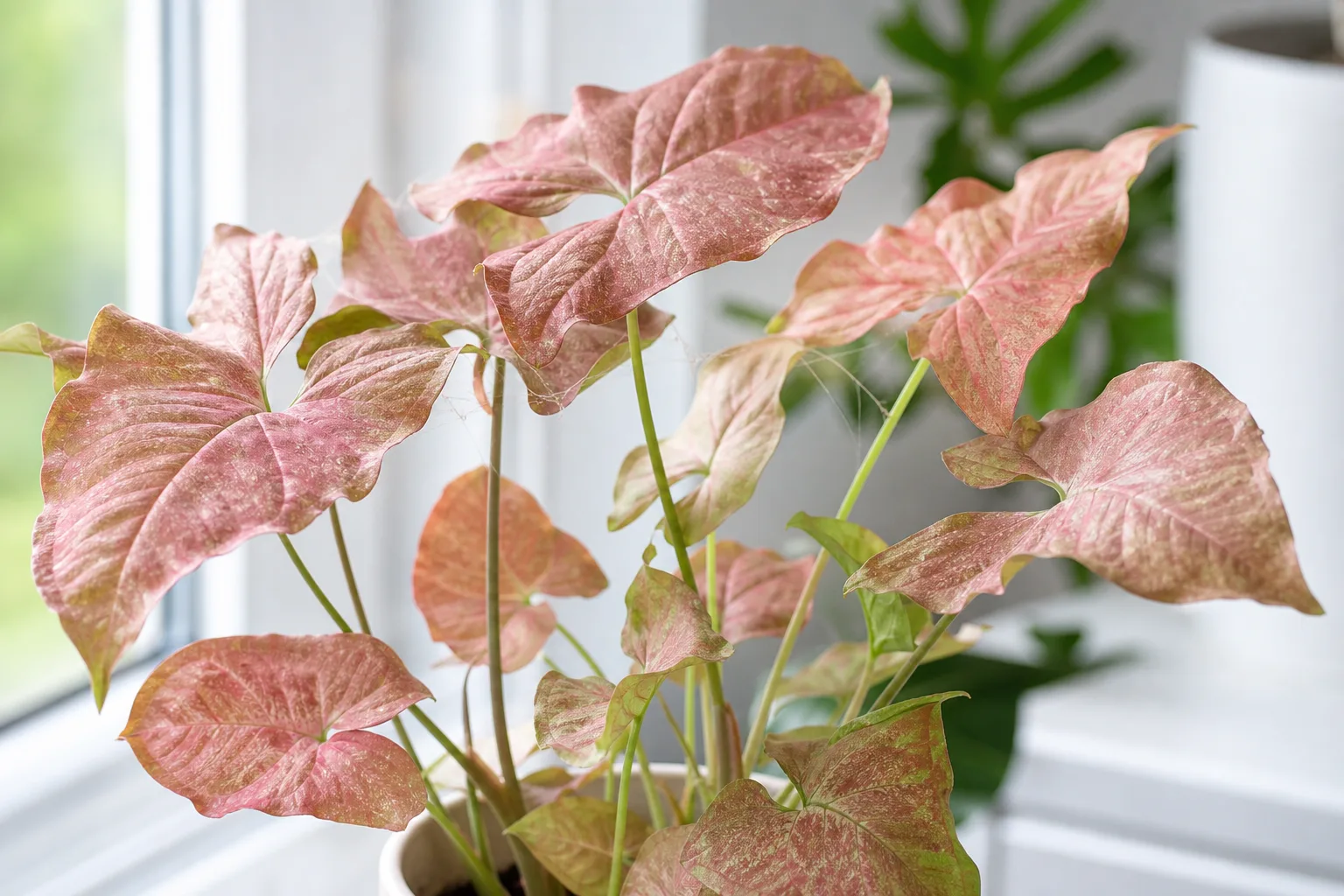
Spider Mites on Syngonium Pink: Causes, Checks & Fixes
This guide covers spider mites on Syngonium Pink. See also the general Spider Mites guide, watering, and light pages for this plant.
Spider Mites on Syngonium Pink: Causes, Checks & Fixes
Quick answer
The fastest way to tell spider mites from low light on Syngonium Pink is the damage pattern: low light bleaches whole leaves evenly toward green, while mites leave granular pale dots with veins slightly darker-and often worst on the warmest window side. Once you see moving specks or silk at petiole joints, you have mites, not a placement issue.
Spider mites are tiny sap-feeding arachnids-not insects-that puncture leaf cells and leave pale stippling. On Syngonium Pink (Syngonium podophyllum ‘Pink’), that damage shows up quickly on thin arrowhead leaves: pink blush fades to dusty speckles, leaf edges bronze, and fine silk appears at tips and petioles when populations build.
First step: isolate the plant and rinse leaf undersides with lukewarm water. Syngonium Pink is often placed in bright windows for color, but the same warm, dry microclimate that keeps pink tones vivid also speeds mite reproduction indoors. Confirm active mites with the white-paper tap test before you spray anything.
What spider mites look like on Syngonium Pink
Healthy Pink Syngonium leaves carry variable blush-from pale salmon to stronger rose-depending on light and leaf age. Mite damage disrupts that pattern:
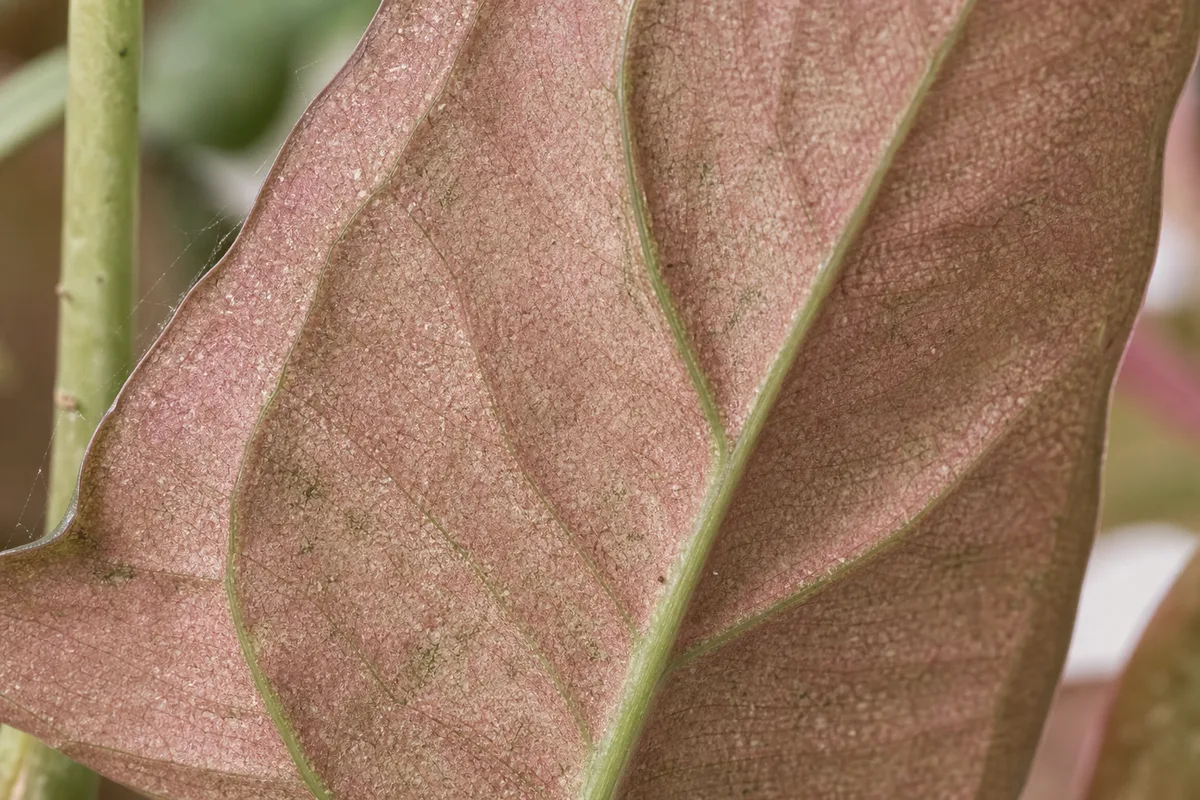
Spider Mites symptoms on Syngonium Pink - compare with healthy tissue on the same plant.
- Fine pale or yellow stippling scattered across the upper leaf surface, making pink areas look washed out or grainy
- Bronze or dull gray cast on older arrowhead leaves while veins stay slightly greener
- Tiny moving dots on leaf undersides, visible with a 10× hand lens or when tapped onto white paper
- Fine silk webbing at leaf tips, petiole joints, or between overlapping juvenile leaves
- Distorted or stuck new growth when mites colonize the softest pink arrowheads first
Syngonium Pink changes leaf shape as it matures-juvenile hearts give way to lobed arrowheads-so damage may look uneven across one vine. That is normal for the cultivar, not proof of multiple problems. What matters is whether stippling comes with webbing and moving specks.
On the same dry shelf, a trailing Pink Syngonium with overlapping juvenile hearts often shows stippling a week before a compact chartreuse Neon Robusta beside it-the blush wash on thin tissue reads as color failure before you notice webbing on the paler neighbor.
Mites themselves are barely visible. The two-spotted spider mite is about the size of a period on a page and often shows two dark spots on a pale green or reddish body. You will notice the leaf damage long before you see individual mites without magnification.
Why Syngonium Pink gets spider mites
Pink Syngonium is a tropical aroid that prefers bright indirect light and high humidity. In practice, growers place it near east or west windows to hold color per our light guide. That placement puts foliage next to glass that heats up by day and cold drafts at night-exactly the kind of hot, dry pocket where spider mites thrive.
Winter makes the problem worse. Central heating drops indoor humidity well below the 50–60% range Pink Syngonium tolerates best-see low humidity for the dry-air lookalike without stippling. Dry air favors mite feeding and slows their natural predators, while the plant keeps transpiring from thin leaves. Stressed hosts show damage faster than fully hydrated ones.
Syngonium-specific habits add risk:
- Dense, overlapping foliage on bushy shelf plants hides undersides where mites feed first
- Trailing or climbing growth lets stems touch neighbors, giving mites a bridge to pothos, calathea, and other pots on the same shelf
- Moderate watering rhythm-when the top inch dries per our watering guide-means foliage can still be dust-dry even when roots are fine
- Pink cultivar sensitivity-color loss from stippling reads as a care failure, so infestations get noticed late
Spider mites rarely start inside healthy, humid collections. They usually arrive on a new plant, open window breeze, or contaminated tools. Once established, one pot can seed a shelf within weeks because mite generations complete quickly in warm rooms.
How to confirm the cause
Work through these checks before treating:
- White-paper tap test - Hold white paper under a suspect leaf and tap the leaf sharply. Mites fall as moving specks. Static dust does not crawl.
- Underside inspection - Tilt arrowhead leaves toward light. Look for colonies, eggs, and early webbing along midribs and petioles.
- Webbing check - Fine silk at tips confirms mites, not thrips or mechanical damage. Thrips leave silver scarring and black specks; mites leave stippling plus webbing at high density.
- Pattern vs. watering - Overwatering yellows lower leaves evenly and may come with soft stems or sour soil. Mite stippling is patchy, often worst on the warmest side, with firm roots if watering has been normal.
- Light stress comparison - Not enough light causes leggy, pale growth without stippling or mites. Direct sun scorch creates crisp brown patches, not fine dots.
- Neighbor scan - Check every syngonium, calathea, and pothos on the same shelf. Shared dry air means shared risk even when only one pot looks bad today.
If tap tests show no movement, no webbing, and leaves feel uniformly yellow with wet soil, pivot to watering and root checks-not mite sprays.
Documented recovery case
A 30 cm Pink Syngonium on an east-window ledge above a baseboard heater showed dusty stippling on two juvenile hearts in mid-January. Room hygrometer read 44% at desk height but 29% at leaf level beside the glass. A white-paper tap test confirmed slow-moving specks on the warmest arrowheads. After isolation, lukewarm sink rinses every four days, insecticidal soap on weeks two and three (label interval), and a small humidifier holding 54% RH at leaf height, clean pink arrowheads emerged by week four. Old stippled hearts stayed marked; success was judged on new growth only, not cosmetic repair of damaged blush tissue.
First fix for Syngonium Pink
Move the plant away from healthy collections and rinse all foliage, especially leaf undersides, with lukewarm water.
Use a shower, sink sprayer, or gentle hose outdoors on a mild day. Support the pot so mix does not waterlog-Syngonium Pink rots easily if soil stays saturated after repeated rinses. Forceful washing removes mites, eggs, and webbing on contact and is the safest opening move before chemicals.
Protect soft juvenile hearts - cup each unfurling pink leaf with your hand and rinse from the petiole outward rather than blasting the delicate tip. Fully hardened lobed leaves can take firmer spray.
Let leaves dry in bright indirect light the same day. Do not follow the rinse immediately with oil or soap in full sun; stressed, wet foliage burns easily on pink cultivars.
Only after the rinse, if mites remain on inspection, apply insecticidal soap or horticultural oil labeled for houseplants and spider mites. Soaps and oils must coat mites directly and do not kill unhatched eggs, so one application is never enough.
Choosing soap, horticultural oil, or miticide
All three are contact treatments-they must wet the mite directly and are repeated because eggs hatch between sprays.
| Product type | Best for Pink Syngonium when… | Cautions on this cultivar |
|---|---|---|
| Insecticidal soap | Light to moderate infestations; you can rinse thoroughly first | Test one juvenile heart if unsure; avoid spraying in hot direct sun on rinsed foliage |
| Horticultural oil | Moderate webbing when soap alone fails after two cycles | Check label temperature limits; avoid oil on soft pink leaves still unfurling |
| Neem oil (labeled for mites) | Owners who already use neem on houseplants; moderate infestations | Same oil-burn rules as horticultural oil; morning application after leaves dry from rinse |
| Labeled miticide | Heavy infestation after three weeks of diligent soap/oil cycles | Follow label exactly; many general insecticides do not control mites |
Escalation path: rinse → insecticidal soap or oil on label interval for two to three weeks → labeled miticide only if tap tests still show live mites and fresh webbing on new arrowheads.
Pet safety during repeated treatment: Arrowhead vine contains calcium oxalate crystals toxic to pets. Wear gloves when rinsing damaged tissue, keep the quarantined pot out of pet reach, and wipe floors after sink rinses so cats do not walk through runoff. Soap and oil residues are not pet food-block access until foliage dries after each application.
Step-by-step recovery
Once the plant is isolated and rinsed, continue in this order:
- Repeat physical washing every three to five days for two weeks. Small syngoniums fit in a sink; larger vines need a shower wand aimed up into leaf backs.
- Apply labeled soap or oil seven days apart for at least three cycles-UF/IFAS notes five- to seven-day intervals because eggs hatch on a staggered schedule. Cover undersides completely.
- Raise humidity moderately with a humidifier or pebble tray (pot above the water line)-not misting alone, which evaporates quickly in heated rooms. Aim for the 50–60% range at leaf height, not just room ambient; a wall hygrometer can read 45% while the crown beside a register sits under 30%.
- Trim only heavily webbed leaves after the first rinse. Removing every stippled arrowhead is unnecessary; focus on leaves where webbing shelters egg masses.
- Treat or inspect neighbors on the same shelf. Mites crawl between touching plants faster than they fly.
- Hold fertilizer until new growth looks clean for two weeks. Nitrogen pushes soft tissue that mites prefer, and stressed roots do not need salts while you are rinsing repeatedly.
- Re-check weekly with a lens for four weeks after the last visible mite. Populations rebound from a single missed egg cluster.
Match rinse frequency to soil moisture per the watering guide so repeated showers do not keep the mix soggy. Gentle airflow helps leaves dry after rinses; stagnant, humid corners invite fungal spots when you raise humidity without circulation.
Recovery timeline
Expect a staged recovery, not overnight green-up:
- Days 1–3: Mite count drops after the first thorough rinse; stippling on existing leaves remains unchanged.
- Week 1–2: Webbing should not spread to new leaves if washing and labeled sprays continue on schedule.
- Week 3–4: New pink arrowheads emerge with cleaner color if humidity and light stay stable.
- Month 2+: Old stippled foliage can stay on the plant harmlessly or be pruned for appearance once you are confident mites are gone.
If webbing returns within five days of treatment, you missed a reservoir-check leaf axils on climbing stems and the backs of juvenile hearts. Persistent rebound after three full spray cycles may mean the plant shares a dry vent with untreated neighbors.
Lookalike symptoms
| What you see | Likely cause | How to tell apart |
|---|---|---|
| Patchy pale speckles with webbing | Spider mites | Moving dots on paper; silk at petioles |
| Uniform lower yellow leaves, wet soil | Overwatering | No mites; soft base possible; sour smell |
| Leggy pale new growth, no dots | Not enough light | Stretch toward window; no webbing |
| Crisp brown patches on sun side | Sun scorch | Hard edges; follows direct sun exposure |
| Silver streaks, black specks, no web | Thrips | Distorted new leaves; thrips visible when shaken |
| Dusty gray film, no stippling | Mineral or dust buildup | Wipes off; no crawling specks |
| Crisp tips without fine dots | Low humidity | No webbing or moving specks on tap test |
On Pink Syngonium, the trickiest confusion is low light fade vs. mite stippling. Low light bleaches whole leaves evenly toward green. Mites create granular dots that leave veins slightly darker and often start on the warmest window side.
Mistakes to avoid
- Stopping after one spray - Eggs hatch after the first kill. Repeat treatments on a five- to seven-day cycle until counts stay zero.
- Spraying only the tops of arrowhead leaves - Mites concentrate on undersides; top-only sprays leave colonies intact.
- Using dish soap mixes - Household detergents burn thin syngonium tissue. Use products labeled for plants.
- Treating in hot sun or on drought-stressed plants - Oils and soaps can phytotox leaves above 90°F or when the plant is wilted.
- Boosting nitrogen while infested - Soft new pink shoots attract more feeding.
- Returning the plant to the shelf too soon - One surviving female restarts the outbreak.
- Ignoring adjacent pots - Dry shelf air affects the whole row, not one cultivar.
- Relying on misting alone - Brief mist does not sustain the humidity shift mites dislike.
Syngonium Pink care cross-check
Mite recovery sticks better when baseline care is stable:
- Light: Bright indirect light keeps pink color without baking leaves against hot glass per our light guide. Pull the pot back a foot if afternoon sun hits the pane.
- Water: Water when the top inch of mix dries-soggy soil stresses roots while foliage still dries out near vents.
- Humidity: Moderate humidity (50–60%) at leaf height matches what arrowhead vine prefers indoors. A humidifier beats misting, which evaporates quickly in heated rooms.
- Airflow: Gentle circulation helps leaves dry after rinses; stagnant, humid corners invite fungal spots.
- Shape: Prune long vines that tangle with neighbors, or give a moss pole so leaves spread for easier inspection.
Fix the dry microclimate that invited mites-not just the mites themselves-or the next heating season brings the same stippling.
How to prevent spider mites next time
- Quarantine new syngoniums two to three weeks before mixing them with established pots.
- Inspect undersides weekly during winter when houseplant mite outbreaks peak in dry air.
- Rinse foliage monthly in the sink during heating season-it dislodges early colonies before webbing forms.
- Keep plants slightly spaced so leaves do not touch; mites crawl across contact points.
- Maintain humidity in the room at leaf level, not just at one leaf with a spritz bottle.
- Clean tools and hands after working on infested vines before pruning healthy ones.
Pink Syngonium bought for bold color rewards boring consistency: stable light, moderate humidity, and early pest checks beat reactive spraying after half the arrowheads look dull.
When to worry
Escalate or consider discarding the plant if:
- Webbing covers most of the vine and mites return within days after three full treatment cycles
- New growth fails to open and stems defoliate from the tips inward
- The infestation spreads to many pots in a shared display you cannot isolate or treat repeatedly
- You cannot physically wash the plant because of size or location, and sprays alone fail
Bag and remove severely infested plants before carrying them past healthy collections-extension guidance recommends bagging before disposal to limit mite migration. Most Pink Syngoniums recover if caught before webbing spans the whole pot and neighbors are treated at the same time.
Related Syngonium Pink care and problems
Use these guides while you treat or after recovery:
- Syngonium Pink overview - blush color cycle, juvenile-to-lobed maturation, toxicity
- Light - window placement without hot dry ledges
- Watering - avoid soggy mix during repeat rinses
- Low humidity - dry-air stress without stippling or webbing
- Overwatering - uniform lower yellowing, not patchy dots
- Not enough light - whole-leaf fade vs. granular mite stippling
- Mealybugs - co-occurring pest in dry winter air
- Genus spider mites - syngonium-wide biology and escalation
Success markers: clean new pink arrowheads, clear tap tests for two consecutive weeks, and RH above 50% at leaf height-not perfect blush on old stippled tissue.
When to use this page vs other Syngonium Pink guides
- Syngonium Pink watering guide - Use for routine moisture checks before assuming spider mites is the main issue.
- Syngonium Pink problems hub - Browse all 2 common issues on this species.