Overwatering on Syngonium White Butterfly: Causes, Checks &
Quick answer
Overwatered Syngonium White Butterfly shows yellow lower leaves, soft stems, or wilting despite wet soil-especially if you watered before the top inch dried. Stop watering, empty standing water, and check drainage before roots rot.
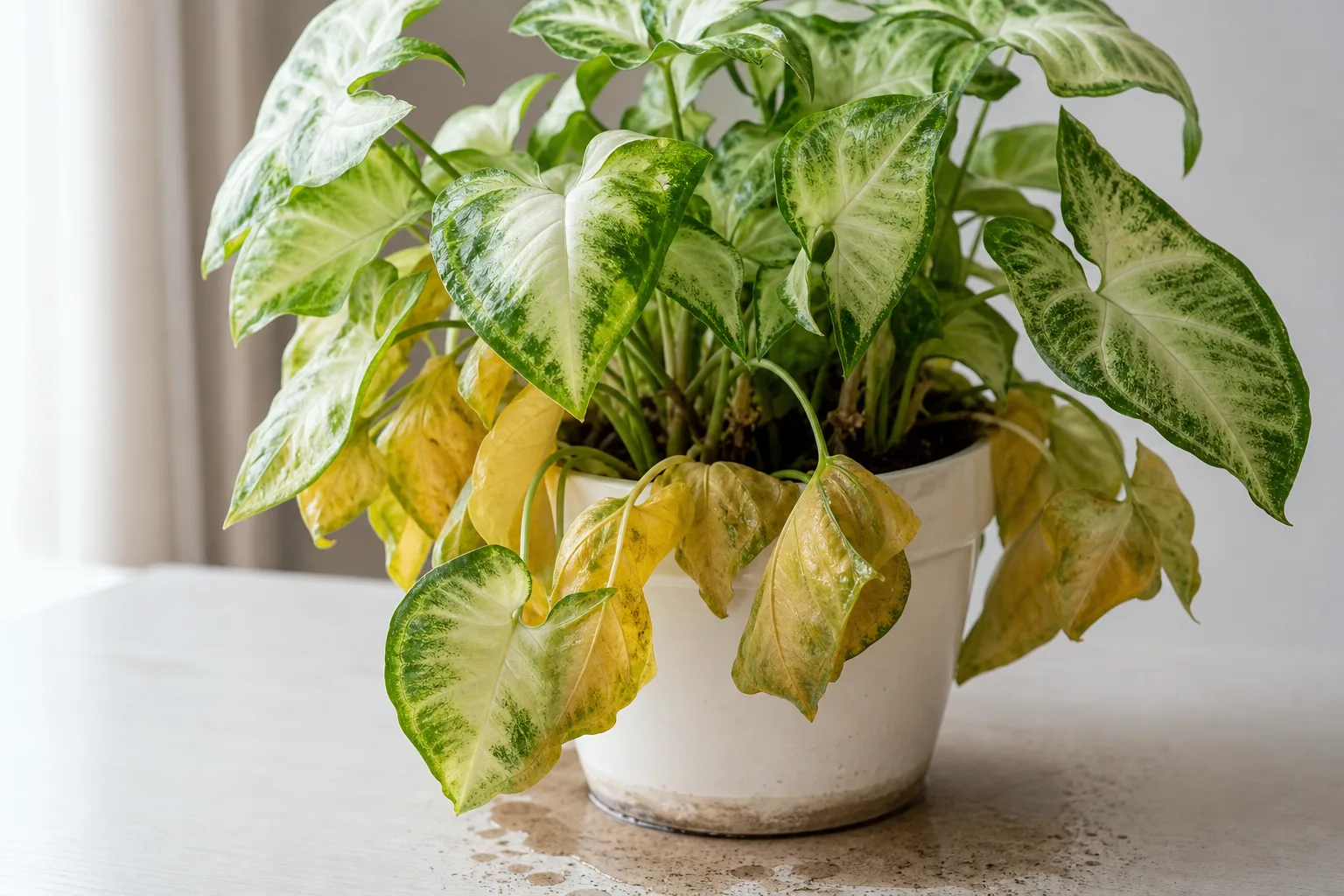
Overwatering on Syngonium White Butterfly: Causes, Checks & Fixes
This guide covers overwatering on Syngonium White Butterfly. See also the general Overwatering guide, watering, and light pages for this plant.
Overwatering on Syngonium White Butterfly: Causes, Checks & Fixes
Quick answer
Your Syngonium podophyllum ‘White Butterfly’ looks thirsty-arrowhead leaves limp, stems drooping-but when you press your finger into the mix, the top inch is still cool and damp. That mismatch is the wilt paradox on this understory aroid: damaged roots cannot transport water upward even though the pot feels heavy. Watering again because the foliage droops is the fastest route to root failure.
First step: stop all watering until the top inch of mix is dry. Lift the container-it should feel noticeably lighter before the next drink. Empty any saucer or cachepot water. White Butterfly tolerates a missed watering better than a Calathea, but fine aroid roots still need oxygen between drinks-not a permanently wet root zone.
| What you find at top inch | Pot weight | Stems at soil line | Likely cause | First action |
|---|---|---|---|---|
| Wet or cool-moist | Heavy | Firm | Early overwatering | Hold water; brighter indirect light; empty saucer |
| Wet for 7+ days | Heavy | Softening | Advancing root stress | Unpot; inspect roots; trim mush |
| Dry | Light | Firm | Underwatering, not this page | See underwatering |
| Wet + sour smell | Heavy | Mushy | Active root rot | See root rot |
Use this page as wet-soil early intervention. For everyday rhythm, finger-plus-weight checks, and seasonal schedule detail, see the White Butterfly watering guide. For thirst droop on dry mix, see underwatering.
What overwatering looks like on Syngonium White Butterfly
White Butterfly is usually sold in its juvenile form-arrowhead-shaped leaves with silvery-white veining on green blades. Overwatering does not always announce itself with obvious yellow leaves at first. Early saturation can look like a plant that “needs water” because the whole vine droops-exactly the signal owners learn to obey.
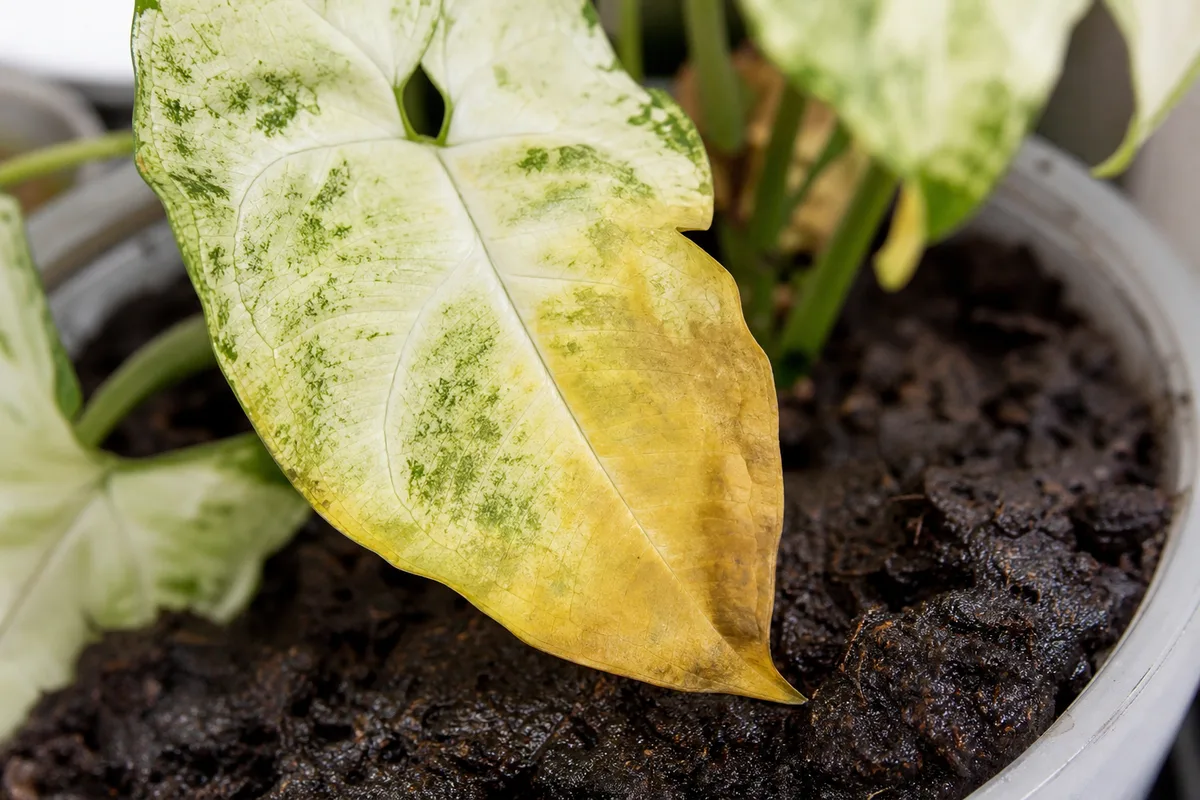
Overwatering symptoms on Syngonium White Butterfly - compare with healthy tissue on the same plant.
Early signs
- Limp arrowhead leaves while mix at the top inch stays moist or wet
- Heavy pot that does not lighten for many days after one watering
- Yellowing lower leaves, sometimes before upper juvenile foliage is affected
- Fungus gnats hovering near the surface-larvae thrive in moist potting media-when the mix stays damp for days
- White mold or algae on the soil surface
- Stalled new leaves with pale, washed-out white veining while older foliage hangs
Advanced signs
- Soft or dark stem bases where petioles meet the soil line
- Sour, musty, or rotten smell when you lift the plant or disturb the mix
- Wilting that returns within one to two days after you watered into already-wet soil
- Small, pale new arrowhead leaves that open weakly then collapse-variegated tissue photosynthesises less efficiently than green tissue, so chronic wet roots show up on slow new growth before the whole plant collapses
Healthy White Butterfly tissue is firm and springy on the stems. Overwatered lower leaves often turn soft yellow and may feel thin compared with the crisp, papery texture of severe underwatering.
The critical pattern: droop plus wet soil. Wilted leaves may indicate soil that is too dry or too wet-on White Butterfly, the wet-soil version means damaged roots cannot supply water to the leaves.
Overwatering vs. root rot vs. underwatering wilt - read the pot before you pour
The same limp arrowhead silhouette can mean three opposite problems. Only soil moisture, pot weight, and stem firmness separate them.
| Symptom pattern | Top inch | Pot weight | Stems | Likely cause | Where to go |
|---|---|---|---|---|---|
| Whole vine limp | Dry | Light | Firm | Underwatering | Underwatering |
| Whole vine limp | Wet | Heavy | Firm | Early overwatering | This page |
| Lower yellow, limp | Wet | Heavy | Softening | Advancing root stress / rot | Root rot |
| Small pale leaves, little limp | Moist cycles normal | Medium | Firm | Low light slow water use | Not enough light |
| Surface gnats, mold | Constantly damp | Heavy | Firm | Chronic wet mix | Fungus gnats |
This page covers early wet-soil intervention-firm stems, sour smell absent or mild, roots mostly firm on spot-check. Active root rot with mushy crowns and widespread black roots belongs on the root rot guide, which walks through full trim-and-repot salvage.
Why White Butterfly is sensitive to overwatering
The wilt paradox and droop-panic watering
White Butterfly recovers from a single dry episode faster than many houseplants, which trains owners to water on droop alone. When roots are failing instead of dry, each pour deepens the crisis. The fix for thirst and the fix for rot are opposites; only a soil probe and pot-weight check separate them.
Cool winter light and slow uptake
Missouri Botanical Garden recommends reducing watering from fall to late winter. In a dim December room, the same summer pour keeps roots saturated for weeks because photosynthesis slows and transpiration drops. Many overwatering cases start when summer habits continue in a cool corner.
Oversized pots, dense peat, and cachepot standing water
This tropical perennial is often sold in moisture-retentive peat-heavy nursery mix inside a decorative cachepot with no drainage. Runoff pools at the bottom; the inner pot wicks standing water back up. Fine roots circle a small root ball inside an oversized wet zone that never dries.
Fine aroid roots and oxygen need
Syngonium has adventitious, succulent stems with fine roots that need air as much as moisture. When mix compacts or stays waterlogged, roots in saturated soil cannot absorb the oxygen they need. Oxygen drops, fine roots die, and the plant cannot move water to leaves even though the pot feels heavy.
White Butterfly variegation under chronic wet roots
Pale white sectors on juvenile arrow leaves carry less chlorophyll than green tissue. When roots stay chronically wet in low light, new leaves may emerge smaller with faded silvery veining while growth stalls-often before stems soften. That pattern overlaps with not enough light, but wet soil plus heavy pot weight points to overwatering first.
How to confirm the cause
Work through these checks before repotting:
- Soil moisture at top inch - Press your finger to the first knuckle. Moist or wet at that depth many days after watering confirms saturation, not a one-time mistake.
- Pot weight - Lift the nursery pot. Heavy with limp foliage points to waterlogged mix; light with limp leaves suggests underwatering instead.
- Stem firmness - Squeeze tissue at the soil line. Firm stems are reassuring; soft or denting bases mean escalate toward root inspection.
- Smell - Neutral or earthy is fine; sour or rotten means active decay.
- Leaf pattern - Soft yellow on multiple lower leaves plus wet soil fits overwatering. Crisp edges with dry soil fits drought.
- Drainage check - Water should exit drainage holes within minutes. Saucer water sitting for hours means roots may stand in liquid.
- Light and season - Note room brightness and month. Dim, cool conditions extend drying time; see not enough light if light is the compounding factor.
- Root spot-check (if unsure) - Slide the plant out gently. Healthy syngonium roots are firm and white or tan; brown, slimy roots that collapse between fingers confirm advanced damage-see root rot next.
If mix is dry throughout, the pot is light, and leaves perk after one deep soak, underwatering is more likely. Do not withhold water further without checking.
First fix for Syngonium White Butterfly
Stop watering until the top inch of mix is dry.
That single pause lets oxygen return to the root zone and breaks the cycle of wet soil → failed uptake → “it looks thirsty” → more water. Move the pot to brighter indirect light if it has been in deep shade-faster photosynthesis uses water and helps the mix dry evenly without scorching pale variegated tissue.
Pull the nursery pot out of any decorative outer shell so air reaches bottom holes. Empty saucer water within 30 minutes of any past watering.
Do not fertilize, mist heavily, or repot on day one unless stems are already soft or roots are clearly mushy on inspection. Most early overwatering cases stabilize with dry-down plus better light alone.
Step-by-step recovery
Mild overwatering (yellowing lower leaves, wet mix, firm stems)
- Hold water until the top inch is dry, then water thoroughly once and pour off excess from the saucer within 30 minutes.
- Adjust placement - Bright, indirect light speeds recovery; avoid direct sun on stressed pale leaves.
- Remove spent yellow leaves - They will not re-green; snip at the base once the plant is stable.
- Monitor new growth - A fresh arrowhead leaf with firm white veining means roots are working again.
Moderate overwatering (persistent wet mix, multiple yellow leaves, fungus gnats)
- Scrape the top inch of moldy or gnat-infested surface soil and discard it.
- Let the pot dry until the top inch is dry-this may take one to two weeks in cool rooms.
- Set yellow sticky traps near the pot to reduce adult gnats while soil dries-see fungus gnats.
- Resume watering only when the finger test passes; never on a fixed weekday.
Severe overwatering (soft stems, sour smell, mushy roots on unpotting)
- Unpot and rinse roots under lukewarm water.
- Trim all brown, mushy roots with clean scissors, keeping firm white or tan tissue.
- Repot into fresh airy mix-a soil-based potting mix with good drainage amended with perlite or orchid bark-in a pot only slightly larger than the root ball, with drainage holes.
- Wait five to seven days before the first light watering so cut roots callus.
- Propagate firm stem sections above the rot line if the crown is fully soft-see root rot for salvage criteria.
Wear gloves when handling trimmed tissue. Arrowhead plant is toxic to pets-keep cut leaves and old soil away from dogs and cats.
Recovery timeline and what to expect
Stabilization often takes one to two weeks after you stop watering and the top inch dries-wilting should ease before new leaves appear.
New arrowhead leaves are the best success signal. Expect them in two to four weeks during spring or summer active growth; winter recovery may take longer in cool, dim rooms.
Old yellow leaves will not turn green again. They may drop on their own or stay until you trim them.
Worsening signs: stems soften further after dry-down, yellowing spreads up the vine, or new leaves emerge small and pale then collapse-those point toward active rot, not simple overwatering.
Case note: A White Butterfly in a 6-inch peat-heavy mix, watered weekly in a dim December room, can stay heavy eight days after one pour. After pausing water, letting the top inch dry, trimming roughly 15 percent mushy root tips, and repotting into airy mix with added bark, many growers see the first firm new leaf within 10 to 14 days once light and drainage improve. Your timeline depends on how long roots were saturated and how much tissue was trimmed.
What not to do
Do not water because leaves look limp when soil is already wet-that feeds the failure loop. Avoid repotting into garden soil or a much larger pot; both hold excess moisture around fine roots.
Do not fertilize a waterlogged plant; salts on damaged roots add stress. Skip misting as a fix; it does not dry wet roots.
Do not assume “moist-loving” means constantly wet. The target is lightly moist, airy soil between waterings-not a permanently wet swamp.
Do not bone-dry the entire root ball in winter as panic correction; dry-down means the top inch passes the finger test, not a desiccated block that shrinks from the pot wall.
When unpotting or trimming, keep debris away from pets-arrowhead tissue contains calcium oxalate crystals that irritate mouths if chewed.
How to prevent overwatering on White Butterfly
Match water to soil dryness, not the calendar. Check your plant every 7 to 10 days in spring and summer and every 14 to 21 days in fall and winter, but water only when the top inch is dry-details in the White Butterfly watering guide.
Lift before you pour-learn the pot’s weight after a full drink versus when the top inch has dried. That habit beats any fixed weekly schedule.
Empty cachepots and saucers within 30 minutes of every watering so roots never stand in runoff.
Reduce frequency in winter or dim rooms-reduce watering from fall to late winter when growth slows.
Use well-draining potting mix in a pot with open drainage. Size up only when roots crowd the pot so excess mix does not stay wet around a small root ball.
When to escalate to root rot recovery
Escalate immediately if stems dent at the soil line, soil smells rotten, or more than a third of roots are mushy on inspection. Those signs mean active root rot-dry-down alone is unlikely to save the plant.
Slow yellowing on one or two lower leaves with firm stems and mix that dries normally within a week can wait for a schedule adjustment on this page.
If the crown softens while mix stays wet for ten or more days, shift to the root rot guide before the last firm stem section is lost.
Related White Butterfly guides
| Your situation | Start here |
|---|---|
| Wet soil, early yellow, need dry-down protocol | This page |
| Everyday moisture rhythm and pot-weight learning | Watering |
| Dry soil, light pot, perks after soak | Underwatering |
| Mushy roots, trim and repot workflow | Root rot |
| Gnats on constantly damp surface | Fungus gnats |
| Dim room, faded white veining, slow dry-down | Not enough light |
Conclusion
Overwatering on Syngonium White Butterfly is a moisture-timing problem masked by dramatic wilt. Confirm it with wet mix at the top inch plus limp arrowhead leaves on a heavy pot, then stop watering until that layer dries. Adjust light, drainage, and pot size so fine aroid roots breathe between drinks. White Butterfly rewards correct dry-down with firm new silvery leaves; it rarely forgives roots that never get oxygen.