Drooping Leaves on Tradescantia Nanouk: Causes, Checks &
Quick answer
Drooping leaves on Tradescantia Nanouk are turgor loss-limp pink-and-cream stems hanging along trailing vines. Lift the pot first: a dry, lightweight container needs a thorough soak; a wet, heavy pot with yellow lower leaves means damaged roots, not thirst. Many healthy Nanouks perk within hours after correct watering.
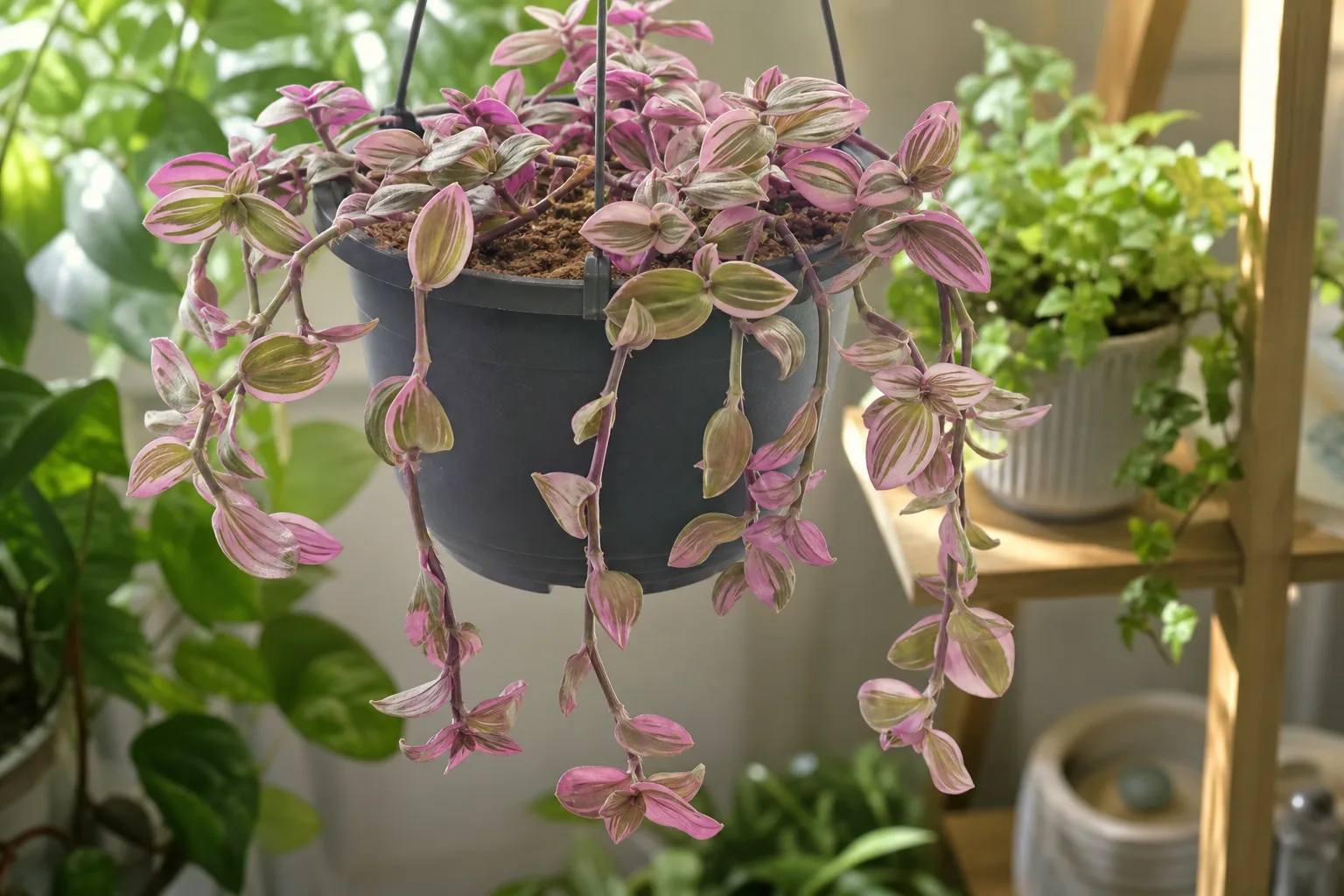
Drooping Leaves on Tradescantia Nanouk: Causes, Checks & Fixes
This guide covers drooping leaves on Tradescantia Nanouk. See also the general Drooping Leaves guide, watering, and light pages for this plant.
Drooping Leaves on Tradescantia Nanouk: Causes, Checks & Fixes
Quick answer
Tradescantia Nanouk (Tradescantia albiflora ‘Nanouk’, sold as Fantasy Venice) shows drooping leaves when stems lose turgor-the internal water pressure that keeps thick pink-and-cream foliage upright along trailing vines. Unlike a single wilted leaf, droop usually means whole stems hang limply while the plant still looks alive.
The critical fork is soil moisture, not leaf color alone. A dry, lightweight pot with limp stems almost always means underwatering-give a thorough soak and recheck in four to six hours. A wet, heavy pot with yellow lower leaves means roots cannot move water even though the mix is damp-stop watering and inspect roots before you add more. Full watering context lives in our Tradescantia Nanouk watering guide.
First step: lift the pot and push your finger into the top inch of mix. Never assume drooping always means “needs water.” Nanouk’s colorful thick leaves can stay pretty while stems droop from root failure underneath-a diagnostic trap covered in detail below.
What drooping leaves looks like on Tradescantia Nanouk
Healthy Nanouk holds firm, slightly succulent leaves on upright to gently arching stems. Drooping changes that silhouette along the trailing vines, not always at every leaf at once.
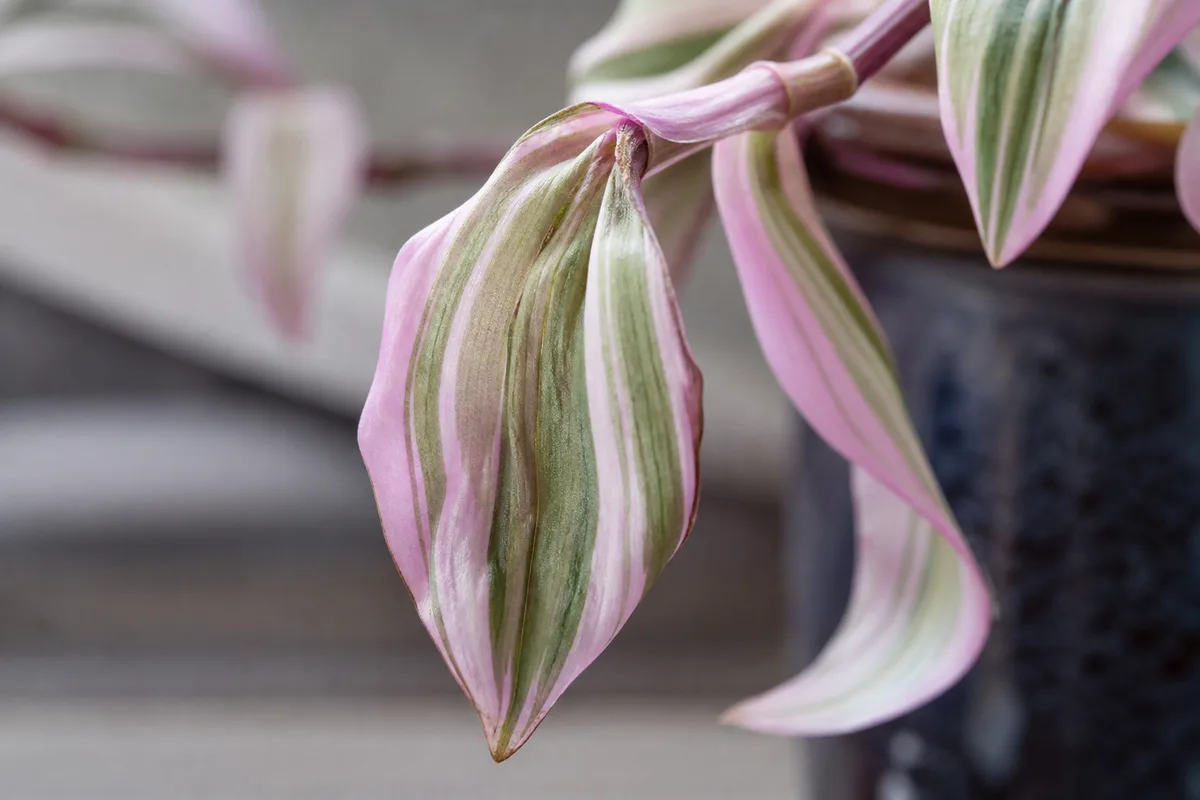
Drooping Leaves symptoms on Tradescantia Nanouk - compare with healthy tissue on the same plant.
Dry-soil droop (most common in bright rooms):
- Whole stems hang limply along the pot edge or basket rim
- Leaves feel soft and less plump, sometimes with crispy brown edges on older foliage
- Mix at the top inch is dusty, pale, or pulled slightly away from the pot wall
- Pot feels noticeably light when lifted
- Stems stay firm at the base, not mushy
Wet-soil droop (more dangerous):
- Stems droop even though soil looks dark and feels cool
- Yellow lower leaves that do not match normal aging
- Pot feels heavy; surface may stay damp for days
- Stem bases near the soil line may feel soft or translucent
- Faint sour smell from drain holes or fungus gnats hovering at the surface
Hanging-basket cascade droop:
- Trailing growth dries faster than roots in a floor pot
- Outer vines droop first while the crown still looks perky
- Weight check is more reliable than a finger test when the basket hangs high
What drooping is not:
- One or two lower leaves yellowing and dropping on an otherwise firm plant (normal senescence)
- Brief afternoon limpness in a hot bright window that recovers by morning (transpiration-see lookalikes)
- Leggy pale stretch toward a dim corner without immediate limpness (insufficient light-see not enough light)
For acute whole-plant collapse within hours, see wilting on Tradescantia Nanouk-drooping leaves here usually describes gradual stem limpness you notice over a day or two, though both pages share the same dry-vs-wet correction fork.
Why Tradescantia Nanouk leaves droop
Nanouk is a fast-growing trailing Tradescantia with thicker, more rigid leaves than classic T. zebrina. That physiology changes how droop appears and how fast the plant recovers.
Turgor loss and trailing-vine physiology. Water moves from roots through stems into leaves. When uptake cannot keep pace with transpiration-or when damaged roots cannot absorb at all-stems lose stiffness first along long trailing sections. Bright indirect light with some morning sun increases legitimate water use; a plant in a sunny window legitimately dries faster than one in a dim corner.
Dry-soil thirst (fast droop, same-day recovery). Nanouk often wilts within hours of the root zone drying and perks back the same day after a thorough drink when roots are still healthy. That expressiveness is useful: quick recovery after watering confirms thirst, not rot. Repeated drought still weakens fine root hairs and can leave lower stems bare over time.
Wet-soil root failure (droop despite moisture). Saturated mix displaces oxygen around roots. Without oxygen, roots cannot function normally, and water-mold pathogens can invade weakened tissue in anaerobic conditions. The plant may droop even though soil is wet-because damaged roots cannot move water into the shoots. Overwatering is among the most common houseplant problems, with symptoms including yellowing lower leaves, soft rotting stems, and a plant that looks wilted despite moist soil.
Heat transpiration in bright windows. On hot afternoons, Nanouk in strong light may look slightly limp while soil moisture is actually adequate. If stems firm overnight without extra watering, you witnessed normal transpiration-not a watering mistake.
Thick leaves masking early root stress. Nanouk’s showy pink-and-green foliage can stay attractive while the base fails. Do not wait for pretty leaves to tell the whole story-check pot weight, stem firmness, and soil moisture at the top inch before you decide.
How to confirm the cause (six-step checklist)
Work through these checks in order. One pot-weight reading beats guessing from photos alone.
- Lift the pot - Compare weight to how it felt right after a thorough watering. Light and dry supports underwatering; heavy and cool supports overwatering.
- Finger or skewer at top inch (2.5 cm) - Dry, dusty surface means water if stems are limp and bases are firm. Clingy, dark soil means wait-even if leaves look tired.
- Stem base firmness - Press gently where stems meet soil. Mushy or translucent tissue on wet mix points to rot-see root rot on Tradescantia Nanouk.
- Which leaves failed - Yellow lower leaves on damp soil fit root stress. Crispy edges on outer leaves with dry soil fit thirst. Even stippling on undersides with dry heated air may point to spider mites or low humidity.
- Recent care changes - Repot, move, heat wave, or vacation skip shifts the answer. Drooping days after repot into a much larger pot often means the new volume stays wet too long.
- Response test (dry branch only) - If top inch is dry and bases are firm, water thoroughly until drain, empty the saucer, and recheck in four to six hours. Perking confirms thirst. Staying limp on wet soil after a soak means inspect roots-not another drink.
You have confirmed underwatering when the pot is light, top inch is dry, bases are firm, and stems perk within hours of a thorough soak. You have confirmed overwatering or root stress when soil stays wet, lower leaves yellow, bases soften, or limpness persists after correct watering on already-damp mix.
Dry-soil vs. wet-soil droop comparison
| Signal | Dry-soil droop (underwatering) | Wet-soil droop (overwatering / root issue) |
|---|---|---|
| Pot weight | Light | Heavy |
| Top inch | Dry, dusty, sometimes pulled from wall | Cool, clingy, slow to dry |
| Stem bases | Firm | Soft or translucent possible |
| Lower leaves | Crispy edges; may stay green | Yellowing on wet soil |
| Smell | None | Sour or musty possible |
| After thorough soak | Perks within hours | Stays limp or worsens |
| First action | Soak until drain | Stop water; inspect roots |
First fix for Tradescantia Nanouk
Match action to what you confirmed-one targeted correction first, not Tradescantia Nanouk repotting guide, fertilizer, and pesticide on the same day.
Dry path: thorough soak and recheck in four to six hours
When the pot is light, the top inch is dry, and stem bases are firm:
- Water evenly across the soil surface until water runs freely from drainage holes.
- Wait thirty seconds and water once more if the first pass channelled through very dry peat.
- Empty the saucer or cachepot completely. Never let Nanouk sit in standing water.
- Blot splashed water from leaf axils if you watered from above.
- Place in bright indirect light and recheck stem firmness in four to six hours.
If stems perk, adjust your check frequency slightly earlier-hanging baskets in summer may need inspection every two to three days. If limpness persists after a thorough soak on soil that was already damp, switch to the wet path.
Wet path: stop watering, improve airflow, inspect roots when needed
When soil stays wet, lower leaves yellow, or bases feel soft:
- Stop watering immediately. More water never fixes root dysfunction.
- Move to bright indirect light with gentle airflow-not a stagnant corner.
- Slide the plant from the pot and inspect roots within a few days if softness or yellowing continues. Healthy roots are white to cream and firm; rotting roots are brown, gray, or mushy.
- Trim mushy roots with clean tools, repot into fresh airy mix only if you found decay-see root rot for the full recovery sequence.
- Save healthy stem tips for propagation if the crown is too far gone-Nanouk cuttings root quickly as backup.
Recovery timeline
Old limp or yellow tissue does not always return to perfect form. Judge recovery by new growth and stem firmness, not by expecting every damaged leaf to stand upright again.
- Dry-soil droop with healthy roots: Stems often firm within four to six hours after a thorough soak; full turgidity along long trailers may take until the next morning.
- Single missed watering: Cosmetic edge crisping on older leaves may remain, but new tips should look plump within a few days once rhythm stabilizes.
- Wet-soil / root-trim recovery: Expect one to three weeks before new growth looks normal; severely trimmed root systems need modest watering and patience.
- Heat-transpiration afternoon droop: Firms overnight without extra water when soil moisture was already adequate.
If new leaves emerge smaller, stems stay soft at the base, or yellowing spreads up the plant while soil stays wet, escalate to root inspection within days-not weeks.
When to route to sibling problem pages
Use these paths once you know which branch fits:
- Chronic dry pots, crispy tips, lightweight soil → underwatering on Tradescantia Nanouk
- Yellow leaves on wet soil, fungus gnats, slow growth → overwatering
- Mushy roots, sour smell, crown collapse → root rot
- Acute whole-plant flop within hours → wilting
- Crispy margins without watering mismatch; hygrometer below 40% → low humidity
- Stippling, webbing, gritty undersides in dry heat → spider mites
- Baseline culture, seasonal rhythm, pot and mix → watering and overview
Lookalike symptoms to rule out
| Pattern | Likely cause | First direction |
|---|---|---|
| Limp stems; dry light pot; firm bases | Underwatering | Thorough soak; recheck in 4–6 hours |
| Limp stems; wet heavy pot; yellow lowers | Overwatering / root stress | Stop water; inspect roots |
| Afternoon limp; firms by morning; normal soil | Heat transpiration | No extra water; confirm overnight |
| Pale stretch; weak stems; soil moist | Insufficient light | Move brighter; see light guide |
| Crispy margins; firm stems; dry air | Low humidity | Hygrometer; see low humidity |
| Stippling + webbing on undersides | Spider mites | Rinse undersides; see spider mites |
| Soft crown; sour soil; black roots | Root rot | Trim, repot, propagate backups |
What not to do
- Do not water because leaves look limp when soil is already wet. That deepens root rot on Nanouk faster than a missed dry day.
- Do not fertilize a drooping plant before you confirm moisture and root health. Feed only after new growth looks firm on a stable watering rhythm.
- Do not repot on day one for simple dry-soil droop-water correctly first. Repot when you confirm rot, failed dense soil, or severe compaction.
- Do not stack repotting, heavy pruning, and pesticide on the same rescue day. Nanouk tolerates one correction at a time.
- Do not assume afternoon droop in a bright window is always pathology-check whether stems recover overnight before you add water.
How to prevent drooping leaves next time
- Water when the top inch of mix dries, then soak until drain and discard saucer water-never on a calendar alone.
- Lift hanging baskets every few days in active season; they dry faster than floor pots.
- Keep bright indirect light with some morning sun so water use stays predictable-see our light guide.
- Use drainage holes and airy mix amended with perlite; dense peat that never breathes causes wet-soil droop even when you water “correctly.”
- Slow winter watering when growth drops; the same July frequency in January keeps mix soggy.
- Inspect stem bases weekly during routine care so soft tissue is caught before the crown collapses.
Stable watering tied to dryness checks-not guesswork from leaf appearance alone-keeps Nanouk’s trailing stems firm through the growing season.
Practical checks
Urgency check
Treat as urgent if stem bases soften, rot smell spreads, several vines collapse at once while soil stays wet, or limpness worsens within days despite corrected dry-soil watering. A single dry spell with firm bases and quick perk after soak is lower urgency-adjust check frequency.
Best inspection order
Pot weight → top-inch moisture → stem base firmness → lower-leaf color → light and placement → leaf undersides for pests if stippling appears.
Severity note
Use spreading yellowing, soft bases, and failure to perk after a correct soak-not one limp outer vine on an otherwise firm plant-to decide how fast to unpot and trim roots.
Related Tradescantia Nanouk problems
- Watering schedule and wilt signs - authoritative hub for the top-inch-dry rule and dry-vs-wet fork
- Wilting - acute collapse within hours
- Underwatering and overwatering
- Root rot
- Tradescantia Nanouk overview
When to use this page vs other Tradescantia Nanouk guides
- Tradescantia Nanouk watering guide - Use for routine moisture checks before assuming drooping leaves is the main issue.
- Tradescantia Nanouk problems hub - Browse all 2 common issues on this species.