Fungus Gnats on Zinnia: Causes, Checks & Fixes
Quick answer
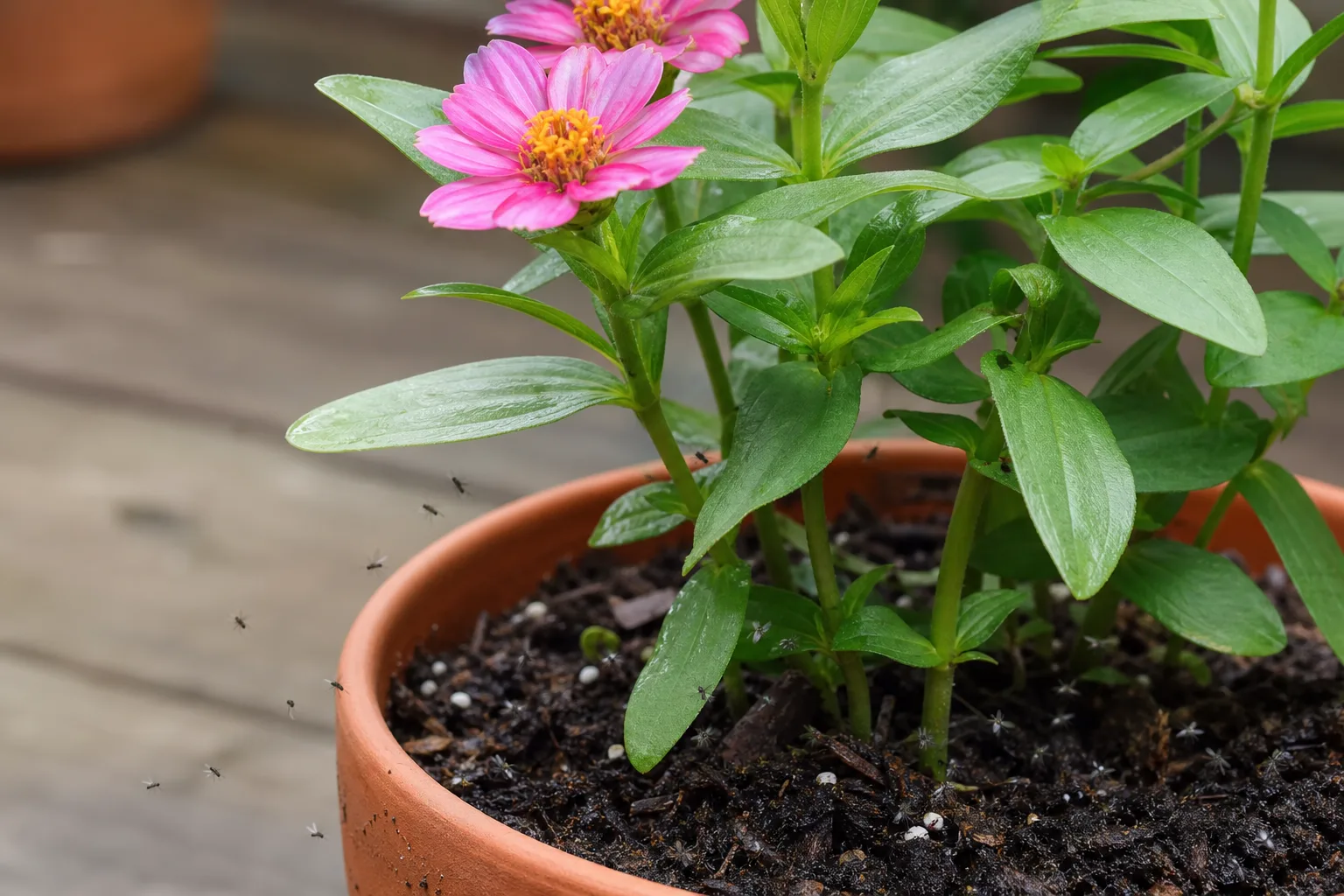
Fungus gnats on Zinnia mean soil stays too wet-most common on indoor seed flats and overwatered patio pots. First step: let the top 2–3 cm dry completely and place yellow sticky traps at tray level.
Fungus Gnats on Zinnia: Causes, Checks & Fixes
This guide covers fungus gnats on Zinnia. See also the general Fungus Gnats guide, watering, and light pages for this plant.
Fungus Gnats on Zinnia: Causes, Checks & Fixes
Quick answer
Small dark flies hovering over a zinnia seed flat or patio pot almost always mean the mix stays wet too long-especially peaty seed-starting media kept moist for germination but never shifted to post-emergence dry-down. Zinnias germinate fast, often within four to eight days at 70–75°F, so flats that made sense under a humidity dome become a fungus-gnat nursery within a week if the surface never dries.
First step: let the top 2–3 cm of mix dry completely, remove any humidity dome, and place yellow sticky traps at tray level. Adults are harmless but annoying; larvae live in the damp top layer feeding on fungi and decaying organic matter. Drying that layer breaks the cycle faster than spraying the air.
If stems pinch, darken, or topple at the soil line while gnats persist, treat it as possible damping-off and act the same day-not as flies alone.
Why Zinnia gets fungus gnats
Zinnia (Zinnia elegans) is a warm-season annual that wants full sun and freely draining soil once established. Fungus gnats are almost always a seed-starting or container culture problem, not something mature zinnias in sunny June beds typically show.
The germination moisture paradox. Zinnia seeds need consistent surface moisture to sprout. Growers cover flats with humidity domes and keep peaty mix wet on top-correct for the first few days. After cotyledons open, that same wet surface breeds fungus gnats and invites damping-off organisms. The care shift from “keep moist for germination” to “let the surface dry between bottom-waters” must happen quickly on a fast-germinating crop.
Peat-heavy seed mix that never dries. Fungus gnat females lay eggs in cracks on moist growing media, especially peat-heavy mixes that stay damp on the surface. Organic-rich peat and coco coir hold surface moisture when evaporation is slow-common under grow lights without airflow or in cool rooms where zinnias grow slowly.
Overhead watering and sealed domes. Misting trays or leaving domes on after sprouting keeps the top layer saturated for days. Bottom-watering can supply roots while leaving the surface dry-but only if you drain the tray and let the top 2–3 cm dry between sessions.
Cool, slow-growing flats. Zinnias germinate best around 21–24°C (70–75°F) and above. Flats in a cool room with constantly wet mix stay in the gnat-friendly zone longer than fast-growing sprouts should.
Overwatered patio containers. Outdoor zinnias in full sun rarely show gnats. Potted zinnias on shaded patios or watered on a calendar without soil checks can hold damp organic mix at the surface-the same habitat gnats use indoors.
Fungus gnats often appear alongside surface mold on soil and chronic overwatering because all three share one trigger: mix that stays wet too long at the top.
What fungus gnats look like on Zinnia
Adult flies
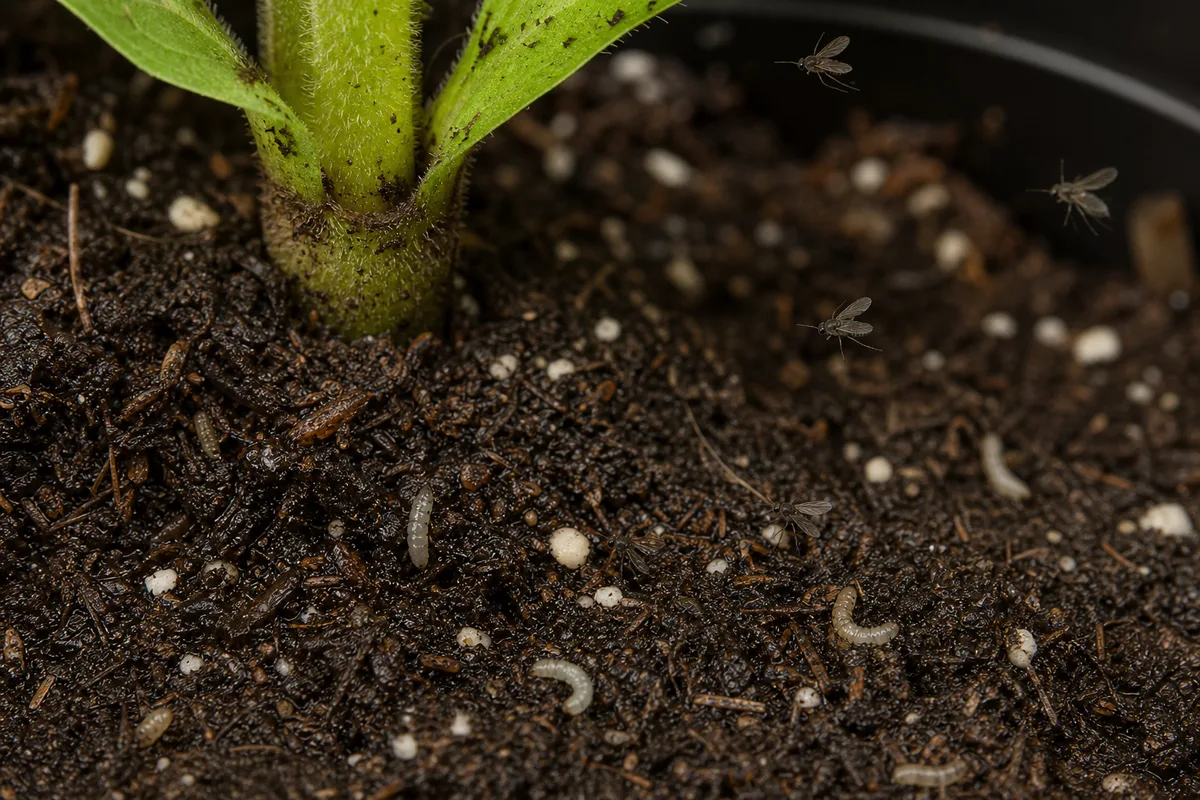
Fungus Gnats symptoms on Zinnia - compare with healthy tissue on the same plant.
- About 1/8 inch long, dark, mosquito-like, with long legs
- Wings folded on the back when resting; a distinct Y-shaped vein pattern near the wing tips when viewed with a magnifying glass
- Hover near the soil surface, walk across damp mix, and rise in a cloud when you water or tap the tray rim
- Collect on windows and grow lights but stay tied to the flat-not the fruit bowl
Larvae in the mix
- Translucent worms roughly 1/4 inch long when mature, with a black head capsule
- Live in the top 2 to 3 inches of moist peat, feeding on fungi, algae, and decaying organic matter
- Occasionally chew root hairs when numbers are high; on healthy zinnia seedlings larval damage is rare in home settings
On zinnia seedlings specifically
- Flies appear days to weeks after sprouting in a flat kept wet post-emergence
- Cotyledons may still look green while the soil surface stays dark and clings to your finger
- Slow growth or pale, leggy seedlings can follow if roots stay oxygen-poor in saturated mix-often the wetness, not gnat feeding, causes the stress
Established garden zinnias with gnats at the pot rim usually point to a container that never dries at the surface, not a random outdoor fly invasion.
Gnat lookalikes to rule out first
Fruit flies (Drosophila) - Attracted to kitchen waste, compost buckets, and overripe produce. They hover near sinks and fruit bowls, not only seed flats. Lack the Y-shaped wing vein pattern of fungus gnats.
Shore flies - Breed in algae on constantly wet surfaces. Short bristle-like antennae, not the long segmented antennae of fungus gnats. More common in greenhouses with standing water than on a typical home seed flat.
Springtails - Tiny white or gray jumpers in damp mix. Scavengers that rarely damage plants; they jump when disturbed. Fix with surface dry-down, not Bti.
Whiteflies - Tiny white insects on leaf undersides, not walking on soil. Require different management on foliage.
If flies stay over the zinnia tray after you remove kitchen fruit and the mix is still wet, fungus gnats are the likely ID.
How to confirm fungus gnats
Work through these checks before repotting every seedling or reaching for broad insecticides:
- Fly behavior - Do adults rise from the zinnia flat when you water or disturb the mix? Flies that ignore the tray and stay in the kitchen are probably fruit flies.
- Wing check - Catch one fly on a sticky card or trap and look for the rounded Y-shaped veins near the wing tips with a magnifying glass or phone macro lens.
- Surface moisture - Push a finger into the top 2–3 cm. If it stays damp for days after the last bottom-water, you have found the trigger gnats need.
- Humidity dome status - Domes still on after most zinnias have sprouted strongly favor gnats and damping-off. Remove domes once green cotyledons appear.
- Potato slice test - Place 1/4-inch potato slices cut-side down on the mix surface. Check the underside after three to four days for translucent larvae. This confirms immature stages without disturbing roots.
- Sticky trap count - Set one yellow sticky card at tray level. Note how many adults you catch per week after you begin dry-down-declining counts confirm the fix is working.
- Stem firmness - Pinch seedlings at the soil line. Firm green tissue supports moisture correction. Mushy or thread-thin bases mean remove that cell and read the damping-off guide.
- Context - Indoor peat flat in early spring? Very likely fungus gnats on wet culture. Mature zinnia in a July garden bed? Look for an overwatered container nearby instead.
Confirmed fungus gnats: flies tied to wet flat, larvae on potato slices or trap counts falling after surface dry-down, firm seedlings with no new collapses.
First fix for Zinnia
Let the top 2–3 cm of mix dry completely, remove humidity domes, and place yellow sticky traps at tray level.
Skip the next scheduled watering until the surface lightens in color and feels dry to the touch. This single correction removes egg-laying sites and kills larvae in dry surface mix. Zinnia seedlings tolerate brief surface dryness better than chronic wet feet-especially once cotyledons are open.
At the same time:
- Set sticky traps - One yellow card per flat, just above the soil line. Adults stick to the cards, reducing the next generation and giving you a weekly count to track progress.
- Bottom-water only after dry-down - When you resume, set the tray in shallow water until the mix darkens slightly below the surface, then lift and drain completely. Never leave flats sitting in standing water.
- Add airflow - A gentle fan reduces humidity around stems without flattening seedlings.
Do not stack Bti drenches, hydrogen peroxide flushes, and repotting on day one. Make one moisture correction first so you can read the response. Most mild gnat flares on otherwise firm zinnias stabilize within one to two dry-down cycles.
Step-by-step recovery if gnats persist
If sticky traps still catch adults after two weeks of corrected watering, add steps one at a time:
- Scrape the top 1–2 cm - Remove algae-coated or crusted surface mix where larvae concentrate. Discard scraped material; do not compost infected flat mix indoors.
- Top-dress with coarse sand or fine gravel - A 1–2 cm layer of sand or gravel keeps the surface drier and less attractive for egg laying.
- Apply Bti (Bacillus thuringiensis israelensis) - Products such as Mosquito Bits or Gnatrol target fungus gnat larvae in soil. Apply as a labeled drench with enough water to move the product through the top layer. Repeat every five to seven days for several applications because Bti does not affect eggs or pupae.
- Hydrogen peroxide soil flush (moderate infestations) - A 1:4 dilution of 3% hydrogen peroxide in water poured through the mix can kill larvae on contact. Let the surface dry afterward. Do not apply hydrogen peroxide and Bti the same day-wait at least 24 hours between treatments because peroxide can reduce Bti effectiveness.
- Thin crowded cells - One strong zinnia per cell improves airflow at the soil line.
- Repot survivors if chronic - When gnats and wet mix persist despite four weeks of corrected culture, transplant sturdy seedlings with several true leaves into individual pots with fresh well-drained mix rather than nursing a contaminated flat.
Hold fertilizer until seedlings have several true leaves and watering rhythm is stable.
Recovery timeline and what improvement looks like
Adult counts on sticky traps should drop noticeably within one to two weeks once the top 2–3 cm dry between bottom-waters. Larval treatments such as Bti may take three to four weeks to show full effect because adults already in flight are not killed by soil drenches.
Judge recovery on:
- Fewer adults on traps each week
- Surface mix that lightens in color between bottom-waters
- Firm stems at the soil line
- Clean new true leaves emerging without overnight collapses
Existing cotyledon edges may look imperfect; recovery means the problem stops spreading and new growth comes in clean. Zinnia seedlings that were only gnat-affected usually grow past the highest-risk period within one to two weeks in warm, bright conditions.
If trap counts stay high after four weeks of proper dry-down, or stems begin pinching at the base, assume the flat is compromised-discard collapsed plants, sanitize trays before the next sowing, and start a backup flat with sterile mix.
When fungus gnats signal damping-off on Zinnia
Fungus gnats and damping-off share wet peaty mix but differ in urgency. Gnats are often the first visible clue that a flat stays too wet. Damping-off rots stems exactly at the soil line-seedlings topple flat and cannot be saved once collapsed.
Treat gnats as a damping-off warning when:
- Stems water-soak or narrow to thread thickness at the base
- Multiple cells fail within 24–48 hours in the same tray
- White cobweb-like growth appears on stem bases
- Pre-emergence rot stops seeds from sprouting while mix stays cool and wet
In those cases, remove infected seedlings immediately, warm and dry the environment for survivors, and read the full damping-off on Zinnia guide before reusing trays or mix.
Chronic wet mix that breeds gnats can also progress to root rot in established container zinnias. Escalate if mature plants yellow on wet soil with soft stems, not just flies over an otherwise firm flat.
What not to do
Do not leave humidity domes on “until every seed sprouts” once most zinnias have emerged-domes trap moisture and extend gnat breeding.
Do not mist seedlings to “wash away” flies; you wet stems and keep the surface saturated.
Do not rely on sticky traps alone without drying the mix-traps catch adults but do not stop egg laying in wet peat.
Do not spray flying adults with aerosol insecticides indoors; spraying the air is ineffective and does not reach larvae in soil.
Do not apply hydrogen peroxide and Bti the same day without a gap between treatments.
Do not reuse mix or un-sanitized trays from a gnat-heavy flat for the next zinnia sowing.
Do not overhead-water seed flats after germination when bottom-watering is available.
Do not assume outdoor garden zinnias need larval drenches when the flies are actually coming from an indoor flat across the room-fix the wet tray first.
How to prevent fungus gnats next time
Shift watering at emergence. Keep mix moist for germination, then remove domes and switch to bottom-watering with surface dry-down per the zinnia watering guide post-emergence protocol.
Use sterile seed-starting mix and clean trays for each zinnia batch. Garden soil and reused flats import pathogens and hold moisture unevenly.
Warm and light from day one after sprouting. Fast zinnia growth in heat and bright light shortens the vulnerable seedling window.
Run gentle airflow across flats to discourage damp surfaces.
For container zinnias, water at the base when the top 2–3 cm dry, empty saucers after each drink, and place pots in full sun so mix dries predictably.
Transplant on time. Move sturdy zinnias to outdoor beds in well-drained soil once weather warms-outdoor zinnias in full sun rarely show indoor-style gnat problems.
Seed flats vs. containers vs. in-ground zinnias
Seed flats (highest gnat risk) - Peat mix, domes, and overhead habits keep surfaces wet. Bottom-water, remove domes at first sprout, use sticky traps at tray level, and watch for damping-off crossover. This is where most “fungus gnats on zinnia” searches originate.
Containers (moderate risk) - Potted zinnias on shaded patios or overwatered on a calendar can breed gnats in organic-rich mix. Fix drainage, move to full sun, and match the dry-down checks in the watering guide. Gnats here often pair with overwatering if lower leaves yellow on wet mix.
In-ground garden beds (low risk) - Established zinnias in full sun and well-drained soil rarely show fungus gnats. If you see small flies, trace them to a nearby indoor flat or an overwatered patio pot rather than treating the bed with soil drenches.
Related Zinnia guides
- Zinnia watering guide - post-emergence dry-down, bottom-watering flats, and container checks
- Damping off on Zinnia - stem pinching, tray recovery, and when seedlings cannot be saved
- Mold on soil on Zinnia - surface fuzz that shares wet-pea habitat with gnats
- Overwatering on Zinnia - yellow leaves, soft stems, and grey mould on blooms when roots stay saturated
- Root rot on Zinnia - escalation when chronic wetness damages established plants
Conclusion
Fungus gnats on zinnia are a moisture alarm on damp peat-not a reason to panic over every fly in the seed-starting room. Let the top 2–3 cm dry between bottom-waters, trap adults at tray level, and shift post-emergence culture from germination moisture to surface dry-down as fast as zinnias sprout. When stems stay firm and new true leaves emerge clean, gnat counts usually fall within one to two weeks. When stems pinch or seedlings topple, shift immediately to damping-off response-drying alone will not save collapsed cells.