17 Best Privacy Trees for Your Yard
Choose privacy trees for your fence, climate, and sightline. Compare evergreen and flowering picks, mature width, planting setbacks, and upkeep before buying.
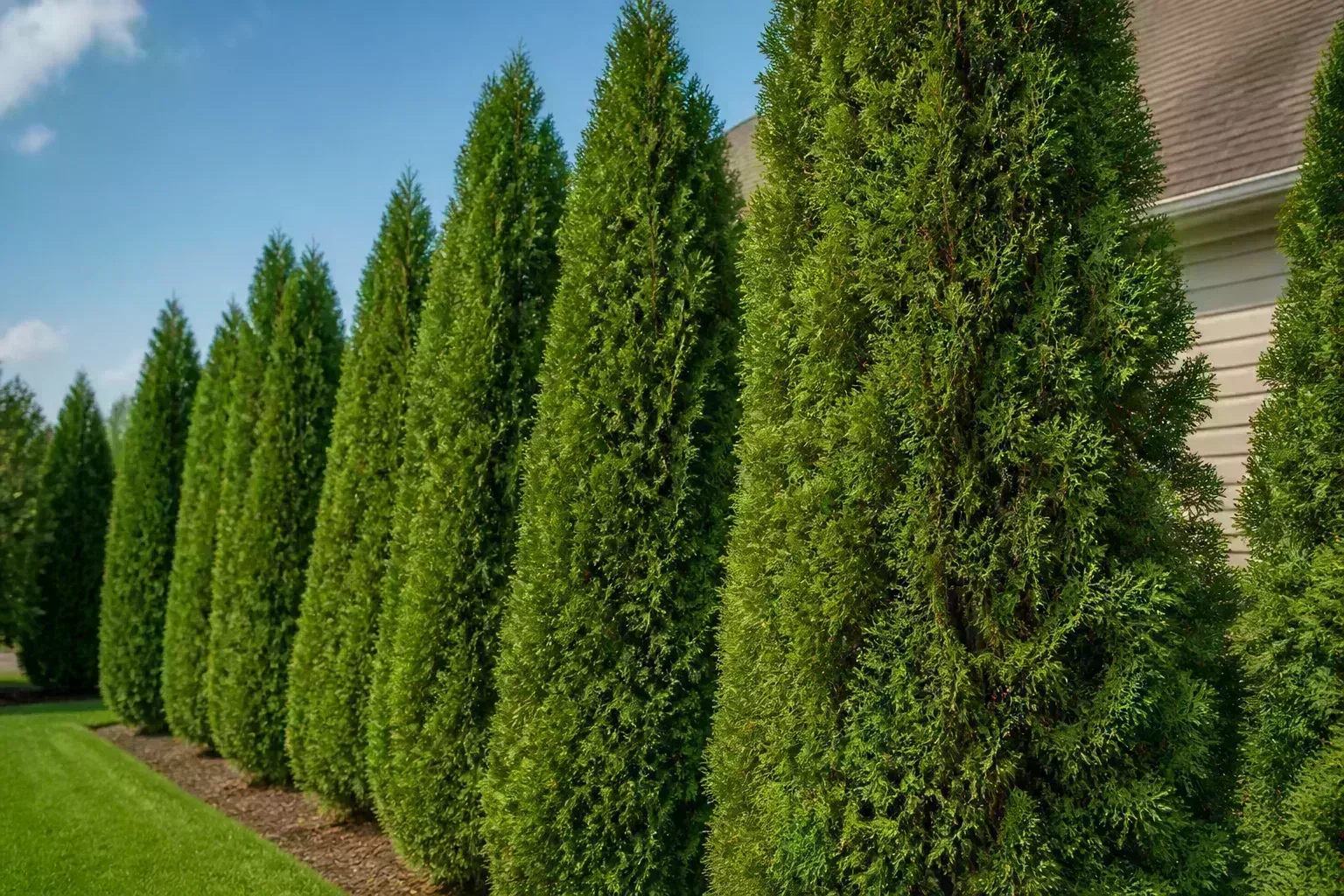
A tree can soften a fence and screen an upstairs window, a raised deck, or the seat where you actually spend time. The right choice depends on that sightline, not simply on which plant grows tallest. A compact evergreen may be enough to block one neighbor’s window; a row of fast-growing trees may consume too much space and become a pruning problem.
For dependable winter privacy, start with a dense evergreen and confirm the named cultivar’s mature width. Deciduous flowering trees provide summer screening, shade, blooms, and wildlife value, but they will not make an opaque winter wall. Several plants below are large shrubs or small trees rather than full-size trees; their listed role is useful, but their mature form still matters.
| If your priority is… | Start with… | Keep in mind… |
|---|---|---|
| A tidy evergreen row in a moderate-width bed | ‘Emerald Green’ arborvitae | It still needs space between trunks and for future access. |
| A narrow, dry-summer evergreen | ‘Spartan’ juniper | Needs sun and drainage; confirm the exact cultivar. |
| Evergreen privacy with flowers | Dragon Lady holly or tea olive | Climate and pollination needs differ; tea olive is frost-sensitive. |
| Summer shade and flowering interest | Flowering crabapple or crape myrtle | Both lose leaves; cultivar size and disease resistance vary. |
| A native, natural-looking screen | American hornbeam or blackhaw viburnum | Both are deciduous and regionally native, not universal choices. |
Emerald Green Arborvitae
‘Emerald Green’ or ‘Smaragd’ arborvitae (Thuja occidentalis) is one of the clearest fits when the job is a neat, narrow, evergreen screen. Its upright, dense foliage can cover a view in all seasons in climates where the cultivar is hardy, and it is usually a more realistic fence-line choice than a broad, full-size tree. Expect a mature plant roughly 10 to 15 feet tall and 3 to 5 feet wide, though nursery listings vary; buy from the actual cultivar dimensions, not a generic “arborvitae” label. Colorado State Extension lists ‘Emerald’ at about 10–12 feet tall and 4 feet wide, while NC State Extension catalogs multiple arborvitae forms.
The trade-off is that a uniform row creates a single point of failure: drought, deer browsing, or a local pest can damage the whole screen. Give each plant room according to its stated mature width, and do not shear the sides so tightly that the outside becomes a thin shell over shaded, bare interior branches. Where you have room, alternate a few species or use a mixed evergreen backdrop. For a formal, consistent effect on a moderate-width planting strip, however, this is a strong shortlist candidate.
Spartan Juniper
Chinese juniper ‘Spartan’ (Juniperus chinensis ‘Spartan’) forms a dense, narrow column and typically reaches about 15 to 20 feet tall. Its scale-like foliage stays evergreen, so it can rise above a fence without the width of a spreading ornamental tree. Junipers generally prefer sun and well-drained soil; established plants can handle some drought and urban conditions. NC State Extension describes ‘Spartan’ as a dense, symmetrical columnar cultivar.
Use it where the line gets plenty of light and you want a defined vertical accent or repeated narrow screen. It is a poor choice for a soggy bed, deep shade, or a place where you plan to trim repeatedly into bare old wood. Junipers are not interchangeable: many Chinese juniper cultivars are wide or low-spreading, while ‘Spartan’ is columnar. Check the botanical name and cultivar on the tag, and space plants using that cultivar’s mature spread rather than the size of the young pot.
Dwarf Italian Cypress
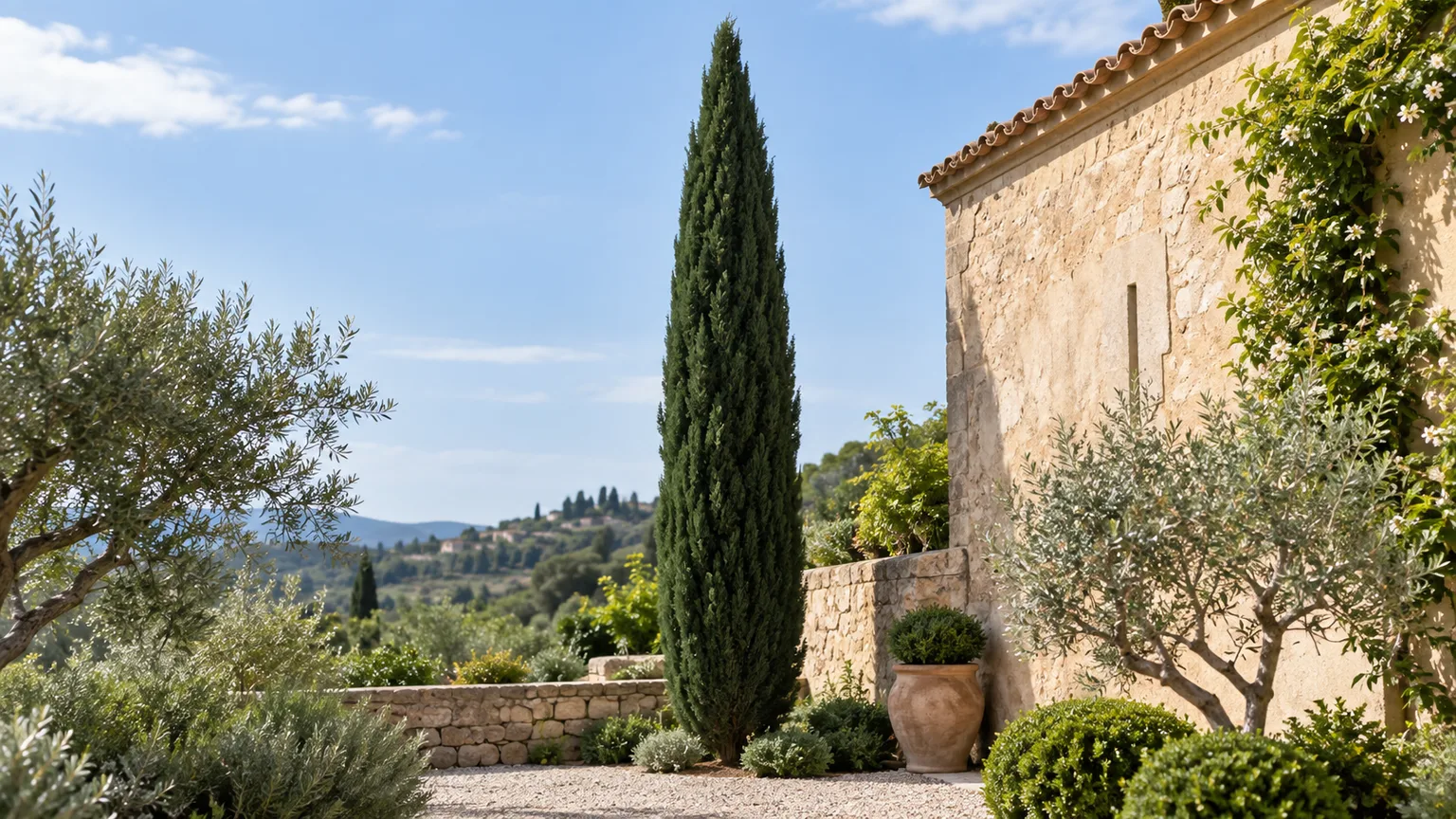
Italian cypress (Cupressus sempervirens) makes a strong architectural screen in climates with hot, dry summers and mild winters. Its narrow, upright habit uses little ground space and creates a vertical evergreen accent above a fence. The species can grow very tall, however, so “dwarf” is not a reliable size by itself: choose a named cultivar with a documented mature height and width, then verify that local nurseries grow it successfully. NC State Extension notes the columnar form and warns that poor drainage can cause root rot.
This is not a universal privacy tree for cold, wet, or humid sites. In a suitable dry-summer garden it can provide a crisp screen with little shaping; in a poorly drained bed it may decline despite careful watering. If you have a narrow strip, compare the mature width of the exact cultivar with the width needed for safe pruning and fence repairs. A row of Italian cypresses is most useful when you want a formal, tall silhouette—not a broad, leafy wall that also shades the yard.
Black Dragon Japanese Cedar
‘Black Dragon’ Japanese cedar (Cryptomeria japonica ‘Black Dragon’) is a compact evergreen for a smaller yard where a large cedar would overwhelm the fence line. It grows slowly into a dense, irregular pyramid, with foliage that deepens to dark green; Clemson Extension gives a mature size of roughly 8 to 10 feet tall and 4 to 6 feet wide. That makes it an accent or a small, repeated screen, not a fast privacy hedge that will fill a long boundary quickly. Clemson’s Japanese cryptomeria guide distinguishes ‘Black Dragon’ from the much larger species and other cultivars.
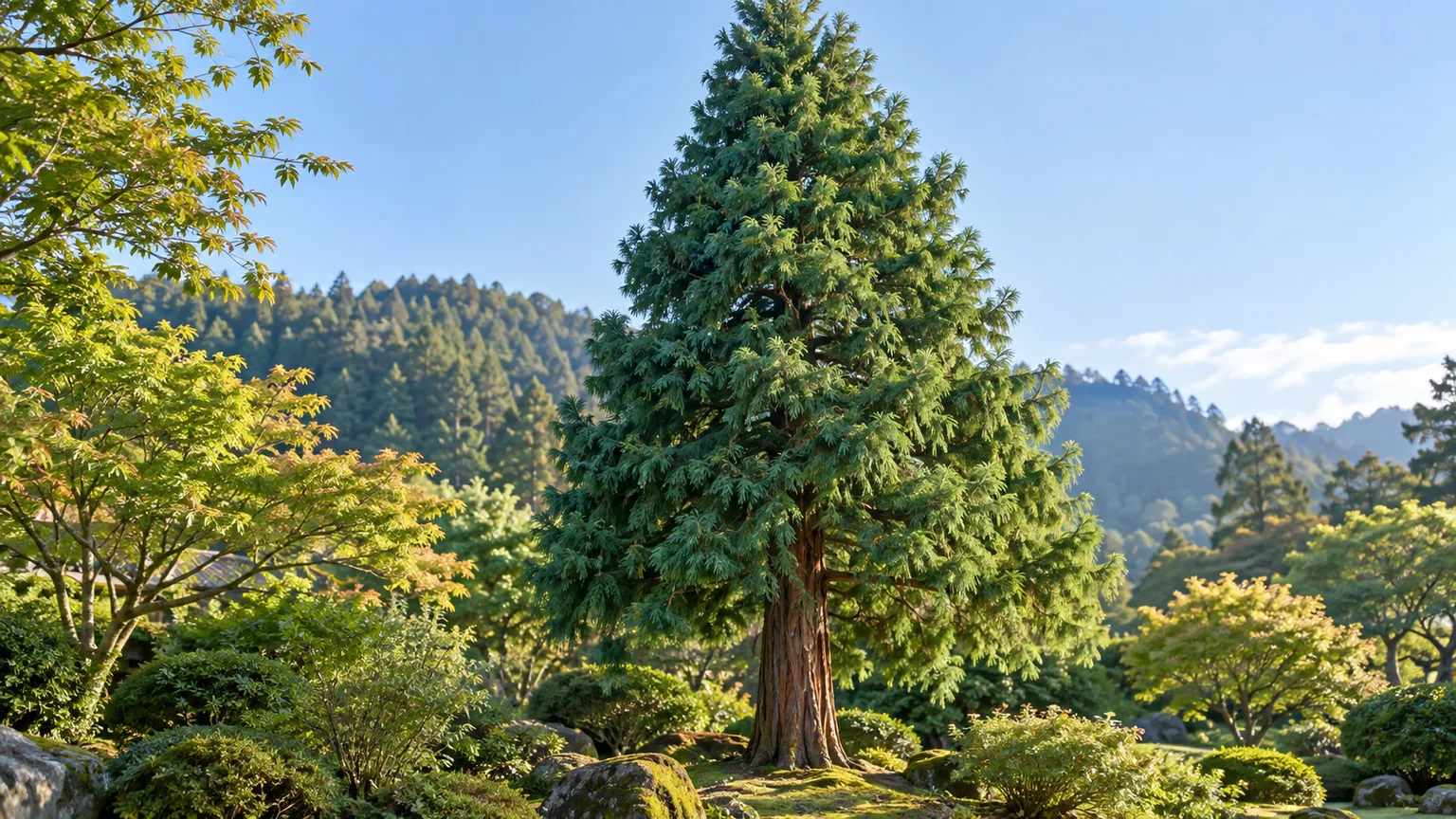
The variety’s asymmetrical form adds texture, but it will not produce the perfectly matched vertical columns of a sheared hedge. Give it room to develop its natural shape and buy a correctly labeled plant; regular Japanese cedar can become a very large tree. If you need immediate opacity or a long, low-cost screen, select a faster, narrower plant. Choose ‘Black Dragon’ when year-round foliage and character matter more than quick coverage.
Dragon Lady Holly
Dragon Lady holly (Ilex × aquipernyi ‘Dragon Lady’) is a narrow, broadleaf evergreen that can screen above a fence while offering a different texture from needled conifers. It is suited to cooler conditions and is often used as a female fruiting cultivar. For red berries, it needs a compatible male holly nearby; Virginia Tech’s extension guide names ‘Blue Stallion’ as a suggested pollinator. The berries are ornamental, not snacks—Poison Control warns that holly berries can cause poisoning if eaten.
This holly is a better fit where a year-round leaf screen and a formal outline are wanted, and where its mature height fits the site. Do not buy it assuming one plant will produce berries on its own, and do not assume it will thrive in a hot, exposed afternoon location. Ask a local nursery which male pollinator blooms at the same time and grows well in your climate. Keep fallen berries and pruning debris away from children and pets that chew plants.
Skip Laurel
Skip laurel is the cultivar Prunus laurocerasus ‘Schipkaensis’, a broadleaf evergreen shrub or small tree. It can reach roughly 10 to 15 feet tall and 5 to 7 feet wide, with upright growth that makes a useful screen in a wider fence bed. Its glossy leaves stay on in mild climates, and the plant tolerates pruning, but its lower branches may be more open than its upper canopy. NC State Extension describes its size, shape, and screening use.
Before choosing it, check your state or regional invasive-plant guidance. Cherry laurel has escaped cultivation in western Washington, where the state places it on a monitor list; King County discourages new plantings because it has spread into parks and forests. Status varies by region, so “evergreen” and “easy to clip” do not mean appropriate everywhere. Check the Washington State Noxious Weed Control Board’s regional note. It also needs a wider planting strip than a narrow columnar conifer. Skip laurel can be a workable, adaptable screen where locally recommended and where there is room for its mature width; where it is listed as invasive or spreads readily, choose a locally suitable alternative.
Little Gem Magnolia
‘Little Gem’ southern magnolia (Magnolia grandiflora ‘Little Gem’) offers broad, glossy evergreen leaves and fragrant white flowers on a smaller scale than the species. NC State Extension describes it as a compact, slow-growing small tree that reaches about 15 to 20 feet tall and 8 to 10 feet wide over time, with flowers that may begin while the tree is still young. Its coverage is substantial for a small ornamental, though a single specimen will not instantly block a full fence line. See the cultivar’s profile for its size, climate, and leaf-drop notes.
The “Little” name should not be read as “tiny”: allow for its width and the space needed to work around it. It performs best in a suitable warm climate and can shed leaves in spring and fall, so it is not a zero-litter screen. Use it as a flowering evergreen focal point above a fence, or combine it with lower planting to cover gaps. Avoid placing it where dry or waterlogged soil is a regular problem.
Fragrant Tea Olive
Fragrant tea olive (Osmanthus fragrans) is a dense evergreen shrub that can be trained as a small tree. It typically grows about 10 to 20 feet tall and 10 to 14 feet wide, so it is better suited to a deep bed than to a narrow path along the fence. Small flowers have a powerful fragrance and may appear in spring and fall. NC State Extension recommends sun to partial shade, moist but well-drained soil, and afternoon shade in southern climates; the species is also frost-sensitive. Read its regional guidance before selecting it for a screen.
Choose tea olive where you can give it room and want evergreen foliage, fragrance, and a softer multi-stem shape rather than clipped uniformity. It can be pruned into a tree form, but hard shaping can remove the growth that carries future flowers. In a colder region, do not rely on it as an outdoor year-round screen without local confirmation of winter performance. Its mature spread is as important as its height: a plant that fits above the fence but crowds the gate is the wrong plant for the spot.
American Hornbeam
American hornbeam (Carpinus caroliniana), also called musclewood or blue beech, is a deciduous North American native tree with a broad but relatively modest crown. Its smooth, fluted trunk, dense branching, and orange-red fall foliage give it interest beyond the leaf-on season. Unlike a solid evergreen wall, it gives summer privacy and shade, then leaves a visible branch structure in winter. NC State Extension notes that it tolerates heavy shade and grows naturally as an understory tree, although it prefers adequate moisture. Its profile covers native range, light, and growing conditions.
Hornbeam suits a naturalistic screen or a mixed planting where local native plants are a priority. It is not a fast, immediate hedge, and the species’ mature width makes it unsuitable for a strip too tight to accommodate a branching crown. Plant it where an open, seasonal canopy is acceptable and where the roots can access moisture. Its layered form can soften a long fence much more naturally than a perfectly straight row, especially when paired with evergreen shrubs that retain some winter cover.
Flowering Crabapple
Flowering crabapples (Malus cultivars) are deciduous small trees selected for spring bloom, foliage, form, and sometimes colorful fruit. They can screen a neighbor’s view during the growing season, but their open crowns do not create a solid winter barrier. Mature size and fruit drop vary substantially by cultivar; small persistent fruits may feed birds but can litter paving, while larger fruits may be messy near patios. Do not shop by the label “crabapple” alone—compare mature dimensions and fruiting habit.
Disease resistance is a key buying criterion. Crabapples can be affected by apple scab, fire blight, rust, and mildew, and a resistant cultivar can reduce maintenance. Cornell’s ornamental plant guidance emphasizes that disease performance can vary by region, so ask a local Extension office or nursery for cultivars that perform well in your area. Cornell’s crabapple profile summarizes disease risks and regional variation. Choose one when you want spring color and summer canopy above the fence, not year-round privacy or a branch-free view.
Flowering Cherry
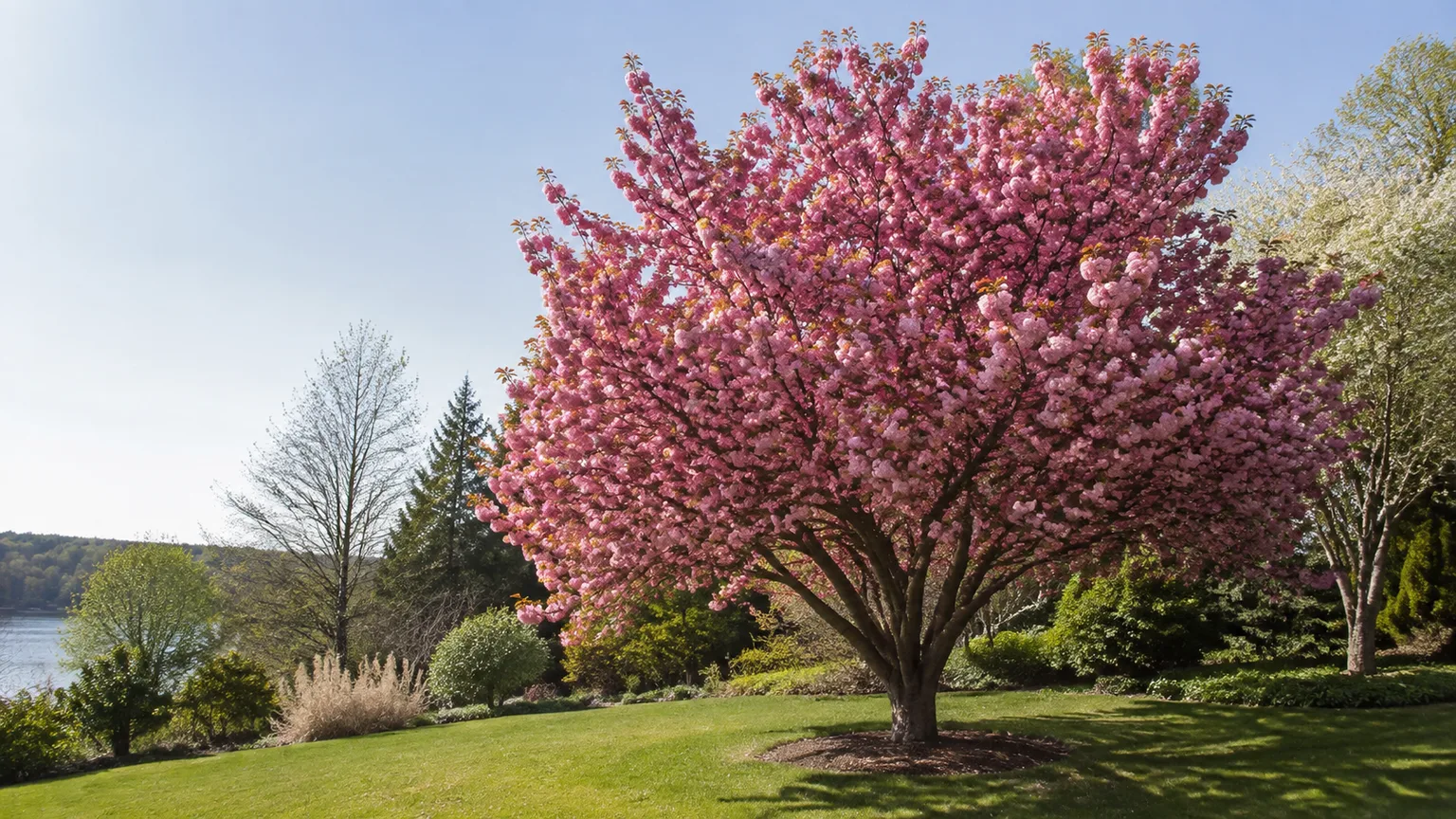
Japanese flowering cherry (Prunus serrulata and its cultivars) is best treated as an ornamental specimen or grouped accent. It offers dramatic spring blooms and a canopy that can soften a fence, but it is deciduous and typically about as wide as it is tall—often around 15 to 25 feet. Its short-lived display and broad spread mean it is rarely the right answer for a tight boundary row. NC State Extension also notes that Japanese flowering cherries can be vulnerable to a range of pests and diseases, and that leaves, stems, and seeds are toxic to cats, dogs, and horses. Check the species profile and exact cultivar before planting.
A flowering cherry can be a beautiful way to screen one elevated view while adding shade and spring interest, especially when planted slightly in from the fence rather than squeezed into the boundary. Allow air circulation and avoid poor-draining soil. Keep cut branches, leaves, and fruit away from pets that chew plant material. Use it for seasonal screening and ornamental value, not as a low-maintenance evergreen substitute.
Purpleleaf Plum
Purpleleaf plum (Prunus cerasifera, often sold in purple-leaved cultivars) brings dark foliage, fragrant spring flowers, and a rounded crown to a fence border. It is a deciduous small tree, commonly 15 to 30 feet tall and 15 to 25 feet wide, so it needs more room than a narrow screen plant. It can soften a fence in summer and make a strong color accent, but the foliage drops in winter and brittle wood can make the tree shorter-lived. NC State Extension lists its size, cultivar variation, pest issues, and seed safety.
Buy this for ornamental foliage rather than as a dense privacy hedge. The pits contain cyanogenic compounds; do not chew or grind them, and keep fallen pits and pruning debris away from children and pets. Some cultivars produce little fruit, while others can create cleanup. Purpleleaf plum is also susceptible to several insect and disease problems. Check that the particular cultivar fits your space, then give it enough distance from paths and the fence for its crown to develop.
Crape Myrtle
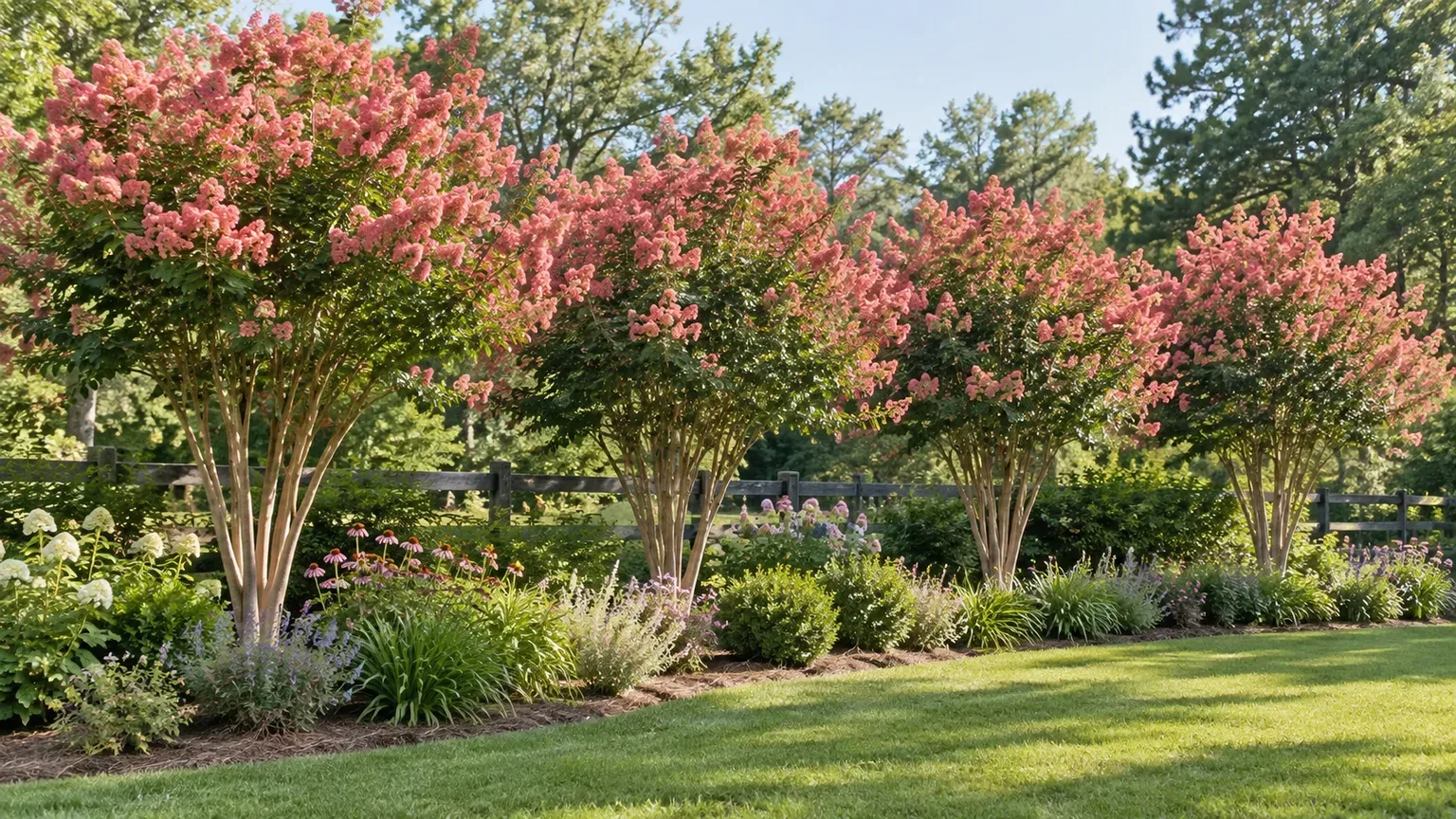
Crape myrtle (Lagerstroemia indica and hybrids) is a deciduous small tree or shrub with long summer-to-fall bloom, attractive bark, and strong fall color. Cultivars range from compact plants to trees taller than 20 feet, so the cultivar—not the common name—determines whether it can screen above your fence. It needs sun for dependable flowering, and its winter silhouette will not provide a solid visual barrier. NC State Extension outlines the wide variation in size, bloom, and growth habit.
Choose a named cultivar that will reach the height you need without topping. Repeated severe cutting to force a plant into an undersized spot produces an unnatural shape and makes the maintenance problem worse. Crape myrtle is a strong option where summer flowers matter and the growing season is long enough; it is a poor substitute for evergreen privacy in a cold winter or shaded site. A flowering screen can be mixed with evergreens if you need some coverage after leaf drop.
Young’s Weeping Birch
Young’s weeping birch (Betula pendula ‘Youngii’) is a small deciduous ornamental with arching branches that form a dome. The cascading crown can soften a fence and offer yellow fall color, but it is not a narrow upright screen: the branches can spread as broadly as the tree is tall, and some reach near the ground. The Royal Horticultural Society lists a mature height and spread of roughly 4 to 8 meters and a time to maturity of 20 to 50 years. Use its cultivar profile to check full size and site needs.
Plant it as a specimen where the weeping outline has space to show, not in a tightly packed row. It loses its leaves, and mature width can interfere with a path or neighboring planting if the trunk sits too close to the fence. A smaller young tree may look compact at purchase, but the umbrella-shaped canopy is the design feature—and the space requirement—you are buying.
American Mountain Ash
American mountain ash (Sorbus americana) is a small, deciduous native tree that suits cool climates better than hot, humid ones. Clusters of white flowers, orange-red fruit, and strong autumn color bring several seasons of interest and attract birds. It commonly reaches about 15 to 30 feet tall, with an open crown; that openness makes it a seasonal screen rather than a dense evergreen barrier. NC State Extension warns that fire blight and other diseases can shorten its life, and that it struggles in hot, humid summers. Check its regional growing notes before choosing it.
Use mountain ash where the climate and soil suit it and where flowers, fall color, and wildlife are as important as privacy. It is a poor investment in a hot site that stresses the species, or where a solid view block is needed in winter. Plant it as part of a varied border instead of depending on one tree to make a continuous wall.
Red Buckeye
Red buckeye (Aesculus pavia) is a deciduous small tree or shrub grown for upright red flower clusters in spring. It typically reaches about 15 to 25 feet and often drops its leaves relatively early, leaving little summer-to-fall screening. This makes it a better flowering accent in a mixed border than a dependable privacy tree. NC State Extension recommends moist, well-drained soil and notes that hot sun can scorch foliage; fallen leaves, stems, and fruits may also create cleanup. Its profile identifies the plant as poisonous to people and pets.
Do not place red buckeye beside a play area if children or pets may pick up or chew the seeds. Its spring flowers are valuable to pollinators and hummingbirds, but that benefit does not cancel the safety and screening limits. Choose it where a woodland-edge or partly shaded ornamental is wanted, then pair it with a different plant if you need summer or winter privacy.
Viburnum (Blackhaw)
“Viburnum” covers many shrubs and small trees, so ask for the exact species and cultivar. For a deciduous North American option, blackhaw viburnum (Viburnum prunifolium) can be pruned into a small tree and reaches about 12 to 15 feet tall, with a spread that can approach its height. It brings fragrant spring flowers, red-purple fall color, and berries that feed birds. NC State Extension describes it as a slow-growing, adaptable shrub or small tree that works as a specimen or hedge. Its profile explains mature size, pollination, and wildlife value.
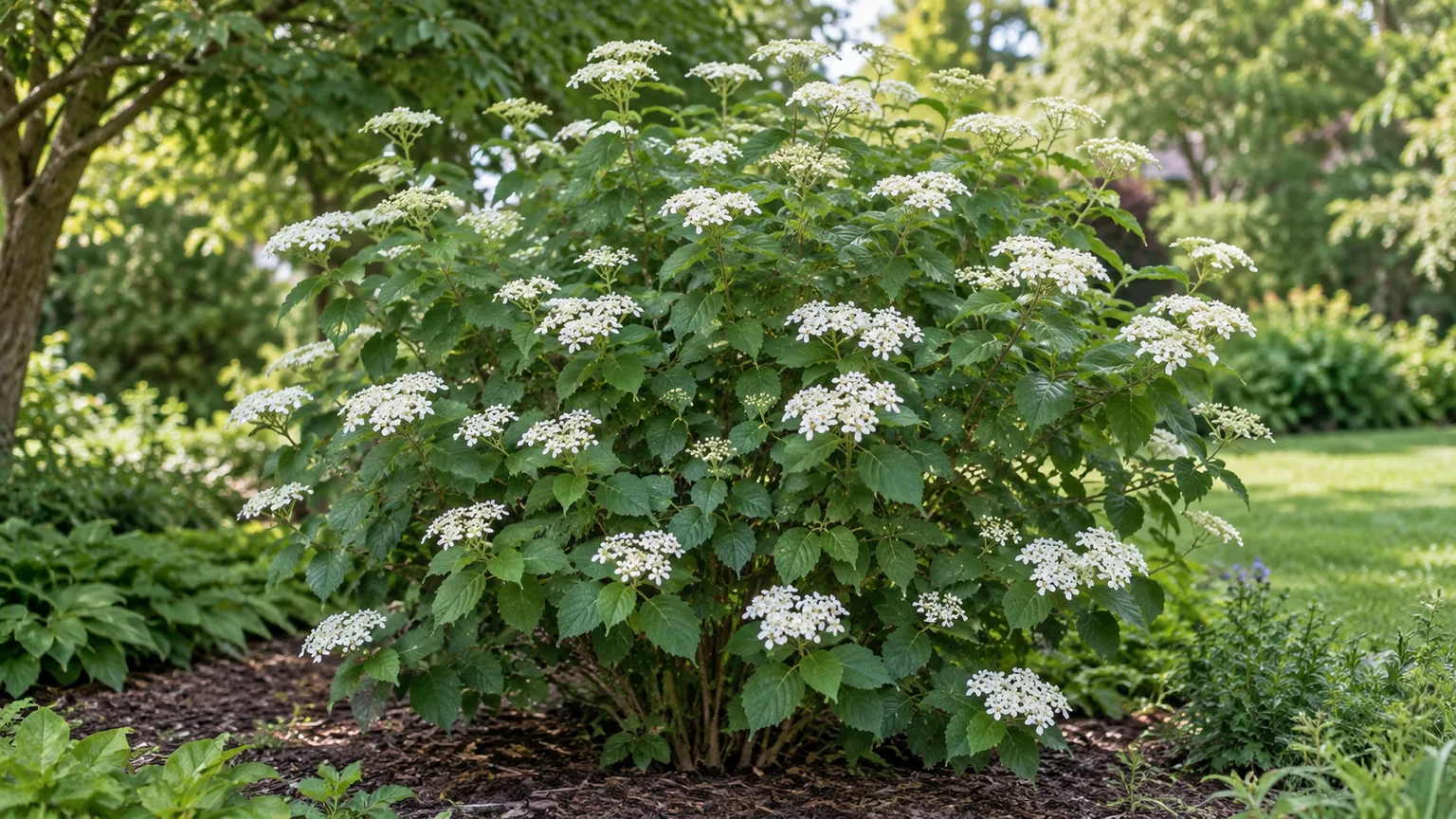
Blackhaw is a good choice for a natural-looking, regionally appropriate screen where winter leaf loss is acceptable. Other viburnums vary widely: some are evergreen, some are deciduous, and their mature sizes and local suitability differ. Do not buy a generic “viburnum tree” based only on a photo. Read the full botanical name, confirm local recommendations, and account for its broad crown and possible suckering.
Conclusion: Choose for the View You Need to Block
First, stand where privacy matters and note the exact window, deck, or neighboring space you want to screen. A tree placed along the fence is not always the best spot: a tree set farther into the yard may block the sightline with a shorter crown, while a row at the boundary may need to grow much taller to cover the same view. Garden designers make a similar point: screen the important view deliberately instead of enclosing every edge with a solid wall of plants. Fine Gardening’s property-line examples show how layered planting can feel more natural than a single-species row.
Then choose by winter coverage and measured space. If you need year-round screening in a narrow bed, start with a correctly sized evergreen cultivar such as ‘Emerald Green’ arborvitae, ‘Spartan’ juniper, or a suitable holly. If seasonal coverage and flowers are enough, compare flowering crabapple, crape myrtle, hornbeam, and blackhaw viburnum. Use local Extension guidance to confirm winter survival, disease resistance, and whether a species is invasive in your area. The USDA Plant Hardiness Zone Map is based on average annual extreme minimum winter temperature; it does not describe summer heat, drainage, wind exposure, or every microclimate.
Before buying, read the mature height and width on the cultivar label, locate overhead lines and underground utilities, and set the trunk far enough from the fence that the canopy and access fit the site. There is no universal “plant it one spread away” rule: begin with half the mature crown width as an approximate canopy radius, then add clearance for fence work, pruning, gates, paths, and property boundaries. Contact your utility-location service before digging; in the United States, Call 811 before you dig to find local notice requirements and get public underground lines marked. Plant with the root flare visible at soil level and water the root zone through establishment; a larger nursery tree does not remove that aftercare. Penn State Extension covers tree placement near utilities and proper planting depth and root-flare care.
Finally, avoid relying on a single species if your bed has room for a mixed screen. A few compatible evergreens can hold the view in winter while deciduous trees add shade, flowers, and seasonal color. That takes more planning than copying a uniform row, but it leaves you with a screen better matched to the yard, the climate, and the years ahead.



