7 Best Fertilizer Spreaders for Even Coverage
Compare seven fertilizer spreaders by lawn size, spread pattern, capacity, control, terrain, and cleanup. Includes calibration steps to prevent stripes and burn.
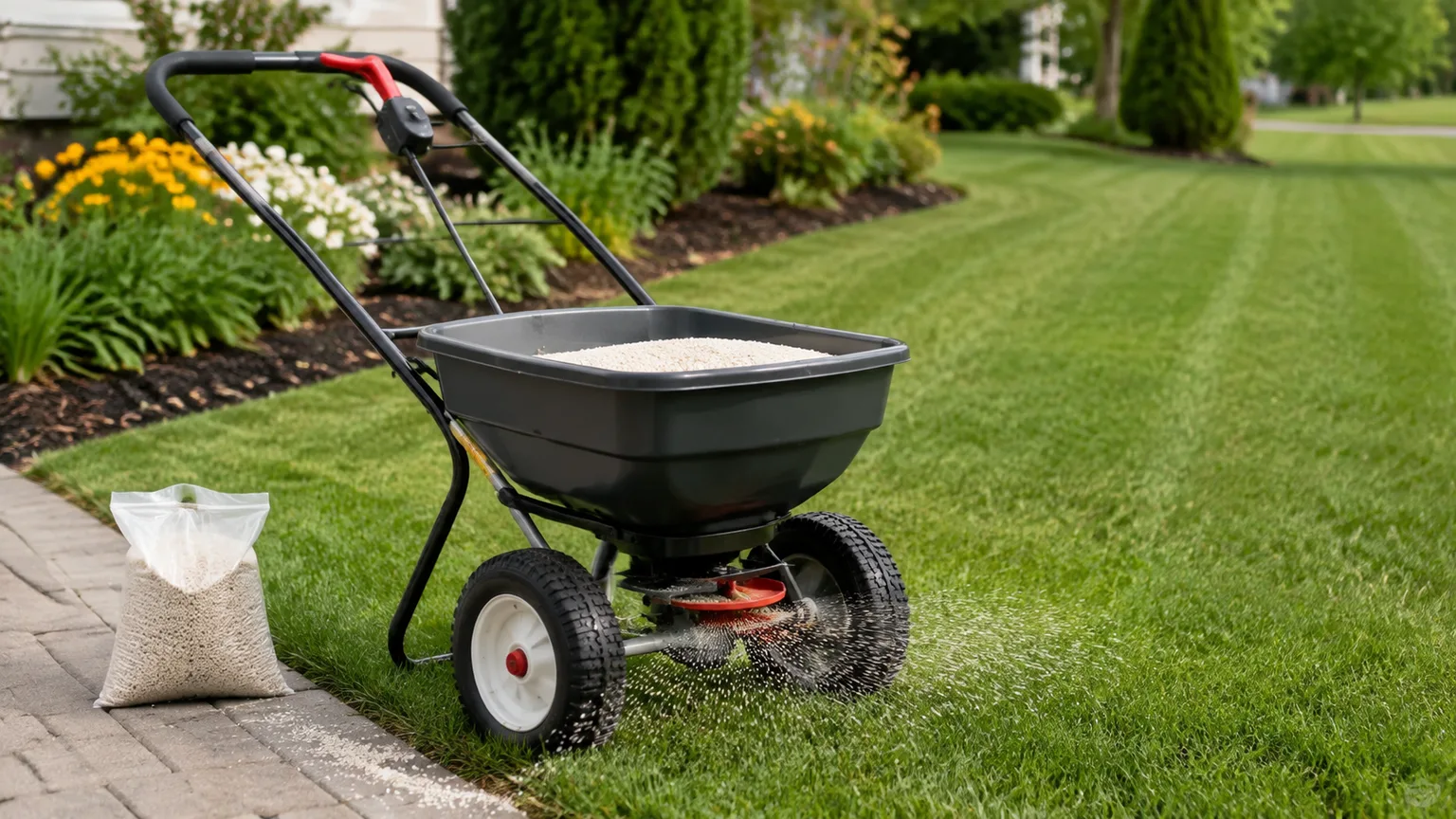
The best fertilizer spreader is the one that matches your lawn size, route, granule type, and tolerance for overlap. A large hopper saves refills, but it cannot compensate for a spread pattern that reaches the flower bed, a dial that was never calibrated, or a machine that is too heavy to steer comfortably.
This guide combines the supplied product-testing record with current product documentation and extension guidance; it does not claim a new side-by-side LeafyPixels test. Model-specific observations are reported observations, while listed capacities, spread widths, battery details, and warranties should be checked against the current manual before purchase. A spreader is an application tool, not a diagnosis for compacted soil, poor irrigation, shade, or the wrong grass type.
Quick Picks by Yard Size and Job
Use this table to narrow the field. Coverage figures are planning estimates or listed manufacturer/retailer claims, not a guarantee: the actual area depends on the fertilizer’s density, your rate, overlap, walking speed, and whether you fill the hopper with a different material.
| Best for | Spreader | Format | Why it stands out | Main compromise |
|---|---|---|---|---|
| Most established residential lawns | Scotts Elite Broadcast Spreader | Push broadcast | Large working capacity, dual-rotor spread, edge control, fold-down handle | Dial lock and phone holder may be less useful than the core spreader |
| Small lawn or spot work on a budget | Scotts Whirl Hand-Powered Spreader | Manual handheld | Light, compact, inexpensive, useful for narrow areas | Right-hand crank creates wrist fatigue on larger jobs |
| Rough ground and frequent large jobs | ECHO RB-60 | Push broadcast | 60-lb hopper, 10-inch pneumatic tires, side deflector, sturdy frame | Larger and more tool than a tiny suburban lawn needs |
| Very large open lawn | Agri-Fab 45-0614 | Push broadcast | Wide pattern and unusually large hopper reduce refills | Heavy, requires calibration, and published capacity details conflict |
| Small push-operated lawn | Scotts Turf Builder EdgeGuard Mini | Compact broadcast | Easy handling, clear dial, edge control, pre-calibrated setup | Hard plastic wheels and smaller hopper are limiting on rough terrain |
| Battery-powered spot treatment | RYOBI 18V ONE+ OSS1800 | Battery handheld | Variable flow, anti-clog agitator, directional control, no manual crank | Battery and charger are not included; availability varies by market |
| Fertilizer, seed, and ice melt across seasons | Yardworks 85 lb All-Season | Push broadcast | Big hopper, no-flat tires, cover, directional flaps | Assembly and calibration take time; full loads are cumbersome |
Choose the smallest spreader that can finish your normal job without repeated refills, then give extra weight to control if borders, paths, trees, or beds dominate the route. A 5,000-square-foot lawn with obstacles may be easier with a compact push model; a half-acre of open grass rewards width and pneumatic tires.
How These Fertilizer Spreaders Were Evaluated
The supplied testing record assessed setup, ease of use, coverage, capacity, terrain, controls, and versatility with fertilizer, grass seed, weed-control granules, and ice melt. That is a useful starting point because the result depends on how steadily a spreader rolls and how predictably its gate opens, not only on the name printed on the hopper.
I added a second layer of evaluation: can a homeowner select, calibrate, operate, clean, and store it without guessing? Penn State Extension explains that each spreader varies slightly and that each granular product should be calibrated separately because density, particle size, and nutrient content change the flow. Its guidance also warns that the label dial is only a starting point because operator speed and the individual machine affect the delivered rate. (Penn State Extension calibration guidance)
That evidence boundary matters: no model will put down an identical pattern on every lawn. Use the recommendations as a shortlist, confirm the current manual, and test the spreader with the exact product you plan to apply.
Choose the Spreader Type Before the Model
Broadcast Versus Drop: Coverage or Control
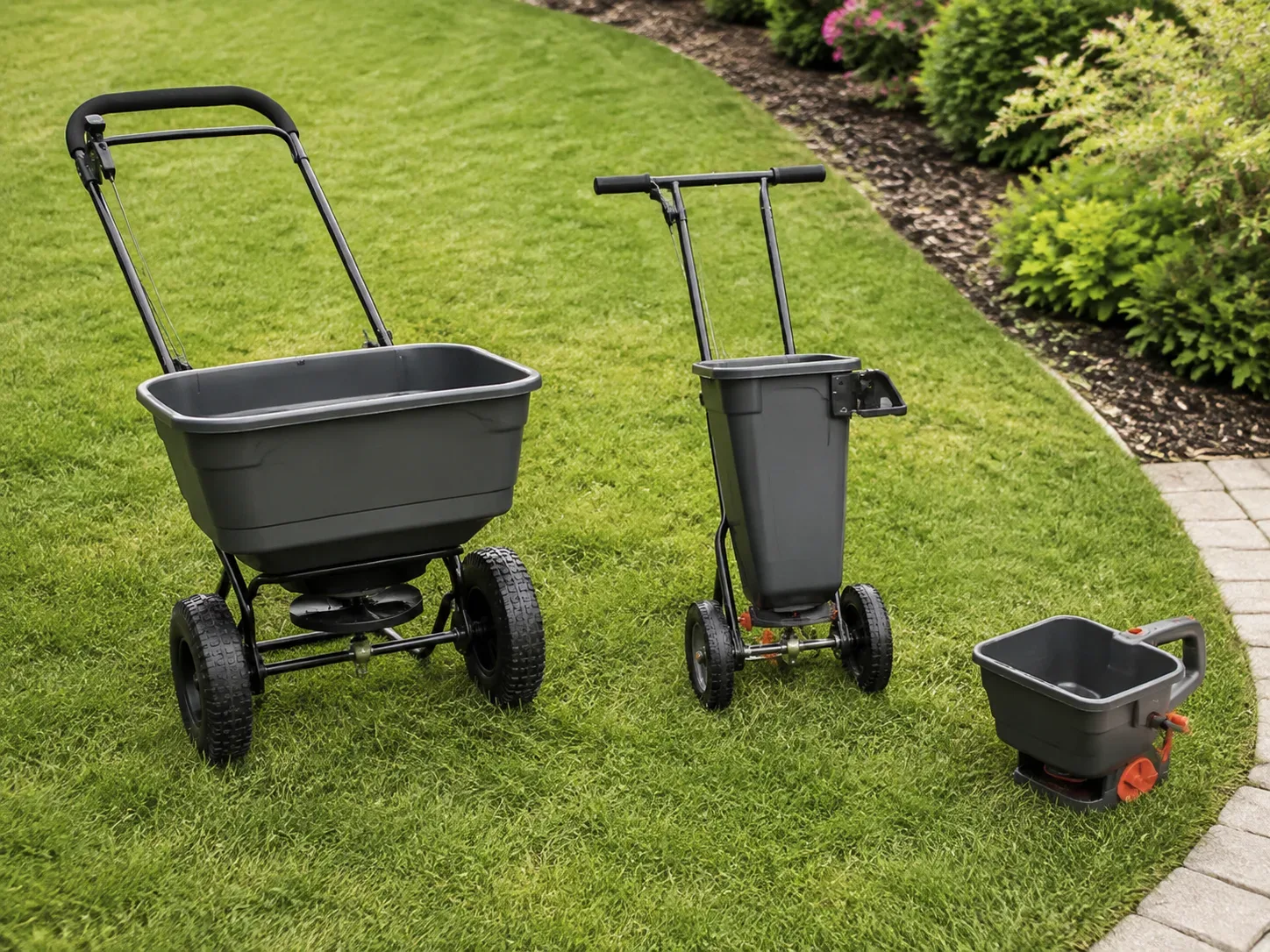
A broadcast, rotary, or centrifugal spreader drops granules onto a spinning plate and throws them outward in a fan. It covers more ground per pass, which is why it is the default for medium and large lawns, but the outside of the pattern is lighter and less predictable than the center. You need a measured or tested swath width and some overlap to avoid skips.
A drop spreader releases material through a row of openings directly under the hopper. Its swath is roughly the width of the machine, so it takes more passes, but it is easier to keep fertilizer off a driveway, pond edge, or flower bed. Penn State describes drop spreaders as precise for confined spaces and fine granules, with the catch that passes must be adjacent and wheel paths need attention because product falls between the wheels. (Penn State drop-spreader guidance)
For most homeowners, the choice is “where would an error be more costly?” Pick broadcast for speed across open turf and drop when a narrow boundary matters more than speed. A handheld broadcast model is convenient around obstacles but still throws material, so its side guard and walking direction matter.
Handheld, Push, or Tow-Behind: Match the Route
Handheld spreaders suit small lawns, reseeding patches, narrow side yards, and spot applications. The hopper becomes tiring when full, manual cranks fatigue a wrist, and a battery model is most convenient if you already own compatible batteries.
Push spreaders transfer the load to wheels and are the best all-around format for a typical residential lawn. They need enough room to turn and enough storage space to stay dry, but they let you keep a steady pace without carrying the material. Pneumatic or no-flat tires are valuable on ruts and soft ground; hard plastic wheels are acceptable on a flat front lawn and less pleasant on a bumpy backyard.
Tow-behind spreaders make sense for broad, open acreage when you already have a compatible lawn tractor, riding mower, or utility vehicle. They are inefficient in narrow routes and add hitch, turning, storage, and loading questions; do not buy a riding machine just to pull a spreader without comparing the total cost.
The Specifications That Change the Result
Calibrate for the Fertilizer, Operator, and Pace
Spreader numbers are not universal pounds-per-square-foot settings. The dial controls the size of an opening, while the amount that passes through depends on the product, humidity, granule size, walking speed, wheel motion, and sometimes the height at which you hold the handles. A setting printed on a fertilizer bag is the correct place to start, not proof that the final application rate is correct.
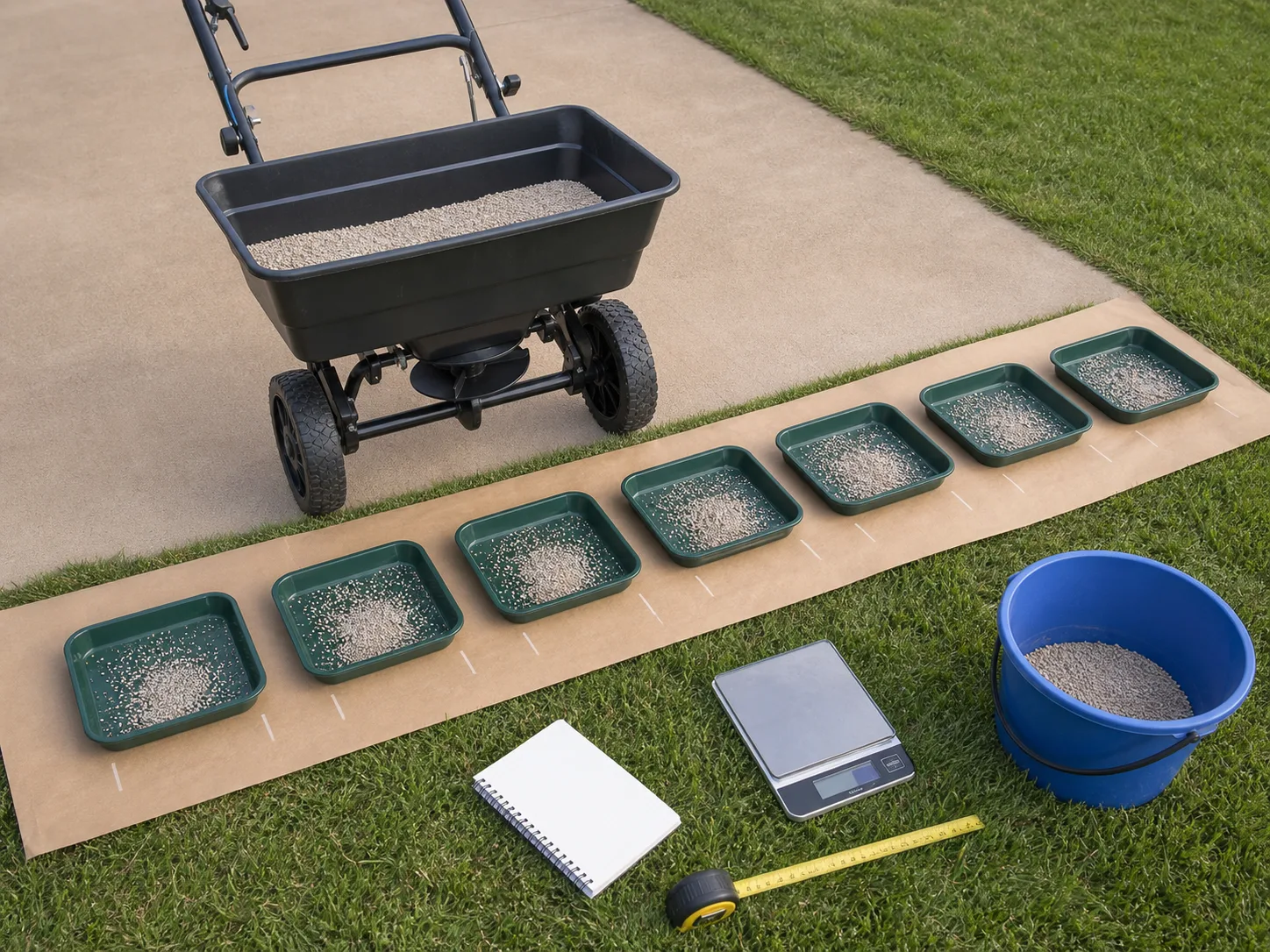
For a homeowner-friendly calibration, measure a 50- or 100-foot test strip, load a known weight of the exact fertilizer, start walking before opening the gate, and close it while still moving at the end. Weigh what remains. The difference is the amount applied on the test area. If the result is too high, close the opening; if it is too low, open it slightly and repeat. This takes longer than trusting a dial, but it protects against the most expensive failure: putting a concentrated band of fertilizer on one part of the lawn.
The basic math is: fertilizer needed for the test area = labeled pounds per 1,000 square feet × test-area square feet ÷ 1,000. If you plan two passes, calibrate each pass to half the total rate. The Penn State example also accounts for the fertilizer’s NPK analysis when the target is expressed as pounds of nitrogen rather than pounds of product. (Penn State fertilizer calculations)
Edge Control, Swath Width, and Terrain
Edge guards and side deflectors are not decorative extras. They let you reduce throw toward a sidewalk, driveway, pond, or ornamental border, but they do not turn a broadcast spreader into a drop spreader. Approach the boundary with the guard engaged, keep the spreader’s centerline a sensible distance from the edge, and make a short test pass before treating the whole perimeter.
Advertised spread width is also not the same as effective swath width. Penn State’s method uses catch pans arranged across a pass and looks for the usable width where the outer collection is roughly half the center collection. That width changes with product and pace, so it is better to measure once for an unfamiliar product than to build a pattern around a number printed on a box.
Terrain adds another variable. A full hopper changes steering effort, pneumatic tires smooth bumps, and a slope makes it harder to keep pace. If the machine bounces, rocks, or slows near the bottom of a hill, the application rate changes. Empty or refill before the spreader becomes difficult to control, and do not walk backward while the gate is open.
The Seven Best Fertilizer Spreaders
Best Overall: Scotts Elite Broadcast Spreader
The Scotts Elite Broadcast Spreader is the strongest general-purpose choice for an established lawn that is too large for a handheld but still managed on foot. Its dual-rotor design, roughly six-foot spread pattern, EdgeGuard control, smartphone holder, and fold-down handle make it appealing when you want quick coverage plus some protection for borders. The current product listing describes it as handling up to 20,000 square feet of Scotts lawn products, including fertilizer, seed, salt, and ice melt. (Scotts Elite product listing)
The supplied testing record reports even distribution, smooth foam-filled wheels, a comfortable cushioned handle, and a large hopper that covered a 10,000-square-foot lawn without a refill. It also reports two annoyances: the phone holder can wobble on rough ground, and the flow-lock switch may be difficult to use. Those are fair trade-offs because the core value is the rolling spreader and its boundary control, not the accessory mount.
Choose it when you have a medium or large residential lawn, want a push broadcast format, and frequently work near hardscape or beds. Skip it for a tiny lawn where the body is unnecessary, or if a drop spreader’s narrow placement is more important than fast coverage. Regardless of the dual rotors, use a test strip and consider two half-rate passes if you see striping.
Best Budget Handheld: Scotts Whirl Hand-Powered Spreader
The Scotts Whirl Hand-Powered Spreader is the sensible low-cost pick for a small lawn, balcony-adjacent patch, seed repair, or narrow area where a wheeled spreader would be awkward. The supplied testing record lists a 1,500-square-foot coverage area, five material settings, a wrist brace, and a very light body. It also reports a more even result than scattering fertilizer by hand.
The crank is fixed for right-handed use, and the wrist becomes tired when the job grows beyond spot treatment. Cranking faster changes the throw, so keep the pace and crank rhythm consistent and refill before the tool becomes awkwardly heavy.
This is the best fit if storage, purchase price, and occasional use dominate your decision. It is not the best value for a 10,000-square-foot lawn simply because the tool is cheap; repeated refills and arm fatigue erase the saving. Choose a compact push model instead when wheels can save your wrist.
Best Heavy-Duty Option: ECHO RB-60
The ECHO RB-60 is the heavy-duty push spreader for homeowners who cover a large lawn, deal with uneven ground, or use the tool often enough to value a sturdier frame. ECHO lists a 60-pound hopper, coverage up to 25,000 square feet, an eight-foot spread pattern, a heavy-duty agitator, a side deflector, 10-inch pneumatic tires, and a powder-coated steel frame. It also lists a five-year consumer warranty, subject to the warranty terms and use category. (ECHO RB-60 product specifications)
The supplied testing record found consistent spreading, good handling on bumps, and reliable performance with fine material. The practical compromise is size: this is more machine to store and steer than a small front lawn needs. The side deflector takes a moment to understand, so practice with a benign granular material or a measured fertilizer load before making a perimeter pass.
Choose the RB-60 when tires and durability are worth more to you than the smallest footprint. It is especially attractive if you want one spreader for fertilizer and seed and need to cross rough grass without bouncing the hopper. Do not treat its 60-pound capacity as a target load; load only what you can push and control safely on your route.
Best for Large Yards: Agri-Fab 130 lb Push Broadcast Spreader
The Agri-Fab 45-0614 is the capacity-first pick for a very large, open lawn. The listing describes a 12-foot pattern, a 130-pound material capacity, pneumatic tires, a positive-flow control, and coverage up to about 25,000 square feet on one load. A separate line in the same product information calls the hopper seven gallons or 85 pounds, however, so the published capacity is internally inconsistent. Treat the model name and the 130-pound claim as information to verify—not as a reason to load the machine to its maximum. (Agri-Fab 45-0614 product listing)
That inconsistency is exactly why this spreader is not my overall pick. Its wide pattern and large hopper could reduce refill stops across open grass, but the supplied testing record found difficult assembly, streaking before calibration, and a flow door that opened too quickly under a full load. Once dialed in, the record reports even distribution and good movement on uneven terrain.
Choose it only if you have the storage room, the strength to push a heavy load, and the patience to calibrate it with your exact material. If your property is fragmented by beds, slopes, or narrow gates, a smaller spreader may finish more predictably even if it needs another refill. Verify the manual, maximum safe load, current warranty, and parts availability before buying.
Best Small-Yard Push Spreader: Scotts Turf Builder EdgeGuard Mini
The Scotts Turf Builder EdgeGuard Mini Broadcast Spreader is the easy choice for a small to average residential lawn where carrying a handheld would be tiring but a full-size spreader would be excessive. The supplied testing record lists coverage up to 5,000 square feet, a clear setting dial, EdgeGuard, fold-down storage, a pre-calibrated setup, and a light body. It also reports consistent results with fertilizer, weed-control granules, lime, and ice melt.
Its hard plastic wheels are happiest on a flat lawn. On ruts or a soft backyard, they can bounce or lose traction, which changes the flow. The handle lacks the padding found on larger models, and the smaller hopper means you may refill on a lawn near the upper end of its range. Those are manageable drawbacks when compactness and border protection matter.
Choose it for a 2,000- to 5,000-square-foot lawn with paths or beds along the edge. It is also a good first wheeled spreader for someone who wants a clear dial and minimal assembly. Still test the rate after changing products; “pre-calibrated” does not mean every fertilizer flows identically.
Best Battery Handheld: RYOBI 18V ONE+ OSS1800
The RYOBI 18V ONE+ OSS1800 is the best handheld option when you want the control of carrying a small spreader without the repeated wrist motion of a crank. RYOBI’s current European product page describes a variable flow rate, adjustable 2.5- to 3.5-meter spread, anti-clog agitator, four-liter container, fertilizer and de-icing-salt compatibility, and up to two hours of runtime with a 2.0Ah battery. The bare tool does not include a battery or charger. (RYOBI OSS1800 product page)
The supplied testing record reports a roughly seven-foot distribution path, effective side guards, even coverage, and much less arm strain than manual cranking. It also reports that the hopper can feel heavy when full and that the manual does not explain the trigger sequence clearly. Availability, battery language, and package contents vary by market, so confirm the local listing before assuming the UK specifications or a battery is included.
Choose the OSS1800 if you already own compatible batteries and need spot treatment around fences, beds, mole hills, or small lawns. It is a poor substitute for a push spreader on a half-acre route: battery power removes cranking, not the weight of carrying the product.
Best All-Season Spreader: Yardworks 85 lb All-Season Spreader
The Yardworks 85 lb All-Season Spreader is for the homeowner who wants one large push tool for fertilizer, grass seed, and winter ice melt. The product information lists an 85-pound poly hopper, 10-inch no-flat rubber tires, a vinyl cover, foam-padded steel handles, directional cover flaps, and manual operation. It arrives partly assembled, so allow time to put it together and inspect the flow controls before using it. (Yardworks 85 lb product information)
The supplied testing record found the big tires comfortable on uneven ground and the cover useful when spreading in winter weather. It also found a learning curve: seeds could bounce backward, early distribution was inconsistent, and the unit needed calibration and small adjustments before the pattern improved.
Choose it when year-round versatility and a large hopper justify the storage footprint. Do not use the ice-melt feature as proof that every salt product is safe for the machine or nearby plants; follow the spreader and material labels, rinse promptly, and keep salt away from garden beds. If you will use it only twice a year on a small lawn, the capacity is more burden than benefit.
How to Spread Fertilizer Without Stripes or Burn
1. Measure the lawn and read the label first
Measure the turf area rather than estimating from the property size. Subtract beds, paths, patios, and the house footprint, then read the fertilizer label for the application rate, grass restrictions, watering directions, and weather cautions. If your lawn has not been tested recently, a soil test is more useful than automatically choosing a complete fertilizer; local extension resources can help interpret nutrient needs. Epic Gardening’s practical lawn guidance also recommends using a soil test when you are unsure how much to apply and avoiding heavy rain that can move nutrients into runoff. (Epic Gardening lawn-fertilizing guidance)
Do not fertilize dormant, drought-stressed, or heat-stressed turf simply because the spreader is ready. Cool-season and warm-season grasses have different growth windows, and a bag that is correct for one lawn can be poorly timed for another. If you are seeding, check whether a weed-and-feed product conflicts with germination or a waiting period.
2. Test-calibrate with the exact material
Inspect the hopper, agitator, wheels, gate, and guard. Use the label setting as your starting point, then run the measured strip at the pace you will use on the lawn. Keep the gate closed while filling, start walking before opening it, and close it before turning. Never shake an almost-empty spreader to force out the last granules; the flow changes when material slides toward one side.
For a rotary spreader, determine a realistic swath width by looking at the edge of the pattern, not the farthest stray pellet. Use catch pans or a test strip if the product is unfamiliar. A two-pass grid can disguise minor skips, but only if the spreader is calibrated to apply half the total rate on each pass. Penn State’s rotary-spreader guidance specifically recommends a steady pace, avoiding backward travel, and cleaning and lubricating moving parts after application. (Penn State rotary-spreader calibration)
3. Apply in a repeatable pattern
Start at the perimeter with the edge guard or deflector set to protect hardscape and beds. Work in straight, parallel lanes and mark your next lane by the tested swath width. Broadcast spreaders need a planned overlap; drop spreaders need adjacent passes without skips. Slow down before a turn, close the gate, turn, line up, start moving, and open again.
For a large rectangular lawn, apply half the rate north-to-south and half east-to-west. This grid is not permission to walk randomly over the same ground; it is a way to spread small human alignment errors across two directions. On an irregular yard, divide it into smaller zones and calculate the product for each zone so one awkward corner does not receive the leftover from the entire lawn.
4. Water, clean, and store
Follow the fertilizer label for watering. Some granules need irrigation to move off leaf blades and into the soil, while some slow-release products specify a different sequence. Do not use a forecast of heavy rain as your watering plan: a downpour can move nutrients off the lawn before roots can use them. BBC Gardeners’ World Magazine similarly advises watering in lawn feed when there is no rain on the way and keeping newly seeded areas consistently moist. (BBC Gardeners’ World lawn-care guidance)
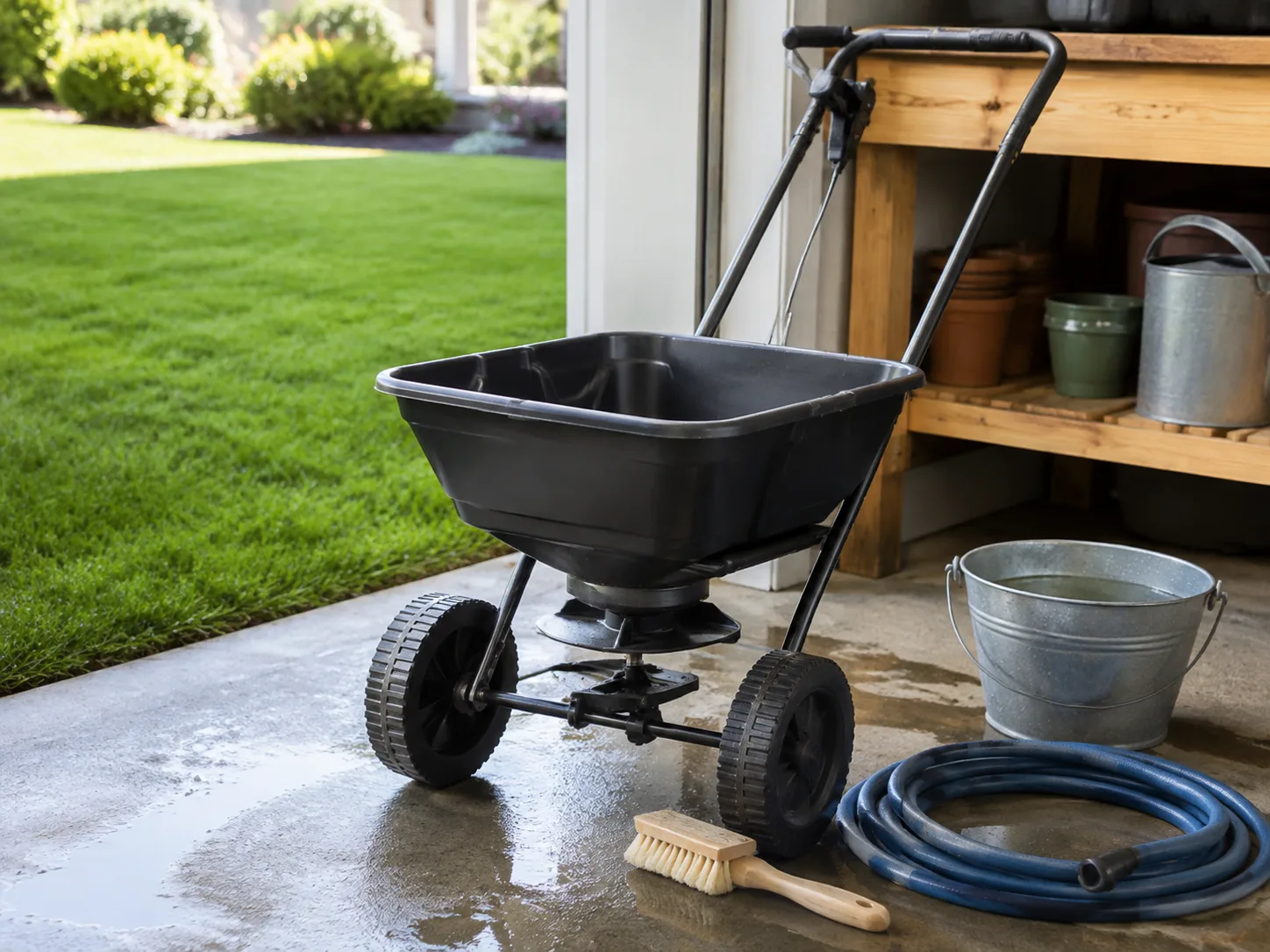
Empty leftover fertilizer back into its labeled container; do not leave granules in the hopper. Sweep product off pavement and keep it out of storm drains. Rinse the spreader, clear the gate and agitator, let every part dry, then lubricate moving parts if the manual allows it. Fertilizer salts and ice melt are both hard on metal and mechanisms when stored wet.
Common Mistakes That Make a Good Spreader Look Bad
Using the same setting for every product is the most common error. A dial number belongs to a particular spreader-product-rate combination, and even two similar-looking granules can flow differently. Recalibrate whenever you change fertilizer, seed, lime, or ice melt.
Walking too fast, slowing at a hill, or starting the gate over the lawn produces uneven bands. Keep a comfortable, repeatable pace, start before the treatment zone, and close the gate before turning. If the machine is hard to push when full, load less rather than compensating with a different pace.
Overlapping because the pattern looks thin is how fertilizer burn begins. Broadcast patterns are supposed to taper at the edges, which is why swath width and a two-pass half-rate plan matter. If the lawn shows stripes after application, do not immediately add more product; first identify whether the stripe came from a skip, overlap, blocked gate, wheel track, or uneven turf color.
Spreading in wind or before a hard rain moves product where you did not intend it. Lightweight seed and fine granules are especially prone to drift. Wait for calmer conditions, protect waterways and beds, and follow local fertilizer restrictions where applicable.
Treating capacity as a safe load can make a tool unmanageable. A hopper’s maximum is a product specification, not a recommendation for every slope or operator. A half-full spreader that rolls smoothly will give a more consistent result than a full spreader that bounces, drags, or forces you to stop and restart.
Skipping cleanup shortens the life of the tool and can contaminate the next material. Do not leave fertilizer in the gate overnight, store a rinsed machine before it is dry, or use the same unwashed spreader for herbicide and seed. If a product label requires a particular cleanup method, follow it rather than improvising.
Conclusion
For most homeowners, the Scotts Elite Broadcast Spreader is the best all-around starting point because it balances coverage, edge control, handling, and storage. Choose the Scotts EdgeGuard Mini for a smaller lawn, the Scotts Whirl for occasional budget spot work, the ECHO RB-60 for rough ground and heavier use, the Agri-Fab for a very large open route after verifying its conflicting capacity claims, the RYOBI OSS1800 if you already own compatible batteries, and the Yardworks when all-season versatility earns the extra storage space.
Whichever model you choose, the purchase is only half the result. Measure the lawn, read the label, calibrate with the exact granules, walk steadily, protect edges and drains, and clean the spreader after every use. Those habits do more for even turf than a larger hopper or impressive dial.



