Blue Orchids: Natural Species, Dye, Care, and Rebloom
Blue orchids do exist, but many florist Phalaenopsis are dyed. Learn the visual clues, natural blue species, Blue Gene nuance, and how to care for each.
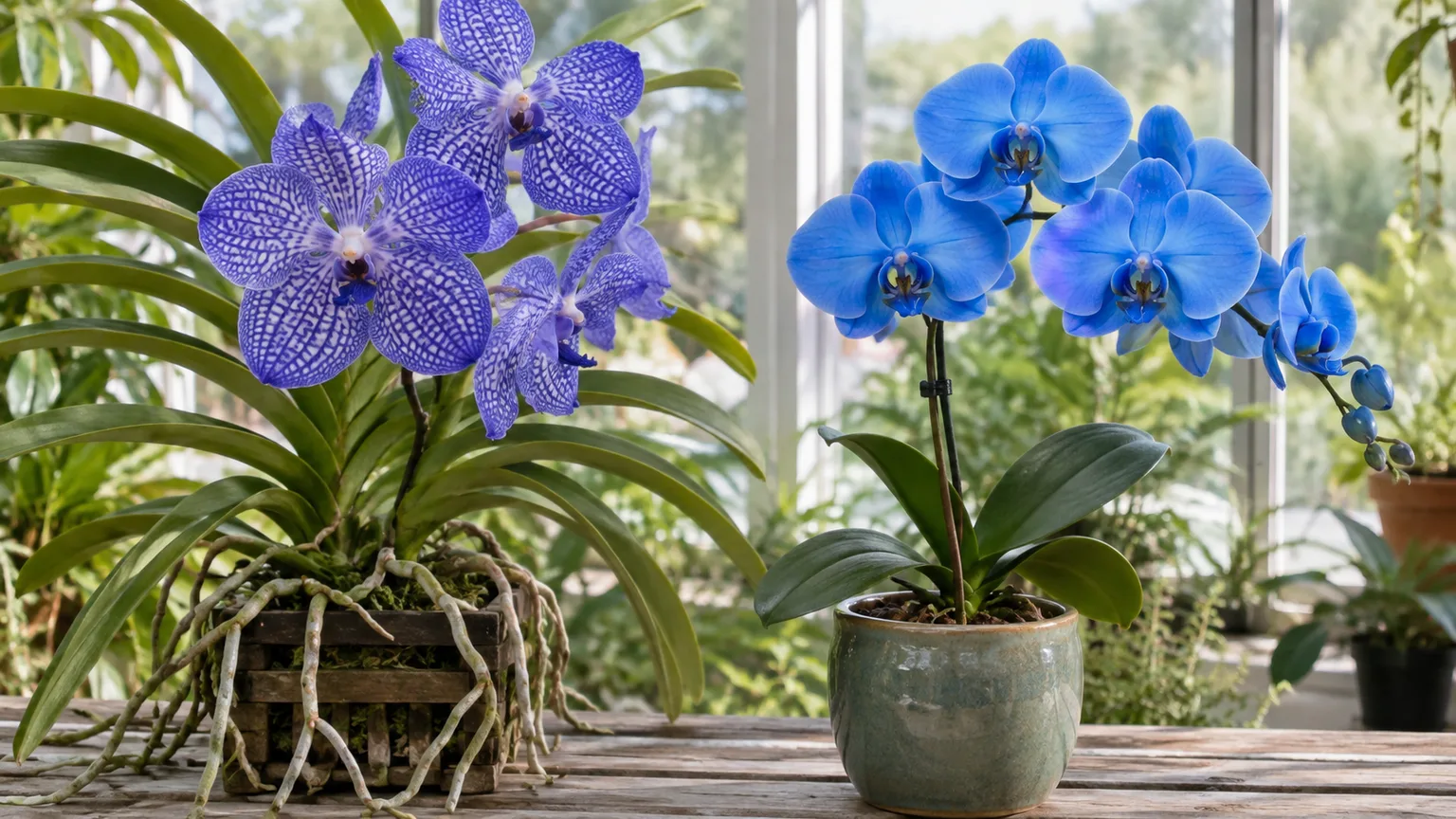
Yes, naturally blue orchids exist. The blue-violet Vanda coerulea and some Australian sun orchids produce blue flowers without added dye. But the vivid, nearly uniform cobalt Phalaenopsis sold in many supermarkets and florist departments is usually a white or pale-flowered moth orchid whose open blooms have been colored through its flower spike. There is also a third category: a genetically engineered blue-purple Phalaenopsis called Blue Gene, which is biologically different from a dyed plant.
That distinction matters when you shop. A dyed orchid can still be a living plant worth keeping, but its next flowers will show the cultivar’s underlying color rather than repeat the injected blue. A naturally pigmented Vanda is a different species with different growing demands, and “blue” may mean blue-violet or patterned rather than the solid electric shade on a retail Phalaenopsis. The quickest way to avoid disappointment is to ask what the plant is and how its color was produced.
The quick answer: yes, but identify which kind
The orchid family includes genuine blue-flowered species and hybrids, although strong blue is uncommon and shade varies with the species, lighting, and how someone describes color. Kew describes Vanda coerulea as a blue-flowered species and notes that it has contributed blue and purple coloring to cultivated Vanda hybrids. The Australian National Botanic Gardens documents blue and other bright flower colors across the terrestrial genus Thelymitra. (Kew’s profile of Vanda coerulea; Australian National Botanic Gardens on Thelymitra)
The familiar blue moth orchid is a separate retail product. It is generally a Phalaenopsis hybrid that opened with its ordinary flower color, then received dye while the blooms were developing or open. The dye changes the visible flowers for that display; it does not turn the plant into a naturally blue species or permanently rewrite the color of future blooms. (Iowa State University Extension explains the process)
| What you may see | What it usually means | What to expect next |
|---|---|---|
| Bright, even cobalt-blue moth-orchid flowers in a mass-market display | A Phalaenopsis flower spike has most likely been injected with dye | New flowers usually return to the plant’s underlying color, often white |
| Blue-violet flowers with a fine, repeating tessellated pattern on a Vanda | Could be a naturally pigmented Vanda species or a hybrid with blue-vanda ancestry | Color is inherited, though the precise shade varies among plants and hybrids |
| A named Blue Gene Phalaenopsis from an authorized seller | A genetically engineered cultivar, not a dyed white orchid and not a naturally occurring wild species | The blue-purple color is produced by the plant; follow the seller’s cultivar-specific terms |
Why the vivid blue florist orchid is usually dyed
Most retail Phalaenopsis are selected for dependable flowering and an array of colors such as white, pink, magenta, yellow, and patterned combinations. The blue flowers in ordinary grocery-store displays are usually created after the plant has grown its flower spike. The University of Iowa Extension describes a water-based, often proprietary dye injected near the base of the spike; water moving through the plant carries color toward the opening blooms. (Iowa State University Extension)
This is why the blue can look unusually uniform or intense, and why the same spike may show a gradient: flowers that opened earlier can be darker, while buds farther along the stem can be paler. Dye may also collect more visibly along veins or in parts of the flower that take up more liquid. Those are useful clues, but they are not a lab test. A naturally colored orchid can be vivid, and cameras, grow lights, packaging, and phone screens can all shift how a flower appears.
How dye is applied to a Phalaenopsis spike
In the common method, a producer makes a small opening in the flowering stem and introduces dye into the vascular tissue. The plant’s water-conducting xylem then moves dissolved color toward the buds and flowers. This is why the petals and sepals change while the green leaves, roots, and potting medium generally remain the plant’s familiar color.
A seller may call the dye food-grade, but a shopper should not assume every grower uses the same formula: the exact solution can be proprietary, and the product label may not identify it. The practical point is not to diagnose a chemical from a picture. Ask whether the plant was dyed, whether the color is expected to recur, and what cultivar or base flower color to expect after this bloom cycle.
The small entry point can be hard to see. It may be on the lower portion of the flower spike, partially covered by a clip, seal, or decorative wrap. Don’t peel back seals or press the stem to investigate; a seller can answer the question without you risking damage to a plant you have not bought.
How long the blue color lasts
The blue stays in the flowers while those particular blooms remain on the plant. It is not permanent coloration of the whole orchid. As the flowers age and drop, the plant grows on; when it eventually produces another spike, those later flowers usually show the underlying hybrid’s natural color. Iowa State Extension makes this distinction directly: the flower display remains colored for its life, while rebloom returns to the original flower color. (Iowa State University Extension)
How soon that happens depends on the individual plant, its health, its environment, and where it is in its blooming cycle. You cannot use the number of weeks since purchase to promise a date for the next flowers. A newly purchased plant may still have a long-lasting display, while a plant with older blooms may drop them sooner. Treat the purchase as a flowering plant whose current flowers are blue, not as a blue-flowering cultivar unless the seller identifies one.
If petals get wet, the safest approach is to blot water gently rather than rub them, and keep the blooms away from pale fabrics or porous surfaces if you are concerned about color transfer. Color behavior varies with dye formulations, so don’t rely on a retailer’s color description as a guarantee that every drop or mark will behave the same way.
How to tell a naturally colored orchid from a dyed one
Start with the plant name, not the flower color alone. If the tag says Phalaenopsis but offers no named cultivar or explanation for the blue, ask directly whether the open flowers were colored after they formed. A vague label such as “blue orchid” describes the look, not the biological source of the color.
A naturally colored flower often has a pattern or shade that matches the named species or cultivar. The blue Vanda shown above has its characteristic blue-violet tessellation; the retail Phalaenopsis has a more even, saturated blue. A photo is helpful for comparison, but it cannot confirm a plant’s identity or growing history on its own.
Color and pattern clues
A very uniform electric-blue hue across every petal of a familiar mass-market moth orchid is a reason to ask questions. In contrast, Vanda coerulea flowers are commonly described as blue to blue-violet, with a distinctive netted or tessellated pattern; their appearance is not the same as a flat, saturated blue wash. Kew notes that this species has been used in breeding blue and purple Vanda hybrids, so a patterned flower may be a hybrid rather than a pure species. (Kew’s Vanda coerulea profile)
Look at the whole plant, not just the most open flower. A dye-treated spike may have blossoms at different stages with different color intensity, and an injection point may be visible lower down. A species label and a seller who can explain the plant’s origin are stronger evidence than a color photograph or a common name printed on a decorative sleeve.
What a stem mark can and cannot prove
A small puncture, plug, or darkened point near the base of the spike supports the possibility that dye was introduced, especially when paired with unnaturally even blue flowers. But the mark may be hidden, and not every dyed orchid shows an obvious one. Conversely, a nick or scar alone does not establish the exact process; growers handle and stake flowering stems for other reasons too.
The clearest evidence is transparent labeling. “Phalaenopsis, flower color enhanced with dye; next blooms expected to be the plant’s natural color” gives a buyer meaningful information. “Blue orchid” without a botanical or cultivar name leaves the key question unanswered. When the seller cannot confirm the process, treat a brilliant blue Phalaenopsis as likely dyed and base your decision on whether you want the present display even if it does not repeat.
Naturally blue orchid species to know
Two useful examples make the range clearer: Vanda coerulea, an epiphytic orchid native to the eastern Himalayan region and parts of Southeast Asia, and Thelymitra crinita, a tuberous terrestrial orchid native to southwestern Australia. Their forms and habits are very different, which is another reason a single phrase such as “blue orchid” can hide several kinds of plant. (Kew on Vanda coerulea; Kew on Thelymitra crinita)
There are other orchids with blue pigments or blue-violet flowers, including the related Vanda coerulescens; blue shades are also found across Thelymitra species. But not every species or cultivar looks the same in person, and orchid naming can change as taxonomists update relationships. If you are shopping for a particular plant, use the accepted botanical name and a current description rather than trusting a seller’s broad color label. (Kew’s accepted name and range for Vanda coerulescens; Kew’s Vanda coerulea profile discusses its blue relatives)
Vanda coerulea and its blue-violet relatives
The blue vanda is the best-known naturally blue orchid that a collector might encounter through a specialist orchid nursery. Its flowers can be large and flat, with blue or blue-violet coloring and netted markings. Kew describes it as an epiphyte that grows on exposed deciduous trees at elevations around 900 to 1,500 meters in parts of the eastern Himalayas and nearby regions. That natural setting gives a clue about care: this is not simply a blue version of a grocery-store moth orchid. (Kew Species Profile)
Kew also notes that V. coerulea is adapted to cooler nights for a Vanda and needs high light to flower. The American Orchid Society’s Vanda culture sheet explains why many Vanda species are challenging as ordinary houseplants: they need strong light, humidity, and quick wet-to-dry cycles, and the full-sized plants are often poorly suited to indoor conditions with limited light and dry air. A greenhouse, bright warm growing area with suitable airflow, or experienced grower’s setup is a more realistic fit than a dim living-room shelf. (AOS Vanda culture sheet)
Vanda coerulescens is another accepted species, smaller-flowered and related to V. coerulea. Kew identifies it as native across parts of the eastern Himalayas and Southeast Asia; its flowers can also fall in the blue range. Hybrids that carry blue Vanda ancestry may have blue-violet, lavender, or patterned flowers, but do not assume that every plant marketed as “blue Vanda” is a pure species. Ask for the hybrid name or parentage if that distinction matters to you.
Thelymitra crinita and other sun orchids
Thelymitra crinita is a native orchid of Western Australia often called the blue lady or queen orchid. Unlike a Vanda with exposed aerial roots, it is a terrestrial orchid with underground tubers. Sun orchids are named for the way many Thelymitra flowers open in warm, sunny conditions and may close when conditions change; the Australian National Botanic Gardens describes the genus as terrestrial and records blue among its flower colors. (Kew’s accepted species record for T. crinita; Australian National Botanic Gardens)
This is a fascinating example of a genuinely blue orchid, but it is not a plug-and-play alternative for a beginner who wants a potted orchid in a heated home. Its growth cycle and habitat are tied to its native region, and specialist knowledge is needed to grow it well. Never dig a wild orchid or buy a plant with no credible propagation history. Choose a legal, nursery-propagated plant from a specialist if the species is available where you live, and confirm the grower can explain its seasonal requirements before bringing it home.
The Blue Gene Phalaenopsis is a separate case
A categorical answer that “blue Phalaenopsis do not exist” is now out of date. Ishihara Sangyo Kaisha developed Blue Gene, a genetically engineered Phalaenopsis that uses a blue-flower gene from dayflower to produce blue-purple blooms. The company announced Japanese sales in 2022 after receiving domestic approval; this is an engineered plant, not a wild species and not a standard white moth orchid temporarily colored with dye. (Ishihara’s Blue Gene release)
There has also been a U.S. regulatory development. In September 2025, USDA APHIS deregulated the company’s ISK-311NR-4 Phalaenopsis after determining that it was unlikely to pose a greater plant-pest risk than its unmodified comparator. That decision concerns a specific U.S. plant-pest regulatory status; it does not mean every blue-looking Phalaenopsis is genetically engineered, establish that a local store carries the plant, or guarantee that the cultivar can be shipped to every destination. The developer’s own terms restrict propagation and taking the plant overseas from Japan, so check the authorized seller’s current rules and the laws that apply where you live. (USDA APHIS’s 2025 determination; Ishihara’s product terms)
This is why asking “is it real?” is not quite enough. A dyed Phalaenopsis is a real plant with a temporary flower treatment. Vanda and Thelymitra species are naturally blue-pigmented plants. Blue Gene is a particular engineered cultivar whose plant produces its blue-purple coloration. Each can be a legitimate horticultural product when sold honestly, but the label should tell you which one you are buying.
How to care for a dyed blue Phalaenopsis
If the orchid you bought is a dyed Phalaenopsis, care for it as a moth orchid, not as a special blue species. The dye does not change its light, watering, or temperature needs. Keep the plant because you like the orchid itself, not because you expect the same shade in the next set of flowers. The American Orchid Society culture sheet and the established houseplant guide Our House Plants both emphasize ordinary Phalaenopsis care after the dye-treated flowers have finished. (AOS Phalaenopsis culture sheet; Our House Plants’ blue-orchid guide)
Light and temperature
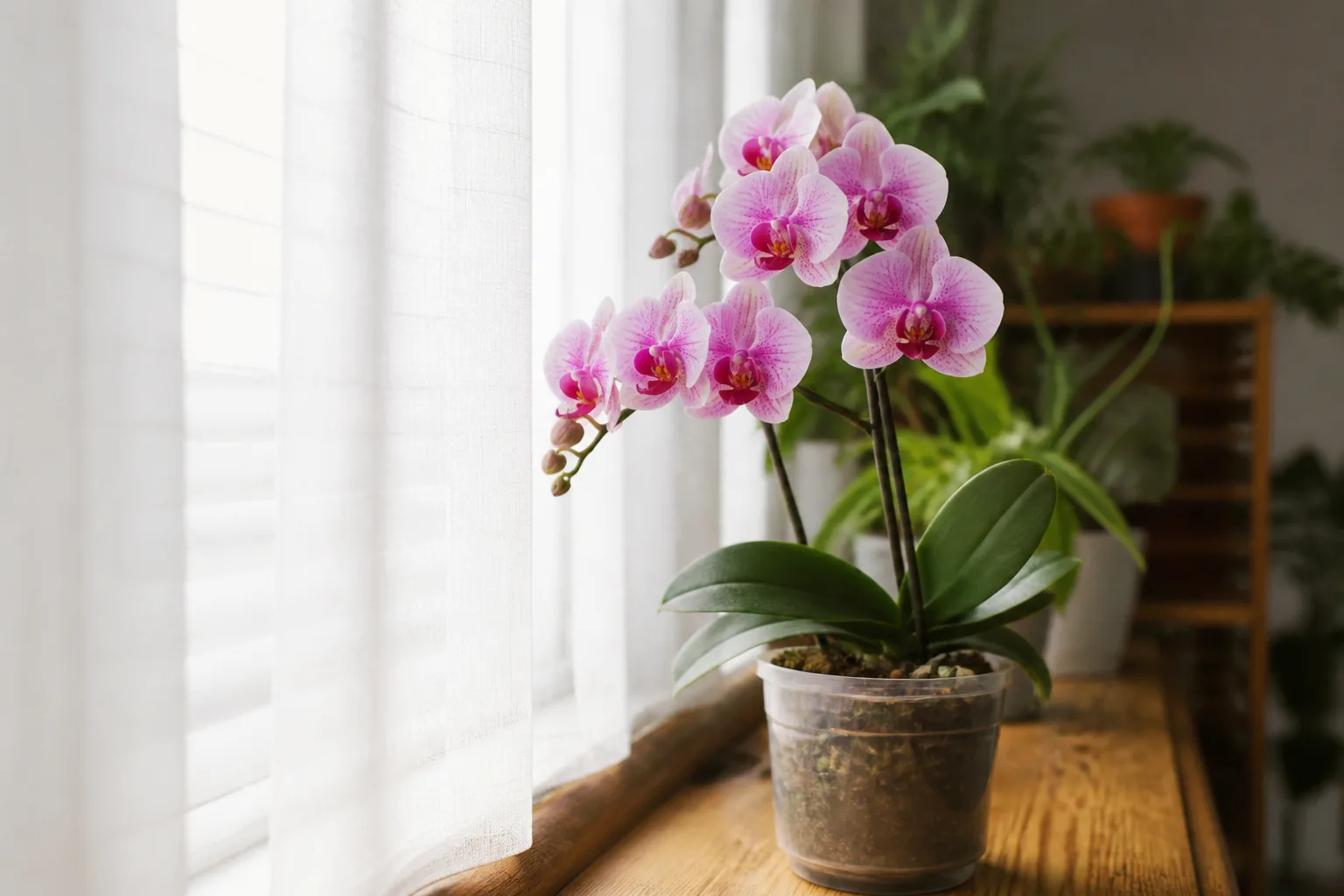
Give a Phalaenopsis bright, indirect light. An east-facing window is often a good starting point; a south- or west-facing window may work if a sheer curtain or distance from the glass prevents harsh midday sun. Inadequate light is a common reason an otherwise healthy orchid fails to rebloom, while hot direct sun can scorch leaves. The American Orchid Society recommends bright-window conditions and notes that changing seasons and temperatures can affect flower-spike initiation. (AOS Phalaenopsis culture sheet)
Aim for comfortable indoor temperatures rather than a dramatic cold treatment. The AOS gives a general Phalaenopsis range above about 60°F at night, with warmer daytime conditions; several weeks of cooler autumn nights can help initiate a new spike in many plants. A steady indoor home usually works, but sudden swings near opening buds can contribute to bud drop. Don’t put the orchid against a heater, in a cold draft, or in direct sun just because the original tag says “blue.”
Humidity is helpful, but stagnant air and water trapped in the crown are not. If your room is very dry, modestly increasing humidity around the plant can help, but leave room for gentle air movement and do not keep the pot sitting in runoff. In many homes, a bright window and correct watering matter more than buying a small humidifier solely for this plant.
Water, roots, and potting medium
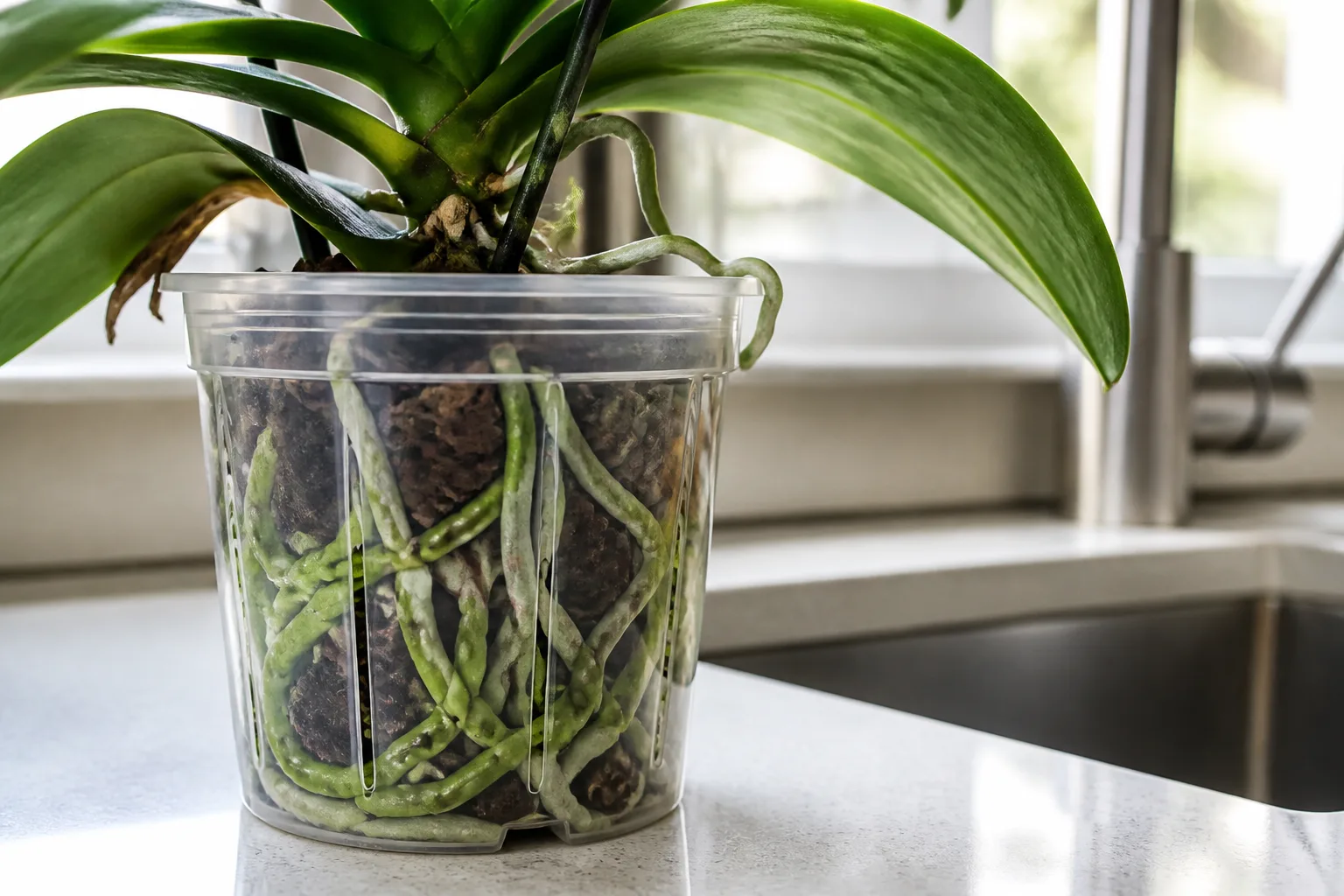
Water thoroughly, then let the potting medium approach dryness before watering again. The timing depends on bark versus moss, pot size, room warmth, airflow, and season, so a fixed schedule such as “three times a week” can leave one plant parched and another waterlogged. Clear pots can help you inspect the roots and medium; green or silvery roots are a more useful signal than the calendar alone. (AOS Phalaenopsis culture sheet)
Use room-temperature water and let the inner pot drain freely. Empty decorative cachepots and saucers after watering, and avoid leaving water pooled in the leaf crown, where it can encourage rot. Phalaenopsis roots need air as well as moisture; dense, broken-down, persistently wet medium is a warning to inspect the roots and consider repotting after bloom rather than pouring on more water.
A loose orchid bark mix or another porous orchid medium is more appropriate than ordinary potting soil. If the plant is still in a tight nursery pot with healthy roots and intact medium, you do not have to repot it immediately just because the flowers are blue. Wait until the medium decomposes, the roots show a problem, or the flowering cycle ends; then choose a pot that drains and is only large enough to accommodate the roots. A clear inner pot can make it easier to see when the mix dries, but clear plastic is not a requirement for keeping the orchid alive.
What to do when the flowers fade
When the blue flowers fall, you do not need to throw the plant away. Remove spent flowers and examine the spike. If it turns brown and dry, cut it near the base with clean snips. If a section remains green, growers differ on whether to trim it above a node for a chance of a smaller side branch or remove the whole spike to prioritize new growth; either option is reasonable for a healthy plant, and neither restores the dye.
Then focus on leaves and roots. Firm leaves and firm green or silvery roots suggest the plant is still growing, even when it has no flowers. Resume a consistent routine of bright indirect light, thorough watering followed by drainage, and occasional orchid fertilizer at a diluted label rate during active growth. A healthy Phalaenopsis may need months before it flowers again. When it does, expect the flowers to reflect the underlying hybrid, which could be white, pink, or another naturally occurring color; without the cultivar identity, no one can reliably tell you the exact shade in advance.
Do not inject craft dye, food coloring, or ink into the spike yourself to force another blue display. The commercial process involves handling a living flower stem, and the formulation and technique used by a grower may not be disclosed. Home experimentation can wound the plant without giving predictable color or a repeatable result.
Buying a blue orchid transparently and responsibly
If you want a blue flower for an event, a dyed Phalaenopsis may suit you as a short-term display—provided the seller tells you the flowers were treated and you are comfortable with that. If you want the plant to produce blue-colored flowers again, ask about a naturally pigmented Vanda or a specifically named engineered cultivar instead. These choices have different care levels, prices, availability, and legal terms, so “blue orchid” by itself is not enough information to make a fair comparison.
Ask the seller four questions before paying: What is the botanical or cultivar name? Were these flowers dyed? What color should I expect at the next bloom? Is the plant nursery-propagated and can you explain any shipping or propagation restrictions? A knowledgeable seller should be able to distinguish a treated Phalaenopsis from a Vanda species or a Blue Gene plant. If they will not answer, assume the vivid-blue flower is a one-cycle display and decide whether the plant is still worth buying to you.
For rare species, provenance matters as much as color. Kew reports that Vanda coerulea remains on CITES Appendix II and faces threats from illegal wild collection and habitat loss. Buy nursery-propagated stock from a specialist and ask for paperwork when a plant crosses international borders; do not collect orchids from the wild or encourage sellers who cannot document where a specimen came from. (Kew’s conservation notes for Vanda coerulea)
A responsible label should explain the color method in plain language, identify the plant as far as the seller can, and set realistic expectations for future flowers. For an engineered cultivar, look for an authorized source and read its current geographic and propagation restrictions. For a dyed plant, the key disclosure is simple: the blue applies to the current blooms, not necessarily to the next ones. Honest labeling lets you enjoy a dramatic flower without mistaking temporary treatment for a rare species.
Conclusion
Blue orchids are real, but the blue orchid on a retail shelf is often not what its color suggests. Vanda coerulea and several sun orchids have naturally blue or blue-violet flowers; standard florist Phalaenopsis with electric-blue blooms are usually dyed; and Blue Gene is a separate engineered Phalaenopsis with its own name and restrictions.
Before buying, check the botanical or cultivar name and ask how the color was produced. If you choose a dyed moth orchid, enjoy the present flowers and keep caring for the plant after they fade. If you want future blooms in blue, seek a clearly identified, nursery-propagated naturally pigmented species or an authorized engineered cultivar, and make sure its growing requirements fit your space.



