7 Bulbs to Plant in September for Spring Color
Learn which bulbs to plant in September, when the soil is ready, how deep to plant each, and how to keep spring foliage feeding next year’s flowers.
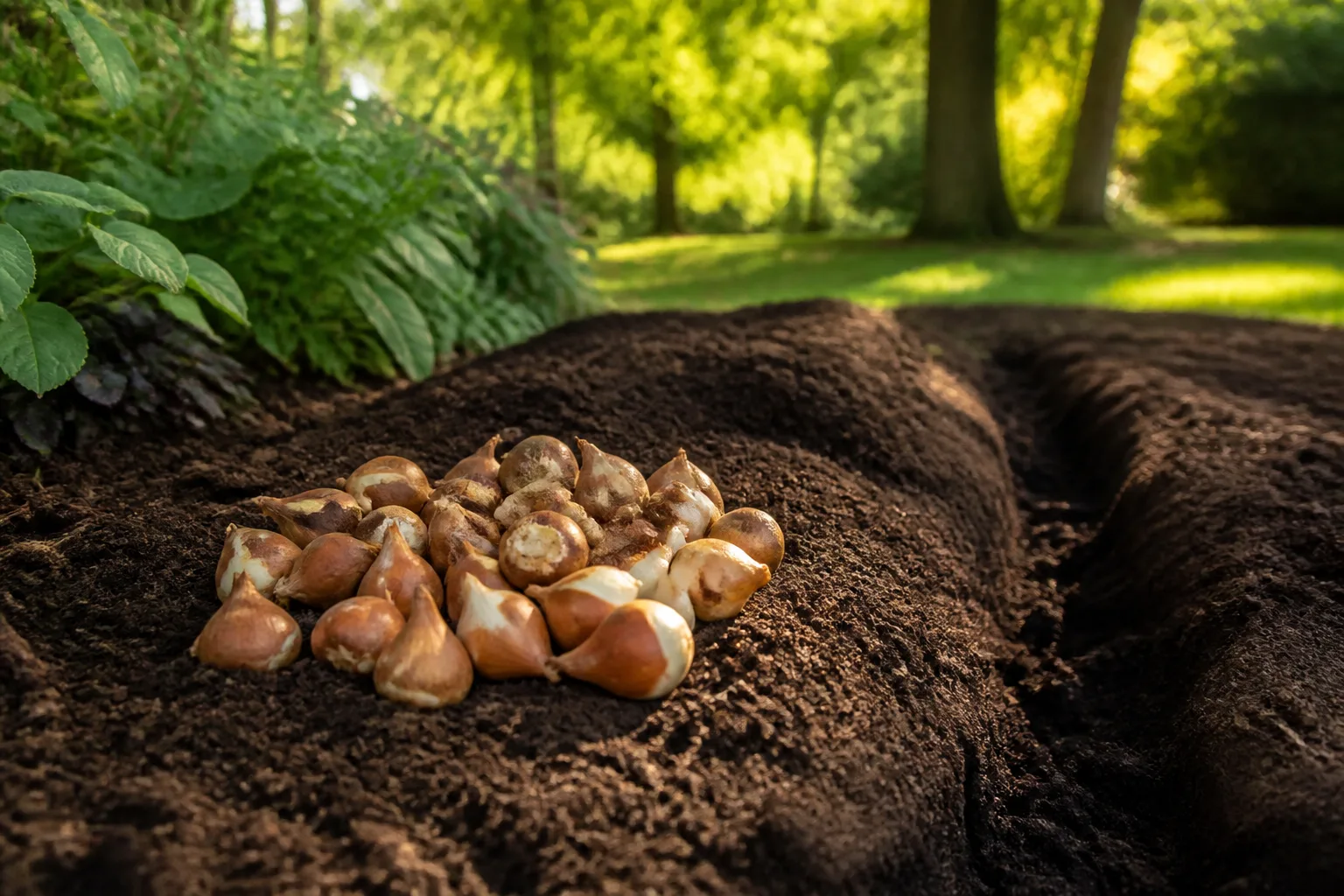
September is when a bare patch of garden can become next spring’s first color, but the date itself is not the whole instruction. Spring bulbs need time to make roots while the soil is workable, then a cool dormant period before they push leaves and flowers. In a cold-winter garden, that usually means planting after summer heat fades and before the ground freezes; in a mild climate, the best date may be later, and some tulips may need pre-chilling or a variety selected for warm winters.
The seven bulbs below are not interchangeable. Daffodils are a reliable backbone, snowdrops are for the earliest weeks, muscari soften the front of a bed, and alliums add height after the little bulbs have finished. Tulips give you the boldest color but can be less dependable as long-lived perennials, while bluebells and crown imperials solve very different design problems. Choose for the place you have, not just the flower you like in a photograph.
The September rule: plant by conditions, not the calendar
The useful September test is simple: summer heat is easing, the soil is still diggable, and several weeks remain before the ground freezes solid. Penn State Extension recommends fall planting before the first frost so bulbs can root before winter, while Colorado State University Extension identifies September and October as the main planting months in its region. Those are regional guides, not universal deadlines.
Spring-flowering bulbs are underground storage organs—true bulbs in the case of tulips and daffodils, but corms or other geophytes in some of the plants gardeners casually call bulbs. The storage tissue already contains much of the energy for the first flower. Fall planting gives the roots a head start and, for many kinds, supplies the cool period that helps the flower develop normally.
Use soil temperature and frost date together
Your calendar gives you a starting window; your soil tells you whether the window is open. Fine Gardening offers a practical rule of waiting until the soil has cooled to roughly 40–50°F (4–10°C) for many spring bulbs, while other guidance uses a broader “cool but not frozen” range. If you cannot measure the soil, use the weather pattern: several cooler nights, no prolonged heat wave in the forecast, and a planting bed that is no longer warm and sticky from late summer.
Planting too early is not an automatic disaster, but warm, wet soil can encourage premature shoots and rot. Planting too late is also not a reason to abandon good bulbs: if the soil is workable after the first light frost, plant as soon as you can, then mulch once the ground begins to freeze. A bulb that has roots but no top growth is in a better position than one left in a dry bag until winter.
In warm-winter areas, replace the first-frost rule with the requirements of the cultivar and the supplier’s instructions. Daffodils and muscari often adapt more readily than many hybrid tulips, and some bulbs sold for mild climates have already received the cold treatment they need. If your winter never supplies a reliable chill, buy bulbs and varieties recommended for that climate instead of assuming every “fall bulb” will perform the same way.
Pick bulbs that match your spring plan
Before you buy, decide what you want the bed to do. For the earliest possible color, combine snowdrops with early daffodils. For a low blue carpet, add muscari. For a formal, high-impact display, use tulips in a repeatable color block. For a planting that hands off to June perennials, add alliums. For a naturalistic woodland edge, bluebells make more sense than tulips in a sunny, exposed border.
Shop early enough to get a good selection, but inspect every bulb. Colorado State University Extension advises choosing large, firm bulbs without mold or mechanical damage; a soft spot, sour smell, deep cut, or spreading mold is a reason to discard or return it. Papery outer skins can be loose or scuffed without meaning the bulb is dead. The important test is firm tissue underneath.
Read the label for mature height, bloom time, hardiness, recommended depth, and whether the bulb is expected to naturalize. Packages often give better cultivar-specific guidance than a generic chart. If your garden has dogs, cats, or young children who dig, also treat the bulb—not only the flower—as a possible exposure risk and plan the bed accordingly.
1. Daffodils are the dependable backbone
Daffodils (Narcissus) earn the first spot because they deliver cheerful early-to-mid spring flowers and can return for years when planted in a site that suits them. You can find yellow, white, cream, orange, and pink forms, from miniature cultivars for a path edge to tall trumpet types for the middle or back of a border. They tolerate full sun and the bright spring light beneath deciduous trees before the canopy fills in.
Plant most daffodils about 6–8 inches deep, or use the package direction and the familiar rule of roughly two to three bulb heights from the soil surface to the top of the bulb. Savvy Gardening’s daffodil guidance likewise emphasizes the label, good drainage, and spacing by bulb width. Tighter planting looks fuller at first but may require division sooner. Groups of five, seven, or more read as a deliberate patch instead of scattered yellow punctuation.
Daffodils are also a smart first choice where squirrels, deer, or rabbits are persistent. Their tissues are unpalatable, but that does not make them safe to eat: the ASPCA notes that daffodils can cause vomiting, diarrhea, and drooling, with the bulb especially dangerous and larger exposures capable of more serious effects. Keep dug bulbs, dropped offsets, and compost scraps away from pets, and contact a veterinarian or animal poison service promptly if ingestion is suspected.
Let the foliage recharge the bulb
The flower is the spring reward; the leaves are the payment for next year. Remove a spent flower if you want to prevent seed development, but leave the green foliage in place until it yellows and pulls away easily. Braiding, tying, mowing, or cutting those leaves while they are green reduces the photosynthetic work that refills the bulb.
Hide the untidy stage by planting daffodils among later perennials whose leaves expand as the bulb foliage fades. That small design decision makes it easier to follow the care rule. Water during an unusually dry spring, but do not keep a poorly drained bed wet in the name of helping the bulbs.
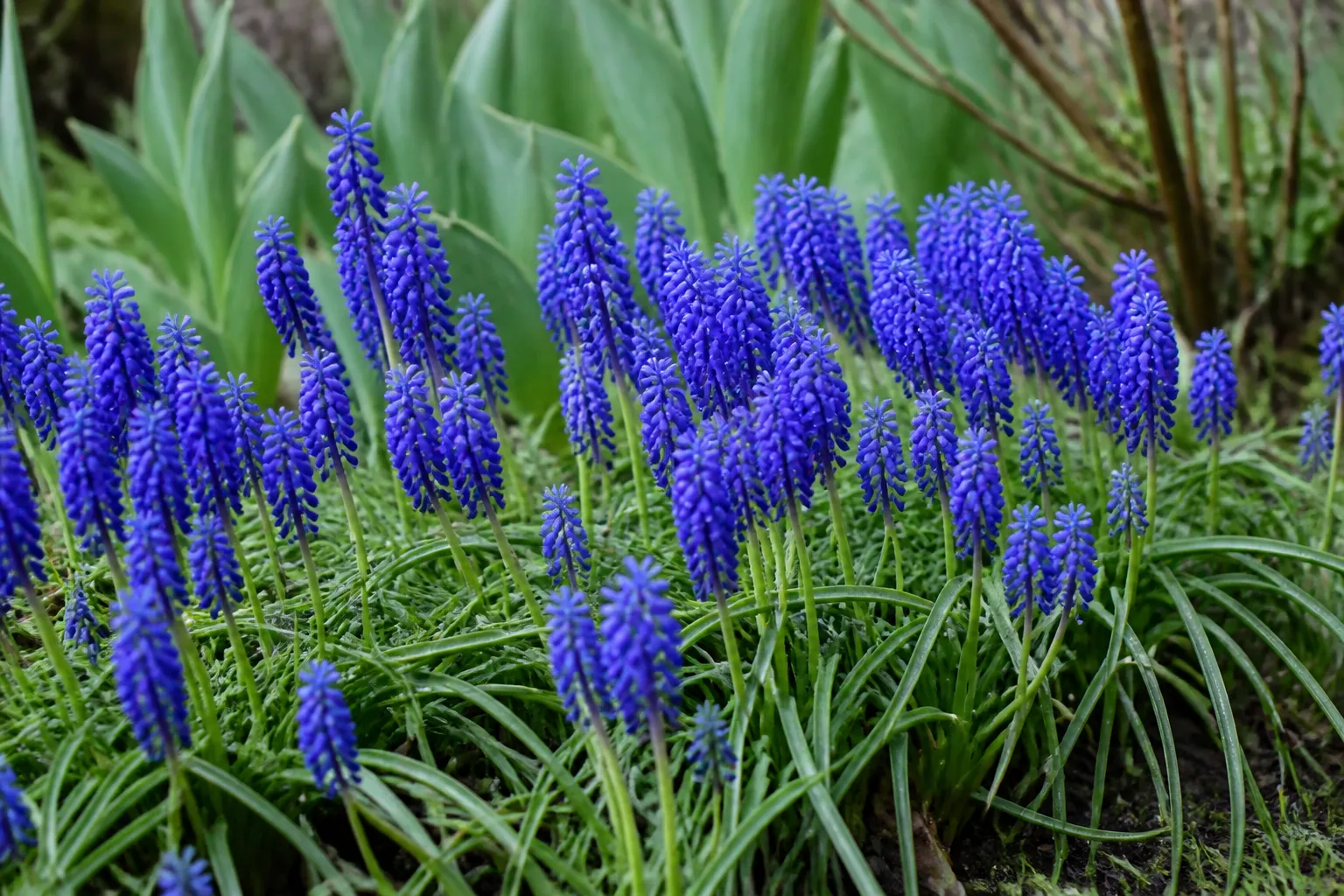
2. Grape hyacinth (Muscari) fills the front of a bed
Grape hyacinth (Muscari) is a compact spring bulb with dense spikes of blue-purple flowers that resemble a cluster of grapes. It is useful where a tall tulip would look out of scale: along a path, at the front of a border, around the feet of daffodils, or beneath a deciduous shrub. Many types grow only about 6–9 inches tall, so plant them in a group rather than expecting one bulb to make an impression.
Set muscari roughly 3–4 inches deep and about 3 inches apart, adjusting for the cultivar’s label. It prefers sun to partial shade and soil that drains well but does not become dust-dry during establishment. The small bulbs can multiply and seed, which is wonderful for a relaxed, naturalized look and less desirable for a tightly controlled design. Use an edging or remove unwanted offsets while the clumps are still manageable if you want a crisp border.
Muscari is one of the best choices for extending a color story. Underplant yellow daffodils with blue muscari, repeat the blue near a patio, and let the low foliage fade among groundcovers after flowering. The result feels designed even though the bulbs require little attention after their initial watering.
3. Snowdrops start the season in cold weather
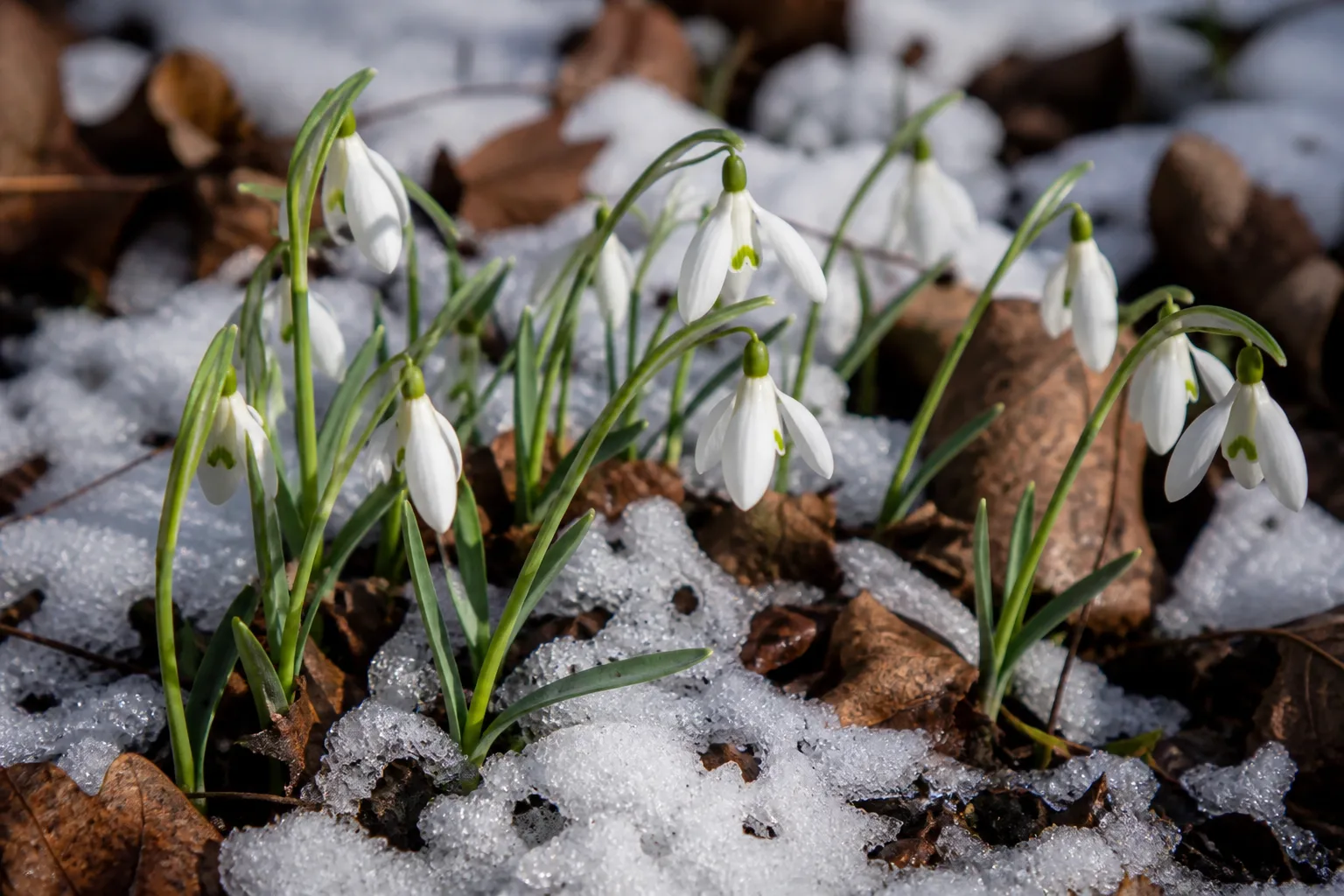
Snowdrops (Galanthus) are the bulb to choose when “spring color” really means the first sign that winter is loosening its grip. Their white, nodding flowers can appear in late winter or very early spring, sometimes while snow still sits around the leaves. They are small—often 4–10 inches tall—and look most convincing in a colony along a woodland edge, under deciduous trees, or beside a path where you will see them up close.
Give them well-drained soil with sun in early spring and partial or dappled shade later. Plant small bulbs about 3–4 inches deep, with the label taking precedence if the species or cultivar differs. Clusters are more visible than single specimens, but do not crowd them against a place that stays waterlogged; cool weather does not excuse saturated soil.
Snowdrops are a good partner for later daffodils because their bloom windows overlap only partly. The snowdrops announce the season, daffodils carry the middle, and alliums or later tulips can take over after the first flowers are gone. That progression is more satisfying than asking one bulb to bloom for an entire month.
4. Tulips deliver the strongest color, with a trade-off
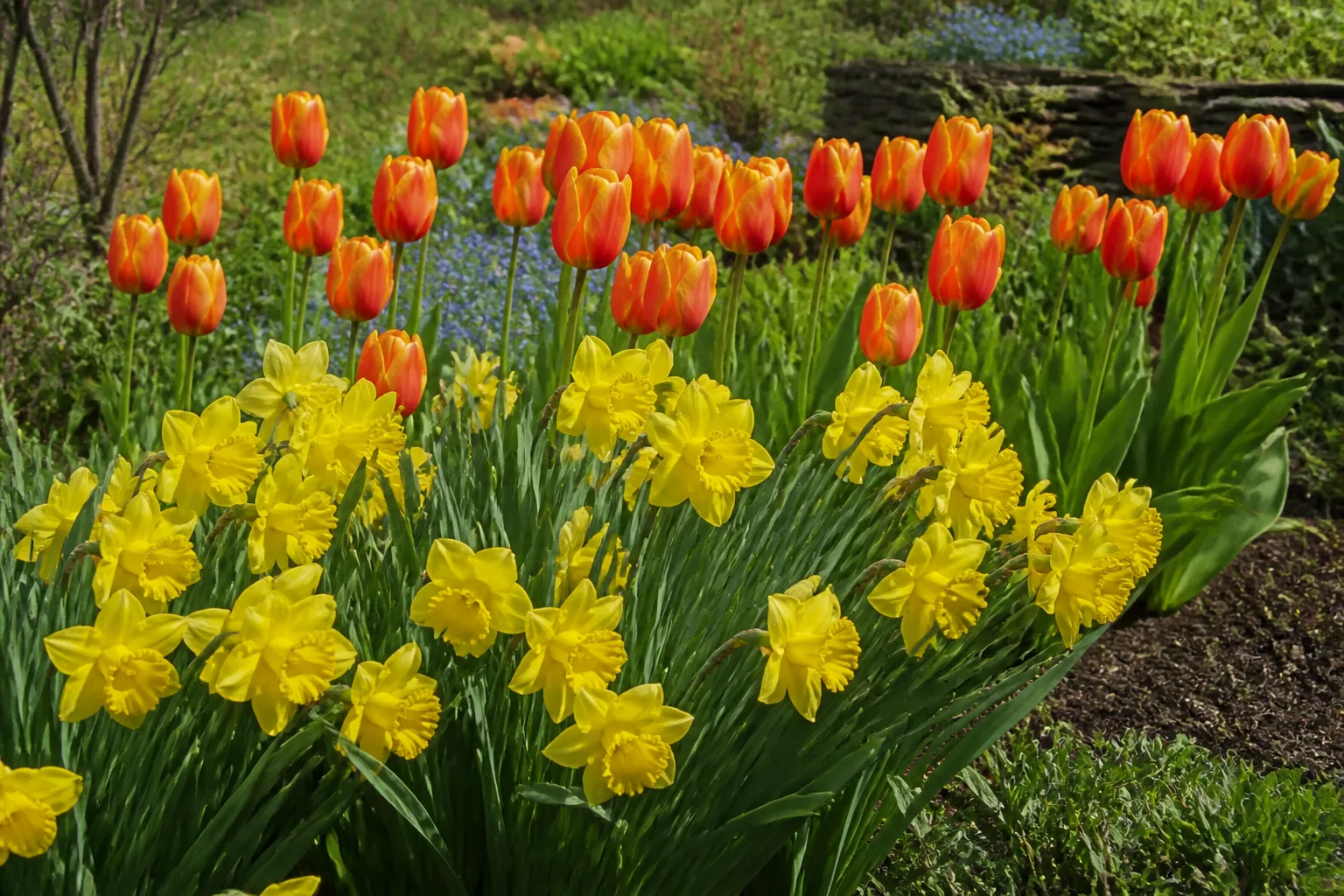
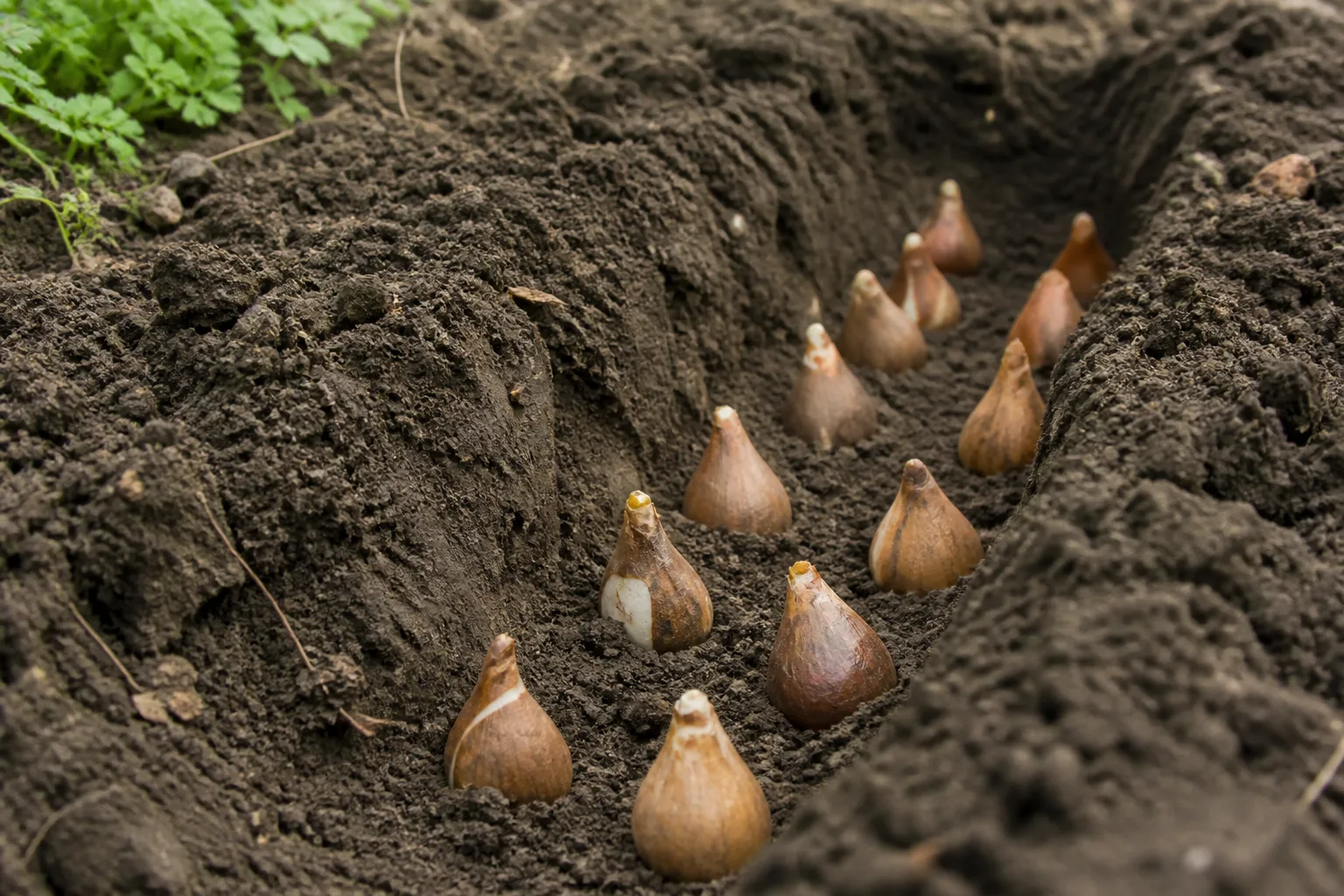
Tulips are the headline act when you want saturated blocks of red, orange, pink, yellow, purple, or white. They prefer full sun and sharp drainage, and the bulbs generally go in 6–8 inches deep, depending on size and the cultivar’s directions. Plant the pointed end up, firm the soil around the bulb, and place taller varieties behind low muscari or edging plants.
The trade-off is longevity. Some species tulips and perennial-designated cultivars return well, but many large hybrid tulips give their strongest show in the first year and become less reliable in warm, wet, or poorly drained gardens. Treat that as a design choice rather than a failure: buy tulips for a spectacular seasonal block, or select naturalizing types when year-after-year return matters most.
Tulips are also attractive to squirrels, chipmunks, deer, and rabbits. Planting at the correct depth and pressing the soil closed removes some digging cues, but it is not a complete defense. In a high-pressure yard, protect a new bed with temporary mesh until the soil settles, use a wire basket for small plantings, or make daffodils and alliums the bulk of the display and use tulips where you can monitor them.
5. Ornamental alliums bridge spring and summer
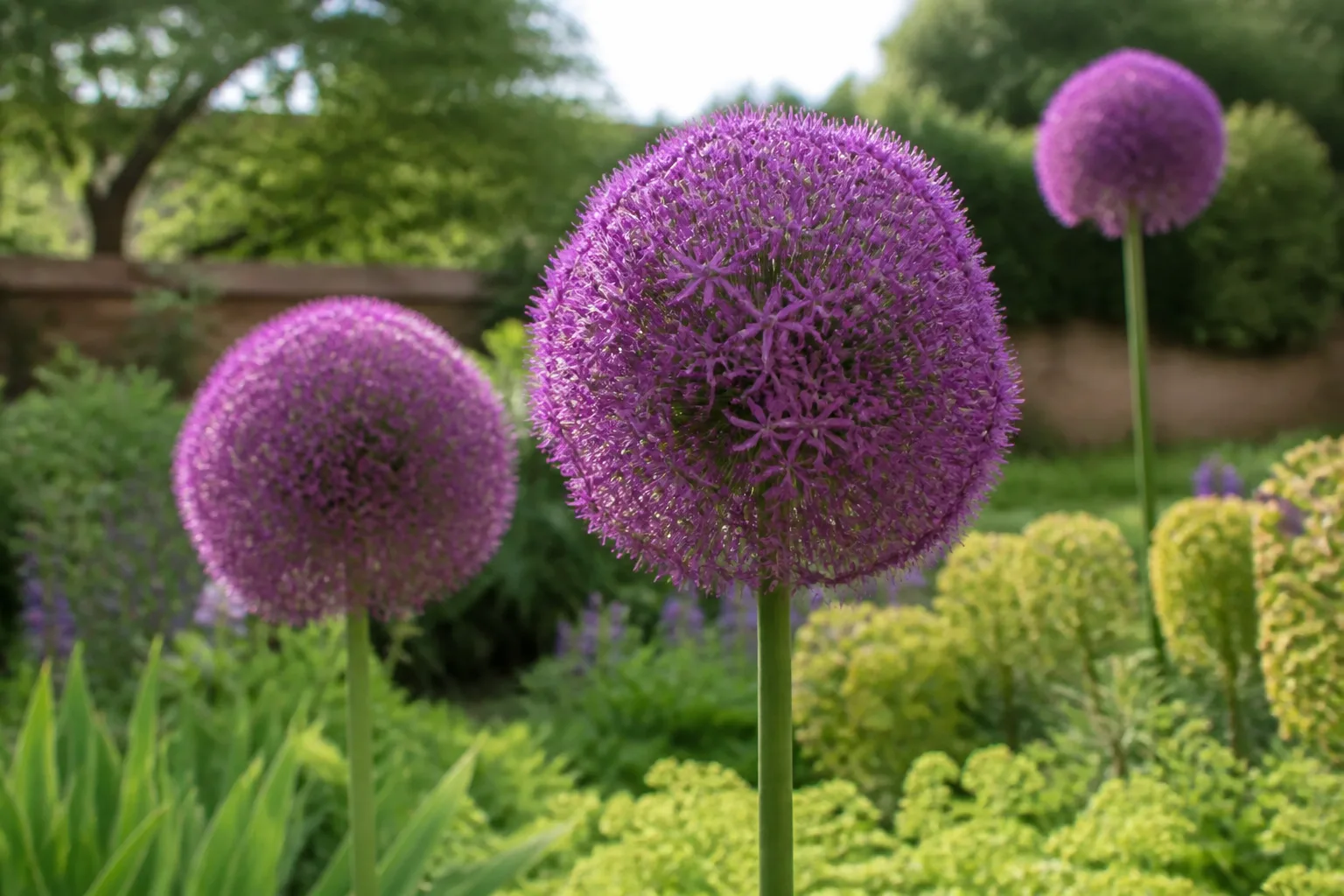
Ornamental alliums turn a fading bulb bed into a structure that still looks intentional. Their globe-shaped flower heads rise above narrow leaves in late spring or early summer, often in purple, pink, white, or yellow. Small alliums suit the front of a border; large types create punctuation marks above perennials. Their onion-family scent and chemistry usually make the bulbs less appealing to browsing mammals, though no plant is wildlife-proof.
Plant alliums in full sun and well-drained soil, generally 6–8 inches deep for medium and large bulbs, with the label as the final word. Do not hide every bulb under a thick evergreen canopy: they need enough light to recharge after flowering, and the leaves may begin fading before the flower stalks open. Pair them with emerging perennials that can disguise the leaves without smothering the soil.
Alliums are especially useful for pollinator-minded gardens because their open flower heads offer many small florets in one landing zone. Leave the dried heads standing if you like their winter shape, or cut them after they brown and use them in arrangements. When planning the bed, count alliums as the late handoff, not as a replacement for the early color supplied by snowdrops, daffodils, or muscari.
6. English bluebells create a woodland drift
English bluebells (Hyacinthoides non-scripta) bring arching stems of blue-violet bells to a partly shaded spring garden. They work best in a naturalistic planting beneath deciduous trees or along a woodland edge, where a loose drift feels intentional. In a formal sunny bed, their relaxed habit can look untidy, so choose them for atmosphere rather than for a precise row.
Give bluebells partial shade and soil that drains reliably while retaining some moisture. Plant the bulbs around 3–4 inches deep, or follow the supplier’s directions, and allow room for the planting to expand. The practical question is not only “Will it grow?” but “Am I happy for it to spread into this space?” Mark the intended boundary now, before the foliage disappears and the planting becomes harder to edit.
If you are buying from a garden center, read the botanical name and source information instead of relying on a common-name sign. English bluebell, Spanish bluebell, and hybrids are not identical plants, and correct labeling helps you choose the growth habit and ecological fit you actually want. A reputable grower and a clear label are worth more than a bargain bag of anonymous bulbs.
7. Crown imperials make a tall, unusual statement
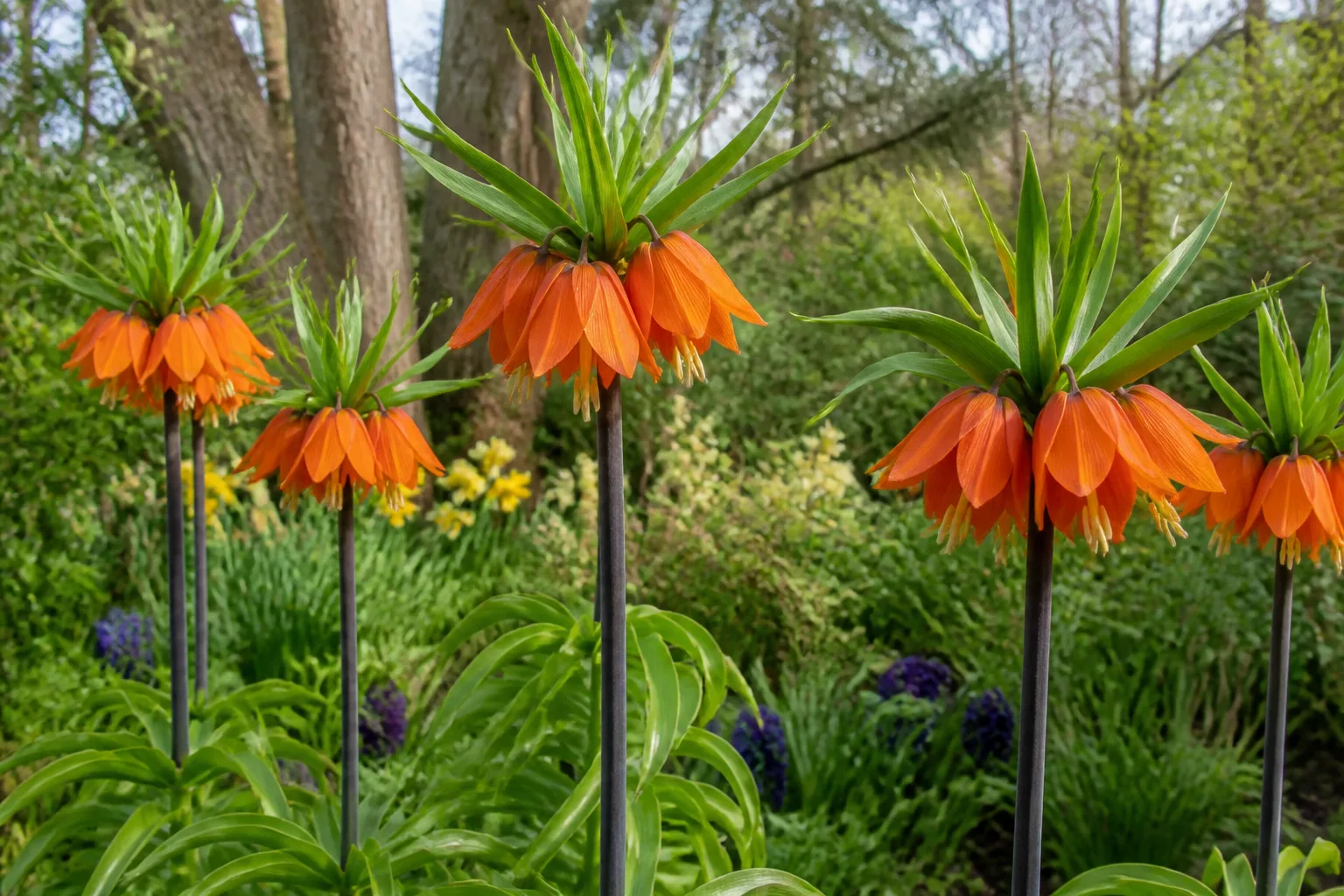
Crown imperial (Fritillaria imperialis) is for gardeners who want height and drama rather than another low spring carpet. Stout stems can reach 3–4 feet, topped by a crown of hanging orange, red, or yellow bell-shaped flowers. Set these toward the back of a border or in a focal clump where their scale will not overwhelm snowdrops and muscari.
Choose full sun to light shade and soil that drains quickly, especially through winter. Plant large bulbs about 6–8 inches deep, unless the package specifies otherwise, and give them enough spacing for the foliage and flower crown to develop. A raised bed or gentle slope is often a better home than a flat pocket where rain collects.
Crown imperials have a noticeable scent and are often selected for gardens troubled by rodents, but scent is not a guarantee against damage. Keep children and pets from chewing ornamental bulbs or plant parts, and do not treat a “pest-resistant” label as a “pet-safe” label. Their unusual form is the benefit, but their drainage requirement is the constraint.
A planting method that works for all seven
Bulb planting is quick when the bed is right and frustrating when you are trying to compensate for a bad site with fertilizer. Work in an area where water drains within a reasonable time after rain, break up compaction without creating a hard layer below the planting depth, and avoid burying bulbs in a permanently wet pocket. Penn State Extension and Colorado State University Extension both put site preparation, drainage, and depth at the center of successful fall planting.
Choose the bed before you buy the bulbs
Start with four observations: hours of sun in spring, how quickly the soil drains, the height you can accommodate, and whether animals or pets can reach the planting. A bed under a deciduous tree may be shady in summer but bright enough in early spring. A low spot may look perfect in September and stay saturated in winter. If drainage is poor, raise the bed or choose another location rather than adding a handful of grit to a deep hole and calling the problem solved.
Lay the bulbs on the soil surface before digging. Repeat one color in a drift, put tall bulbs behind short ones, and mix early, middle, and late bloomers instead of scattering seven unrelated colors across the bed. Penn State Extension notes that a solid wave of one color often has more visual impact than a thin mixture, and that design principle holds even in a small garden.
Plant at the right depth and orientation
Use this table as a starting point, not a substitute for the package label. PlantTalk Colorado notes that depth varies with bulb size and soil, and that larger daffodil or allium bulbs generally go deeper than small crocus-like bulbs. Depth here is measured from the finished soil surface to the top of the bulb, not to the bottom of the hole.
| Bulb | Typical depth | Best placement | Main watch-out |
|---|---|---|---|
| Daffodil | 6–8 in | Sun or spring sun beneath deciduous trees | Do not cut green foliage early; bulb is toxic if eaten |
| Muscari | 3–4 in | Front of beds, paths, light shade | Can spread beyond a formal edge |
| Snowdrop | 3–4 in | Dappled shade or woodland edge | Small flowers need clusters to show |
| Tulip | 6–8 in | Full sun, strong drainage | Browsing and weaker repeat performance in some gardens |
| Ornamental allium | 6–8 in | Sunny border among later perennials | Leaves may fade before flowers open |
| English bluebell | 3–4 in | Moist, well-drained partial shade | Choose the botanical name and allow for naturalizing |
| Crown imperial | 6–8 in | Sunny, fast-draining back border | Large plant and winter wet |
Place the pointed or growing end up and the flatter root plate down when the bulb has an obvious orientation. If a corm or unusual bulb is not obvious, follow its label rather than guessing. Refill the hole with the same soil, firm it gently so there are no large air pockets, and do not stomp a wet bed into a compacted slab.
Water, mulch, and mark the bed
Water once after planting to settle soil around the bulbs and start root contact. After that, let rainfall do most of the work unless the autumn is unusually dry; repeated irrigation in heavy soil is a fast route to rot. Check moisture a few inches down rather than watering because a calendar says it is “bulb day.”
Apply mulch after the soil cools and begins to freeze, not as a thick wet blanket over warm bulbs. A layer of about 2–3 inches can reduce freeze-thaw movement and help moderate soil moisture; Colorado State University Extension specifically recommends mulch after the ground freezes. Keep mulch loose and away from stems once shoots emerge, and replace it if erosion exposes bulbs.
Finish by marking the planting with a weatherproof label or a simple map. In spring, bulb foliage appears before you remember exactly what is underground. A map prevents accidental digging, tells you which leaves must be left to recharge, and makes it easier to diagnose a missing bloom next year.
Make the bloom sequence last
Think in handoffs rather than a single “spring bulb” moment. Snowdrops can begin the show in late winter, early daffodils and muscari carry the first real color, tulips fill the middle, and alliums extend the display toward summer. Bluebells can overlap the middle of that sequence in shade, while crown imperials add height wherever the bed needs a vertical anchor.
The easiest way to build this sequence is to repeat one or two colors and vary height and bloom time. For example, use white snowdrops, yellow daffodils, blue muscari, and purple alliums; tuck tulips into the same bed only where their color will not compete with every other flower. Choose cultivars labeled early, midseason, or late when available, because bloom dates shift with winter and spring weather.
Plan for the leaves, not only the flowers. Daffodil and allium foliage need to remain while green, so surround them with perennials that emerge later and hide the fade. Avoid placing every bulb in the most visible front edge of the bed unless you are prepared to tolerate several weeks of yellowing leaves after the flowers have gone.
What to do when bulbs fail
Nothing emerges by spring: Dig one test spot after the expected bloom window. A missing bulb may have rotted in wet soil, been eaten, been planted too deeply, or simply be a late cultivar. Inspect the bulb before replanting the whole bed; replacing every bulb without finding the cause repeats the same failure.
Leaves emerge in fall: Do not pull them out. Early leaves can be damaged by hard weather, but the bulb still has a chance. Water only if the soil is genuinely dry, add a light protective mulch when a hard freeze is expected, and wait for spring to judge the flower performance. Warm soil or an unusually mild autumn is often the trigger.
Bulbs are pushed up or dug out: Firm the soil after planting and check for animal tracks, shallow depth, and freeze-thaw heaving. Replant displaced bulbs at the correct depth while the ground is workable. Use temporary mesh over new beds if rodents are the problem, and consider making daffodils, alliums, or crown imperials a larger part of the next planting where their scent and chemistry reduce browsing.
Leaves appear but there are no flowers: Premature cutting is a leading suspect. Other possibilities include undersized bulbs, insufficient light for recharging, crowding, a warm winter that did not meet the bulb’s chilling needs, or a cultivar that is not a reliable perennial in your climate. Leave healthy foliage in place, improve the site before adding fertilizer, and record the cultivar so you can make a better decision next September.
Flowers are weak and bulbs rot: Stop watering on a schedule and inspect drainage. If the soil stays wet, move future bulbs to a raised or sloped area. Compost can improve structure over time, but it cannot turn a chronically waterlogged pocket into a bulb bed overnight.
Conclusion
September is a useful planting month because it gives spring bulbs time to root before winter, but the best planting day is the one that matches your soil and weather. Buy firm, correctly labeled bulbs; choose the bed before you dig; plant by the package depth with the growing point up; water once; mulch after the ground cools; and leave the spring foliage alone until it has finished its work.
For the safest starting combination, plant daffodils for dependable return, muscari for low blue color, and snowdrops for the earliest flowers. Add tulips for drama, alliums for a late handoff, bluebells for shade, or crown imperials when you have a fast-draining place for a tall statement. A little planning now turns a dormant patch of soil into a spring display that unfolds in stages instead of arriving all at once.



