Creeping Juniper Ground Cover: Planting, Cultivars, and Fixes
Grow creeping juniper (Juniperus horizontalis) for slopes and rock gardens: cultivar sizes, planting spacing, watering, blight fixes, and cedar-apple rust risks.
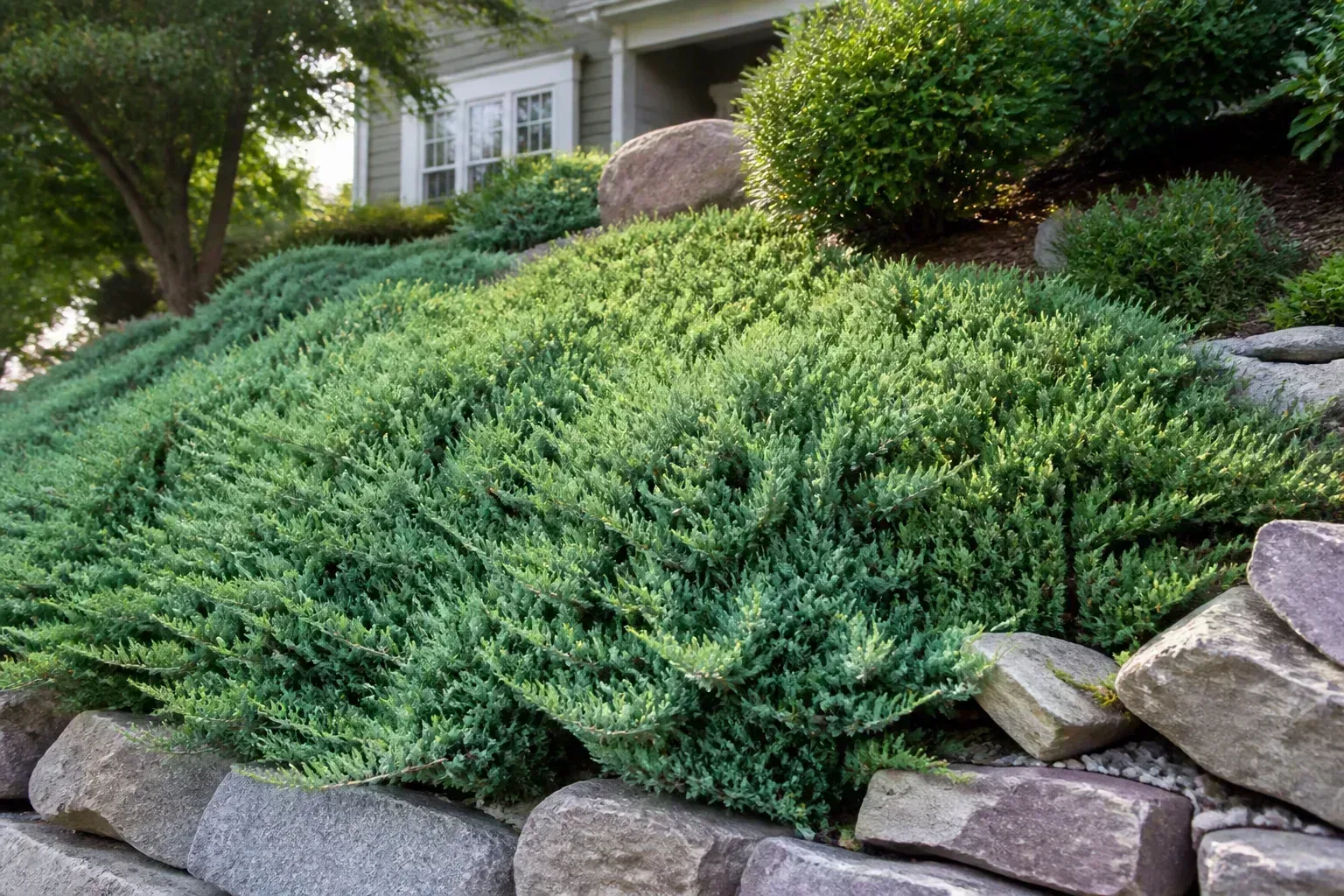
Creeping juniper (Juniperus horizontalis) is a procumbent North American evergreen that spreads into dense mats rarely taller than 18 inches but often 5 to 10 feet wide. Gardeners reach for it when they need year-round color on slopes, rock gardens, retaining walls, and hot, dry banks where turf struggles. Its scale-like foliage runs blue-green through summer and frequently shifts plum-purple in winter — a combination of drought tolerance, deer resistance, and erosion control that few ground covers match in USDA zones 3 through 9.
This guide starts with the site check most care pages skip, walks through cultivar sizing so you do not plant a 20-foot spreader beside a sidewalk, and ends with a practical brown-foliage diagnostic when blight, wet soil, or shade each demand a different fix.
Is Creeping Juniper the Right Ground Cover for Your Site?
Before you buy flats of plugs, run a five-minute site audit. Creeping juniper rewards the right location with decades of low input. In the wrong one — shade, soggy clay, or a path edge — it thins, browns, and becomes a maintenance headache.
Where It Excels Versus Where It Struggles
Choose creeping juniper when you have full sun (six or more hours of direct light), well-drained soil, a slope or rocky bank that needs holding, a coastal or roadside spot with salt spray, or a xeriscape bed where you want evergreen coverage without weekly mowing. NC State Extension notes tolerance for heat, urban air pollution, moderately poor soils, and deer browsing — useful traits for parking islands and hell strips paired with other low-maintenance full-sun plants.
Skip it or pick another ground cover when the bed stays wet after rain, tree canopies block afternoon sun, you need walkable turf replacement, or you want fast color from flowers. Creeping juniper is not invasive in the usual sense — it spreads by trailing branches, not aggressive seeding — but wide cultivars can swallow edging if you under-space them. For faster green carpets in warm climates, compare options in a fast-growing groundcovers roundup before committing to a slow conifer mat.
Foot traffic is a hard no. Stems break under repeated stepping; use stepping stones or a dedicated path material instead of expecting a living walkway.
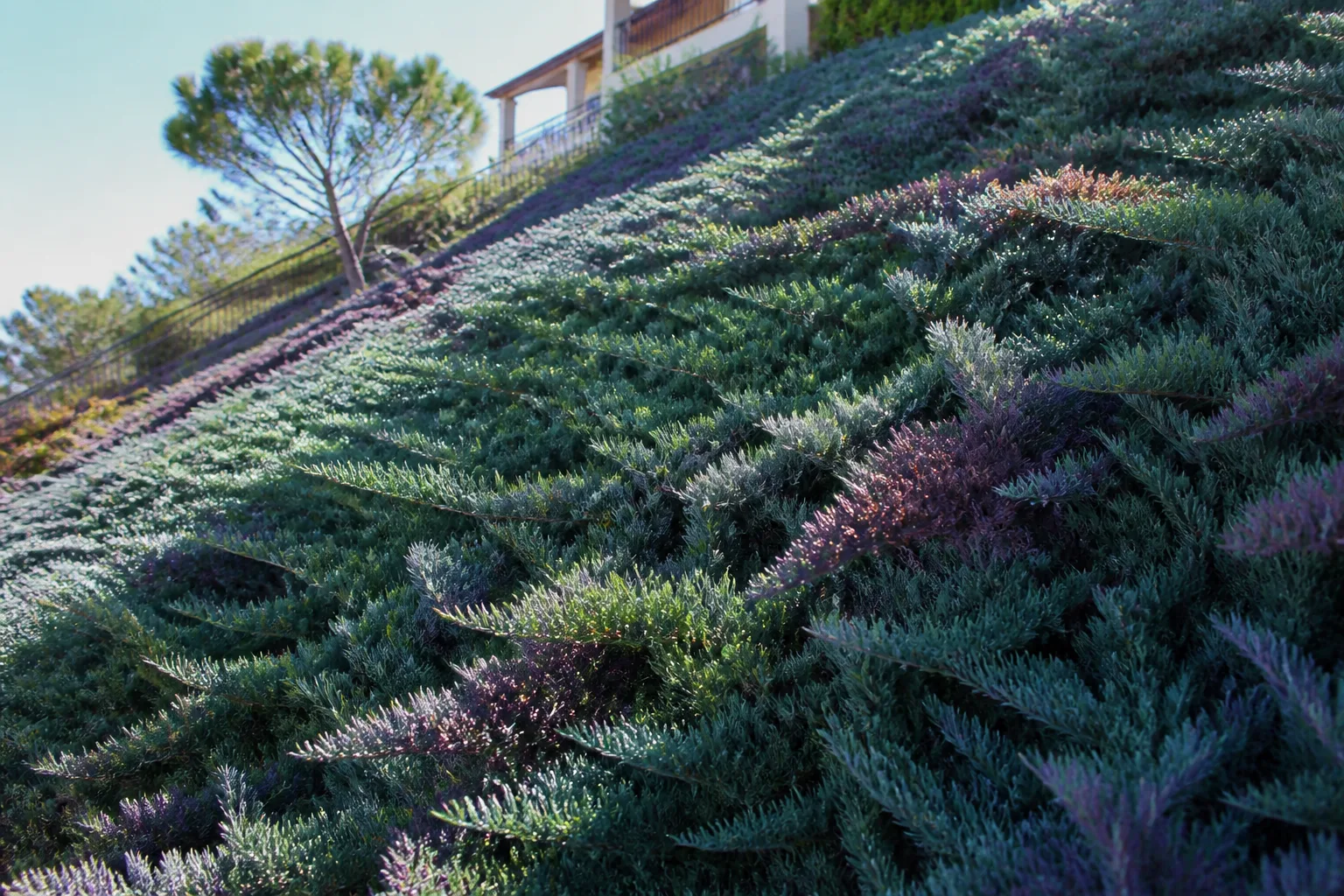
Creeping Juniper at a Glance
| Feature | Details |
|---|---|
| Common names | Creeping juniper, creeping cedar, trailing juniper |
| Botanical name | Juniperus horizontalis (Cupressaceae) |
| Plant type | Low evergreen shrub / ground cover |
| Mature size | 0.5–1.5 ft. tall, 5–10 ft. wide (Missouri Botanical Garden) |
| Sun | Full sun |
| Soil | Average, well-drained; adapts to sandy, rocky, or moderately poor soils |
| Soil pH | Acidic to neutral |
| Hardiness | USDA zones 3–9 |
| Native range | Northern North America — Alaska, Canada, northern U.S. |
| Water | Medium while establishing; drought-tolerant once rooted |
| Deer | Generally resistant (Missouri Botanical Garden) |
| Uses | Slopes, erosion control, rock gardens, retaining walls, coastal beds |
| Tolerates | Drought, erosion, shallow rocky soil, salt spray, urban pollution |
The species name horizontalis describes the habit: long trailing branches with short side shoots form mats far wider than they are tall. Foliage is mostly adult scale-like needles with some juvenile awl-shaped pairs. Berry-like seed cones mature blue but appear inconsistently on cultivated plants in landscapes.
Choosing a Cultivar That Fits Your Space
More than 100 cultivars exist. Height and spread vary enough that buying “creeping juniper” without a cultivar name is a common landscaping mistake. Read the tag for maximum width, not just color.
Blue Rug and Other Low Mats
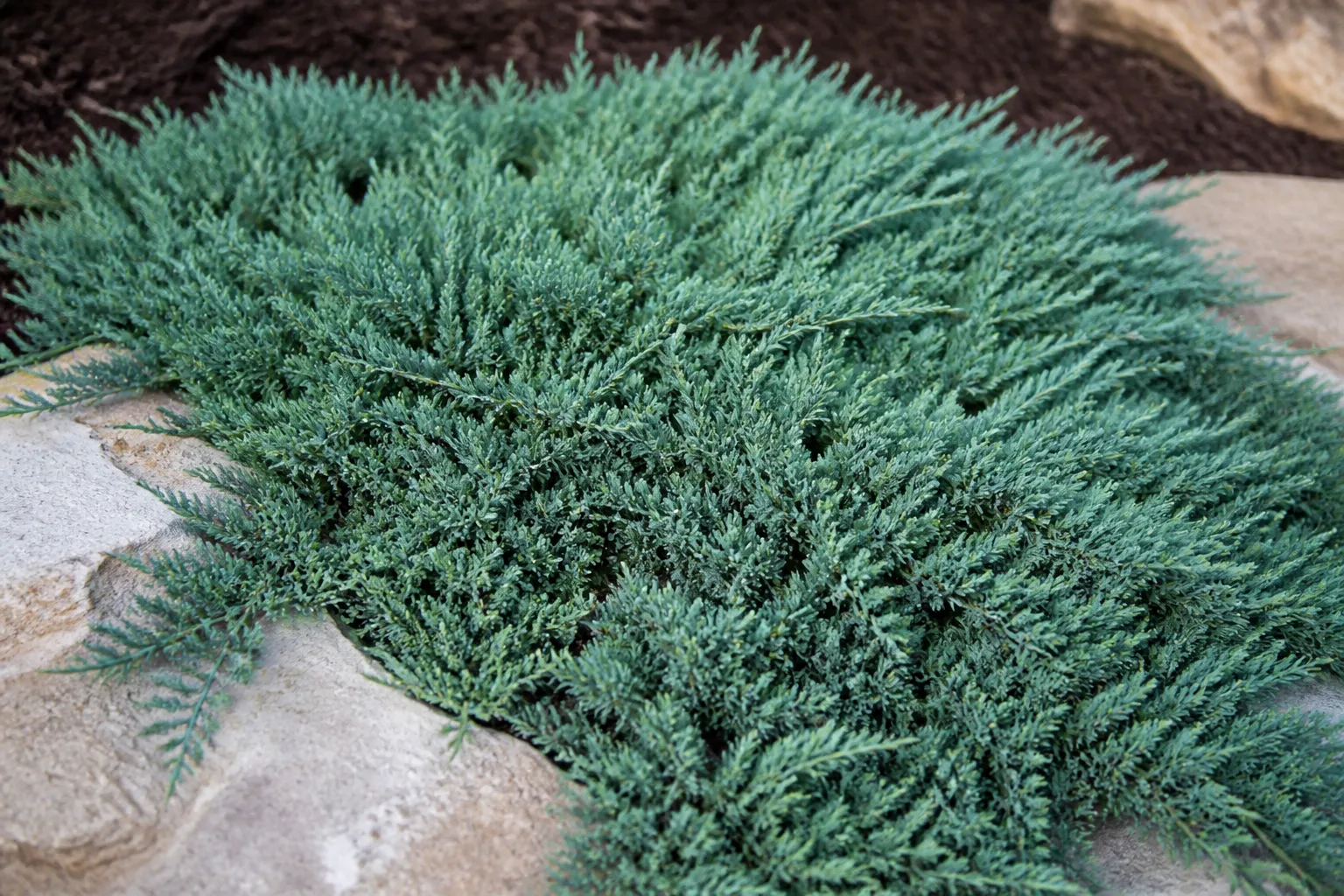
‘Wiltonii’ (Blue Rug) — The benchmark low mat: 4–6 inches tall, up to 5–8 feet wide, steel-blue foliage purpling in winter. Salt- and wind-tolerant; discovered on Vinalhaven Island, Maine (UConn Plant Database). Ideal for rock gardens and foreground edging where you need a tight carpet.
‘Bar Harbor’ — Gray-blue summer foliage reddening in winter; about 1 foot tall and 6–8 feet wide. Slightly looser texture than Blue Rug — good along walkways where you do not want a solid wall of blue (NC State Extension).
‘Pancake’ — Ultra-low at roughly 3 inches; deep green. Choose when height restrictions matter above all else.
‘Mother Lode’ — Gold-variegated sport of Blue Rug; slow spread (4–6 inches per year), only about 3 inches tall. Winter turns the gold portions orange — plan for that seasonal shift in formal beds.
Taller Mats and Fast Spreaders
‘Plumosa’ (Andorra juniper) — Denser, up to 2 feet tall and 10 feet wide; bluish-green summer color, plum-purple winter. Historically popular but more Phomopsis-sensitive than some selections (UConn Plant Database).
‘Blue Acres’ — Among the widest spreaders, often reaching 20 feet. Use only on large banks with no competing hardscape within a decade.
‘Lime Glow’ — Chartreuse-yellow foliage on a smaller 3-foot spread; bright accent in mixed conifer plantings — pair with darker small evergreen shrubs for contrast.
‘Prince of Wales’ — Cold-hardy Canadian selection; bright green mat about 6 inches high, modest spread. Reliable in zone 3 exposures.
When in doubt, measure the bed width and divide by the tag’s mature spread to estimate how many plants you need for overlap in five years — not just year one.
Planting Creeping Juniper the Right Way
Timing, Spacing, and Depth
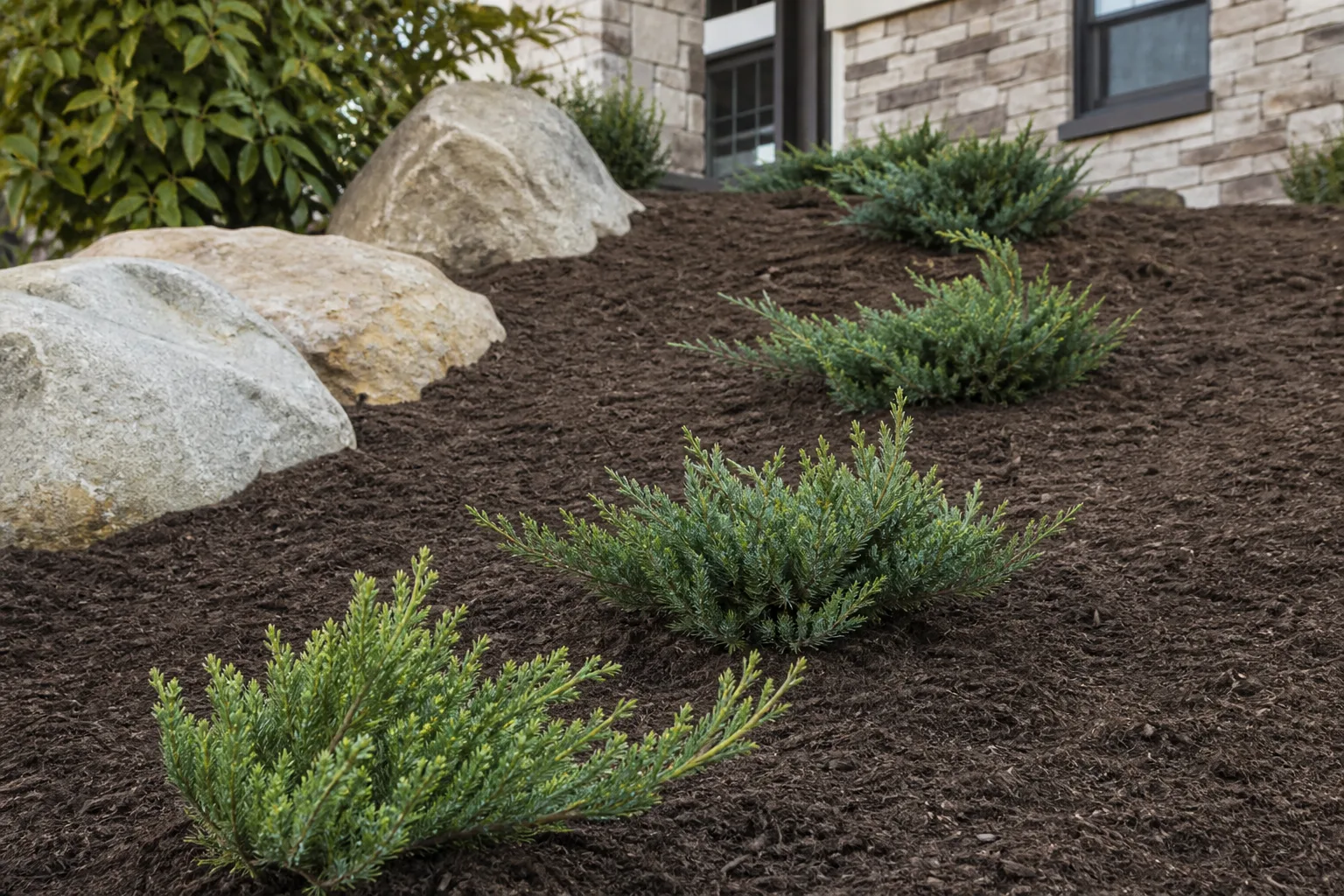
When: Plant in early spring after frost danger passes, or in early fall six weeks before your ground freezes. Spring gives a full growing season to root before summer heat; fall planting works well in mild climates because cool soil encourages root growth without top push.
Spacing: For solid ground cover within three to five years, space most cultivars 5 to 8 feet apart on center. NC State Extension suggests 6 to 12 feet for slower fill on very large slopes where budget matters more than speed. Tighter spacing (3–4 feet) speeds coverage but raises upfront cost — reasonable on a highly visible front bank, excessive on a remote erosion patch.
How: Dig a hole as deep as the root ball and twice as wide. Juniper roots are fibrous and shallow — do not bury the crown. Set the plant so the top of the root ball sits level with or slightly above grade. Backfill with native soil; skip heavy compost amendments that hold moisture against the crown. Water deeply immediately.
On slopes, stagger rows in a brick pattern and pin long branches with landscape staples until they root at nodes — trailing stems layer naturally when soil contact is good. Mulch with 2 inches of pine fines or shredded bark, keeping mulch off the crown.
Container-grown 1-gallon plants are standard; 5-gallon specimens jump-start coverage on steep sites where erosion cannot wait three seasons.
Light, Soil, and Drainage Requirements
Creeping juniper demands full sun. Less than six hours of direct light produces thin, leggy growth and washed-out winter color. Shade also predisposes plants to needle blights during humid spells — the brown patches you see are often a site problem, not a mystery disease.
Soil flexibility is a strength. Sandy, rocky, and moderately poor soils suit the species; Missouri Botanical Garden notes adaptation to dryish sandy loam and tolerance of compacted urban soils. The non-negotiable requirement is drainage. Standing water invites Phytophthora root rot and general decline. If your site puddles, build a berm, install a French drain, or choose a wet-tolerant alternative instead of fighting physics.
Soil pH from acidic to neutral works. Saline coastal exposures are acceptable — another reason Bar Harbor and Blue Rug appear in seaside plantings (NC State Extension).
Watering Through Establishment and Drought
Year one: Keep root zones evenly moist — not soggy — from planting through the first full growing season. Deep watering once or twice weekly beats daily sprinkles that wet only the surface. Probe 4 inches down; if dry, water.
After establishment: Rainfall usually suffices in most climates. Supplement only during extended heat droughts — a slow soak every 7 to 10 days when leaves dull and soil is powder-dry 6 inches down. Overwatering established plants is a more common killer than underwatering; wilting from root rot looks superficially similar to drought stress, but the soil will feel wet.
New transplants on slopes may need temporary drip irrigation uphill of the planting line until roots anchor. Remove irrigation once mats knit together — constant spray heads that wet foliage nightly encourage blight in humid regions.
Fertilizer: When Less Is More
Creeping juniper thrives in lean soil. Do not fertilize the first year after planting while roots are settling. If a soil test shows deficiency, apply a balanced slow-release granular fertilizer in early fall at half the label rate for shrubs — once annually is plenty.
Excess nitrogen pushes soft growth that blights target first. Yellowing on alkaline soils may indicate iron chlorosis; fix pH or use chelated iron per test results rather than doubling fertilizer.
Pruning and Controlling Spread
Routine pruning is unnecessary. The plant’s horizontal habit is the point. Prune only to:
- Trim branches encroaching on walks, driveways, or structures — cut back to a side branch, not bare wood in the center of old mats if avoidable.
- Remove dead or blight-stricken tips in dry weather, disinfecting shears between cuts.
- Rejuvenate a thin center by lightly thinning outer layers in late winter, though severe renovation is slow on old plants.
If spread worries you, the real control is cultivar choice at purchase, not annual hedge trimming. A Blue Acres juniper will not stay petite because you shear it twice a summer.
Pests, Diseases, and What Brown Foliage Really Means
Healthy creeping juniper in full sun with sharp drainage is remarkably trouble-free. Problems cluster where moisture, shade, or crowding stack up.
Insects: Watch for bagworms (defoliate sections by late summer), spider mites (stippled gray-green needles, fine webbing), aphids, juniper scale, and juniper webworm. Mites spike during hot, dusty dry spells — a hard hose blast early helps; horticultural oil treats heavier infestations when temperatures are below 85°F (NC State Extension).
Fungal blights: Phomopsis tip blight, Cercospora needle blight, and Kabatina twig blight cause browning branch tips, especially after wet springs. Prune 4 to 6 inches below visible damage into healthy tissue; destroy debris; avoid overhead watering. Copper or mancozeb fungicides labeled for juniper may help on valuable specimens when weather stays wet — follow label timing; prevention beats rescue.
Root rot: Whole-plant yellowing and collapse on wet sites points to Phytophthora. Improve drainage; do not replant juniper in the same hole without fixing the hydrology.
Brown foliage decision path:
- Wet soil + shade → relocate or improve drainage and light; fungicides will not fix site failure.
- Tips only, after rainy spring → blight; prune and consider fungicide next year before rain.
- Interior dieback on old mats → natural aging or mite stress; thin and monitor.
- Orange gelatinous masses on branches near apples → cedar-apple rust (see below).
Cedar-Apple Rust and Apple Neighbors
Gymnosporangium juniperi-virginianae alternates between juniper and apple-family hosts (apple, crabapple, hawthorn). Orange galls on juniper branches release spores that spot apple leaves; the cycle returns to juniper. NC State Extension lists this rust among key disease concerns.
If you grow fruiting apples within a few hundred feet, choose rust-resistant apple cultivars, plant junipers downwind when possible, or select non-host ground covers near the orchard. Cosmetic galls on juniper rarely kill the plant but look alarming — prune affected twigs if appearance matters.
Propagation: Cuttings Versus Nursery Plants
Most garden guides stop at “buy from a nursery.” That is still the practical default for instant coverage, but propagation is possible for patient gardeners.
Take semi-hardwood cuttings in mid- to late summer from healthy side shoots. Strip the lower third of needles, dip in rooting hormone, and stick in a sand-perlite mix under mist or a humidity dome. Rooting takes several weeks; overwinter young plants in cold frames before field planting. Expect two to three years before a cutting matches a 1-gallon nursery plant’s spread.
Seed is unreliable for cultivar traits — every seedling differs. For named mats like Blue Rug, vegetative cuttings or purchased liners are the only way to preserve color and habit (Oregon State Landscape Plants).
Creeping Juniper Versus Shore Juniper
Nurseries often confuse two prostrate junipers. Shore juniper (Juniperus conferta) hails from Japan’s coast, tolerates slightly more salt and sand, and runs brighter green with coarser needles. Creeping juniper (J. horizontalis) is the North American species with finer texture and stronger cold hardiness inland.
Use shore juniper in zone 6+ coastal dunes where horizontalis may struggle with humidity diseases; use creeping juniper on northern slopes, rocky alkaline sites, and anywhere you need zones 3–5 reliability. NC State Extension explicitly notes the two are commonly confused — check botanical names on tags, not just “creeping” on the pot sticker.
Conclusion
Creeping juniper earns its place when you match cultivar width to the bed, plant in full sun with drainage that would satisfy a lavender, and water patiently through the first year before stepping back. Pick Blue Rug or Bar Harbor for tight blue mats, steer clear of Blue Acres unless you have acreage, and run the brown-foliage checklist before reaching for fungicide. Get those decisions right and you get a living carpet that holds slopes, shrugs off deer, and colors up every winter without another trip to the garden center.



