How to Cat-Proof Houseplants Without Risky Repellents
Cat-proof houseplants with secure room barriers, stable pot covers and enrichment. See which DIY sprays to skip and when a plant bite needs a veterinarian.
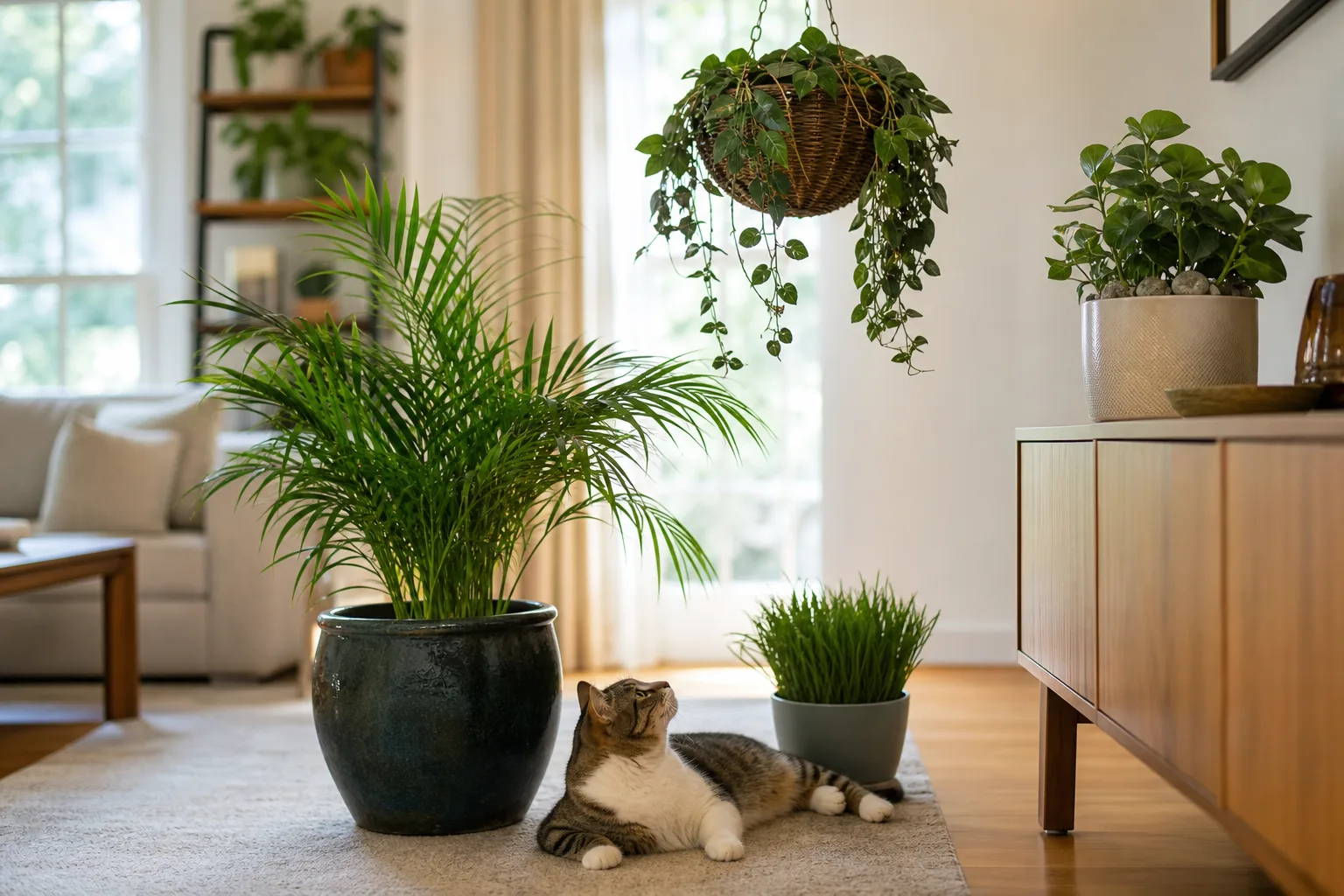
You can keep houseplants and cats in the same home, but no scent, shelf, or training trick makes an accessible plant automatically safe. Start by identifying what each plant is, then prevent access to anything that could seriously harm your cat; after that, address chewing, digging, and climbing with a combination of physical setup and enrichment.
This order matters. A cat that eats a mildly irritating leaf and a cat that contacts a true lily need different responses, while the same cat may be drawn to one plant’s dangling leaves and another pot’s loose soil. Choose a fix for the behavior you actually see, and treat every barrier as risk reduction rather than a guarantee.
Start with the risk, not the repellent
Cat-proofing has two jobs: reduce the chance of harmful exposure and prevent routine damage to plants and pots. A bitter spray cannot make a highly toxic plant safe to chew, and a non-toxic plant can still cause vomiting or diarrhea if a cat eats a lot of it. The ASPCA plant database also cautions that its list is not all-inclusive and that consuming any plant material can upset a cat’s stomach.
Begin with the most serious risk you can control: remove access to unknown plants and those known to cause severe poisoning. Then set up the room so your cat cannot simply leap from a chair to a shelf, reach a dangling vine, or knock a pot onto the floor. Only once exposure is addressed should you test lower-stakes adjustments such as a soil cover or a designated cat-grass pot.
Toxicity is species-specific
Common names are not a safe way to judge a plant. “Lily” can refer to unrelated plants with very different effects: true lilies (Lilium) and daylilies (Hemerocallis) can cause life-threatening kidney injury in cats, while peace lily (Spathiphyllum) contains insoluble calcium oxalate crystals that cause intense mouth irritation, drooling, vomiting, or difficulty swallowing. The ASPCA’s lily guidance explains that all parts of true lilies can be toxic, small amounts can injure kidneys, and cats may be exposed by grooming pollen from their fur or drinking vase water; the ASPCA peace lily entry describes a different toxic principle.
| Plant group | Why the name matters | Practical response |
|---|---|---|
| True lilies, Lilium | Can cause kidney failure in cats | Keep out of a cat household; treat possible contact as urgent |
| Daylilies, Hemerocallis | Also included among lily groups dangerous to cats | Do not rely on a high shelf; remove access and call a vet if exposure may have occurred |
| Peace lily, Spathiphyllum | Not a true lily; calcium oxalates cause painful oral irritation | Keep away from chewing and seek veterinary advice after a bite |
| Lily of the valley, Convallaria | A different plant with cardiac glycosides; can cause serious poisoning | Keep it out of a cat household and call a veterinarian if exposure may have occurred |
| Peruvian lily, Alstroemeria | Can cause stomach upset but is not expected to cause the same life-threatening organ injury as true lilies | Identify it carefully; ask a veterinarian after a suspected bite |
| Pothos, philodendron, monstera and similar aroids | Many contain insoluble calcium oxalate crystals | Identify the exact plant and block chewing; symptoms can include oral pain and drooling |
The ASPCA has separate records for plants with similar names, so search by the scientific name on the nursery label, not just a store tag that says “lily,” “palm,” or “fern.” Its 2025 veterinary toxicology overview lists pothos, peace lily, philodendron, monstera, dieffenbachia, ZZ plant, and others among houseplants containing needle-like raphides that irritate the mouth when chewed. (ASPCA toxic houseplants)
A “non-toxic” label is not permission for a cat to eat the plant. It means the plant is not expected to cause systemic poisoning under the listed classification; fiber, sap, soil, fertilizer, or a large quantity of leaves can still trigger a problem. If your cat is a persistent chewer, plant selection can lower risk, but it does not replace access control. See the cat-safe houseplant guide for species options and the cautions behind those classifications.
Make an inventory and deal with the highest-risk plants first
Walk through the home at cat level as well as human eye level. Check windowsills, floor planters, bathroom counters, cut-flower bouquets, dropped leaves, and plants in rooms that are usually open only briefly; cats often encounter a plant when a door is left ajar or a branch falls during pruning.
For each plant, record the botanical name, where it sits, whether your cat can reach it, and whether it has shed leaves or pollen. Photograph the whole plant and its label, then verify the name in a veterinary toxicology database. If you cannot confidently identify a plant, temporarily put it behind a closed door until you can verify it rather than assuming that its common name or appearance proves it is safe.
Prioritize this way:
- Remove true lilies and daylilies from the home. Hanging a bouquet or placing it on a tall counter does not address pollen, dropped petals, or access if the plant is knocked down.
- Isolate plants classified as seriously toxic. Use a closed room or a secure cabinet that the cat cannot open, climb into, or tip over; if that setup is not dependable, rehome the plant.
- Move lower-risk but irritating plants away from chewing routes. A high shelf can help only if furniture, curtains, neighboring plants, and dangling stems do not make a ladder.
- Clear fallen leaves and flowers promptly. A cat may find a fallen piece that is easier to reach than the pot.
- Review after pruning, repotting, or bringing home a bouquet. Fresh cuttings and loose debris can create a new exposure even when the established plant is normally contained.
This is a better use of effort than buying a repellent before you know whether the plant is dangerous. When one exposure could be an emergency, dependable exclusion is more useful than hoping a cat will dislike a smell.
Choose a barrier that closes the real access route
Watch your cat approach the plant before choosing a barrier. Does it jump from a sofa to a sill, climb shelving, paw at trailing leaves, or tip a lightweight pot? A barrier works only when it interrupts that route and remains stable when the cat pushes, jumps, or bats at it.
A locked room is the clearest option for a toxic collection, but daily household routines can defeat a door that is routinely propped open. A glass-fronted plant cabinet can also work when it has a closing latch, no accessible gaps, safe wiring, adequate ventilation, and the light and temperature each plant needs. Do not seal plants into an unventilated case or put a cat inside a room where it could be trapped with chemicals, fertilizers, or sharp equipment.
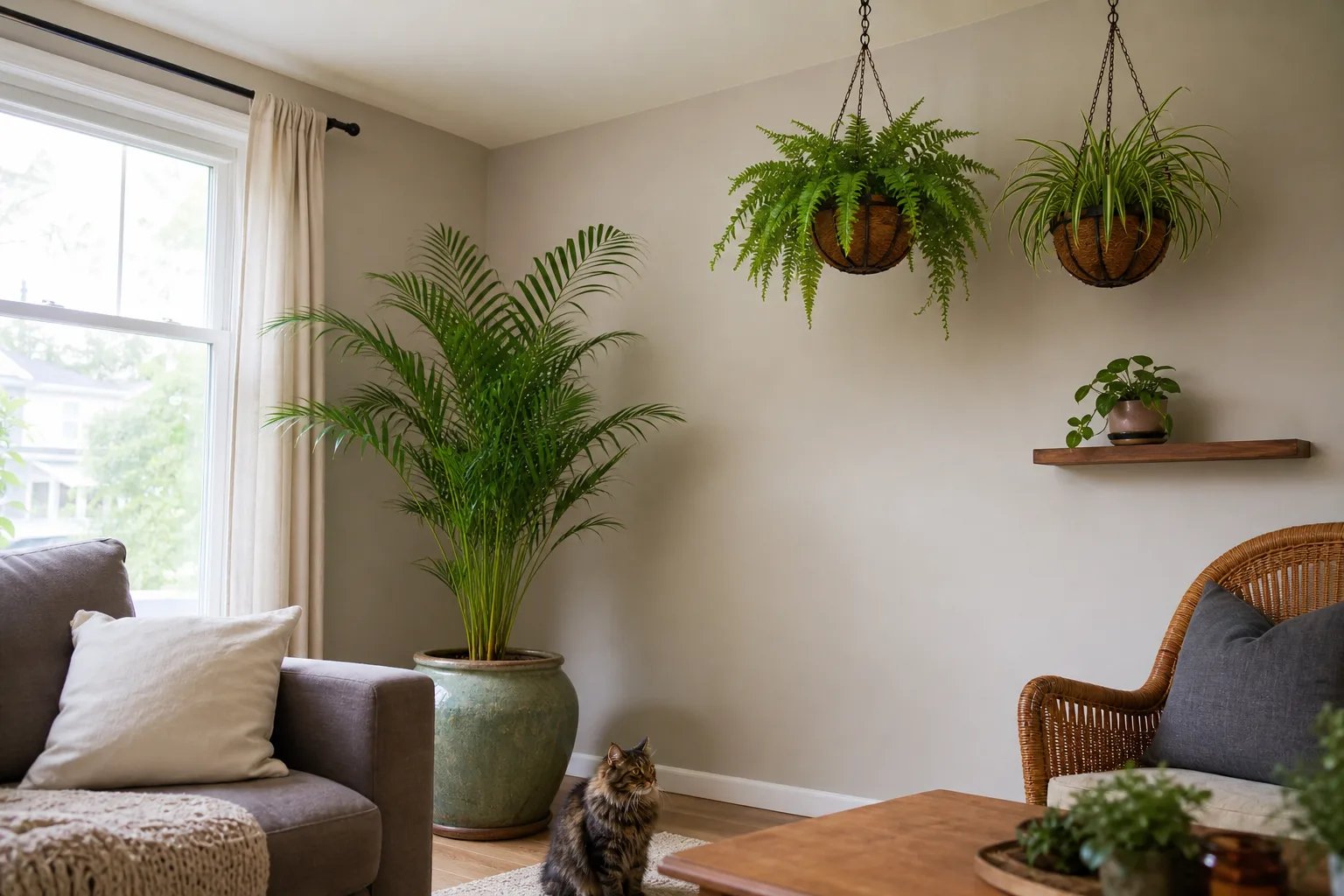
A closed room or latching cabinet
Before relying on a cabinet, test every opening: can a cat paw a door open, slip through a cable hole, or reach a trailing leaf through a gap? Anchor tall furniture to the wall and keep heavy pots on lower stable shelves; putting a top-heavy pot above a cat’s jump path can turn a plant problem into a falling-object injury.
The setup must remain workable for plant care. You need to open the doors for watering and airflow, catch runoff, prune leaves before they touch the floor, and ensure the cabinet does not overheat in direct sun. If keeping the cabinet secure depends on remembering to shut an unreliable door every time, it is not a robust choice for the plant with the highest toxicity risk.
Hanging baskets and high shelves
Hanging plants can move foliage out of reach, but height alone does not cat-proof a plant. Cats may climb bookcases or curtains, jump from nearby furniture, or pull a dangling vine down; plan the whole route, not just the plant’s current pot position. Secure hooks into suitable structural support, use a stable basket, and trim growth before it hangs into a jumpable zone.
For a shelf, leave a clear gap from furniture and remove tempting stepping stones such as stacked boxes or a nearby plant stand. A hanging pot should not be above a bed, crib, walkway, or the cat’s favorite perch where it could fall. Choose this method for non-toxic plants and cats who are not determined climbers; for a toxic plant or a cat that tests every ledge, a closed barrier is the safer choice.
Protect potting soil without making the pot unsafe
Some cats dig in potting mix because it is loose and easy to scratch, while others investigate soil after a plant is moved or watered. Covering the surface can reduce access, but do not use sharp skewers, toothpicks, toxic powders, mothballs, or small loose objects a cat could swallow. A fitted mesh disk, reusable pot cover, or rigid screen with a central opening can keep paws off the soil while leaving the stem, air, and water pathways open.
Measure the inside of the pot, cut the cover to fit without sharp edges, and make sure it cannot be lifted or chewed into pieces. Leave enough space around stems so the plant can grow; remove or lift the cover when you water, then check that water still drains freely and the root zone does not remain soggy. Large smooth stones are sometimes suggested, but they are heavy, can conceal the soil surface, and may not stop a determined cat from moving them. If you use a top dressing, make sure pieces are too large to swallow and easy to remove for inspection.
If your cat is using a pot as a toilet, a cover alone will not solve the cause. Keep litter boxes clean, easy to reach, and in a quiet location, and make the plant inaccessible while you reset the habit. A new pattern of urinating outside the litter box can also signal a health problem; contact your veterinarian, especially if your cat strains, makes frequent trips, vocalizes, or passes only small amounts.
Give a plant-curious cat a better outlet
A tray of cat grass—often young wheat, oat, or barley seedlings sold for pets—can give some cats an appropriate plant to investigate. Read the package so you know which grain you are growing, put the pot in a stable place away from toxic plants, and replace it if it wilts or becomes moldy. Cat grass is an option to test, not a proven way to stop all chewing; Gardening Know How also warns that offering plant material may not stop a cat from sampling other greenery. (Gardening Know How)
Do not assume catnip is a safe substitute for cat grass. The ASPCA lists catnip (Nepeta cataria) as toxic to cats and notes that it can cause vomiting and diarrhea, with some cats becoming sedated and others stimulated, even though many are attracted to it. That is a useful reminder to verify a plant by species rather than by the fact that people call it cat-friendly. (ASPCA catnip entry)
Think of cat grass as enrichment, not a repellent or safety device. Some cats ignore it; others chew it and continue sampling a spider plant or trailing vine. Keep even a designated nibble plant in a place where it cannot fall, and continue to make toxic species inaccessible.
Round out the alternative with opportunities that match a cat’s daily needs: short interactive play sessions, scratching surfaces, climbing space, and food puzzles can give it something to do besides paw at the plant shelf. If the chewing is new, persistent, or paired with vomiting, reduced appetite, or eating non-food materials, ask your veterinarian rather than assuming the cat is simply bored.
Use deterrents carefully—and skip hazardous DIY mixes
A deterrent is a small behavior nudge, not a protective boundary. One cat may ignore foil while another avoids it; a deterrent can also lose effect once the cat gets used to the texture or has a strong reason to reach the plant. Use it only alongside a physical setup that still limits contact if the cat chooses to test it.
Scent, sprays, and essential oils
Skip DIY scent sprays on foliage. Citrus juice, vinegar, cayenne, garlic, and soap mixes have no dependable cat-proofing effect and may damage leaves; if residue can be licked or carried on paws, do not assume it is safe because it came from a kitchen ingredient. Concentrated essential oils are a particular risk: the ASPCA says cats can develop health problems after walking through them, getting them on their coat, or ingesting them. Diffusers add a separate airborne exposure, so do not use an oil or diffuser as a plant deterrent. (ASPCA guidance on essential oils)
There is also a plant-care cost: acidic, oily, salty, or soapy mixtures can spot leaves, clog surfaces, or affect potting mix. If you are considering a commercial deterrent, use only a product whose label explicitly permits use around cats and the intended plant surface, follow the label exactly, and ask a veterinarian about your cat’s exposure risk. Stop if your cat chews the treated plant, develops irritation, or simply ignores the product; do not increase the concentration.
Foil, textured mats, and commercial products
A temporary foil sheet or smooth deterrent mat may make a particular landing spot less appealing to one cat, but neither is a secure barrier. Foil can be pulled into the pot or chewed, and an unsecured mat can slide or become a toy. Avoid spiked products or sharp wire that could injure paws, eyes, or mouths; use an actual physical enclosure for plants that pose a serious toxic risk.
For repeated problems, reward the alternative behavior you want—using a cat-grass pot, scratching post, or permitted climbing spot—and calmly block access to the plant. Do not yell, hit, spray water at the cat, or use a startling device; punishment may create stress without teaching the cat which safe activity to choose. Homes & Gardens discusses scent sprays and barriers for outdoor spaces, but advice about a stray cat crossing a patio does not establish that a mix is safe to spray on a leaf your indoor cat may lick. Keep the indoor solution focused on blocking access and giving the cat an acceptable alternative. (Homes & Gardens)
Match the fix to the behavior you actually see
A plant can attract a cat for several reasons, and treating every incident as “chewing” misses the practical cause. Keep a short log for a few days: which plant, time, location, what happened first, whether the cat had just been fed or played with, and whether soil was disturbed. You do not need to catch or punish the cat; the goal is to notice a pattern you can change.
Chewing, digging, climbing, and urinating need different fixes
- Chewing or pulling leaves: Move toxic or unidentified plants behind a closed barrier. For verified lower-risk plants, pair secure placement with cat grass and play; remove fallen leaves before the cat reaches them.
- Digging: Fit a removable mesh or pot cover, add a stable cachepot only if it does not block drainage, and redirect pawing to an appropriate digging or play activity. Never leave sharp material in the soil.
- Climbing or batting: Anchor shelves, move launch points, shorten trailing growth, and shift valuable or toxic plants into a closed room. Do not expect a higher shelf to work if the cat has a route to it.
- Knocking pots over: Use a wider, heavier outer pot or a stable stand, keep the plant out of a running path, and secure furniture. A heavy pot should not be placed where it could fall onto the cat.
- Urinating in a planter: Block the pot and review litter-box access and cleanliness. If the behavior is sudden or accompanied by urinary signs, call your veterinarian rather than using a stronger smell to mask it.
If the same plant keeps drawing attention after you change the setup, remove that plant from the accessible room. Repeated chewing is not proof that a cat needs that species, and a plant that is beautiful but constantly exposed may not be a good fit for that home.
Put the plan in place over one week
You can make a useful first pass without redesigning every room at once. Make the changes in this order so the highest-consequence exposure is addressed before you spend time testing less reliable deterrents.
- Today: Move unknown plants and all true lilies or daylilies behind a closed door. Pick up loose leaves and flowers.
- Next: Photograph and identify every plant by botanical name; check each name in a veterinary poison-control database. Mark any plant that needs permanent exclusion.
- Then: Watch how your cat reaches the remaining plants. Remove nearby launch points, anchor unstable shelves, and decide whether a door or latched cabinet is needed.
- For pots: Fit a removable soil screen where digging happens. Test watering and drainage before leaving the cover in place.
- For chewing: Add a stable cat-grass pot if your cat is interested, plus daily interactive play. Continue supervising the plant room while you learn whether it helps.
- After a few days: Look for hanging leaves, knocked pots, or new soil disturbance and change the setup where it failed.
- At the end of the week: Recheck plant names, clear debris, and decide which plants should be rehomed rather than repeatedly defended.
The check-in matters because plants grow and cats learn routes. A vine that was safely short can reach a chair over time; a shelf that was inaccessible can become reachable after furniture moves. Repeat the review after seasonal rearranging, adding a new plant, or changing a room’s layout.
What to do if your cat has chewed or swallowed a plant
Remove the cat from the plant and prevent further contact, but do not wait for symptoms to decide whether the exposure matters. Take clear photos of the whole plant, the damaged leaf, and any nursery label; write down the scientific or common name, when it happened, how much may be missing, and your cat’s weight. Keep the plant or a clipped sample available for identification, and bring any fertilizer, pesticide, or plant-treatment label if it could also have been contacted.
Call your veterinarian or a veterinary poison-control service promptly and follow its directions. Do not induce vomiting or give milk, oils, food, or medication unless a veterinary professional tells you to. The Pet Poison Helpline notes that serious toxic exposures may look mild early on and that timing can change the outcome, so the absence of symptoms is not a reliable reason to wait. (Pet Poison Helpline)
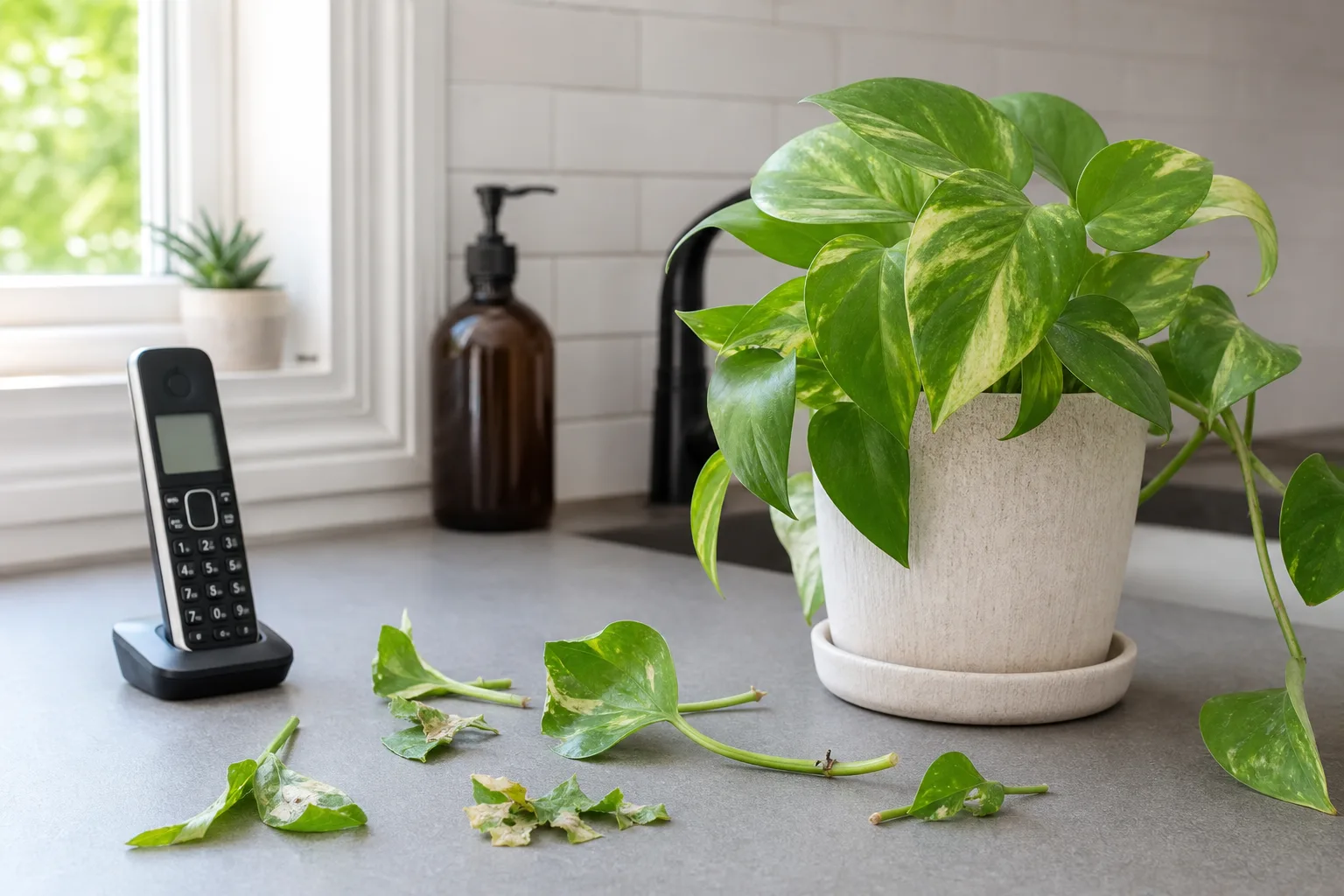
Treat true lily exposure as an emergency
If the plant might be a true lily (Lilium) or daylily (Hemerocallis), contact a veterinarian or animal poison-control service immediately, even if your cat seems normal. The ASPCA identifies these lily groups as capable of severe kidney injury, and pollen, leaves, or petals can be part of the exposure. Do not try to sort out the plant’s identity or amount eaten before calling.
Peace lily is a different plant group (Spathiphyllum) and is not the same kidney-failure toxin as true lilies, but its crystals can cause severe mouth pain, drooling, vomiting, and difficulty swallowing. Tell the veterinary team the exact label name and describe what was chewed; when identity is uncertain, let them assess the risk rather than using a common name to rule it out.
Conclusion
The dependable way to cat-proof houseplants is to combine three steps: identify every plant, remove access to species that could cause serious harm, and change the setup around the behavior your cat shows. A closed door or a securely latched enclosure is stronger than a scent, while soil screens, stable pot placement, and cat grass can help with lower-risk problems when they are used for the right reason.
Keep the limits in view: hanging plants can be reached, deterrents can be ignored, and “non-toxic” does not mean edible. If your cat may have chewed an unidentified or toxic plant—especially a true lily—call a veterinarian or animal poison-control service right away with the plant name or photos. That response plan is part of cat-proofing, not an afterthought.