How to Grow and Care for Chinese Pistache Trees
Plan a Chinese pistache tree from planting site to mature canopy. Get practical watering and pruning guidance, cultivar trade-offs, and region-aware advice on fruit.
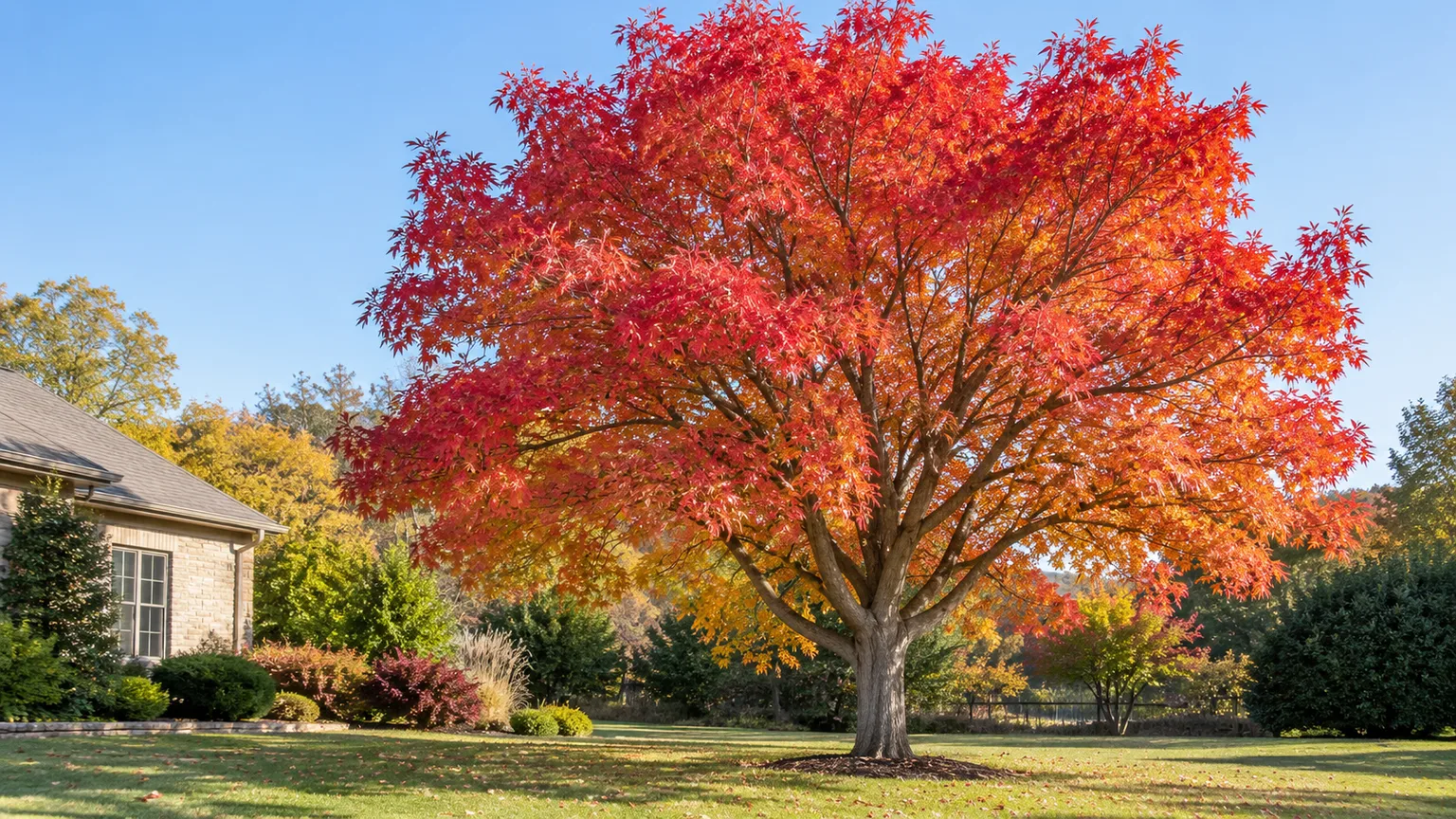
A Chinese pistache can become a broad shade tree with luminous orange and red autumn leaves, but it needs two deliberate choices up front: enough room for a 20- to 30-foot crown and, if seedlings would be a problem where you live, a male cultivar that will not bear fruit. Once the tree is established in a sunny, well-drained site, care is usually modest. The years that take the most attention are the first few after planting, when roots are spreading and the young trunk needs a sound branch structure.
Chinese pistache is Pistacia chinensis, an ornamental deciduous tree in the cashew family. It is related to the edible pistachio, Pistacia vera, but it is not the tree grown for the familiar food crop. The small fruits on female Chinese pistache trees are ornamental drupes, not snack pistachios. That difference, along with the tree’s mature size and the possibility of bird-dispersed seedlings, should shape the purchase decision before you dig.
Chinese pistache at a glance
| Feature | What to plan for |
|---|---|
| Mature size | About 30 to 35 feet tall and 20 to 30 feet wide; some sources give a broader range by cultivar and growing conditions |
| Light | Full sun, generally six or more hours of direct light |
| Soil | Adaptable to several textures and pH levels, but drainage matters more than richness |
| Water | Regular, deep watering while young; much less supplemental water after roots establish |
| Foliage | Deciduous, with green pinnate leaves and variable yellow, orange, or red fall color |
| Fruit | Only pollinated female trees set red fruits that mature toward blue-black; they are inedible to people |
| Hardiness | Commonly listed for USDA Zones 6 through 9, with cold exposure and local conditions affecting performance |
| Growth habit | Slow to look polished when young; develops a rounded or spreading crown with good early training |
The ranges are planning numbers, not a guarantee for every tree. NC State Extension describes mature specimens around 35 feet tall and 20 to 30 feet wide, while the Sacramento Tree Foundation lists a roughly 30-foot mature canopy for its local urban forestry context. A nursery may also sell a cultivar with a different form. Measure the space for the mature crown, not the container size on planting day.
Growth-rate labels are similarly broad. NC State calls the species a medium grower, while regional garden profiles often describe it as fast once established. Expect establishment and canopy shape to matter more than a guaranteed number of inches each year: a tree in sun with adequate root-zone moisture can grow differently from one planted in shade, compacted soil, or a restricted strip. Buy for the mature dimensions and let the crown fill in at its own pace.
Is Chinese pistache right for your climate and region?
This species is a strong fit for a sunny, warm-temperate yard where a medium-to-large shade tree can mature without constant pruning. NC State Extension lists it across USDA Zones 6a–9b and describes it as tolerant of heat, drought, and urban pollution. Those traits do not mean a newly planted tree can go without water, nor that every cultivar performs equally well in every cold or humid microclimate.
In colder parts of its range, winter exposure and wind can slow establishment or damage young growth. In hot, dry regions, the tree can handle summer conditions once its root system is established, provided the soil drains and the root zone is watered deeply during the transition. In humid or poorly drained sites, avoid planting where water lingers after rain; drought tolerance is not tolerance of waterlogged roots.
Fall color is an attraction, but it is not a fixed color swatch. Temperature, sun, cultivar, and the timing of autumn weather affect whether leaves turn yellow, orange, scarlet, or a mix. A warm spell can delay color and a sudden cold snap can shorten the display, so choose the tree for shade and form first, then treat vivid fall foliage as a likely bonus rather than a guaranteed annual performance.
Regional behavior matters as much as climate. NC State calls Chinese pistache a potential weed tree in the Southeast because birds eat the fruit and can disperse seed. The UGA Invasive Plant Atlas documents an invasive-listing source through the Texas Invasives Database, but that is not evidence of a blanket legal ban everywhere. Before buying a fruiting female, check your state and county invasive-plant guidance. If local sources flag seed escape, choose a male cultivar or a regionally appropriate native shade tree instead.
Decide on tree sex and cultivar before buying
Chinese pistache is dioecious: male and female flowers occur on separate trees. A male tree does not produce the fruit clusters; a female tree can set them when a compatible male flowers nearby. The fruit decision is not just cosmetic. It affects sidewalk cleanup, seedling risk, and whether you want to support the wildlife that eats the drupes.
Fruit, seed, and cleanup trade-offs
Female trees form small red fruits that darken toward blue-black as they mature. They are not edible pistachios. Birds may carry viable seed away from the parent tree, so fallen fruit is only part of the cleanup issue in locations where seedlings can naturalize. If you want fall color and shade without that seed source, a correctly identified male tree is a practical choice; if you value wildlife food and local guidance does not discourage the species, a female may be acceptable.
Do not assume every tree labeled “fruitless” is the same cultivar or that a lone female will always stay fruitless. Ask the nursery for the botanical name, named cultivar, and documented sex, and get the answer in writing if seed prevention is important. Pollen can travel from other nearby male trees, so a female that appears fruitless while young may set fruit later as it matures or as a male tree in the neighborhood begins flowering.
Cultivars worth asking about
‘Keith Davey’ is a widely sold male selection known for strong orange-to-red fall color and no fruit production. NC State Extension identifies it as a male tree. ‘Sarah’s Radiance’ is grown for showy fall foliage, but confirm the sex of the specific plant if avoiding fruit matters. You may also see ‘Red Push’ offered for reddish new growth; check whether the nursery is selling a Chinese pistache selection or a related hybrid, because names and parentage can be easy to blur in retail descriptions.
Cultivar names are useful only if the tag is accurate and the plant is propagated true to type. Ask whether the tree was grafted or otherwise vegetatively propagated. Seed-grown Chinese pistache seedlings can vary in canopy form, fall color, and sex, so they are a poor way to guarantee a specific landscape trait.
Choose a full-sun site with room for the mature crown
Give the tree a position that receives at least six hours of direct sun. More open light generally supports a fuller canopy and stronger autumn display; in shade, a young tree can stretch toward light and develop a lopsided shape. The Sacramento Tree Foundation notes that this tree is used as a broad shade tree in its regional plantings, while Water Use It Wisely highlights its usefulness in dry Southwestern landscapes.
Plan for the mature canopy before choosing the planting spot. A tree expected to spread 20 to 30 feet needs a generous clear circle, not a narrow strip between a fence and driveway. Sacramento’s local guidance suggests 15 feet from foundations, 6 feet from hardscape, and 20 feet from power lines; treat those as that organization’s regional recommendations, not universal code. Check your utility easements and local arboriculture guidance, and favor more clearance when a large canopy would interfere with a roof, walk, or overhead wire.
Soil texture is flexible, but drainage is not. NC State lists clay, loam, and sand among suitable textures, yet its profile also emphasizes good drainage and only occasional dryness. If a test hole stays wet long after rain, or the site receives runoff from a downspout, correct the drainage or choose another species rather than trying to compensate with gravel in the planting hole. A layer of gravel at the bottom does not turn a poorly drained site into a well-drained one.
Plant in the right season and at the right depth
In mild-winter regions, fall planting gives roots a cooler season to establish before hot weather returns. In colder locations, plant in spring after the ground is workable and the worst freezes have passed. Southern Living’s tree profile also describes spring or fall planting, with fall favored where winters are not severe; avoid planting into frozen, saturated, or heat-stressed soil.
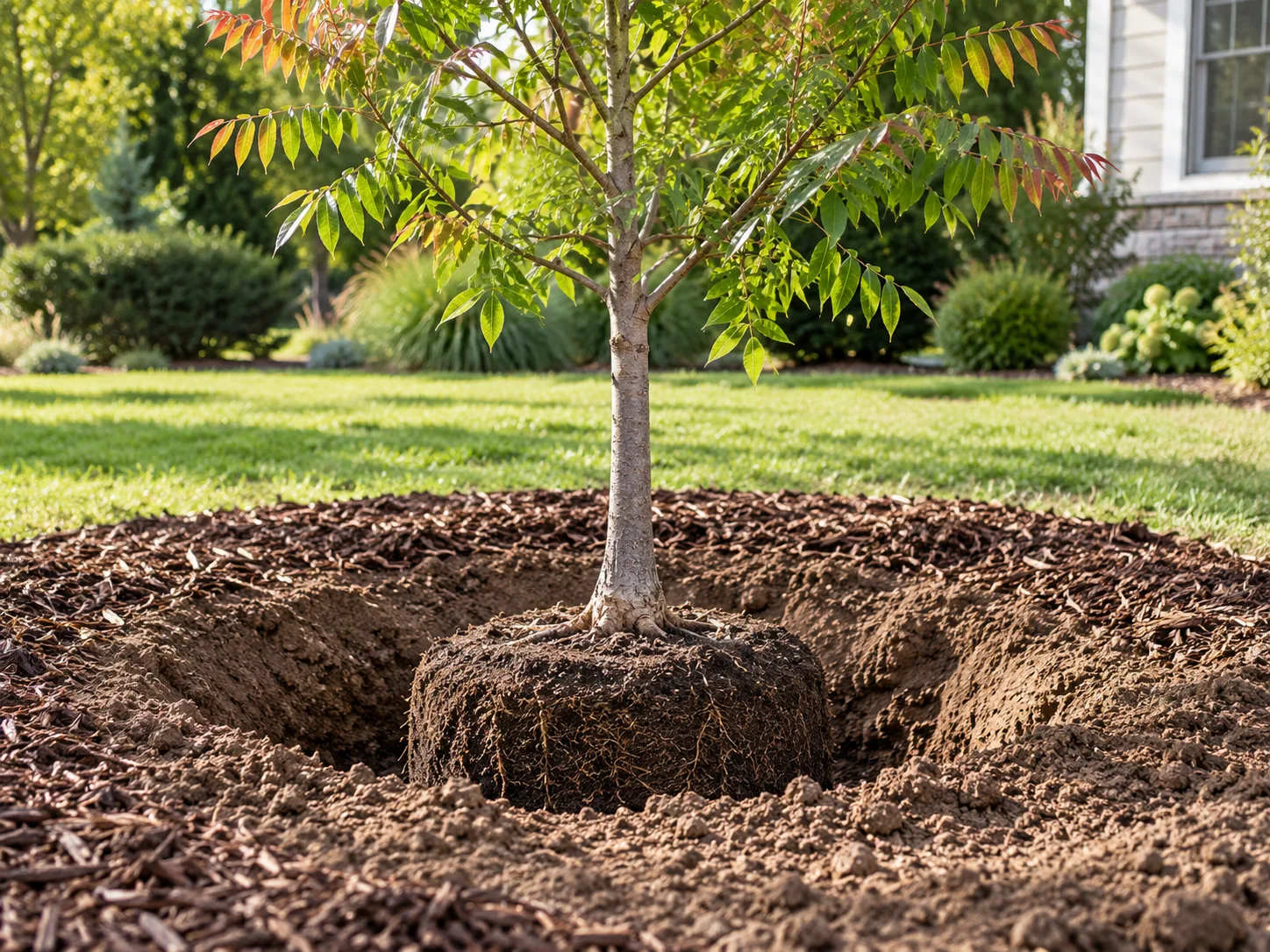
Choose a healthy nursery tree with a straight trunk, a stable root ball, and no severe circling roots. Find the root flare, where the trunk widens into the first structural roots, before you set the tree in the hole. Dig a broad hole but no deeper than the root ball’s measured height, set the flare at or slightly above finished grade, and backfill with the native soil you removed. Do not bury the trunk to make the tree look more upright, and do not amend only the backfill with rich compost that creates a sharp boundary around the roots.
Before backfilling, rotate the tree so the strongest side of its branching faces the yard or street view, but do not force a crooked trunk upright with a rigid stake. If roots circle tightly around the container, loosen or redirect them while the root ball is exposed; roots left in a tight loop may continue to grow that way. If the tree is balled and burlapped, remove twine and any synthetic covering from the trunk and root flare, and follow local arboriculture guidance for the basket. Small corrections are easier at planting than after roots have grown into the surrounding soil.
Water the root ball and surrounding soil slowly after planting so the soil settles around roots without leaving a deep basin of standing water against the trunk. Add a shallow mulch layer over the root zone, then pull it back from the bark. A stake is needed only when the root ball cannot stay stable in wind; use flexible ties and remove the support once the tree can stand firmly on its own. Southern Living also advises keeping mulch off the trunk, since constant bark moisture can encourage decay.
Water deeply while roots establish, then taper
Drought tolerance develops after the tree has rooted into a larger volume of soil. During the first growing season, check the root ball and nearby soil every few days in hot or windy weather, then water slowly when the root zone is drying. The goal is to moisten the root ball and adjacent soil deeply, not to keep the surface constantly wet. A fixed gallons-per-inch rule can mislead because soil, tree size, temperature, and rainfall change how quickly moisture moves through the root zone.
For the second year, continue checking during dry spells and lengthen the interval as roots grow beyond the original nursery container. Water again when the soil a few inches down is dry, but do not wait until the root ball has become dusty and shrunken away from the surrounding soil. A soaker hose or slow drip over the root zone is more useful than a brief splash at the trunk. Increase the interval after rain, and reduce irrigation in cool weather when evaporation is low.
After establishment—often a year or two, but longer in difficult soil or extreme climates—water deeply during extended drought rather than on a weekly schedule by habit. A healthy, mature tree can tolerate dry periods, but hot, dry winds or unusually long heat waves may still cause stress. If leaves wilt during summer, check soil moisture at multiple points before watering: dry soil calls for a deep soak, while wet soil points toward drainage or root trouble.
Prune a young tree into a strong, balanced canopy
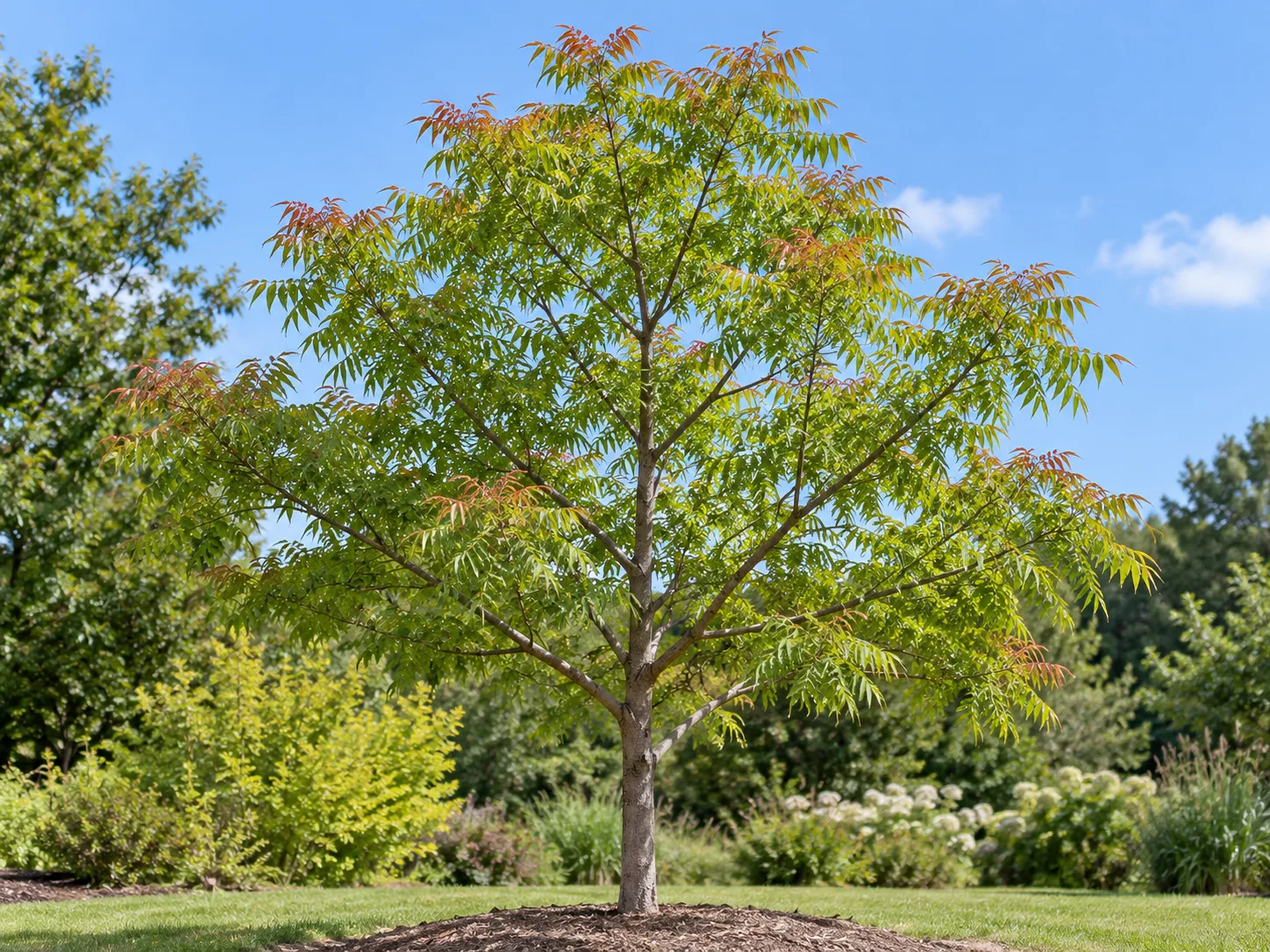
Chinese pistache often looks sparse or awkward when young; that is a normal stage, not a reason to cut the top off. The goal is a sturdy trunk and a balanced crown of well-spaced branches that can support the tree as it grows. Training is easiest while branches are small, so inspect the tree once or twice a year during its first several seasons.
Select one leader and well-spaced scaffold branches
If the tree is intended as a shade tree, start by selecting one main trunk. Remove or reduce competing upright leaders while they are small, then retain lateral branches that are distributed around the trunk rather than clustered at one height or all on one side. Keep branches with sound attachments and avoid choosing a scaffold that is nearly as thick as the trunk at its point of origin; a tight, included-bark fork can split as the canopy gains weight.
Work gradually. A practical young-tree pass is to remove dead, broken, crossing, or inward-growing shoots first, then decide whether one or two structural corrections are needed. Do not strip the lower crown in one season just to make the trunk look taller. The tree needs enough foliage to feed root and trunk growth, and lower temporary branches can be shortened over time as the permanent scaffold structure develops.
Avoid topping and excessive thinning
Never top a Chinese pistache to force a rounded shape or control height. Heading every branch back creates dense weak shoots near the cuts, spoils the natural crown, and does not keep a large tree permanently small. If the site cannot accommodate the species’ mature height and spread, replace the plan with a smaller tree rather than fighting its natural size for decades.
Make structural cuts just outside the branch collar, not flush with the trunk and not leaving a long stub. Remove only what is needed to improve structure; heavy pruning can reduce shade, expose bark to sun, and provoke a flush of weak growth. Prune in the dormant season or another locally recommended window, but avoid routine pruning when the tree is heat-stressed. For a mature tree, large limbs, or branches near power lines, use a qualified arborist instead of climbing or making large cuts from a ladder.
Keep soil, mulch, and fertilizer simple
Chinese pistache does not need a rich, constantly amended planting bed. It adapts to several soil textures and pH ranges if water drains through the root zone. A 2- to 3-inch mulch layer helps moderate soil temperature and reduce evaporation; keep a visible gap around the trunk and expand the mulched area as the canopy grows. Avoid piling mulch into a “volcano,” which traps moisture against bark and hides the root flare.
Skip routine fertilizer when the tree is growing normally. If growth is poor, first check sun, soil drainage, watering, root depth, and whether the nursery tree was planted too low. A soil test can show whether a nutrient is actually deficient; adding nitrogen without evidence may create long, weak shoots without fixing waterlogged or damaged roots. Keep lawn fertilizer from accumulating against the trunk, and never put a concentrated dose in the planting hole.
Propagate from seed or cuttings
Seed propagation is possible, but it is the least predictable route for a landscape tree. The seedlings may not match a selected cultivar’s color or form, their sex is unknown, and a female seedling could eventually produce fruit. The Southern Living propagation guide describes cold-conditioning cleaned seed before sowing; follow a regionally appropriate seed protocol and expect germination and early growth to vary. Do not distribute seed-grown trees in a region where local guidance warns about escape.
Seed is most useful when the goal is to raise several trees for observation, not to reproduce a named cultivar faithfully. If you collect fruit, handle it as a seed crop rather than edible pistachios, clean the pulp away, and keep the seed labeled by source. A nursery-grown, named male selection offers far more predictability for a yard where fruit or volunteer seedlings are unwelcome.
Softwood cuttings are another option, though rooting success depends on timing, humidity, and the cultivar. Take several healthy current-season shoots rather than relying on a single cutting, use a sterile medium that drains freely, and maintain bright indirect light and even moisture while roots form. Southern Living’s propagation directions describe short softwood cuttings under humid conditions, but rooting is not guaranteed just because a cutting stays green. A grafted nursery plant is usually the practical choice when you want a known male cultivar or predictable ornamental traits. Before propagating a patented or trademarked selection for sale, check its propagation rights; a name on a label does not automatically make a cultivar unrestricted.
Troubleshoot stress, wilt, and weak growth
A newly planted tree that pauses or sheds some leaves is not automatically diseased. Compare the timing and pattern with heat, transplant shock, dry soil, soggy soil, root injury, and the tree’s normal fall dormancy. Look at several branches and inspect both the root zone and trunk base before changing care. A symptom that appears on one branch is different from a uniform seasonal color change across the whole crown.
Check water, drainage, planting depth, and disease history first
For leaf scorch or wilting, test soil moisture at the edge of the root ball and just outside it. Dry root-zone soil suggests the tree needs a slow, deep soak; persistently wet soil suggests poor drainage, overwatering, or damaged roots. Also check whether the root flare is buried, mulch touches the trunk, or a tie is constricting the bark. Correct the condition you can verify, then watch whether new growth improves rather than applying fertilizer or pesticide as a guess.
NC State Extension reports few serious pest and disease issues overall but notes susceptibility to Verticillium wilt. The fungus persists in soil, so a pattern of sudden wilt and branch dieback deserves diagnosis, especially if susceptible plants have had the disease in that bed before. Brown or drooping leaves alone do not confirm Verticillium. Contact your local extension office or a certified arborist to assess the tree; if the diagnosis is confirmed, there is no simple curative spray, and replanting another susceptible species in the same soil can repeat the problem.
Weak growth may reflect shade, a root ball that dries between irrigations, waterlogged soil, transplant stress, or a cultivar that grows more slowly than expected. Compare growth across seasons, not week to week. If a tree declines after several years of healthy growth, have the root zone and trunk inspected instead of assuming the cause is fertilizer. The USDA PLANTS profile and NC State Extension Plant Toolbox are useful starting references for confirming the species and its regional characteristics.
Conclusion
Chinese pistache suits a sunny yard with room for a roughly 20- to 30-foot canopy, well-drained soil, and patience while a young tree develops its crown. Choose the cultivar and tree sex before purchase, check local invasive-plant advice if fruiting trees could spread seed, and water deeply during establishment rather than treating “drought tolerant” as “never needs water.”
Once roots are established, keep care straightforward: maintain mulch away from the trunk, prune lightly for a strong leader and balanced branches, and investigate site or water problems before adding fertilizer. The right tree in the right place can provide summer shade and striking fall color for years without demanding constant attention.



