How to Grow and Care for Common Snowberry
Common snowberry is hardy and wildlife-friendly but spreads by suckers. Learn where to plant it, how to prune for berries, and how to keep it in bounds.
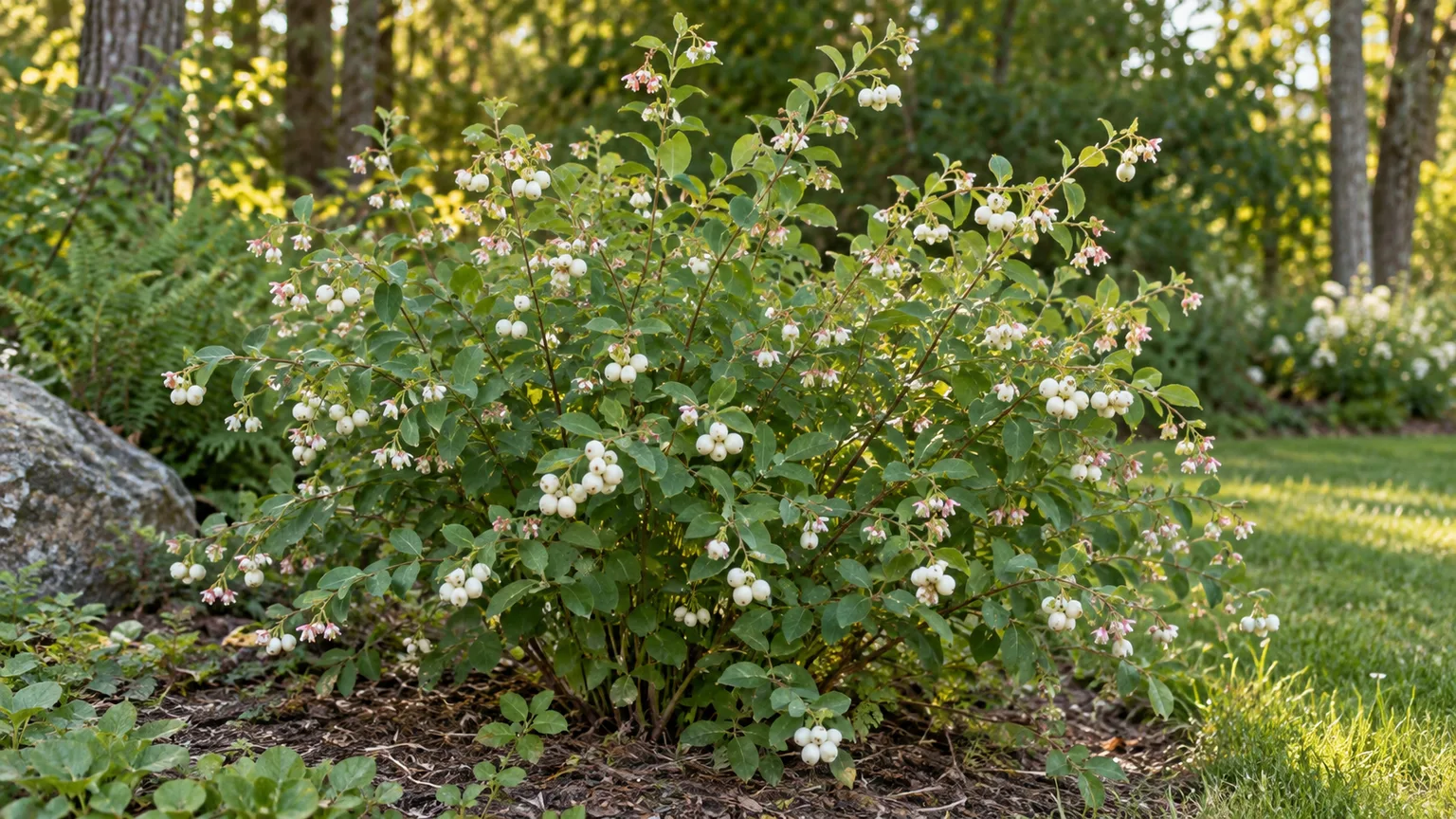
Common snowberry (Symphoricarpos albus) is a tough, deciduous shrub with small pink-to-white flowers and rounded white fruits that stand out after the leaves drop. It can handle sun, partial shade, clay, rocky ground, and periods of drought once established, which makes it useful in difficult parts of a yard.
That toughness comes with a design question: do you have room for a shrub that spreads by underground stems and suckers? Common snowberry is a good choice for a naturalized border, slope, wildlife garden, or informal screen. It is a poor fit for a narrow foundation bed where every stem must stay inside an exact footprint.
Know the shrub before you plant
Common snowberry is a woody member of the honeysuckle family, Caprifoliaceae. It typically forms a rounded, twiggy shrub about 3 to 6 feet tall and wide, with arching stems and opposite, oval leaves. In late spring or summer, small bell-shaped flowers appear in clusters; the flowers are easy to overlook, but they lead to the shrub’s main display: green fruits that mature to puffy white drupes in late summer and fall.
The fruits often remain after the foliage turns yellow and falls. That leafless, berry-covered silhouette is why the plant earns its place in winter gardens. The National Park Service description of common snowberry also notes the shrub’s range of habitats, from woodlands and streambanks to north-facing slopes, and its value to birds, small mammals, and pollinators.
Snowberry’s growth habit is as important as its flowers and berries. Underground rhizomes can send up new shoots several feet from the original crown, eventually making a colony. That behavior helps stabilize slopes and create cover, but it also means that “easy care” does not mean “no management.” Plan for annual sucker inspection from the beginning.
Choose a site for berries without losing control
The best site balances three things: enough light for fruit, soil that does not stay saturated, and enough spare ground for new shoots. Before buying a plant, look beyond the mature shrub’s advertised width. Ask whether a spreading colony would be welcome five years from now, including on the far side of a fence or beneath nearby shrubs.
Light determines fruiting more than survival
Common snowberry tolerates partial shade and can survive in fairly deep shade, but survival is not the same as a strong berry display. A site with full sun or bright part sun generally gives you denser growth, more flowers, and better fruit production. In hot climates, morning sun with afternoon protection can reduce heat stress while still providing enough light for flowering.
Shade is a reasonable choice when the goal is a woodland edge or wildlife cover rather than maximum berries. If the shrub is healthy but open, thin, and nearly fruitless, check light before reaching for fertilizer. Moving or thinning an overstory is often a more useful correction than adding nutrients.
Soil and drainage matter more than fertility
Snowberry is adaptable to clay, sand, rocky soil, and a broad pH range. The non-negotiable condition is drainage: the root zone should not stay waterlogged. NC State Extension’s plant profile describes common snowberry as tolerant of poor, dry, and occasionally wet soils, while also identifying good drainage as a cultural requirement.
Do not improve a heavy clay planting hole by filling it with a small pocket of rich potting mix. That can act like a bowl, holding water around the root ball. Instead, loosen a broad area, blend in modest organic matter if the soil is extremely compact, and set the shrub at the same depth it grew in its nursery container. A thin mulch layer can moderate moisture, but keep mulch away from the stems.
Plant common snowberry in the right season
Early spring or fall is usually the easiest planting window because cooler air reduces transplant stress while the soil still supports root growth. In cold regions, finish fall planting early enough for roots to settle before the ground freezes. Container-grown plants can be planted during the growing season if you can keep them consistently watered, but summer planting demands more follow-up.
A five-step planting method
- Mark the eventual footprint. Reserve at least the plant’s expected mature width, then add a maintenance strip where you can reach emerging suckers.
- Check the soil after rain. If water remains pooled for a day or more, choose a slightly raised or better-drained location rather than assuming the shrub will tolerate permanent saturation.
- Dig wide, not excessively deep. Make the hole about twice the root ball’s width and no deeper than the root ball. Tease apart circling roots without shredding the entire root system.
- Set and backfill carefully. Keep the crown at its original soil level, backfill with the excavated soil, and firm it lightly so no large air pockets remain.
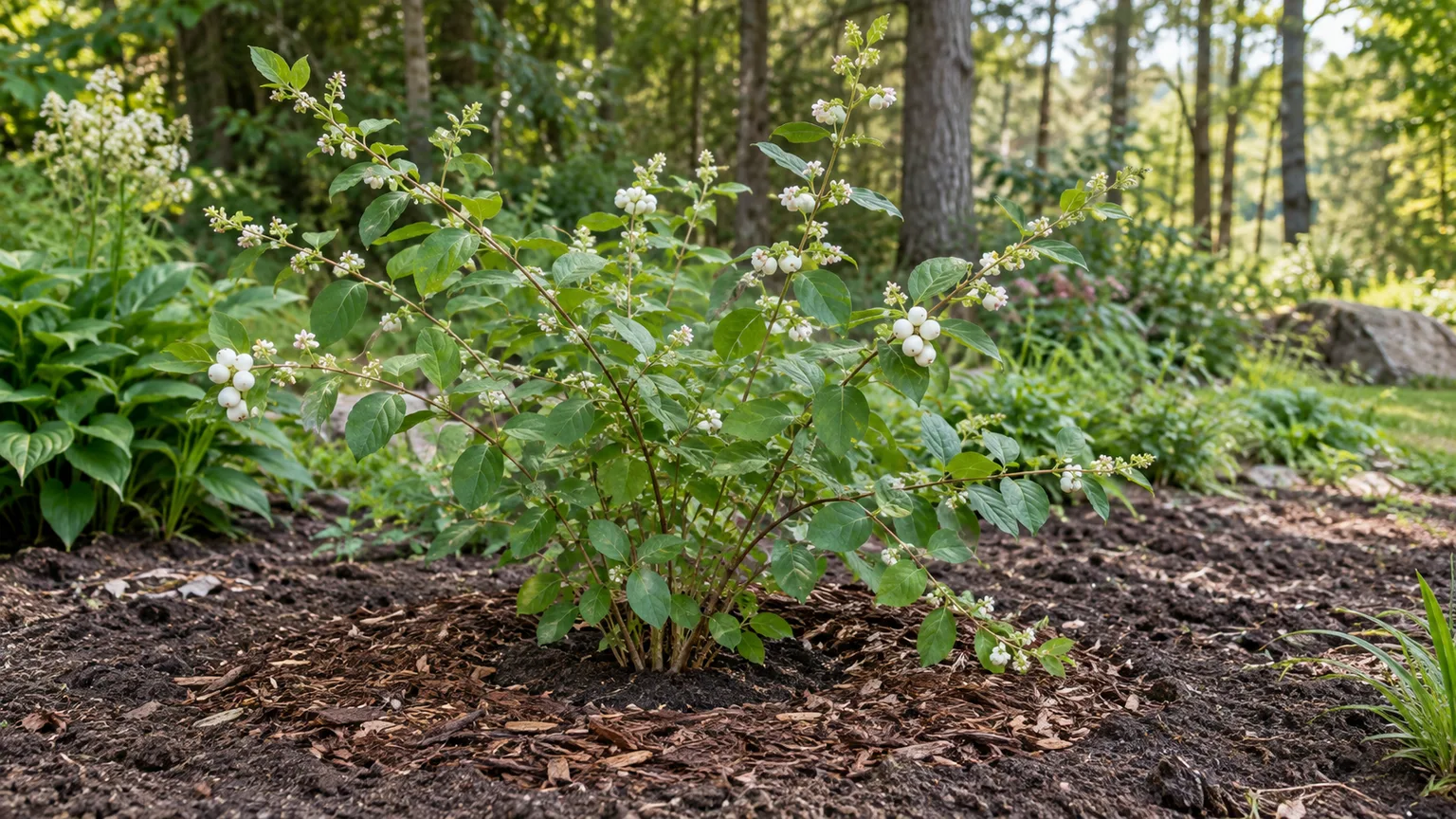
- Soak and mulch. Water slowly until the whole root ball is wet. Add about 2 to 3 inches of organic mulch over the root zone, leaving a gap around the stems.
If you are planting a hedge or screen, avoid crowding shrubs to get an instant wall. Crowding reduces airflow and makes leaf spots and mildew more likely. It also creates a tangle of suckers that is harder to inspect. A slightly wider spacing with room for mature arching stems is easier to manage.
Water, feed, and monitor through the seasons
Water newly planted snowberry deeply whenever the upper few inches of soil begin to dry, rather than applying a light splash every day. A once-weekly check is a useful starting point during the first growing season, but the actual interval depends on soil, heat, rainfall, and root-ball size. The goal is evenly moist soil during establishment, not a constantly wet planting hole.
Once roots have moved into the surrounding soil, common snowberry usually tolerates dry spells. Water during prolonged heat or drought when leaves lose firmness, new growth is weak, or the soil is dry well below the mulch. Deep watering is especially important in the first two summers; drought tolerance is an established-plant trait, not a reason to neglect a new transplant.
Fertilizer is rarely the first fix. If growth is steady and foliage is a healthy green, skip routine feeding. Excess nitrogen can push soft leafy growth at the expense of a balanced shrub and can make the plant harder to keep compact. If a soil test shows a genuine nutrient shortage, correct that specific deficiency in spring according to the test rather than following a blanket fertilizer schedule.
Use the seasons as a simple maintenance calendar. In spring, remove dead wood, inspect the base for new shoots, and refresh mulch. In summer, check moisture during drought and thin crowded stems if airflow is poor. In fall, decide whether you want to leave the berries for wildlife and winter interest or harvest a small number of branches for decoration. In late winter, complete structural pruning before vigorous new growth begins.
Prune for structure, berries, and boundaries
Pruning common snowberry is easier when you choose the goal first. Use light thinning to improve airflow, renewal pruning to rejuvenate an old colony, and sucker removal to keep the planting in its assigned area. Do not treat every pruning job as a hedge haircut.
For the heaviest work, prune in late winter or early spring before new growth starts. Remove dead, broken, crossing, or weak stems at their point of origin. Then remove a few of the oldest stems near ground level to encourage younger, more productive shoots. If the shrub has become a tangled mass, take out roughly one-third of the oldest growth over one or more seasons rather than shearing everything at once.
Timing affects berries. Pruning after summer flowers have formed but before fruits mature can remove the season’s display. If the white berries are the reason you planted snowberry, wait until they have served their fall and winter purpose, then prune before spring growth. If the priority is a tidy hedge, accept that a summer haircut may reduce fruiting.
When cutting branches for indoor arrangements, use sharp, clean pruners and make each cut just above a healthy side shoot or bud. Practical guidance from Savvy Gardening’s berry-producing shrub article recommends clean cuts and taking no more than about one-quarter of a shrub at a time for decorative harvests. That conservative limit is sensible for snowberry: it preserves structure and leaves enough stems for wildlife and next season’s growth.
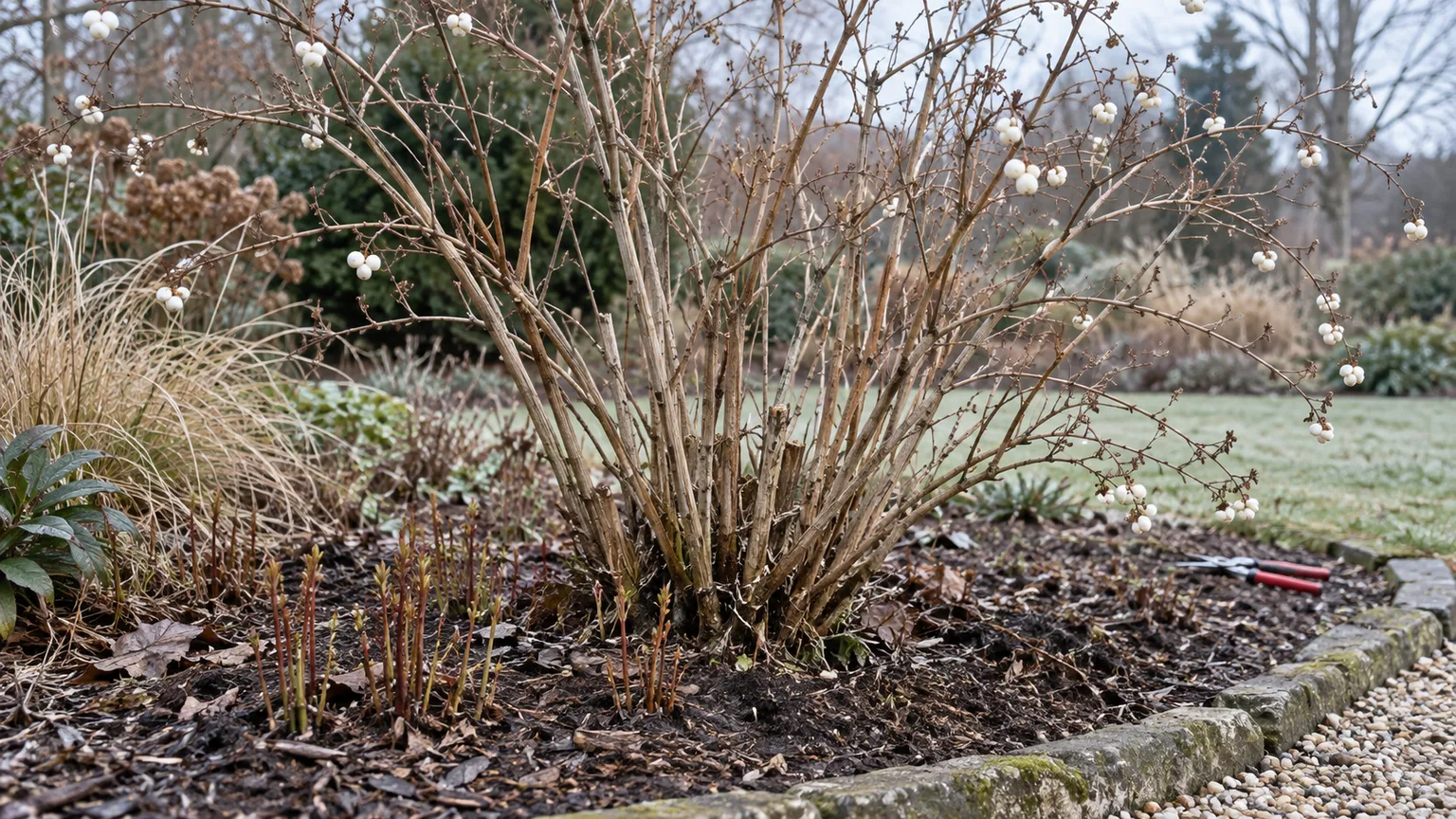
Avoid topping the shrub into a flat ball. A hard, uniform cut encourages a thicket of shoots at the ends of branches and does little to solve underground spread. Selective cuts through the oldest stems produce a more natural shape and open the interior without sacrificing the plant’s arching habit.
Propagate common snowberry without creating a thicket
The easiest propagation method is often the method the plant chooses for you: a sucker emerging from a rhizome. In fall or early spring, dig around a young shoot, trace it back to a piece of root or rhizome, and sever it with a clean spade or pruner. Replant it at the same depth in prepared soil and keep it evenly moist until it resumes growth.
Suckers give you a larger, faster-starting plant, but they carry the same spreading behavior as the parent. Only propagate one if you already have a suitable destination. Never move an unwanted sucker to a natural area or a property edge where it could establish beyond your management.
Suckers, cuttings, roots, and seed compared
Stem cuttings are useful when you want a genetically identical plant without digging far into an established colony. Take several 4- to 6-inch pieces from healthy current-season growth in late summer, remove lower leaves, and insert the cut ends into a clean, well-drained propagation medium. Keep the medium lightly moist and the cuttings out of harsh direct sun. Not every cutting will root, so start more than one and wait for new growth before transplanting.
Root cuttings can work, but they disturb the parent and are harder to manage neatly. Seed is the slowest and least predictable option. Common snowberry’s hard-coated seeds can require scarification and extended warm and cold treatment, and seedlings need protection while young. Because rhizomes and cuttings are faster, seed propagation makes sense mainly for restoration work, experimentation, or preserving genetic diversity rather than filling an ornamental bed quickly.
Contain spread and rethink containers
The simplest containment strategy is a deliberate location: a broad bed, slope, woodland edge, or naturalized strip where a colony is an asset. Mowable lawn, pavement, or a regularly cultivated border can form a practical boundary, but inspect the edge several times during the growing season. Pulling or cutting top growth without removing the connecting root can lead to repeated resprouting.
For a small garden, remove suckers while they are young. Trace each shoot to its origin when possible, cut or dig out the rhizome connection, and check the same area again in a few weeks. An underground barrier can help if it is installed deeply and continuously, but no barrier removes the need for monitoring at seams and above-ground edges.
Common snowberry is not a good long-term container shrub. The root system wants room to spread, containers dry and freeze faster than garden soil, and a pot does not reliably prevent vigorous shoots from escaping through drainage openings. A temporary container can hold a young plant while you prepare a permanent site, but choose a contained in-ground location for its mature life.
Solve common snowberry problems
Most failures come from a mismatch between the plant and the site, not from a demanding care routine. Start with the root zone, light, and air movement before treating leaves or reaching for pesticides.
Limp, curling, or scorched leaves
Check soil moisture below the mulch and inspect the base of the plant. A new shrub in dry soil may wilt, curl, scorch, and produce smaller leaves even though established snowberry is drought tolerant. Give it a slow, deep soaking and monitor it more often during heat; do not wait for the entire crown to collapse.
If the soil is wet and the leaves still wilt, suspect root stress from poor drainage, planting too deeply, or damage to the root ball. Improve the site rather than watering more. Brown leaf edges on a hot, windy site can also reflect heat and moisture loss; temporary afternoon shade and a thicker, properly applied mulch layer may help while roots establish.
Leaf spots, mildew, or rotting berries
NC State Extension lists leaf spot, rust, powdery mildew, and berry rot as possible though uncommon problems. Look for the pattern before acting: scattered lesions, a white powdery coating, prematurely rotting fruit, or whole branches declining point to different causes and should not be treated interchangeably.
Start with sanitation and airflow. Remove heavily diseased leaves and dead stems, thin crowded interior branches, water at the soil line, and avoid working among wet foliage. Do not compost visibly diseased material if your local composting system will not heat sufficiently. If a disease continues to spread, identify it locally and follow the product label and local extension guidance before using a fungicide.
Sparse berries have several possible explanations. Too much shade is a common one, but late pruning can also remove flowering wood or developing fruit. A young transplant may need a season or two to settle. Confirm the plant’s identity, assess light, review the pruning date, and check whether drought interrupted flowering before assuming fertilizer is missing.
Cultivars and look-alikes that change the decision
The straight species is the practical choice when you want a hardy, natural-looking colony and a dependable native-plant role. Cultivars can offer larger, more numerous, or differently tinted fruits, compact growth, or variegated foliage, but availability and mature size vary by nursery. Read the plant tag for the actual selection rather than assuming every plant sold as snowberry will behave identically.
Names such as ‘Magical Avalanche’ and ‘Sweet Sensation’ are marketed for especially showy berry displays. They can be attractive choices when winter color is the priority, but they still deserve a spread check before planting. A larger berry does not make a rhizomatous shrub less vigorous.
Common snowberry is often confused with winterberry. Winterberry is a holly with red fruit and usually requires compatible male and female plants for a heavy crop; common snowberry has white fruit and a different growth habit. Coralberry is a close relative in Symphoricarpos with pink to purplish fruit, while creeping snowberry is a low groundcover in a different genus. Confirm the botanical name before choosing a site or pruning schedule.
Wildlife value, toxicity, and responsible placement
Common snowberry can serve several garden jobs at once: winter structure, pollinator support, bird and small-mammal cover, erosion control, and a food source for wildlife. The National Park Service describes birds, bears, mice, rabbits, elk, deer, bees, butterflies, and a snowberry-feeding sphinx moth among the animals associated with the plant or its habitat. Savvy Gardening’s shade-shrub guidance likewise places snowberry among hardy berrying shrubs that can bring seasonal interest to lower-light gardens.
Wildlife value does not mean every animal will leave the display untouched. If birds strip the berries before winter, that is a successful wildlife planting, not a care failure. If you want a few branches for decoration, harvest selectively and leave most of the fruiting wood. A garden with nearby cover, water, and several native plants will usually support more wildlife than a single isolated shrub.
Treat the berries as ornamental, not edible. NC State Extension rates the fruit as low-severity poisonous and lists vomiting and diarrhea among possible symptoms; the plant profile identifies calcium oxalate and possibly saponic glycoside as toxic principles. Do not taste the berries, use them in food, or encourage children to handle and squeeze them. If a person or pet eats an uncertain amount, contact a poison-control service or veterinarian promptly and keep the plant label available.
Regional status also matters. Common snowberry is native to much of North America, but a plant can be appropriate in one region and naturalized or invasive in another. Check your local native-plant society, extension office, or invasive-species list before planting near wild land or connected waterways. Even where it is native, a dense colony may displace smaller garden plants, so “native” is not a substitute for good placement.
Conclusion
Common snowberry is a low-fuss shrub when its growth habit matches the space. Give it sun or bright part shade for the best fruit display, well-drained soil, deep water during establishment, and enough room for rhizomes or a clear plan for removing suckers. Prune selectively in late winter, after you have decided whether winter berries are part of the design, and use cuttings or young suckers only when you have a responsible destination.
Its white fruits, winter silhouette, and wildlife value are real strengths, but so are its spread and toxicity limits. Choose it for a managed naturalized planting, slope, screen, or wildlife border, and it can earn its space for years without demanding complicated care.