Get Rid of Carpenter Ants Without Pesticides
Learn how to get rid of carpenter ants without pesticides by finding the nest, fixing moisture and decay, sealing entry routes, and monitoring results.
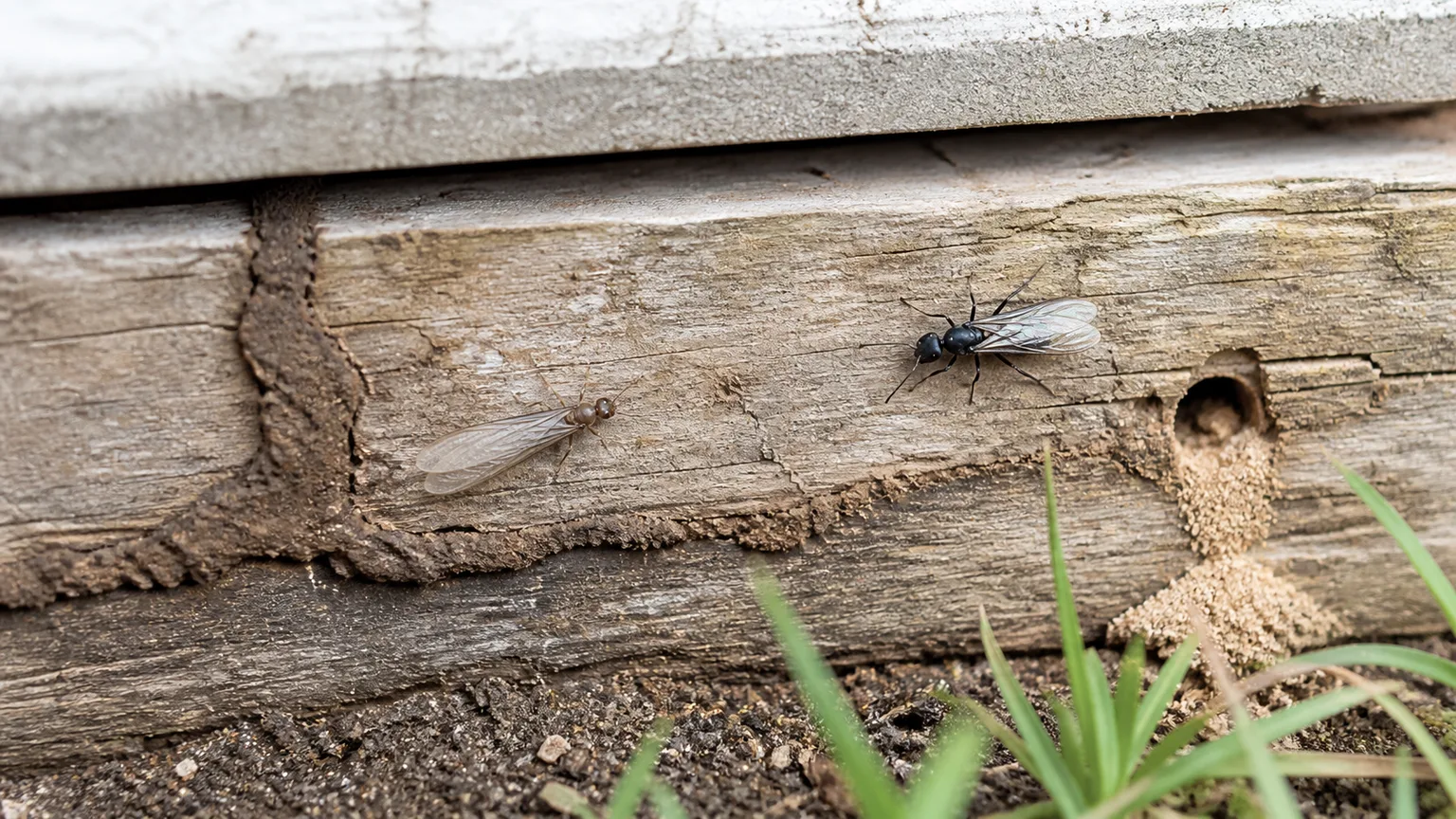
If you want to get rid of carpenter ants without pesticides, start with the wood and moisture—not the ants you can see. Carpenter ants excavate galleries in soft or decaying wood; they do not eat wood for food. That makes an indoor infestation both an insect problem and a useful warning that a leak, condensation problem, failed seal, or old piece of structural wood deserves attention.
The practical sequence is simple, although it is not always easy: confirm the identification, follow activity to the nest after dark, remove an accessible nest only when doing so is safe, dry and repair the wood, seal the route into the building, and monitor for new frass or swarmers. If the colony is inside a wall, ceiling, floor, or unsafe tree, the pesticide-free part of the plan is still moisture repair and exclusion; opening the structure or climbing into a tree is a professional job.
This approach is slower than spraying a line of ants, but it targets the reason the colony is there. UC IPM summarizes the same principle bluntly: eliminating moist wood and old stumps, finding nests, and using baits for hidden satellite colonies matter more than spraying foraging ants. (UC IPM carpenter-ant management tips)
Is It Really Carpenter Ants—or Just Ants in the Garden?
Not every large ant outdoors needs to be eliminated. Ants in garden soil can aerate tunnels, recycle dead material, disperse some seeds, and serve as food for wildlife. They may also gather on peony buds or around aphids for sugary honeydew without chewing the plant itself. Practical garden coverage from Epic Gardening and Empire of Dirt makes the useful distinction: tolerate ordinary garden activity when it is not harming people, plants, or structures.
Carpenter ants deserve a different response when you find large black or bicolored ants indoors, coarse sawdust-like material falling from a crack, winged ants emerging from a wall, or a steady trail entering soft wood. A few scouts crossing a patio are not proof of an indoor nest. Frass, repeated indoor traffic, and a damp wood connection are much stronger evidence.
| What you see | More likely interpretation | First move |
|---|---|---|
| A few small ants in a flower bed | Ordinary garden foraging | Look for aphids or food; do not treat broad soil by default |
| Large ants along a foundation at night | A route or outdoor nest may be nearby | Follow the trail and inspect stumps, firewood, and damp wood |
| Large ants indoors plus fibrous debris | Carpenter-ant nest near or inside the building | Photograph the debris, trace the route, and inspect moisture |
| Winged ants emerging indoors | A mature colony or satellite nest may be inside | Arrange prompt pest and moisture inspection |
That distinction prevents two expensive mistakes: using insecticide around a healthy garden when no control is needed, and dismissing a structural nest as harmless because carpenter ants are “natural.”

Identify Carpenter Ants Correctly Before You Treat
Carpenter ants belong to the genus Camponotus, and their appearance varies by species and by worker role. In the UC IPM key, workers range from about 1/4 to 1/2 inch for several western species; Rutgers describes northeastern workers from about 1/4 to 5/8 inch. Workers in one colony can be different sizes, so size alone is a poor diagnosis. (UC IPM’s carpenter-ant identification key)
Look for the combination of traits: a narrow waist with one node, a smoothly rounded thorax when viewed from the side, and elbowed antennae. Color may be uniform black or red-and-black depending on species. Carpenter ants often move in loose trails and forage late in the day or at night. If you can safely collect one in a sealed container, a local Cooperative Extension office can help with identification; do not handle a swarm with bare hands just to get a closer look.
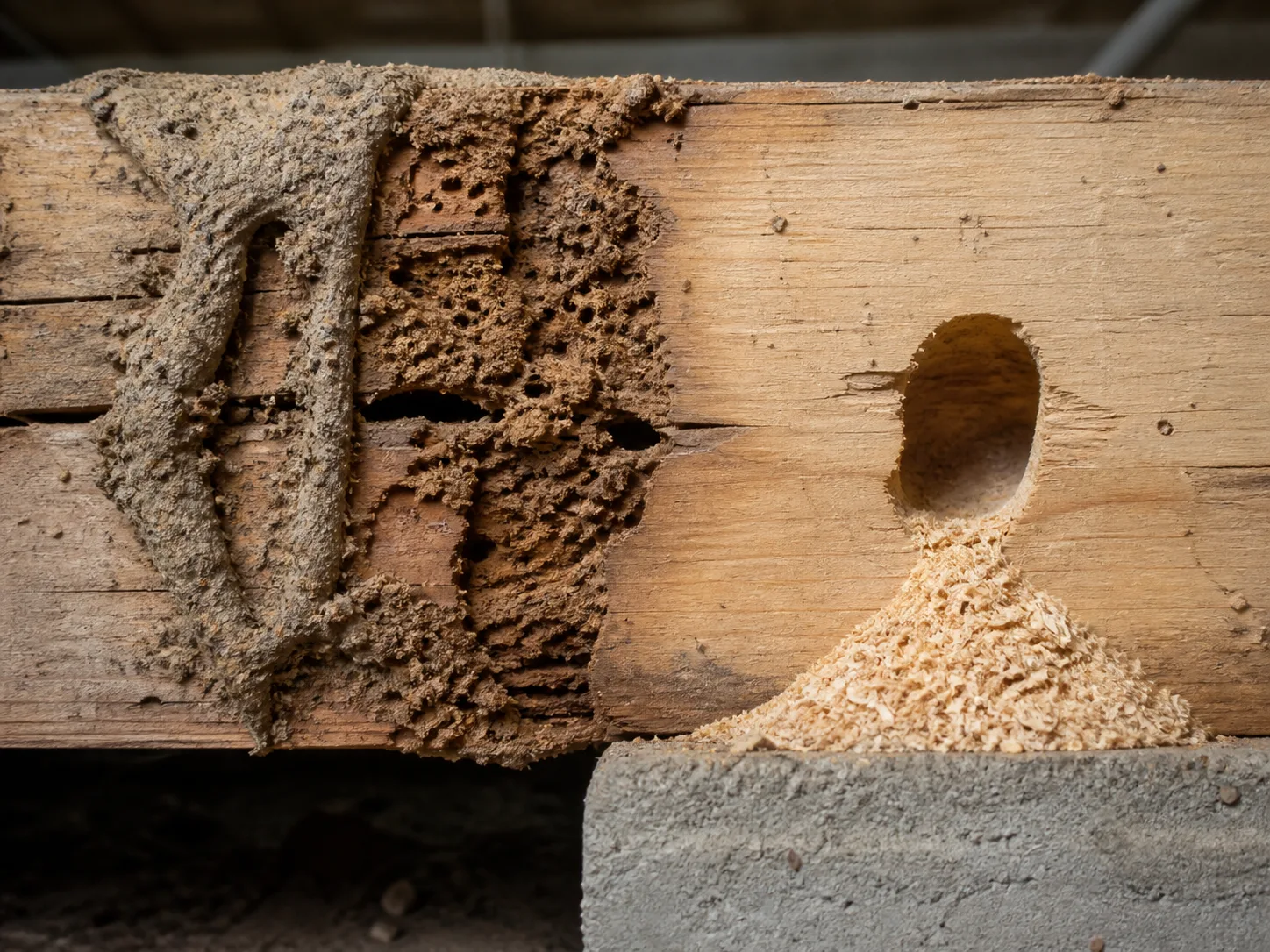
The most useful clue is often not the insect at all. Carpenter-ant frass is fibrous excavated material that can include wood fragments, soil, and insect parts. UC IPM’s frass comparison distinguishes this loose sawdust-like material from the pelletized droppings associated with drywood and dampwood termites.
Carpenter Ants vs. Termites: The Fast Visual Split
Winged ants and termites are easy to confuse during a spring or early-summer swarm, but the control problem is different. Use the table as a first screen, not as a substitute for a professional inspection when wood damage is visible.
| Feature | Carpenter ant | Termite |
|---|---|---|
| Waist | Narrow and pinched, with one visible node | Broad, more cylindrical body without the ant-like pinch |
| Antennae | Bent or elbowed | Straight or bead-like |
| Wings | Front pair longer than rear pair; wings often shed after mating | Four wings are similar in length and may be shed near the swarm site |
| Wood evidence | Fibrous frass and smooth galleries | Pelletized frass in drywood cases, or mud-covered galleries in some termite damage |
| Relationship to wood | Excavates wood for shelter and tunnels | Feeds on cellulose in wood |
The National Pesticide Information Center’s carpenter-ant guidance also points to the bent antennae and sawdust-versus-pellets distinction. When in doubt, preserve a sample or clear photograph and get the insect identified before choosing bait or dust. A remedy aimed at the wrong insect can waste time while damage continues.
Why Carpenter Ants Move Into Houses
Moisture is usually the invitation. Carpenter ants prefer wood that is wet, softened, or partly decayed because it is easier to excavate. Common trouble spots include window and door frames, sills, roof rafters below a leak, wood around plumbing, crawl-space framing, hollow porch posts, and wood in contact with soil. Penn State Extension notes that carpenter ants in trees and structures often indicate decay or a moisture-related condition rather than a preference for tunneling through sound, dry wood. (Penn State Extension on carpenter ants in trees)
The colony may not be entirely inside. A larger parent colony can occupy a stump, dead tree, fence post, or firewood pile outdoors while satellite colonies occupy damp sections of a building. UC IPM says a single parent nest may be associated with several satellites, which is why killing the ants on one baseboard rarely ends the problem. The hidden nest is the target; the visible workers are the dispatch team.
Food and access keep the route active. Carpenter ants eat insects, dead animals, fruit juices, plant exudates, and honeydew from aphids and scale insects. Inside, crumbs, pet food, sticky pantry jars, and water around a sink can keep workers returning even after the original trail is disturbed. Fixing the moisture without closing the trail, or wiping the trail without repairing the wood, leaves half the invitation in place.
Use This Inspection Sequence to Find the Nest
Inspect after sunset, when carpenter ants are more likely to be foraging. Start where you saw the greatest activity, then watch the direction of travel rather than crushing every ant immediately. Use a flashlight with a narrow beam, a phone camera, and a notebook; record the time, exact location, trail direction, nearby wood, and any frass.
Follow the trail in both directions. Indoors, check baseboards, window and door trim, plumbing penetrations, ceiling edges, attic framing, crawl spaces, and the lower edges of walls near wet rooms. Outdoors, check the foundation line, downspouts, hose bibs, mulch, stacked lumber, stumps, dead limbs, fence posts, and wood-to-soil contact. A trail that disappears at a pipe or cable penetration is an entry route, not necessarily the nest.
You can use a small, nontoxic food lure to make a quiet trail easier to follow. Rutgers recommends diluted honey, 25% sugar water, or crushed insects placed at several likely locations after sunset, with an inspection after one to two hours. Use tiny amounts on disposable material, keep them away from children and pets, and remove the lure when the inspection is over. This is a tracking aid—not a poison and not a reason to leave food out overnight. (Rutgers Cooperative Extension’s carpenter-ant fact sheet)
Do not tear open drywall or drill into a wall just because you hear an occasional tick. A faint rustling can be a valuable clue, but the location of a wall void, electrical wiring, plumbing, insulation, and load-bearing wood is not something to guess through. Mark the area, photograph the evidence, and let a qualified professional choose the access point if the nest cannot be reached from exposed wood.
Check Outdoor Satellite Sites Before Opening Walls
The outside inspection is not optional. A stump beside the porch, a damp firewood stack, a hollow tree limb touching the roof, or a rotting fence post can support the parent colony that keeps reseeding indoor activity. Move firewood only when you can do so safely, keep it off the ground and away from the building, and do not carry suspect logs through the house.
Look at trees with a safety lens, not only a pest lens. Carpenter-ant galleries may occupy decay in a living tree; the ants are not automatically the cause of the original decline, but extensive excavation can weaken a limb or trunk. If a tree is leaning, shedding large branches, hollow, or close to a roof or walkway, call an arborist rather than climbing or cutting it yourself. Penn State Extension recommends professional advice when treatment of carpenter ants in a nearby tree is being considered.
Control Carpenter Ants Without Pesticides: Repair the Invitation
A pesticide-free plan has four parts. It works best when you do them in the same week, because removing an exposed nest while leaving the leak or bridge in place simply creates a vacancy for another colony.
- Remove an accessible outdoor nest. If ants are nesting in loose, rotten firewood or a small removable stump away from structures, dispose of the material according to local rules or move it well away from the house. Do not cut a hazardous tree, dismantle a porch post, or open structural framing without the right help. For a nest in exposed, nonstructural wood, wear gloves, avoid carrying the material indoors, and inspect the surrounding area for additional colonies.
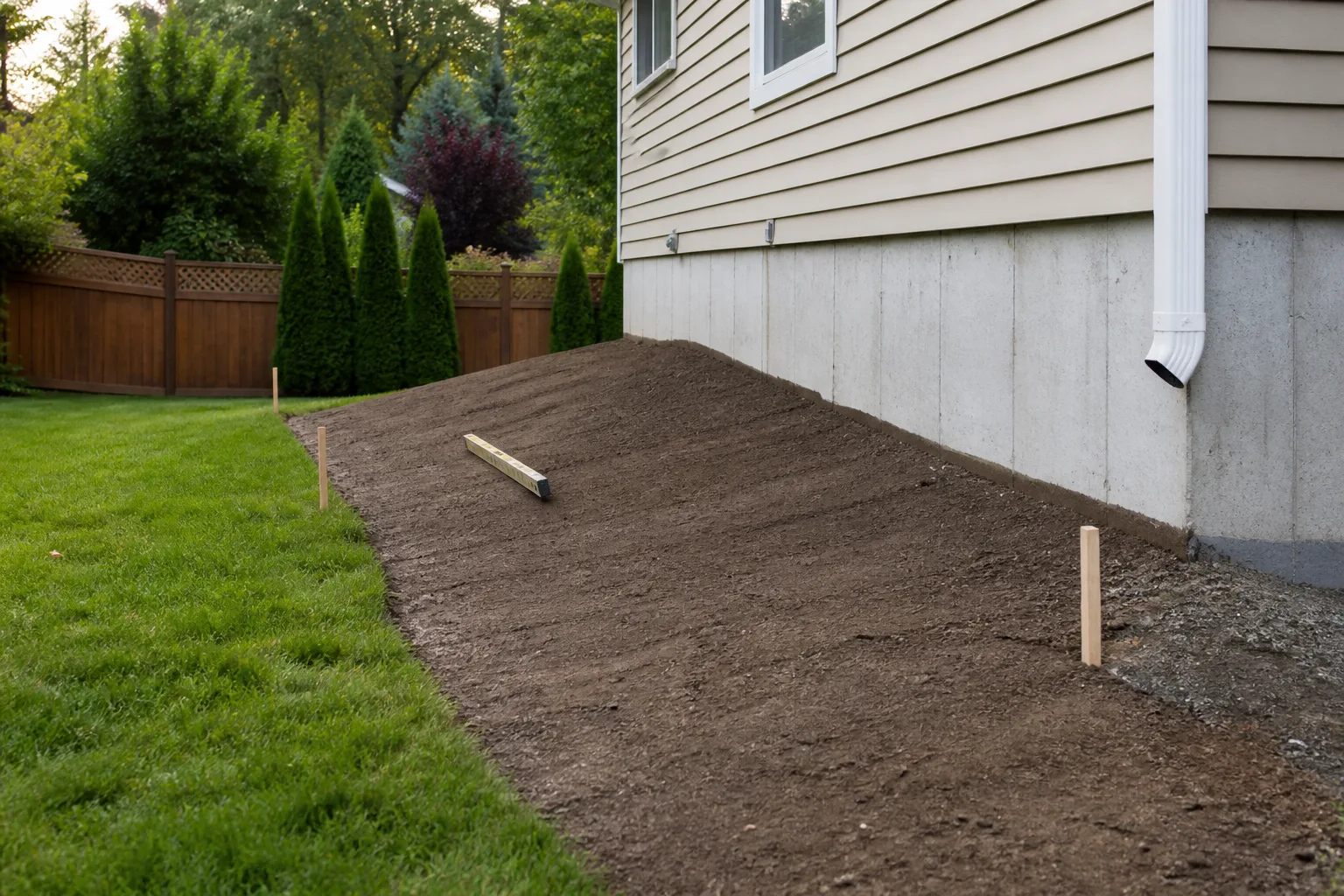
- Dry the wood and repair the source. Fix roof and plumbing leaks, clear gutters, extend downspouts, correct drainage toward the foundation, ventilate damp crawl spaces, and insulate pipes that sweat. Replace water-damaged wood after the source is fixed; covering wet wood with new trim only hides the nest site. NPIC’s control guidance specifically emphasizes ventilation, leak repair, pipe insulation, and replacing damaged wood. (NPIC carpenter-ant control tips)
- Close the routes. Seal gaps around plumbing, cables, electrical hardware, windows, doors, siding, and foundation penetrations with a suitable exterior sealant. Trim branches and shrubs away from the building so they cannot act as bridges. Reduce thick perimeter mulch; UC IPM recommends keeping it around 2 to 3 inches deep rather than building a damp, concealed edge against the structure.
- Remove competing food and water. Store sugar, cereal, flour, pet food, and ripe fruit in sealed containers. Wipe sticky pantry lids, clean crumbs, empty pet bowls overnight during an invasion, and dry persistent sink or bathroom leaks. Outdoors, inspect plants for aphids and scale if ants are repeatedly climbing stems; removing the honeydew-producing insects can reduce traffic, though it will not remove a carpenter-ant colony by itself.
For visible indoor trails, vacuuming and wiping with soapy water can remove workers and their scent route. A mild vinegar wipe may disrupt a pheromone trail on a washable surface, as BBC Gardeners’ World explains for ordinary household ant trails. Use it as cleanup, not as structural treatment, and never spray a strong-smelling cleaner over bait that you want ants to carry home.
Low-Toxicity Products Are Not the Same as Pesticide-Free
Borax, boric acid, diatomaceous earth, silica gel, pyrethrin, and pyrethroids are often grouped under “natural” or “organic” pest-control advice. That label can hide the important distinction: a product may be naturally derived or lower in some exposure categories and still be a pesticide with a label, hazards, and a legal use site. If your requirement is truly no pesticide, stop at nest removal, moisture correction, exclusion, sanitation, and monitoring.
If you are willing to consider a targeted, lower-exposure product, read the full label and treat it as a pesticide. Never pour a homemade mixture into an unlabeled bottle, dust a wall void through a random hole, or assume that food-grade means safe to inhale or safe around pets.
Borate Bait Is Targeted but Not Harmless
Slow-acting bait can be useful when ants are entering from a hidden satellite colony that you cannot reach. Foragers carry acceptable bait back to the nest and share it, which gives the active ingredient a path to workers that never leave the wall. Rutgers notes that complete colony control takes several weeks and that ants may accept different liquid or solid bait formulations at different times.
The safest home version is a commercially packaged, tamper-resistant bait station labeled for ants and for the location where you intend to use it. Place it where workers are already traveling, but away from children, pets, food preparation, and blooming plants. Do not make open bottle-cap bait from a recipe found online; the concentration, spill risk, and access by a curious child or animal are not controlled.
Do not combine bait with vinegar, peppermint oil, citrus oil, contact spray, or heavy cleaning on the same trail. Repellents can divert workers before they feed, turning a slow colony treatment into no colony treatment. If ants ignore one bait, follow the label and consider a different labeled formulation rather than adding more active ingredient. If you suspect a nest in a wall, bait can be a bridge while you arrange inspection, not an excuse to postpone finding the moisture source.
Desiccating Dust and Pyrethrin Are Where DIY Stops
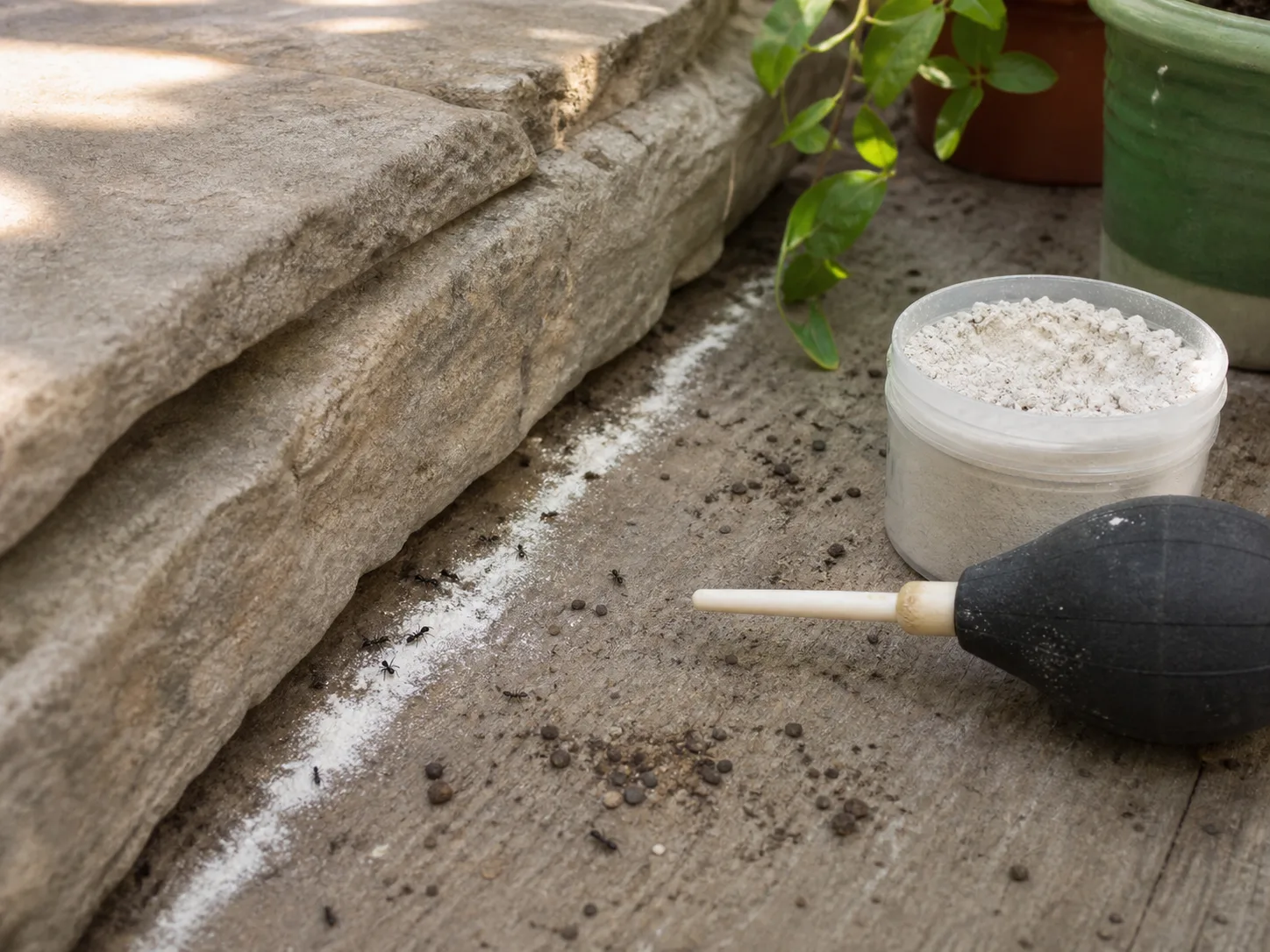
Diatomaceous earth and silica-based dusts work by damaging or removing the insect’s protective outer layer, but they only work when the dust remains dry and contacts the insects. A wet leak, humid wall cavity, or outdoor rain can end the effect. UC IPM also warns that dusts can cause serious lung irritation when inhaled, even when their toxicity to people is otherwise low. Use only a product labeled for the pest and site, and do not blow loose powder through a living space.
Pyrethrin is derived from chrysanthemum flowers, but it is still an insecticide. NPIC says pyrethrins can irritate skin, eyes, and airways; exposure can occur through spray or dust, and the chemicals are highly toxic to honey bees and fish. They break down relatively quickly in sunlight, but that does not make a wetland, flowering border, child’s play area, or poorly ventilated room a suitable treatment site. (NPIC’s pyrethrins fact sheet)
Drilling holes and injecting dust or spray into a colony is a structural treatment, not a casual weekend remedy. It can distribute material into wiring and insulation, damage finishes, and still miss the parent colony. For an inaccessible nest, professional inspection is the safer boundary.
Why Common Quick Fixes Disappoint
Contact sprays kill the workers they wet, but they do not reach the queen, brood, or hidden galleries. UC IPM notes that only about 10% of a carpenter-ant colony may be out foraging at one time, which explains why a dramatic line of dead ants can be followed by fresh activity later. Spraying the trail can also push workers into a different route while the nest continues undisturbed.
Vinegar, peppermint oil, cinnamon, citrus, coffee grounds, and similar household deterrents may change where ants walk or erase a scent trail for a while. They do not dry rotten wood, seal a pipe penetration, or kill a queen in a wall. Gardeners’ World recommends non-toxic trail cleanup and deterrence for ordinary ants, while Birds & Blooms cautions that killing workers without reaching the queen is not a permanent garden solution.
Boiling water is another poor fit for carpenter ants. It rarely reaches a deep wood gallery, can damage roots and soil organisms around an outdoor nest, and is dangerous to carry near a house. Flooding a wall, porch, tree cavity, or potted plant creates a moisture problem of its own. Use the least disruptive action that matches the actual location.
Prevention: Make the Property Harder to Colonize
After the first control week, walk the property once each season and after major storms. Pay particular attention to places that stay damp longer than the surrounding area.
- Roof and gutters: Clear leaves, repair flashing and roof leaks, and send downspouts away from the foundation.
- Plumbing and ventilation: Check under sinks, around tubs, near water heaters, and anywhere cold pipes collect condensation. Improve airflow in crawl spaces and attics where practical.
- Wood contact: Keep siding, porch posts, firewood, and stored lumber off soil where possible. Replace rotten trim instead of painting over it.
- Vegetation: Trim limbs and dense shrubs away from roofs, siding, and eaves. Remove dead branches that touch the building.
- Perimeter: Seal utility penetrations and cracks around window and door frames. Avoid creating a thick, wet mulch berm against the foundation.
- Food: Keep pantry goods and pet food sealed, clean spills promptly, and inspect outdoor plants for aphids or scale that produce honeydew.
The goal is not a sterile yard. Healthy garden soil can support ordinary ants that are doing useful ecological work. The goal is to remove the combination that turns a harmless outdoor colony into a building problem: soft wood, reliable moisture, sheltered routes, and an easy food source.
When to Call a Professional
Call a qualified pest professional promptly if you see a large indoor swarm, repeated winged ants, fresh frass, ants emerging from several rooms, rustling in a wall or ceiling, or damage near a sill, joist, roof rafter, or porch post. Also escalate when the nest is in a tree that could fall, inside insulation or electrical voids, or behind structural finishes you cannot safely remove.
Professional help is not a failure of pesticide-free control. A good inspection should identify the ant, trace the parent and satellite nests, document moisture or decay, and explain which repairs are needed before any treatment is chosen. Ask whether the plan uses targeted integrated pest management, what product and application site are proposed if a pesticide is recommended, how children and pets will be protected, and when follow-up will occur.
If the wood itself may be compromised, you may need two specialists: a pest professional for the colony and a qualified builder, home inspector, or arborist for the structure or tree. Carpenter ants often exploit decay that existed first, so killing the ants without repairing the wood leaves the underlying risk in place.
What Success Looks Like—and How Long It Takes
Success is not “no ants for one afternoon.” After accessible nest removal and moisture repair, you should see less traffic over the next several nights and no fresh frass at the original opening. Hidden colonies take longer: Rutgers notes that colony elimination can take several weeks because food or bait must reach workers, brood, and the queen.
Use a simple monitoring schedule. Recheck the original trail after 48 hours, inspect the moisture source within the first week, and repeat the indoor and outdoor walk at two and four weeks. Photograph any new debris in the same location so you can distinguish old frass from fresh excavation. If activity stops and then returns after a few weeks, suspect a missed satellite colony, a still-wet piece of wood, or a parent nest outdoors—not a need to spray more aggressively.
Season matters too. Winged reproductives appear during species-specific mating flights, often in spring, but timing varies by region. A swarm indoors is a stronger escalation signal than a single worker because it suggests the colony has matured enough to produce reproductives. Do not seal an opening blindly while ants are active inside; first understand whether you are closing the route, trapping the colony, or hiding a moisture problem.
Conclusion
The most reliable way to get rid of carpenter ants without pesticides is to remove what makes the site usable: damp or decaying wood, sheltered entry routes, and nearby nesting material. Confirm the insect, follow its trail after dark, inspect the house and yard together, remove only safe and accessible outdoor nests, repair leaks and drainage, replace damaged wood, and seal the routes back in.
Skip the promise that vinegar, essential oils, boiling water, or a contact spray can solve a hidden colony. They may clean or disrupt a trail, but they do not replace a nest diagnosis. When frass, swarmers, wall sounds, structural wood, or a hazardous tree are involved, professional inspection is the safest next step—and still fits a thoughtful, low-chemical control plan.



