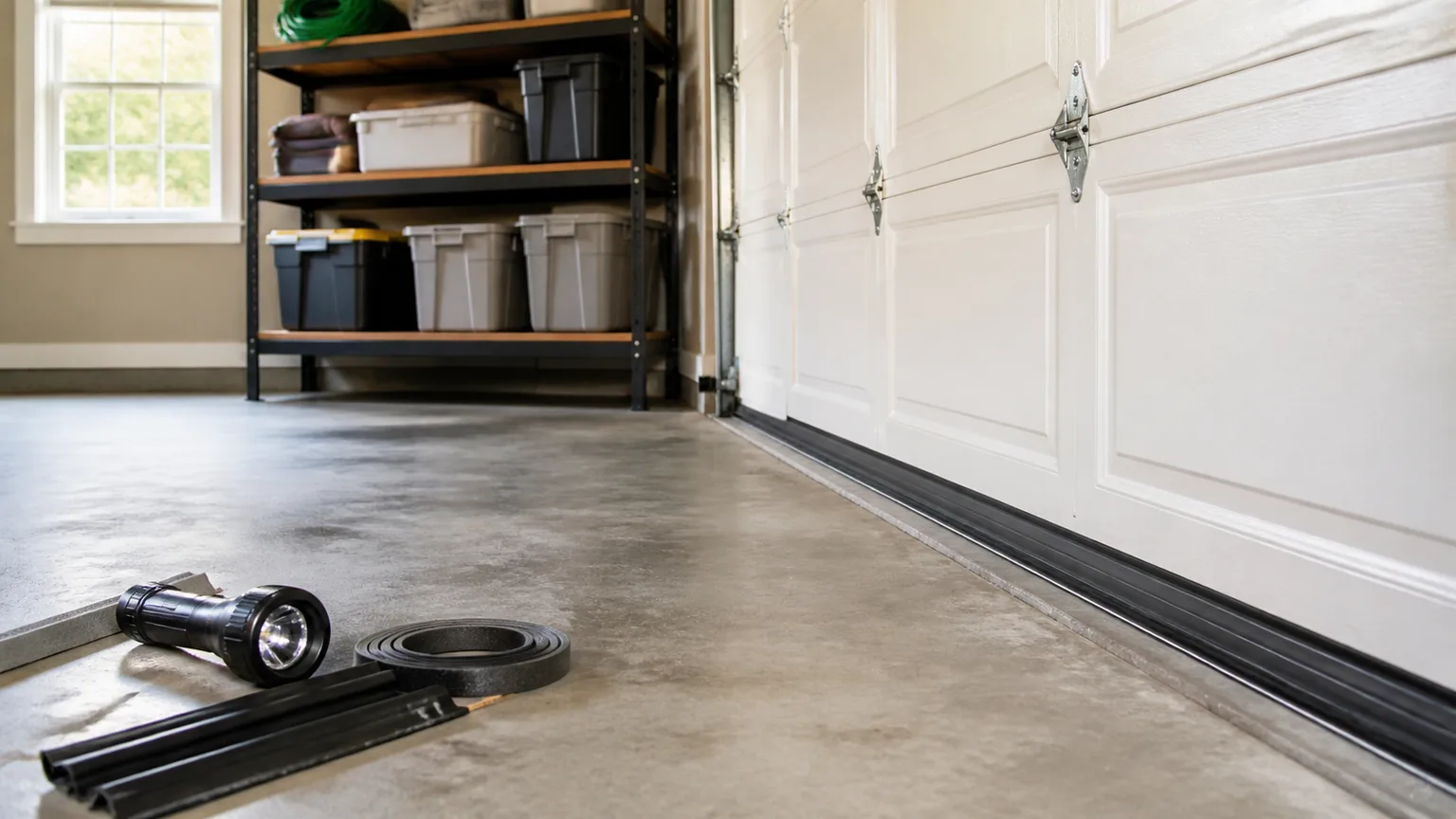
How to Use Cotton Balls to Keep Pests Away This Fall
Learn how to try cotton balls with essential oils this fall at home, which pests they may not deter, pet safety limits, and the entry-point fixes that last.

Cotton balls with essential oil can create a noticeable scent near a window or doorway, but there is no established household recipe that keeps every fall pest out. Treat the idea as a small, temporary scent experiment, not a dependable barrier or a way to eliminate an infestation. If you are seeing insects indoors, identify what they are and look for the opening, food, moisture, or hiding place that explains why they are there.
That distinction matters most in autumn. Some insects are searching for a sheltered place to spend winter; others are following crumbs, moisture, or a host. A cotton ball might change how one insect responds to a scent in one setting, but it cannot seal a screen gap, remove a nest, or protect you from mosquito bites. The steps below show how to try the hack cautiously and when to switch to a method that addresses the source.
The quick answer: a temporary scent test, not pest control
If you want to try the trick, use one cotton ball, one oil, and one monitored location. A small amount of peppermint oil is a common DIY choice, but the evidence does not establish a household dose, a guaranteed protection window, or a list of every pest it will repel. Do not soak a ball, scatter many around a room, or treat a strong smell as proof that insects cannot enter.
The name “natural” does not mean harmless or effective. Essential oils are concentrated plant extracts, and their effects vary by compound, dose, insect, and how the oil is used. Some pests may turn away from a scent in a controlled test; the same treatment may be ignored by another species or lose its scent before the next insect arrives.
A cotton ball is not the right response to a suspected bed bug, flea, pantry moth, cockroach, or rodent problem. Those pests need identification and a control plan that matches their biology. If insects are repeatedly appearing, first photograph or collect a specimen, note where and when you see them, and inspect the nearby route rather than layering on more oil.
Why fall pests enter in the first place
“Fall bug” can describe very different situations. Boxelder bugs, multicolored Asian lady beetles, and some picture-winged flies may move into attics, wall voids, or window casings as temperatures fall because they are seeking an overwintering shelter. North Dakota State University Extension describes these insects entering through cracks and openings and recommends screens and sealing as the main prevention; they are not necessarily coming inside to find food or reproduce there. NDSU Extension explains seasonal insect invaders and exclusion.
That is different from ants following a food trail, pantry insects finding stored grain, or roaches using water and warm hiding places. For these, a strong scent at one window may have little to do with the actual route. A trail may bend around a treated area, or the pest may be entering from a plumbing gap, shared wall, package, or infested food container.
Mosquitoes also need their own plan. They can bite in different seasons and at different times of day, and a cotton ball near the door is not personal protection. The CDC recommends EPA-registered repellents for bite prevention, along with screens and other measures; it says the effectiveness of non-registered repellents, including some natural ones, is not known. CDC guidance on preventing mosquito bites.
Before putting anything down, ask: Is this insect trying to overwinter, find food, breed, or bite? A row of beetles near an upstairs window in October suggests a different cause than ants near a sink or flies around fruit. Getting that first distinction right will save more time than choosing between lavender and peppermint.
What cotton balls can and cannot do
A cotton ball acts as a passive scent source: oil evaporates from its surface and releases volatile compounds into the surrounding air. The scent is strongest close to the ball, disperses through the room, and fades as the oil evaporates or air moves through an open window. It does not create an invisible wall that insects cannot cross, and it does not reach a nest inside a wall or under a floor.
Laboratory research shows why sweeping claims are risky. In one study, researchers tested ten essential oils against three mosquito species using an arm-in-cage method. Peppermint produced different median protection times for different species, and the study applied oil to volunteers’ forearms; it did not test cotton balls placed around homes. A separate study tested catnip oil against Aedes aegypti in a laboratory olfactometer, again using a specific oil, species, and setup. Those results can guide research, but neither study proves that a peppermint cotton ball will repel spiders, beetles, ants, or all mosquitoes at a house entrance. The mosquito essential-oil study and the catnip-oil laboratory study illustrate how narrow the evidence is.
The practical takeaway is modest: certain aromatic oils may alter the behavior of certain insects under specific conditions. How long that effect lasts at a real sill or doorway, and whether it reduces the number of pests entering a home, cannot be assumed from a lab result or a pleasant smell. If a blog suggests a precise number of drops or a replacement interval, treat that as a home-use recipe—not a tested pesticide rate.
Which essential oils make sense for the pest you have
Peppermint is the oil most often associated with the cotton-ball hack, while lavender, citronella, rosemary, and eucalyptus also appear in DIY lists. These lists often group flies, mosquitoes, ants, ticks, spiders, beetles, and roaches together as if one scent works equally well on all of them. The research does not support that kind of universal ranking.
| Oil commonly suggested | What you can reasonably conclude | What not to assume |
|---|---|---|
| Peppermint | It has been studied against some mosquito species and is commonly used in household scent recipes. | That a cotton ball deters every insect, lasts for a set number of days, or prevents an infestation. |
| Citronella | It appears in mosquito-repellent products and research, but a cotton ball is not the same as a tested product. | That any citronella oil or scented item protects people from bites. |
| Lavender, rosemary, or eucalyptus | Some sources describe them as insect-deterring scents; actual results depend on the pest and formulation. | That a pleasant or strong fragrance is evidence of efficacy or pet safety. |
Peppermint is popular, but not universal
Peppermint is a reasonable choice only if you want to test one scent in a small, low-stakes location and can keep it away from children and animals. A 2022 study found different responses to oils among Aedes, Anopheles, and Culex mosquitoes, even when the oils were applied in a controlled arm-in-cage experiment. That species variation is a useful warning against turning “peppermint showed repellency in a study” into “peppermint cotton balls repel bugs.”
Gardening Know How describes a peppermint-and-lavender cotton-ball recipe and suggests replacing the balls every two to three days. Hunker describes using a couple of drops near possible entry points. Those are editorial suggestions, and their different amounts underscore that there is no validated household cotton-ball dose or schedule. If you want the scent, use only the smallest amount that produces a tolerable fragrance, then reassess whether there is any visible change in the pest activity. Gardening Know How’s cotton-ball method and Hunker’s fall cotton-ball idea are practical examples, not proof that the method controls a range of pests.
Citronella, lavender, rosemary, and eucalyptus
Citronella is best known for mosquito products, but a product designed and evaluated for use around people is not interchangeable with a few drops of oil on cotton. For mosquito bite prevention, use a repellent that is registered with the EPA and follow its label, as CDC recommends. Cotton balls and room scents should not replace a repellent on exposed skin, protective clothing, or screens.
Lavender, rosemary, and eucalyptus are also common in DIY scent lists, yet a smell alone does not tell you whether a particular insect will avoid it. Essential oils are mixtures whose composition can vary, and a study on one compound, oil, or pest does not test a different bottle in your living room. If a particular pest is the problem, look for control advice about that pest rather than trying every oil mentioned online.
How to try the cotton-ball method responsibly
If there are no children, pets, birds, or fragrance-sensitive people who can reach or be exposed to the oil, you can treat the hack as a short trial. Do not use it where you need reliable protection, around stored food, or over a suspected infestation. Start by documenting the pest activity so a change in scent does not become the only measure of success.
Choose one oil and one location
Identify a likely route first. If a few harmless beetles are collecting by one upper window, place a single cotton ball in a small dish on a stable, inaccessible sill near that area—not at every entrance in the home. If you cannot identify the insect or the likely opening, a scent trial is unlikely to answer the useful question.
Add only a tiny amount of one oil to the cotton; there is no established household application rate for this method. Do not mix several oils, saturate the ball, or put oil directly on painted trim, wood, fabric, counters, or screens. Keep the dish away from food, heat, flames, and anywhere a child or animal can touch, lick, chew, knock over, or carry it.
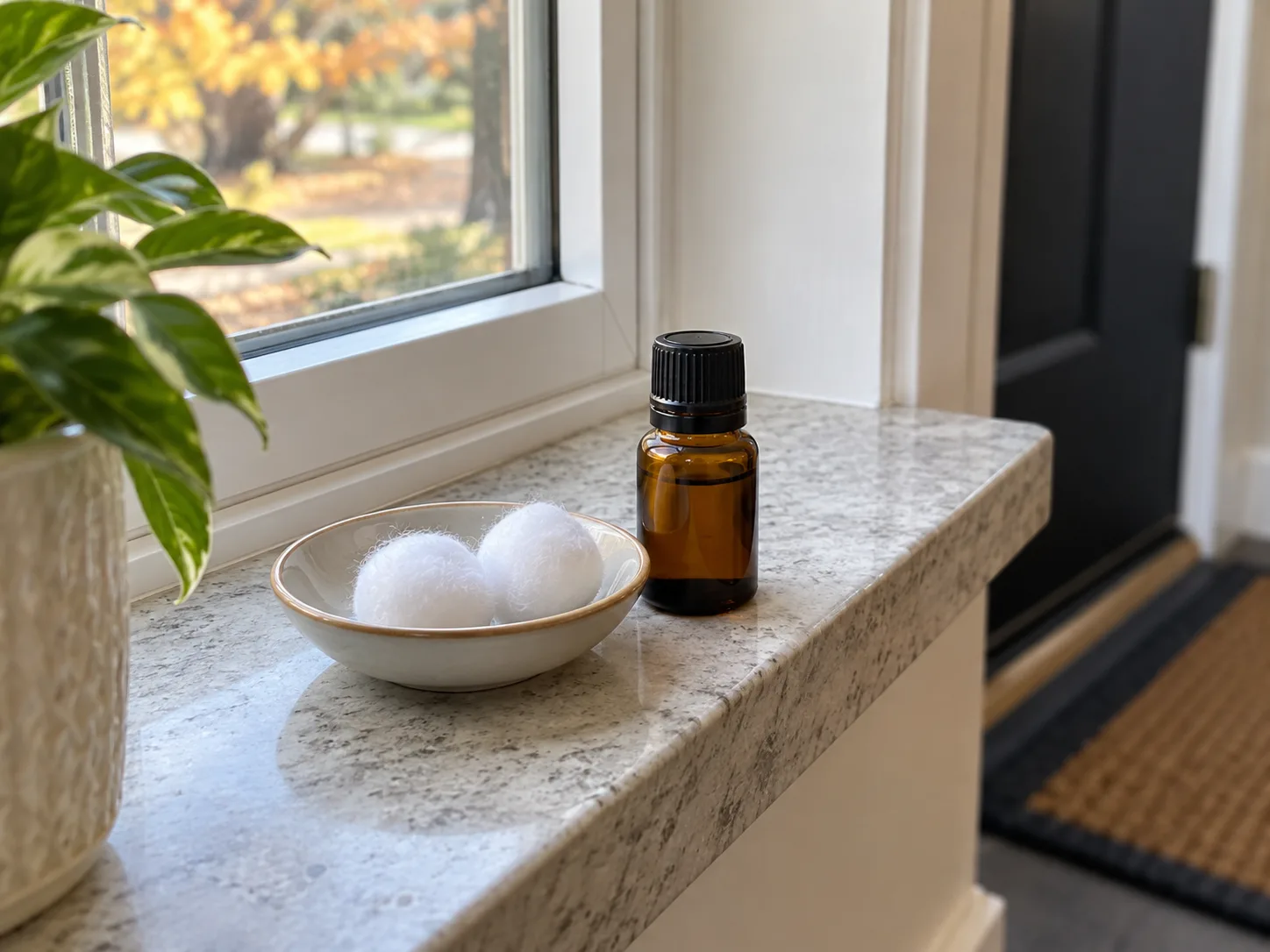
If you try the scent hack, contain it in one stable dish and keep it out of reach. The picture shows a setup, not a proven pest barrier.
Check after a day, not by smell alone
Check the area the next day and again after several days. Note how many insects you see, where they appear, whether they are alive or dead, and whether the route seems to have changed. A strong scent can make the treatment feel active even when the number of pests has not changed.
If you see no difference, remove the cotton ball rather than adding more oil or moving it throughout the home. If activity falls, keep monitoring before deciding the scent caused the change; weather, a closed window, cleaning, or a temporary lull may explain it. Do not keep refreshing a cotton ball for weeks while a gap, food source, or nest remains unaddressed.
Where to place cotton balls—and where not to
A cotton ball is best treated as a single scent point, not a perimeter. If you choose to test it, a stable high sill near a suspected entry may be easier to monitor than a floor-level doorway, where it can be kicked, vacuumed up, or picked up by a pet. Put it in a dish that will not stain or absorb oil, and remove it if the fragrance is uncomfortable.
Avoid placing scented cotton on kitchen counters, food shelves, cutting boards, pet bowls, children’s rooms, beds, upholstered furniture, or directly inside wall and floor gaps. Do not put it inside an electrical outlet, vent, drain, or HVAC return. The oil can leave residue, and the ball itself can be swallowed or carried away; a doorway is not automatically the safest place simply because insects may use it.
If you are using the idea for mosquitoes, a cotton ball indoors has no demonstrated role in protecting someone sitting outside or sleeping in a room. Repair screens and choose a registered repellent when personal bite protection is needed. A scent source next to a window is not a substitute for a physical barrier or a product tested for that use.
Essential-oil and cotton-ball safety
Essential oils are concentrated, and exposure matters. Pet Poison Helpline warns that essential oils can pose a toxic risk to pets; cats and birds are particularly vulnerable, and risks vary by oil, dose, concentration, and route. The Helpline lists peppermint, citrus, eucalyptus, clove, tea tree, and other oils among those associated with poisoning in cats. A cotton ball can be licked or chewed, and volatile fragrance can bother animals or people with respiratory sensitivity. Pet Poison Helpline’s veterinary guidance on essential oils.
For a home with a curious cat, dog, bird, toddler, or anyone with asthma or scent sensitivity, the safest choice is to skip oil-soaked cotton balls and use exclusion instead. Do not apply essential oil to an animal, a child’s skin, or your own skin based on a household hack. Keep bottles closed and stored securely; if a pet chews or ingests a cotton ball or develops drooling, vomiting, weakness, tremors, coughing, or breathing trouble after exposure, contact a veterinarian or animal poison-control service promptly.
Avoid using oils in any spot where residue could contact food or dishes. Do not assume that a product labeled “pure,” “natural,” or “therapeutic grade” has been tested for pest control or is safe for every household. If you use a labeled pest product instead, follow its directions for the named pest and location; do not improvise by soaking cotton with a pesticide or applying it where the label does not permit.
Why the hack fails or seems to work
The pest may not respond to that scent. Insects use different cues, and a result for one mosquito species does not predict what an ant or fall beetle will do. Even within mosquitoes, the controlled results vary by species and oil; a home scent trial has more variables than a lab assay.
The source remains available. Ants can return to a sugary spill, roaches to water and shelter, pantry pests to an infested package, and flies to fermenting food. A cotton ball does not remove any of those attractants. Clean the source and identify where the pest travels before trying a repellent.
The route is larger than the scent cloud. A window that does not close tightly, a torn screen, gaps around utility lines, and an unsealed attic vent can all create entry points. A scent near one opening does not cover a whole façade, wall cavity, or shared structure; insects may simply use the next gap.
The fragrance fades or gets masked. Air movement, open windows, cooking odors, cleaning products, and time all change the amount of scent reaching a pest. Replacing the ball by the calendar does not solve this uncertainty, because there is no established interval for a cotton ball to remain effective in every room.
A seasonal lull gets mistaken for proof. Some insects appear in short waves as weather changes. If sightings stop after one day, it may be because the outdoor temperature changed or the insects finished moving—not because the scent prevented entry. Record the pattern and inspect the window or attic before drawing a conclusion.
The fall plan that actually reduces indoor pests
Begin with the evidence you can observe: the species, location, and route. Watch the room at the time you normally notice the pest, check window frames and attic openings, and inspect the exterior wall on the sunny side of the house. For small numbers of harmless fall invaders, use a vacuum or broom and dustpan rather than crushing them; some can stain fabrics or surfaces.
Then make the physical changes that stop access. North Dakota State University Extension recommends tight-fitting screens and sealing cracks around windows, doors, vents, and utility entry areas for common seasonal invaders. Those measures address the point of entry directly. A cotton ball might be an optional scent alongside them, but it should not delay repairs.
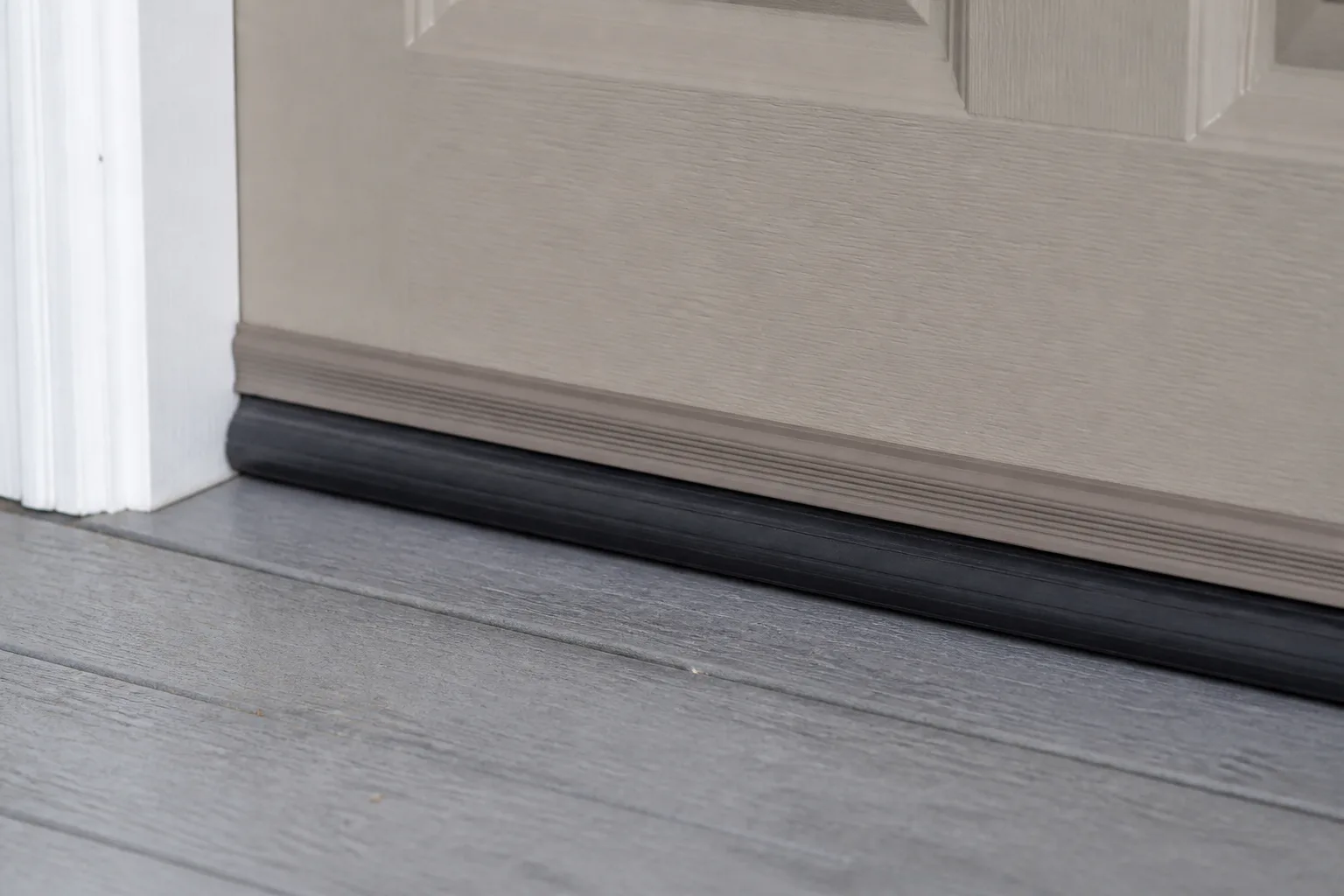
An intact door sweep closes a real opening; a scent source cannot fill the gap beneath a door.
Close gaps, screens, and door sweeps
Start with the easiest routes: repair torn window screens, confirm that screens fit tightly, and add or replace a door sweep if daylight is visible beneath an exterior door. Check screens over attic vents and louvers, and inspect gaps around pipes, cables, and utility lines where they pass through siding or the foundation. Use an appropriate sealant for the material and opening; large gaps may need a more durable repair than a bead of caulk.
Look at windows and doors from both sides if safe. Weatherstripping that has become brittle, a loose threshold, or a screen door that does not latch leaves an opening even when the door looks closed. In multi-unit housing, pest routes can run through shared walls or service chases; tell property management when an entry point is outside your unit or recurring despite basic sealing.
Remove food, water, and outdoor shelter
For ants, roaches, and pantry pests, wipe food residue, store dry goods in sealed containers, empty trash regularly, and repair leaks. Keep pet food sealed between meals and dry sinks and counters overnight if moisture is drawing insects. Check produce and pantry packages for signs of infestation rather than covering them with scented cotton.
For insects that gather outside and then enter, reduce the conditions that crowd them near the building. Move firewood away from exterior walls, trim vegetation that touches siding, and remove accumulated leaves or debris beside vents and foundation gaps. Do not seal an active animal or insect into a wall cavity; if a large group is emerging from a structural space, identify it and get appropriate pest advice before closing the opening.
What to do for specific pest types
Boxelder bugs and multicolored Asian lady beetles: These may cluster on sunny walls and find cracks around windows, eaves, and attic vents to overwinter. Screen or seal those openings and vacuum insects that make it inside. A cotton ball is unlikely to intercept a hidden gap or deal with a seasonal aggregation already inside a wall.
Cluster or picture-winged flies: Look for them at upper windows and attic spaces rather than assuming they are breeding in kitchen trash. Seal or screen entry routes and remove indoor strays with a vacuum. If numbers are large or persistent, ask a local extension service or pest professional to identify the fly and inspect the building.
Ants: Follow the trail to the food or water source, clean it, and find the crack they use. A scented barrier may move the trail without addressing the colony. If ants keep returning, use a control method labeled for that species and location or seek help; do not scatter multiple essential oils across the trail and pantry.
Mosquitoes: Repair screens and remove standing water where mosquitoes can breed. For time outdoors or personal bite protection, use EPA-registered repellents according to CDC guidance; a cotton ball with peppermint or lavender oil is not a proven substitute. If mosquitoes repeatedly appear indoors despite intact screens, look for a door left open, a damaged screen, or nearby breeding water.
Roaches, pantry pests, fleas, or bed bugs: These require targeted identification and a specific control plan. Cotton balls cannot treat eggs, hidden harborages, infested food, or pests carried in on people or animals. If you suspect bed bugs, fleas, or a growing cockroach problem, stop experimenting with scent and use species-specific guidance or a qualified pest professional.
Conclusion: treat cotton balls as optional, temporary backup
Cotton balls with essential oils may create a scent some insects avoid, but the evidence does not support them as a reliable way to keep every pest out this fall. If you try one, keep it small, contained, inaccessible to pets and children, and limited to a monitored location; stop if the scent is irritating or pest activity continues.
For lasting prevention, identify the insect and close the route it uses. Tight screens, sound door sweeps, sealed gaps, clean food storage, and moisture control address more of the reasons pests enter than a cotton ball can. Use a registered repellent when you need mosquito bite protection, and choose pest-specific treatment for an infestation.