Do Dryer Sheets Repel Fungus Gnats? What One Test Found
A 2010 lab study found one Bounce dryer sheet repelled adult fungus gnats. Learn what that result cannot prove and how to interrupt the soil life cycle.
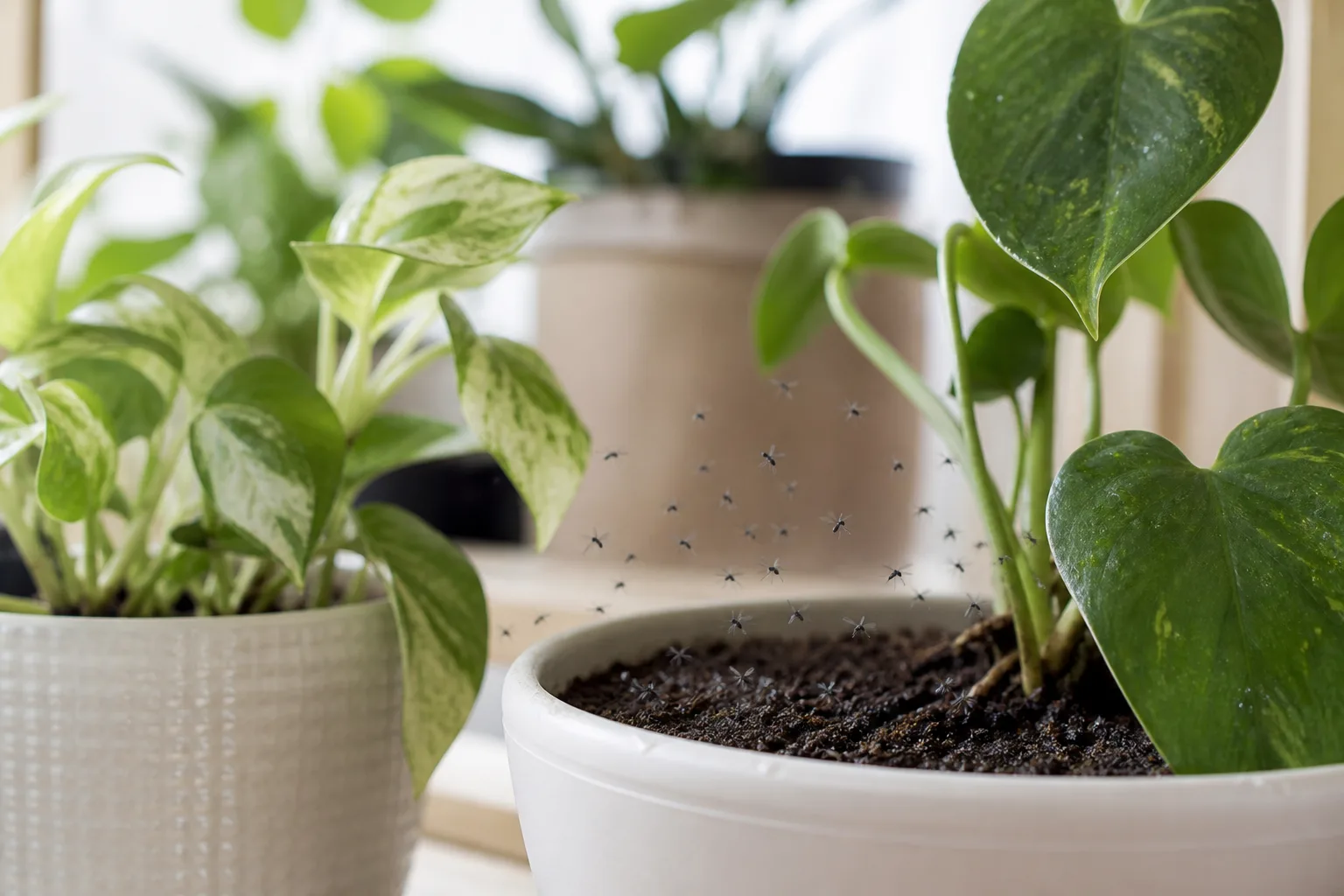
The short answer: a limited yes for adult gnats
There is a real study behind the dryer-sheet tip, but the useful answer is narrower than “put sheets in the garden and the gnats are gone.” In five replicated laboratory experiments, researchers found that a particular Bounce fabric softener sheet repelled adult fungus gnats from test compartments. That is evidence of adult avoidance under those conditions, not proof that dryer sheets stop a houseplant infestation, protect an outdoor garden, or kill anything in the pot.
So, do dryer sheets repel fungus gnats? One tested Bounce formulation repelled adult gnats in a lab. The study did not establish a home-use rate, how long a sheet works, whether cut pieces or buried sheets perform the same way, or whether it reduces eggs and larvae in potting soil. If gnats are coming from a damp pot, a scent that adults avoid may change where a few flies land; it does not remove the breeding conditions or the stages already in the mix.
For a plant owner, the practical decision is straightforward: treat the dryer-sheet finding as interesting, limited evidence, not a dependable control method. Confirm that the insects are fungus gnats, then focus on moisture management, adult monitoring, and a treatment labeled for fungus gnat larvae if the population persists.
What scientists tested—and what they did not
The 2010 study by entomologist Raymond A. Cloyd and colleagues, published in HortScience, examined adult fungus-gnat behavior around Bounce sheets with an Outdoor Fresh scent in laboratory arenas. The study reported five replicated experiments. In the sample compartments containing the sheets, the mean proportion of released adults collected was 12% to 18%; in compartments without sheets, it was 33% to 48%. In plain terms, fewer adults ended up in the sheet-associated compartments during those tests. The HortScience paper is the source of the original finding.
Those percentages describe where adults were collected in an experimental arena. They are not the percentage of gnats killed, the reduction in an infested pot, or the share of an outdoor population repelled. That distinction matters: an insect can avoid a treated compartment and still lay eggs somewhere else, survive, or return when the odor fades.
The researchers also analyzed volatile compounds and reported linalool and beta-citronellol among compounds detected in the sheets. That offers a plausible reason for a behavioral response, but it does not prove that either compound alone caused the effect or that every dryer sheet contains the same blend or amount. The research team itself framed further work as necessary before dryer sheets could be widely recommended. It did not publish a household placement recipe for plant owners.
Why adult repellency does not clear a plant
Fungus gnats have several life stages, and most of the population is hidden in potting media. Adults are the small flies you notice hovering near soil or windows. Females lay eggs in moist growing media; larvae then feed mainly on fungi, algae, and decaying organic material, with root hairs and tender roots sometimes damaged when larval numbers are high. They pupate in or on the medium before emerging as adults.
A sheet that discourages some adult movement does not reach eggs, larvae, or pupae below the surface. It also does not change the moisture that makes a pot attractive for egg laying. University of Georgia Cooperative Extension notes that high moisture in potting media is the main reason fungus gnats become abundant in homes and offices, and that allowing the soil to dry between waterings can reduce the problem.
That is why an adult repellent, even one with a demonstrated lab effect, is not equivalent to population control. You may see fewer flies around one location for a while and still have new adults emerging from the same pot. The control target is not only the insect in the air; it is the damp, organic-rich media supporting the next generation.
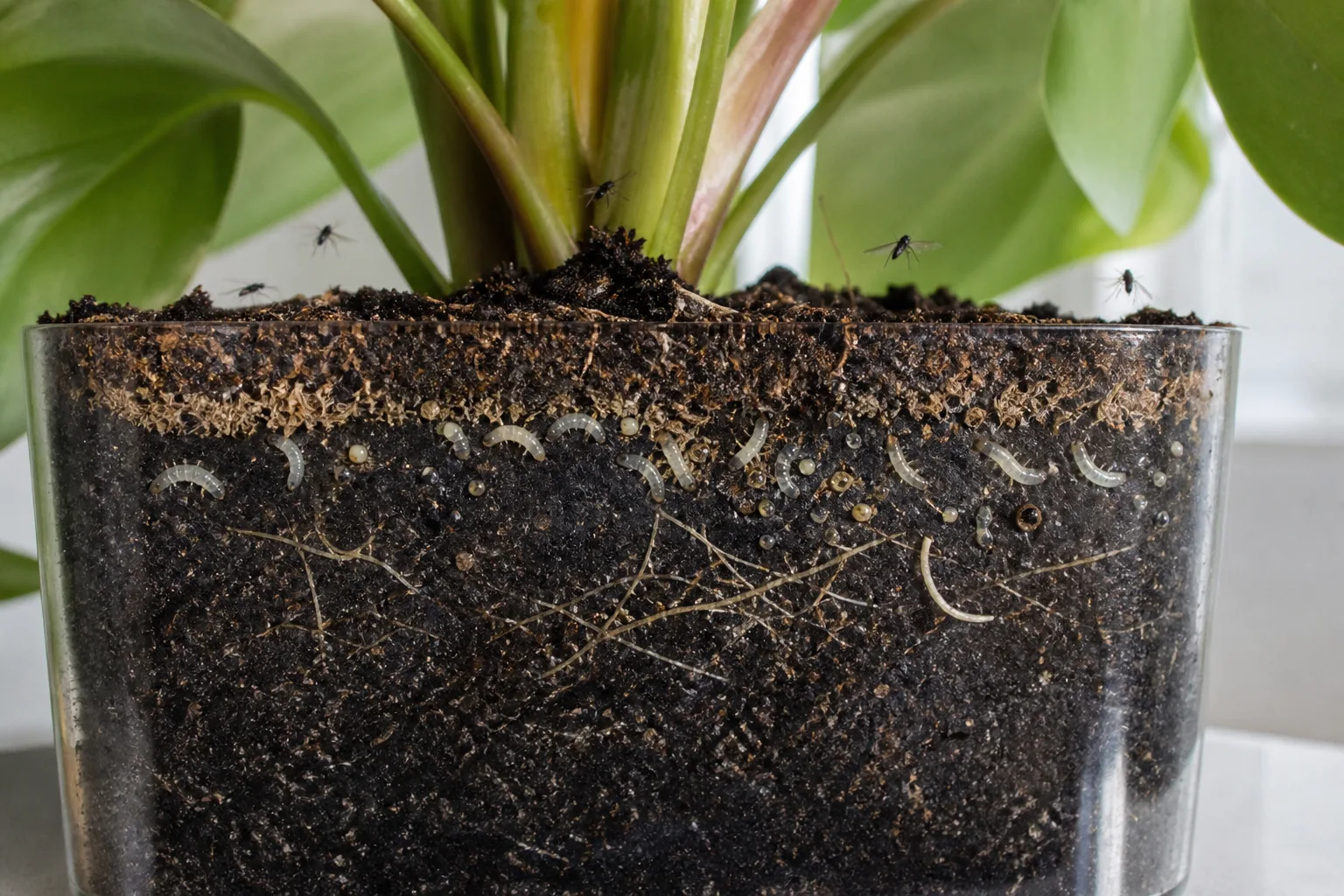
Confirm the fly before trying a fix
A small flying insect near a plant does not automatically mean fungus gnats. A wrong identification can make a sensible treatment look ineffective: drying a pot will not solve a fruit-fly source in old produce, and a dryer sheet has not been shown to repel every insect casually called a gnat.
Fungus gnat adults are usually dark, slender, mosquito-like flies with long legs and a weak, erratic flight. They tend to run or flutter near the surface of a potted plant and may gather at windows. Their larvae are pale, threadlike worms with dark heads in moist soil. Adults do not bite, and a light infestation is often more of a nuisance than a serious threat to an established plant.
A yellow sticky card placed at the pot edge can help answer a practical question: are the adults coming from this plant? Check several plants rather than treating the first one you notice. If a card beside one pot catches gnats while cards elsewhere remain mostly clear, you have a more useful lead than a flying insect across the room.
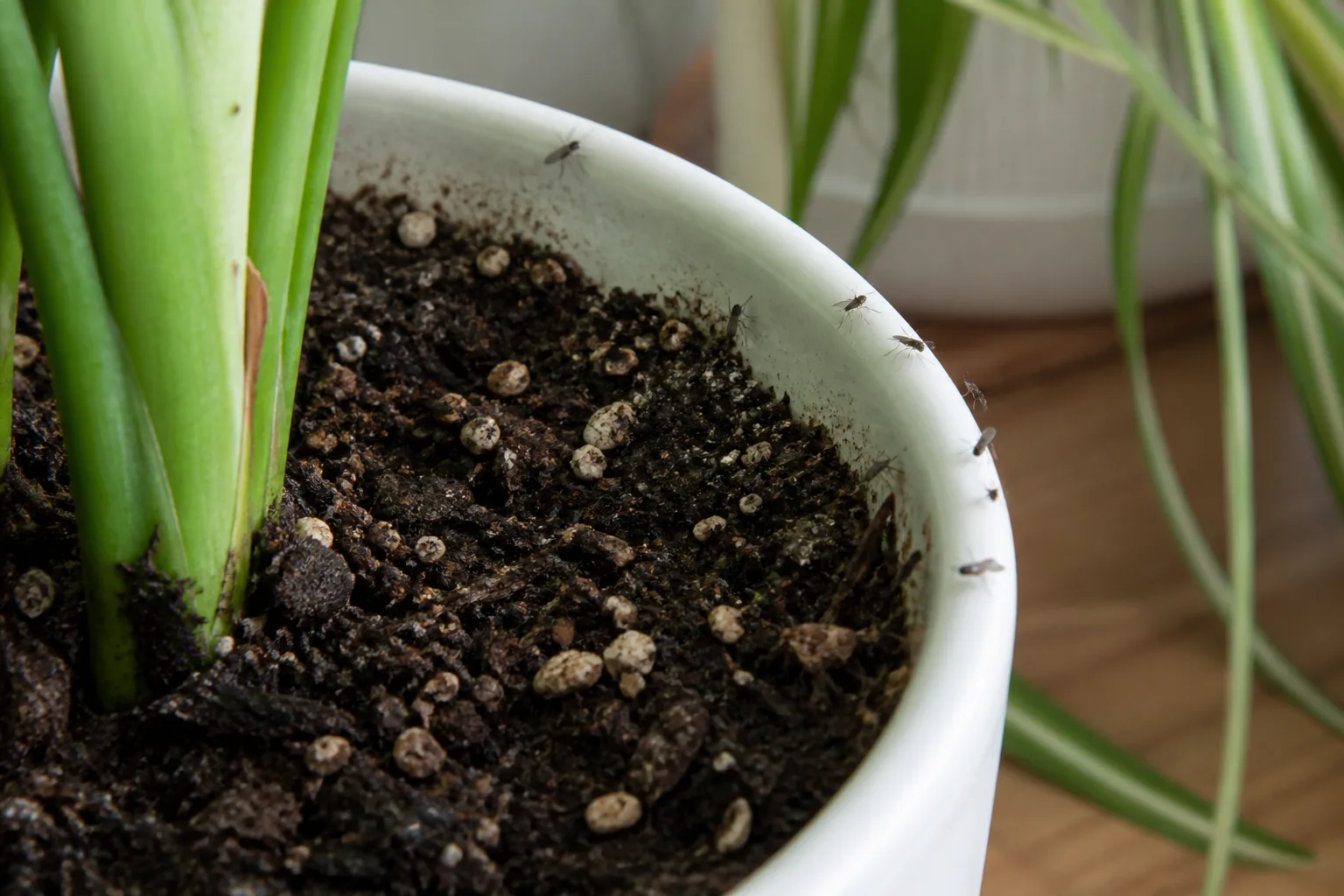
Fungus gnat, fruit fly, or drain fly?
Fungus gnats are slender and dark, often appearing over potting soil. Fruit flies are typically stockier and tan to brown, sometimes with red eyes, and cluster around ripening fruit, recycling, or fermenting residue. Drain flies look fuzzy or moth-like and are more likely to rest near sink, shower, or floor drains. These are different insects with different breeding sites.
If you are unsure, use location as a clue, not a final diagnosis. Move fruit and rinse the recycling bin, then see whether activity continues around plant pots; for suspected drain flies, check the drain rather than treating every plant. The University of Wisconsin–Madison Extension notes that vinegar traps used for fruit flies do not work for monitoring fungus gnats, while yellow sticky traps near houseplants can catch adults and help track their numbers.
Find the damp pot that is sustaining them
Start with the collection, not the most visible gnat. Look for soil that stays wet for days, a decorative cachepot holding drainage water, a plugged drainage hole, a pot without drainage, decomposing leaves on the surface, or old mix that has collapsed and remains soggy. Check seed trays, newly purchased plants, and any open bag of potting mix stored somewhere damp. An infestation can involve more than one container.
A simple check takes less time than scattering scent remedies around the room. Place one yellow sticky card beside each suspect pot and label the date or pot; look at the number caught after several days. If you need to confirm larvae, Wisconsin Extension and Colorado State University Extension describe using a small potato slice or wedge on the medium surface and checking its underside after a few days. Remove and discard it after the check.
Do not assume the plant with the most visible adults is the only source. Adults can fly short distances and collect at windows, so the breeding container may sit elsewhere. A small number of cards used as a map can show whether the source is one persistently wet pot, a propagation tray, or a broader moisture issue.
A more reliable plan: change soil conditions and monitor
The strongest home strategy combines a change that makes the medium less favorable with a way to track adult activity. This addresses both the reason gnats return and the annoying adults already flying. Extension guidance emphasizes moisture management and trapping; practical horticulture guides, including Epic Gardening’s houseplant gnat overview, also describe sticky cards as an adult-focused tool rather than a treatment for larvae in soil.
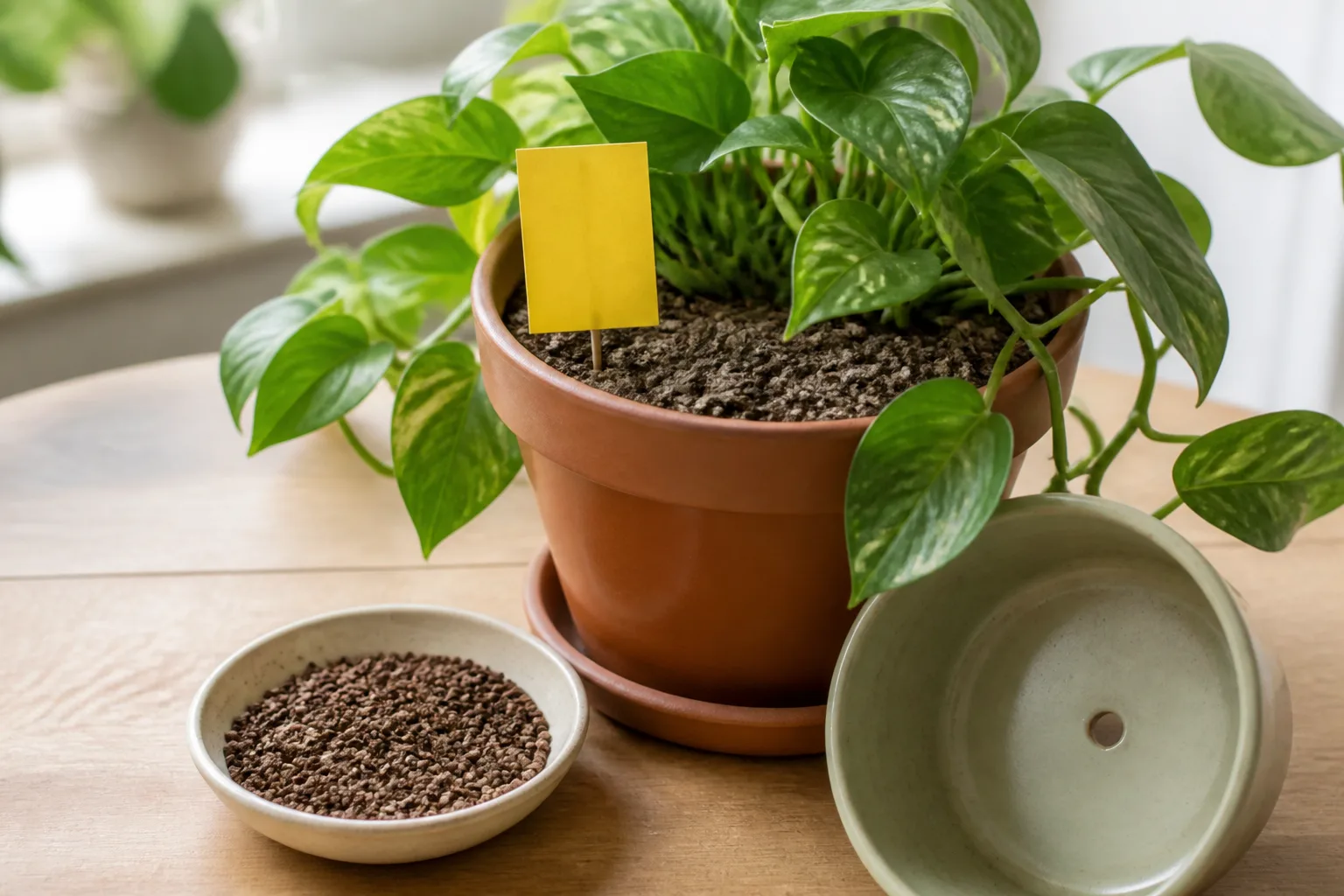 \n\nDo not try to solve the problem by making every plant bone-dry. A cactus and a moisture-loving fern should not follow the same watering schedule. Instead, water according to the plant’s needs, remove standing water, and decide whether a labeled larval treatment is warranted after you have identified the source. Keep a dated sticky card near the same pot so you can tell whether counts are trending down rather than judging by one fly you saw today.
Let the surface dry only as far as the plant tolerates
For plants that tolerate some drying, allow the upper layer of potting mix to dry before watering again. Colorado State University Extension recommends letting the top one to two inches dry between waterings; Wisconsin Extension gives the same basic approach as a way to keep the soil surface less attractive for egg laying. The relevant interval is the plant’s own care need, not a fixed number of days.
Some plants, seedlings, and newly rooted cuttings can be damaged by a prolonged dry spell. For those, do not withhold essential water as a gnat treatment. You can remove dead leaves, empty the saucer after drainage, improve airflow around the pot, and consider bottom-watering when appropriate so the upper surface stays drier. Wisconsin Extension cautions that the pot still needs to drain; roots should not sit in water.
If the mix stays saturated despite reasonable watering, investigate the container and medium. A pot that is much too large for its root ball, a blocked drainage hole, or a compacted, broken-down mix can remain wet long enough to support gnats. Repotting may be more useful than adding another home remedy when the growing medium itself has stopped draining well.
Use yellow sticky cards to capture and count adults
Place yellow sticky cards near the soil line or just inside the canopy, where adults are active around the plant. They serve two purposes: they catch some adults, and they give you a rough record of activity. A card beside one pot that catches several flies while cards by neighboring pots stay nearly empty helps narrow the source. Replace cards when their sticky surface is full or dusty, and record counts at similar intervals.
A card is not a complete treatment. It cannot catch larvae feeding in the soil, and a low count does not prove the pot is free of eggs or pupae. Its value comes from pairing capture with soil-level changes and comparing counts over time. If the number remains high, return to the moisture and container inspection rather than simply adding more cards farther across the room.
Use care around children, curious pets, and beneficial insects. Keep cards out of reach and use them indoors where you can monitor what they catch. For a very small plant, a tiny card can be enough; for a large shelf, several cards may help you locate which pots are active.
Consider a labeled larval treatment for persistent populations
When the infestation continues despite better watering and adult monitoring, look for a product whose label specifically permits use against fungus gnat larvae in houseplant growing media. Some products contain Bacillus thuringiensis subsp. israelensis (Bti), a microbial larvicide used against certain fly larvae. Availability and permitted uses differ by product and location, so the label—not a social media recipe—sets the application method, dose, repeat interval, and precautions.
Wisconsin Extension explains that Bti soil treatments target larvae, not eggs, pupae, or adults, and may require repeated applications as larvae hatch. That is why a larval treatment works best alongside adult trapping and watering adjustments. Do not substitute a mosquito product designed for standing water unless its label also allows the exact indoor plant use you intend; do not exceed the label rate or mix products.
For a severe problem in a room full of plants, ask a local extension office or qualified horticulture professional to identify the insect and review the product label. This is especially useful if the plants include seedlings or valuable specimens that cannot tolerate trial-and-error watering. Routine spraying of the room is not a replacement for treating the pot where larvae live.
Check for larvae without guessing
If you want to know whether a plant still has larvae, press a thin potato slice onto the soil surface and check it after three to four days. Larvae may gather to feed on the underside, where they are easier to see than against dark potting mix. Use a small piece, remove it promptly, and throw it away; this is a monitoring trick, not a cure for an infestation.
The Wisconsin Extension guide and Colorado State Extension fact sheet both describe potato as a way to scout for larvae. A positive result tells you the soil is involved, so continue the soil-focused plan even if sticky cards have already reduced the adults. A negative result from one slice is not definitive: a small sample may miss larvae in another part of the pot, or the population may be low.
Use this check when it will change your decision. If you have seen adults repeatedly emerge from a plant, the source is already plausible and improving the moisture conditions is worthwhile whether or not the slice attracts visible larvae. If adults appear near several containers and you cannot tell which one is active, testing the most suspicious pots can save you from repotting every plant.
Why common dryer-sheet placements disappoint
The original experiment tested adult behavior around a specific Bounce formulation under laboratory conditions. It did not test pushing sheets into potting mix, cutting them into a garden perimeter, or tying them to branches outdoors. Those placements also lack a tested dose, spacing, replacement schedule, or measured duration. A scented material in an open yard will not behave like a controlled sample compartment, and no field result lets you predict how long any effect would last.
| Suggested placement | What the research supports | Practical limitation |
|---|---|---|
| Bury a sheet in a pot | Adult repellency for one formulation in a lab arena | No soil-use rate or evidence that it reaches larvae |
| Scatter cut pieces around a bed | No outdoor perimeter test in the paper | No tested spacing or duration; wind and weather change exposure |
| Tie sheets to branches | No tree or yard trial in the paper | Does not treat gnats breeding in pots, compost, or other damp media |
The sheet-in-soil suggestion is especially easy to misread. The paper did not establish that dryer sheets are safe or beneficial as a soil amendment, and a laundry product is not a fungus-gnat treatment label. Do not bury one in a houseplant pot, edible-herb container, or vegetable bed as though the experiment validated that use. If you already tried it, remove the sheet and continue with plant-appropriate care; you do not need to panic or assume the plant has been harmed.
Other quick fixes: what earns a place in the plan
Vinegar bowls are useful to some people for fruit flies, but they are not a dependable fungus-gnat monitor. Wisconsin Extension specifically distinguishes them from the yellow cards used around potted plants. A homemade trap that catches a few flies without locating the pot can create the impression of progress while the soil continues to produce replacements.
A thin gravel or sand layer may help keep the surface drier in some pots, but it does not undo wet media underneath or treat larvae already present. Wisconsin Extension describes coarse sand or fine gravel as one way to make a soil surface less attractive for egg laying, while also advising moisture changes and sticky traps. Use a top dressing only if it suits the plant and does not make you water by guesswork; it is an accessory, not a standalone cure.
Be cautious with homemade drenches and essential oils. A remedy can be “natural” and still stress roots or leaves, and concentration matters. Stick with the lower-risk basics first; if you use a pesticide or larvicide, confirm that the product label covers fungus gnats and your plant setting, then follow its directions. The Halton Master Gardener article on fungus gnats also emphasizes moisture changes, adult traps, and potato-slice monitoring rather than scent alone.
Protect seedlings, sensitive plants, and edible herbs
Established houseplants usually tolerate light fungus-gnat activity. The risk changes for seedlings, cuttings, and young plants, whose small root systems have less capacity to absorb damage. Georgia Extension notes that larvae can stunt young plants and seedlings even when adult flies are mainly a nuisance. If you see seedlings wilting or failing to grow, check roots and moisture as well as looking for gnats; root rot, poor light, and transplant stress can produce similar symptoms.
Moisture-loving plants need a different plan from a dry-soil succulent. Do not solve gnats by repeatedly withholding water from a fern, a newly rooted cutting, or a seed-starting tray. Remove decaying leaves and algae, increase drainage if the container is waterlogged, and use a product only if its label permits that plant and use. Yellow sticky cards can be placed where they do not contact foliage or stick to a curious pet.
For edible herbs and vegetables, avoid adding laundry products or unregistered pesticide mixtures to the growing medium. A lab result about adult repellency does not provide a residue, harvest, or soil-safety assessment. Identify the insect, correct the moisture issue without stressing the crop, and rely only on pest-control directions that explicitly permit the crop and setting.
What to expect over the next three to four weeks
Fungus gnats do not disappear the moment the surface begins to dry. At typical indoor temperatures, the egg-to-adult cycle can take roughly three to four weeks, and several stages may be present at once. Wisconsin Extension describes eggs hatching within days, larval development over one to two weeks, and adults emerging after a short pupal stage. A few adults during the first part of a control effort do not automatically mean it has failed.
Use a simple weekly check: look at the same sticky cards, note whether fewer adults are caught, confirm that saucers are empty, and feel the top layer before watering plants that tolerate drying. If counts stay flat, reconsider whether you identified the correct insect, whether another pot or bag of damp mix is the source, or whether the medium is still staying wet. Change one key condition at a time so you can tell what helped.
If activity remains high after several weeks of consistent, plant-safe management, inspect every pot again and consider whether degraded mix or a hidden propagation tray is sustaining the cycle. Repot only the plants that need it; replacing all your soil can stress plants and does not address a new source if the watering or storage conditions remain unchanged. A dryer sheet is not a useful progress marker. A falling adult count and fewer signs in the actual breeding medium are.
Conclusion
The dryer-sheet claim has a factual core: a 2010 study found that one Bounce formulation repelled adult fungus gnats in laboratory tests. It did not show that burying sheets, laying a perimeter, or hanging them around a yard eliminates fungus gnats, protects plants, or kills the larvae living in damp potting media.
For a household infestation, start by confirming the insect and identifying the pot that stays wet. Adjust watering to the plant rather than forcing a drought, use yellow cards to monitor adults, and consider only a larval treatment labeled for houseplant use if the problem persists. That approach targets the conditions and life stages that keep gnats returning; a scented sheet does not.



