Does Lavender Repel Mosquitoes? A Practical Guide
Lavender smells strong, but a potted plant is not a mosquito shield. Get evidence-based placement, care, standing-water fixes, and safer evening protection.
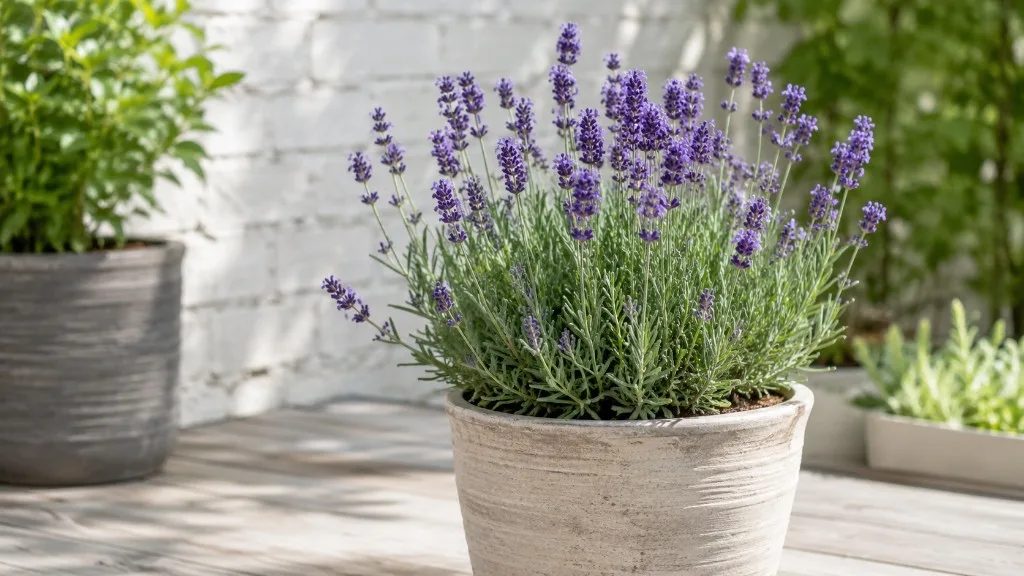
Lavender is worth planting in a summer yard—but not because one pot will create an invisible mosquito fence. A healthy lavender plant can add fragrance, flowers, and nectar for pollinators; its presence alone is not a dependable substitute for mosquito control or a skin-applied repellent.
That distinction matters because “lavender repels mosquitoes” can mean four very different things: a living plant in the ground, leaves that have been crushed, lavender essential oil, or a commercial product formulated and labeled for use on skin or clothing. Those are not interchangeable. Their concentration, coverage, duration, and safety instructions are different.
If you want lavender, grow it in the sunniest, driest place near the patio or path. If you want fewer bites, start with standing water, then add airflow and personal protection. That layered approach gives the plant a role it can actually perform.
The short answer: lavender is a useful plant, not a mosquito shield
Does planting lavender keep mosquitoes away from a yard? Usually, no—not by itself. The scent may be unpleasant to some insects at close range, and lavender oils have shown repellent activity in controlled tests. But a plant sitting in a bed or container does not release a measured, evenly distributed dose across the whole yard, and wind, heat, plant size, and the number of mosquitoes all change what happens outdoors.
UF/IFAS Extension makes the practical distinction clearly: plants such as lavender contain compounds that can deter mosquitoes, but those compounds generally need to be extracted and used in a concentrated form to provide meaningful repellency. The same guidance recommends combining personal protection with habitat management rather than expecting a plant to eliminate bites (UF/IFAS Extension).
So the honest answer is “lavender may contribute scent near a seating area, but it is not proven passive yard-wide protection.” Plant it because it is beautiful and useful, and treat mosquito reduction as a separate job with a separate checklist.
What the evidence says about lavender and mosquitoes
The evidence is not a simple yes-or-no verdict because researchers test different things under different conditions. A mosquito in a small laboratory chamber encountering a known concentration of oil is not the same as a mosquito flying through a backyard with one lavender plant, several chairs, a breeze, and multiple sources of standing water.
The strongest conclusion you can draw is modest: lavender-derived compounds may repel some biting arthropods for a limited time, but that does not prove that a living lavender plant protects people outdoors. That is a more useful conclusion than either “lavender does nothing” or “lavender keeps mosquitoes out all summer.”
What laboratory and field studies actually tested
One PubMed-indexed study often brought into conversations about lavender tested diluted lavender and geranium oils against Ixodes ricinus nymphs—ticks—not a lavender plant against mosquitoes. In that experiment, lavender oil was weak at a 1% dilution and much more active at a 30% dilution; the test also measured treated blankets in a tick-infested area, not an untreated garden. That is evidence that concentration matters, not evidence that a living plant forms a mosquito barrier (PubMed study).
Reviews of plant-based repellents also show why results vary. Species, plant chemistry, extraction method, formulation, target insect, weather, and application site can all change performance. A product containing a small amount of lavender oil may behave differently from a standardized oil preparation, and neither result tells you what a loose flower spike will do six feet away from a chair.
This is also why claims based on “natural” can be misleading. Natural describes an origin, not a guaranteed strength, coverage area, or safety profile. A concentrated essential oil can be biologically active while a plant in a border is simply a fragrant plant.
Why concentration, coverage, and reapplication change the result
Repellency is a dose-and-contact problem. A mosquito must encounter enough of the active volatile compounds for long enough to alter its behavior. A living plant releases scent unevenly and intermittently; people and mosquitoes move through the space; and wind disperses the compounds before they can create a consistent cloud.
That is why a commercial repellent is a different category. It has a stated active ingredient, directions for where it may be applied, and a reapplication interval. Mississippi State Department of Health describes plant-derived products as providing limited or modest protection and advises using reliable repellents according to their labels when bite prevention matters (Mississippi State Department of Health).
Do not turn this into an invitation to improvise a skin spray from essential oil and water. Oil and water separate, a homemade concentration is easy to misjudge, and “plant-based” does not automatically mean non-irritating or safe for every person, child, pet, fabric, or surface. If you use any repellent on skin or clothing, choose a product intended for that use and follow its label.
Grow lavender for scent, flowers, and pollinators
Lavender still earns its place in a mosquito-conscious yard. Its aromatic foliage and flower spikes make a strong sensory boundary around a path or seating area, and the flowers can provide nectar for bees and other pollinators. That benefit is real even when the passive mosquito claim is overstated.
The plant is most rewarding when you give it the conditions it evolved to handle: abundant sun, lean soil, and roots that dry between thorough waterings. A struggling lavender plant is not likely to be a useful scent source, and wet roots are a much more immediate threat to its survival than mosquitoes are.
Planting and drainage checklist
Start with the site, not the repellent claim. English lavender and lavandin generally want a position with full sun and fast drainage. The Royal Horticultural Society lists full sun and well-drained conditions for lavender, and warns that heavy soil should be improved because lavender does not tolerate waterlogging (RHS lavender profile).
Use this checklist before planting:
- Choose the brightest spot available, ideally with several hours of direct sun.
- Avoid a low pocket where rain collects or a downspout keeps the soil wet.
- In clay, plant on a slight mound or raised bed and improve drainage rather than simply adding more water-holding compost.
- For containers, use a pot with a drainage hole and a gritty, free-draining mix; never let the pot sit in a full saucer.
- Leave enough space for the mature width so foliage dries after rain and the plant does not become a damp, crowded island.
If you are buying for a cold-winter garden, match the lavender type to your climate and choose a locally suitable cultivar. English lavender is generally the safer starting point for a temperate perennial bed; tender Spanish or French types may behave more like seasonal container plants where winters are cold. A plant that dies after one season cannot provide flowers, fragrance, or habitat.
Water, feeding, and pruning after planting
Water a newly planted lavender deeply enough to settle its roots, then let the soil begin to dry before watering again. Frequency depends on heat, rainfall, soil, and container size—not a fixed calendar. Established plants in the ground often need little supplemental water once rooted, while containers dry faster and need closer observation.
Avoid the common instinct to fertilize a lavender plant into lushness. The RHS notes that high-nitrogen fertilizers and manure can produce floppy growth; lavender is usually happier in lean conditions than in a heavily amended, constantly moist bed. If flowers decline, check light, drainage, age, and pruning history before reaching for fertilizer.
Deadhead spent spikes if you want a tidier display or a possible second flush. After flowering, trim lightly into green growth to maintain a compact shape, but do not cut hard into old, leafless wood. Lavender may not regenerate from those woody sections. Garden Ninja’s practical pruning guidance also highlights the difference between trimming soft green growth and trying to renovate old wood that has no active buds (Garden Ninja).
Place lavender where it can add value to an outdoor space
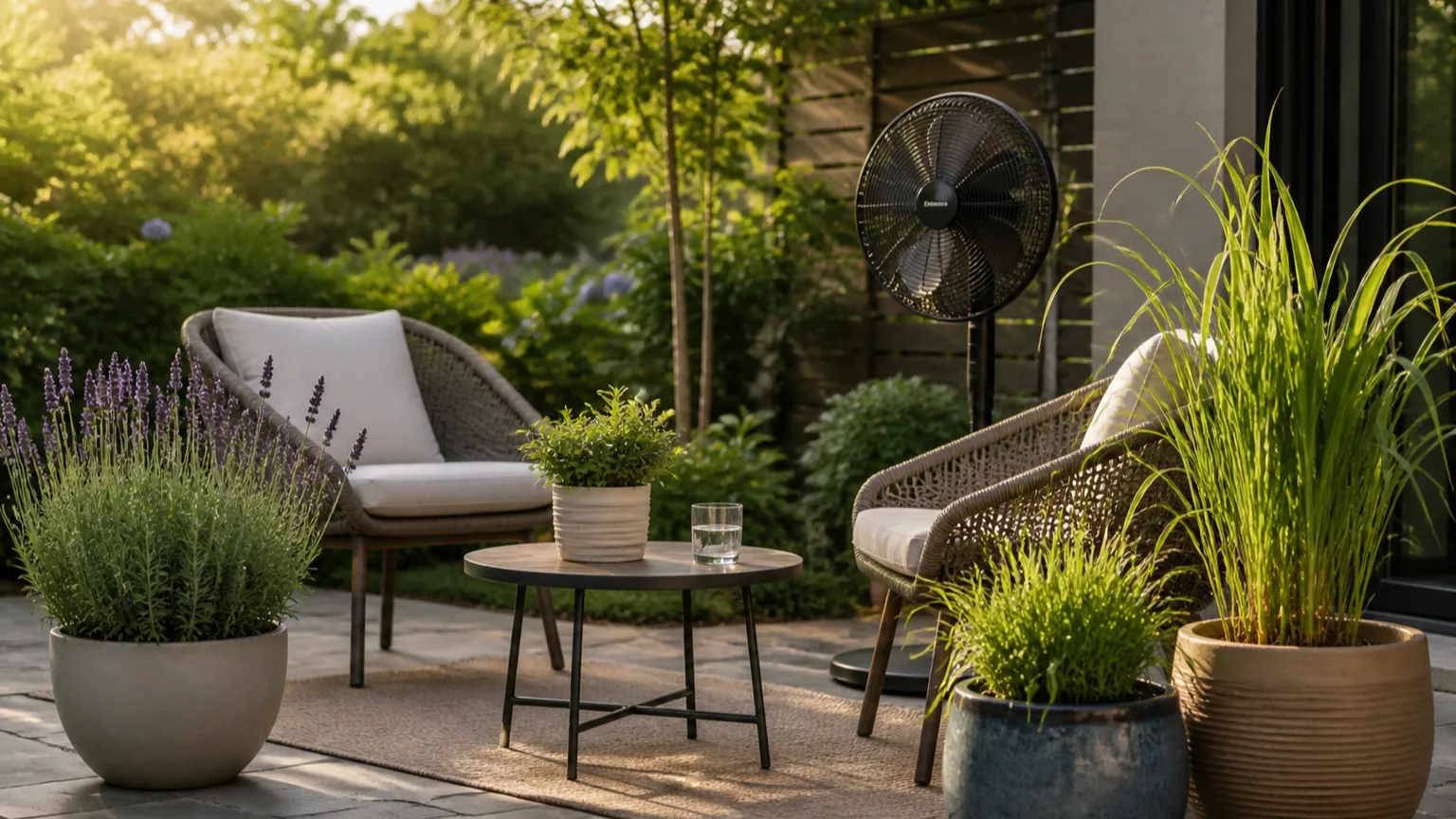
Placement is the part of the mosquito claim that can be made practical. If you want the fragrance close to you, place lavender at the edge of the place you actually use: beside steps, near a sunny patio border, along a walkway, or in a container near a doorway. Do not hide it at the far end of the property and then judge it by whether mosquitoes reach the table.
Think of lavender as a close-range garden feature, not a perimeter treatment. A group of healthy plants will give you more flowers and a stronger local fragrance than a single stressed specimen, but even a mass planting does not provide a measured level of protection around every person in a yard. Gardening Know How similarly recommends using mosquito-associated plants near seating areas and pairing them with other control practices rather than treating them as a complete solution (Gardening Know How).
Containers are useful when your patio, balcony, or rental yard has limited beds. They let you move the plant into its best light and keep the scent where you sit, but the trade-off is faster drying and more frequent checks. A container is also easy to overwater, especially if its decorative outer pot hides a blocked drainage hole.
What to plant beside lavender—and what not to promise
You do not need to assemble a dozen “mosquito plants” to make lavender worthwhile. Basil, rosemary, mint, catnip, marigolds, and citronella grass can all be attractive additions in the right climate and location, but each has its own growing requirements and none should be sold as a guaranteed passive shield. Mint can spread aggressively; catnip can attract cats; citronella grass is often confused with scented geraniums sold under similar names; and tender herbs may be annuals where lavender is perennial.
Choose companion plants for a useful garden outcome first: culinary harvest, flowers, fragrance, pollinator value, drought tolerance, or container performance. If their foliage is aromatic, that is a pleasant bonus. The wrong reason to plant them is the belief that a crowded row of scented plants will make a patio mosquito-proof without removing breeding water or protecting exposed skin.
There is also an important difference between attracting mosquito predators and repelling mosquitoes. Flowering plants can support birds and beneficial insects, and a diverse landscape can improve habitat, but predator activity is not an instant or guaranteed reduction in bites. UF/IFAS experts recommend a balanced, layered landscape approach rather than promising complete elimination (UF/IFAS Extension mosquito guidance).
The mosquito-control layer that matters most: remove breeding water
If mosquitoes are multiplying in your yard, the first question is not “Which plant should I buy?” It is “Where can water sit long enough for eggs and larvae to develop?” Adult mosquitoes can fly in from elsewhere, but removing local breeding sites is still one of the highest-value actions a homeowner can take.
The CDC explains that female Culex mosquitoes lay eggs on fresh or stagnant water. Larvae and pupae remain in water before adults emerge, and small containers around a home—including buckets, planters, toys, birdbaths, and flowerpots—can be used as sites (CDC on Culex mosquitoes). That makes the plant-care details in this article part of mosquito management: an abandoned saucer under a lavender pot can undermine the scented plant beside it.
The standing-water audit for pots, barrels, and birdbaths
Walk the property after rain and inspect every object that can hold water. Turn over what does not need to be outside, empty what can be emptied, and redesign what must stay. Look at the bottom of nursery pots, saucers, toys, tarps, clogged gutters, wheelbarrows, grill covers, and low spots in hardscape—not just the obvious birdbath.
Use this short audit:
- Empty plant saucers after watering or raise pots so water drains away instead of remaining below the pot.
- Refresh birdbaths and pet bowls frequently and scrub the container when buildup develops; do not let a decorative basin become a neglected nursery.
- Screen rain barrels and keep lids fitted so adult mosquitoes cannot reach the stored water.
- Keep water moving in ornamental features with a pump where appropriate, and follow local guidance for any treatment product used in permanent water.
- Ask for local help if a ditch, storm drain, abandoned pool, or neighboring property is creating persistent mosquito pressure you cannot correct yourself.
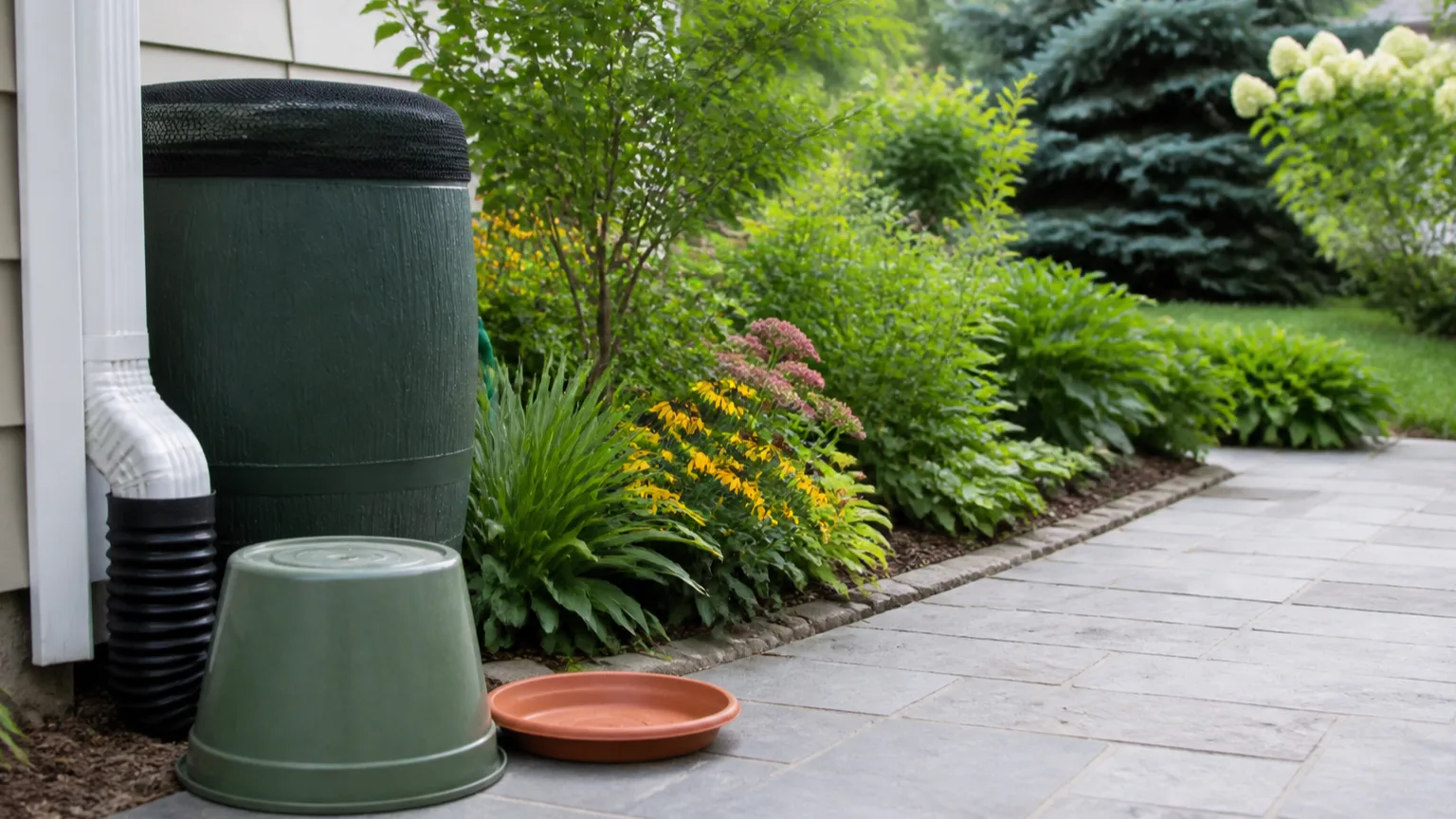
Never add a mosquito-control product to water just because it is labeled “natural,” and never improvise a dose around pets, fish, birds, or a pond. Read the label and local guidance. The goal is to remove or manage the water source first, then use a product only when the water cannot reasonably be drained or covered.
Reduce adult mosquitoes around the places you sit
Removing water interrupts the life cycle, but it does not instantly clear adults that already emerged or flew in from nearby. Adult mosquitoes often rest in cool, dark, humid vegetation during the day. A patio surrounded by dense, untrimmed growth may be pleasant for people and sheltered for insects at the same time.
You do not need to strip the yard bare. Keep the immediate seating zone open enough for air movement, trim vegetation that touches chairs and walls, and avoid creating a permanently damp pocket beside the patio. A healthy, layered landscape can support wildlife while still giving the area where you sit a little breathing room.
Use airflow and manage dense resting cover
A fan can be more useful at a table than another scented pot. Mosquitoes are small, relatively weak fliers, so moving air can make it harder for them to approach and land. Place a fan so it creates a gentle cross-breeze through the seating area without becoming a hazard, and keep cords, water, and outdoor electrical equipment dry and protected.
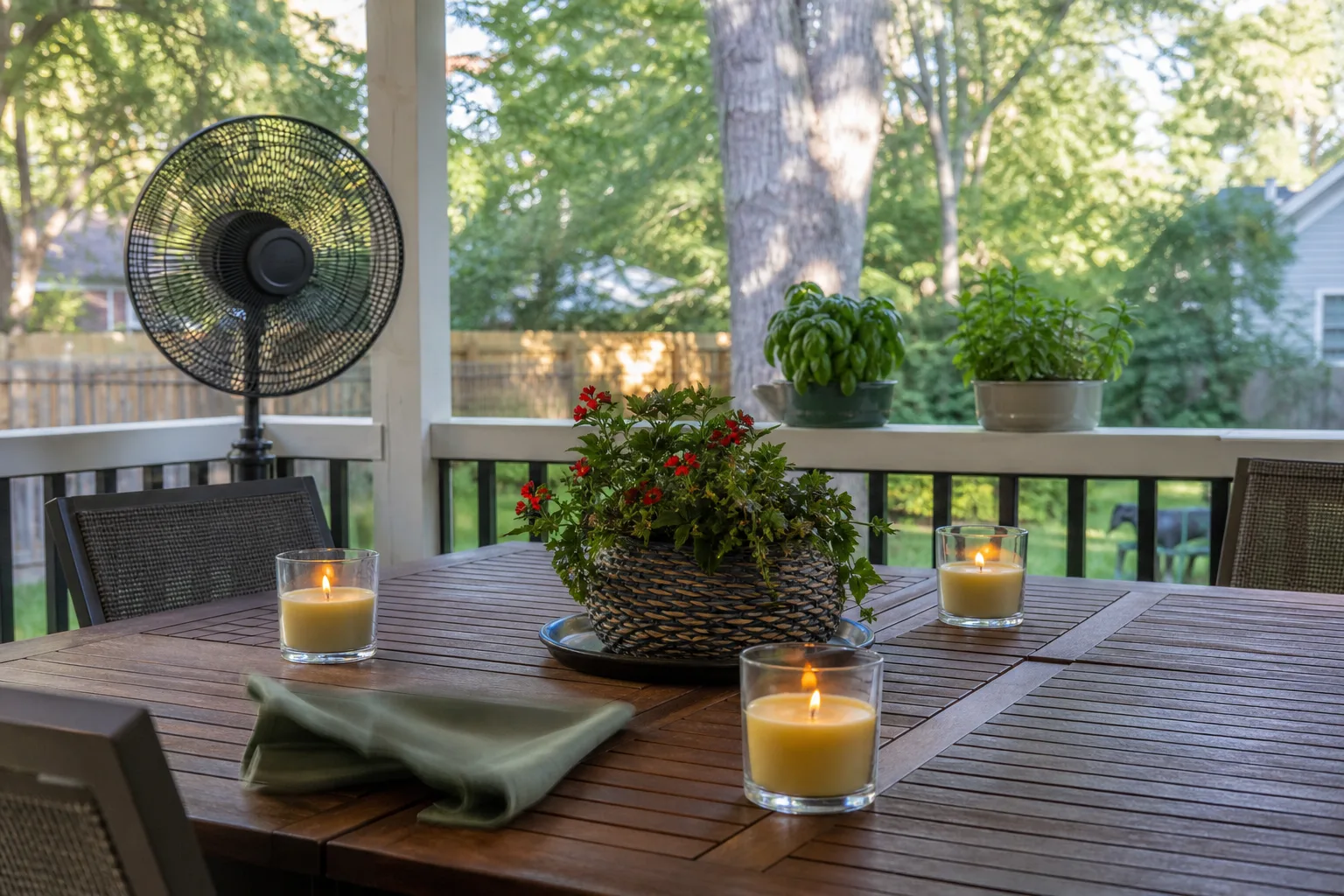
Manage the area around the patio as a comfort zone: mow or trim the immediate edge, remove dense weeds that stay damp, and keep screens and doors in good repair if the patio connects to the house. These steps do not guarantee a mosquito-free yard, but they address adult behavior in the space where bites matter most.
Choose personal protection for evenings outside
When mosquitoes are abundant, health protection should not depend on a plant. Wear loose, long sleeves and pants when practical, and use a repellent formulated for exposed skin or clothing if you need dependable bite reduction. Follow the product label for age limits, application areas, reapplication, and washing it off when you return indoors.
Mississippi State Department of Health lists DEET, picaridin, IR3535, oil of lemon eucalyptus products, and permethrin-treated clothing among established repellent options, with different instructions and age considerations. It specifically distinguishes oil of lemon eucalyptus from untested “lemon eucalyptus oil” and notes that children’s products require extra care. Read the current label and use the product as directed rather than mixing your own essential-oil formula (MSDH repellent recommendations).
Lavender essential oil is not a free pass for skin. Even if a study shows activity at a certain concentration, that does not establish a safe homemade recipe for your skin, a child, a dog, a cat, or a pregnant person. If your exposure is high, if you are traveling in an area with mosquito-borne disease, or if a family member has a reaction, prioritize public-health guidance and a properly labeled product.
Common lavender mosquito mistakes
Mistake 1: Buying one tiny pot and expecting yard-wide coverage. A small container offers a small scent source. Use it as a patio accent, not an invisible boundary.
Mistake 2: Confusing the plant with its oil. The oil is concentrated and may be tested at measured dilutions. A living plant has no standardized release rate. The word “lavender” does not make the two products equivalent.
Mistake 3: Rubbing crushed leaves on skin without checking safety. A brief scent burst is not the same as a tested repellent. Plant sap and essential oils can irritate skin, and homemade applications have no dependable dose or duration.
Mistake 4: Overwatering the plant in the name of summer care. Lavender wants drainage and a dry-down between deep waterings. A constantly wet pot kills roots and may leave a saucer full of water that helps mosquitoes.
Mistake 5: Pruning into old wood. Cutting a woody lavender plant back as if it were a regenerating shrub can leave bare stems that never refill. Trim green growth and replace a plant that is truly old and declining rather than repeatedly cutting harder.
Mistake 6: Treating “natural” as “proven.” Plants, candles, oils, traps, and sprays are different tools. Ask what was tested, against which mosquito, at what concentration, for how long, and on what surface before trusting a claim.
Mistake 7: Ignoring the saucer under the repellent plant. The plant may be dry while the saucer holds enough water for larvae. Empty it as part of every watering routine.
A ten-minute summer routine
Once a week, make mosquito control a quick walk rather than a large project. Start at the patio and work outward. Empty saucers and containers, check the rain barrel screen, look inside the birdbath and any toys or covers, and clear a clogged gutter or low spot that has become obvious.
Next, inspect the lavender. Is it in full sun? Is the soil actually dry enough to need water? Is foliage crowding the chair or rubbing against a damp wall? Deadhead faded spikes and remove only damaged or dead growth. If the plant is in a container, lift it briefly to confirm the drainage hole is open and no hidden cachepot is holding water.
Before an evening outside, put the fan where it will move air across the seating zone, choose clothing that covers more skin, and apply a labeled repellent if conditions require it. This sequence is more dependable than adding another plant because it addresses breeding water, adult access, plant health, and human exposure in that order.
Lavender can then do what it does well: bring color, fragrance, and pollinator-friendly flowers to the edge of the space. That is a meaningful result even when it does not repel every mosquito.
Conclusion: grow lavender, but solve mosquitoes with layers
Lavender is a smart summer plant and a poor standalone mosquito-control system. Its oils may have repellent activity in specific formulations and concentrations, but a living plant does not reliably protect an entire yard or replace personal protection.
Give lavender full sun, quick drainage, restrained watering, and careful pruning. Place it near the patio or path for the fragrance you want to enjoy, then remove standing water, manage dense resting cover, add airflow, and use a labeled repellent when bite prevention matters. Grow lavender for the garden—and use a layered plan for the mosquitoes.



