20 Evergreen Shrubs for Shade: Best Picks by Site
Compare 20 evergreen shrubs for shade, from azaleas and camellias to yew and aucuba, with site-fit notes for soil, size, and first-year care.
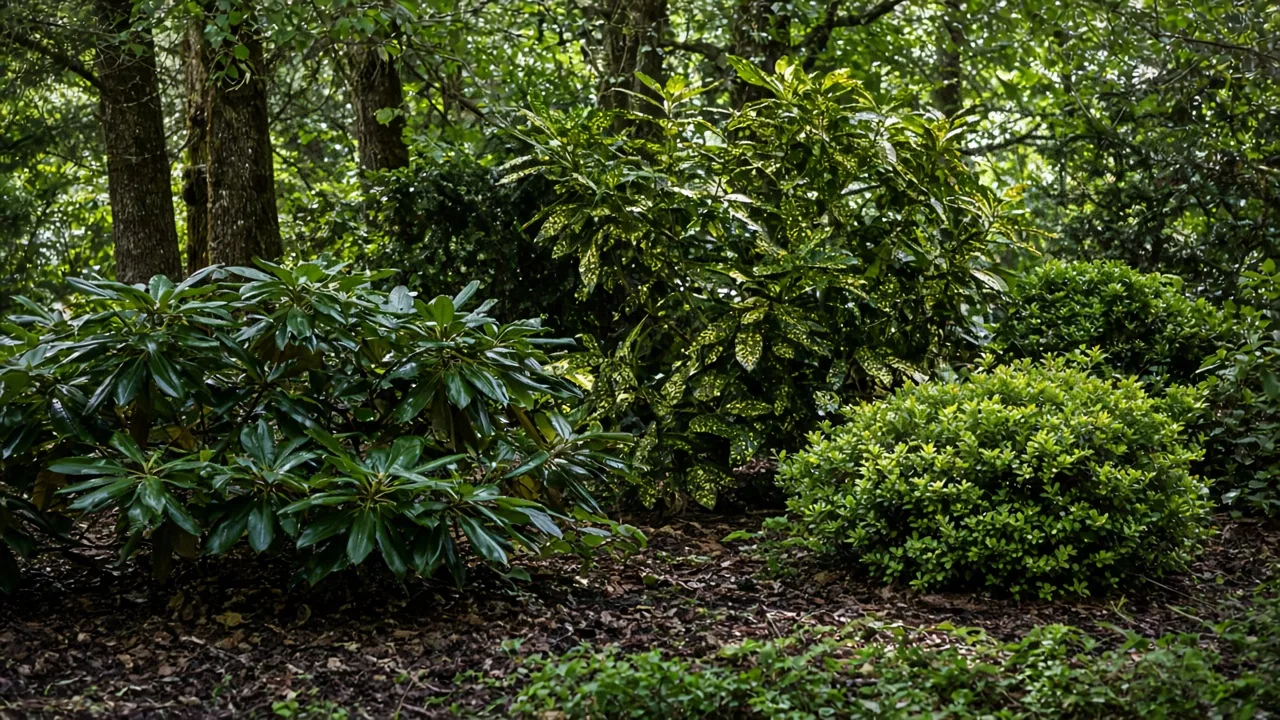
If a garden bed is shaded for most of the day, an evergreen shrub can provide the structure that flowers cannot. The best choices keep their leaves through winter, tolerate the actual light available, and fit the soil and mature footprint instead of merely surviving for one season.
The important distinction is between deep shade, dappled shade, and bright partial shade. A shrub that looks excellent with two hours of morning sun may become thin in the shadow of an evergreen tree. A shrub that tolerates dry roots beneath a mature oak may struggle in a cool, wet corner beside a downspout. Use the site notes below to match the plant to the problem.
What makes a shrub truly good for shade?
Evergreen shrubs fall into two broad groups: broadleaf evergreens, such as aucuba, camellia, and holly, and needled evergreens, such as yew and plum yew. Broadleaf plants often contribute flowers, berries, or colorful leaves, while conifers bring dependable shape and texture. Neither group is automatically low-maintenance; evergreen foliage still loses water in winter and can scorch when roots are dry.
Shade tolerance also comes with trade-offs. Flowering shrubs usually need more light than foliage-first shrubs to set abundant buds. A shrub can be happy in shade and still need acidic soil, steady moisture, shelter from wind, or a pollinating partner. The RHS shade-shrub guidance separates deeper shade from partial or dappled shade for exactly this reason, and notes that final size varies with location and soil.
Read the light and moisture together
Start by watching the planting spot on a clear day. Deep shade means less than about two hours of direct sun; dappled shade shifts between sun and shadow beneath a tree canopy; partial shade commonly receives roughly two to six hours, often in the gentler morning. A north-facing wall, the shadow of a building, and the dry interior of a tree canopy may all look dark but create different growing conditions.
Then check the soil with your hand after a normal rain. If it is cool and crumbly, you have a useful woodland-style site. If the surface is dry and roots are visible, you have dry shade. If water stands after rain, choose a moisture-tolerant shrub and improve drainage before planting; do not treat shade as permission to keep roots waterlogged. The Missouri Botanical Garden’s dry-shade guide makes the same essential point: very few plants prefer dry shade, and even tolerant plants need water during extended drought.
Quick picks by garden job
Use this short list to narrow the field before reading the full profiles. The heights are broad species or cultivar ranges, not guarantees; confirm the label for the exact plant in your region.
| If you need… | Start with… | Watch for… |
|---|---|---|
| The deepest shade | Japanese aucuba, yew, sweet box, plum yew | Drainage, winter wind, and low flowering in very dark sites |
| Spring or winter flowers | Camellia, evergreen azalea, rhododendron, mountain laurel, skimmia, pieris | Acidic soil and enough filtered light to form buds |
| A clipped hedge | Yew, Japanese holly, boxwood, inkberry | Mature width, airflow, and whether the cultivar tolerates local heat |
| Dry shade beneath trees | Yew, boxwood, aucuba, Japanese holly, plum yew | Supplemental water during drought; never build soil over tree roots |
| Berries or wildlife value | Inkberry, Oregon grape holly, Japanese aucuba, holly, skimmia | Male/female pollination and household or pet safety |
| A small border plant | Sweet box, skimmia, dwarf plum yew, compact pieris | Slow growth and the temptation to overplant |
| A warm-climate screen | Podocarpus, aucuba, Osmanthus | Heat, humidity, and drainage; cold limits vary sharply |
The 20 evergreen shrubs for shade
These are arranged by the job they can do in a shade garden, not by a universal ranking. Within each profile, the limitation is as important as the attraction.
Flowering shrubs for filtered light
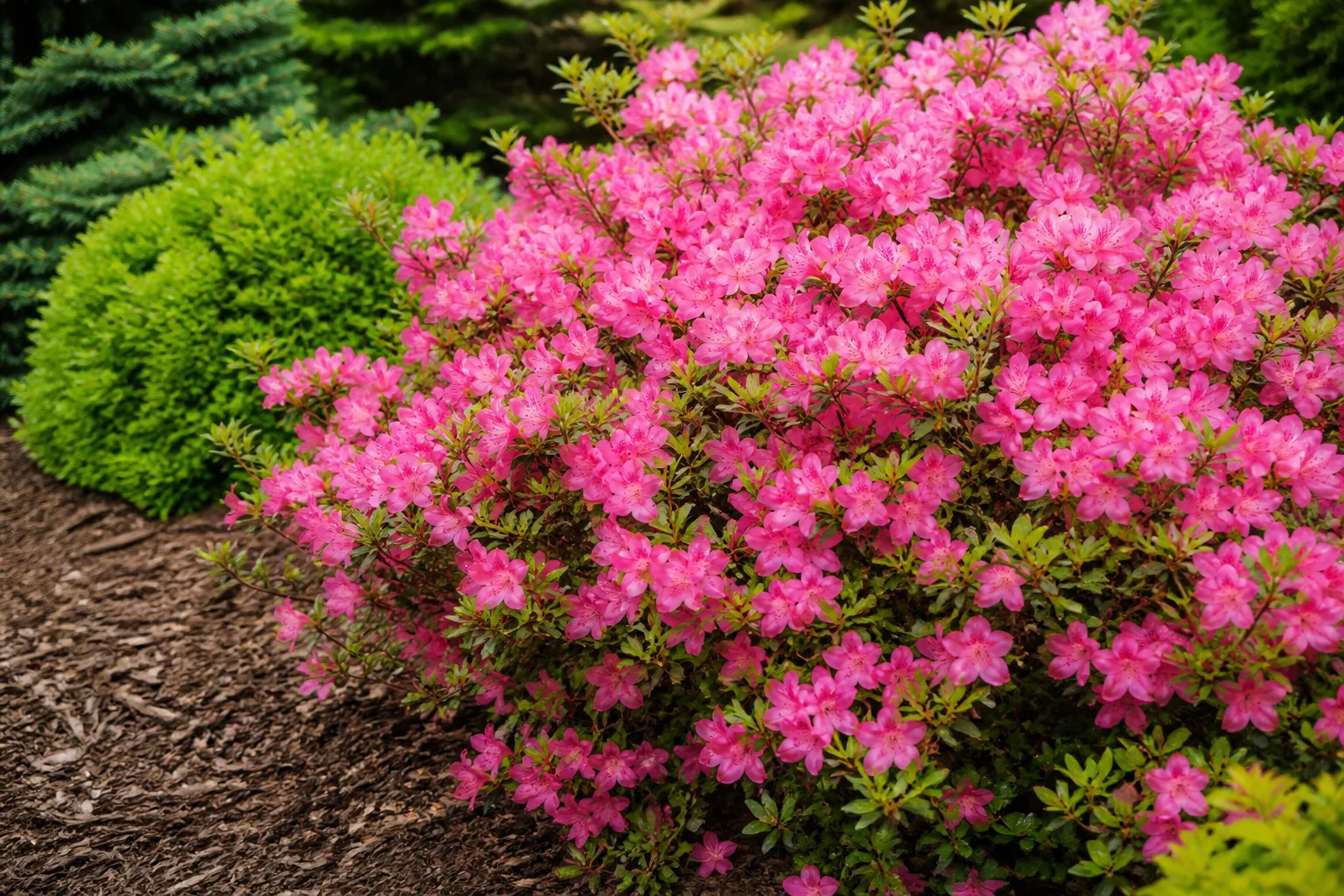
1. Evergreen azalea (Rhododendron hybrids) — Evergreen azaleas are compact flowering shrubs for the bright edge of a woodland garden. Depending on the group and cultivar, they commonly mature from about 2 to 6 feet tall and flower in spring in white, pink, red, purple, or orange. Give them acidic, organic soil that drains freely, morning light or dappled shade, and a mulch layer that protects shallow roots. Deep, dry shade produces foliage but often disappointing bloom, so place an azalea where it receives some sky light or early sun.
2. Camellia (Camellia japonica, C. sasanqua, and hybrids) — Camellias bring glossy leaves and rose-like flowers to a season when many gardens are quiet. Japonica types are usually larger and flower from late winter into spring; sasanqua types are often more open, fragrant, and earlier. They prefer partial shade, acidic soil, even moisture, and protection from drying winter wind. Too much shade reduces flowers, while hot afternoon sun can scorch leaves or make flowers open quickly. The RHS list of shade shrubs includes camellia cultivars for deeper shade when soil and moisture are right.
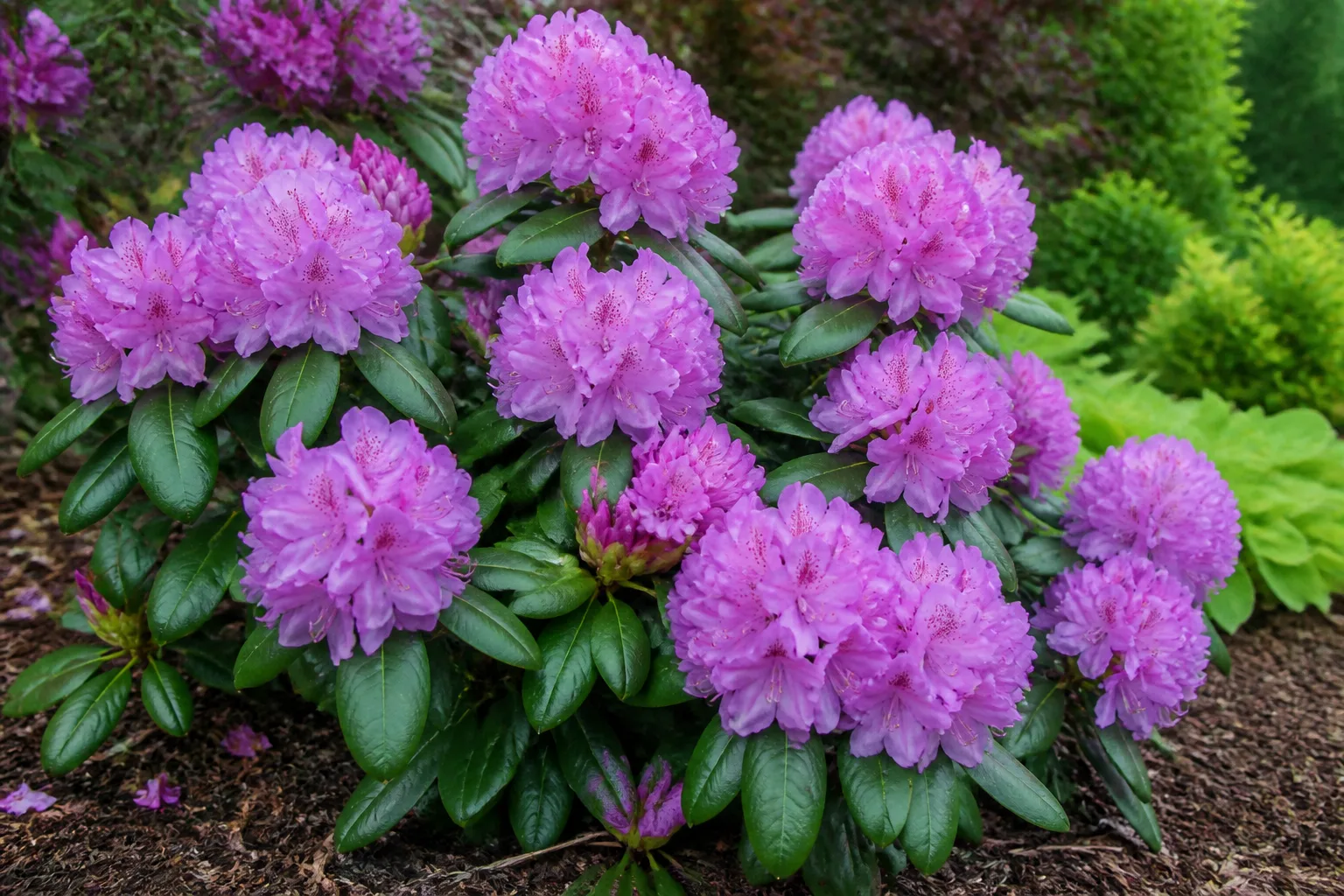
3. Rhododendron (Rhododendron spp.) — Evergreen rhododendrons make a strong background or specimen in cool, filtered light, with large flower trusses in spring or early summer. Their mature size ranges from low yakushimanum hybrids to shrubs several feet tall, so the cultivar matters more than the generic plant name. Plant into acidic, well-drained soil rich in organic matter, keep the root zone evenly moist, and avoid a hot west-facing wall. Rhododendrons dislike both drought and standing water; a thick canopy overhead can create the first problem even when the bed looks shaded and protected.
4. Mountain laurel (Kalmia latifolia) — This eastern North American native offers leathery evergreen leaves and unusual folded flowers in late spring. It is a good choice for a naturalistic, dappled-shade border where the soil is acidic and moisture is moderate but drainage remains good. Plants can become broad, multi-stemmed shrubs roughly 5 to 15 feet tall, although compact cultivars are available. Mountain laurel is not the best answer for a tiny foundation bed or alkaline clay. Site it where it can keep its informal shape, and use the RHS mountain-laurel profile to compare cultivar size.
5. Japanese skimmia (Skimmia japonica) — Skimmia is a compact, glossy-leaved shrub for cool, sheltered shade. Fragrant flowers appear in spring, and female plants may carry red berries into winter when a compatible male is close enough to pollinate them. It grows best in acidic, moisture-retentive but well-drained soil and usually reaches about 3 to 5 feet tall and wide. It is a particularly good choice for a courtyard, entry bed, or container in a mild climate, but hot, dry exposure and alkaline soil can lead to weak growth.
6. Sweet box (Sarcococca confusa or S. hookeriana var. humilis) — Sweet box earns its place through fragrance rather than showy size. Tiny white flowers open in late winter or early spring, often when you notice their scent before you see them, and the dense dark foliage stays attractive afterward. Compact S. hookeriana var. humilis stays close to 2 feet, while S. confusa can become a larger screen. Choose a sheltered, moist, well-drained spot in partial or deep shade, and do not bury the crown under mulch. The RHS includes compact sweet box among its shade and hedge recommendations.
7. Japanese andromeda or pieris (Pieris japonica and related cultivars) — Pieris combines evergreen leaves, colorful red or bronze new growth, and hanging white flower clusters. Compact cultivars can suit the front of a shade border, while larger forms become rounded foundation shrubs. It prefers acidic, evenly moist soil and dappled light, with shelter from harsh winter wind. Pieris is a better fit for a cool woodland edge than for reflected heat beside paving. Use the cultivar’s mature dimensions; some forms remain around 2 feet, while others can become several feet tall.
Foliage and berry shrubs for deeper shade
8. Japanese aucuba or spotted laurel (Aucuba japonica) — Aucuba is one of the most dependable broadleaf evergreens for deep shade. Its thick leaves tolerate low light, and variegated forms add gold flecks where flowers would struggle. NC State’s plant profile describes partial to deep shade as its best setting, with good drainage and soil that may be moist, occasionally dry, or occasionally wet. Most plants reach about 6 to 10 feet tall and 4 to 6 feet wide, but pruning can control them. Protect the foliage from strong wind, which can cause winter burn.
9. Japanese holly (Ilex crenata) — With small glossy leaves and dense branching, Japanese holly is a useful formal hedge or topiary shrub in cool or moderate climates. Many cultivars stay around 3 to 4 feet, while the species can reach 5 to 10 feet. It tolerates partial shade and some drought after establishment, but it prefers acidic, well-drained soil and may struggle in regions with extreme heat and humidity. NC State notes that the species is dioecious: a female plant needs a compatible male to set its small black fruits. For a hedge, choose a cultivar for mature width rather than shearing a naturally oversized plant into a narrow wall.
10. Inkberry holly (Ilex glabra) — Inkberry is a native broadleaf evergreen with rounded dark leaves and black fruit on female plants. It is strongest in moist, acidic soil and can take full sun to partial shade; in the hottest climates, afternoon shade is helpful. Compact selections such as ‘Densa’ make tidy foundation or hedge plants, while older plants may become open at the base. This is a better choice than many nonnative hollies for a moist eastern North American site, but it is not a drought-proof plant. Water new plants deeply and give them room for their natural spread instead of forcing a tight hedge immediately.
11. Yew (Taxus x media and other landscape yews) — Yew is the most adaptable option here for shade, pruning, and dry soil, provided drainage is excellent. Cultivars range from low spreaders to upright hedge plants, commonly about 2 to 20 feet tall. NC State’s Taxus x media profile notes its shade-garden use, drought tolerance, pruning tolerance, and intolerance of wet conditions. The serious limitation is safety: yews have high-severity poisonous characteristics, and the foliage and seeds are dangerous if eaten. Keep yew away from livestock, children, and pets that chew plants, and do not use dropped clippings in animal-accessible areas.
12. Oregon grape holly (Mahonia aquifolium and related species) — Oregon grape holly provides spiny, holly-like foliage, yellow spring flowers, and blue-purple berries. It is most useful in dappled or partial shade with well-drained soil and enough moisture to establish. Depending on the species, plants can range from a low, spreading groundcover to a shrub several feet tall. The leaves are prickly, so site it away from a narrow walkway or a place where children brush past. Berries can support wildlife, but check your state or regional plant list before planting any mahonia that is known to spread aggressively.
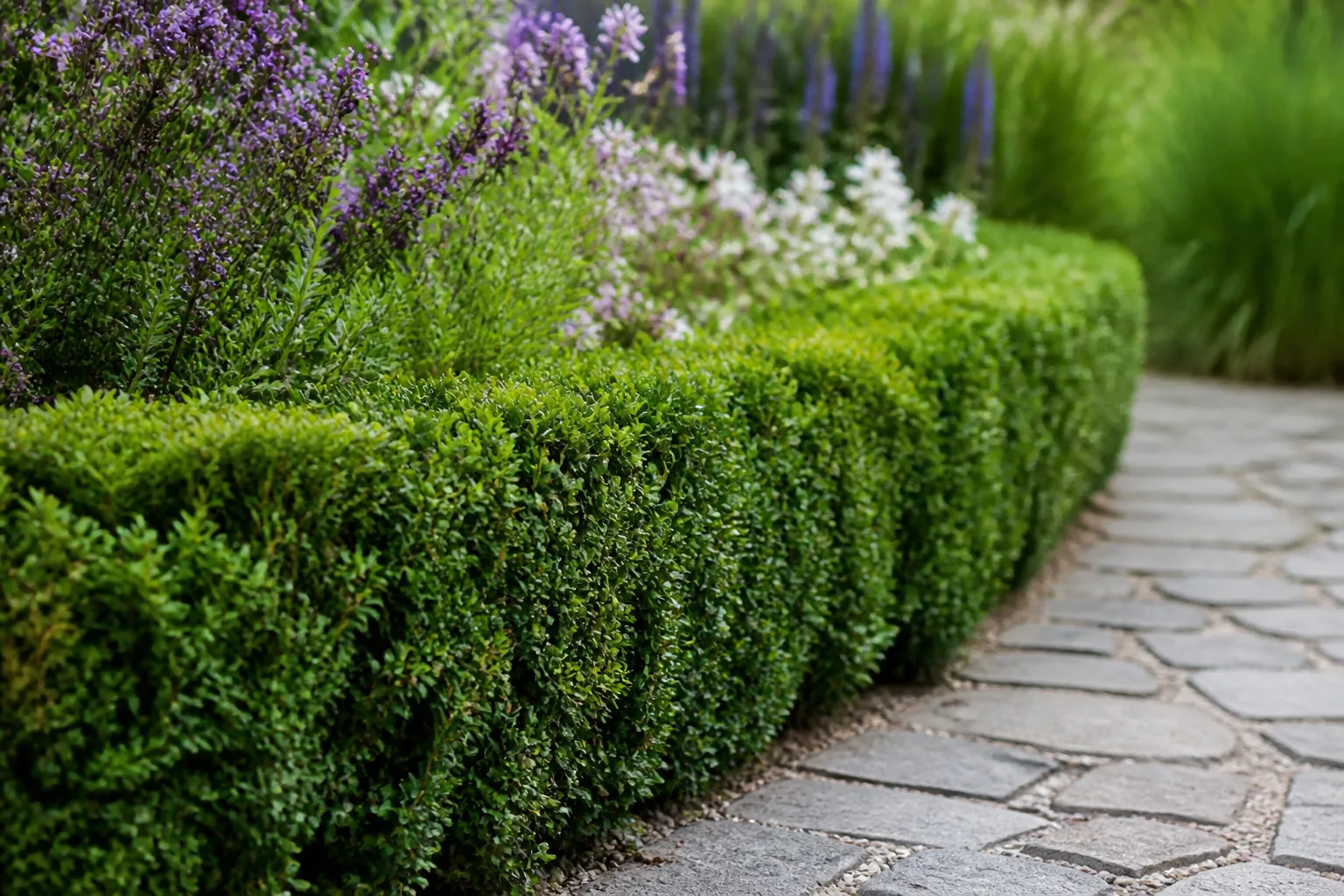
13. Boxwood (Buxus spp. and cultivars) — Boxwood remains valuable in shade because its small leaves, dense habit, and pruning tolerance create structure even without flowers. Korean and other compact types can be used as rounded edging or a low hedge; larger kinds make foundation shrubs. Missouri Botanical Garden lists boxwoods among plants that tolerate dry shade, while still warning that average moisture is better than prolonged drought. Its guidance also reinforces the drainage rule: dry-shade plants can still develop root problems in waterlogged soil. Avoid sites with poor airflow if boxwood blight is a known local concern.
14. Dog hobble or coast leucothoe (Leucothoe axillaris and related species) — Leucothoe has arching stems, glossy leaves, and small bell-shaped flowers. Many forms bronze, burgundy, or purple in colder weather, giving a shade bed more than one season of interest. It prefers acidic, moist, well-drained soil and is a good companion for rhododendrons, azaleas, and pieris. Allow about 4 to 6 feet of width for the species, or choose a compact cultivar for a smaller bed. It is less forgiving of dry, reflected heat than aucuba or yew, so do not mistake its evergreen foliage for drought tolerance.
15. Holly osmanthus (Osmanthus heterophyllus) — Holly osmanthus has glossy leaves that can look spiny when young and soften as the plant matures, plus small fragrant flowers in autumn. It makes a dense screen or specimen in partial to deep shade in mild climates, usually growing several feet tall and wide. Variegated forms brighten dark corners but can be slower and less vigorous than green-leaved plants. The RHS includes Osmanthus heterophyllus among shrubs for deeper shade. Give it a protected position and check its hardiness before planting in a cold or exposed garden.
Hedges, screens, and formal shapes
The best hedge shrub is not the fastest one. A plant that reaches its mature width slowly, branches from the base, and responds to light pruning will look better than a quick-growing shrub that becomes bare inside. Yew is usually the most flexible for a tall, shaped screen; Japanese holly and boxwood suit lower formal lines; inkberry is the strongest native-style option for a moist site.
Measure the planting line before buying. If a shrub will mature 6 feet wide, spacing centers 3 feet apart may create a fast hedge, but it also increases competition and airflow problems. A slower, healthier plan may space plants at 4 to 5 feet, mulch the gap, and let the canopy close over several seasons.
Low-growing and cold-climate conifers
16. Dwarf plum yew (Cephalotaxus harringtonia cultivars) — Plum yew is a useful substitute when you want the texture of a conifer but have too little sun for many pines. It has soft, flat needles, a naturally spreading form, and a slow growth rate. Cultivars range from roughly 2 to 5 feet tall, with prostrate selections spreading wider. Give it partial to deep shade, well-drained soil, and protection from harsh winter wind. It is a patient plant; do not plant several inches apart simply because the nursery pots look small.
17. Dwarf mugo pine (Pinus mugo cultivars) — Dwarf mugo pine belongs on a shade list only for bright shade or partial shade, not for the dark center of a tree canopy. It forms a compact mound of dense needles, usually 2 to 5 feet tall and wide, and prefers cool, sharply drained soil. In warm climates or wet clay it can decline quickly. Use it on the sunny side of a shade bed, beside a path, or beneath a deciduous tree where enough light reaches the ground. If the site receives no direct or reflected light, choose plum yew instead.
Warm-climate and regional options
18. Yew pine or podocarpus (Podocarpus macrophyllus) — Podocarpus is a southern option with narrow evergreen leaves, a clean upright habit, and good tolerance for pruning. NC State’s profile describes it as a shrub that prefers rich, slightly acidic, moist but well-drained soil in full sun to partial shade and tolerates shade without tolerating wet soil. In warm zones it can form a hedge or screen; in colder regions, grow it as a container plant you can protect. Watch for yellowing in alkaline soil and scale on stressed plants.
Conditional picks that need a location check
19. Heavenly bamboo or nandina (Nandina domestica cultivars) — Nandina has fine-textured foliage and seasonal red tones, but it is not a carefree recommendation everywhere. NC State identifies the species as invasive in North Carolina and records high-severity poison characteristics; its profile notes that leaves and berries can be toxic to people, pets, livestock, and birds. If your local authority permits it and you still choose one, select a documented non-fruiting cultivar such as ‘Fire Power’ or ‘Gulf Stream’, understand that sterile does not make foliage edible, and remove seedlings promptly. A native holly or inkberry is usually the more responsible starting point.
20. Wintercreeper (Euonymus fortunei cultivars) — Wintercreeper can provide evergreen groundcover or a small shrub in partial shade, with variegated leaves that brighten a dark edge. It also can climb, root where stems touch moist soil, escape into woods, and become difficult to control. NC State’s extension profile lists it as invasive in North Carolina and other states and warns that climbing forms can dominate trees. Treat it as a conditional plant only after checking your local invasive-species list; choose a non-spreading native groundcover when the planting borders natural areas.
How to choose the right shrub for your site
The winning shrub is the one that matches the site you have, not the one with the most dramatic photograph. Narrow the list in this order: light, moisture, soil pH, mature size, hardiness, and household constraints. If a plant fails one of the first three, a prettier cultivar will not rescue it.
Use mature size, not nursery size
Write down the bed’s length and depth, then measure from walls, windows, paths, fences, and tree trunks. Look for the shrub’s mature height and spread, not the dimensions on the pot. A 2-foot yew may become a 10-foot hedge; a compact skimmia may stay small but can still suffer if packed between larger roots.
For a mixed border, put the tallest shrubs toward the back or at the outside edge, then repeat a few reliable shapes rather than planting one of everything. Three aucubas or inkberries usually create more visual weight and easier irrigation than ten unrelated single specimens. Use flowers as seasonal punctuation and evergreen foliage as the framework.
Check soil pH, drainage, and root competition
Azalea, camellia, rhododendron, pieris, mountain laurel, skimmia, and leucothoe generally prefer acidic soil. Test before planting if you see pale new leaves, mossy ground, or a history of rhododendrons failing. Do not pour amendments into a small hole and assume the problem is solved; a sharply different pocket can hold water around the root ball or discourage roots from moving into the surrounding soil.
Under mature trees, the shade is only half the challenge. Tree roots compete for water and nutrients, while the canopy can intercept rainfall before it reaches the bed. Epic Gardening’s discussion of planting beneath trees explains this competition and also warns against piling a raised bed over surface roots. Dig gently between major roots, choose smaller shrubs when possible, and water new plants at the root zone rather than wetting the surrounding mulch.
Planting and first-year care
Plant in a cool season when the ground is workable, avoiding periods of extreme heat, drought, or frozen soil. Dig a hole about twice the root ball’s width but no deeper than the root ball, loosen circling roots, and set the shrub with the top of the root ball level with or slightly above the surrounding soil. A root flare buried under soil or mulch is a slow failure that can look like “the shrub does not like shade.”
Backfill with the soil you removed unless a soil test shows a specific need. Water slowly until the root zone is saturated, then add 2 to 3 inches of organic mulch over the surrounding soil. Keep mulch a few inches away from stems and trunks. Do not fertilize a newly planted shrub heavily; roots need contact and consistent moisture before they need a growth push.
Watering and mulching under trees
For the first growing season, check new shrubs twice a week during dry weather and water deeply when the upper few inches begin to dry. Sandy soil, hot wind, a root-filled tree bed, and a small root ball may require more frequent checks. Once established, drought-tolerant choices such as yew and boxwood need less irrigation, but no evergreen should be expected to survive a long drought without water.
Keep the mulch porous and level rather than building a volcano around the stems. A light layer of leaf mold or compost can improve a woodland bed, but never raise the soil grade around an existing tree. Remove dead branches with clean pruners, and prune only to correct crossing, damaged, or badly placed growth until you know the shrub’s flowering cycle. Hard shearing can remove next year’s buds on camellia, azalea, rhododendron, daphne relatives, and other spring-flowering plants.
Common mistakes to avoid
Calling all shade “full shade.” A bed with two hours of morning sun is not the same as a dark corner beneath a dense evergreen. Put flowering shrubs in the brighter site and foliage-first shrubs in the darker one.
Choosing by leaf color alone. Gold or variegated foliage can brighten shade, but it often needs more light to hold its best color. If a variegated aucuba or euonymus fades, move the decision toward light and exposure rather than adding fertilizer.
Planting an acid-lover in alkaline soil. Pale leaves, weak growth, and few flowers can be a pH problem, not a watering problem. Test the soil before changing it and choose a naturally compatible shrub if correction would be extensive.
Overwatering a “shade plant.” Shade slows evaporation, and heavy clay can remain wet for days. Yew, podocarpus, boxwood, and many broadleaf evergreens decline when drainage is poor, even if the surface looks dry.
Ignoring pollination. Female Japanese hollies, inkberries, aucubas, and skimmia may need a compatible male plant for fruit. If berries are the reason you are buying the shrub, confirm the sex, cultivar compatibility, and flowering overlap before planting.
Forcing a shrub into a narrow space. Repeated shearing hides a size mismatch until the plant becomes thin inside or blocks a path. Choose a naturally compact cultivar and leave enough space for airflow around the mature canopy.
Assuming “wildlife friendly” means safe for pets. Berries can feed birds and still be poisonous to dogs, cats, horses, or people. Yew and nandina deserve particular caution; keep children and animals away from plant material and ask a veterinarian or poison-control service for urgent ingestion advice.
Planting conditional spreaders without checking locally. Nandina and wintercreeper are not identical risks in every region, but local lists and natural-area proximity matter. If a shrub can escape, substitute a well-behaved native or a clumping plant before you dig.
Conclusion
The best evergreen shrubs for shade are the ones that solve a specific site problem. Choose aucuba, sweet box, yew, or plum yew for darker areas; azalea, camellia, rhododendron, mountain laurel, skimmia, or pieris for flowers in filtered light; and Japanese holly, inkberry, boxwood, or yew for structure and hedges. In warm regions, podocarpus and Osmanthus extend the list, while dwarf mugo pine belongs only in bright, cool shade.
Before buying, measure the light, feel the soil, check pH and drainage, and look up the mature dimensions of the exact cultivar. Water new plants through their first dry season, mulch without covering stems or tree roots, and treat yew, nandina, and wintercreeper as plants with meaningful safety or regional limitations. A shade garden becomes easier when every shrub has a job and the site—not the nursery tag—makes the final decision.



