How to Grow and Care for Red-Flowering Currant
Grow red-flowering currant with the right light, drainage, first-year watering, pruning window, and cultivar spacing for reliable spring flowers.
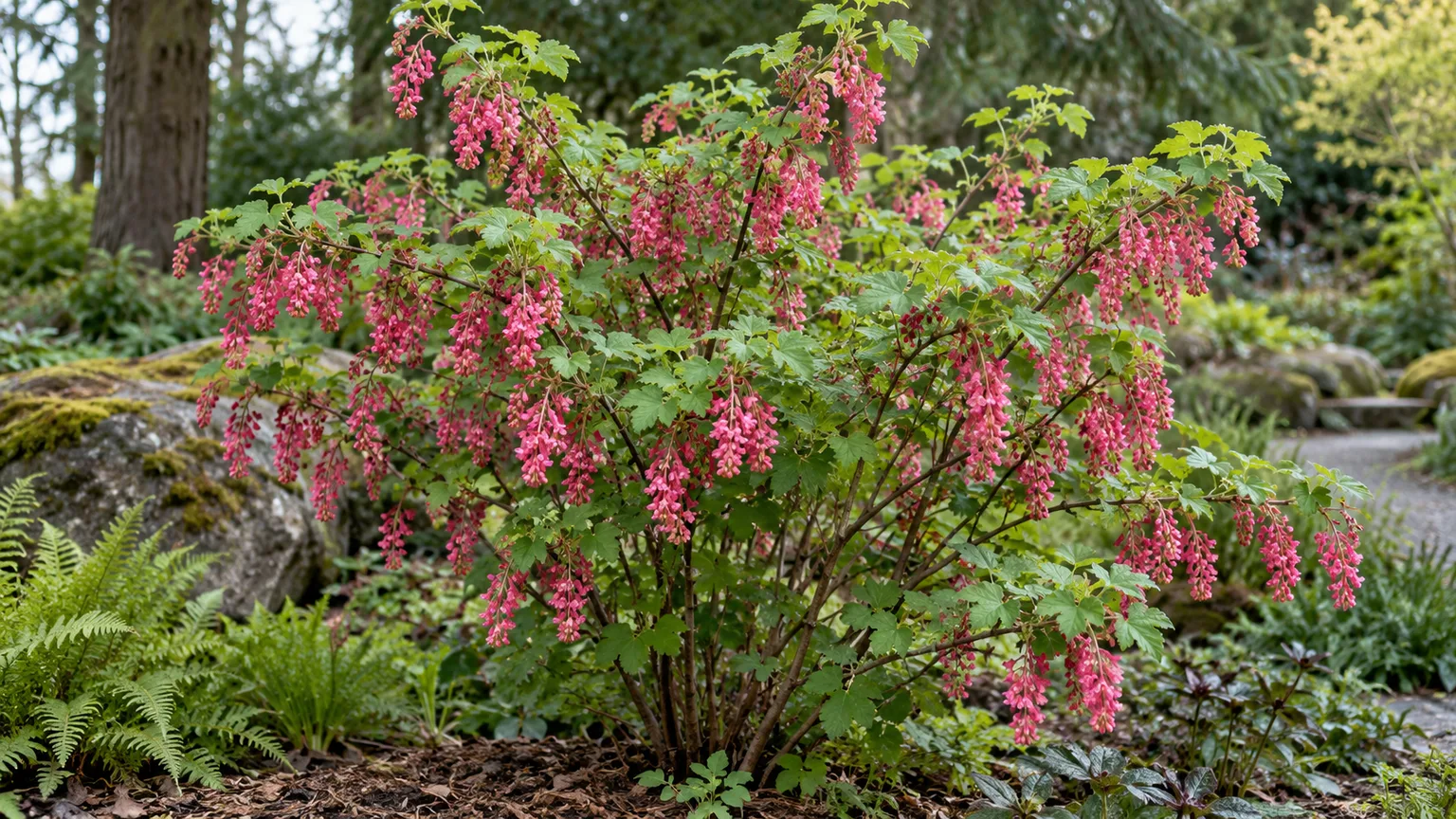
Red-flowering currant is a deciduous, multi-stemmed shrub native to western North America, valued for pendulous spring flower clusters and the birds and pollinators that visit it. The best care plan is simple but seasonal: plant it in sun or light shade where water drains away, help new roots through their first dry summer, and prune only after flowering if you want next year’s display. Mature plants need little routine feeding or irrigation, but a wet site, an ill-timed haircut, or an unexpectedly large cultivar can undo that easy-care reputation.
Red-flowering currant at a glance
| Feature | What to expect |
|---|---|
| Botanical name | Ribes sanguineum |
| Form | Deciduous, upright-to-arching, multi-stemmed shrub |
| Typical size | Often about 8–10 feet tall; width and final size vary by cultivar and conditions |
| Flowers | Red, pink, or white tubular flowers in hanging clusters in early spring |
| Light | Full sun to light shade; fuller sun usually means more flowers |
| Soil | Adaptable if it drains well; avoid soil that remains saturated |
| Water | Regular checks while establishing; drought tolerant after roots settle |
| Main pruning window | Immediately after flowering |
The species produces rounded, shallowly lobed leaves and clusters of small flowers that hang along the stems; the flower color ranges from rich red through pink to white. Oregon State University describes the shrub as a deciduous plant usually 8 to 10 feet tall, with clusters of 10 to 30 flowers and small blue-black berries. Those dimensions are a planning range, not a promise: cultivars, exposure, summer moisture, and pruning history change the final shape. Oregon State University’s Landscape Plants profile is useful for checking the mature dimensions of named Pacific Northwest selections before you buy.
The name can cause confusion at the nursery. Red-flowering currant is grown primarily for flowers, while familiar red currants grown for eating are different species with conspicuous red fruit clusters. Ribes sanguineum develops blue-black berries after flowering, and the plant’s own value is its spring show, wildlife use, and broad landscape form rather than a dependable harvest.
Decide whether this shrub fits your climate and space
This shrub is a strong candidate for a Pacific Northwest native planting, woodland edge, informal screen, or mixed border that needs color early in the season. It is native from British Columbia south toward northern California, with populations extending inland in parts of its range; it is not a universal “North American native” for every U.S. region. In a garden it can provide a useful early nectar source and later berries, but it also becomes a substantial shrub, so it is not a tidy foundation plant for every small bed.
Think first about the whole year, not just the flowering week. Red-flowering currant is deciduous, and its foliage has a noticeable scent when crushed; some gardeners enjoy the aromatic leaves, while others prefer to site the shrub away from a frequently brushed walkway. Bare winter stems and peeling mature bark still give it seasonal structure, but the shrub is not evergreen privacy screening.
Choose a cultivar by mature size and flower color
If space is tight, choose by the cultivar’s listed height and width, not by the size of the plant in its nursery pot. Oregon State lists ‘King Edward VII’ at roughly 7 by 7 feet, ‘Pokey’s Pink’ at about 6 to 8 feet tall and 6 feet wide, ‘White Icicle’ at approximately 6 to 8 feet tall and wide, and ‘Elk River Red’ at 8 to 10 feet tall and around 7 feet wide. ‘Pulborough Scarlet’ can be as large as 10 feet in both directions. Labels and local nursery stock may describe slightly different figures, so allow for the larger dimension when there is a wall, path, window, or neighboring plant nearby.
Flower color is only one distinction. ‘White Icicle’ is a white-flowered form; ‘Pokey’s Pink’ is a light-pink selection; and ‘Elk River Red’ carries red flowers. ‘Brocklebankii’ is known for yellow foliage and is often sold as a more compact selection, though its exact size depends on growing conditions. If a cultivar name is important to your design, buy a named nursery plant: a seedling may not reproduce the parent’s flower color or habit exactly.
For a loose screen, estimate spacing from the expected mature width and leave enough room to reach the shrub for pruning. If you want neighboring shrubs to knit together, modest overlap is possible, but crowding the stems tightly makes it harder to remove old wood and can reduce air movement. A single specimen can be allowed to arch naturally; do not plant multiple shrubs close together and then rely on annual shearing to keep them small.
Understand native, naturalized, and restricted status
“Native” and “invasive” depend on location. Red-flowering currant is native in the Pacific Northwest, but New Zealand’s official weed database currently lists Ribes sanguineum as an environmental weed. It can self-seed where conditions suit it, so remove unwanted seedlings and check local guidance if you live outside its native range. New Zealand’s weed record provides a country-specific example; it does not mean the shrub is invasive everywhere.
There is a separate disease-regulation issue. Currants and gooseberries (Ribes species) can serve as alternate hosts in the white pine blister rust life cycle, a disease affecting five-needled pines. Some jurisdictions restrict planting or seed production: for example, North Carolina Extension’s plant profile states that Ribes are prohibited there. Check with your state or regional agriculture department or extension service before buying a currant if you are in a region with white-pine blister-rust rules. The U.S. Forest Service review of the rust’s host cycle explains why the issue is regional, while North Carolina State Extension documents that state’s current prohibition.
Choose a site and plant for drainage first
Red-flowering currant tolerates a range of soil textures, including rocky ground, as long as excess water can drain from the root zone. It is a poor match for a low spot that stays puddled, a compacted clay pocket, or a downspout outlet. The University of Washington’s plant data sheet describes the species in dry to somewhat moist sites and specifically notes that it is intolerant of saturated soil. A rain garden’s upper edge or a slope can work; the soggy basin at the bottom is a different environment.
Before planting, watch the site after a soaking rain. If water remains standing or the soil stays glossy and sticky long after nearby ground has drained, move the shrub, improve drainage across a broad bed, or select another plant. Do not try to solve a wet planting hole by mixing in a small amount of sand or compost; that can leave the root ball sitting in a bowl that drains no better than before.
Balance sun, heat, and flowering
Full sun generally produces the heaviest bloom. Light shade is acceptable, particularly where the shrub would otherwise face severe afternoon heat, but a very shaded position often means fewer flowers and a more open, stretched shape. If the currant is healthy but flowers poorly, compare its direct-sun exposure with that of nearby flowering specimens before reaching for fertilizer. An Oregon State Extension response about a non-blooming flowering currant names inadequate light and pruning at the wrong time among the first factors to investigate.
Climate matters more than a hardiness-zone label alone. The species is adapted to a Pacific climate with wet winters and dry summers, but hot humid regions can present a different combination of heat, disease pressure, and persistent moisture. A local extension or native-plant nursery can tell you whether a particular selection performs well in your area. If summers are much hotter or more humid than its native range, choose the site carefully and avoid overwatering the shrub.
Set the root ball and spacing correctly
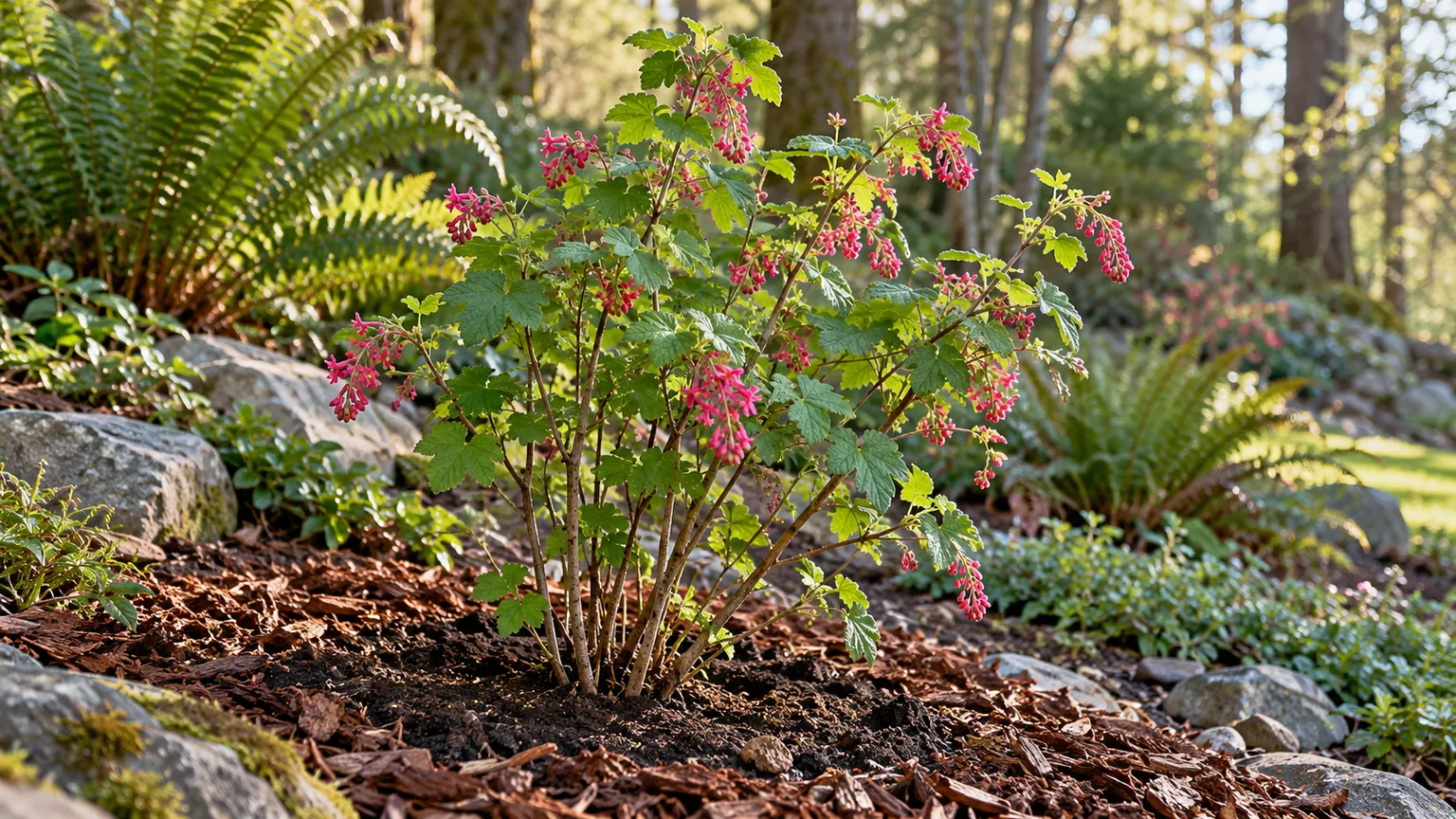
Plant in fall or early spring when the soil is workable and temperatures are moderate, giving roots time to grow before the hottest or driest weather. Dig a hole roughly as deep as the root ball and several times wider. Set the top of the root ball level with, or a little above, the surrounding grade, then backfill with the native soil you removed. A deeply buried crown is more likely to stay wet than it should.
Water slowly after planting so the root ball and the surrounding soil settle together. Add a light organic mulch layer over the root zone if the site dries quickly, but keep it several inches away from the stems. The aim is to reduce evaporation and weeds without keeping bark constantly damp. Skip fertilizer at planting unless a soil test points to a specific deficiency; richer soil is not a substitute for a suitable site.
Do not disturb the root system more than necessary. If the plant is pot-bound, loosen circling outer roots gently so they can grow outward, then water the entire root ball rather than only the soil beside the stem. Keep the label until you know the cultivar’s mature size, especially if you plan to use the shrub as an informal hedge.
Water according to establishment, then taper
Newly planted shrubs need help while their roots are still confined to the nursery root ball. Water thoroughly after planting, then check the soil near the root-ball edge rather than relying on a calendar or a dry surface. The goal is evenly moist soil during establishment, not a permanently wet planting hole. The University of Washington data sheet recommends weekly watering for container-grown plants during their first summer and warns against saturation; in-ground plants also need regular checks when rain is absent, but their interval depends on soil, temperature, and root-ball size.
Check young plants through their first dry season
During the first growing season, push a finger or narrow trowel a few inches into the root ball. If that root zone is dry and no useful rain is expected, give a slow, deep soak that wets the full root ball and a little of the surrounding soil. Recheck after a few days in hot, windy weather; in cool or rainy conditions, wait longer. A plant that wilts in dry soil needs water, while a wilting plant in saturated soil needs drainage investigation rather than another drink.
Use the plant’s response to taper irrigation. Once new shoots are growing and the soil around the root ball remains moist between checks, lengthen the interval. Keep this closer attention through the first summer and into the next dry spell if the shrub was planted late, is growing in sandy soil, or is exposed to reflected heat from pavement or a wall. Water is most useful when it reaches the roots slowly; frequent shallow sprays wet the surface but may leave the lower root ball dry.
Let established shrubs experience a dry summer
After roots have spread into the surrounding soil, red-flowering currant is more drought tolerant and usually needs little supplemental summer water in its native climate. Do not keep it on a daily irrigation schedule simply because nearby lawns are watered. If an established plant shows persistent wilt during an unusually long heat wave and the soil is dry below the surface, a deep soak may help; if leaves are dropping while the soil is wet, stop watering and inspect drainage.
A summer slowdown can look alarming if you expect lush growth all season. The shrub is deciduous and is adapted to seasonal changes, but premature yellowing or widespread leaf drop can also reflect drought stress, root injury, or waterlogged soil. Check the moisture several inches down and scratch a small twig to see whether the tissue beneath the bark is still green. Make one correction at a time instead of combining extra water, fertilizer, and heavy pruning on a stressed plant.
Keep soil, mulch, and fertilizer simple
Red-flowering currant does not need a highly amended planting mix or routine feeding in average garden soil. Add compost as a surface mulch if the bed is genuinely poor in organic matter, but avoid piling it against the crown. In a low-fertility site, a soil test can identify a real nutrient shortage; without one, heavy nitrogen feeding can push leafy growth without solving weak flowering caused by shade or pruning.
A 2- to 3-inch mulch layer helps slow evaporation and suppress weeds, especially while roots establish. Organic mulch is useful where summers are dry; keep it away from the base and refresh it only as it breaks down. In naturally moist climates, use less mulch and be especially careful not to create a damp collar around the stems. The Royal Horticultural Society notes that Ribes generally need no regular feeding and can be grown in most soils that are not waterlogged in winter. That is a better starting point than treating every lackluster season as a fertilizer problem.
Prune after the flowers fade
The most important pruning rule is timing: red-flowering currant blooms on growth produced the previous season, so prune immediately after flowering has finished. A late-winter tidy-up can remove flower buds that are already set, leaving a healthy shrub with little or no spring display. The Royal Horticultural Society’s Ribes growing guide recommends pruning after flowering and cutting flowered stems back to strong young growth.
If the plant is young or already has a balanced shape, pruning may not be necessary. Remove dead, broken, or crossing stems and shorten a flowered shoot only when it is out of bounds. For a moderate size reduction, cut back no more than about one-third of the finished flowering growth, making each cut just above a strong outward-facing branch or bud. Avoid clipping every stem into a flat hedge face; that removes a lot of the plant’s natural arching form and can make the exterior dense while the center becomes woody.
Pruning has a trade-off: removing spent flower stems also removes the berries that would have followed them. If berries for birds matter more than a tightly controlled outline, prune selectively and leave some flowered branches to fruit. If you want more flowers next spring, prioritize young replacement shoots and remove older or awkward stems just after the current display.
Rejuvenate an old shrub gradually
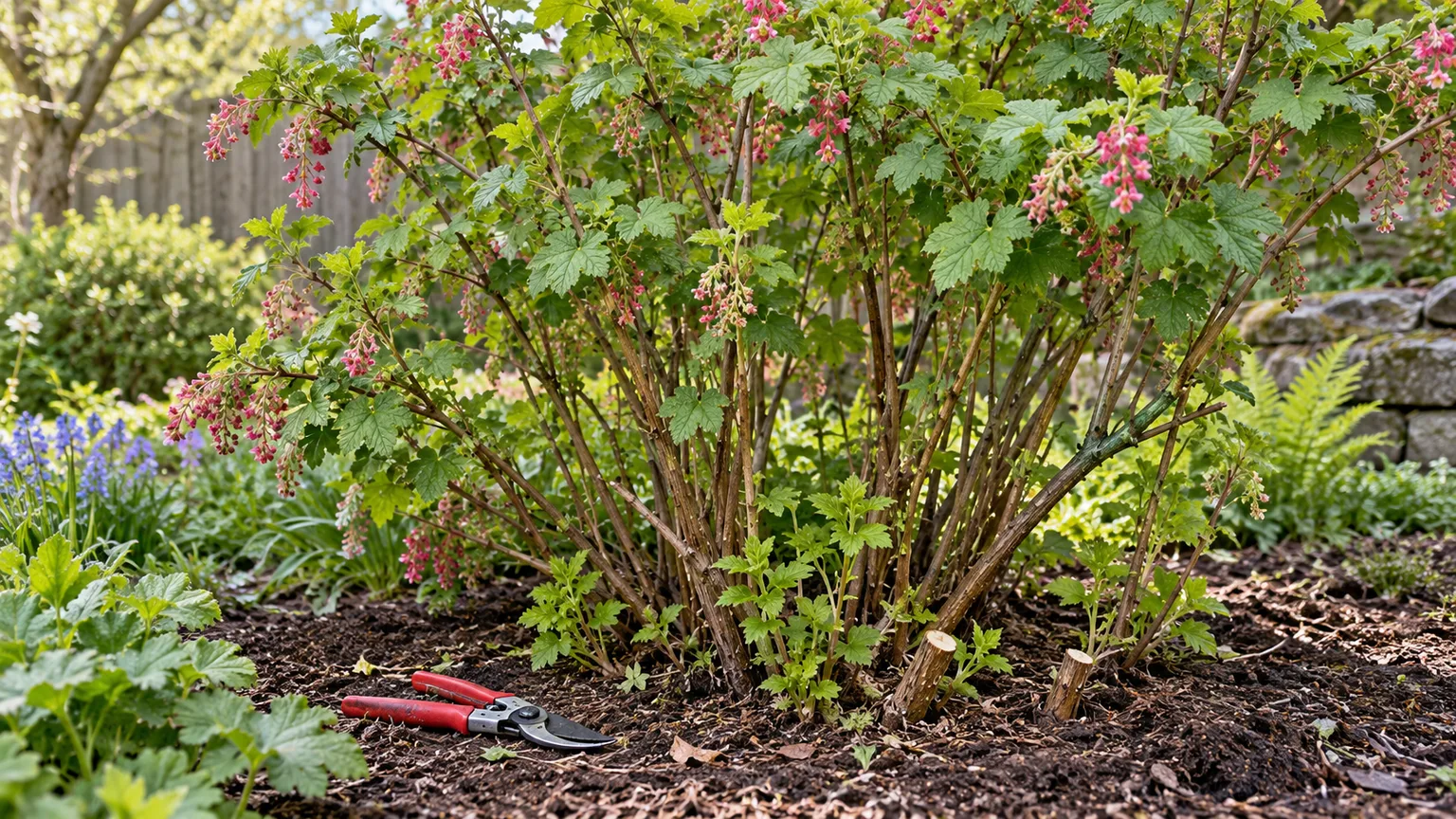
An older currant that has become crowded or bare in the center usually benefits from renewal pruning, not an annual shearing. Each year after flowering, remove about one-fifth of the oldest stems close to the base and keep the strongest younger replacements. The RHS gives this one-fifth approach for established or neglected Ribes. Spreading the work over several seasons maintains some flowers and berries while making room for fresh stems.
If the shrub is severely overgrown and you are willing to sacrifice much of the next display, a more drastic renovation can be considered, but avoid cutting every stem just before spring bloom. A cautious sequence is safer: remove dead wood first, then take out a few of the oldest stems, observe the response for a season, and continue if new growth is strong. Use clean, sharp bypass pruners for stems you can cut cleanly; thicker wood may need loppers or a pruning saw. Do not top every stem at the same height, which leaves blunt ends and a crowded outline.
Propagate by cuttings or seed
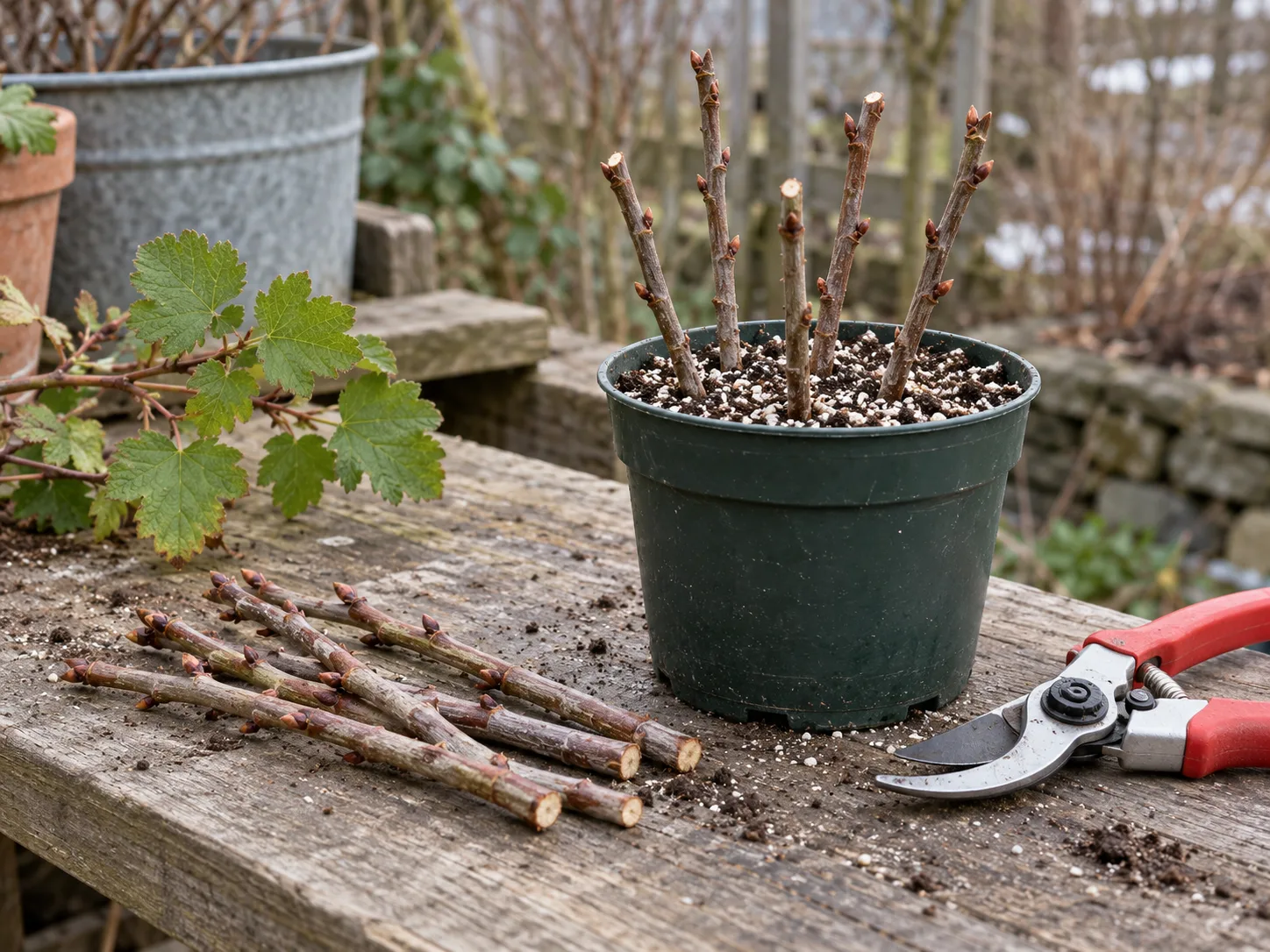
Cuttings are the most predictable way to keep a named cultivar’s characteristics. Softwood cuttings are taken in spring or early summer from flexible new growth; hardwood cuttings are taken from firm dormant stems in late fall or winter. The Royal Horticultural Society’s guide to Ribes propagation recommends softwood cuttings when a greenhouse or propagator is available and hardwood cuttings in winter. The University of Washington data sheet also lists seed, hardwood cuttings, and layering as options for red-flowering currant.
For a hardwood cutting, choose a healthy pencil-thick shoot from the current year and cut a section about 6 to 8 inches long. Keep the buds oriented upward, remove the lower leaves if any remain, and leave a few buds above the growing medium. Set it in a freely draining propagation mix, water it in, and keep the medium slightly moist rather than saturated. Rooting takes time; wait for stable new growth and a root system before potting the young shrub into its own container or moving it outside.
Seed works well if you want several plants and do not need them to match a specific cultivar. Collect the blue-black fruits when ripe, remove the pulp, and sow fresh seed outdoors in fall; otherwise, cold stratification is needed before spring sowing. The University of Washington sheet specifies roughly three to five and a half months at 32–36°F for seed that was not sown in fall. Keep the seed medium consistently damp but not waterlogged, and expect seedlings to vary from the parent. For a single compact or named-color plant, purchasing a cultivar is usually simpler than waiting for seed-grown shrubs to mature.
Troubleshoot sparse flowers and stressed leaves
When a shrub grows leaves but few flowers, check the likely causes in this order: pruning timing, direct light, plant age and establishment, then nutrition and winter damage. Late-winter pruning is a common preventable cause because it removes the buds for that season. Deep shade also reduces flowering; if the shrub has become shaded by a fence, tree, or neighboring plants, carefully improve light or accept a less floriferous habit.
A newly planted or recently moved currant may spend its first seasons building roots, so a light first bloom is not automatically a sign of failure. Excess nitrogen can also favor vigorous leafy growth over flowers, while a late freeze can damage developing buds. Compare the plant with one growing nearby under different conditions, and note whether it flowered before you change care. A soil test is more useful than guessing at fertilizer when sun, pruning, and water appear appropriate.
Yellowing or leaf drop calls for a moisture check before treatment. Dry root balls, root disturbance, saturated soil, and heat stress can all produce decline that looks similar from a distance. If the soil is wet, pause irrigation and address the site; if it is dry below the surface, water slowly and recheck. Remove only clearly dead stems until you know whether the roots are healthy, because hard pruning cannot repair damaged roots.
Watch for pests, disease, and rust concerns
Red-flowering currant is generally a resilient landscape shrub, but “low maintenance” does not mean pest-proof. Aphids may gather on tender growth, and other currant-family pests or fungal problems can occur depending on climate. Look closely for the insect or a characteristic pattern of damage before treating; a few aphids on a mature shrub rarely justify broad spraying, especially when the plant is flowering and pollinators are visiting.
White pine blister rust deserves a separate, regional note because it is not just a shrub-health issue. The fungus uses Ribes as one part of its life cycle and affects five-needled pines; the details vary by host species and local conditions. Do not assume that every red-flowering currant will be visibly diseased, and do not remove a native planting solely on the basis of a broad description. Check local restrictions first, and follow current state or regional agriculture guidance if currants are regulated where you live. The North Carolina rule is a specific example, not a nationwide ban.
If the shrub has persistent dieback, cankers, or unusual leaf spotting, photograph the symptoms and ask a local extension office or certified arborist for diagnosis. Pruning out diseased material may be appropriate for some problems, but the right response depends on the cause. Avoid applying fungicide or insecticide without identifying the target and checking whether the product is labeled for the site and plant.
Support pollinators and understand the berries
Red-flowering currant blooms early enough to be useful before many summer shrubs flower. In Oregon, Oregon State Extension’s pollinator guide lists red-flower currant’s bloom period as roughly April through June, though local weather, elevation, exposure, and cultivar shift the calendar. The hanging flowers attract hummingbirds and a variety of bees; the shrub can also provide cover, while the later blue-black berries are used by birds and small mammals. This makes it a good part of a mixed habitat planting, not a substitute for a season-long succession of flowers.
Allow some flower clusters to mature if you want berries and wildlife food. The fruit is technically edible according to horticultural references, but it is small and often described as sour or insipid, so it is not comparable to a productive red currant crop. Oregon State University describes the fruit as edible but insipid, while North Carolina Extension recommends leaving it to wildlife. Do not eat fruit unless you have positively identified the shrub; common names can refer to different currants, and an unknown berry should never be identified by color alone.
For a more useful wildlife bed, pair flowering currant with regionally appropriate plants that bloom later, so food is available after its early spring display ends. Leave some branches unpruned for fruit and nesting cover, and avoid routine insecticide use on a plant visited by pollinators. If the shrub self-seeds in an area where it is not native, remove seedlings before they establish and follow local invasive-plant guidance.
Conclusion
Red-flowering currant is easiest to grow when its seasonal rhythm guides the work: give it sun or light shade and fast drainage, water the root ball regularly while it establishes, and let an established shrub dry between occasional deep soaks. Choose a cultivar by its mature width as carefully as by flower color, and prune just after bloom so you do not cut away next spring’s flowers.
If flowers are sparse, check pruning timing and light before feeding. If growth is weak, check moisture and drainage before adding fertilizer. Leave some spent flower stems if you value berries, and verify local Ribes rules where white pine blister rust is a concern. With that balance, the shrub can offer spring color, useful wildlife habitat, and a naturally arching form without demanding constant attention.



