How to Grow and Care for Foamflower (Tiarella)
Grow foamflower in the right shade and soil. Learn when to plant, how to water and divide it, which varieties spread, and how to prevent soggy roots.
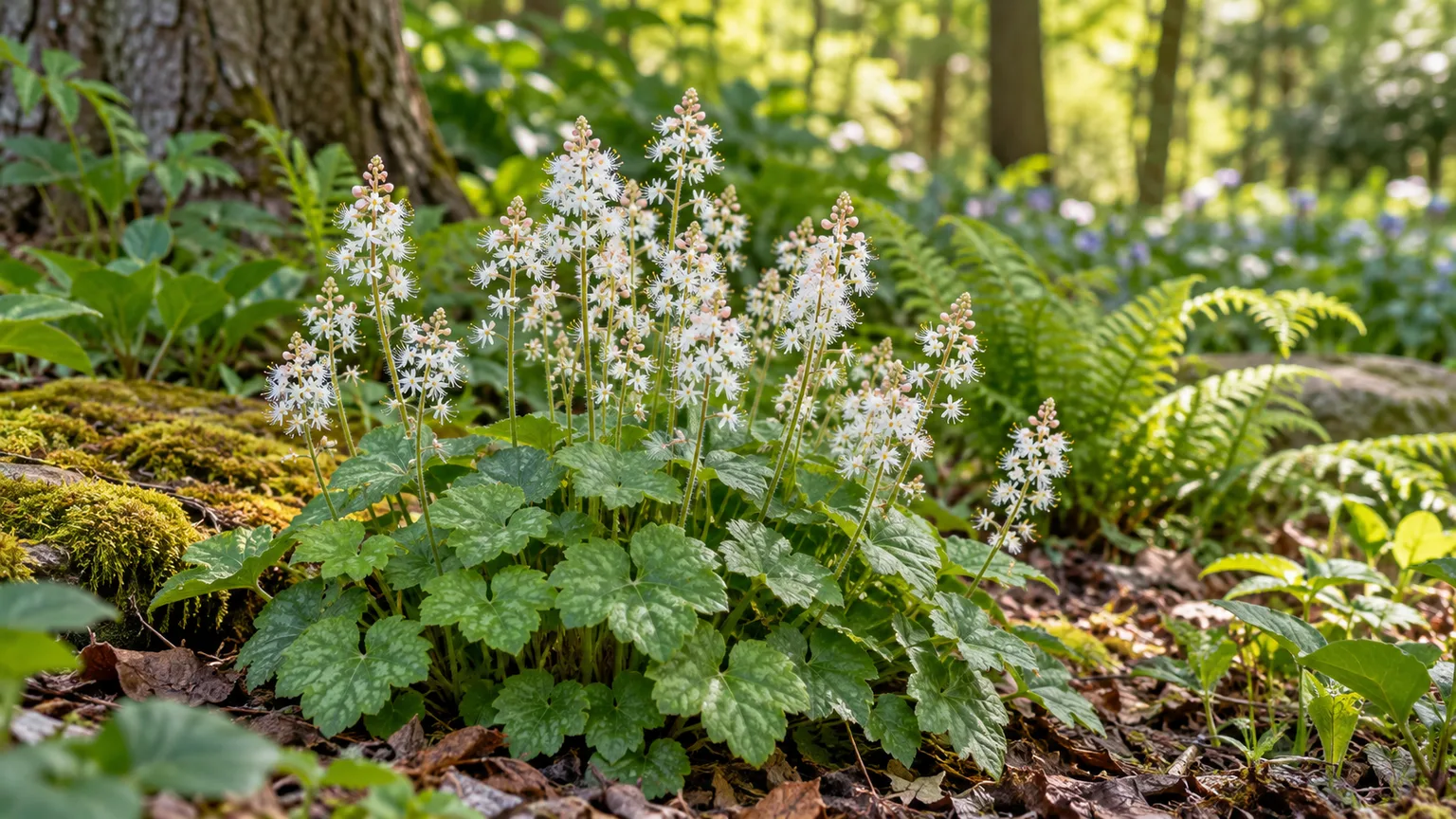
Foamflower is a low woodland perennial for the parts of a garden that stay cool, shaded, and reasonably moist. It is most dependable in humus-rich soil that drains after rain: roots need regular moisture, but they should not sit in saturated ground, especially through winter.
The plant is often sold as Tiarella cordifolia and valued for two seasons of interest: airy white or pinkish flower spikes in spring, then patterned, sometimes bronze-tinged leaves that make a ground layer. Before planting, check the label for growth habit. Some foamflowers send out runners and form colonies, while other selections stay in a tighter clump; that difference affects spacing, propagation, and how much edging you may want later.
| At a glance | What to expect |
|---|---|
| Plant type | North American woodland perennial in the saxifrage family |
| Light | Part shade to full shade; gentle morning sun can suit cooler sites |
| Soil | Humus-rich, evenly moist, and well-drained |
| Size | Usually about 6–12 inches of foliage, with taller spring flower stems; spread varies by selection |
| Bloom | Spring, commonly early to mid-spring; timing shifts with climate and cultivar |
| Spread | Clumping or colony-forming, depending on the species or cultivar |
| Hardiness | Many selections are listed around Zones 3–8 or 4–9; check the plant label and local summer conditions |
Identify foamflower varieties and growth habits
Foamflower is the common name used for several Tiarella species and their garden selections. The familiar heartleaf form, T. cordifolia, has heart-shaped, shallowly lobed leaves and produces the kind of low groundcover gardeners often want. Flower stems rise above the leaves with clusters of tiny blossoms; the long stamens give the spikes a soft, frothy look. NC State Extension describes it as a shade-loving perennial of moist forests and well-drained bottomlands, with pollinator-attracting flowers and spreading runners. NC State Extension’s plant profile is a useful reference when comparing labels.
The name on a nursery pot may not tell the whole taxonomic story. A 2022 account from the North Carolina Botanical Garden distinguishes five eastern Tiarella species using traits such as whether the plant makes aboveground runners, the shape of its basal leaves, and whether the flowering stem carries small leaves. Earlier horticultural references often grouped some of these forms as varieties of T. cordifolia, so labels and regional plant lists do not always match. For home gardening, the practical question is usually whether the plant forms a colony or stays clumping; buy from a nursery that identifies the selection and, for native-plant projects, favors stock propagated from a suitable regional source. The North Carolina Botanical Garden’s taxonomy overview explains why the names can differ.
Foamflower fits beneath deciduous trees, along a woodland path, at the cool edge of a shrub bed, or in a shaded rock garden where water can drain. Avoid low pockets that stay swampy after rain and hot strips where tree roots pull moisture away; its low foliage is not a substitute for a regularly walked lawn.
Choose a site with shade and steady moisture
Think about the whole growing season, not just what the bed looks like on planting day. Foamflower often gets its best spring light before deciduous trees leaf out, then grows through summer under a darker canopy. A sunny spring window can be fine if summer shade protects the plant from strong afternoon heat and the soil does not dry sharply between rains.
Read light by climate and canopy
Partial to full shade is the safest general starting point. In cooler northern gardens, a little more sun may be tolerated if the roots stay moist; in warmer regions, aim for dappled light or shade during the hottest part of the day. The Horticulture magazine profile notes that the plant can accept more sun in northern regions, while NC State Extension recommends dappled to full shade. Those statements fit together when you account for climate: the same hours of direct sun are less stressful in a cool summer than in a hot, dry one. Horticulture magazine’s foamflower profile and NC State Extension support that regional distinction.
Check the bed after the canopy fills in: if it dries quickly by afternoon, expect to water more often or choose a naturally moister site. A north-facing wall can be shaded yet dry beneath an overhang, while a woodland edge may offer bright morning light without baking the foliage. “Shade” describes the light, not the water supply.
Check drainage before planting
Foamflower prefers soil that holds moisture but does not stay waterlogged. The Missouri Botanical Garden recommends humusy, moisture-retentive ground while warning that wet winter soil can be fatal; Mt. Cuba Center likewise describes average-to-moist, well-drained soil as a good fit. If rainwater pools on the surface or the bed stays sticky and saturated long after nearby soil has drained, do not try to solve the problem by watering less in summer alone. Improve the bed’s structure across a broad area, plant on a modest raised mound, or move the plant to a better-drained spot. Missouri Botanical Garden’s profile and Mt. Cuba Center’s foamflower page describe this balance.
Under a mature tree, inspect the soil in more than one place. Tree roots can create a dry pocket even in a garden that looks lush, and adding a small pocket of rich compost into heavy clay can sometimes leave water collecting in that planting hole. Work a thin layer of finished leaf compost into a wider bed instead of filling one deep hole with a different texture. If the site is persistently wet in winter, choose another perennial rather than trying to keep foamflower alive with repeated amendments.
Plant foamflower at the right depth and spacing
Plant nursery-grown foamflower in spring or early fall, when mild weather gives roots time to establish before summer heat or hard freezes. Spring is convenient if you can keep the root ball evenly moist through the first hot season; early fall can work where the ground stays workable and plants have time to root before winter. Avoid transplanting during a heat wave or into frozen soil. Garden Design recommends planting in milder weather and spacing plants about 12–18 inches apart, a useful starting range for common garden forms. Garden Design’s planting section also notes that mature width varies.
Water the nursery pot first, slide the root ball out, and loosen only roots that are circling tightly around the outside. Set the plant so the crown—the point where leaf stems meet the roots—rests level with the surrounding soil. Backfill, press lightly to remove large air gaps, then water slowly until the root ball is fully wet. Keep any mulch thin and pulled slightly away from the crown so it does not trap moisture against the growing point.
Choose spacing based on the plant’s mature form and the look you want. Use roughly 12–18 inches for a quicker connected ground layer, but give compact, clumping varieties more breathing room if you want each mound to remain distinct. Runner-forming plants can bridge larger gaps over time; a tighter grid does not make a bed fill instantly and can create crowded foliage that is harder to inspect. If you are unsure what the selection will do, plant a small group first and watch one growing season before ordering enough to cover the whole bed.
Water during establishment and dry weather
During the first growing season, check the root zone often enough that it does not dry completely. Water when the soil a finger’s depth below the surface begins to feel dry, then soak the root ball rather than sprinkling the leaves. The exact interval depends on rain, temperature, soil, and the amount of tree-root competition. A plant under a shallow-rooted maple may need attention sooner than one in a naturally moist woodland border.
Established plants may ride through a brief dry spell better than new divisions, but foamflower is not a drought plant. NC State Extension emphasizes its low drought tolerance, while some horticultural profiles allow for limited tolerance once established. If leaves lose firmness and soil is dry below the surface, water deeply and reassess; do not rely on a fixed weekly schedule.
If the ground is wet and the plant still looks wilted, pause before adding water. Saturated soil limits the air available to roots, so extra irrigation can deepen root stress rather than correct it. Feel the soil below the mulch and check whether water drains from the bed. A plant that wilts in damp ground needs a drainage and root-health check, not another watering can.
Feed lightly and mulch with leaf mold
Foamflower usually needs little fertilizer when it grows in soil with organic matter. At planting, use finished compost or leaf mold to improve the soil surface and help it retain moisture; an annual thin topdressing is often enough. Do not bury the crown under a deep mound of compost or keep adding rich fertilizer to chase darker leaves or more flowers.
If the soil is genuinely poor and growth remains weak after the plant is established, a light spring application of a balanced slow-release fertilizer may help. Follow the product label for the amount and placement, and avoid feeding late in the season when the plant is preparing for winter. Excess fertilizer can encourage soft foliage without fixing shade, drainage, or root competition—the site problems that more often explain poor performance.
Shredded leaves make a natural woodland mulch. Keep the layer modest and away from the crown; mulch can moderate moisture, but it cannot fix dry shade under tree roots or waterlogged ground.
Follow a seasonal care routine
Spring: Before new leaves cover the crown, remove collapsed or damaged foliage and any winter debris. Watch for new growth, then water newly planted plants when the root zone begins to dry. After flowering, cut old flower stems if you want a neater mound; deadheading is optional and does not make a healthy plant rebloom continuously.
Summer: Check soil during heat waves and rain-free stretches, especially beneath trees. Weed before runners root through the bed, and keep the crown visible if you refresh mulch.
Fall and winter: Leave sound foliage in place where winters are mild; many selections are semi-evergreen, and leaves may bronze or redden as temperatures cool. In colder climates, foliage may die back naturally. Clear only wet, decaying material that is smothering the crown, and avoid planting or dividing so late that roots cannot establish before the soil freezes. Missouri Botanical Garden notes that winter-wet soil is a particular risk, so fall drainage matters more than a heavy blanket of mulch. The garden’s cultural notes explain why foliage retention and winter moisture vary by climate.
Control spreading before a colony reaches paths
A runner-forming foamflower can spread into a useful groundcover, but the edge of a colony is easiest to manage while individual runners are still visible. Lift rooted plantlets and replant them where you want coverage, or cut and remove runners that are moving into a path or a neighboring plant’s crown. A shallow spade cut along the bed edge can help define a boundary; repeat it when you see new growth crossing rather than waiting until the whole edge becomes a dense mat.
A native plant can still spread beyond its planting spot. Check the plant’s range against your location, especially outside eastern North America; the North Carolina Botanical Garden notes that runner production differs among regional species, and cultivars vary in vigor.
If you need a tidy border, choose a clumping selection and check the label rather than relying on the common name alone. If you want a broad carpet under shrubs, a spreading selection may be the better tool. For more plant options by site and spread, see our guide to fast-growing groundcovers; foamflower is specifically a choice for cool, shaded, moist ground rather than every empty patch.
Propagate by division or rooted runners
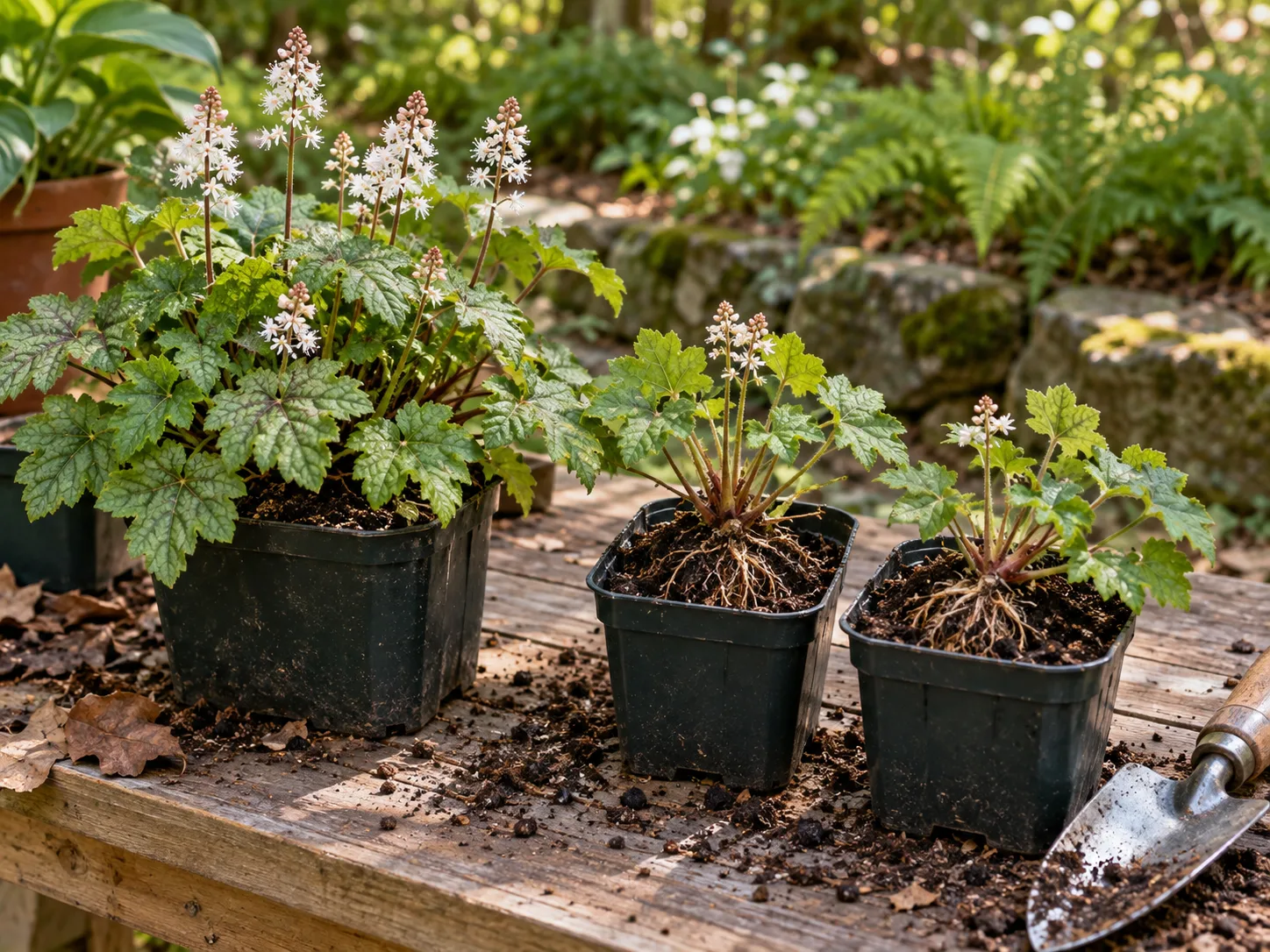
Division is the most dependable home method when you want another plant with the same general characteristics. Work in early spring as growth begins or in early fall during mild weather. Water the clump the day before lifting, loosen soil around its edge, and raise only as much of the plant as you can replant promptly. Separate it into pieces that each have a healthy crown, leaves or viable buds, and a sound portion of roots; a loose handful of leaves without a crown will not establish as a division.
Replant each piece at its original depth, firm soil around the roots, and water thoroughly. Keep divisions evenly moist while they resume growth, but do not leave them standing in water. If one wilts, check that the root ball is moist and the crown is not buried; persistent wilt in wet soil points to drainage or root damage.
Some plants make rooted runners with small plantlets at their tips or nodes. Follow the runner to the mother plant before cutting so you can see whether the plantlet has formed its own roots. NC State Extension recommends allowing these plantlets at least two growing seasons to develop a root system before separating them from the parent. Once rooted, lift a small section of soil with the plantlet, sever the runner, and replant it without teasing away the fine roots. NC State’s propagation notes make this waiting period especially useful for gardeners tempted to detach every new rosette as soon as it appears.
Grow foamflower from seed when it makes sense
Seed is a slower, less predictable way to make more foamflower, but it can be worthwhile if you want to raise a regional native or grow a number of plants inexpensively. Collect seed only from a plant you have permission to harvest and that is correctly identified; a cultivated named selection may not produce seedlings that match its foliage or flowers. Seeds can also be difficult to obtain from a lone clonal plant. NC State Extension explains that Tiarella cordifolia is mostly self-incompatible and needs two genetically distinct plants for seed production; many nursery plants are vegetatively propagated and may share one genotype.
Use fresh seed when possible, or follow the specific cold-treatment instructions supplied with purchased seed. Native-plant nurseries recommend surface-sowing foamflower seed after a period of cold-moist stratification, because the small seeds need light to germinate. A specialist grower gives a 12-week cold-stratification option for Wherry’s foamflower; seed supplier instructions can differ by taxon and lot, so do not bury the seed or assume every packet uses the same schedule. Toadshade Wildflower Farm’s foamflower listing provides one example of those directions.
Sow the seed on the surface of a clean, moist seed-starting mix, press it gently into contact, and keep the container in bright indirect light rather than direct afternoon sun. Cover the tray loosely to slow drying, but ventilate it so the mix does not stay swampy. Germination and seedling growth may be uneven; keep the mix lightly moist, pot up only when seedlings are large enough to handle, and harden them off before planting outdoors. Expect a gradual path to flowering rather than treating seed as a shortcut to a mature groundcover.
Grow foamflower in a container
A pot can work if you can give the plant shade, consistent moisture, and free drainage. Choose a wide container with drainage holes and a fresh, well-draining potting mix that holds some moisture. Foamflower has a spreading, shallow-rooted habit, so a broad bowl or trough usually suits it better than a narrow, deep pot. Avoid a decorative cachepot that leaves water standing at the bottom.
Place the container where it gets bright shade or gentle morning light and protection from hot afternoon sun, wind, and reflected heat. Pots dry faster than garden soil, especially in summer; check the mix regularly and water when it begins to dry below the surface. At the same time, do not water automatically if the mix is already wet. Empty standing water from a saucer and confirm that drainage holes are clear after heavy rain.
Container roots face colder conditions than roots in the ground. Near a cultivar’s hardiness limit, move the pot to a sheltered, unheated spot or insulate it while keeping drainage open. Pots limit a colony but do not remove the need to divide a crowded clump.
Choose cultivars by spread and foliage
Select the plant by growth habit first, then by flower color or leaf markings. A runner-forming selection can fill a woodland bed; a clumping one is easier to keep in a small border or pot. Nursery tags and plant databases may use different names for older varieties, so confirm the botanical name and mature spread on the label instead of assuming that all plants called “foamflower” behave alike.
‘Running Tapestry’ is known for heart-shaped leaves with dark markings and a spreading habit, while ‘Brandywine’ is selected for dark veining and bronze-toned foliage. ‘Sugar and Spice’ is often sold for its patterned, deeply lobed leaves and pale flower spikes. ‘Cutting Edge’ is a useful example of a more compact, clumping hybrid in horticultural references. These are not interchangeable forms: compare mature width, runner habit, and climate rating before using one as a groundcover or a container specimen. Garden Design’s cultivar overview and NC State’s cultivar list provide different but complementary descriptions.
Hardiness ranges also vary among references. NC State lists T. cordifolia across Zones 3a–8b, while the Missouri Botanical Garden and Mt. Cuba Center give broader ranges that reach Zone 9. That difference is a reason to check the exact selection and your regional summer conditions, not a promise that every foamflower tolerates the same heat. USDA hardiness zones describe average annual extreme winter minima; they do not tell you whether a shaded bed stays moist through a hot summer.
Pair foamflower with other shade plants
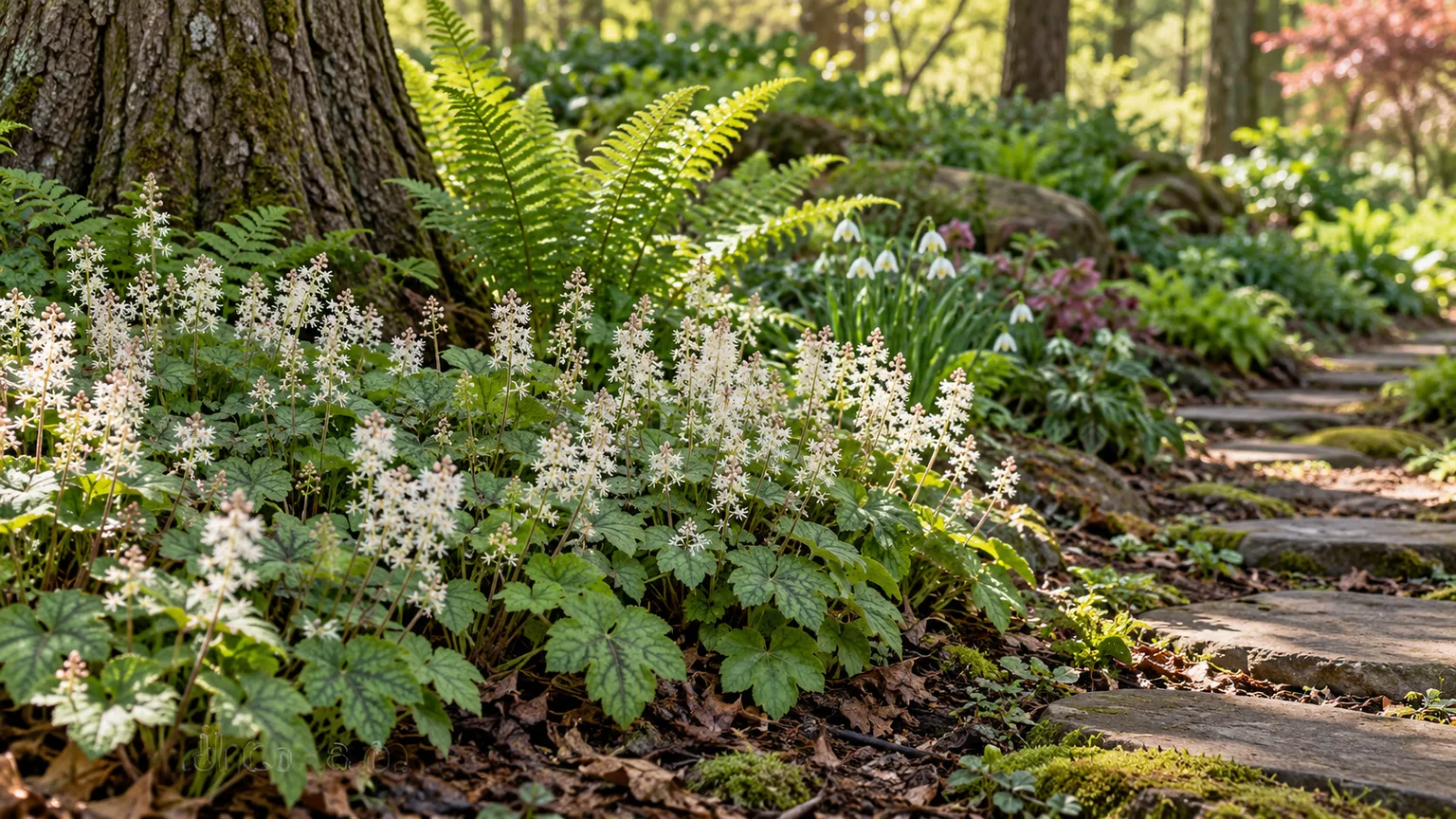
Use foamflower as the low layer rather than expecting it to carry the whole composition. Its spring flower spikes rise only a little above the leaves, so place taller ferns or woodland perennials behind it and let the foamflower trace a path edge or weave between stepping stones. When its flowers fade, the foliage remains as a ground texture while later-blooming companions take over.
Mt. Cuba Center suggests companions such as creeping phlox, Dutchman’s-breeches, blue wood aster, northern lady fern, broad-leaved goldenrod, and large-flowered trillium. Match each companion to the moisture and light in your own garden rather than copying the list as a fixed planting recipe; a plant that tolerates dry shade may not thrive in a wet hollow. Keep enough space for spreading forms, and avoid placing slow, small woodland flowers where vigorous runners can smother them. Mt. Cuba Center’s foamflower profile lists several compatible woodland plants.
For a calm woodland look, repeat foamflower in loose drifts and contrast its leaves with fern fronds or fine-textured sedges. If you prefer a tidy bed, use a clumping cultivar and leave a buffer along paths.
Diagnose soggy crowns, leaf damage, and weak growth
Foamflower has relatively few serious problems when planted in a suitable site, but “low maintenance” does not mean immune to bad drainage or summer stress. The most useful first check is soil moisture below the leaf litter. If the soil is dry, water deeply and watch for recovery; if it is saturated, stop watering and investigate whether the bed drains. The Missouri Botanical Garden warns that winter-wet soil can be fatal, while NC State Extension identifies black vine weevil as an occasional pest that can be destructive.
Ragged holes or scalloped leaf edges can come from slugs or snails in a moist, sheltered bed. Look for fresh slime trails or damage that appears overnight before treating the plant; remove hiding debris near the crown and inspect after rain. If leaves are notched but the whole clump remains firm and continues growing, the damage may be cosmetic. If foliage declines despite moist soil, inspect the crown and roots for dark, soft tissue and look for signs of root-feeding pests before assuming the plant simply needs more water. Garden Design’s pest overview lists slugs, snails, and weevils among possible pests.
Tell dry stress from root trouble
Dry-stressed leaves often lose firmness while the soil below the surface is dry; water the root zone and reassess the next day. Root trouble is more likely when wilt persists in wet ground, the crown softens, or leaves collapse despite regular rain. Pull mulch back, check for drainage, and remove only tissue that is clearly dead. If the whole crown is mushy or the roots are largely decayed, replacing the plant in a better-drained location may be more reliable than trying to nurse it in place.
Do not apply a pesticide just because leaves are chewed or a plant looks weak. Confirm the pest first, then use local extension guidance and follow any product label exactly if treatment is needed. For black vine weevil, NC State notes the potential for serious damage, so persistent decline or root injury is a good reason to contact a local extension office or a knowledgeable native-plant nursery for identification. A correct diagnosis matters more than treating every foamflower bed on a calendar.
Encourage spring flowers without forcing growth
Foamflower usually flowers when it is healthy and mature enough, receives suitable seasonal light, and is not under prolonged drought or root stress. Bloom time is commonly spring, but it shifts with latitude, weather, canopy timing, and cultivar; the Missouri Botanical Garden describes a spring display lasting about six weeks, while Mt. Cuba Center records early- to mid-spring flowering. Use these as regional guides rather than exact calendar dates.
If a plant grows leaves but produces few spikes, check its age and site. New divisions spend energy establishing roots; deep shade, prolonged drying, and saturated soil can also limit flowering. Correct light or moisture problems before adding fertilizer, and give a healthy plant time to settle.
Cutting spent flower stems is optional. Remove them when you want a tidier edge or want to prevent seedlings, but leave them if you are curious about seed or want the plant to self-sow where conditions allow. A light spring cleanup and a suitable site do more for long-term performance than aggressive pruning or repeated feeding.
Conclusion
For reliable foamflower care, choose a shaded site with humus-rich soil that stays evenly moist and drains well, especially in winter. Plant at the crown’s original depth, water new plants through their first dry spells, and use the nursery label to learn whether your selection forms a clump or sends out runners. Divide or redirect established plants when needed, and treat seed as an optional, slower route because clonal stock may not set seed reliably. Those choices give foamflower the conditions to build a cool woodland ground layer without turning its care into a guessing game.



