How to Grow and Care for Dwarf Morning Glory Plants
Grow dwarf morning glory (Blue Daze) with guidance on sun, drainage, watering, containers, propagation, winter care, and a longer run of blue flowers.
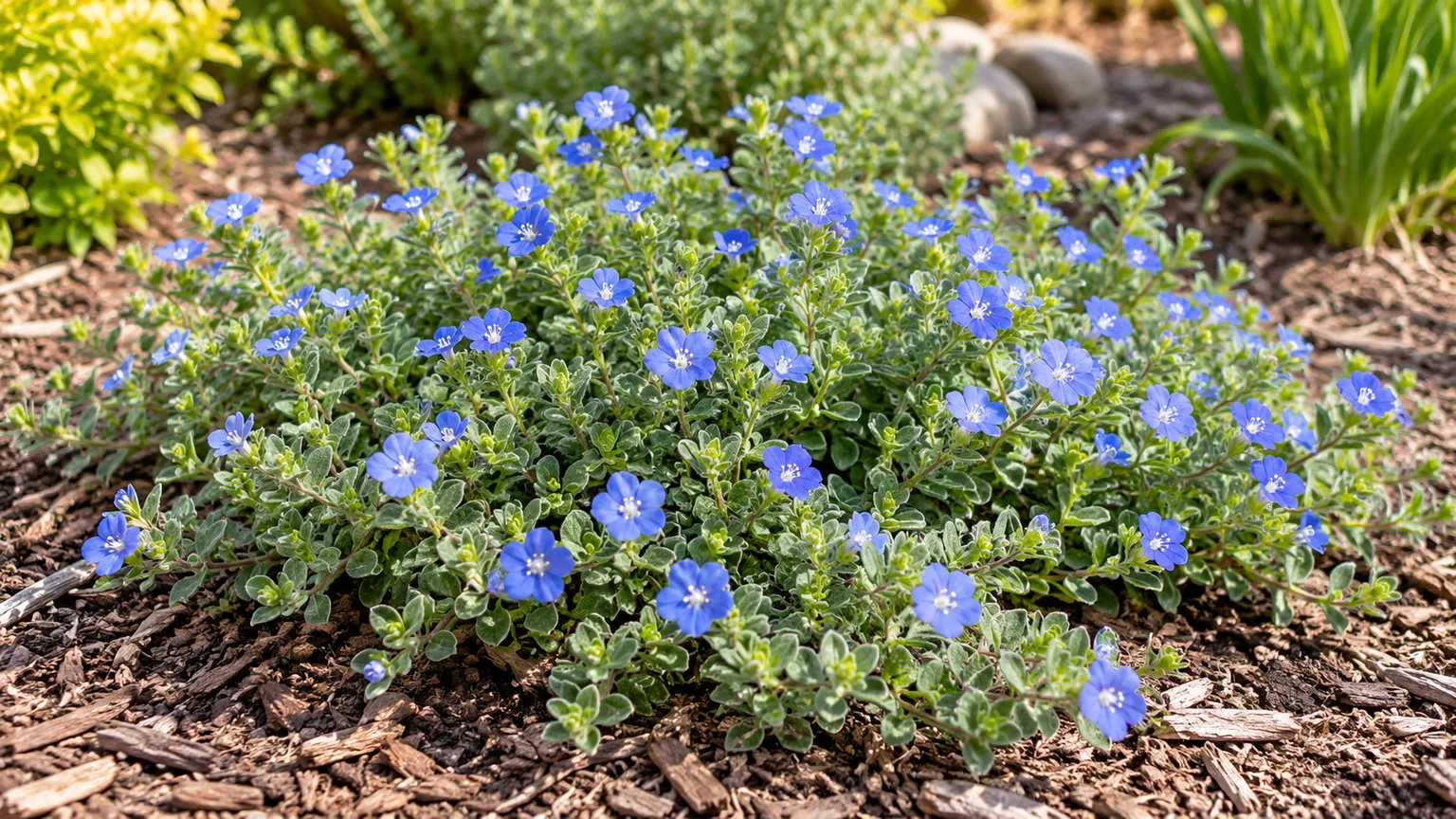
Dwarf morning glory earns a place in a hot-weather garden with its low cushion of soft gray-green leaves and small, clear-blue flowers. Give it sun and drainage, and it can trail over a pot or spread along a warm border; give it soggy soil or a freezing winter, and it may collapse or fail to return.
The plant usually sold under this name is Evolvulus glomeratus, also labeled Blue Daze or Brazilian dwarf morning-glory. Despite the common name, it does not twine up a trellis like a climbing morning glory. It forms a compact, spreading mound, so its best roles are groundcover, edging, and a container “spiller.” NC State Extension’s plant profile describes it as a tender, non-vining perennial native to South America.
The simplest care rule is to keep the roots moist while the plant establishes, then water when the surrounding soil begins to dry. Full sun and sharply draining soil matter more than frequent fertilizer. Whether it behaves as a perennial or a seasonal annual depends mainly on winter temperatures and the cultivar sold.
| Care factor | Starting point | Adjust it when |
|---|---|---|
| Light | At least 6 hours of direct sun | A very hot site may benefit from some late-day relief |
| Soil | Moist but well-drained | Use a raised bed or container if water lingers |
| Water | Regular while new; less once rooted | Pots and long dry spells need more frequent checks |
| Spacing | About 18–24 inches for a bed | Tighter spacing fills faster but reduces airflow |
| Winter | Protect from frost | Treat it as an annual where freezes are routine |
What “dwarf morning glory” means
Evolvulus glomeratus belongs to the morning-glory family, Convolvulaceae, but the resemblance is mostly in the flower. Each bloom is typically small, funnel-shaped, and blue with a pale center; the oval leaves are lightly fuzzy and often look silvery in bright light. A mature plant commonly spreads wider than it grows tall, with stems that lie across the soil or hang over a container rim. NC State Extension lists the plant at about 9–18 inches tall and 2–3 feet wide, though cultivar and growing conditions can change the final size.
Labels can blur the distinction between species and cultivar. Blue Daze is used as a common name and sometimes as a cultivar name; Blue My Mind® is a selected, branded cultivar of Evolvulus, not a separate species. It is often sold for larger flowers and a compact trailing habit, but use the measurements on the nursery tag because cultivar sizes vary. Proven Winners’ Blue My Mind profile lists its own cultivar as a short, heat-tolerant annual, while UF/IFAS Extension’s Blue Daze notes discuss the species and named selections in warm Florida landscapes.
That label matters when choosing how to grow it. A plant sold as a summer annual is still useful in a frost-prone climate, but you should not expect its roots to survive winter outdoors just because a general species page lists a broad hardiness range. Buy a cultivar for its habit and flower size, then use local winter performance to decide whether to treat it as perennial.
Choose where to grow it
Dwarf morning glory is most convincing where its low, spreading shape can be seen from above or allowed to soften an edge. It is not a substitute for a tall flowering vine or a dense turf-like groundcover: it stays low, leaves gaps until established, and performs best where drainage and sunshine are easy to control.
Use it as a groundcover in warm regions
In a warm, frost-light climate, plant it along a raised bed, over a low retaining wall, or at the front of a sunny border. Space plants roughly 18–24 inches apart so air can move between them while the stems expand; closer spacing closes the gaps sooner but can keep foliage wetter in humid or rainy weather. UF/IFAS Extension recommends that spacing and a well-drained site for mass plantings. The stems may root where they touch soil, so trim them back if they cross into a path or a neighboring plant’s space.
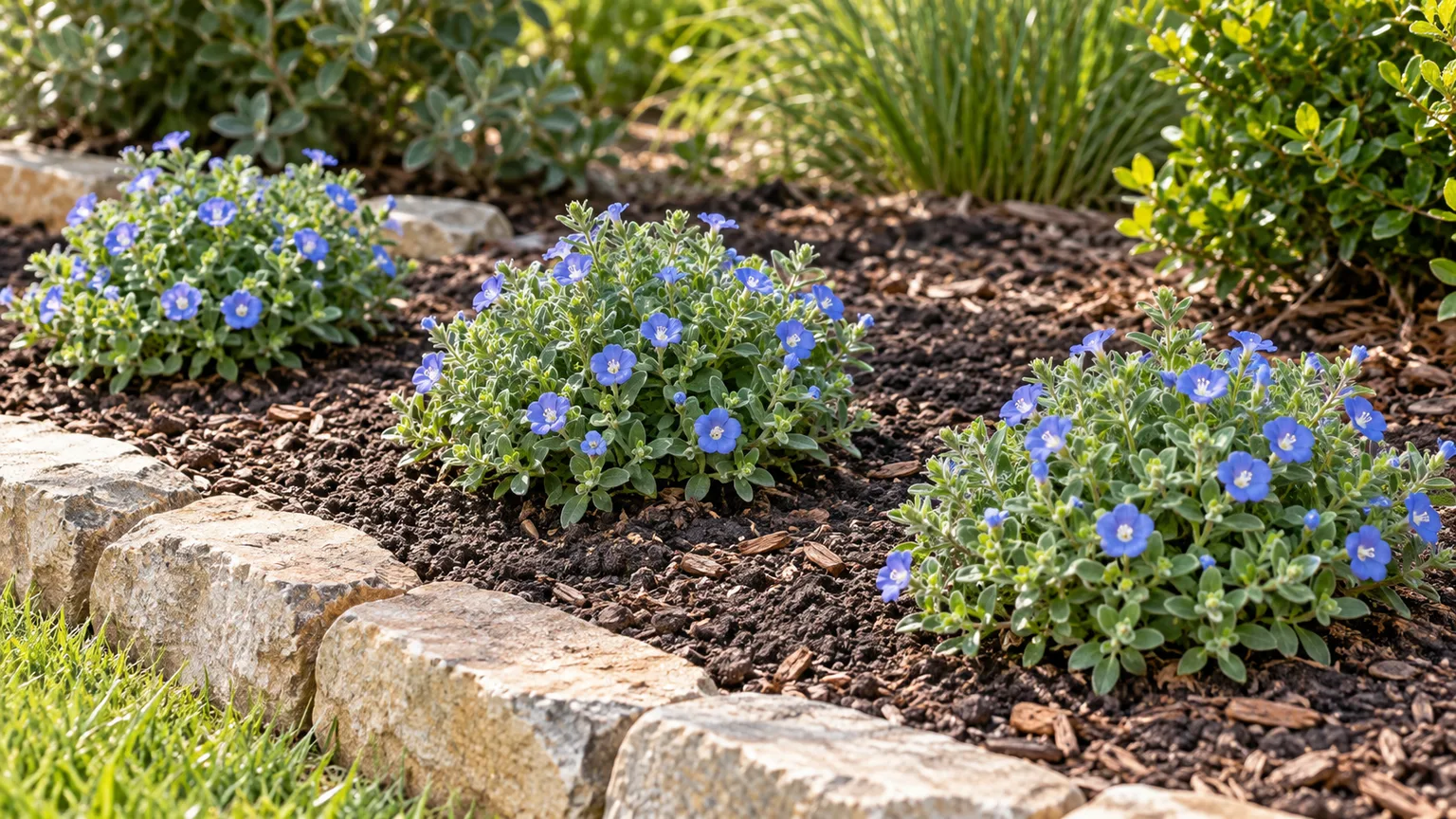
Use a container instead of a bed where winters are too cold for outdoor survival or the garden soil stays wet. This does not guarantee an indoor perennial, but it gives you the option to move the plant under shelter before frost and to control the potting mix and drainage.
Grow it in a container for seasonal flexibility
A pot, window box, or hanging basket shows off the trailing stems and makes seasonal use practical. Choose a container with several unobstructed drainage holes and a free-draining commercial potting mix; garden soil compacts in a pot and often stays wet around the roots. Set the plant at the same depth it grew in its nursery pot, and avoid burying the crown.
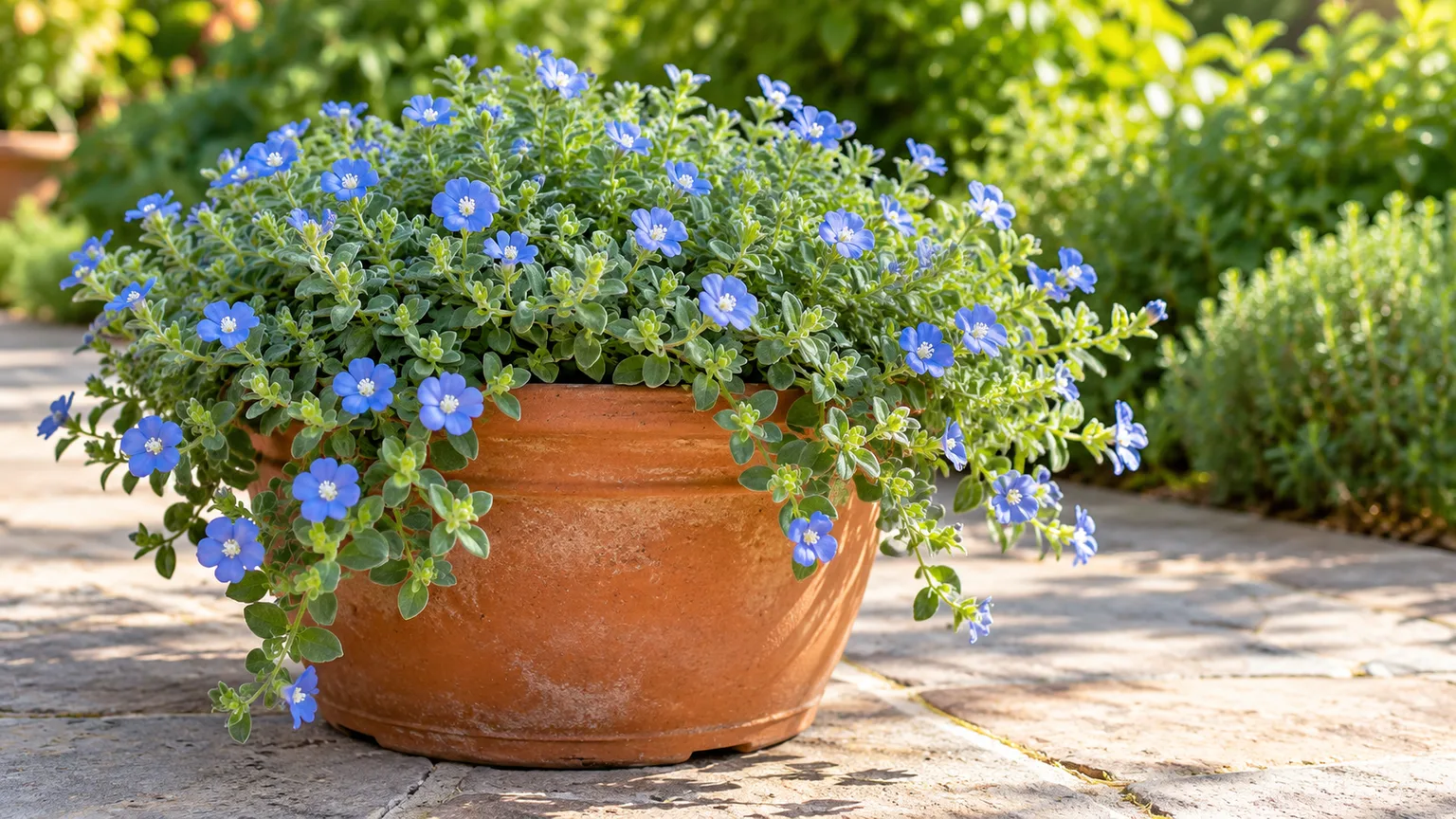
Containers dry faster than garden beds, especially in wind and full sun. Check the mix with a finger rather than assuming an outdoor plant is drought-proof: water thoroughly when the top inch or so has dried, then let the pot drain. Empty any saucer after watering. A plant that wilts in a small pot during a hot afternoon may need water, but confirm the mix is dry first; wilt above saturated soil points to a root problem, not a shortage of water.
Give it sun for reliable flowering
Aim for at least six hours of direct sunlight a day. Sun supports dense growth and the heaviest flowering; in deep shade, dwarf morning glory often stretches, develops fewer blooms, and loses the compact silvery-green look that makes it useful at the edge of a bed. NC State Extension classifies it as a full-sun plant, and Fine Gardening’s heat-garden profile describes Blue My Mind as thriving in full sun and well-drained soil.
The species handles summer heat, but heat tolerance does not mean it can live indefinitely in a dry root ball. If your site has punishing afternoon sun and reflected heat, keep an eye on moisture during the first few weeks and in pots; a little late-day shade may reduce stress in the hottest microclimates, though too much shade usually costs flowers. When a plant is leggy and bloom-poor, add light before adding fertilizer.
Plant after frost and leave room to spread
Set nursery plants outside after the risk of frost has passed and the weather has settled into warm growing conditions. A cold snap can damage a tender plant even if it is thriving during a mild week, so wait rather than planting on the first warm afternoon of spring. In regions with mild winters, plant when soil is workable and the site is not waterlogged.
Before planting, water the nursery pot so the root ball is evenly moist. Dig a hole as deep as the root ball and about twice as wide; roughen the sides if the soil is compacted. Slide the plant out without pulling on the stems, tease only tightly circling roots, and set the top of the root ball level with the surrounding soil. Backfill with the same soil, water to settle it, then apply a thin mulch layer without covering the crown.
If the bed is heavy clay or collects water, do not try to fix a small planting hole by filling it with loose potting mix. Water can collect in that pocket and keep the roots wet. Improve drainage across the bed, raise the planting area, or choose a container instead. Correct placement saves more plants than extra feeding after roots begin to rot.
Choose free-draining soil
Use average garden soil if water moves through it freely after rain. Evolvulus can tolerate a range of soil textures, including sandy or modestly lean soil, but it resents a root zone that stays saturated. A little finished compost worked across a poor garden bed can improve its structure; do not make the planting hole a rich, water-holding pocket.
For containers, use fresh potting mix labeled for outdoor planters and make sure water exits the drainage holes freely. Do not place gravel in the bottom of the pot as a substitute for drainage: it reduces root space and does not correct a dense, compacted mix. If the pot remains heavy and wet days after watering, switch to a more open mix or a container with better drainage.
Soil pH is not the main lever for this plant. If you have a specific reason to test it, follow local soil-test recommendations; otherwise prioritize drainage, sun, and appropriate watering over adding amendments to chase a particular number.
Water by checking the soil
Water consistently during establishment, which is usually the first few weeks after planting. Check the root ball and the soil just outside it; a nursery plug can dry faster than the surrounding bed, even when the surface looks damp. Water slowly at the base so moisture reaches the roots, then wait until the upper soil begins to dry before watering again.
Once rooted, this plant can tolerate short dry spells, but “drought tolerant” is not the same as “never water.” During prolonged heat and drought, give an in-ground plant a deep soak rather than frequent splashes. If leaves wilt, check soil moisture before reaching for the hose: dry soil suggests drought stress, while wet soil plus drooping or yellowing leaves suggests roots are struggling to take up water. UF/IFAS’s landscape guidance pairs its heat and drought tolerance with a clear warning to use well-drained soil to avoid fungal root rot.
Water containers when the surface layer dries, and expect to check more often in hot, breezy weather. Water until it runs from the drainage holes; do not leave the pot sitting in water. In rainy or humid periods, let the mix dry a little more between waterings and remove debris that holds moisture against the stems.
Fertilize lightly
Start with modest nutrition, not a monthly rescue routine. If the bed has decent soil or you incorporated compost, additional fertilizer may not be needed right away. In a container, a balanced slow-release fertilizer at planting or a dilute liquid feed during active growth can support flowering; follow the product label and the cultivar grower’s instructions. LSU AgCenter’s 2025 guidance recommends well-drained soil, regular watering while plants establish, and balanced fertilizer at planting for its regional dwarf morning glory selections.
If foliage becomes very lush but flowers remain sparse, stop feeding and reassess light and drainage. Extra fertilizer cannot make up for shade or unhealthy roots, and repeated applications can build up salts in a container. Do not fertilize a stressed or waterlogged plant until its roots have recovered.
Understand its daily and seasonal bloom
In warm weather, dwarf morning glory can bloom from late spring through summer and continue until frost in climates where the season is long enough. Individual flowers are short-lived, often opening on sunny days and closing at night or in cloudy weather; a closed bloom is not necessarily spent. The plant produces new flowers as it grows, so its display comes from repeated small blooms rather than one long-lasting flower.
A sunlit site, healthy roots, and steady moisture during active growth are the practical requirements for a continuous show. In very humid or rainy climates, plants may deteriorate sooner even when temperatures are warm; wet foliage and saturated roots can shorten the season. UF/IFAS describes the daily replacement of flowers and use in beds, walls, and containers, while NC State Extension notes that blooms close at night and on cloudy days.
Prune for shape, not to deadhead
You do not need to remove every spent flower. The small blooms drop as the plant continues to produce new ones, so deadheading is optional grooming rather than a requirement for rebloom. This makes the plant easier to maintain than flowers that need their old blooms clipped continually.
Pinch the tips of young stems if you want a fuller mound, then use clean snips to shorten long or untidy stems as needed during active growth. Avoid cutting back into bare, old woody sections; leave green leaves and growing points on the plant so it can branch again. A light trim can tidy a container or renew a straggly edge, but first check for shade, overwatering, and crowding, which often caused the weak shape in the first place.
Propagate with stem cuttings or seed
For an exact copy of a named plant, use a stem cutting. A cutting is a clone of its parent, so it keeps the cultivar’s traits more reliably than seed; NC State Extension lists stem cutting as the recommended propagation method for Evolvulus glomeratus. Cuttings are also useful as insurance before winter in a region where the mother plant may not survive outside.
Root tip cuttings to keep a cultivar true
Take a 3–5-inch piece of healthy, actively growing stem, ideally before it has flower buds. Remove leaves from the lower third to half of the cutting, then place that bare section into a small pot of clean, moist, free-draining propagation mix. Keep the leaves above the mix, and cover the pot loosely with a clear bag or dome to hold humidity without letting the foliage remain dripping wet.
Set the cutting in bright indirect light, not hot direct sun, and keep the medium lightly moist. Check every few days for condensation and remove any fallen leaves; if the mix is saturated, uncover it and let the surface dry slightly. When a gentle tug meets resistance and new growth appears, roots are developing; gradually remove the cover and pot it on once it fills the small starter container. These steps follow the general guidance in NC State Extension’s propagation handbook; rooting speed varies with temperature, stem maturity, and cultivar.
Use seed when the plant label supports it
Seed may work for species plants, but named cultivars are not guaranteed to come true from seed. If you collect seed, let the pods mature and dry on the plant, then sow a few in a small pot rather than relying on a single seedling. Seedlings can vary in vigor, flower size, and habit; if you want the same plant you bought, cuttings are the safer choice.
Overwinter according to your climate
Evolvulus glomeratus is a tender perennial, but it is commonly grown as an annual where frost is routine. Hardiness-zone lists are not perfectly consistent: NC State Extension describes the species as not cold-hardy even while its plant record shows a broad zone range, and commercial cultivar profiles may give narrower ratings. Use the tag for your exact cultivar and nearby local guidance; if your winter includes freezing temperatures, plan to protect it or replace it in spring rather than assuming it will return.
In a frost-free or nearly frost-free region, an established plant can remain outdoors if its soil drains well through cool, wet weather. Reduce watering when growth slows and avoid feeding during cold weather. If a hard freeze is forecast, protect the plant with a frost cloth or move the container under cover; a container is easier to shelter, but its roots can chill faster than roots in the ground.
You can try overwintering a potted specimen in a bright, cool indoor spot before frost arrives. Reduce water as growth slows and keep the pot away from cold drafts and heating vents. Indoor light is often weaker than this sun-loving plant prefers, so it may become thin or stop flowering; taking cuttings can be a more dependable way to preserve a favorite cultivar than expecting a full outdoor-style display indoors. NC State Extension specifically suggests keeping summer cuttings indoors in a bright, cool location and watering sparingly.
Watch for wet-soil disease and sap-feeding pests
The recurring problem is usually too much moisture around the roots, not an insect outbreak. Poor drainage, dense soil, and humid rainy weather can encourage fungal or root disease; symptoms may include yellowing, limp stems, and a plant that fails to recover after watering. Space plants for airflow, water the soil rather than the foliage when possible, and remove badly collapsed growth rather than repeatedly fertilizing it.
Aphids, whiteflies, or mites may appear, especially on crowded plants or under cover. Look under leaves and along new stems before treating; a small population can often be rinsed off with a firm stream of water. If the plant declines, check the growing conditions first and identify the pest or disease before applying a pesticide. The UF/IFAS landscape article and Ball FloraPlant’s Blue Daze culture notes both emphasize well-drained growing media; Ball also lists aphids and whiteflies among production pests.
Troubleshoot sparse growth or few flowers
Start with the symptom and rule out the most likely cause before changing several things at once. A quick check of light, soil moisture, and recent temperature shifts usually points to the next useful action.
- Long, thin stems with few flowers: Move or trim back nearby plants to restore direct light. Pinching the tips can fill the mound after conditions improve, but repeated pruning will not compensate for shade.
- Yellow or limp growth in wet soil: Pause watering and check whether water drains after rain. If the bed stays saturated, lift the plant into a better-drained site or container; root rot cannot be fixed by adding fertilizer.
- Wilt in a small pot on a hot day: Check the mix with a finger. If it is dry, water thoroughly and let it drain; if it is wet, wait and inspect the roots rather than watering again.
- Closed flowers on a cloudy day or after dusk: This is normal. Recheck during bright daylight before deciding the plant has stopped blooming.
- No new growth after a cold night: Wait for the weather to warm and look for green tissue before pruning. If stems are blackened or soft after frost, the plant may not recover; take a healthy cutting or replant after frost risk ends.
A newly planted specimen may also need time to root before it puts on steady growth. Keep its root ball evenly moist, but do not keep the entire bed wet. If a plant has been in place for weeks and stays sparse despite strong sun and good drainage, check the label to confirm the species and cultivar; small blue-flowered groundcovers are sometimes mislabeled.
Conclusion
Give dwarf morning glory sun, room to spread, and soil that drains promptly. Water it regularly while it establishes, then use soil checks to avoid both a dry pot and waterlogged roots; feed lightly, and trim only when you want to shape the mound.
Treat it as a tender seasonal plant wherever winter brings frost, or save a favorite cultivar with a stem cutting before cold weather. Once you understand that it is a low, non-vining Evolvulus rather than a climbing morning glory, it is easy to choose the right place for its blue flowers: a warm border, a raised bed, or a pot that can move with the season.



