Red Sunset Maple Care: Planting, Water, and Pruning
Red Sunset maple care starts with room to grow, moist soil, and correct planting depth. Learn watering, mulching, pruning, troubleshooting, and fall cleanup.
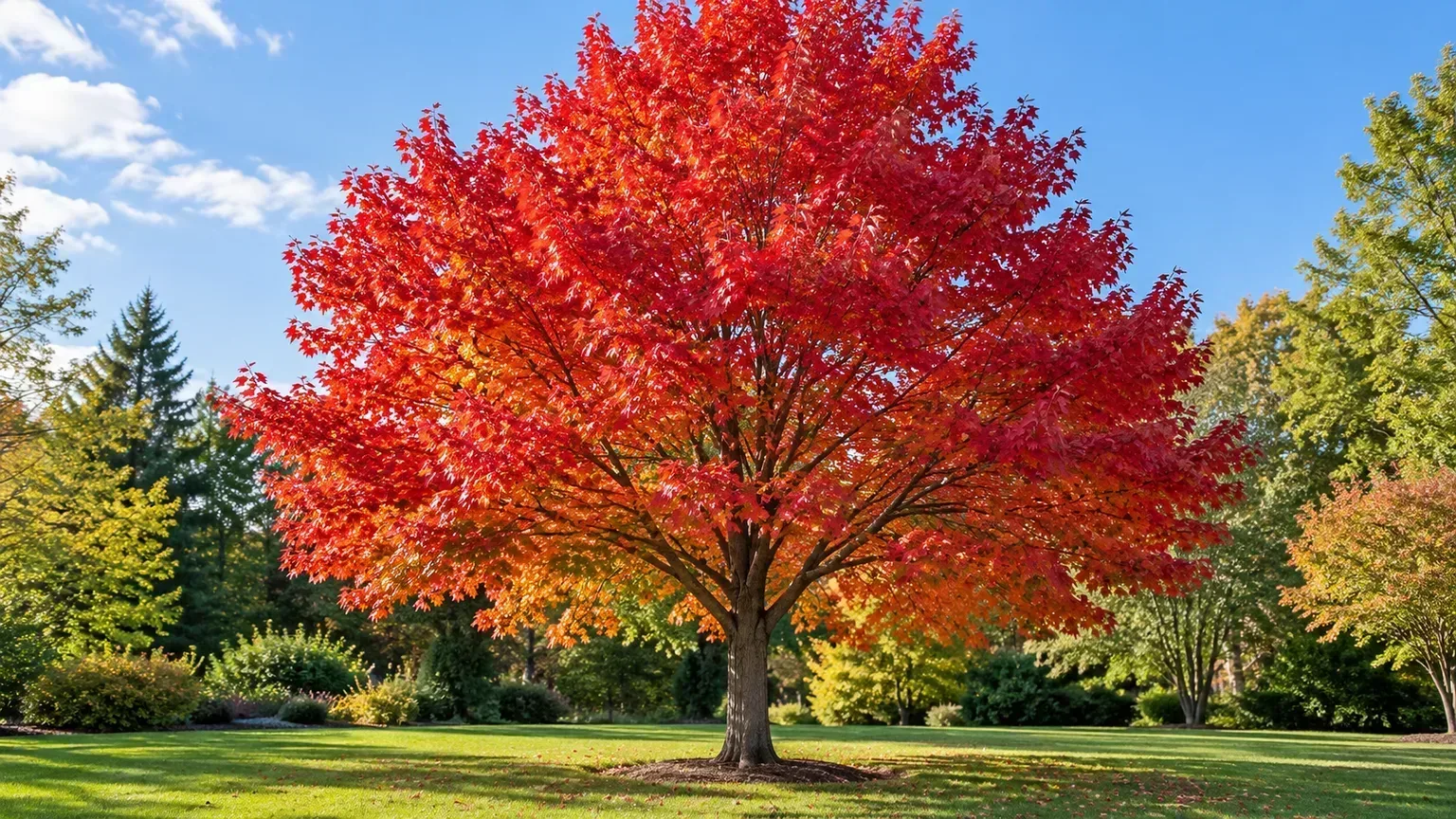
A Red Sunset maple earns its place through autumn color and summer shade, but it needs a lot more room than its nursery pot suggests. The cultivar name is ‘Franksred’ (Acer rubrum), a selected red maple commonly sold for orange-to-scarlet fall foliage. Plan for a substantial tree, give its roots a broad, moist but draining soil area, and plant it at the correct depth. Those early choices matter more than a bag of fertilizer or a rigid watering calendar.
This is a good fit for a larger lawn, park-like yard, or broad rain-garden edge where the soil stays evenly moist without remaining waterlogged. It is a poor fit for a narrow foundation bed, a strip boxed in by pavement, or a small lot where a 30-foot-plus canopy would be a problem. Decide whether the site works before choosing the tree; correcting a poor location later is difficult and expensive.
Red Sunset maple at a glance
| Feature | What to plan for |
|---|---|
| Botanical identity | Red maple cultivar ‘Franksred’, often sold as Red Sunset® |
| Mature landscape size | Roughly 40–50 feet tall and 30–35 feet wide; allow for a broader crown in favorable conditions |
| Light | Full sun for a strong crown and good fall display; light or afternoon shade can help in hotter sites |
| Soil | Moist, well-drained soil; slightly acidic to neutral conditions are a good starting point |
| Growth | Moderate to fairly fast once established; growth varies with water, soil, and climate |
| Seasonal interest | Spring flowers, summer shade, winged samaras, and yellow-orange to red fall foliage |
Cultivar profiles put the tree around 40 to 50 feet tall with a 30- to 35-foot spread, while red maple as a species can become larger. Treat nursery dimensions as a planning estimate rather than a size limit; a tree with good soil and ample moisture may grow beyond a compact landscape expectation. Western Star Nurseries describes ‘Franksred’ as starting with a more conical habit and broadening into a rounded crown, and NC State Extension lists Red Sunset among red maple selections known for early orange-scarlet color. (Western Star Nurseries; NC State Extension Plant Toolbox)
Decide whether this tree fits your yard
Choose Red Sunset for a broad, sunny space where you want a deciduous shade tree with a strong fall display and can support it through dry spells while it establishes. Red maple tolerates a range of soils, including clay, and can handle periodic wetness, but it performs best when roots receive moisture and oxygen rather than sitting in permanently saturated ground. A low area with good drainage can suit it; a compacted basin that stays soupy after rain is a different problem.
Think about your household’s tolerance for a mature tree’s seasonal cycle. Small flowers appear in spring, winged seeds develop and fall later, and the canopy drops leaves in autumn. These are not defects; they are ordinary costs of growing a large deciduous tree. If seed cleanup, leaf raking, shade over lawn, or surface roots would frustrate you, select a smaller or evergreen tree instead of trying to prune Red Sunset into a smaller role.
Mature size, roots, and seasonal cleanup
A 30- to 35-foot expected spread means the branches will reach well beyond the trunk. Measure the available canopy zone on a simple site sketch and include the mature crown, nearby roof edges, overhead utilities, sidewalks, driveways, and neighboring property. Do not count the young tree’s current crown as its future footprint. Call the local utility-locating service before digging, and check municipal rules where street trees or utility easements are involved.
Red maples form shallow, spreading roots. They are useful for anchoring a landscape tree, but the surface root mat can compete with lawn grass and may eventually push against nearby paving. NC State Extension cautions that red maple’s surface roots can buckle sidewalks or driveways if planted too close. This is not a reason to label every red maple root “invasive”; it is a reason to provide root room and avoid planting directly beside hardscape you need to keep perfectly level. (NC State Extension Plant Toolbox)
Expect to manage the area under the canopy differently as the tree matures. Grass may thin because of shade, root competition, and dry soil under the crown. A broad mulch bed or shade-tolerant ground layer is often easier to maintain than repeatedly raising the mower deck and cutting around exposed roots. Never add soil over those roots or cut large roots to restore a smooth lawn without advice from an arborist; both can stress or destabilize the tree.
Choose a site for steady growth and fall color
Sun and moisture are the two site conditions to assess first. A tree with adequate light but a dry, compacted root zone may scorch in summer; a moist site shaded by buildings can keep it alive while producing a looser crown and less consistent fall display. Check the site at different times of day and after rain before you buy.
Sun exposure and fall foliage
Full sun gives Red Sunset the best opportunity to build a dense canopy and display strong autumn color. NC State lists red maple for full sun to partial shade, and the Royal Horticultural Society notes that red maple grows in both exposures and that acidic soil can improve the autumn display. In a hot inland climate, some afternoon shade may reduce stress; at cooler northern sites, more direct sun can improve the tree’s form and color potential. These are trade-offs, not guarantees. (NC State Extension Plant Toolbox; RHS red maple profile)
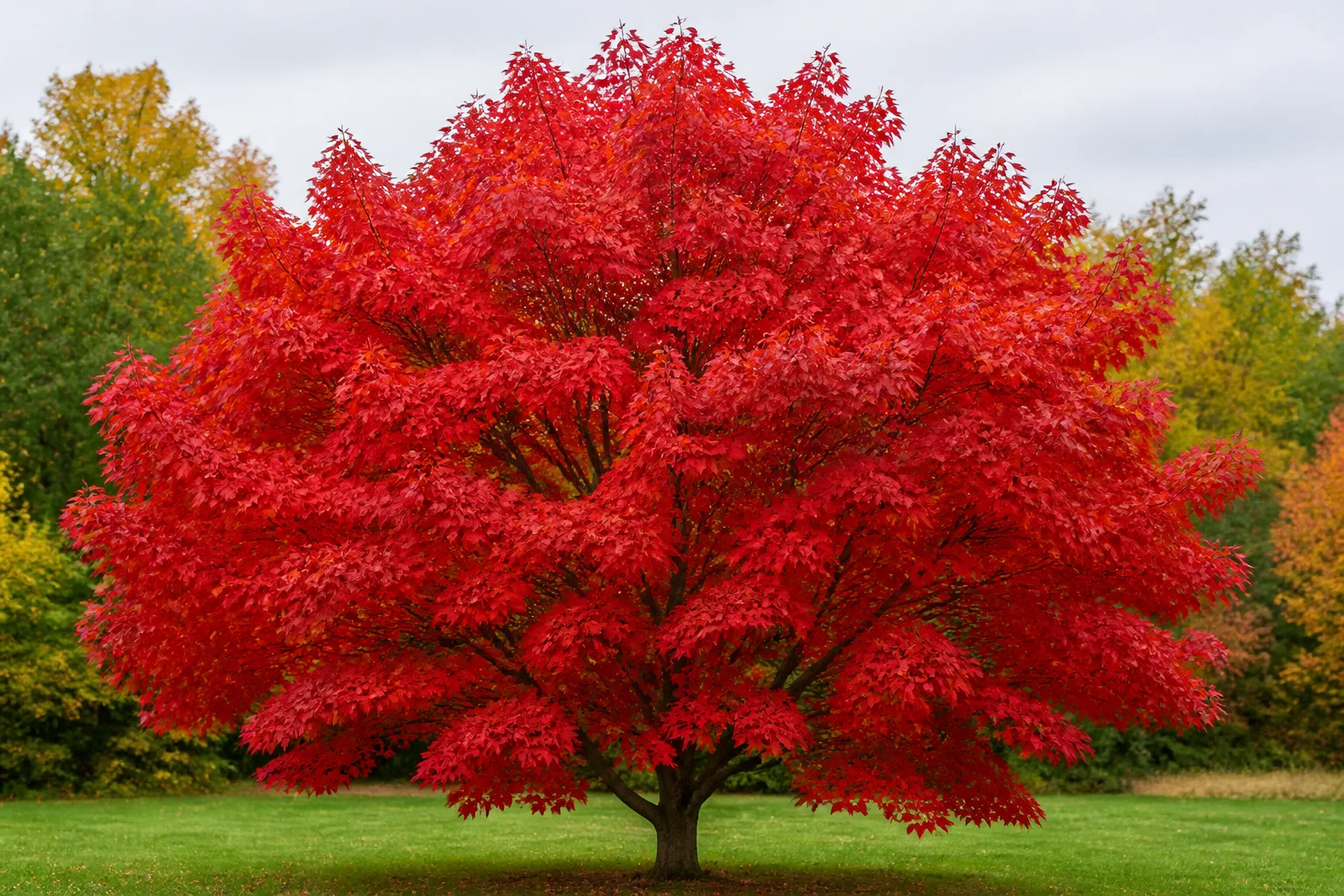
A red maple cultivar is not an autumn-color machine. Genetic identity makes color more predictable than an unselected seedling, but weather, leaf health, site conditions, and year-to-year temperature patterns still influence whether foliage appears yellow, orange, scarlet, or a mix. An unusually warm fall, drought stress, early frost, or damaged leaves can shorten or alter the show. Buy from a reputable nursery that labels the cultivar correctly, then focus on steady tree health rather than trying to force a particular shade.
Soil, moisture, pH, and drainage
Red Sunset prefers soil that stays evenly moist and drains between rains. The RHS lists red maple for moist but well-drained soil and acid to neutral pH; NC State describes the species as adaptable to several soil textures, including clay, while preferring moist, slightly acidic conditions. This means a clay site is not an automatic rejection, but a heavy clay planting hole must not become a water-holding pot surrounded by harder soil. (RHS red maple profile; NC State Extension Plant Toolbox)
Test your soil before adding sulfur, lime, peat, or a specialty “acid-loving plant” fertilizer. Alkaline soil can limit manganese availability and cause chlorosis in red maples, but yellow leaves alone do not prove high pH; poor drainage, root injury, drought, and girdling roots can also interfere with leaf color and vigor. A local laboratory test gives you pH and nutrient context, while a drainage check tells you whether the site holds water after ordinary rain. Do not add amendments merely because a product label sounds right for maples.
Plant the tree without burying its root flare
Correct planting depth is one of the most useful things you can control. A tree planted too deep can develop oxygen stress, trunk decay, and stem-girdling roots that wrap around and restrict the trunk as they thicken. Maryland Extension notes that maples are among the species more prone to girdling-root problems and recommends checking the root flare at planting rather than assuming the potting-soil surface marks the right depth. (University of Maryland Extension, “Free the Flare”)
Choose the planting window and inspect the nursery tree
Plant a container-grown or balled-and-burlapped maple during a cool period when the ground is workable and the tree is not under heat stress—usually spring before strong new growth or fall after the worst heat has passed. Your region’s timing matters more than a calendar date. Avoid planting into frozen soil, during a heat wave, or when you cannot keep the root ball moist during the next several weeks.
Before buying, inspect the trunk base and container. The root flare should be visible where the trunk widens and the first major roots emerge. If the trunk narrows straight into potting mix, gently remove excess surface mix until you find the flare; trees can arrive from a nursery already planted too deeply. Look for circling roots that wrap tightly around the root ball. Correct small roots at planting when you can do so cleanly, but reject a severely girdled or unstable specimen rather than expecting it to repair itself in the ground.
The best nursery size is not necessarily the largest available. A smaller, healthy, well-rooted tree can establish more easily than an oversized specimen with a large root ball and damaged roots. Ask which cultivar is being sold and how it was propagated; a correct label and a sound root system are more valuable than a tall trunk in the parking lot.
Dig wide, set the flare high, and backfill with site soil
Dig a hole broad enough to loosen the surrounding soil, but no deeper than the root ball measured from the root flare to the bottom. If the tree is container-grown, remove the pot and tease or correct outward-facing roots where needed. If it is balled and burlapped, follow local arborist guidance for removing synthetic wrapping and ties. Do not leave a hidden cord or wire tight around the trunk.
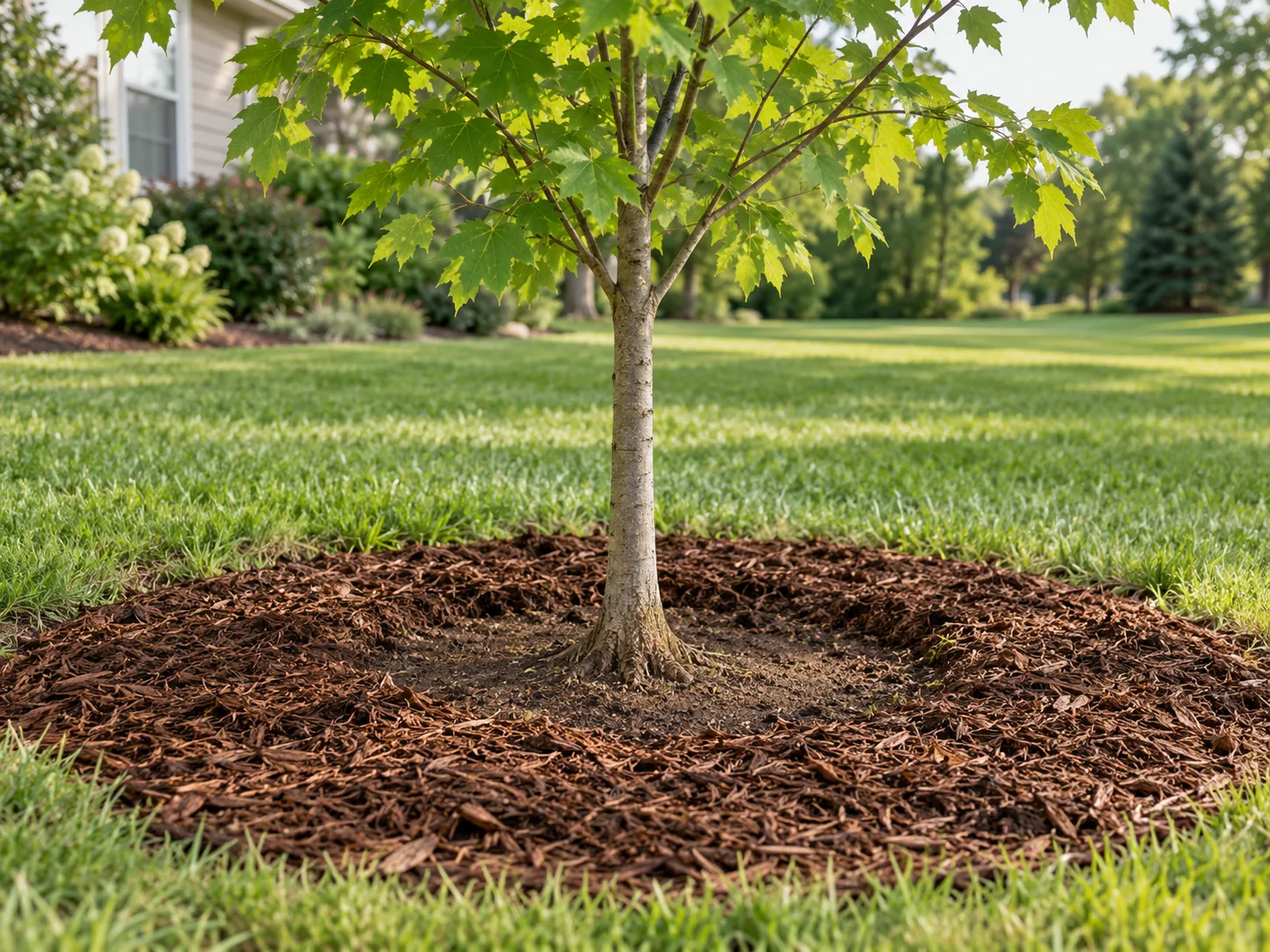
Set the tree upright with the root flare visible at or just above the surrounding finished grade so settling does not bury it. Backfill around the root ball with the soil removed from the site, breaking large clods but not packing the soil hard. Avoid making a highly amended pocket; a sharp soil contrast can discourage roots from growing outward into the native ground. Water slowly after backfilling to settle soil around the roots, then recheck that the flare remains visible.
Apply a shallow, broad mulch ring over the root zone rather than piling material against the trunk. Keep the trunk base open so you can see bark and the root flare. A tree stake is needed only if the root ball cannot remain stable; remove temporary ties when the tree stands securely, rather than leaving them to girdle the trunk.
Establish roots with careful watering and mulch
The first growing seasons are when a Red Sunset maple needs the most attention. The objective is not to keep every inch of soil wet; it is to keep the original root ball and adjacent backfill from drying completely while preserving air in the soil. Rain can wet the surrounding lawn without reaching the nursery root ball, especially when the canopy intercepts water or the ground slopes away.
Adjust irrigation to rainfall and soil moisture
Check the soil at the edge of the root ball before watering. A narrow trowel or soil probe can help you tell whether the root zone is damp below the surface. If it is still cool and moist, wait. If it is dry several inches down and the tree is newly planted, water slowly enough for moisture to soak through the root ball rather than run across the surface. Recheck after watering to see how far the water penetrated.
Use a hose on a slow trickle, a soaker hose, or a temporary watering basin to apply water across the root ball and a little beyond it. A quick spray at the trunk only wets bark and surface soil; it does little to support root growth. In sandy soil and hot, windy weather, checks will be needed more often. In cool, rainy weather or heavy soil, watering too frequently can deprive roots of oxygen. Let rainfall and soil checks set the schedule instead of applying one inch every week regardless of conditions.
As the tree establishes and expands roots, widen the watered area rather than concentrating water against the trunk. Continue checking during extended dry spells even after the tree looks settled. Mature red maples tolerate a range of conditions, but drought and heat can still produce scorched leaf edges or early leaf drop, particularly where pavement reflects heat or the root zone is small.
A two- to three-inch layer of organic mulch helps moderate soil temperature and reduce evaporation. Extend it outward as the canopy and root zone grow, but leave a few inches of bare soil around the trunk. Maryland Extension advises keeping the root flare visible and applying mulch as a broad, shallow ring; it describes roughly two to four inches as a useful depth range. If a previous mulch layer is still present, measure the total depth before adding more. (University of Maryland Extension)
Fertilize only when a soil test or growth pattern calls for it
A newly planted tree does not need a fertilizer dose simply because it has just been installed. Fertilizer cannot compensate for a buried root flare, a dry root ball, poor drainage, or an undersized site. Too much readily available nitrogen can push leafy growth when the roots are still adapting, and acidifying fertilizer does not safely correct a soil pH problem without a test.
Start with a laboratory soil test if growth is weak, leaves show recurring chlorosis, or the soil history is unknown. Follow the test’s recommendation for the affected area and use a product appropriate to the stated nutrient need. If the tree grows normally and the leaves have their expected seasonal color, leave the fertilizer bag closed; maintain mulch and water instead. A confirmed pH issue may require a measured correction, but the rate depends on soil texture and test results, not on a generic recipe for maples.
If chlorosis appears, inspect drainage and roots as well as pH. Uniform yellowing between green veins can be consistent with nutrient unavailability, but a damaged root system can produce similar symptoms. Photograph the leaves, note whether the problem begins on new or older growth, and send a soil sample or diagnostic sample to a local extension service before applying iron, manganese, or acidifying products.
Prune young trees for structure and mature trees for safety
Red Sunset needs little routine pruning once it develops a sound framework. While the tree is young, look for a strong central leader and well-spaced scaffold branches. Remove a dead or broken branch and correct an obvious competing leader in stages rather than stripping lower limbs all at once. Each cut should solve a specific structural problem; avoid pruning simply to keep a large shade tree small.
Use sharp, clean hand pruners for small branches and leave large limbs, high work, and branches over roofs or wires to a qualified arborist. For a branch-removal cut, preserve the slight swelling at the branch base instead of cutting flush to the trunk or leaving a long stub. Do not top the tree or shear its crown into a ball. Those methods leave large wounds, damage natural form, and often trigger a thicket of weak regrowth.
Pruning timing varies with local conditions and the job. Remove a broken limb that presents an immediate hazard, but schedule major structural work with a qualified arborist if the tree is mature or the branch is large. Red maples may bleed sap when pruned as growth resumes; sap flow can look dramatic, but it is not a reason to paint over the wound. For a small homeowner correction, choose a mild period when the tree is not under drought or heat stress, and avoid removing a large share of the live canopy at one time.
Troubleshoot common Red Sunset maple problems
Use the pattern and timing of symptoms before choosing a treatment. A few marked leaves after a wet spring, scorched edges during a dry heat spell, and a declining branch are different problems. A calendar of weather, watering, and symptom spread helps more than spraying the whole tree after seeing one discolored leaf.
Separate fall-color variation from scorch, spots, and dieback
Fall color is yellow or orange instead of scarlet. Some variation is normal, even in a named cultivar. NC State describes Red Sunset as an early orange-scarlet selection but notes that red maple color can vary among trees and cultivars. If the tree has grown well and the canopy is healthy, a less-red year may reflect autumn weather rather than a care failure. Recheck the cultivar label if the tree has never shown the expected color, then assess sun exposure and soil moisture. Do not drought-stress it or add fertilizer in an attempt to force red foliage; neither can guarantee a particular color.
Leaf edges turn brown in summer. First check the root zone for dryness, recent heat, reflected pavement heat, and mulch piled against the trunk. Drought-related scorch often appears during hot weather and can be worse on exposed edges. Water deeply if the root ball is dry, then wait to see whether new growth improves. If the soil is saturated, do not add more irrigation; investigate drainage and root condition instead.
Dark or spotted leaves appear after cool, wet weather. Red maple can develop fungal leaf spots. A limited outbreak is often mostly cosmetic, and fungicide is not a first response. Rake and discard heavily affected fallen leaves where disease recurs, avoid overhead irrigation that keeps foliage wet, and give the crown enough room for air movement. If spots return alongside thinning, twig death, or overall decline, ask a local extension diagnostic service to identify the problem rather than guessing at a chemical treatment.
Branches die back or the whole canopy thins. Check whether the dieback is isolated to a twig or spreading through major limbs. A single damaged branch may be pruned back to healthy wood; progressive top-down decline, repeated scorch despite adequate moisture, trunk wounds, or a buried root flare warrants a professional assessment. NC State lists verticillium wilt, canker, leaf spot, and root rot among possible red maple problems. These diseases do not all have the same treatment, so confirm a diagnosis before cutting large limbs or applying pesticides. (NC State Extension Plant Toolbox)
Red Sunset vs. Autumn Blaze: choose by site, not hype
Red Sunset is the red maple cultivar ‘Franksred’ (Acer rubrum). Autumn Blaze® is ‘Jeffersred’, a cultivar of Freeman maple (Acer × freemanii), a hybrid between red maple and silver maple. The names refer to different cultivar identities, not interchangeable labels for the same tree. NC State lists Red Sunset under red maple and Autumn Blaze under Freeman maple. (NC State Extension: red maple; NC State Extension: Freeman maple)
| Consideration | Red Sunset (‘Franksred’) | Autumn Blaze (‘Jeffersred’) |
|---|---|---|
| Parentage | Red maple selection | Red maple–silver maple hybrid |
| Fall display | Often orange to scarlet; still weather-dependent | Often orange-red; also varies with site and season |
| Site planning | Large shade tree; needs moisture and broad root space | Large, vigorous shade tree; verify mature spread and local fit |
| Best reason to choose | You want a red maple cultivar with a strong early fall color reputation | You prefer a Freeman maple hybrid and its growth/form traits |
Choose between them by the mature size on the nursery’s regional label, expected soil moisture, and the space available. Do not choose on a promise that one will always be redder, grow a precise number of feet each year, or avoid root conflict. Ask a local arborist or extension office which performs better in your region’s summer heat, soil pH, and winter conditions.
Plan for flowers, samaras, leaves, and horse safety
Red maple’s small spring flowers are part of its seasonal cycle; they are not ornamental blooms that require deadheading. Female trees produce paired winged samaras—often called helicopters—that spin down as they mature. The amount of seed litter varies by tree. Keep young seedlings pulled while small if you do not want volunteers, and expect a separate leaf cleanup after the autumn display.
If horses can reach the tree or its fallen debris, add a safety plan to ordinary cleanup. UConn Extension’s December 2025 fact sheet says fresh red maple leaves are not toxic to horses, while wilted or dried leaves and bark are extremely toxic; it recommends checking pastures and hay for debris and calling a veterinarian immediately if a horse may have eaten the hazardous material. Remove windblown branches and fallen leaves from horse-accessible areas after storms, and do not feed hay contaminated with red maple leaves. This warning is specifically about horses; do not extrapolate it to household pets without veterinary guidance. (UConn Extension, “Red Maple Toxicity and Your Horse”)
Propagation, seed-grown trees, and cultivar identity
A seedling grown from a Red Sunset maple samara will be a red maple, but it should not be expected to match ‘Franksred’ in shape, timing, or autumn color. Seedlings inherit a mix of traits, and pollination can come from a different red maple cultivar or species nearby. If you want the named cultivar, buy a correctly labeled nursery tree; named selections are propagated vegetatively, commonly by grafting or other clonal methods. The RHS describes red maple propagation by seed and grafting, but seed is appropriate for the species rather than for reliably reproducing a named clone. (RHS red maple profile)
Home propagation is also a long-term project. Seed must be collected at the right stage and may need specific pretreatment, while grafting requires compatible rootstock, clean technique, and experience. If your goal is simply to grow a Red Sunset in the landscape, sourcing a healthy, verified cultivar is more predictable than raising seedlings and waiting years to see what they become.
Conclusion
Red Sunset maple care begins before planting: make sure the yard can accommodate a 40- to 50-foot tree and its broad, shallow roots, then choose a site with ample light, moist but draining soil, and room away from pavement and utilities. Inspect the nursery tree for circling roots, set its root flare where you can still see it, and water according to the root ball’s actual moisture while it establishes. Maintain a broad mulch ring, but keep mulch off the trunk.
After establishment, use a soil test before fertilizing or changing pH, prune selectively for structure and safety, and treat fall color as a cultivar tendency rather than a guarantee. Plan for spring flowers, winged seeds, and autumn leaves; if horses have pasture access, remove wilted or dried maple debris promptly. With a suitable site and sound planting, Red Sunset can deliver shade and vivid seasonal color without demanding a complicated maintenance routine.



