How to Grow and Care for Tea Olive Shrubs in Your Garden
Grow tea olive shrubs with clear guidance on light, soil, watering, pruning, cuttings, containers, cold snaps, and the causes of leaf drop and weak flowering.
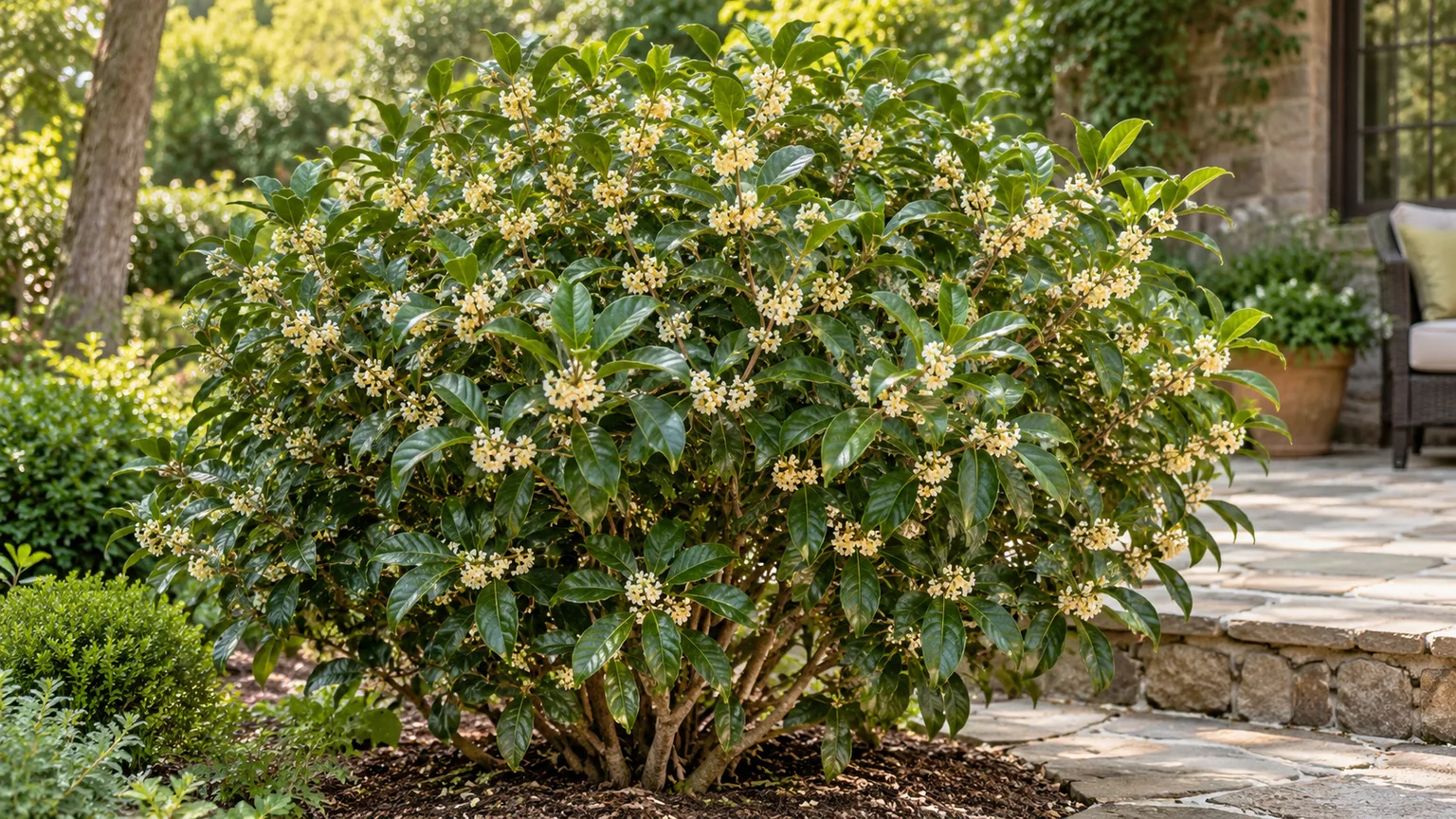
Tea olive, or sweet osmanthus (Osmanthus fragrans), is an evergreen shrub prized for tiny flowers with a surprisingly powerful perfume. Its glossy foliage supplies year-round structure, but the shrub is not a fit for every yard: it can become a small tree, dislikes poorly drained roots, and is vulnerable to sudden cold in some regions. Choose the right cultivar and sheltered site first; the routine care is then straightforward.
One point clears up much of the confusion: “tea olive” here means Osmanthus fragrans, not the fruiting olive tree (Olea europaea) or every shrub sold under the broader Osmanthus name. The plant belongs to the olive family, Oleaceae, but its care and flowers are distinct. NC State Extension’s plant profile describes it as a dense broadleaf evergreen with fragrant flowers, a habit that can be shaped, and frost sensitivity.
Identify which tea olive you’re buying
The common name can cover different species and cultivars, so read the botanical name on the nursery label before you buy. This guide focuses on O. fragrans. Holly osmanthus (O. heterophyllus) has more obviously spiny leaves and different cold tolerance, while other species and hybrids may differ in size, flower timing, and how well they handle a particular region. A label that says only “osmanthus” is not enough for a climate-sensitive planting decision.
Expect a dense evergreen shrub that can be trained as a multi-stem small tree, hedge, screen, or espalier. Published mature dimensions vary with cultivar and growing conditions: some garden references describe plants around 10 to 15 feet tall, while older specimens may become substantially larger. Reserve enough width for air circulation and maintenance rather than planting to the nursery-pot footprint; clipping a naturally broad plant into a narrow box creates recurring work and can remove flowering growth.
Is tea olive hardy where you live?
Hardiness guidance is not perfectly consistent. NC State Extension lists O. fragrans for USDA zones 8a through 11b, Oregon State University describes it as hardy around zones 7 to 8, and a recent University of Georgia Cooperative Extension publication places it in zones 7b through 9b. Those ranges reflect different regional guidance, plant material, and conditions; they are not a promise that every cultivar will tolerate every winter at the cold edge.
Use your USDA zone as a first filter, not the whole decision. A sheltered urban courtyard, a south-facing wall, wind exposure, soil moisture, the plant’s age, and the speed of a temperature drop can all change the outcome. If your garden sits near the low end of a published range, ask a local extension office or experienced nursery which O. fragrans cultivars have survived there, and treat a container as an option only if you can provide bright winter light and a gradual move indoors. Compare the regional profiles from NC State, Oregon State University, and UGA Extension rather than forcing their ranges into one universal number.
Choose a site for mature size and scent
Place tea olive where its fragrance can reach you: near a patio, entry, open window, or path where people pause. The flowers are small and may be partly hidden in the foliage, so the plant is most rewarding at close range. That same strong scent can be too much immediately beside a bedroom window for someone sensitive to perfume; give it a little distance if you prefer a softer effect.
Think of the shrub’s full outline before planting. A broad bed, lawn edge, or back-of-border position accommodates its natural shape; a narrow foundation strip next to a walkway may not. If you want a hedge, decide whether you value a softer, flowering screen or a sharply clipped wall. The first needs less repetitive shearing and usually displays more flowers; the second requires regular shaping and can sacrifice some bloom.
Give tea olive sun and draining soil
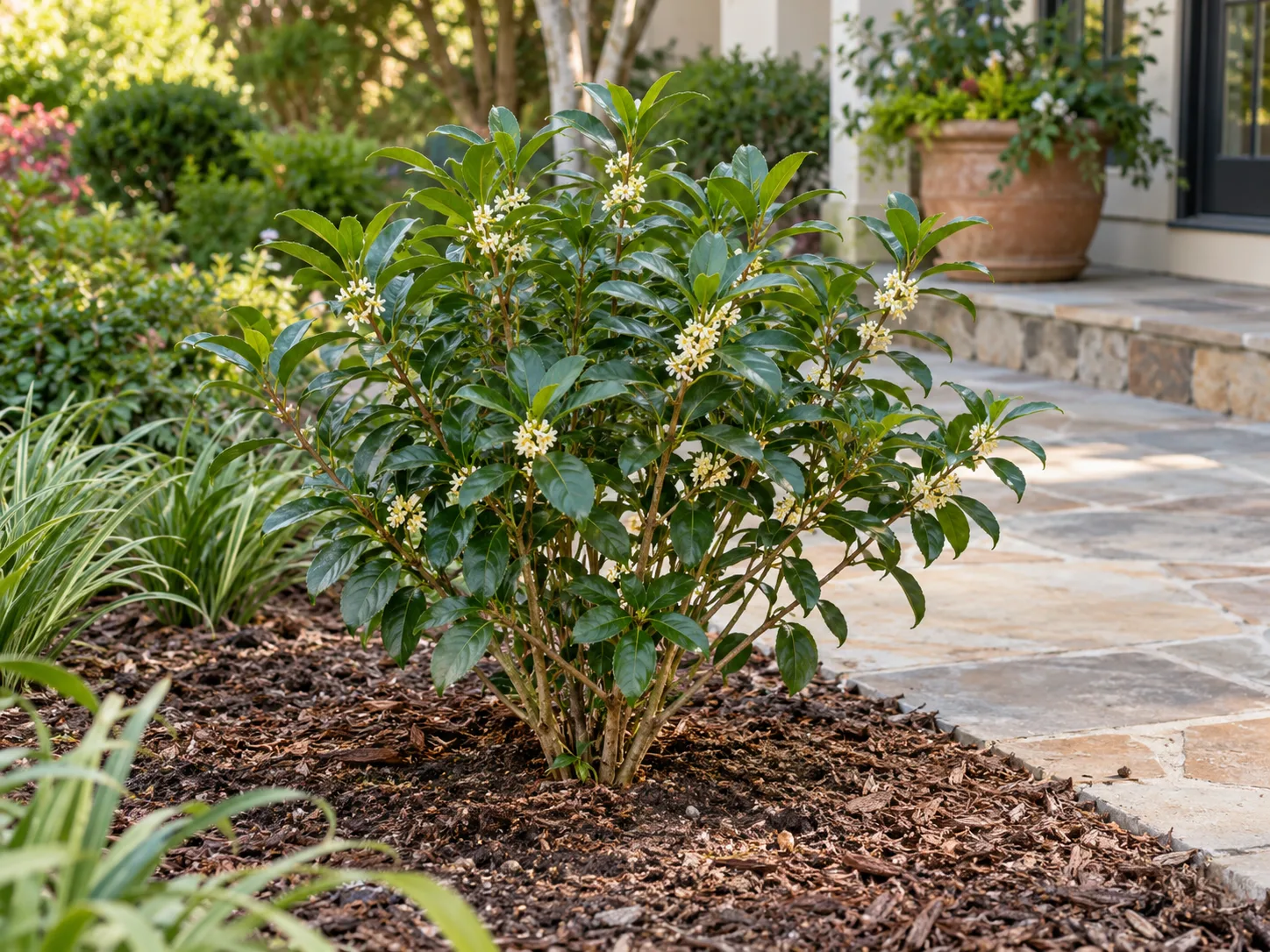
Aim for several hours of direct sun daily for denser growth and stronger flowering. In a hot-summer climate, give the shrub some protection from intense afternoon sun, especially while it is young or if the cultivar has variegated foliage. Deep shade usually creates a looser plant with fewer flowers; full exposure in a hot, dry spot can stress foliage. A morning-sun position with light afternoon shade is a useful compromise in much of the South.
As a practical starting point, Southern Living suggests about five hours of sunlight with afternoon shade to limit leaf scorch, but your cultivar and local heat should guide the final placement. Its tea olive care guidance is a regional reference, not a universal light threshold.
Moist, well-drained soil is more important than an exact garden recipe. Tea olive tolerates a range of ordinary soils, including some clay, but roots should not sit in water after rain. If the planting spot remains soggy, choose a different location or create a broad raised bed; adding a pocket of fluffy compost only inside a clay planting hole can make a water-holding basin around the root ball. For pH, start with a soil test if the site is notably alkaline or leaves yellow between green veins. Do not apply sulfur or iron on the basis of yellow leaves alone. Gardening Know How’s tea olive care guide also emphasizes drainage and notes that full sun tends to produce denser growth, while shade can help protect variegated forms.
Plant it at the right depth
Plant a container-grown shrub in mild weather when the soil is workable: fall can be useful in warm regions, while spring gives plants in colder gardens more time to settle before winter. Avoid planting into frozen ground, saturated soil, or the hottest stretch of summer unless you can keep close watch on moisture. Before digging, confirm the botanical name and mature size, then place the shrub far enough from paving and walls to allow its future canopy to breathe.
Dig a hole about twice the root ball’s width but no deeper than the root ball. If roots circle tightly around the pot, loosen the outer layer so new roots can move into the surrounding soil; do not tear the root mass apart. Set the top of the root ball level with or slightly above the finished grade, backfill with the native soil, and water slowly to settle it. Spread a modest mulch layer over the root zone, leaving a clear ring around the stems. The goal is contact between roots and evenly moist soil, not a buried trunk or a mound of amendments.
Water deeply while roots establish
During the first growing season, inspect the root zone often and water when the original root ball begins to dry. Apply water slowly at the base so it reaches the root ball and adjacent soil, then let excess drain; a quick sprinkle over the leaves does little for establishment. In hot, windy, or sandy sites, a new plant may need more frequent checks than one in a cool, heavier soil. Rainfall, texture, and plant size matter more than a fixed weekly schedule.
Once established, tea olive can tolerate short dry periods, but “drought tolerant” does not mean it performs best when chronically dry. During a prolonged hot spell, water thoroughly when the root zone has dried several inches down. If the soil remains wet and the shrub is yellowing or dropping leaves, pause irrigation and investigate drainage instead. A container dries faster than an in-ground bed and may need regular checks even when a nearby shrub is fine.
Prune after flowering, not on a calendar
You do not need to prune tea olive simply because a year has passed. If size, shape, dead wood, or crossing branches call for a cut, make the main shaping cuts just after the strongest flowering flush for your cultivar. Flowering can vary among forms, and new growth can carry later flowers; pruning before a seasonal display or shearing repeatedly through the year can remove buds and reduce fragrance. NC State Extension specifically cautions that pruning can diminish the next floral display, while Gardening Know How recommends selective branch removal rather than routine shearing.
Use hand pruners or loppers for individual branches instead of shaving the outside into a hard rectangle. Remove dead, damaged, or badly crossing stems first, then shorten long shoots back to a side branch or a leaf node. For a more open multi-stem shrub, remove one or two of the oldest stems near the base over time; for a small tree form, gradually remove lower lateral branches while preserving a balanced crown. Do not strip away a large portion of the shrub in one session unless you are willing to wait for recovery and miss flowers. A severe cut is a renovation choice, not routine maintenance.
Feed sparingly and mulch without burying stems
A tea olive growing steadily in decent soil usually needs little or no fertilizer. If growth is weak, first check light, water, drainage, root crowding, and winter injury; fertilizer cannot correct a shaded or waterlogged site. A soil test can identify a nutrient shortage before you choose a product. When feeding is justified, use a balanced slow-release fertilizer labeled for landscape shrubs and follow its label, applying it during active spring growth rather than just before cold weather.
A thin organic mulch layer helps moderate soil moisture and temperature, especially for a newly planted shrub. Keep mulch away from the base of the stems so bark stays dry and you can spot suckers, pest activity, or damage. More fertilizer and deeper mulch are not automatically better: excessive nitrogen may push soft leafy growth at the expense of flowering, while a wet mulch pile against the crown can hold moisture where you do not want it.
Propagate tea olive from cuttings
Stem cuttings are the practical way to make a plant like the parent. UGA Extension’s 2025 propagation circular describes several methods and explains that tea olive cuttings need controlled moisture and humidity to root consistently. Seed-grown plants can vary and take much longer to mature, so choose a cutting when preserving a named cultivar matters. For a home attempt, late spring to early summer is a reasonable time to try flexible current-season growth; results depend on cultivar, temperature, and humidity, so treat each cutting as an experiment rather than a guaranteed clone.
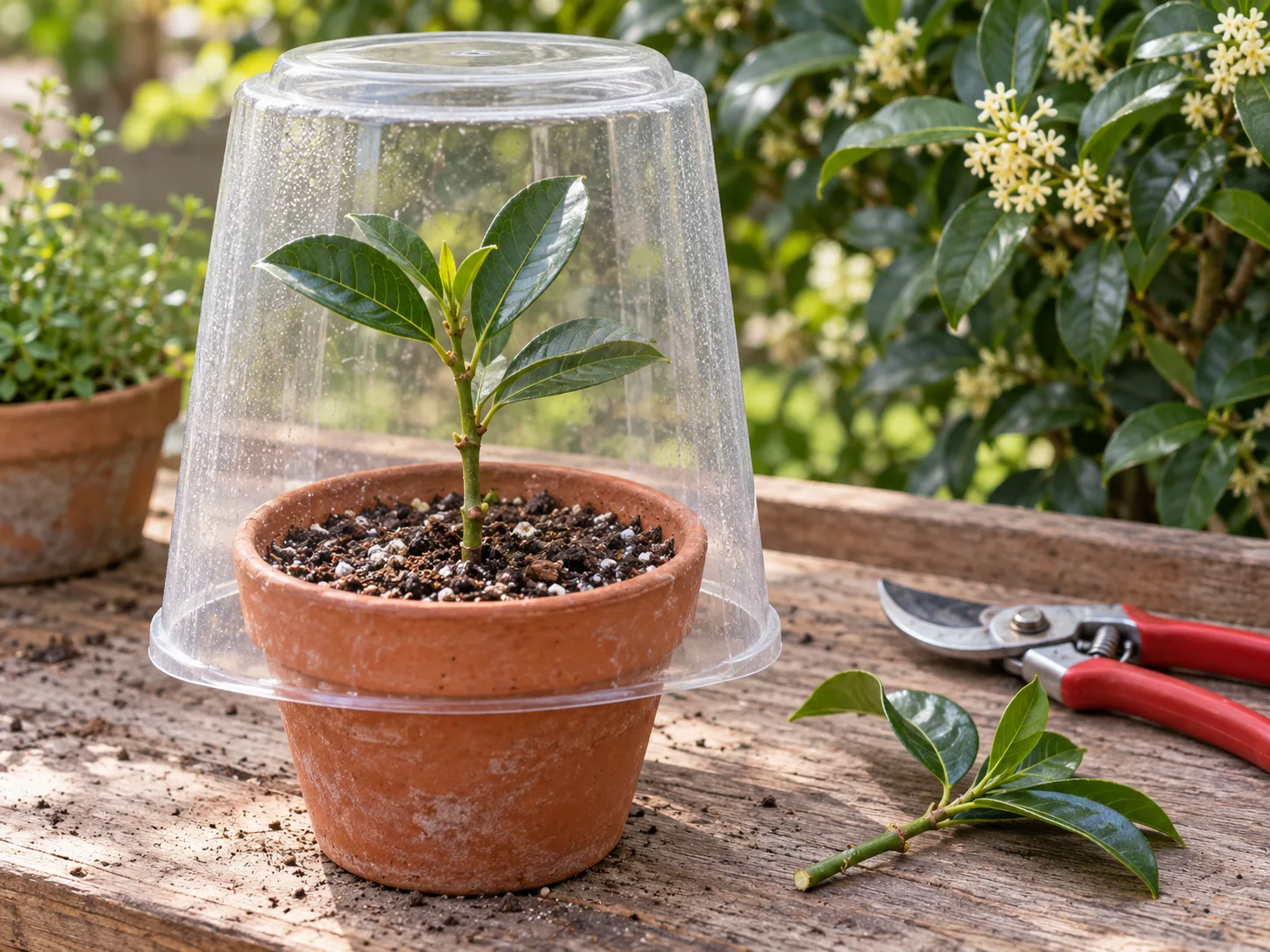
Take a healthy 4- to 6-inch nonflowering shoot with several nodes, remove leaves from the lower portion, and keep one or two leaves near the tip. Use a clean pot with drainage and a sterile, airy rooting mix; make a small hole first so the stem is not scraped as you insert it. A rooting hormone labeled for ornamental cuttings may help, but follow that product’s directions instead of copying concentration rates from research trials. Enclose the pot in a clear bag or dome to hold humidity, keep it warm in bright indirect light, and ventilate regularly so condensation does not turn into stagnant, wet conditions.
Check the mix by touch: it should stay evenly moist, not waterlogged. Avoid tugging at the stem to test for roots; new leaves can appear before a cutting has a strong root system. UGA Extension distinguishes softwood cuttings taken in late spring or early summer from semi-hardwood cuttings taken later after shoots firm up; professional misting systems and controlled humidity are part of why published rooting percentages do not translate directly to a kitchen-window setup. Pot rooted cuttings on gently and protect them through their first winter.
Grow it in a container only if winter requires it
A container makes tea olive movable and lets gardeners in colder regions protect the root ball, but it also makes the plant more dependent on regular moisture checks and bright light. Choose a sturdy pot with several drainage holes only modestly larger than the root ball; an oversized pot holds unused wet mix around small roots. Use a free-draining container mix and never leave the pot standing in a full saucer.
During warm months, acclimate the shrub gradually when moving it outside. Place it in a bright spot with some afternoon protection, then monitor both soil moisture and leaf condition. Before the first hard freeze, move it to a bright, cool, protected area if that is how you plan to overwinter it. A sunny, unheated room or sheltered greenhouse may be more suitable than a dim, heated living room; indoor air can be dry and light may be insufficient for an evergreen shrub. Reduce watering as growth slows, but do not let the root ball become bone dry.
Protect the shrub through a cold snap
A plant’s hardiness rating describes average annual minimum temperature patterns; it does not describe how well an evergreen shrub handles every sequence of warm days and abrupt freezing nights. Tea olive can show leaf or bud damage after cold, and NC State notes that frost injury can affect a later floral display. A sheltered site out of drying wind and a layer of mulch over the root zone can help an in-ground shrub, especially when young, but neither makes the foliage freeze-proof.
After a freeze, wait before pruning. Damaged leaves may look alarming while stems remain alive, and cutting too early can remove tissue that would recover or expose inner branches to more stress. When new growth begins, scratch a small stem section gently to check for green tissue beneath the bark; prune clearly dead wood back to live growth. If the entire plant is badly injured, give it time to show where it can resprout before making a major renovation cut. For a pot, protect the container and plant together because roots in a pot are more exposed than roots insulated by garden soil.
Choose cultivars by flower color, size, and season
Tea olive is not one uniform flowering schedule. UGA Extension groups more than 160 classified cultivars by visible traits and flowering behavior: white to pale-yellow forms that flower once in autumn, yellow forms that flower in autumn, orange forms with autumn bloom, and repeat-flowering forms that can bloom several times from fall into spring. The group names and naming conventions may vary in nursery listings, so confirm the exact cultivar and expected bloom habit with the seller.
For the classic creamy-white flower and evergreen shape, start with a correctly labeled O. fragrans cultivar and check its expected mature dimensions. ‘Apricot Gold,’ ‘Butter Yellow,’ ‘Conger Yellow,’ and ‘Orange Supreme’ are selected for different flower shades; O. fragrans var. aurantiacus has orange-toned flowers. The repeat-blooming var. semperflorens may suit gardeners seeking a longer season, while ‘Fudingzhu’ is often sold as a compact, longer-flowering form. Descriptions such as “cold hardy” or “blooms for months” are relative: ask which winters and conditions support that claim, and do not assume the cultivar will stay small without pruning. NC State’s profile and UGA Extension’s cultivar-group summary are useful references when a nursery label is brief.
Diagnose poor bloom before you fertilize
If a healthy-looking tea olive has few flowers, begin with light and pruning history. A shrub in deep shade usually has less energy for flowers, and cuts made before the main bloom can remove buds or flowering shoots. Next, consider a recent cold snap: frost can damage buds even when the evergreen plant survives. Give a recently planted or heavily pruned shrub time to establish and rebuild flowering wood before deciding that it needs a stronger fertilizer.
Then verify the cultivar and its expected season. Some forms flower mainly in autumn, others can bloom intermittently, and weather shifts the calendar from one region to another. A plant bought without a cultivar name may not match a neighbor’s plant even if both are called tea olive. Keep a simple note of bloom dates, pruning, and freeze events for a year; that record helps distinguish a normal cultivar rhythm from a care problem more reliably than adding fertilizer in midsummer.
Treat leaf drop as a clue, not a diagnosis
Evergreen shrubs naturally replace some older leaves, but widespread or sudden leaf drop signals stress worth investigating. Start with the root zone: dry soil points toward missed watering or a pot that dries quickly, while persistently wet soil suggests poor drainage or too much irrigation. Feel the mix below the surface rather than responding only to a dry-looking top layer. If roots are waterlogged, adding more water is the wrong fix.
For a container moved indoors, consider the transition itself. A sharp change in temperature, humidity, light, and airflow can trigger leaf drop even if the plant was healthy outside. Move it gradually, give it the brightest suitable location, keep it away from heat vents, and avoid the temptation to compensate for dry indoor air by keeping the pot constantly wet. If leaves drop along with sticky residue, tiny insects, or dark growth on the surface, inspect for sap-feeding pests and address that specific cause.
Watch for scale and aphids
NC State Extension lists aphids and scale among tea olive’s pests. Check leaf undersides, young shoots, and stems when foliage looks dull or sticky; scale may appear as small fixed bumps, while aphids cluster on tender growth. Honeydew can make leaves tacky and may support dark sooty growth, but that residue alone does not identify which insect is present.
First confirm the pest and how widespread it is. On a small plant, a firm water rinse or wiping accessible insects away may be enough to reduce a light infestation; recheck new growth because one cleanup may not reach every insect. Avoid spraying on a hot day or applying a pesticide without confirming it is labeled for the plant and pest, and follow all label precautions if a product is needed. A shrub under drought, root, or light stress is also less able to tolerate pest pressure, so correct the growing condition alongside the infestation.
Follow a simple seasonal care plan
In spring, inspect for winter injury and wait until the main bloom flush ends before shaping. Add mulch if the root zone is exposed, check whether water drains after rain, and fertilize only if a soil test or clear growth symptoms justify it. This is also the easiest season to select and plant a shrub in colder locations.
In summer, water new plants and pots according to root-zone moisture, and protect a young shrub from severe afternoon heat if leaves scorch. Take softwood cuttings while flexible new growth is available, if you want to propagate. In autumn, note which cultivar is blooming before you prune, reduce late-season feeding, and prepare container plants for a gradual move to shelter before freezing weather. In winter, water only when the soil is not frozen and the root ball is drying; do not prune frost-damaged branches until the boundary between live and dead growth is clear.
Conclusion
Tea olive is easiest to grow when you treat climate, cultivar, and drainage as connected choices. Confirm that you have Osmanthus fragrans, give it room and several hours of sun with afternoon relief in hot climates, keep the root zone moist while it establishes, and avoid soil that stays saturated. Its mature size and cold response matter more than a generic promise of low maintenance.
If flowers are the priority, preserve the growth that carries buds and prune after the main display rather than shearing on a fixed schedule. If your winters are uncertain, choose a locally proven cultivar or grow it in a pot only when you can provide bright, protected winter conditions. Observe before you intervene: checking the soil, light, recent weather, and cultivar will usually point to a better next step than more water or fertilizer.