Heavenly Bamboo Care: Planting, Watering and Pruning
Learn how to plant, water, prune, and overwinter Nandina domestica, choose a right-size cultivar, and responsibly manage fruit, pet access, and regional spread.
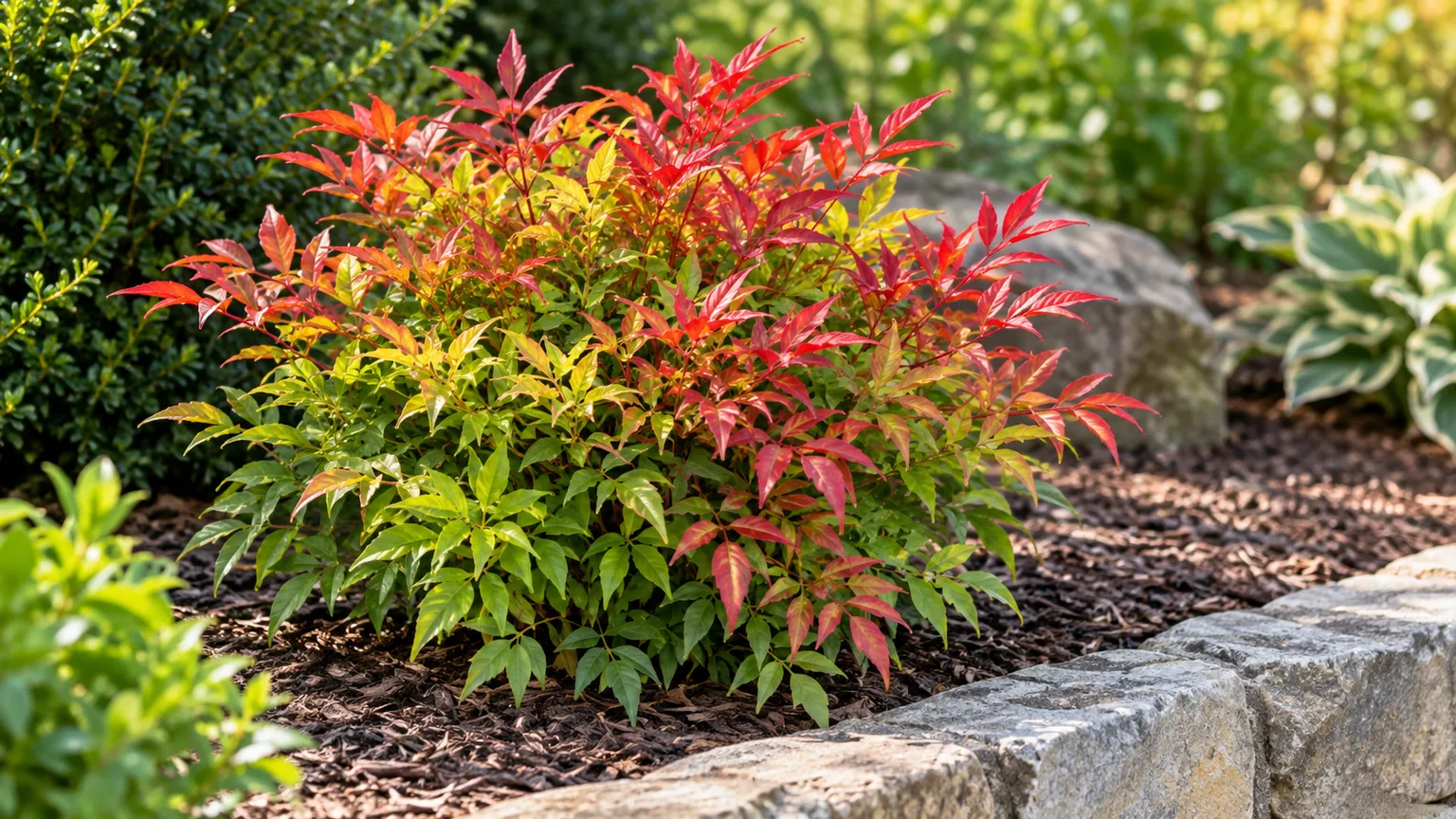
Heavenly bamboo (Nandina domestica) is an upright evergreen or semi-evergreen shrub with cane-like stems, fine compound leaves, spring flowers, and often bright red winter fruit. Its common name is misleading: Nandina is in the barberry family, not the grass family, and it does not grow like a running bamboo. It can still spread by underground stems, and its fruiting forms raise real regional and animal-safety concerns, so check where you live before planting.
The basic growing recipe is simple: give Nandina a site with light to partial shade, soil that drains, and steady moisture while roots establish. The harder decision is whether the plant and cultivar are appropriate for your location. In parts of the Southeast it escapes gardens, and berries and foliage contain cyanogenic compounds; a low-fruiting selection reduces berry concerns but does not make every issue disappear.
| At a glance | Practical range |
|---|---|
| Botanical name | Nandina domestica |
| Plant type | Broadleaf evergreen or semi-evergreen shrub in Berberidaceae |
| Typical species size | Often about 6–8 feet tall, but cultivar size varies widely |
| Light | Full sun to shade; brighter light often improves seasonal color |
| Soil | Adaptable if the root zone is moist but well-drained |
| Hardiness | Commonly listed for USDA zones 6–9; cold damage and leaf drop vary |
| Main decision before planting | Check local invasive status, fruit set, and access by pets or children |
Identify heavenly bamboo before you plant
Look at the leaves and flowers, not the common name. Heavenly bamboo has upright, woody canes and long, compound leaves divided into many small leaflets; mature plants may carry clusters of white flowers followed by red fruit. That combination separates it from true bamboo, which is a grass with jointed culms and simple leaves.
A mature Nandina also has a different shape from the fast-growing running bamboos that can cross property lines. It is a shrub whose underground stems can send up new shoots and expand a clump, but the aboveground growth is a branching collection of canes rather than bamboo culms. The distinction matters for identification and maintenance: you do not manage Nandina with bamboo barriers, but you should still watch for basal shoots and seedling spread.
Why Nandina is not a true bamboo
Nandina belongs to Berberidaceae, the barberry family; true bamboos belong to Poaceae, the grass family. The name “heavenly bamboo” refers to the plant’s straight stems and fine foliage, not to its botanical relationships. University of Maryland Extension identifies it as an evergreen barberry relative and points to compound leaves, white flowers, and red berries as features that separate it from bamboo (University of Maryland Extension).
That identification changes what to expect. Nandina does not produce the hollow, jointed culms characteristic of bamboo, and it does not need the same containment strategy as a vigorous running bamboo. It can spread through rhizomes and suckers, however, and birds can move seed from fruiting plants. A plant that looks contained at the foundation today can therefore create shoots or seedlings beyond its original outline later.
Check local invasive status before buying
Nandina is nonnative in North America, but its ecological status is not identical in every state or county. North Carolina State Extension lists the species as invasive in North Carolina and recommends considering alternatives or non-fruiting cultivars. Clemson Extension describes naturalization in South Carolina woodlands and calls out the spread of fruiting plants; Virginia Tech notes that Nandina has proved invasive in warmer parts of Virginia and farther south (NC State Extension; Clemson Cooperative Extension; Virginia Cooperative Extension).
The concern is not a blanket claim that every plant is invasive everywhere. Maryland’s current agriculture department list includes Nandina domestica among prohibited invasive plants, while other local guidance may rank it differently or focus on naturalized areas. Before you buy, search your state department of agriculture, invasive plant council, or local Cooperative Extension database for the scientific name. If it is prohibited, invasive, or discouraged near natural areas where you live, choose a native substitute rather than relying on a nursery label or a cultivar’s marketing name (Maryland Department of Agriculture).
Choose a cultivar for the site and its fruiting habit
The species can become a medium to large shrub, while named selections range from compact mounds to taller forms. Clemson Extension gives the species a mature range around 6 to 8 feet tall, and Virginia Tech lists plants reaching roughly 10 feet; this variation is a reminder to use the cultivar tag, not a generic species height, when spacing a planting. Allow room for the mature spread and for shoots that may appear around the base.
Fruit production is as important as size. Older or species-form Nandina can produce heavy clusters that persist into winter, while several compact cultivars are selected for very low or absent fruit. ‘Fire Power’ and ‘Gulf Stream’ are commonly recommended as low-fruiting selections, but descriptions vary among extension profiles: some say essentially sterile, while others say little or no fruit. Treat “fruitless” as a selection goal to verify, not as a guarantee that all plants sold under a name will behave identically.
What compact, low-fruiting selections actually solve
A compact cultivar solves a space problem: it is easier to fit into a small border, foundation bed, or pot than a full-sized species plant. A selection with very low fruit set also reduces the chance of berries being carried away and lowers the amount of fruit near pets or children. It does not remove the plant’s leaves and stems, change Nandina’s regional status, or make the plant safe to chew.
If you want a dwarf shrub mainly for color, compare height and width, winter foliage, and fruit notes together. ‘Fire Power’ is a familiar small form with reddish foliage and little fruit; ‘Gulf Stream’ is another compact choice. For a broader comparison and growing details, see this guide to Firepower Nandina. If your local extension discourages all Nandina, choose a regionally native shrub with a similar size and foliage role instead; Clemson lists American beautyberry, winterberry, inkberry, and Virginia sweetspire among alternatives suited to parts of the Southeast, but the best substitute depends on local conditions and desired height (Clemson Cooperative Extension).
Site the shrub for healthy growth and foliage color
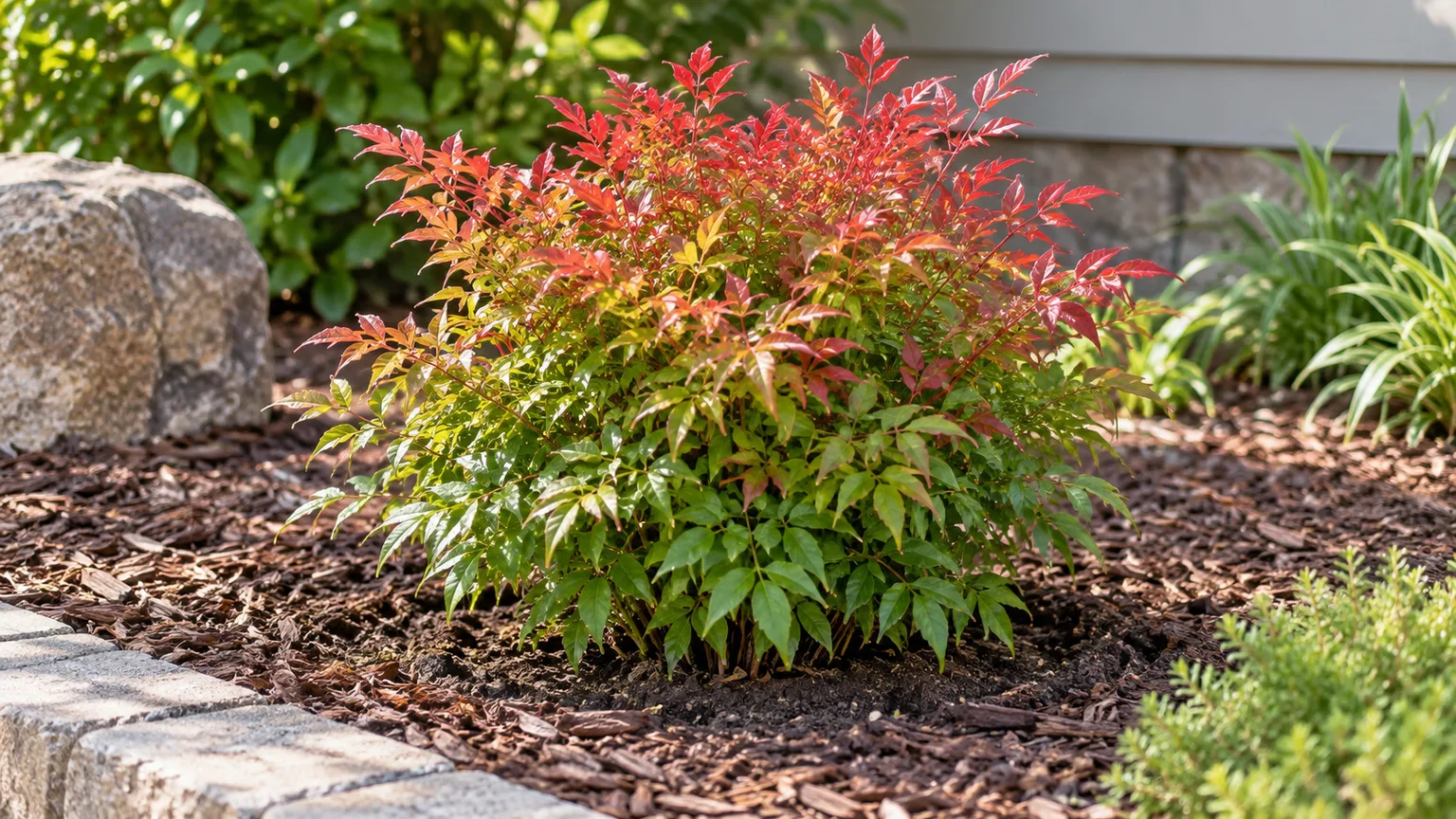
Nandina is adaptable enough to grow in full sun, partial shade, or even fairly deep shade, but appearance changes with exposure. A brighter site generally strengthens red or bronze seasonal foliage and can keep the plant denser. In high heat, a spot with morning sun and some afternoon relief may protect leaves from stress while still giving more light than a deep, dark corner.
Do not choose a site only for a nursery photo of red leaves. Some cultivars turn more colorfully in cool weather; winter display can vary with cultivar, climate, and the amount of sun. If you are planting a taller species form, also consider its mature outline and whether the site sits beside a path, window, fence, or natural area where fruit and new shoots would be unwanted.
Balance light with summer heat and winter wind
Use the local climate to choose between open sun and filtered light. In a cool or mild summer, full sun can be a good way to encourage strong foliage color. In hot regions, especially where a paved wall reflects heat, morning sun with light afternoon shade may reduce scorch; Virginia Tech also recommends a spot protected from harsh winds, which can intensify winter leaf and stem damage.
Shade is not automatically a problem, but it can make the plant looser and less colorful. If a healthy shrub remains green in shade, moving it is optional unless color is your priority. Avoid relocating an established shrub in extreme heat or drought; if you do move it, choose a cool part of the year for your region and keep the root ball moist until it reestablishes.
Match soil moisture to drainage
The useful soil description is “moist but well-drained,” not “constantly wet.” Nandina tolerates a range of textures and pH, but roots still need oxygen; heavy soil that stays saturated after rain can cause declining roots and yellowing. If water sits in the planting spot after a storm, choose a better-drained bed or build a modest raised area rather than trying to fix a chronically wet site with a handful of sand.
Improve the bed across a broad area with organic matter when soil structure needs it, but do not create a small pocket of rich potting mix in a clay hole. That can hold water like a bowl around the root ball. A light organic mulch over the root zone helps moderate moisture and temperature; leave the canes clear so mulch does not stay piled against stems. The Royal Horticultural Society likewise recommends a sheltered position in moist but well-drained soil (RHS plant profile).
Plant heavenly bamboo at the right depth and season
Plant container-grown Nandina in a mild season when you can keep up with watering. Fall is often useful in warm-winter climates because roots can grow while air temperatures are moderate; spring is safer where winter arrives early or where a newly planted shrub would face a deep freeze before establishing. Avoid planting during a heat wave or when the ground is waterlogged or frozen. The best month depends on your climate, not a single nationwide calendar.
Set the root ball so the top sits level with, or slightly above, the surrounding soil. Dig a hole wider than the root ball but no deeper than its height, loosen circling roots at the outer edge, and backfill with the soil you removed. Water slowly to settle soil around the roots, then add a 2- to 3-inch mulch layer over the root zone without banking it against the canes. General UGA landscape guidance recommends fall planting for many woody shrubs in the Southeast; local extension advice should guide the timing in colder or wetter areas (UGA Cooperative Extension planting guidance).
Space the plant according to its expected mature width, not the small nursery pot. Dwarf cultivars may need only a few feet, while a full species plant should not be squeezed into a narrow strip that forces repeated shearing. If the label gives only a common name, look up the cultivar and scientific name before planting so you can confirm mature size and local status.
Water by establishment stage, not by calendar
A newly planted shrub needs more reliable moisture than an established one. During its first growing season, check soil near the root ball every few days in dry or hot weather; water deeply when the upper few inches are drying rather than giving a light sprinkle that wets only the surface. The exact interval changes with rain, soil texture, temperature, and the size of the root ball, so a weekly schedule is only a starting point.
Once the roots have grown into surrounding soil, Nandina can tolerate short dry periods better than a newly planted shrub. Water during extended drought or when the soil is dry well below the surface, then let excess water drain. Repeated shallow watering encourages surface roots, while frequent watering in a poorly drained bed leaves roots short of air. If leaves droop during heat, check the soil before adding water; a plant can wilt from either dry soil or waterlogged roots.
Mulch helps keep the root zone more even, but it does not replace checking moisture. A 2- to 3-inch layer of bark or leaf mulch is usually enough for a shrub bed; keep it several inches away from the plant base. Fertilizer is rarely the first fix for slow growth or pale foliage. Start with drainage, light, planting depth, and root moisture, and use a soil test before applying nutrients if growth remains weak.
Grow Nandina in a container
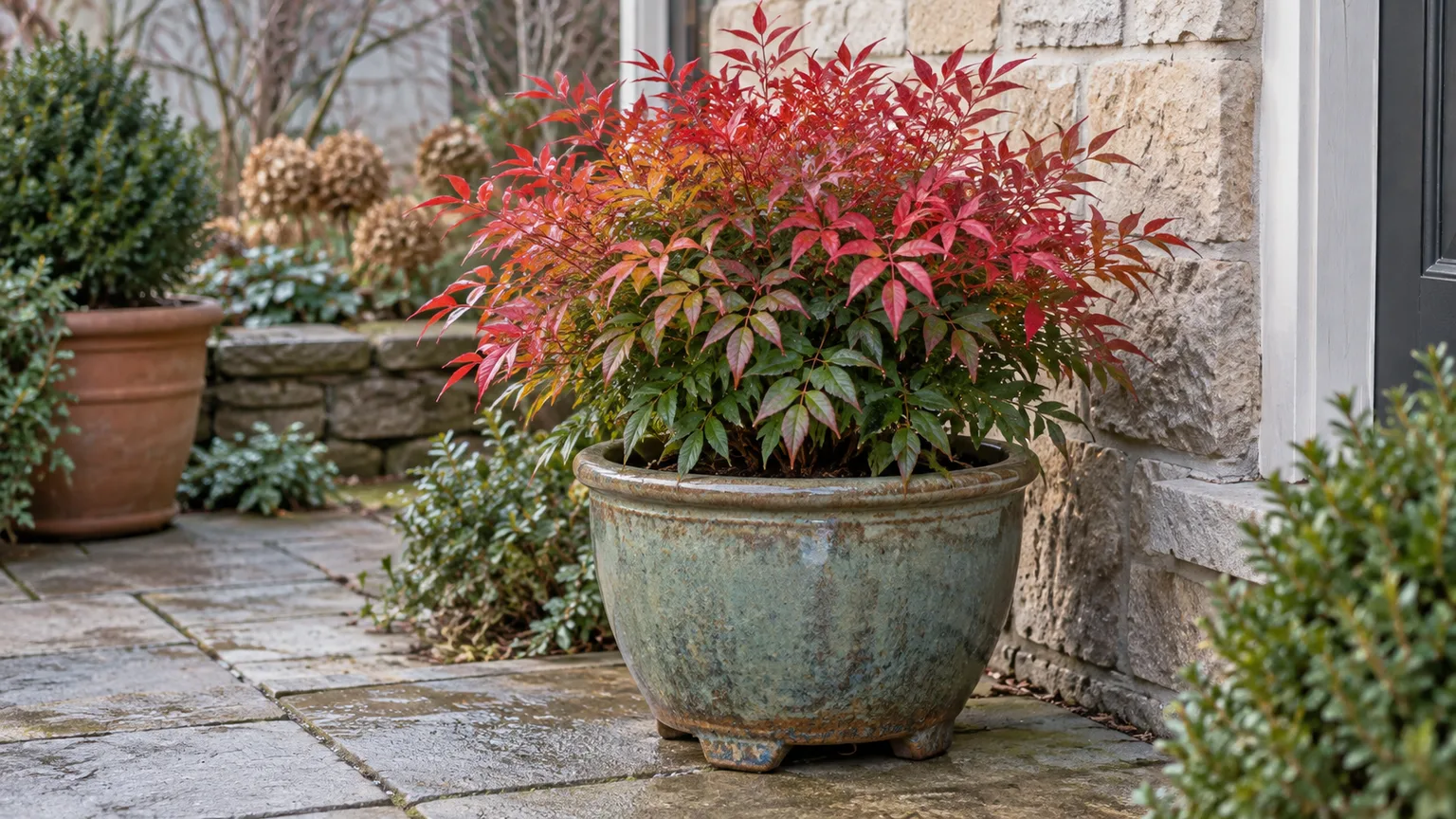
A container is practical for a compact cultivar when you need a movable accent or have limited planting space. Choose a stable outdoor pot with several drainage holes and room for the root ball plus a little growth; an oversized pot can stay wet longer than the roots can use. Use a free-draining potting mix made for outdoor shrubs, and do not place a layer of stones in the bottom as a substitute for drainage.
Container plants dry more quickly than plants in a garden bed because their roots have less soil around them. Check the mix with a finger or moisture probe and water thoroughly when it begins to dry; empty a saucer rather than letting the pot sit in water. In winter, a container root ball is exposed to cold from all sides, so shelter it against a wall, insulate the pot, or move it to a protected outdoor location when severe cold is forecast. Do not assume the shrub must live indoors: Nandina is an outdoor landscape plant, and a warm, dim room is a poor substitute for outdoor light and seasonal conditions.
Re-pot only when roots densely circle the pot, water runs straight through, or the plant has outgrown its container. Move it into a container one size larger and refresh some mix rather than jumping to a very large pot. A low-fruiting cultivar is still the better choice around pets or wildlife, and a pot does not eliminate the possibility of berries, discarded seeds, or escaped shoots.
Prune canes to keep the shrub full from the base
Prune Nandina to manage old canes, not to force every stem into a clipped ball. A common problem with taller forms is bare lower stems and a leafy crown; shearing only the top makes the shrub look more formal for a moment but does not encourage a balanced base. Clemson Extension recommends cutting canes at varying heights or removing some of the oldest stems at ground level to improve light and encourage new shoots.
Late winter or early spring, just before new growth starts in your area, is a useful time to assess structure. Remove dead or damaged canes first, then take out the oldest, weakest, or most crowded stems at ground level. For a light annual tidy, remove a few canes rather than shortening every stem. If you want to keep flowers or fruit, recognize that pruning can reduce the next flush; if you want to prevent fruit, remove flower clusters after flowering and before berries develop.
Renovate a leggy plant in stages
For a shrub that has become tall and bare underneath, thin out about one-third of the oldest canes at soil level in the first year. The remaining canes keep some screening while new basal growth fills space. Repeat the process the next year if needed, choosing the oldest stems again rather than cutting all stems to the same height.
If the whole plant is badly overgrown, Nandina can usually tolerate harder renovation, but timing matters. UGA Cooperative Extension advises severe pruning of broadleaf shrubs such as Nandina as spring growth begins; a hard cut may sacrifice flowers and fruit for that season and can expose the plant to cold if done before a severe freeze. Use sharp clean loppers or pruning shears, make cuts close to the base without damaging the crown, and then let new shoots develop naturally rather than immediately shearing them into a box. If the plant is in the wrong place, difficult to manage, or locally discouraged, removal and replacement may be a better long-term choice than repeated renovation.
Handle flowers and berries responsibly
Nandina’s flower clusters appear above the leaves, usually in late spring or early summer, and are followed by red fruit on many forms. That fruit is one of the reasons the plant was widely used in winter landscapes, but it is also the feature that can carry seeds beyond the garden. If your area lists Nandina as invasive or you want to reduce spread, remove the flower panicles before fruit forms and bag the clippings rather than leaving seed-bearing material near a woodland edge or storm drain.
The wildlife risk should be described precisely. A 2010 case report from University of Georgia veterinary researchers examined cedar waxwings that died after eating large amounts of Nandina berries; the birds had berries in their digestive tracts and findings consistent with cyanide toxicity. This documents a real hazard under heavy feeding when fruit is readily available, not proof that every bird that samples a berry will be poisoned. Still, a shrub that can produce large fruit clusters is not a reliable bird-food planting, and birds may disperse the seeds as well (published case report in Veterinary Medicine International; Clemson Extension).
For pets, the ASPCA lists Nandina domestica as toxic to dogs, cats, and horses because it contains cyanogenic glycosides. The Pet Poison Helpline notes that all plant parts may contain cyanide-containing compounds and that plant material may release free cyanide when chewed or damaged; the risk depends on the amount eaten and the animal. Keep pets from chewing leaves, stems, or berries, and contact a veterinarian or animal poison service promptly after a suspected ingestion rather than waiting for symptoms or trying a home remedy (ASPCA plant entry; Pet Poison Helpline).
If the plant is already in your yard, you do not need to panic because it has berries. Remove fruit clusters if you want to limit seed spread or keep them out of reach, and check the area around the shrub for seedlings. But if your goal is a wildlife-friendly planting, replacing a fruiting Nandina with a locally appropriate native shrub is a cleaner solution than expecting birds to avoid the berries.
Propagate only when the cultivar and location make sense
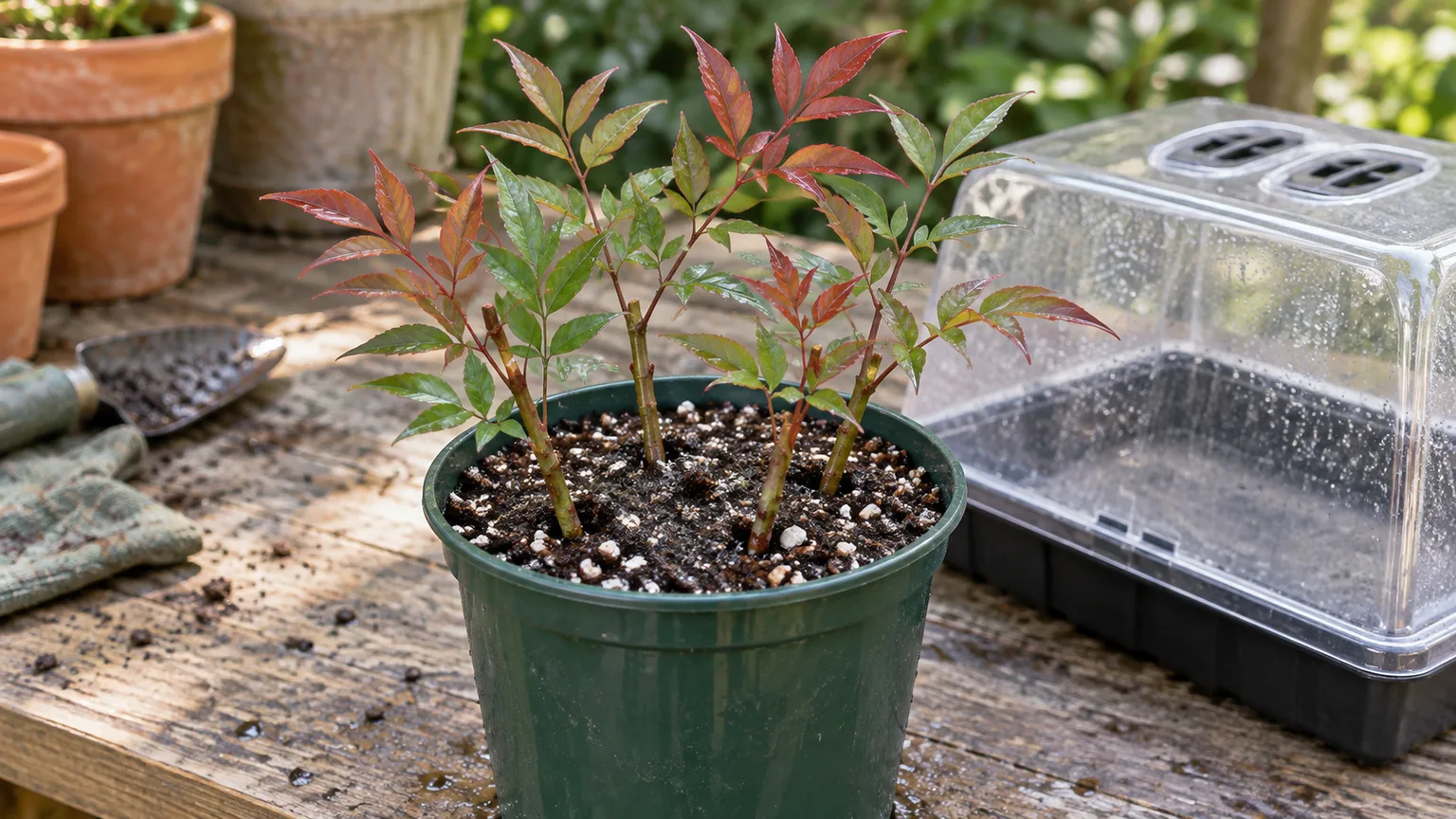
You can increase Nandina by separating rooted suckers, taking semi-ripe stem cuttings, or growing seed, but first decide whether creating more plants is responsible where you live. Do not collect berries and sow seed from a fruiting plant in an area where Nandina is invasive or regulated. If the existing plant is a low-fruiting named cultivar, use a vegetative method so the new shrub retains the parent’s growth habit and foliage traits.
Use suckers or semi-ripe cuttings
A rooted sucker is the simplest choice when the plant already produces shoots at the edge of the clump. In early spring or mild weather, expose the connection carefully and separate a shoot that has its own roots; replant it promptly at the same depth and keep its soil evenly moist while it recovers. Avoid digging in summer heat, when a small division loses water before it can replace roots.
For cuttings, choose a healthy semi-ripe stem in summer: firm at the base but still flexible, with current-season leaves. Cut a short section with several nodes, remove lower leaves, and insert the base into a clean, free-draining propagation mix. Keep it humid but not waterlogged, and ventilate a cover to limit mold; rooting can be slow, so do not tug the cutting to check progress. Fine Gardening lists semi-ripe summer cuttings as a propagation method, and the Royal Horticultural Society also recommends semi-hardwood cuttings or seed (Fine Gardening plant guide; RHS plant profile).
Seed is possible but slower and less predictable than vegetative propagation. It also carries the highest risk of spreading a fruiting plant, and seedlings may not match a named cultivar. If local guidance discourages Nandina, do not propagate or give away seedlings; use the opportunity to switch to a species suited to local ecosystems.
Diagnose yellow leaves, brown tips, pests, and winter damage
Do not treat every color change as a disease. Some Nandina foliage develops red or bronze tones in cooler weather, and leaf color varies by cultivar and sun exposure. Before changing the site or applying fertilizer, check whether the change is seasonal, whether it affects old or new leaves, and whether the soil is dry, saturated, or recently disturbed.
Yellow leaves on multiple stems can follow waterlogged soil, transplant stress, or root damage; inspect drainage and root-zone moisture first. If only older leaves are changing while new growth looks normal, watch for normal leaf turnover before intervening. Brown edges or tips can follow dry soil, reflected heat, harsh wind, or winter injury. Water based on the soil, not the color alone, and avoid adding fertilizer to a stressed plant until you know the cause.
Nandina usually has few serious pest or disease problems, but inspect stems and leaf undersides if growth declines. Cottony or scale-like bumps, sticky residue, or clusters of small insects may signal scale, mealybugs, or whiteflies; confirm the pest before choosing a treatment. Clemson notes that some compact cultivars can show a nonlethal virus that causes cupped, crinkled, or twisted leaves and stunted growth. Those symptoms are not corrected by extra water or fertilizer, so compare new leaves with the cultivar’s normal appearance and ask a local Extension office if you are unsure.
Cold injury can turn an evergreen shrub partly or fully deciduous, especially in exposed sites or near the cold edge of its range. Virginia Tech lists Nandina across approximately zones 6a/6b to 9, but notes that plants in zone 6a can suffer stem damage near 0°F and colder; local microclimate matters. After a hard winter, wait until new growth begins before removing canes so you can see which stems are alive. A sheltered location and mulch around the root zone help, but they cannot make a marginal cultivar reliably hardy in every winter.
Conclusion: choose the site and cultivar with care
Heavenly bamboo is an adaptable shrub, but good care begins before the planting hole: identify it as Nandina domestica, check local invasive guidance, and choose a cultivar whose mature size and fruiting habit fit the site. Where local authorities discourage it, choose a native alternative rather than assuming a compact label removes every concern.
For an appropriate site, give the shrub light suited to your climate, well-drained soil, and consistent moisture while it establishes. Then maintain its natural cane form with selective pruning, grow compact forms in containers when useful, and keep any fruit or foliage away from chewing pets. These simple choices produce a healthier shrub and a more responsible planting.



