Hornet vs Wasp: How to Tell the Difference
Learn hornet vs wasp ID by size, color, nest shape, and behavior—plus which U.S. "hornets" are actually yellowjackets.
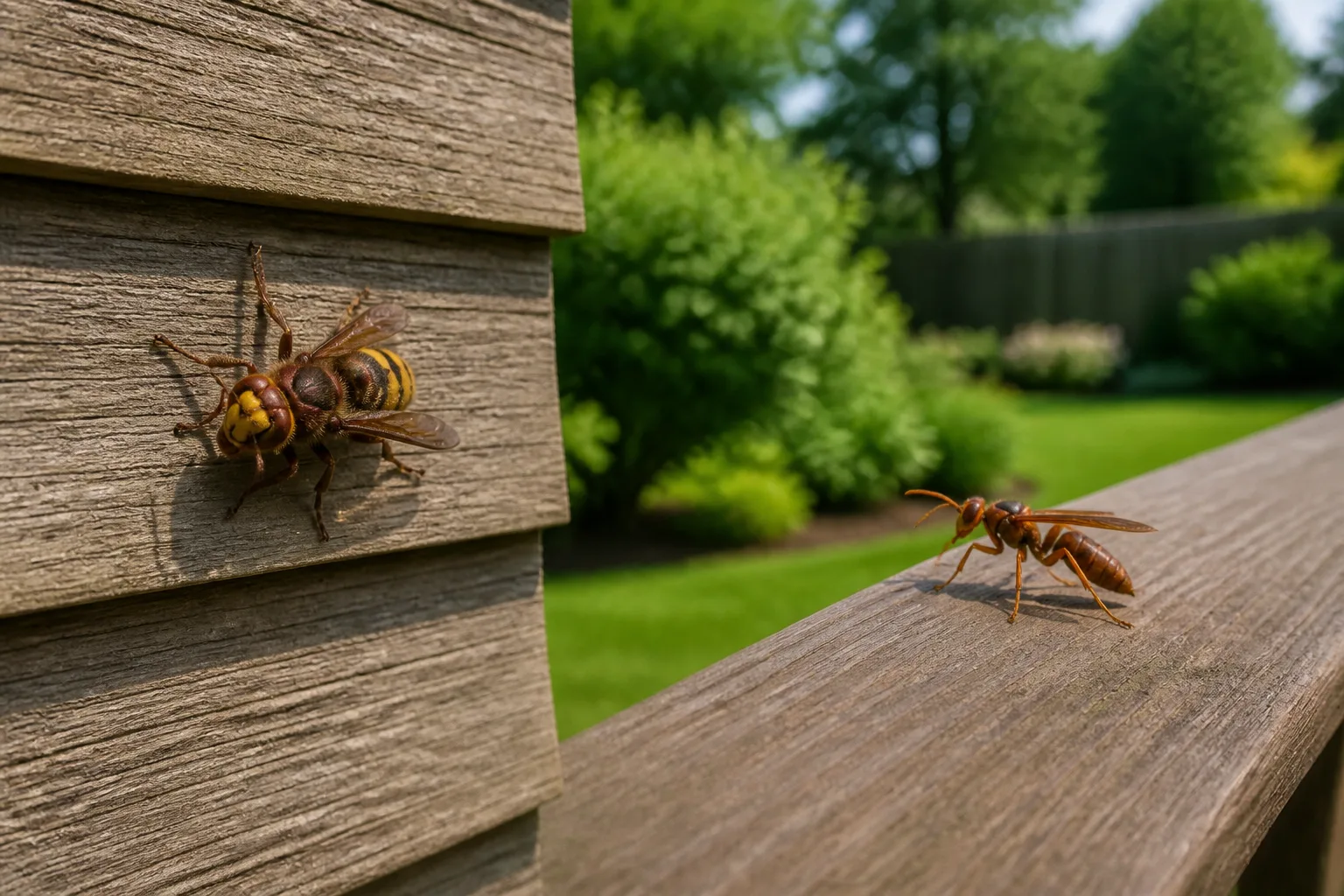
That loud, striped insect circling your soda can might be a hornet, a yellowjacket, or a paper wasp—and the label you pick changes how carefully you need to act. Hornets and wasps share the same insect order and family, but homeowners use “hornet” for a handful of large social wasps and “wasp” for everything else. Learning the difference is less about winning trivia and more about reading risk: nest location, defensive radius, and whether the colony is a seasonal scavenger or a tree-dwelling predator.
This guide walks through the species you are most likely to see in North American yards, the field marks that hold up at a distance, and the nest shapes that identify insects faster than color alone. You will also learn where bees fit in, when stings become a medical emergency, and which invasive hornets deserve a report—not a panic.
Why “Hornet vs Wasp” Starts With Taxonomy
Entomologists classify both hornets and the wasps people complain about at picnics in the order Hymenoptera and the family Vespidae. True hornets belong to the genus Vespa—large, social, paper-nest builders with robust bodies and powerful flight. The word “wasp,” meanwhile, covers tens of thousands of species, most of them solitary and harmless to humans.
All Hornets Are Wasps—But Not All Wasps Are Hornets
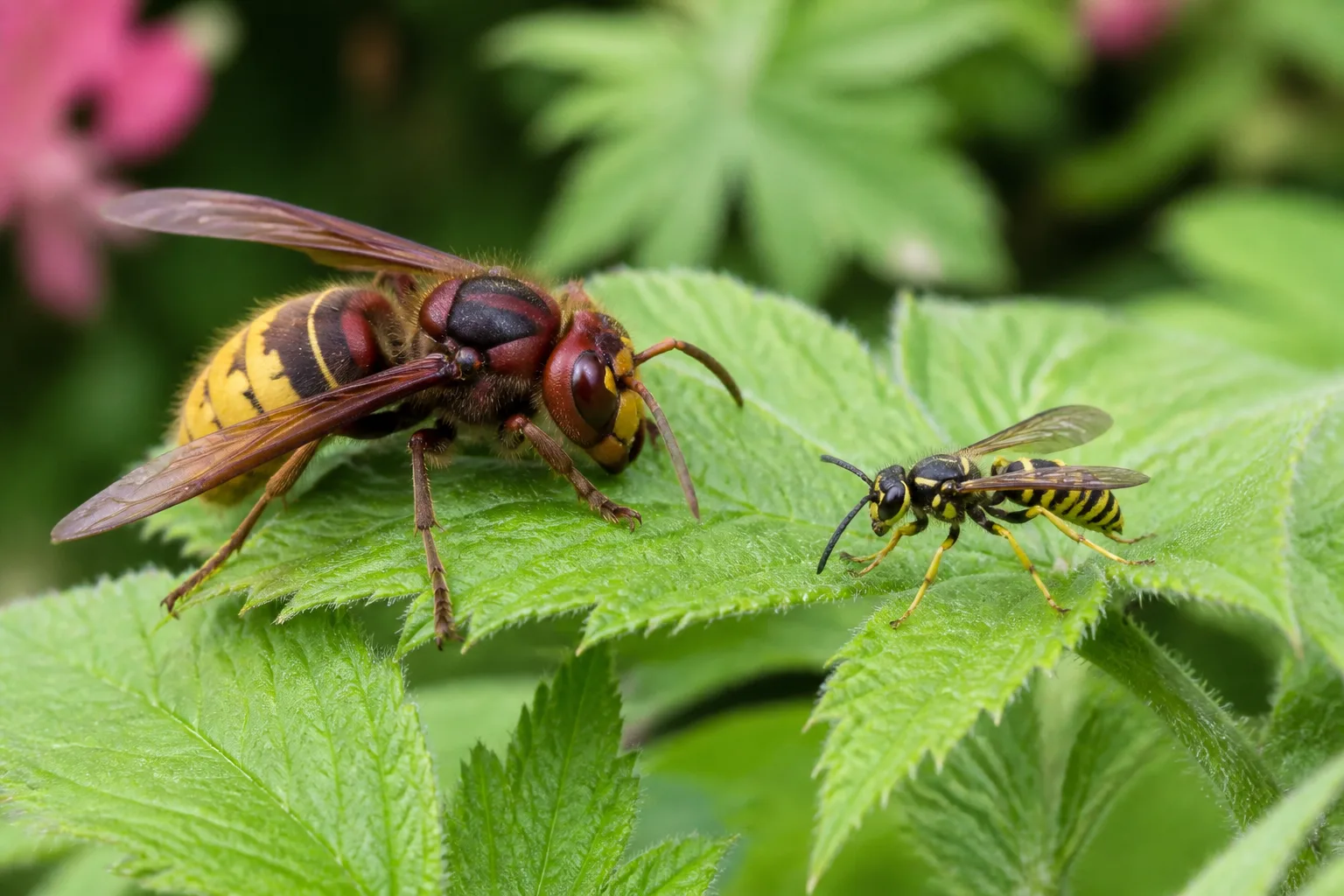
Every hornet is a wasp; not every wasp is a hornet. Yellowjackets, paper wasps, mud daubers, and cicada killers are all wasps. Only a small subset earns the hornet name. In the United States, the European hornet (Vespa crabro) is the primary true hornet most people encounter—it was introduced in the 1800s and now ranges across much of the eastern and central U.S. Everything else labeled “hornet” in casual speech may be a yellowjacket wearing a misleading common name.
That naming mess matters. A European hornet at a porch light behaves differently from a western yellowjacket in your recycling bin. Treating them identically leads to either unnecessary fear or dangerously casual nest removal.
Quick ID: Hornet or Wasp in 30 Seconds
When an insect will not sit still for photos, run through five checks in order: size, waist, color pattern, flight style, and nest location. Size alone is unreliable—queens and workers vary—but the combination narrows candidates fast.
The Five Field Marks That Matter Most
- Body bulk: True hornets and bald-faced hornets look heavy in flight, with thick thoraxes and wide heads. Paper wasps look slender, with long dangling legs.
- Waist: Paper wasps and many solitary wasps have a obvious narrow “thread waist.” Hornets and yellowjackets look more compact.
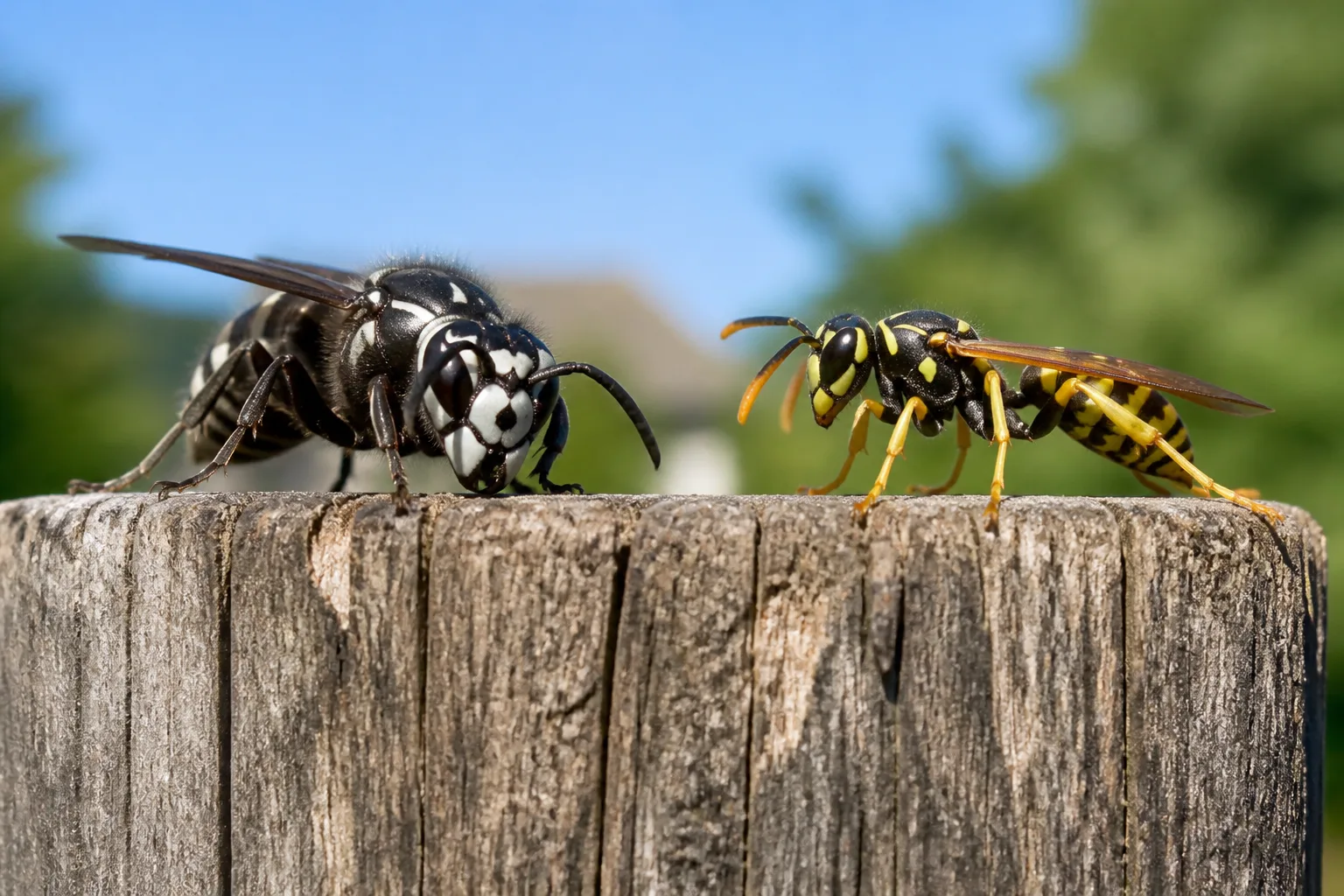
- Color: European hornets are brown, yellow, and reddish—not stark black-and-white. Bald-faced hornets are mostly black with white face patches and white tail bands. Yellowjackets are bright yellow and black. Paper wasps vary from reddish-brown to black with yellow markings.
- Behavior at food: Yellowjackets scavenge meat and sweets aggressively at human food. European hornets hunt live insects and visit ripe fruit but are less likely to mob your grill.
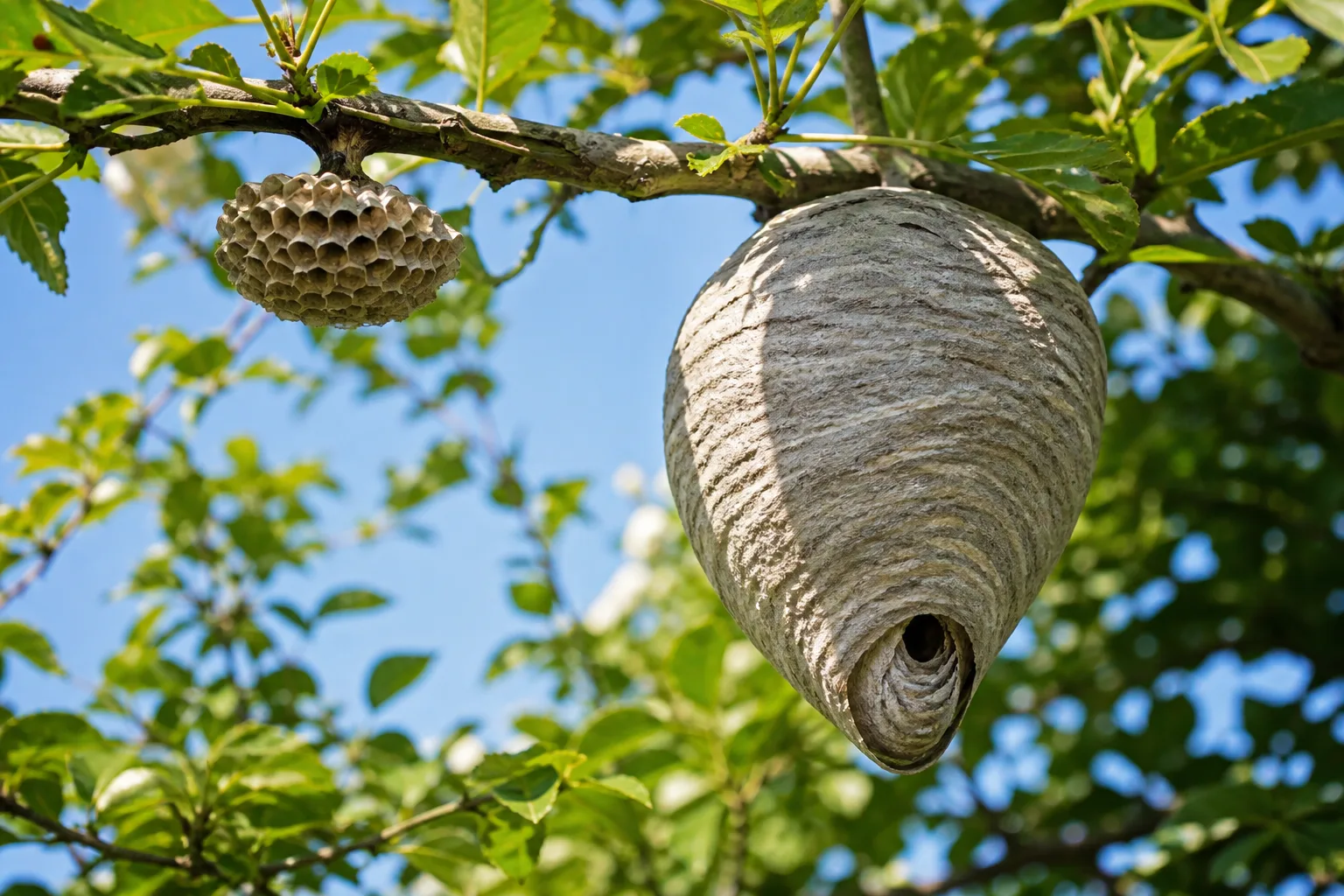
- Nest clues: Open umbrella comb under an eave = paper wasp. Gray football hanging from a branch = bald-faced hornet or related aerial yellowjacket. Hole in the lawn with steady traffic = ground yellowjacket.
If you are still unsure, photograph the nest from a safe distance. Nest architecture is often the fastest confirm.
Physical Differences: Size, Color, and Body Shape
Hornets are generally larger than the wasps that share your patio—workers commonly measure ¾ inch to 1¼ inches, with some true hornets approaching 2 inches. Wasps span a wider range: tiny solitary species go unnoticed, while yellowjacket workers are often ½ to ¾ inch. Hornets also tend toward a rounded abdomen and wide head; paper wasps look elongated.
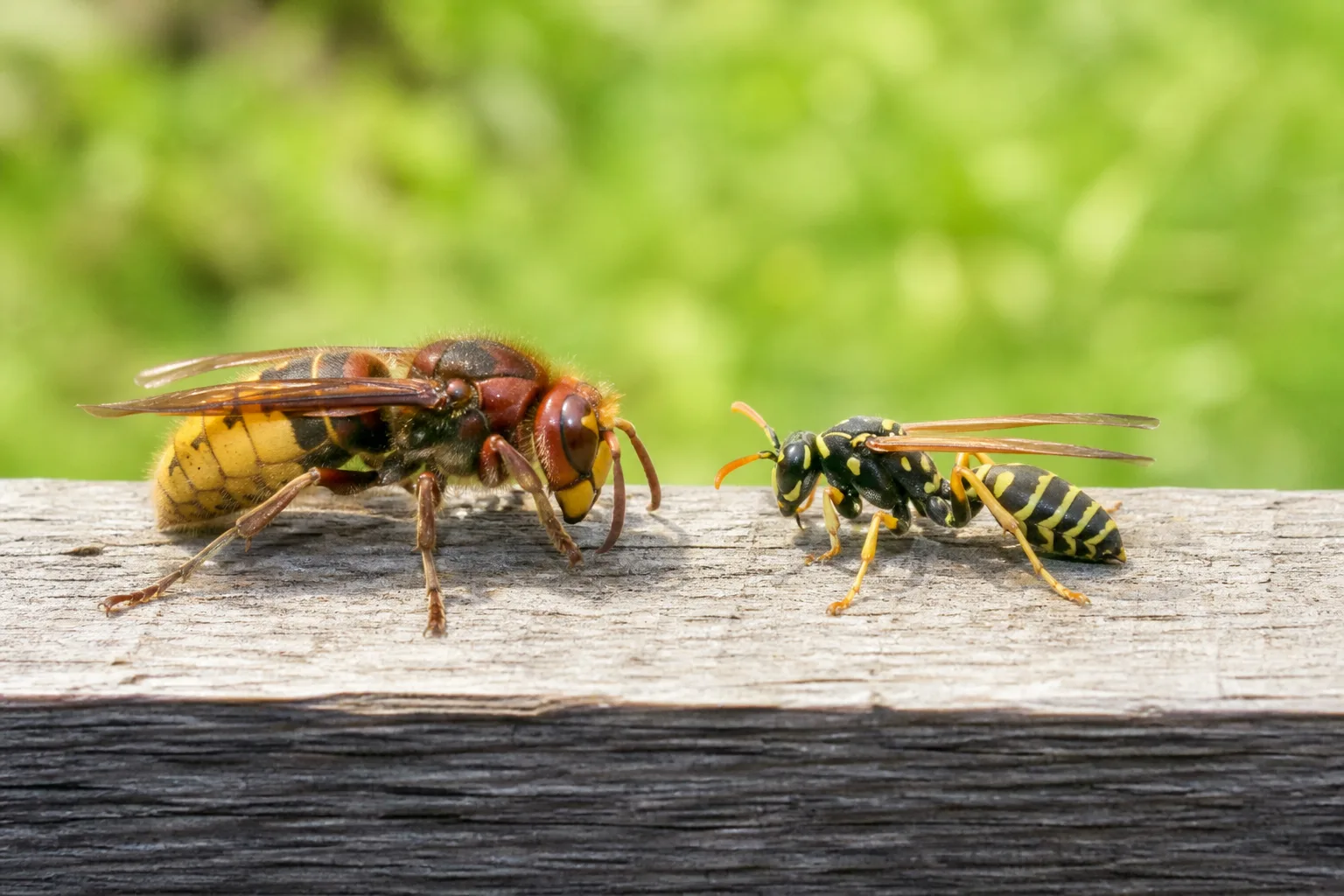
Hair is another clue when comparing stinging insects to bees. Bees are hairy; bees use branched hairs to carry pollen. Wasps and hornets have relatively smooth, shiny bodies with little hair, though European hornets can look fuzzier than yellowjackets in good light.
European Hornet: The Only True Hornet Most Americans See
The European hornet (Vespa crabro) is the established true hornet in much of the U.S. Adults are large, with brown and yellow abdominal bands and a reddish thorax. They are often active at dusk and attracted to lights—behavior that startles homeowners who assume all big wasps sleep at night.
Despite their size, European hornets are less likely to sting unprovoked than yellowjackets. They defend nests when disturbed but do not usually chase people across the yard. Nests are built in hollow trees, wall voids, attics, and sheltered cavities, sometimes with a visible paper envelope. According to UC IPM Pest Notes on yellowjackets and other social wasps, European hornets prey on other insects and can be beneficial predators even when nests are inconveniently placed.
Bald-Faced Hornet: Black, White, and Actually a Yellowjacket
Here is the identification trap most articles gloss over: the bald-faced hornet (Dolichovespula maculata) is not a true hornet. It is a yellowjacket relative in the genus Dolichovespula. It is called a hornet because it is large and builds aerial paper nests, but taxonomically it sits with yellowjackets.
Field marks: mostly black body, white face, white bands on the abdomen, and white markings on the legs. Workers are about ¾ inch long. Nests are the classic gray, football-shaped structures hanging from tree branches, shrubs, or building eaves.
Washington State Department of Agriculture identification guidance notes bald-faced hornets at roughly an inch long with black-and-white patterning—distinct from the orange-headed northern giant hornet.
Bald-faced hornets can be defensive near nests and will sting repeatedly. They also hunt pest insects and are beneficial away from high-traffic areas. Give aerial nests a wide buffer—at least 10 feet is a practical minimum, more if the nest is at head height along a path.
Paper Wasps: Slender Hunters With Umbrella Nests
Paper wasps (Polistes spp.) are the insects most people benignly ignore until a nest appears under the deck rail. They are slender, long-legged, and often reddish-brown or black with yellow markings. Their signature nest is a small open comb with visible hexagonal cells—like an upside-down umbrella—usually attached to a protected horizontal surface.
Most paper wasp species are moderately defensive. They sting when you grab the railing they are sitting on, not when you walk past ten feet away. They are valuable garden predators, capturing caterpillars and beetle larvae to feed larvae in the nest. A single open comb with a dozen cells in early summer may be removable with a broom at dusk if you accept some sting risk; a large fall colony is a different calculation.
Yellowjackets: Small, Bold, and Often the Real Aggressor
Yellowjackets (Vespula and some Dolichovespula species) are the wasps that ruin outdoor meals. They are compact, fast, and yellow-and-black banded. Western yellowjacket (Vespula pensylvanica), German yellowjacket (V. germanica), and eastern species nest in ground burrows, wall voids, and attic spaces—not always in visible aerial nests.
Here is where common wisdom breaks: yellowjackets are often more aggressive toward humans than European hornets, especially in late summer when colonies are large and workers hunt carbohydrates. UC IPM describes yellowjackets as scavengers that become serious nuisance pests around food and garbage. If something small and bold lands on your ham sandwich, suspect yellowjacket before hornet.
Ground nests are the highest-risk type for accidental disturbance. Mowing over a burrow entrance can trigger mass stinging. Buzzing or rustling inside a wall during daytime hours may indicate a void nest—treat that as a professional job if anyone allergic lives nearby.
Nest Shape Tells You More Than the Insect
Color patterns blur in bad light. Nest architecture is the homeowner’s most reliable ID tool.
Aerial Paper Nests vs Open Combs
| Nest type | Typical builder | Look | Common location |
|---|---|---|---|
| Open umbrella comb | Paper wasp | Exposed hex cells, no full paper shell | Under eaves, deck rails, grill covers |
| Gray football envelope | Bald-faced hornet, some aerial yellowjackets | Fully enclosed paper, rounded | Tree branches, shrubs, porch ceilings |
| Large cavity nest | European hornet | Paper layers inside hollow tree or wall | Tree holes, soffits, attics |
A small open comb in May is a low-stakes paper wasp starter nest. A closed football growing through July can hold hundreds of bald-faced hornet workers by September.
Ground Burrows, Wall Voids, and Hidden Colonies
Yellowjackets often nest underground, expanding old rodent burrows. Look for a steady stream of insects flying to a hole in the lawn, garden bed, or retaining wall. Some species nest in structural voids—you may hear chewing or buzzing without seeing the nest itself.
Hidden nests are why “I only saw one wasp” is a poor risk assessment. A single forager can mean a colony of thousands behind siding. If void nesting is suspected, see our guide on how to get rid of a wasp nest for when DIY ends and professional extraction begins.
Hornet vs Wasp vs Bee: Don’t Skip This Step
Before you reach for spray, confirm you are not looking at a bee. Bees are hairy, rounded, and pollen-focused. Most bees sting once and leave a barbed stinger in skin. Wasps and hornets have smooth stingers and can sting repeatedly.
Honeybees are fuzzy amber-and-brown foragers critical to pollination—destroying a honeybee colony by mistake has real ecological cost. Bumble bees are large, fuzzy, and usually nest in old rodent burrows or compost—not paper envelopes. Carpenter bees look like shiny flying thumbs boring into wood; they rarely sting.
The practical rule: if it is smooth, skinny-waisted, and building a paper nest or scavenging meat, you are in wasp/hornet territory. If it is fuzzy and carrying pollen baskets, slow down and identify before treatment.
Behavior and Aggression: Species Matters More Than the Label
“Hornets are more aggressive than wasps” is only half true. Colony defense depends on species, colony size, season, and whether you are near the nest or a food source.
European hornets defend nests but are often tolerant at a distance. Bald-faced hornets defend aerial nests vigorously when vibrations or shadows hit the envelope. Yellowjackets defend ground nests and food sources with less warning. Paper wasps are calm until you touch their comb.
Season matters too. In spring, queens build small starter nests—low worker counts, lower risk. By late summer, colonies peak. A nest that was ignorable in June can be dangerous in August.
If a flying insect approaches you, stay calm and move away slowly. Swatting triggers defensive behavior. Do not run in a panic unless you are fleeing an active swarm from a disturbed nest.
Stings, Venom, and Allergy Risk
Unlike honeybees, hornets and wasps do not leave stingers behind. A single insect can sting multiple times. Pain varies with species venom, sting depth, and your sensitivity—not just the label “hornet.”
Hornet stings are often described as more painful because of larger stingers and venom volume, but a yellowjacket swarm is medically more dangerous than one European hornet bumping a window screen. According to the American College of Allergy, Asthma, and Immunology, insect sting allergies can cause anaphylaxis—a life-threatening reaction requiring immediate emergency care.
First Aid for Hornet and Wasp Stings
For typical local reactions without allergy history:
- Move away from the nest or food source so you are not stung again.
- Wash the site with soap and water.
- Apply a cold pack for 10–15 minutes to reduce swelling.
- Use over-the-counter pain relievers or antihistamines as directed on the label.
- Watch for systemic symptoms for several hours: hives spreading beyond the sting site, swelling of lips or throat, difficulty breathing, dizziness, or nausea.
Call emergency services if breathing is difficult, swallowing feels tight, or symptoms escalate rapidly. People with known sting allergies should carry prescribed epinephrine and use it per their allergist’s plan—not wait to see if symptoms pass.
Bee stingers should be scraped out; wasp and hornet stings do not leave embedded stingers, so focus on cleaning and monitoring instead.
Invasive Hornets Worth Knowing About
Most U.S. “hornet scares” involve native or long-established species. Two invasive hornets deserve awareness because they threaten honeybees and are subject to active monitoring:
- Northern giant hornet (Vespa mandarinia), formerly called Asian giant hornet: 1.5–2 inches, large orange head, black and orange-banded abdomen, often nests in the ground. USDA APHIS tracks this species and provides comparison photos against lookalikes.
- Yellow-legged hornet (Vespa velutina): smaller, with yellow legs and yellow-orange fourth abdominal segment, building nests in trees and structures.
Common imposters include cicada killers, great golden digger wasps, and large hover flies. WSDA’s identification page emphasizes yellow jackets, bald-faced hornets, and paper wasps as insects mistaken for invasive giants.
If you photograph something matching invasive hornet descriptions in an affected state, report it through your state agriculture department. Do not attempt nest destruction on a suspected invasive giant hornet colony without professional help.
What to Do When You Spot a Nest
Identification should drive action:
- Single open paper wasp comb, low traffic area: knockdown at dusk may be acceptable if you can retreat indoors immediately; wear eye protection.
- Aerial football nest on a path or porch: mark a wide no-go zone or remove professionally—bald-faced hornet defense is serious.
- European hornet in a wall void: professional extraction reduces structural damage and repeat colonies.
- Ground yellowjacket hole near play areas or pets: treat at night with labeled products or hire a pro; daytime disturbance is high risk.
- Any nest near a sting-allergic person: default to professional removal.
Prevention complements nest work: seal garbage, cover drinks outdoors, fill abandoned rodent burrows in spring, and repair soffit gaps before queens scout cavities. Repellent plants and essential oils may reduce visits but will not eliminate established colonies. For perimeter trapping of scavenging yellowjackets, see how to make a DIY wasp trap—traps manage foragers, not hidden void nests.
When using insecticides, read the label, treat at night when workers are inside, and never spray toward honeybee hives. Colorado State University Extension notes that most social wasps are beneficial predators; remove nests only when human safety or structural risk justifies it.
Conclusion
Hornet vs wasp is really a question about which social wasp you are facing. True hornets like the European hornet are large Vespa species; the bald-faced “hornet” is a yellowjacket in disguise; paper wasps and yellowjackets cover most patio conflicts. Use size, color, nest shape, and behavior together—never one field mark alone—and separate wasps from bees before you treat.
Aggression and sting risk follow species and context, not the word on a blog headline. Give nests space in summer, act at night if you must treat, and call a professional when nests sit in walls, ground traffic zones, or near anyone with sting allergy. Correct ID is the first step toward handling these insects safely—and toward leaving beneficial predators alone when they are not actually in your way.



