What Do Venus Flytraps Eat? A Practical Feeding Guide
Learn what Venus flytraps eat, how their traps digest prey, which bugs are safe, how often to feed, and why meat, fertilizer, and tap water fail.
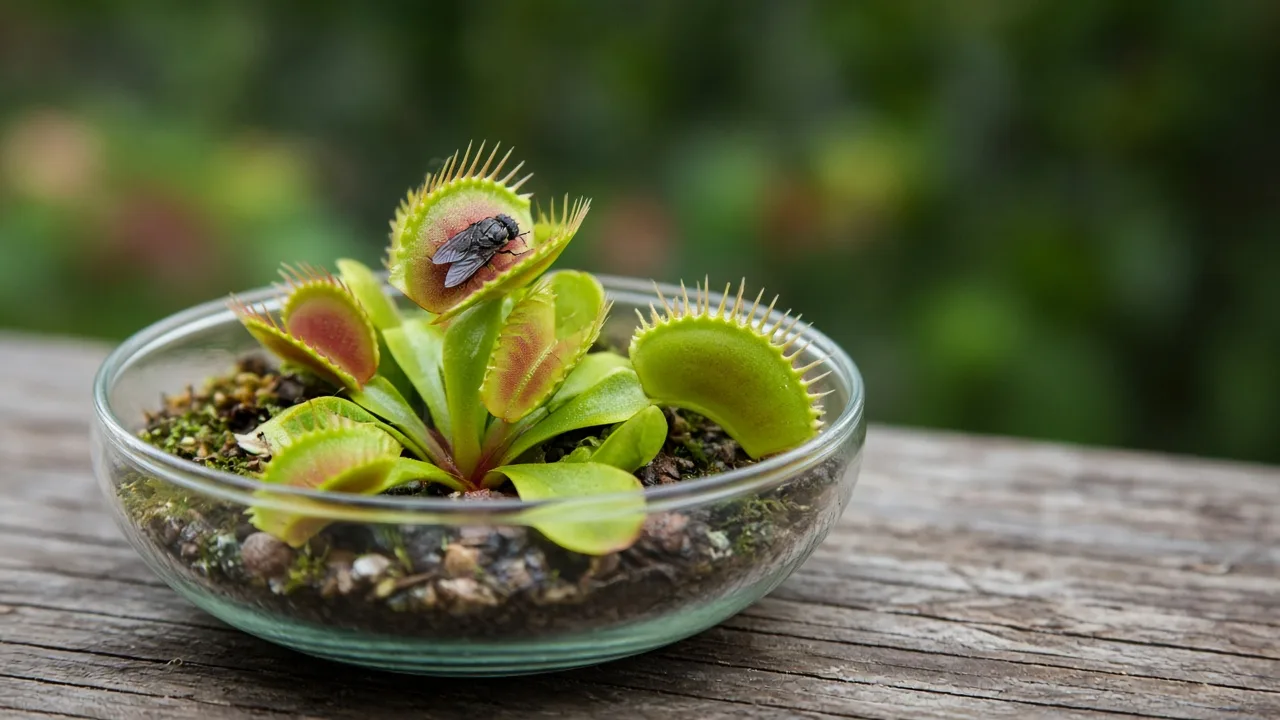
Venus flytraps eat insects for nutrients, not calories. Like every green plant, Dionaea muscipula uses photosynthesis to make the sugars that power growth. Its traps are modified leaves that supplement that energy supply with nitrogen, phosphorus, and other nutrients pulled from prey because the plant’s native bog soils are too poor to provide much of them.
That distinction makes feeding easier. A healthy plant outdoors may catch what it needs without your help, while an indoor plant can benefit from a small insect now and then. The plant does not need a daily menu, a mound of bugs, or human food. It needs the right prey, a trap that is actively functioning, and the wet, bright, low-mineral growing conditions that allow it to use the nutrients.
The short answer: insects are supplements, not the plant’s fuel
If you are wondering what to feed a Venus flytrap, choose a small soft-bodied insect or other small arthropod that fits comfortably inside a healthy trap. Flies, fruit flies, small crickets, and appropriately sized mealworms are practical choices for an indoor plant. Ants, spiders, beetles, and grasshoppers are part of the natural prey mix, but any captive food must be small enough that the trap can seal around it without being forced open.
You do not have to feed a Venus flytrap simply because it has traps. Plants grown outdoors often catch prey on their own, and a plant can survive for a considerable time without a meal. The Royal Horticultural Society notes that these plants need only a few bugs a year and can survive for more than three months without an insect. Hand-feeding is a support when access to prey is limited, not a replacement for light and photosynthesis.
This is also why fertilizer is a poor substitute. Fertilizer salts go into the root zone, where a Venus flytrap is adapted to very dilute, nutrient-poor conditions. Insects deliver nutrients through the trap’s specialized digestive system; regular plant fertilizer can damage the roots and eventually kill the plant.
Why a Venus flytrap eats insects at all
In its very small native range in the coastal plain of North and South Carolina, the Venus flytrap grows in wet, sunny wetlands with acidic, nutrient-poor soil. Those conditions offer plenty of water and light but little of the nitrogen needed to build proteins. Carnivory is the plant’s workaround: the roots take up water and a limited amount of minerals, while the traps gather nutrients from animals.
The trap is not an animal mouth, and the plant is not hunting for its main energy source. Its green petiole and trap tissue still photosynthesize. Prey-derived nitrogen can be moved into new leaves and other tissues, so a meal may support growth even though the plant could continue making sugars without it.
This habitat also explains why a “better” potting mix can be worse. Ordinary potting soil, compost, manure, and fertilizer are designed to feed roots. A Venus flytrap needs a low-nutrient carnivorous-plant medium and pure water. The New York Botanical Garden’s Venus flytrap care guide pairs strong light and live or simulated food with an intolerance of most tap water, a combination that is more useful than thinking of the plant as a novelty that only needs flies.
Buy nursery-grown plants from reputable sellers rather than taking one from the wild. The NYBG notes that habitat loss, pollution, fire suppression, and poaching threaten wild populations, while the RHS describes nursery-grown cultivation as the responsible choice. Your plant’s diet is fascinating; its conservation story is a good reason to keep the fascination in a pot.
What happens when a trap catches prey
A working trap follows a sequence that is more selective than a simple spring-loaded mouth. It first notices repeated mechanical stimulation, then closes, then decides whether the captured object is worth digesting. That sequence helps the plant avoid spending energy and digestive fluid on raindrops, dust, or a bit of leaf litter.
Trigger hairs create a two-step decision
The inner surfaces of a trap carry small sensory hairs. When an insect touches one, the plant generates an electrical signal, but one touch usually does not snap the trap shut. A second touch within a short interval—whether from the same hair or another—triggers the rapid closure.
The mechanism has been studied as a form of electrical signaling rather than as a reflex in the animal sense. Research published in Genome Research describes the first touch as an “attention” state and the second as the signal that closes the lobes within a fraction of a second. That is why brushing a trap once with a finger may do nothing, while repeated pokes can close it.
The hairs are not the whole story. Bright light helps the plant build the energy reserves needed for movement, and a dehydrated or weak plant may produce traps that close slowly or incompletely. You can understand the trigger system perfectly and still lose the plant if its water contains too many minerals or its light is too dim.
Struggling prey starts digestion
A closed trap is not automatically digesting. The captured insect’s continued movement stimulates additional hairs, which tells the plant that the object is living prey and probably contains useful nutrients. As the signals accumulate, the lobes press more tightly together and the edges form a seal that limits escape and helps retain digestive fluid.
Once digestion begins, glands on the inner surface release a fluid containing enzymes. Those enzymes break down the softer tissues of the arthropod into compounds the plant can absorb. The hard exoskeleton is not dissolved completely, which is why an old trap may reopen with a dry shell inside.
The peer-reviewed study on the Venus flytrap’s carnivorous lifestyle links prey stimulation with digestive-gland activity, protein secretion, and nutrient transport. In practical terms, the plant is not “chewing” a bug. It is switching a specialized leaf into a temporary external stomach, absorbing what it can, and later reopening the trap.
Digestion can take several days to a couple of weeks depending on prey size, temperature, plant condition, and how completely the trap seals. Do not pry a closed trap open to inspect it. A trap that stays shut for a while is normally doing the slow part of its job.
What Venus flytraps eat in nature
Wild Venus flytraps take whatever small animals walk across or land on their traps. Ants and spiders are common examples, along with beetles, grasshoppers, and other insects. The plant is not limited to houseflies, and “flytrap” is a common name, not a complete prey list.
The exact species matters less to a home grower than the insect’s size and behavior. A small, soft insect that cannot chew through the trap is generally a better offering than a large, heavily armored beetle. Some caterpillars and powerful insects can damage the trap or escape, so the fact that something is technically an insect does not make it good captive food.
The plant also has to decide whether prey is worth the cost. Small insects may escape through the gaps between the marginal teeth, especially if they do not stimulate the trap enough to create a seal. That apparent “failure” can be useful: the trap is not obliged to digest every object that touches it.
How to choose prey for a captive plant
For an indoor plant, choose prey from a clean, pesticide-free source. Flightless fruit flies are convenient for small plants, while a tiny cricket or a small mealworm can suit a larger trap. Pet-store insects are often easier to control than insects collected from a windowsill, where exposure to aerosol sprays, ant bait, or other chemicals is unknown.
| Prey choice | When it makes sense | What to check |
|---|---|---|
| Flightless fruit flies | Small traps, seedlings that are ready for prey, and easy indoor feeding | Use only a small number and keep the culture free of mold or chemical contamination. |
| Small flies | A naturally available indoor or outdoor meal | Make sure the insect is not contaminated with insecticide or household cleaner. |
| Tiny crickets | Medium or large traps | Choose a size that cannot force the trap open or chew its way out. |
| Small mealworms | A captive-food option for larger traps | Use a small larva and do not pack the trap with several worms. |
| Ants or spiders | Occasional outdoor prey | Avoid collected insects if they may have contacted pesticide; ants are not a reason to establish a routine. |
The trap-size rule matters more than the bug’s name
Use the one-third rule as a practical ceiling: the insect or food portion should be no more than about one-third the length of the trap and should fit inside the lobes without pushing them apart. The NYBG gives the same approximate limit and warns that large insects can take too long to digest and may contribute to bacterial rot. A small insect in a large trap is safer than a large insect that makes the trap bulge.
Look at the individual trap, not just the plant. A Venus flytrap can have new, fully functional traps beside old leaves that no longer close. Choose a healthy, open trap with firm lobes and intact trigger hairs. If the plant is producing only tiny, weak, or misshapen traps, fix the environment before trying to solve the problem with larger or more frequent prey.
Consider the prey’s escape plan. Caterpillars can chew their way out, large crickets can push or bite, and a hard-bodied beetle may leave a bulky shell that slows cleanup. The best food is not the most dramatic food; it is the item the trap can contain, stimulate, and digest without strain.
How to feed a Venus flytrap by hand
Hand-feeding makes sense when the plant is indoors, actively growing, and not catching insects on its own. It is optional for an outdoor plant with regular access to small prey. Before you feed, check the basics: the pot is sitting in pure water, the plant receives strong light, the trap is open and healthy, and the plant is not in winter dormancy.
That indoor/outdoor distinction is also the practical recommendation in Tom’s Carnivores’ Venus flytrap guide: solve the growing conditions first, then supplement indoor plants only when they lack access to prey.
A live insect is the simplest method
Use clean, narrow tweezers to place one appropriately sized insect in the center of an open trap. Let the insect move naturally so it can stimulate the hairs. If it does not trigger the trap immediately, you can gently brush an inner trigger hair twice with the insect or with the tip of the tweezers, then remove the tweezers as soon as the lobes begin to move.
Do not hold the trap shut or squeeze its sides. The prey should remain inside while its movement prompts the trap to seal. If the insect walks out, do not chase it around the plant or repeatedly trigger another trap; wait and try again later with a smaller item.
Feed one trap at a time. You do not need to place a bug in every trap, and feeding the same reliable trap more than once is not automatically a problem. A trap has a finite useful life and eventually ages out after repeated closures, but that turnover is normal leaf biology. The plant replaces old traps from its central growing point.
Once closed, leave the trap alone. It may remain shut for days or longer, and the exact timing varies. You will get more information by watching new growth and overall color than by opening the trap to see whether dinner has disappeared.
Dead insects and bloodworms need a workaround
Live prey is the most straightforward option because it supplies the movement that helps the plant complete the closure and digestion signals. A dead fly may be usable for an indoor plant, but simply dropping it into the trap often produces a disappointing result: the lobes close loosely, reopen soon, and leave the insect unchanged.
To use dead prey, place a tiny portion inside a healthy open trap and stimulate the trigger hairs after the lobes have started closing. A clean toothpick, the tip of a soft paintbrush, or a gentle massage of the outside of the lobes can provide movement; remove the tool immediately once the trap responds. The process should be delicate, not a wrestling match with the leaf.
Rehydrated, additive-free bloodworms are another commonly used simulated prey. The New York Botanical Garden describes softening dried bloodworms with a few drops of water, squeezing out excess liquid, and offering a portion roughly one-third the trap size. This is a fallback for indoor culture, not a reason to feed every trap on a schedule.
Different experienced growers use slightly different stimulation methods and feeding intervals. Treat substitute prey as a controlled experiment: use a tiny portion, one trap, and a healthy plant. If the trap repeatedly blackens after feeding, stop feeding and investigate water, light, prey size, and dormancy rather than adding more food.
Foods that can harm a Venus flytrap
Never use mammal meat, chicken, fish, cheese, sausage, pet food, or other kitchen scraps. These foods contain a mix of fats, salts, proteins, and additives that the trap is not adapted to handle. They can remain trapped, decay, attract mold, and damage the leaf before the plant gets anything useful from them.
Fruit is not a clever substitute for insects. The sugars and soft pulp can ferment or rot inside a poorly sealed trap, and the plant still will not receive the balanced prey-derived nutrients it evolved to use. Milk, honey, candy, and wet bits of human food create the same basic problem: they are not appropriate arthropod prey.
Do not put fertilizer in the soil or directly into a trap. A foliar fertilizer is still fertilizer, and a concentrated dose can burn tissue. The RHS plant guide specifically warns that inanimate foods such as cheese or meat are not digested as prey, while the RHS care advice cautions that nitrogen-containing fertilizer can kill the plant.
Avoid insects that may have contacted pesticide, flea treatment, ant bait, household cleaner, or a treated lawn. “Natural” prey is not automatically safe if it has picked up a chemical. When in doubt, use a small captive insect from a reputable source or let an outdoor plant forage for itself.
How often to feed—and when not to
There is no magic number of insects that every Venus flytrap needs each month. A plant’s need depends on whether it is outdoors, how much prey it catches, how many healthy traps it has, whether it is actively growing, and whether the rest of its care is correct. A useful indoor starting point is one small insect for one trap every one to two weeks during active growth, then adjust downward if the plant is growing well or catching prey naturally.
That interval is a ceiling for a supported routine, not an instruction to keep a trap continuously occupied. A small plant with a few traps does not need the same amount of food as a large clump. Feeding multiple traps at once can create more stress than benefit, especially if the plant is recently shipped, recovering from repotting, or acclimating to stronger light.
Stop and wait when the plant is dormant, sick, badly dehydrated, or receiving weak light. Feeding cannot correct mineral buildup, root damage, heat stress, or a potting mix that contains fertilizer. The NYBG explains that plants can survive for extended periods without feeding but grow more slowly, while the RHS advises stopping feeding during the winter rest.
Do not feed a trap that is already closed, damaged, blackening from the center outward, or unable to hold its lobes together. Do not trigger traps just to demonstrate the snap. Each closure costs energy, and repeated empty closures are a poor trade for a moment of entertainment.
Indoor and outdoor plants have different feeding jobs
An outdoor Venus flytrap with strong light, pure water, and a suitable growing setup usually has access to more prey than you can provide. It may go weeks without a meal you notice and still grow normally. Hand-feeding an outdoor plant can introduce pesticide-contaminated insects and unnecessary handling, so let it forage unless there is a clear reason to supplement it.
An indoor plant behind glass has fewer opportunities. If it is growing in bright light and producing open, functional traps but never encounters insects, occasional hand-feeding can supply the missing nutrient input. The Epic Gardening care guide makes the same indoor/outdoor distinction and notes that a plant outside can catch its own prey.
A terrarium changes the equation again. Enclosure can help retain humidity and keep prey from wandering away, but stale, still air and excessive heat increase other risks. Use an open or ventilated setup, provide enough light, and do not turn the plant into a sealed display case that traps moisture against decaying leaves.
The care foundation that makes feeding worthwhile
Food only helps when the plant can grow. Start with pure water: distilled, rainwater, or reverse-osmosis water. Bottled and filtered water can still contain enough dissolved minerals to build up in the medium, and leaving tap water out does not reliably remove the salts that matter. The NYBG recommends pure water and warns that tap or bottled water may kill the plant.
Keep the medium wet but airy. A pot with drainage holes should sit in a shallow water tray during the growing season, with the water level below the soil surface rather than flooding the crown. The RHS recommends watering from below and keeping a Venus flytrap permanently moist; its plant guide also emphasizes that tap water and dryness at the roots are major problems.
Give the plant strong light. Full direct sun is the best default for an established plant that has been acclimated gradually, and a strong grow light may be necessary indoors. Bright light supports photosynthesis, sturdier traps, and the red coloration that many plants develop inside the lobes. A dim windowsill can leave a plant too weak to benefit from feeding.
Use a low-nutrient, acidic medium designed for carnivorous plants. Peat-free options based on sustainable sphagnum moss are increasingly useful, and an unamended sphagnum-and-perlite mix is a common approach where appropriate materials are available. Do not use potting soil, compost, manure, lime, or fertilizer-containing mixes.
Humidity does not need to be turned into a sealed greenhouse. Moisture at the roots and adequate water quality matter more than chasing a particular household humidity percentage. Keep the plant away from heating and air-conditioning vents, and provide airflow if you use an enclosure.
Black traps, failed closures, and other feeding clues
A black trap does not automatically mean that the plant rejected its food. Individual traps are leaves with a limited lifespan, and older leaves naturally darken before they are replaced. Dormant plants also lose leaves and traps as they retreat to the rhizome. Remove completely black, dry tissue gently, but do not cut green tissue just because one edge looks tired.
If a trap closes and reopens within a day or two with an intact insect, suspect incomplete stimulation or a food item that was too still. A dead insect may not have provided the continued movement needed for sealing. Next time, use live prey or a much smaller simulated portion and stimulate gently; do not force the same trap through repeated demonstrations.
If the trap turns black soon after a large meal, size is a likely first check. An oversized insect can hold the lobes apart, take too long to digest, or decay inside the trap. Remove the mistake only if the trap is still open and the item is accessible; never pull apart a sealed trap.
When many traps blacken at once, feeding is rarely the only suspect. Check water history first, then light, root moisture, temperature changes, recent repotting, and the onset of dormancy. Mineral-rich water and ordinary potting soil can damage a plant even if every insect you offered was appropriate.
If the plant has stopped making traps, look at the growing point and the care routine rather than buying larger bugs. Weak light, a dry root zone, mineral buildup, cold-season slowdown, and transplant stress can all reduce new growth. Feeding a struggling plant more often can add another stressor without fixing the cause.
Winter dormancy changes the feeding plan
Venus flytraps from temperate climates follow a seasonal rhythm. As days shorten and temperatures cool, growth slows, traps may become smaller or more upright, and older leaves can blacken. During dormancy the plant relies more on stored energy in its rhizome, so feeding should stop rather than continue on a summer schedule.
Dormancy is handled differently depending on climate and setup. The RHS describes Venus flytraps as perennial plants that die down for part of the year and benefit from a cool winter rest. The NYBG notes that opinions differ on whether indoor plants must go dormant, but a cool rest can benefit a plant and is especially useful when winter light is not strong enough for healthy active growth.
If you choose dormancy, keep the medium from drying completely while using less water than in summer, provide a cool protected location, and avoid feeding until active growth resumes. Do not place a dormant plant in a warm, dim room and try to compensate with food. When spring growth returns, increase light and water gradually, then resume feeding only after new traps are open and functioning.
Conclusion: feed lightly, protect the trap, fix the habitat
Venus flytraps eat insects because prey supplies nutrients that their wet, acidic, nutrient-poor habitat cannot provide. They do not eat bugs for their sugar, and they do not need a constant supply. For most indoor plants, one small, clean insect in a healthy trap every week or two during active growth is plenty; outdoor plants can usually catch their own food.
Use the one-third trap-size rule, avoid meat and fertilizer, treat dead insects as a careful substitute, and leave closed traps alone. If feeding seems to make the plant decline, stop adding food and check the basics—pure water, strong light, low-nutrient medium, root moisture, airflow, and seasonal dormancy. The best diet is the one that supports a plant already growing in the right habitat.