How to Choose the Right Garden Hose for Your Garden
Choose the right garden hose by measuring your route, comparing common diameters, and matching material, fittings, and hose type to the way you water.
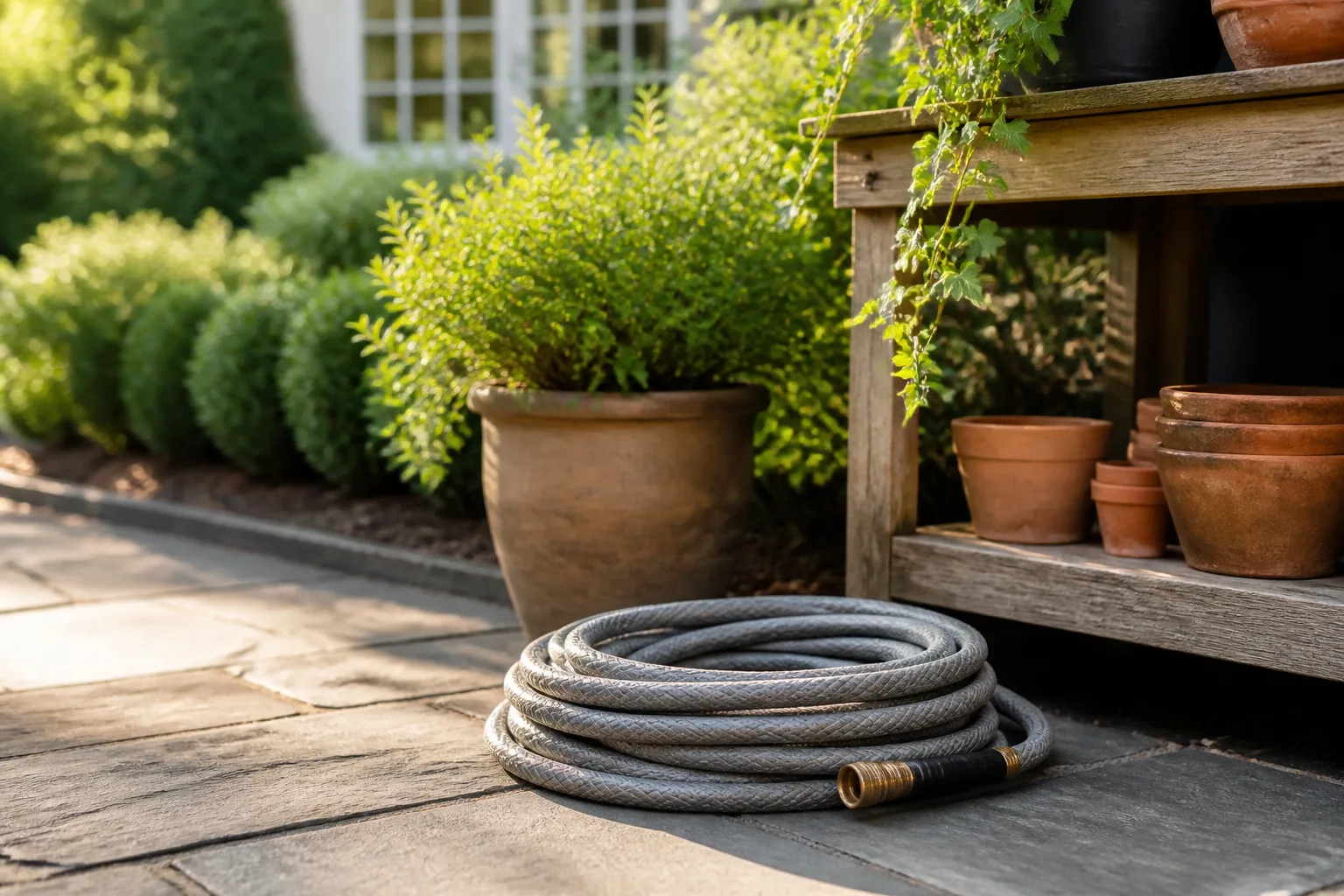
A garden hose is easy to buy badly. Pick one that is too short and you pull on its fittings; pick one that is far longer than you need and you drag, coil, and store weight that does no work. A narrow hose can feel slow on a sprinkler, while a heavy hose may be durable on paper but frustrating to move around the beds you water every morning.
Choose in this order: decide what you water, measure the route, choose a workable inside diameter, then match the material, fittings, and storage method to your yard. That sequence prevents the most common mistake: buying based on a “heavy-duty” label or a pile of features before you know whether the hose will reach, flow, and coil easily.
Start With the Jobs You Need the Hose to Do
Begin with the tasks you actually repeat. Hand-watering a few containers beside a patio door calls for a short, light hose; reaching a back lawn or running a sprinkler asks more of flow and length; watering a narrow vegetable bed row by row may be easier with a soaker line attached to a regular hose. The hose body is only one part of the setup—the source, the nozzle, and how the water is applied matter just as much.
Use this quick match as a starting point, not a rule that overrides your own water supply:
| Your regular job | Sensible starting point | What to prioritize |
|---|---|---|
| Patio pots or a compact bed | Short, light 1/2-inch hose | Easy handling, flexible routing, simple nozzle |
| Mixed beds, lawn edges, and containers | 5/8-inch hose in the shortest useful length | Balanced flow and weight, strong couplings |
| Long run or a high-demand sprinkler | Consider 5/8 or 3/4 inch after a flow test | Available supply, pressure rating, compatible sprinkler |
| Repeated watering along rows or borders | Regular hose plus a soaker or drip system | Even delivery, pressure control, clog maintenance |
| Drinking water or filling a pet’s bowl | A hose explicitly labeled potable | Exact product certification and water-contact materials |
This is why there is no single “best garden hose” for every property. A small balcony gardener will notice the weight of a 100-foot rubber hose more than a slight increase in volume, while someone filling a stock tank at the end of a long drive may care more about flow than coil convenience. Let the least convenient recurring task determine your minimum reach and performance, then avoid paying to solve occasional jobs with extra bulk.
If most watering is near the spigot but one occasional job is farther away, two shorter hoses or a detachable extension can be easier than one oversized coil. The extra connector can leak or snag, so use this approach only when the added reach is genuinely occasional.
Measure the Route Before Choosing a Length
Do not measure the diagonal across your lawn or guess from the lot size. Start at the outdoor spigot and trace the path you want the hose to follow, around trees, raised beds, steps, and corners, to the farthest place you regularly water. A piece of rope or a flexible tape laid along that path gives a better estimate than pacing across open ground.
Add enough extra length to make a broad turn and reach the plant bed without pulling the hose tight. Do not add a whole extra 25 or 50 feet “just in case” if the route only needs a few feet of slack; every unused section adds weight, takes room on a reel, and can make the hose harder to move. Common retail lengths often come in 25-foot increments, so choose the next size that covers your measured route with a small practical margin.
A hose that reaches only by scraping through a flower border or bending sharply around a step is too short for the route, even if its printed length looks adequate. Reroute along a fence or consider a second spigot before buying a longer hose that still drags through delicate plants.
Check storage before buying: a thick 100-foot hose may exceed a small wall reel’s capacity even if the stated length sounds right. A cart, roomy hanger, or pair of shorter hoses can be easier to move and store.
Choose Inside Diameter for Flow and Weight
A hose’s inside diameter is the size of the water channel, not the outside width of the hose or necessarily the size of its end fitting. The common residential choices are 1/2, 5/8, and 3/4 inch. As the inside diameter increases, the hose can carry more water with less resistance over a given distance, but the filled hose is generally bulkier and more difficult to coil.
| Inside diameter | Good fit for | Main trade-off |
|---|---|---|
| 1/2 inch | Short runs, patios, containers, light hand-watering | Easier to move; less capacity for high-flow attachments |
| 5/8 inch | Most mixed household gardening | A useful balance of volume, weight, and handling |
| 3/4 inch | Long runs or tasks that call for more volume | Heavier and often excessive for close-in container watering |
A 5/8-inch hose is a practical middle choice for many mixed gardens, but do not treat it as a universal upgrade. If your source already has modest flow, the run is short, and you mainly hand-water with a wand, a lighter 1/2-inch hose may be easier to live with. If a sprinkler or long route is the problem, 3/4 inch may reduce resistance, but it cannot create water pressure your outdoor tap does not supply.
The “bigger is better” idea also overlooks the complete path. Water must pass through the faucet, hose, any quick connectors, and the nozzle or sprinkler. A narrow attachment or partially closed valve can become the bottleneck even when the hose diameter is large, and a kink can restrict flow more than the difference between two nominal hose sizes. If you want to decide between diameters confidently, test your actual setup rather than relying on a chart that cannot know your supply.
Understand Pressure and Flow With a Simple Test
Pressure describes the force pushing water through the line; flow is how much water reaches the end in a given time. A strong, narrow stream can look powerful while delivering little total water, and a high-pressure rating printed on a hose describes a limit for the hose—not how many gallons your faucet can deliver. Longer runs, narrow openings, sharp bends, and extra connectors can all reduce flow at the nozzle.
You can test flow without buying a pressure gauge. Put the hose in its real route, attach the nozzle or sprinkler you intend to use, set it to the normal working pattern, and time how long it takes to fill a container with a known volume. If the stream is weak, repeat the test with the hose straight and then with the nozzle removed; a better result in one setup points toward a kink, nozzle restriction, or fitting problem rather than proving that you need a larger hose.
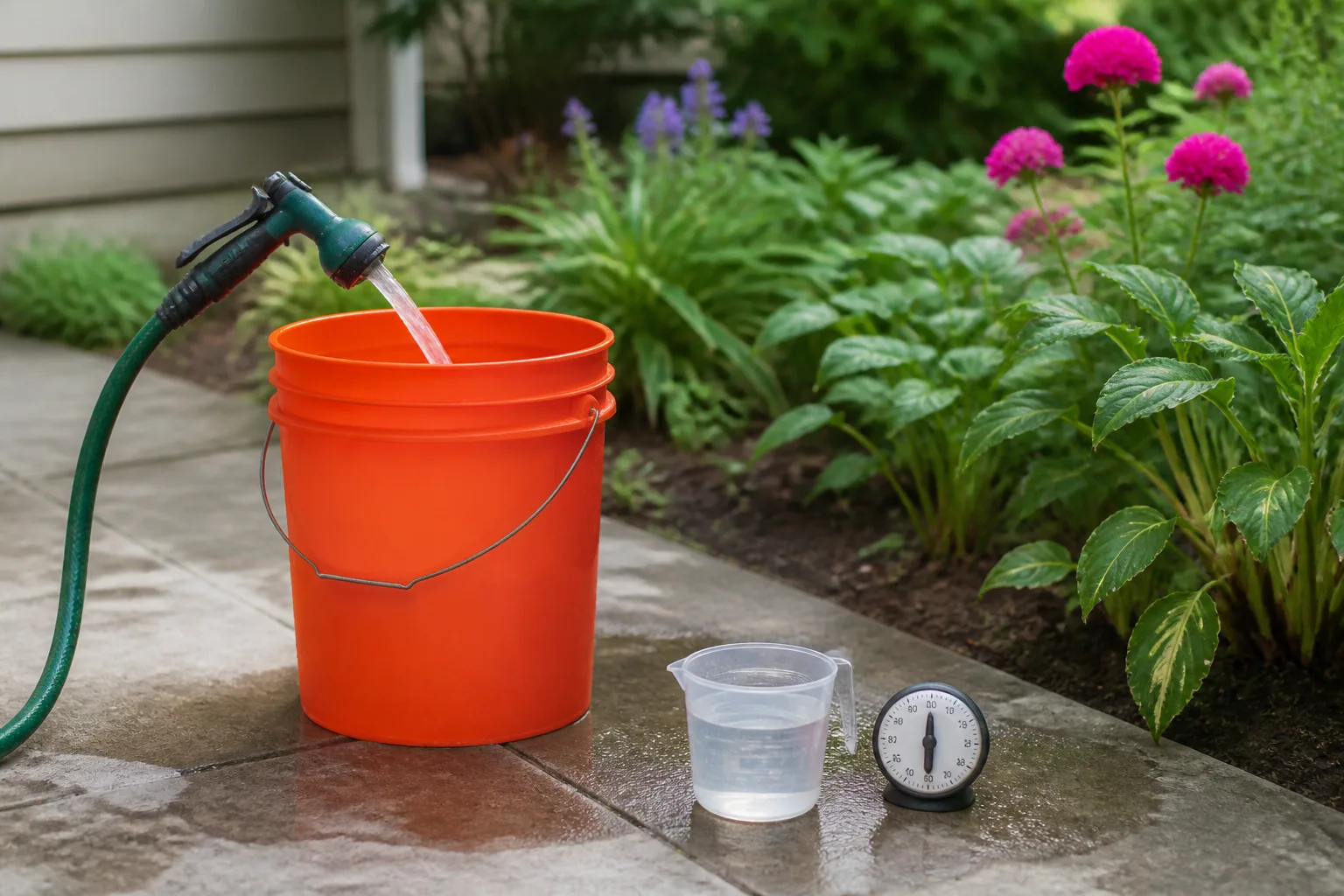
A useful comparison is to run the same bucket test at the end of the hose and then directly at the spigot. Use the same faucet opening and time interval, and compare the amounts rather than expecting one “correct” number for every home. If the spigot fills the bucket quickly but the hose end does not, check for a kink, clogged nozzle screen, crushed fitting, or an unnecessarily long run; if both are slow, a bigger hose is unlikely to solve the supply limit.
When you shop, read pressure specifications carefully. “Burst pressure” is not a recommended working pressure and does not indicate the strength of the spray at your nozzle; follow the manufacturer’s stated operating limits, especially for expandable hoses and soaker lines. Hose guidance from Gilmour also separates the length, diameter, material, and pressure factors rather than treating a single PSI number as a substitute for choosing the right fit.
Match Hose Material to the Route and Workload
Material affects weight, flexibility, and how a hose tolerates rough handling; it does not determine whether the hose is right for your yard by itself. Compare the route and storage first, then choose the lightest construction that can handle the surfaces, frequency, and weather you expect. No material prevents damage if the hose is dragged over sharp edges or left under a mower wheel.
Vinyl: Light and Affordable for Occasional Use
A basic vinyl hose usually costs less and is relatively light, which can make it a sensible choice for a short patio run or occasional rinsing. It is not the best value if it spends long periods in full sun, is dragged over gravel every day, or is pulled around tight corners; repeated kinks and abrasion can shorten its useful life. Look at wall construction and the manufacturer’s stated temperature and pressure limits, not color or the word “light-duty” alone.
Vinyl’s practical advantage is ease of lifting, especially in a short length. If a heavy hose makes watering a chore, a smaller diameter and shorter route may help more than thicker construction. A low-cost vinyl hose can suit a small area if you store it out of harsh exposure and use it gently.
Rubber: Tougher and Heavier for Frequent Use
Rubber and reinforced rubber hoses are often chosen for frequent use, rougher surfaces, and situations where flexibility matters. The trade-off is weight: a long rubber hose can be tiring to pull and coil, particularly after it has filled with water. If you have limited grip strength, stairs, a narrow side yard, or a reel with a modest capacity, try lifting or handling the hose in person before choosing a heavy construction.
Check what “reinforced” means on the product specification. A fabric or mesh layer can support the hose wall, but it does not guarantee that a coupling will not bend, a washer will not wear, or a puncture will not happen. A hose that feels flexible in the store can behave differently in cold weather, so confirm the manufacturer’s stated temperature range if you water in a cool season.
Hybrid Polymers: A Middle Ground
Hybrid-polymer hoses aim to combine easier handling with more durability than the lightest vinyl models. They can be useful when a hose gets daily use but must still snake around a patio, raised beds, or garden furniture. The construction varies from one product to another, so compare the hose’s weight per length, kink behavior, pressure limits, coupling design, and warranty instead of assuming that “hybrid” names a consistent standard.
If possible, uncoil the hose before using it and let it relax in the sun or shade as its directions advise. Some new hoses retain tight packaging loops that cause frustrating twists until they are laid out. That is a setup issue, not necessarily evidence of a defective material, but a hose that continues to flatten at ordinary turns is not a good match for the route.
Expandable and Metal-Jacket Hoses: Convenience With Limits
An expandable hose is appealing where storage space and low weight matter more than heavy-duty use. It contracts when drained and stretches while pressurized, so it can be easier to carry around a small yard; the inner tube and fabric sleeve can be more vulnerable to sharp edges, abrasion, and being left under pressure. Fine Gardening’s garden hose review, written by a landscape designer, advises storing expandable hoses out of direct sun and relieving pressure between waterings. Treat that as sensible care for a construction with moving fabric and liner, not a promise that every model will last a certain number of seasons.
Metal-jacketed hoses also emphasize handling convenience, but the outer sleeve is not the water channel. The material inside still carries the water, and the end fittings still determine whether the connections seal. A metal shell may be useful where the outside of a hose gets scraped, yet the hose can still restrict flow at a tight bend or leak at a washer; check the actual inner diameter, pressure limits, and return policy instead of trusting “no-kink” as a literal guarantee.
If the hose is for everyday watering across a rough yard, a conventional reinforced hose may be easier to repair or replace than a lightweight design with proprietary ends. If it is for small beds and tucked-away storage, low weight may be worth more than extra reinforcement. Choose for the failure you are most likely to encounter.
Choose a Specialty Hose Only for a Specific Job
Specialty hoses change how water is delivered, not just how it is carried. A regular garden hose with a soft nozzle is flexible for spot-watering, seedlings, containers, and newly transplanted plants; a soaker hose or drip line can make repeated watering along rows easier but needs a layout suited to the bed. Use the specialized option when it solves a recurring task rather than buying one because it sounds more efficient.
Soaker and Sprinkler Hoses
A soaker hose has porous walls that release water gradually along its length. It can suit a level row or border where you want moisture around the root zone, especially when you cover it with mulch, but its delivery may be uneven on slopes and its small openings can clog with sediment. Keep pressure within the manufacturer’s limits; too much can cause leaks or splits, while too little can leave the far end dry.
A sprinkler hose releases water through holes along the hose to cover a strip or small lawn area. That makes it different from a soaker hose, which seeps water into nearby soil, and from a regular hose, which delivers water through one nozzle at a time. If you use an overhead pattern on vegetable foliage, windy conditions can carry water away from the target; reserve spray delivery for areas where broad coverage is useful.
For permanent or repeated watering in a vegetable bed, drip irrigation may be a better fit than leaving a hose in your hand. The USGS overview of irrigation techniques explains that drip systems carry water along lines near crop rows and reduce evaporation relative to flood irrigation. Epic Gardening’s comparison of garden irrigation methods notes that a standard hose remains useful for containers, transplants, and targeted watering, while soaker hoses trade simpler installation for less precise flow than drip emitters.
Flat and Coiled Hoses
A flat hose can pack into a small space, but it generally needs to be laid out so it can open fully before use. If you leave a section folded under a planter or trapped beneath a wheel, it may restrict water just like any flattened hose. Choose a flat style when compact storage matters and the route is fairly open, not when you need to snake around many obstacles under pressure.
A coiled hose springs back toward its compact shape after you pull it out, which can reduce the storage footprint on a small balcony or patio. The coil can snag on furniture legs, pot stands, and plant supports, so its convenience depends on a clear path and a watering area near the tap. If you have raised beds far apart, a straight hose on a reel or a short lightweight hose may be easier to control.
Check the Couplings, Washers, and Fittings
Couplings are a common source of frustrating leaks because a good hose body cannot seal a damaged or missing washer. Before connecting the hose, look inside the female fitting and confirm that the flat rubber washer is present and seated evenly. Start the connection by hand so you can feel whether the threads line up; if it binds immediately, back it off and try again rather than forcing it with pliers.
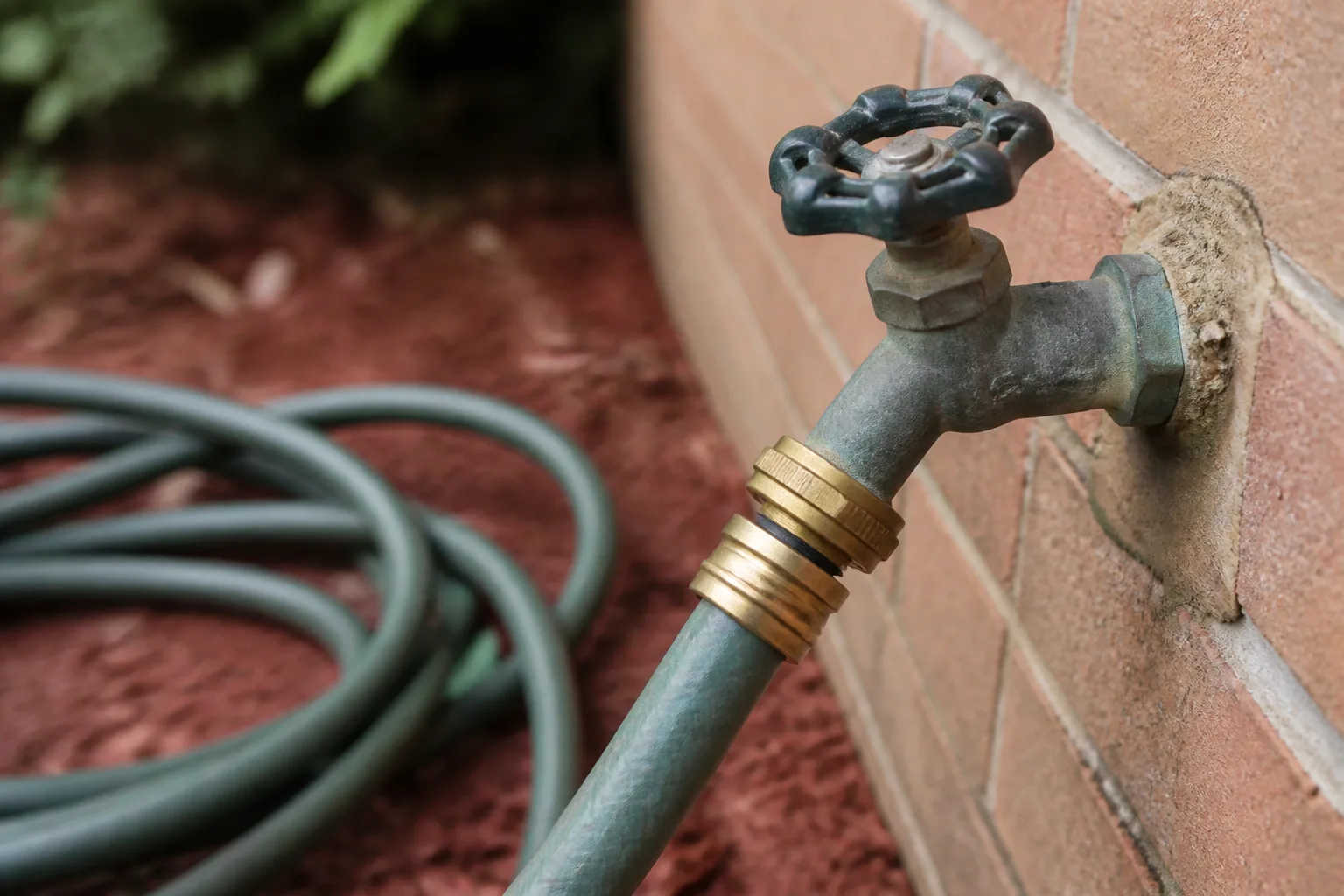
The hose’s inside diameter and fitting compatibility are separate specifications. A larger hose can still have an end connector that fits a standard outdoor tap, and a mismatched thread or adapter can become the narrow point in the system; check both ends before buying a specialty hose, splitter, quick connector, or new nozzle. Metal couplings are generally less prone to cracking than thin plastic ones when knocked or pulled sideways, but the washer and how the fitting is supported still matter.
When a new hose leaks, first shut off the faucet and inspect the connection. Replace a flattened or split washer, wipe grit away from the mating surfaces, and reconnect by hand. If water seeps between the hose wall and the connector, the problem may be a damaged crimp or split end; a repair coupling can work for some conventional hoses, but confirm the manufacturer’s repair method and do not patch a pressure hose beyond its stated limits.
Give the hose a first-use check before walking away. Open the faucet slowly, let trapped air escape through an open nozzle, then close the nozzle and check the spigot connection under pressure. Run the hose around its intended path and watch whether a coupling twists or pulls down when the hose catches. This first test finds an awkward length or route while the hose is still easy to exchange.
Check Potable-Water Safety if Anyone Will Drink It
A hose that carries irrigation water is not automatically suitable for drinking. If anyone may drink from it, fill a pet’s bowl, or use it for food preparation, choose a hose specifically labeled for potable or drinking-water use and verify the certification for the exact product and water-contact material. Do not rely only on a green “garden” label, a brass fitting, or a general “lead-free” statement.
The distinction between standards matters. NSF explains that NSF/ANSI/CAN 372 covers lead content only; it does not by itself address the full set of health-effects or leaching criteria. NSF’s official listings for hoses certified to NSF/ANSI/CAN 61 show why checking the specific listing matters: certification can be limited to the water-contact material, size, and conditions identified there. If the manufacturer cannot identify a current certification for the exact hose, use it for garden watering and keep drinking water in a clean, approved container.
This step is especially useful for edible gardens, but the reason is exposure through drinking water, not that every ordinary hose makes produce unsafe. Water soil at the base of edible plants and follow local food-safety guidance for your garden; if drinking-water use is important, make the certification requirement a filter at the shopping stage instead of trying to infer safety from the hose’s color or construction.
Put Water Where the Plants Can Use It
A hose is a delivery path, not a guarantee of good watering. For beds and containers, choose an attachment that lets you direct water to the soil, use a gentle pattern for seedlings and loose potting mix, and pause long enough for moisture to soak in rather than run off. A wand can be easier on your back and shoulders when you need to reach the soil beneath foliage or water elevated containers.
The right attachment changes with the job. A soft rose or breaker nozzle spreads water gently across new transplants; a narrow stream can disturb bare soil or push water past a small container. A sprinkler head can water lawn evenly when its flow matches the tap, but it may waste water on paths or neighboring beds if it sprays beyond the target.
USGS notes that drip irrigation applies water through lines near crop roots and can reduce evaporation compared with flood delivery. That does not mean a hand hose is the wrong choice: Epic Gardening describes standard hoses as useful for containers, transplants, and watering in freshly sown beds. The choice is about scale and repetition—hand watering gives control for scattered plants, while a well-laid drip or soaker system is more comfortable for rows you water often.
If a hose is your main garden tool, fit it with a nozzle that has a positive shutoff so water is not running while you walk between beds. Turn the faucet off when you finish, especially if the hose will stay attached; then release pressure at the nozzle before storing it. Fine Gardening’s practical hose guidance also cautions against leaving an expandable line pressurized between watering sessions.
Store the Hose to Prevent Kinks and Damage
Storage determines whether the hose is ready when you need it. Coil it in loops wide enough to avoid sharp bends, keep it off sharp gravel and mower paths when possible, and use a reel or hanger sized for the hose rather than forcing a long, thick hose onto a narrow hook. If a kink forms during watering, walk back to the bend and straighten it; yanking at the nozzle can pull the coupling sideways or drag the hose through plants.
After watering, turn off the spigot and open the nozzle briefly to release pressure and let excess water drain. A landscape designer writing for Fine Gardening recommends this routine for expandable hoses, which are more sensitive to pressure and sun exposure; it is also a simple way to reduce stress on any hose that will otherwise sit connected. Avoid using a tight shutoff nozzle as a reason to leave the faucet open for hours or overnight.
In climates with freezing winters, disconnect and drain the hose before a hard freeze, then store it somewhere sheltered. Water left in a hose can expand when it freezes and damage the wall or fittings; the Gilmour hose guide likewise recommends draining and storing hose before freezing weather. In warm climates, focus instead on keeping hoses shaded where possible and protecting them from repeated high-heat exposure, sharp corners, and vehicles.
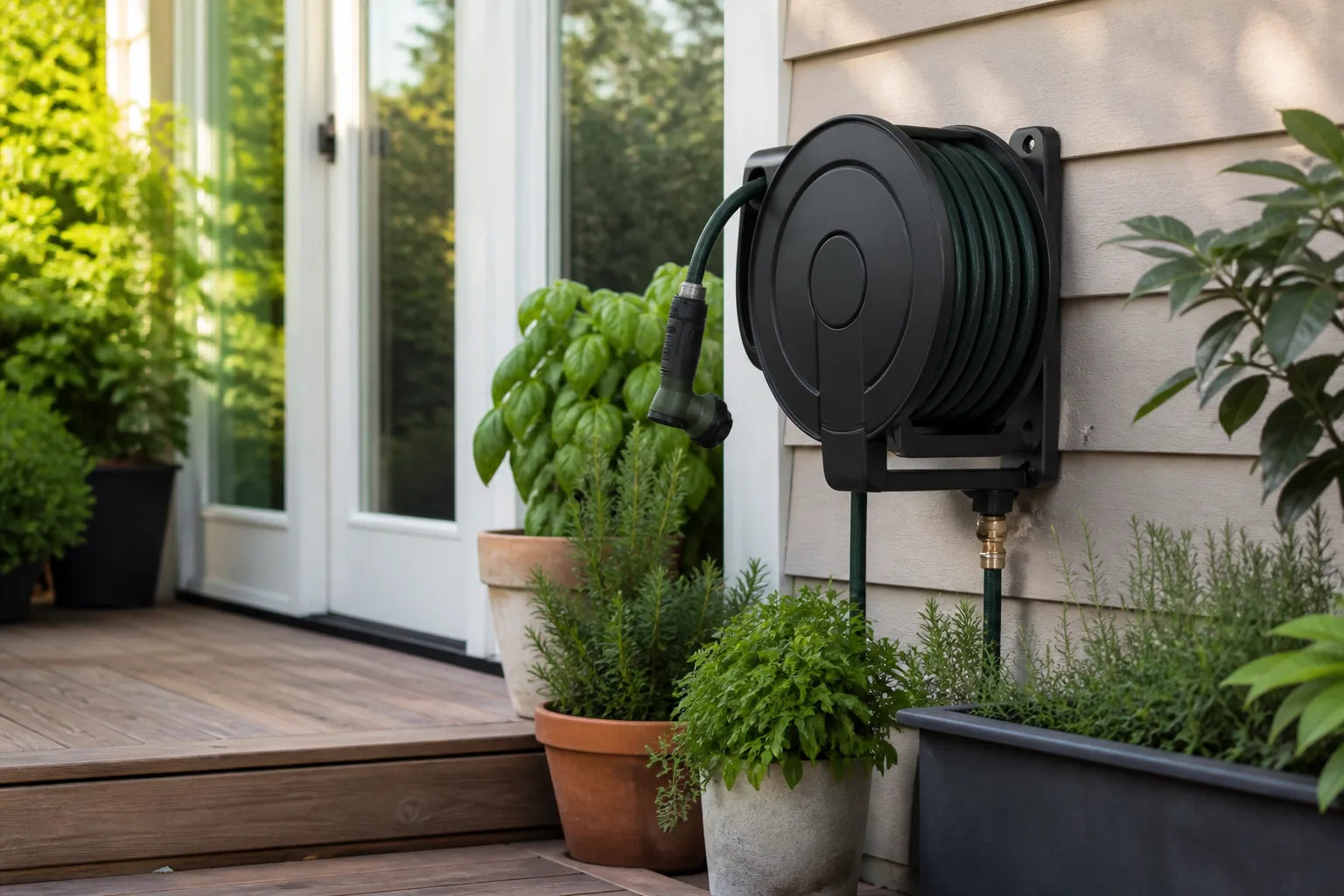
A hose reel is worth considering when you water frequently, have several beds to reach, or want to keep the hose off the walkway. It is less useful if a heavy hose is difficult for you to pull onto the reel or if the reel is mounted too far from the route you use. In those cases, a lightweight short hose on a hanger can make regular watering easier than a large retractable system with more pieces to maintain.
Conclusion: Buy for Your Route and Routine
The right garden hose is long enough to reach your farthest regular watering spot with slack for turns, but not so long that you drag and store unused weight. Choose 1/2 inch for short, light-duty work, 5/8 inch as a balanced starting point for a mixed garden, and 3/4 inch only when the route or attachment can use more volume and your water supply supports it. Then match the material to how often and over what surfaces you move the hose.
Before buying, trace the route, check the reel and tap connection, and decide whether you need a standard hose, a soaker line, or a sprinkler style. On the first day, run a bucket test at the spigot and at the far end, inspect both couplings for drips, and make sure your nozzle waters the soil where you intend. If you want model comparisons after settling your size and use case, see our garden-hose picks and buying notes.