How to Get Rid of Ant Hills in Lawns and Garden Beds
Learn how to get rid of ant hills without ruining grass or garden beds. Match the method to the colony, use bait safely, and prevent repeat mounds.

An ant hill is only the visible roof of a much larger nest. That is why flattening a mound can make the yard look better for an afternoon while doing almost nothing to the colony underneath. The safest lasting fix is to match the method to the situation: leave harmless ants alone, correct the food source when possible, use a dry contact method only where it will not harm plants, and choose a properly labeled slow-acting bait when the colony itself must be controlled.
Start by deciding whether the hill needs removal
Most ants in a yard are not automatically plant pests. They can move organic matter, disturb compacted soil, and prey on other insects. The goal is not to sterilize the garden; it is to stop a colony that is damaging plants, interfering with mowing, stinging people or pets, entering a building, or protecting sap-sucking pests.
Signs the ants are causing a real problem
Treat the problem when ants are concentrated on tender shoots, repeatedly building mounds in a path or mowing area, biting or stinging when the soil is approached, or using a plant bed as a highway into the house. A trail up a shrub is especially worth investigating because ants may be harvesting honeydew from aphids, mealybugs, soft scale, or whiteflies rather than feeding on the plant itself.
That distinction changes the job. If the ants are protecting honeydew-producing insects, killing workers at the mound can leave the plant problem untouched. UC Integrated Pest Management recommends tracing trails, checking plants, and managing the insects producing honeydew as part of ant control.
When leaving a mound alone is the smarter choice
If a low mound is away from paths, play areas, foundations, and valuable plants, watch it for a few days before reaching for a product. You may find that the ants are passing through, cleaning up fallen material, or hunting other pests. Mark the location with a stick or stone and inspect the nearby plants instead of disturbing the soil immediately.
Removal becomes more reasonable when the hill is expanding, repeatedly rebuilt, or attached to a larger pattern of trails. A few minutes of diagnosis prevents two common mistakes: applying a broad-spectrum insecticide to a harmless colony or pouring a plant-killing liquid into a bed because the mound looks unsightly.
Also separate a mound from the damage around it. Ants may loosen soil around shallow roots, but yellow turf, wilt, and bare patches can have unrelated causes such as drought, grubs, compaction, or mower stress. Treat the ants only when their behavior, location, or safety risk makes them the most likely problem.
Identify the situation before you disturb the soil
Ant species vary in food preference, nest structure, aggression, and response to bait. You do not need a perfect species identification for every small nuisance hill, but you should know whether you are looking at ordinary foraging ants, ants tending plant pests, or a potentially aggressive fire-ant colony.
Ants have a narrow waist and elbowed antennae. Termites have a broad waist and straight antennae, so winged insects around a mound should not be treated blindly. If you are unsure, take a close photograph from a safe distance or ask a local extension office for help.
Follow the trail to find the food source
Observe the mound and trails before raking. Look under mulch, edging, stones, boards, and low branches, then inspect the undersides of leaves and new growth. Sticky leaves, clusters of aphids, cottony insects, or scale-like bumps suggest honeydew is helping maintain the traffic.
Remove fallen fruit, leaking pet food, and decaying plant debris, and correct irrigation that leaves a persistently wet edge. If ants are climbing a tree or shrub, prune branches that touch another plant, a fence, or the house. This reduces the route without placing any powder or spray on the foliage.
Watch the same trail at two different times of day. Ants can disappear during the hottest part of the afternoon and reappear in the evening, so a quiet mound does not prove that the colony is inactive. A short observation also tells you whether the ants are commuting to a plant, a crack, a compost area, or a food source that can be removed before treatment.
Choose the least disruptive effective method
Use this order of operations: cosmetic disturbance for a single harmless mound; a targeted dry-contact treatment for a small, exposed nest in hardscape; and slow-acting bait for a persistent colony. The method that kills the most ants in the first minute is not necessarily the method that controls the nest.
| What you see | Best first move | Avoid |
|---|---|---|
| One small mound in turf with no stinging | Level it and monitor | Repeated blanket spraying |
| Ants climbing a plant with sticky leaves | Inspect and control aphids, scale, or mealybugs | Treating only the mound |
| A trail beside pavers or a foundation | Use a narrow, dry, labeled treatment or enclosed bait | Dusting flowers or wet soil |
| Several active mounds | Identify the ant and consider bait | Disturbing every mound before baiting |
| A mound that may contain fire ants | Keep people and pets away and get local guidance | Kicking, digging, or flooding it |
Flatten, rake, or relocate a small nuisance mound
For a small mound in turf, rake the soil level and refill any exposed depression with the same soil. In a bed, lift the loose mound away from plant stems rather than piling it against a crown. Repeat disturbance only when the ants are a cosmetic nuisance and you are willing to monitor the spot; this approach often makes the colony relocate rather than disappear.
Do not dig aggressively into an unknown mound. Excavation can tear roots, expose irrigation lines, and provoke stinging ants. For a mound beside a walkway, leveling the surface may be all that is needed; for a mound that returns in the same place, move to a colony-level strategy rather than repeatedly wrecking the bed.
Flooding and boiling water: fast but limited
A garden hose can collapse shallow tunnels and wash out a small mound, but it is a blunt tool. Use a slow flow aimed at the mound, not a high-pressure jet aimed at plant stems, and stop before water runs across a bed or toward a drain. Flooding may relocate ants through underground passages and often needs repeating.
Boiling water is more damaging to living tissue than many “natural” labels suggest. It can kill exposed ants, but heat also scalds grass crowns, feeder roots, beneficial soil organisms, and low foliage. Save it for an isolated mound in gravel, a driveway crack, or bare soil with no valued roots nearby; never use it as a blanket treatment across a lawn or planted bed. Even when it works on a small nest, the heat may not reach the queen or every chamber.
If you do use plain water on a truly isolated mound, check where the runoff will go first. A low spot can carry loosened soil and ants into a planting hole, drain, pond, or neighboring bed. Water is a reasonable way to erase a temporary mound in an unplanted area; it is not a substitute for bait when the same colony is rebuilding beside the same plant.
Practical garden guidance from Better Homes & Gardens also treats flooding and boiling water as limited treatments that may need repeating. That is the important takeaway: “natural” describes the ingredient, not a guarantee of plant safety or colony control.
Diatomaceous earth: useful only while dry
Diatomaceous earth, or DE, is a dry-contact powder. When ants cross a dry deposit, the abrasive particles can damage their waxy outer surface and contribute to dehydration. It does not behave like a bait that workers carry deep into the nest, and rain, irrigation, or heavy dew removes the advantage.
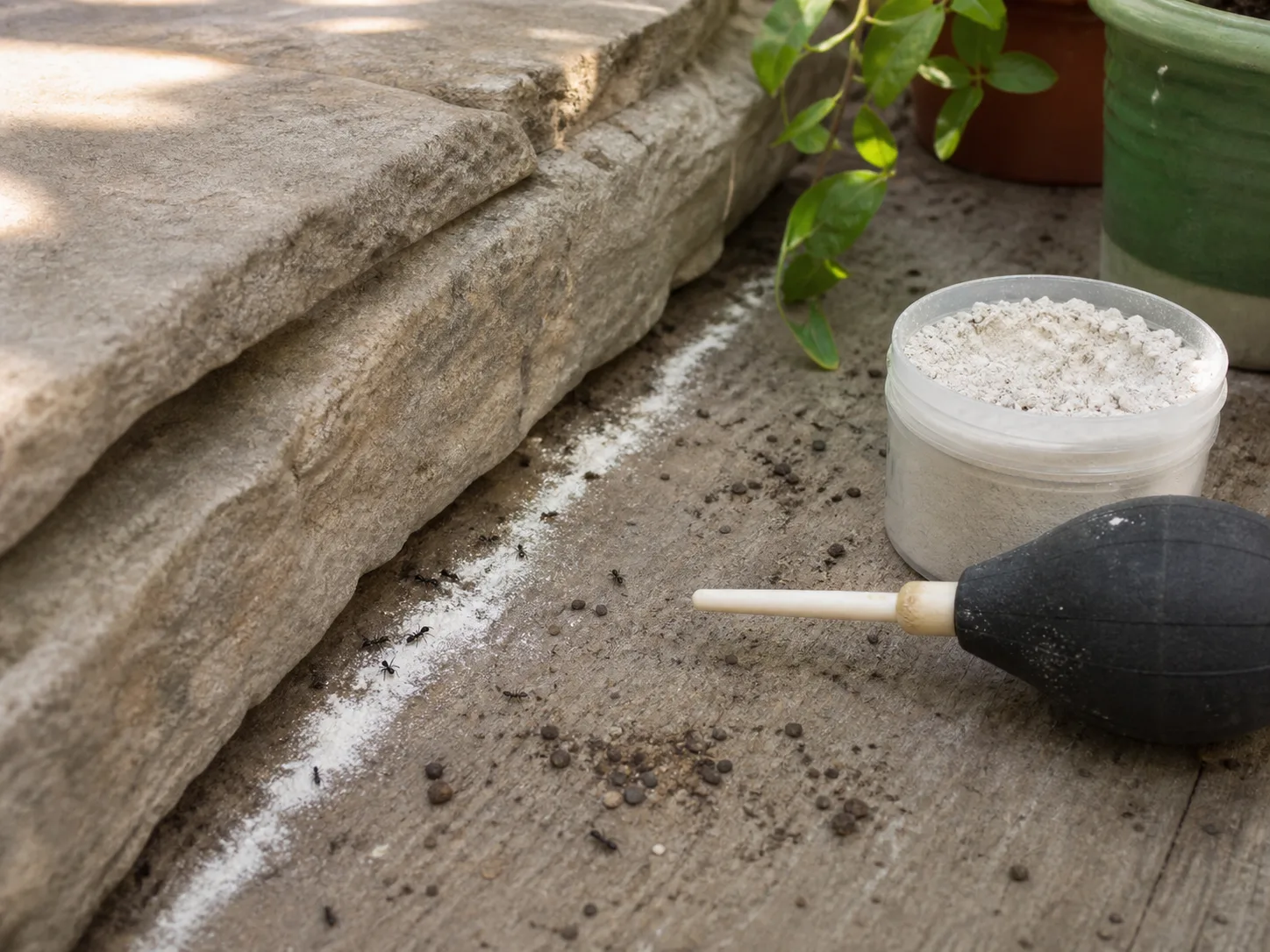
If you use DE, choose a product labeled for the intended site, apply the thinnest effective layer to cracks or bare ground, avoid flowers and active pollinator areas, and keep the dust out of your face. Do not dust leaves, open blooms, or the entire bed. Reapply only according to the product directions after moisture, and do not assume food-grade wording means a product is suitable for every garden use.
DE is most useful when ants are crossing a dry, defined route beside pavers or a foundation. It is a poor choice for a damp lawn, a windy day, or a colony hidden below a thick mulch layer. If the ants simply walk around the powder, remove the obstruction and switch to a bait or exclusion plan rather than making a wider dust ring.
Use bait when you need colony-level control
Slow-acting bait is usually the most efficient option for a persistent outdoor colony because workers can carry the food-based formulation back to nestmates. Ants exchange food inside the colony, allowing the active ingredient to move beyond the workers visible on the surface. UC IPM explains this colony-level pathway and notes that bait can take more than a week, so patience is part of the method.
Test what the ants will eat
Ants do not all prefer the same bait. Outdoor formulations may be sugar-based liquids or protein- and grease-based solids, and food preference can change with the colony’s needs and the season. Put a tiny, temporary test portion of the type you are considering near—not in—the trail, then watch from a distance. If workers ignore it, remove it and try a different labeled bait rather than increasing the amount.
For fire ants, N.C. Cooperative Extension recommends a simple foraging check: place a small piece of potato chip near an active mound and see whether ants reach it in roughly 10 to 30 minutes. That test is for activity, not identification, and it should never involve touching or opening a suspected aggressive mound.
Place bait without contaminating the bed
Use a product labeled for outdoor use and for the exact location you are treating. Put enclosed stations on a firm surface where rain will not wash contents into soil, and keep them away from children, pets, wildlife, irrigation spray, and edible plant parts. For granular bait, apply only the labeled rate and placement; do not pile it directly against a plant stem or broadcast it into a vegetable bed unless the label specifically allows that use.
Do not flatten or flood an active mound immediately before baiting. Disturbance can stop foragers from accepting the bait. Apply fresh bait to dry ground when ants are actively searching and follow the label’s rain-free window. N.C. Cooperative Extension notes that fire-ant bait should remain dry and that fresh bait, an undisturbed mound, and active foraging improve the odds of uptake.
Keep competing food away during the baiting period. Fallen fruit, sugary spills, grease, pet food, and a heavy flush of honeydew can make a carefully chosen bait less attractive. That does not mean starving the garden; it means removing the avoidable alternatives so the workers have a reason to investigate the bait. Never mix a commercial bait with sugar, borax, fertilizer, or another pesticide unless the label specifically directs it.
Expect the surface traffic to change slowly. A sudden pile of dead workers is not the only measure of success; fewer active trails and no rebuilding over the following days matter more. If activity remains unchanged after the label’s stated evaluation window, check whether the bait was wet, stale, ignored, misplaced, or used on a species that prefers a different food base.
Take extra care if it might be a fire-ant mound
Fire ants can sting repeatedly and may swarm when the mound is disturbed. A smooth, irregular mound without a clear entrance is not enough to identify them, and color alone is unreliable. Watch from a distance for unusually rapid, aggressive movement when the ground is lightly approached, and use regional extension guidance because fire-ant distribution differs by location.
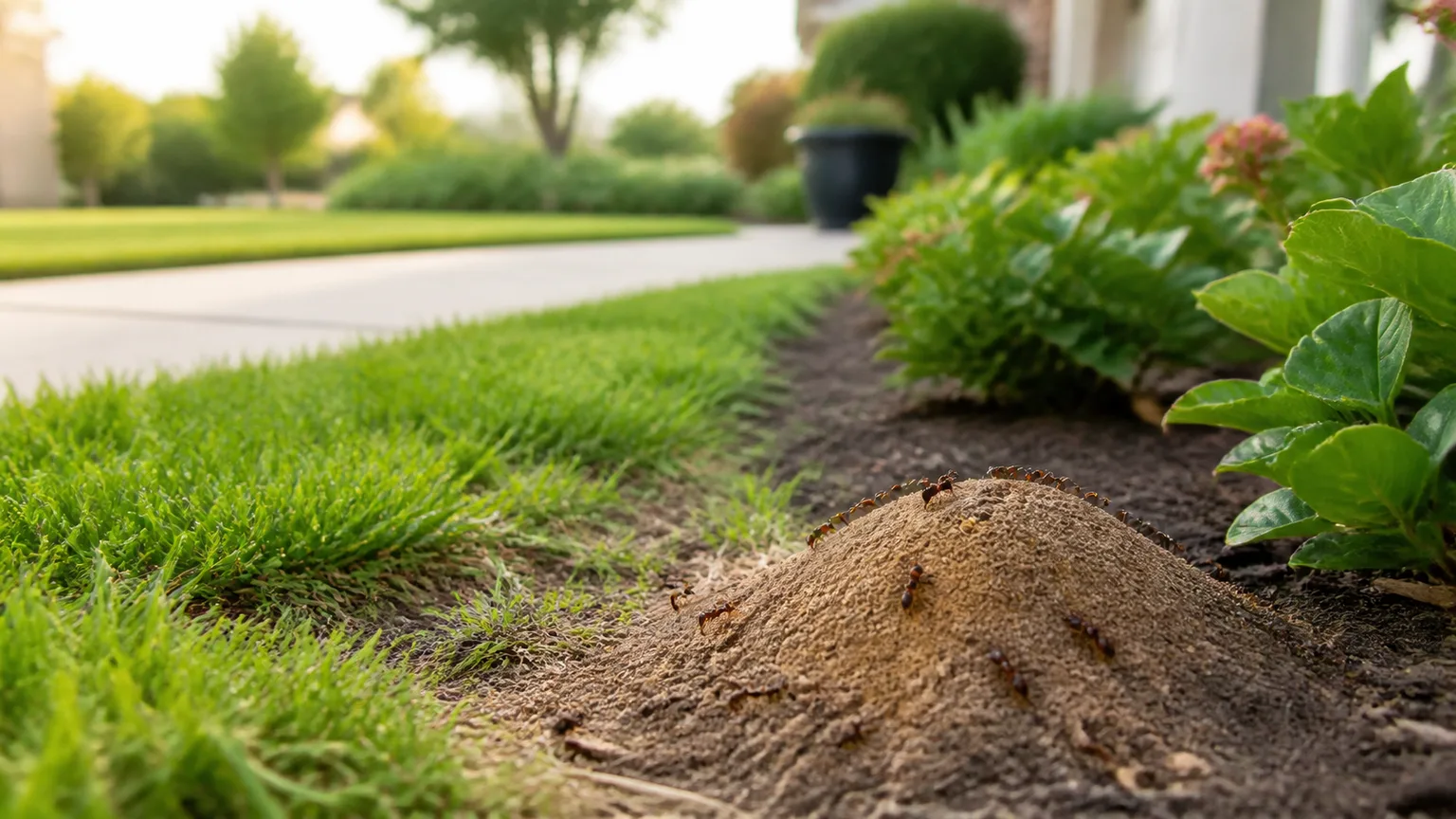
Do not kick, rake, dig, flood, pour boiling water on, or collect ants from a suspected fire-ant mound. Keep children and pets away, and use a product whose label covers the site and the pest. For many mounds, a broadcast bait program can be more practical than treating each mound, but the product and timing must match the label and local conditions.
If anyone is stung repeatedly, develops a significant reaction, or if the mound sits where people cannot avoid it, stop the do-it-yourself experiment and contact a qualified pest professional. Fire-ant control is one of the cases where correct identification and local label guidance matter more than a clever home remedy.
Protect lawns and garden beds during treatment
The safest application is narrow and deliberate. Keep any liquid treatment out of the grass crown, keep powders off flowers and leaves, keep bait out of reach of non-target animals, and prevent runoff into ponds, storm drains, and streams. A cardboard shield or small piece of plastic can help keep a spot treatment off a nearby plant, but it is not permission to use an unlabeled chemical.
In a lawn, repair the cause of weak turf after the ants are controlled: compacted soil, dry edges, bare patches, or leaking irrigation can all create favorable nesting conditions. In a garden bed, maintain a clear inspection strip around stems, avoid piling mulch against crowns, and water deeply enough for the plant without leaving a constantly saturated surface.
Do not confuse a treatment mark with plant injury. A small patch of disturbed turf can be raked smooth and reseeded at the seasonally appropriate time, while a wilted plant may be reacting to broken roots, heat, or waterlogged soil. Photograph the area before applying anything; a before-and-after record helps you tell whether the mound, the product, or an unrelated irrigation problem caused the change.
Respect the label boundary around vegetables and fruit
“Natural,” “organic,” and “pet-friendly” are not interchangeable with “approved for this crop.” Pesticide labels define the permitted site, crop, application rate, harvest interval, and precautions. If the label does not name a vegetable garden, fruit tree, herb bed, or the specific ant problem, do not improvise.
That boundary matters especially for fire-ant baits. N.C. Cooperative Extension points out that only some products are labeled for agricultural areas such as vegetable gardens, orchards, and cropland. When in doubt, choose physical exclusion, remove the food source, contact your county extension office, or hire a licensed pest professional rather than risking a crop.
Why ant hills return after treatment
The visible mound is not the whole colony. A worker-killing spray, shallow flooding, or a quick rake may leave the queen, brood, and deeper chambers intact. Ants may also rebuild nearby after being displaced, so a new mound does not always mean the first treatment “failed” in the way you think.
Look for four repeat causes: the nest was never reached; the ants relocated; a honeydew-producing pest remains on a plant; or the original attraction—fallen fruit, debris, dry soil, a protected edge, or a food spill—was left in place. Broad-spectrum sprays are particularly prone to providing a false win because they kill foragers while new workers emerge from the nest. UC IPM cautions that sprays commonly kill only the ants that are out foraging, while bait is designed to move through the colony.
Prevent the next mound
After treatment, walk the property once a week for a month. Follow any new trail before disturbing it, check the base of trees and shrubs, lift edging and boards, and inspect the underside of leaves for honeydew pests. Early monitoring is easier than trying to rescue a bed after several colonies are established.
Keep grass and bed edges maintained without scalping turf. Remove fallen fruit, rotting vegetables, brush, and log piles; correct leaks; and keep stored pet food away from outdoor feeding areas. Trim branches that touch the house or bridge between plants. Southern Living’s lawn-focused guidance similarly emphasizes mowing, debris removal, fallen food, and separation between vegetation and the home as part of prevention.
Put the mound location on a simple yard map if you are dealing with more than one. Record the date, whether the ground was dry, what the ants were following, and whether activity dropped after treatment. Patterns often reveal that several “new” hills are one colony shifting along an edging line, or that every mound appears near the same irrigation fault. Fixing that pattern is more durable than rotating through products.
If ants are climbing a woody plant to tend aphids or scale, treat that plant-pest relationship instead of repeatedly treating the ground. On suitable mature bark, an appropriately placed sticky barrier can interrupt the climb, but it must not touch green stems or be applied where heat, young bark, irrigation, or debris could cause injury. Inspect barriers regularly so trapped debris does not create a bridge over them.
When a location stays dry and bare, improve the cover after the colony is gone: restore turf, add a suitable layer of mulch, or replant the edge so the soil is not left as an open, protected nesting site.
Conclusion
The best way to get rid of ant hills without damaging a lawn or garden bed is to stop treating every mound as the same problem. Diagnose the trail, decide whether removal is necessary, use disturbance or water only where roots are out of range, reserve dry powders for defined dry surfaces, and use a properly labeled slow-acting bait when the colony itself must be controlled.
Give the treatment time to work, then look for the reason ants chose that location. When the food source, bridge, moisture problem, and hiding place are corrected together, the yard usually needs less pesticide and fewer emergency fixes.



