How to Get Rid of Ground Wasps Safely
Find out when to leave a ground wasp nest alone, when traps help, when a professional is safer, and which DIY methods can make stings more likely.
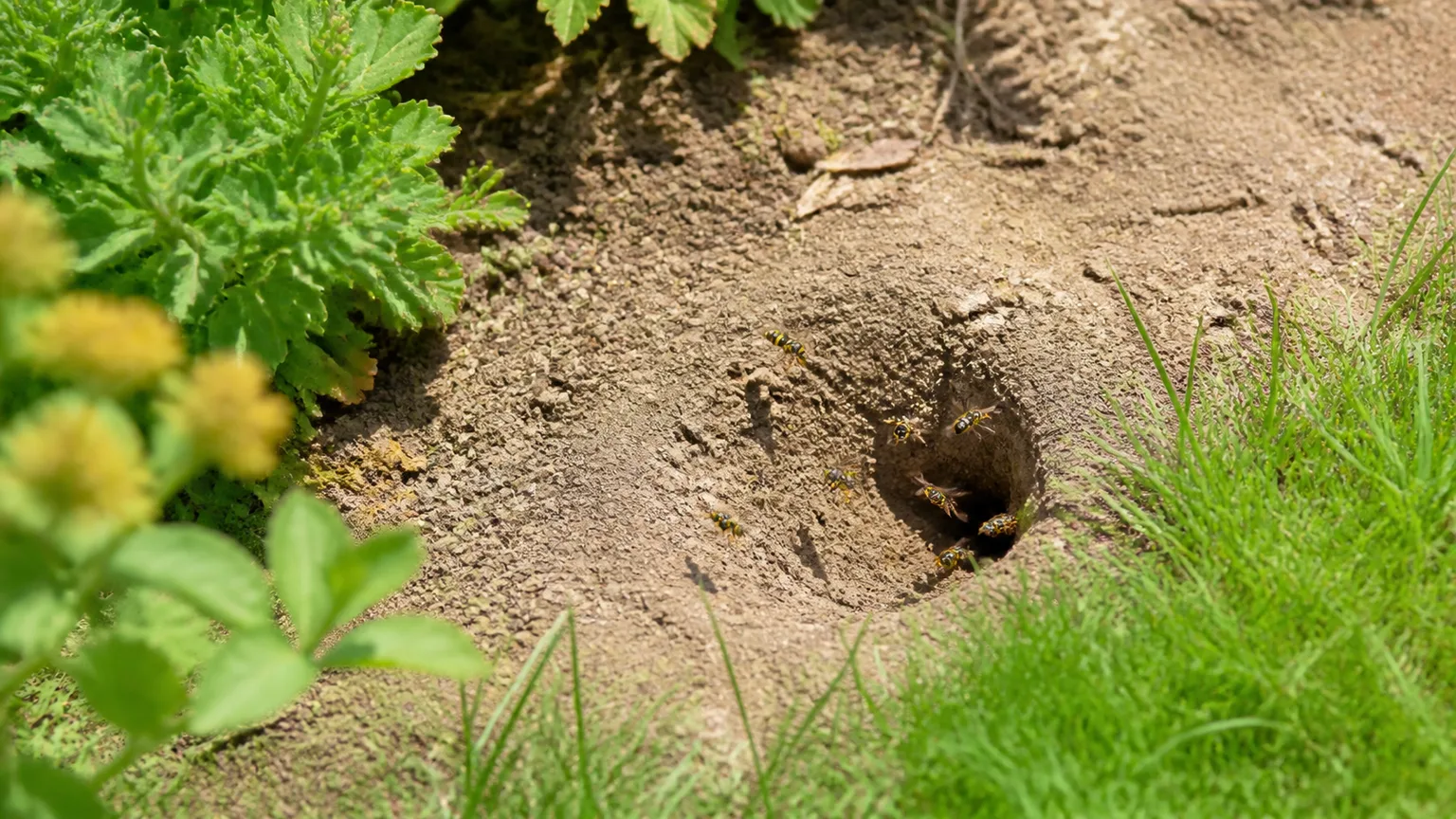
If wasps are flying from a hole in your lawn, do not start by pouring water into it or sealing the opening. First determine whether you are looking at a defensive yellowjacket colony, a group of harmless solitary wasps, or even ground-nesting bees; the safest response can range from leaving the nest alone to hiring a licensed professional.
“Ground wasp” is a useful yard description, not one precise insect. Social yellowjackets may share one underground nest and defend it vigorously, while solitary digger wasps and cicada killers usually occupy individual burrows and spend their time hunting prey rather than guarding a colony. The University of Minnesota Extension explains that many solitary wasps nest close together but still have separate nests, whereas yellowjackets have many workers using one entrance. Its comparison of solitary wasps and yellowjackets is the most useful starting point for deciding what you have.
Quick rule: Keep everyone away and observe from a distance. If there is a steady stream of wasps from one opening, the nest is beside a path, or anyone in the household has a history of a serious sting reaction, do not attempt removal yourself.
Decide whether the nest truly needs removal
A nest at the back of a sunny bed is a different problem from a nest beneath the only route to the compost bin. Wasps are important predators of caterpillars, flies, aphids, and other insects, and adults visit flowers for nectar; eliminating every nest also removes useful garden activity. BBC Gardeners’ World Magazine’s overview of wasps also emphasizes that most garden wasps are beneficial when they are not defending a nest beside people.
Leave a low-traffic nest alone when it is well away from doors, play areas, seating, pet runs, vegetable rows, and mowing routes. Put a temporary visual barrier around the approach to the area, tell children not to investigate it, and observe whether the activity naturally declines rather than creating a disturbance that turns a tolerable nest into a defensive encounter.
Removal becomes reasonable when people or animals must pass within a few feet, the entrance is in a lawn that needs mowing, the nest is beside a doorway or play structure, or workers repeatedly swarm around food and seating. It is also reasonable to escalate when you cannot identify the insect confidently; uncertainty is a safety factor, not a reason to experiment.
Season matters. Solitary wasps generally live for one season and may be active for only a few weeks, while social yellowjacket colonies usually grow through the warm season and become more defensive as the colony gets larger and food becomes scarce. UC Integrated Pest Management notes that some yellowjacket colonies can contain roughly 1,500 to 15,000 individuals, depending on species, so a small entrance does not tell you that the nest itself is small. UC IPM’s yellowjacket guidance explains why a quiet-looking entrance can still deserve respect.
Identify what is using the hole
Do not crouch over the opening, shine a flashlight into it, or scrape away the soil. Watch from well outside the flight path on a warm day, take a zoomed photograph if you can do so without approaching, and look for the pattern of traffic rather than trying to catch an insect.
Ground-nesting yellowjackets
Yellowjackets are usually medium-sized, smooth-bodied insects with jagged yellow-and-black markings and a narrow waist that is not especially long. The strongest clue is behavior: multiple workers fly directly in and out of one opening, often on a repeated route, and the area may become noticeably busier from midsummer into fall.
The entrance may be in an abandoned rodent burrow or another cavity, and the underground paper nest can extend away from the visible hole. A hole about two inches wide with little or no neat mound is consistent with a yellowjacket entrance, but hole size alone is not enough for identification; the University of Minnesota’s lawn-hole diagnostic also lists season, soil disturbance, and the insect’s appearance as part of the check. Use its lawn-hole guide to compare possibilities.
Yellowjackets are beneficial predators when they are away from people, but social workers defend a colony when it is disturbed. Their risk is highest at the nest, during mowing or digging, and when a person swats at a foraging insect near food.
Solitary digger wasps and cicada killers
Solitary wasps may form a loose-looking neighborhood of holes in dry, sandy, well-drained soil. That visual density can be alarming, but each female generally provisions her own nest; she is not part of a large colony waiting inside one shared chamber.
Cicada killers are among the largest wasps you may see around a lawn. They often use sunny, sparse soil and leave a conspicuous mound beside a large entrance. Iowa State University Extension describes each female as working alone to dig and provision her nest, and notes that these wasps are unlikely to sting unless directly handled or seriously threatened at the tunnel. Read the Iowa State cicada-killer profile for the life-cycle distinction.
That does not mean you should touch one. Avoid mowing, string-trimming, raking, or digging through an active patch, but do not treat a few large wasps moving between separate holes as proof of a yellowjacket colony. A solitary nest in a quiet part of the yard is usually a “watch and wait” problem, not an emergency.
Ground bees and other look-alikes
Some holes belong to ground-nesting bees, and the difference matters. Bees tend to look hairier and may carry pollen on their hind legs; many solitary bees are gentle unless physically trapped or handled. A hole with a few insects visiting flowers is not automatically a wasp nest.
Mud daubers are another common source of confusion, but they generally build mud nests on sheltered walls, ceilings, or other structures rather than forming a large underground colony. A black-and-yellow insect, a mound of soil, or a single tunnel is not enough to justify pesticide use.
If the insect is too fast, the light is poor, or the nest is hidden beneath a shed, stop at a broad identification such as “stinging insect.” A local extension office, university insect clinic, or licensed pest professional can often identify a clear photograph without you opening the nest.
Map the nest without disturbing it
Use daylight to understand where people and wasps move, not to plan a close approach. Stand far enough away that the insects continue their normal flight, note the entrance in relation to paths and structures, and watch whether traffic is one-way and continuous or consists of occasional individual visits.
Never probe a hole with a stick, kick the mound, pour a test liquid into it, or place your face near the opening. Do not mow over an unknown hole “just to see what happens”; vibration and a damaged entrance can trigger the exact defensive response you are trying to avoid.
Mark the hazard from a distance with a temporary sign or barrier placed well away from the entrance, then redirect foot traffic. Keep the marker visible to children, guests, gardeners, and anyone who might arrive after dark when the hole is harder to see.
If you need a professional, record the location, the number of visible entrances, the time of day activity is highest, and whether the insects are entering a wall, shed, or other void. That information is more useful than a sample of the insect and keeps you out of the nest’s flight path.
Make the yard safer before you control anything
The first useful intervention is often separation. Reduce the reasons for wasps to visit patios and bins, then remove the chance that a person or pet will accidentally cross the nest while you decide what to do.
Remove food and scent attractants
Yellowjackets hunt insects for their developing young and later in the season may scavenge sugary drinks, ripe fruit, pet food, meat scraps, and garbage. Cover outdoor drinks, keep food indoors when you are not actively eating, close trash and recycling lids, bring pet bowls in promptly, and pick up fallen fruit before it softens and ferments.
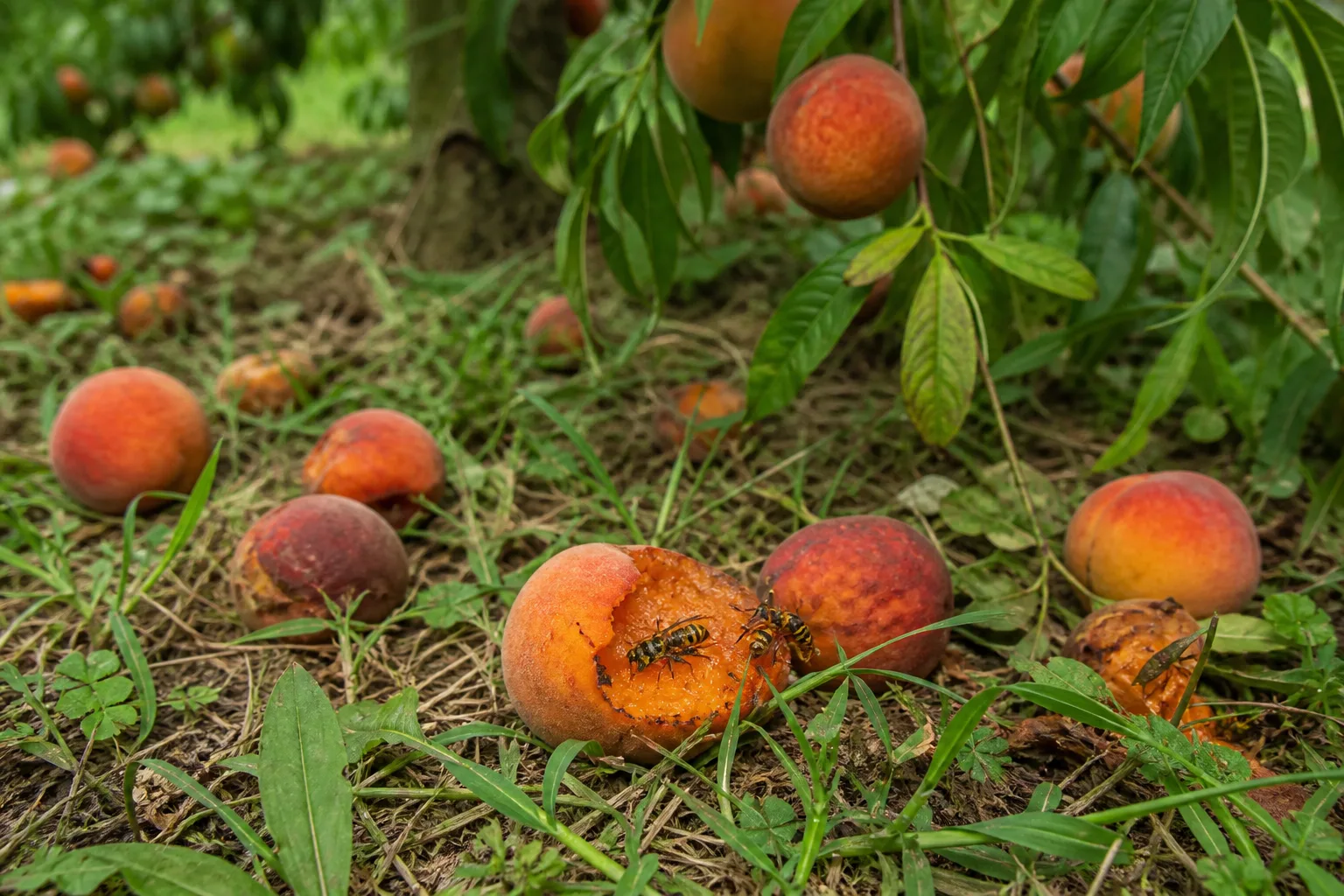
UC IPM recommends sealed garbage, covered food and pet food, covered drinks, and removal of ripe fruit because wasps can continue searching a location after they have learned it contains food. These steps will not kill an underground colony, but they can reduce the number of workers hovering around a patio while the nest itself is assessed.
Do not spray flowers, fruit, or a nest with scented oils and assume the problem is solved. Fragrance-based repellents may change where a few foragers fly, but they are not a dependable way to make a defensive colony abandon a buried nest, and spraying flowering plants can affect beneficial insects.
Protect people, pets, and equipment
Put mowing, edging, digging, and soil work on hold around the suspected entrance. Keep dogs on a leash away from the area, move children’s play equipment if it directs traffic toward the nest, and avoid using a leaf blower or string trimmer nearby.
If one wasp lands on you, stay still and let it leave or gently brush it away. Do not slap, swat, or run at the first sight of an insect; if several wasps begin defensive flight, cover your face and retreat indoors along the route you already planned.
Someone with a known sting allergy should not inspect or treat an active nest. The same caution applies when a nest is beside a doorway, under a deck, inside a wall, beneath a shed, or in any place where escape would be difficult.
Manage a low-risk problem without treating the nest
If the nest is away from daily activity, the best control may be to reduce encounters and let the insects complete a short seasonal cycle. If it is in the wrong place, change the site only after activity has stopped or obtain professional advice rather than disturbing an active entrance.
Use seasonal timing and surface changes
Solitary wasps often disappear by the end of summer, and their individual nests are not reused year after year. Most social wasp colonies are also annual, with workers and the old queen dying as the season ends; in mild climates, however, some yellowjacket colonies can persist longer, so “wait for winter” is not a universal guarantee.
For a low-risk patch of solitary wasp burrows, frequent light raking or covering the area with a tarp for several days may discourage future use, according to University of Minnesota Extension. Do this only when you can confirm the area is no longer active, and never pin a tarp over a live yellowjacket entrance as a first experiment.
After the season, improve the surface rather than trying to make the whole yard wet. Plant a suitable ground cover, repair thin turf, add an appropriate layer of mulch, or redesign the path so the bare, well-drained patch is no longer in the traffic lane. Keep some undisturbed soil elsewhere if you want to support ground-nesting pollinators.
Use traps only for yellowjacket foragers
Yellowjacket lure traps can reduce some foraging activity around a patio, but they do not remove the underground nest. UC IPM says lure traps work for some species and should be placed around the perimeter, away from picnic tables or other places people gather; they are not a universal trap for every wasp.
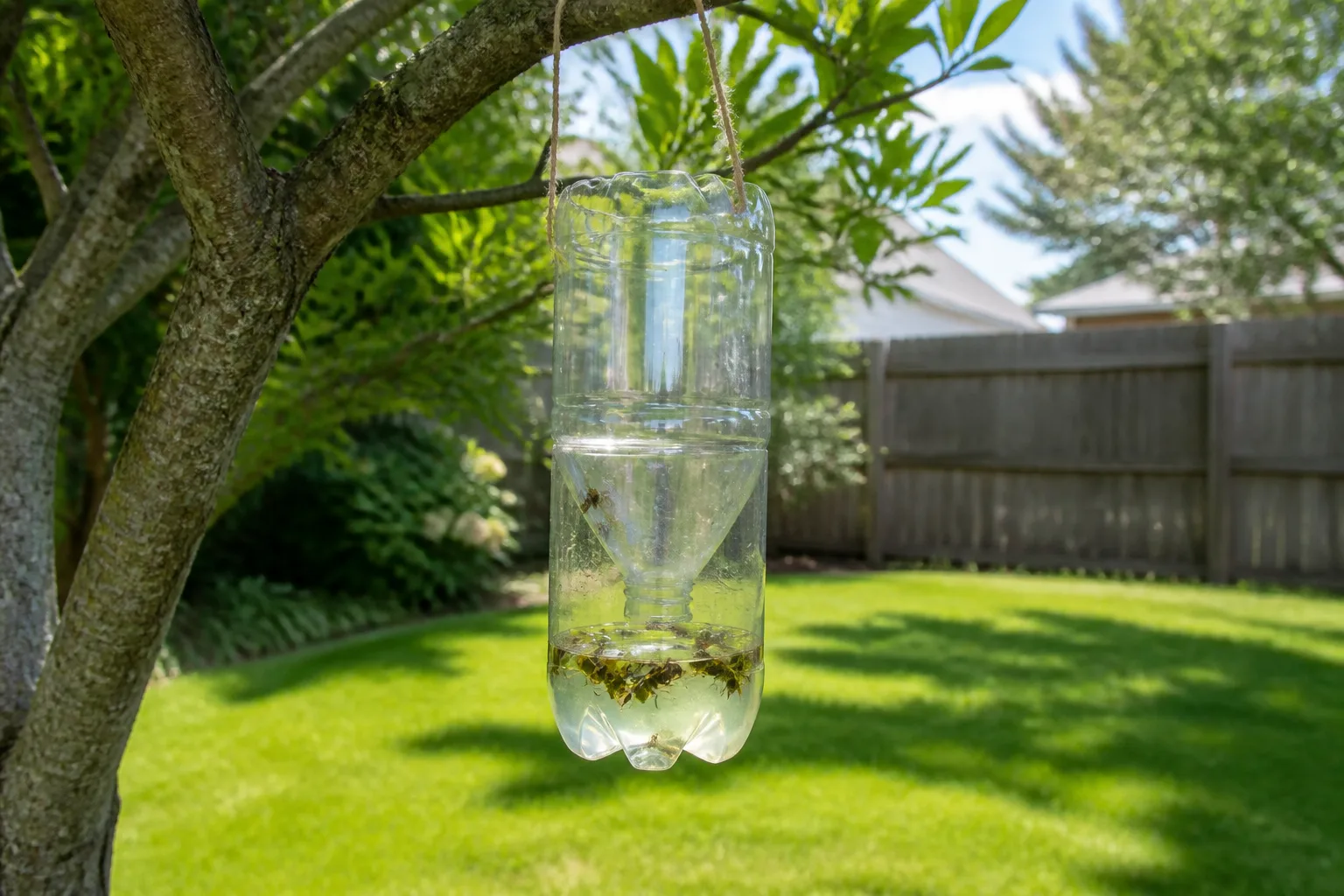
Use a commercial lure according to its instructions, place it between the suspected foraging area and the property edge, and check it as directed. Do not hang a trap beside the table where you eat, and do not use one to justify walking closer to an active nest.
Traps are the wrong tool when the insects are solitary digger wasps, cicada killers, or an unidentified species. They may also attract more foragers to a property if placed beside food or a doorway, so the placement decision matters as much as the trap itself.
Handle an active nest in a high-traffic place
An active nest in a walkway, lawn, play area, pet run, or work bed is a legitimate safety problem. The goal is not to prove that you can eliminate it with a household mixture; the goal is to reduce the chance of multiple stings while using the smallest effective intervention.
Know when to call a professional
Hire a licensed pest-management professional, where licensing applies, when any of these conditions are present:
- Someone in the household has a known or suspected sting allergy.
- The nest is beside a door, path, play area, pet route, or lawn that must be mowed.
- The insect is an unknown stinging species or the entrance leads under a structure or into a wall.
- There are many entrances, strong defensive flights, or a large colony.
- You cannot see a clear escape route, or the treatment would require a ladder, crawling, digging, or working near electrical, plumbing, or irrigation equipment.
Ask the professional to identify the insect, explain whether the nest is active, describe the product and application method, and give re-entry instructions for children, pets, and pollinators. A responsible plan should also account for flowers, vegetable beds, runoff, and the possibility that an underground nest extends beyond the visible entrance.
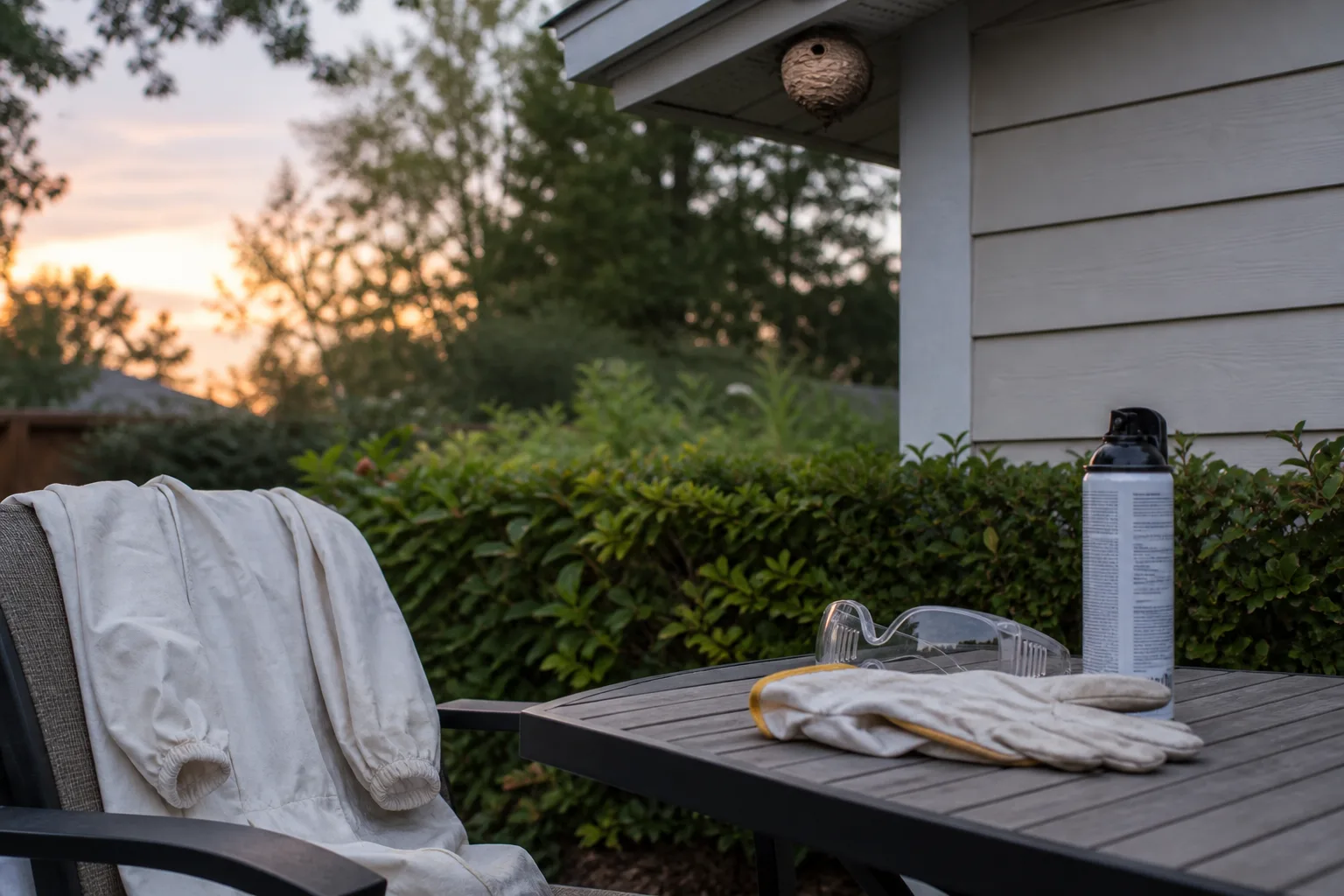
Extension guidance from Penn State emphasizes that stinging-insect nest work is inherently dangerous and that protective clothing, distance, an escape plan, and the right treatment method matter. Even a professional may recommend waiting when the nest is at the end of its natural season and is not threatening anyone.
If a label-approved treatment is used
Home treatment is not a recipe with a universal mixture or a guaranteed time of night. Only use a product whose current label specifically allows the site, insect, and application, and follow the label’s protective equipment, wind, distance, storage, disposal, re-entry, and environmental instructions; the pesticide label is the legal instruction for that product.
Do not use gasoline, diesel, fire, boiling water, household cleaners, vinegar, or an improvised soap flood. These methods can injure the person applying them, contaminate soil or water, drive insects out through another opening, or leave a nest active while creating false confidence.
Do not spray a flower bed or broadcast an insecticide across the yard to solve one nest. Targeted treatment, when truly needed and legally allowed, is less damaging than a blanket application, but it still carries risk to people, pets, pollinators, and other wildlife. If you are not comfortable reading and following the entire label before opening the container, call a professional instead.
Methods to skip and why they fail
Flooding with soapy water is unreliable. A buried nest may be deeper or offset from its entrance, and water can make the soil collapse or redirect surviving insects without reaching the colony. The procedure also requires you to work at the hole while it is active.
Vinegar and essential oils are not nest removal. A smell that makes one forager change direction does not neutralize a colony, and repeated spraying can affect plants, beneficial insects, and soil life. Treat scent products as unproven for this job rather than as a safe substitute for identification and distance.
Diatomaceous earth is not automatically harmless. Dust can irritate eyes and lungs, and a loose application can expose non-target insects. A product must be registered and labeled for the intended site and pest in your area; even then, dust may not reach a nest that is far from the visible entrance.
Sealing an active entrance can backfire. Wasps may open another exit or emerge where people least expect them, and you have no reliable way to know whether the colony is dead. Pack or mulch an opening only after activity has clearly ended, or let a professional make that decision.
A trap cannot replace nest control. Traps can reduce some workers around a defined outdoor area, but they do not make a colony safe to mow over and they do not work equally well for all wasps. Never judge nest size by how many insects a trap catches.
What to do after activity stops and next season
Confirm dormancy from a distance on more than one warm day rather than assuming that cold weather or rain has ended the nest. Once there is no repeated traffic, remove the temporary barrier, fill or level the opening if it has become a trip hazard, and restore the surface with turf, plants, or a site-appropriate mulch.
Do not excavate an old nest simply to satisfy curiosity. Underground paper and brood material can collapse, attract scavengers, or sit farther from the entrance than you expect; if the ground is sinking near a foundation, septic component, drain, or retaining structure, have the area checked before you dig.
Next spring, inspect high-risk routes before mowing or turning soil. Look for repeated traffic into one opening, not just isolated wasps over flowers, and keep a clear walking route around any early-season activity until you know what it is.
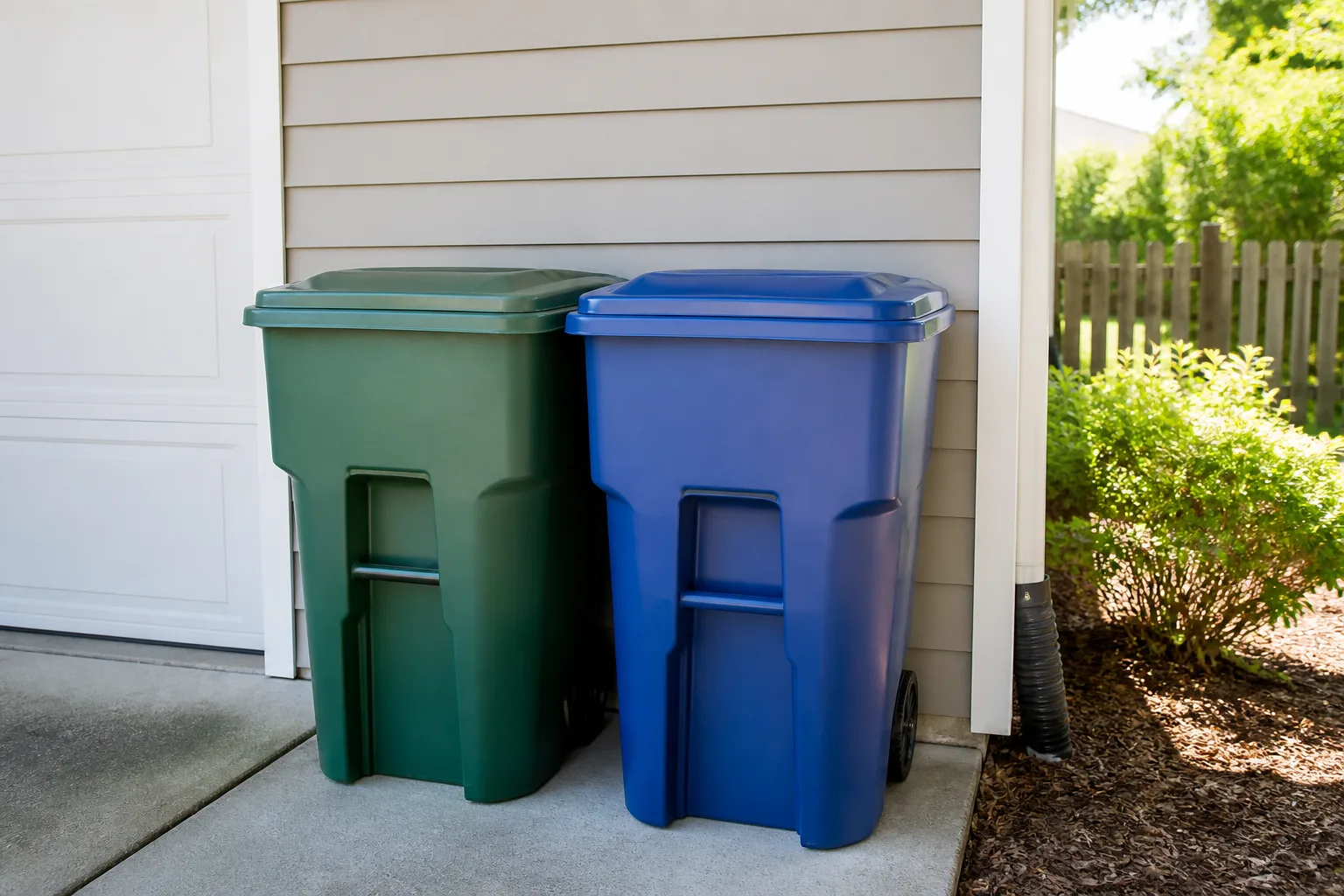
Keep garbage, pet food, fallen fruit, and outdoor meals managed throughout the warm season. A clean food area will not stop a queen from choosing suitable soil, but it reduces the later scavenging that makes an otherwise distant colony feel like a patio infestation.
What to do if you are stung
Move away from the nest and indoors, then wash the site with soap and water and use a wrapped cold pack for pain and swelling. If a stinger is visibly left behind, scrape it away rather than squeezing it; many wasps can sting more than once and do not leave a barbed stinger in the skin.
Call your local emergency number immediately for trouble breathing, throat tightness, swelling of the lips or tongue, faintness, widespread hives, repeated vomiting, or other signs of a whole-body reaction. MedlinePlus advises using the person’s prescribed epinephrine auto-injector when indicated and seeking emergency care; do not wait to see whether a severe reaction improves on its own. Review the MedlinePlus insect-sting guidance.
For a painful or unusually large local reaction, contact a clinician or pharmacist for advice, especially if swelling continues to expand or the person has been stung many times. A sting is also a good reason to stop any planned nest treatment until the source and the household’s risk are reassessed.
Conclusion
The safest way to get rid of ground wasps is to make the right identification before choosing control. Leave a quiet solitary nest alone when you can, reduce food attractants and foot traffic, use yellowjacket traps only for localized foraging, and bring in a professional for an active colony in a high-use area or any situation involving allergy, children, pets, or uncertain identification.
That approach protects more than the person who wants the hole gone. It preserves useful predators and pollinators where they belong, avoids contaminating a garden with an improvised treatment, and gives you a clear escalation point when a small-looking entrance is actually a defensive underground colony.



