Japanese Black Pine Care: Planting, Pruning & Problems
Learn where Japanese black pine thrives, how to plant and water it, when to prune spring candles, and how to recognize disease before decline spreads.
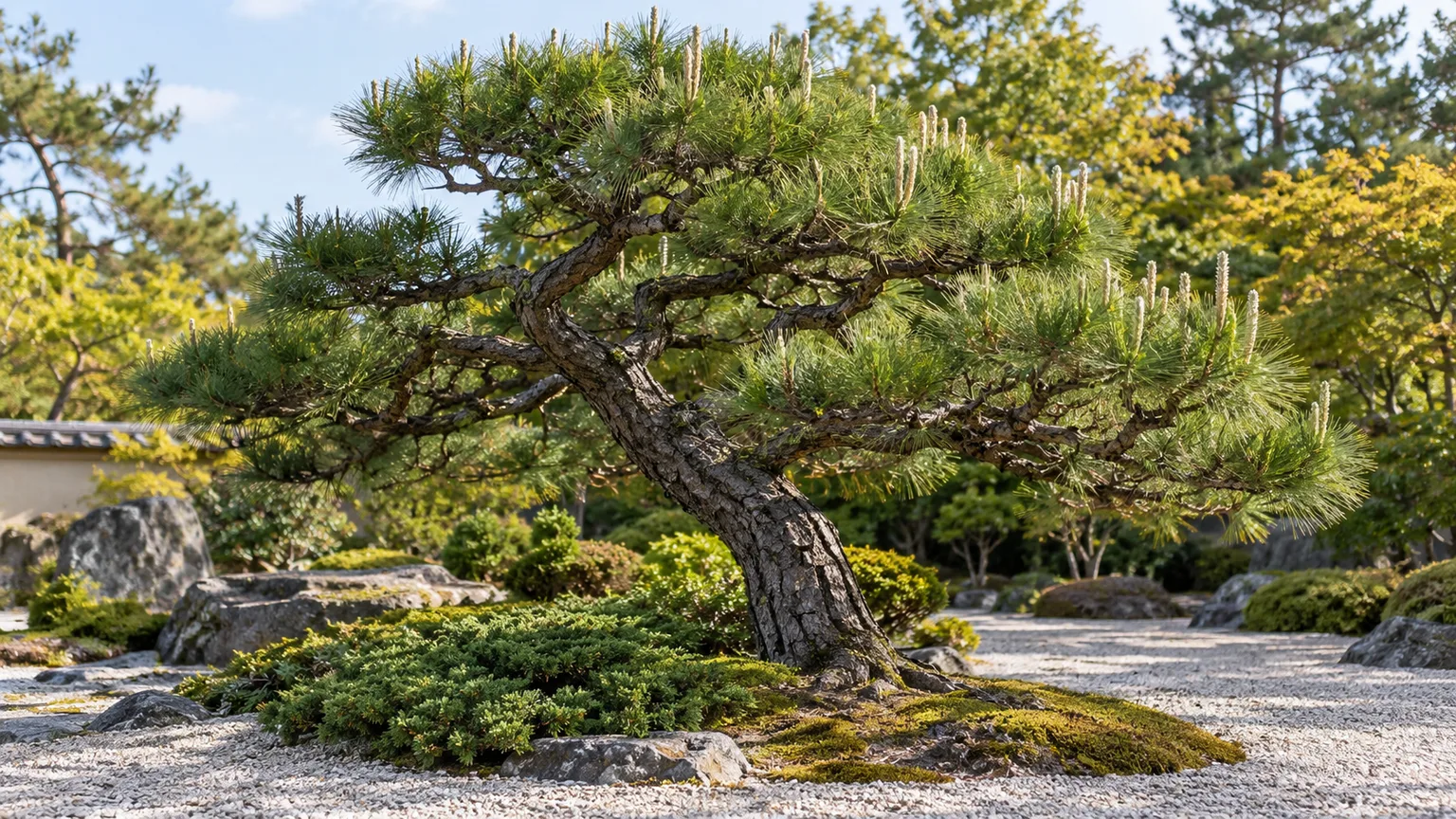
Japanese black pine (Pinus thunbergii) is a bold evergreen with paired, dark needles, rugged gray-black bark, and pale spring growth buds called candles. It can look windswept and sculptural without formal shaping, but the same tree can outgrow a small yard, suffer in waterlogged soil, or decline under disease pressure in parts of North America. The most useful care decision happens before planting: check the mature dimensions, local climate, and regional plant-health risks.
In the right place, Japanese black pine tolerates coastal salt, sandy soil, heat, and short dry spells better than many ornamental conifers. It still needs strong sun and a root zone that drains; “salt tolerant” does not mean a tree can live in saturated ground or any climate. This guide focuses first on landscape care, then separates bonsai practice because a tree in a shallow pot has very different watering and winter-protection needs.
Is Japanese black pine right for your garden?
Think of this as a long-lived landscape tree rather than a naturally small shrub. NC State Extension lists typical landscape dimensions around 20 to 60 feet tall and 12 to 20 feet wide, while the Morton Arboretum gives a broader possible height range reaching 80 feet. Those ranges vary with cultivar, climate, growing conditions, and how the tree has been trained, so give it room for the form on its nursery label rather than relying on a young plant’s current size.
The species is a strong candidate for a sunny coastal garden, a large specimen bed, or a roomy screen where its irregular crown can become part of the design. Oregon State University describes its tolerance of sandy sites, salt, and drought, and UF/IFAS notes its use near the ocean and along salted roads. Salt resistance is useful where salt spray or road de-icing is a recurring problem; it does not compensate for poor drainage, deep shade, or a site too small for the tree.
If your goal is a compact focal point, shop for a named cultivar and verify its mature height and spread from the grower. Do not assume “dwarf” means small enough for a foundation bed: published estimates for ‘Thunderhead’ vary considerably, and even a compact pine can become wider and taller than a patio setting can accommodate. In Massachusetts, the state’s invasive-plant assessment classifies Japanese black pine as invasive because it produces dispersing seed and has established in minimally managed sandy habitats; gardeners elsewhere should check current local guidance before planting near natural areas.
How to identify Japanese black pine
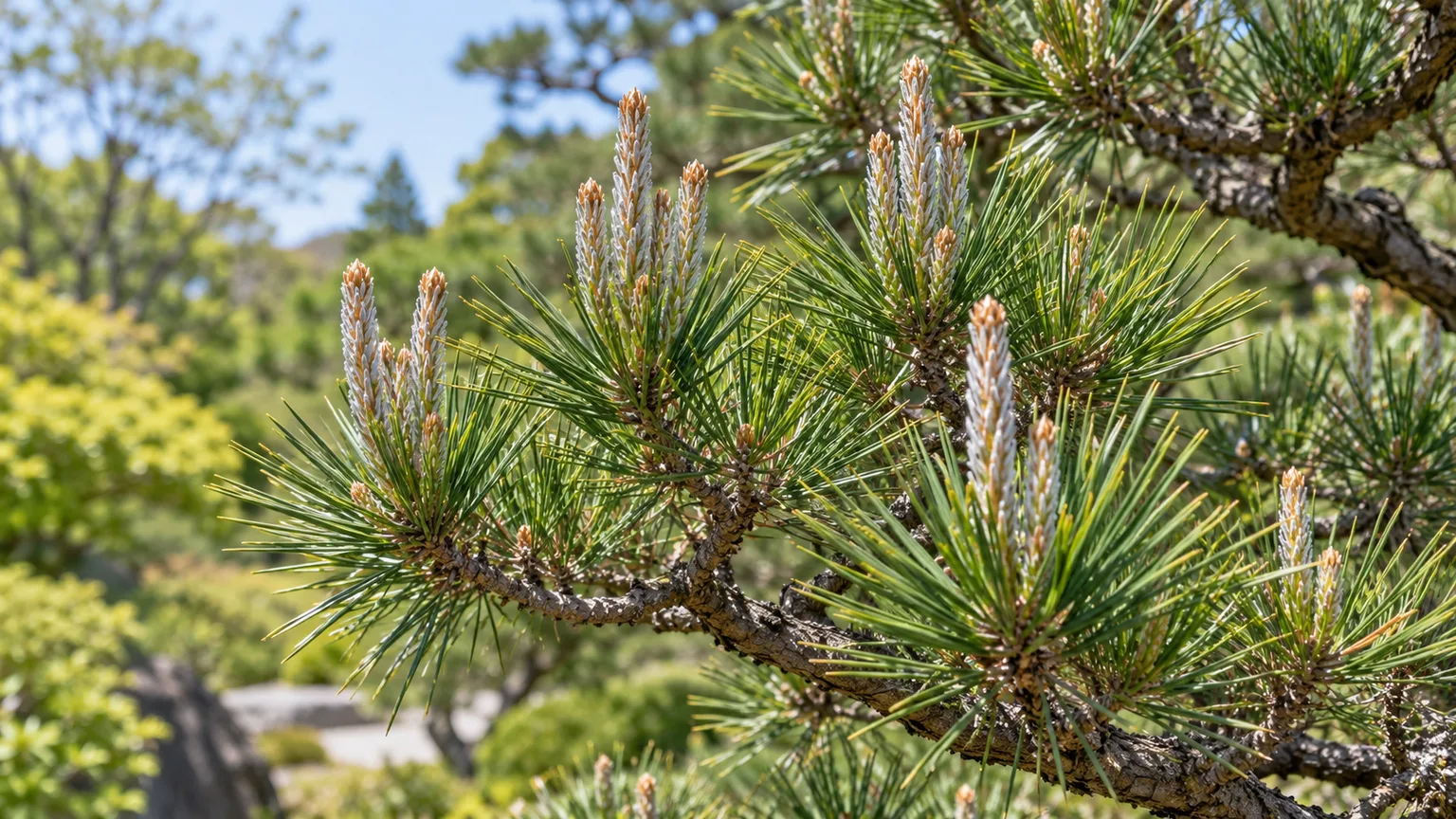
The species often has a flat-topped, irregular outline instead of the straight central leader many people expect from a young pine. Mature branches can spread or droop, the trunk develops dark plated bark, and the stiff pointed needles grow in bundles of two. White or silvery terminal candles stand upright at the ends of branches in spring; cones are woody and brown.
Those paired needles alone are not enough to confirm a nursery label because several pines share that feature. Look for the combination of dark, relatively long needles, pale candles, rough dark bark, and an asymmetrical crown. NC State Extension notes that Japanese black pine is sometimes mislabeled as Austrian pine (P. nigra); ask the nursery to verify the scientific name if species identity matters for size, local disease pressure, or a bonsai project.
Choose a site with enough sun and space
Choose a spot that receives at least six hours of direct sun and has open space for both the crown and its visual character. A young plant may look narrow, but the species can develop a spreading canopy and low branches; allow access for maintenance and keep it away from overhead wires, rooflines, driveways, and other places where repeated hard cuts would be necessary. For a screen, plan spacing from the selected cultivar’s eventual spread, not a generic “hedge” measurement. Gardener’s Path’s practical growing guide also distinguishes the greater attention young trees need from the lighter watering routine of an established pine.
A windy coast is not automatically a bad site. Japanese black pine is adapted to exposed maritime conditions, and salt spray can sculpt a crooked silhouette, but a newly planted tree may need shelter while its roots establish. Avoid a low pocket where water stands after rain, and be especially cautious in regions where the tree is marginally hardy or summers are unusually hot and humid.
Soil, drainage, and exposure
Japanese black pine grows in sand, loam, and a range of soil reactions, including neutral and alkaline ground. The common requirement is drainage: a soil that stays saturated deprives roots of oxygen and can invite root problems. If water pools in the proposed planting hole long after rain, correct the site or choose another location rather than trying to solve chronic wetness with extra fertilizer.
Before planting, check drainage by observing how quickly the soil clears after a normal rain and look for compacted fill or a high water table. A well-drained sandy loam is convenient, but do not amend a broad area with a rich potting mix that creates a sharp texture boundary around the roots. RHS guidance for Pinus thunbergii likewise recommends full sun and well-drained chalk, loam, or sand, showing that a narrow “acid soil only” rule is unnecessary.
Plant a nursery tree without burying its roots
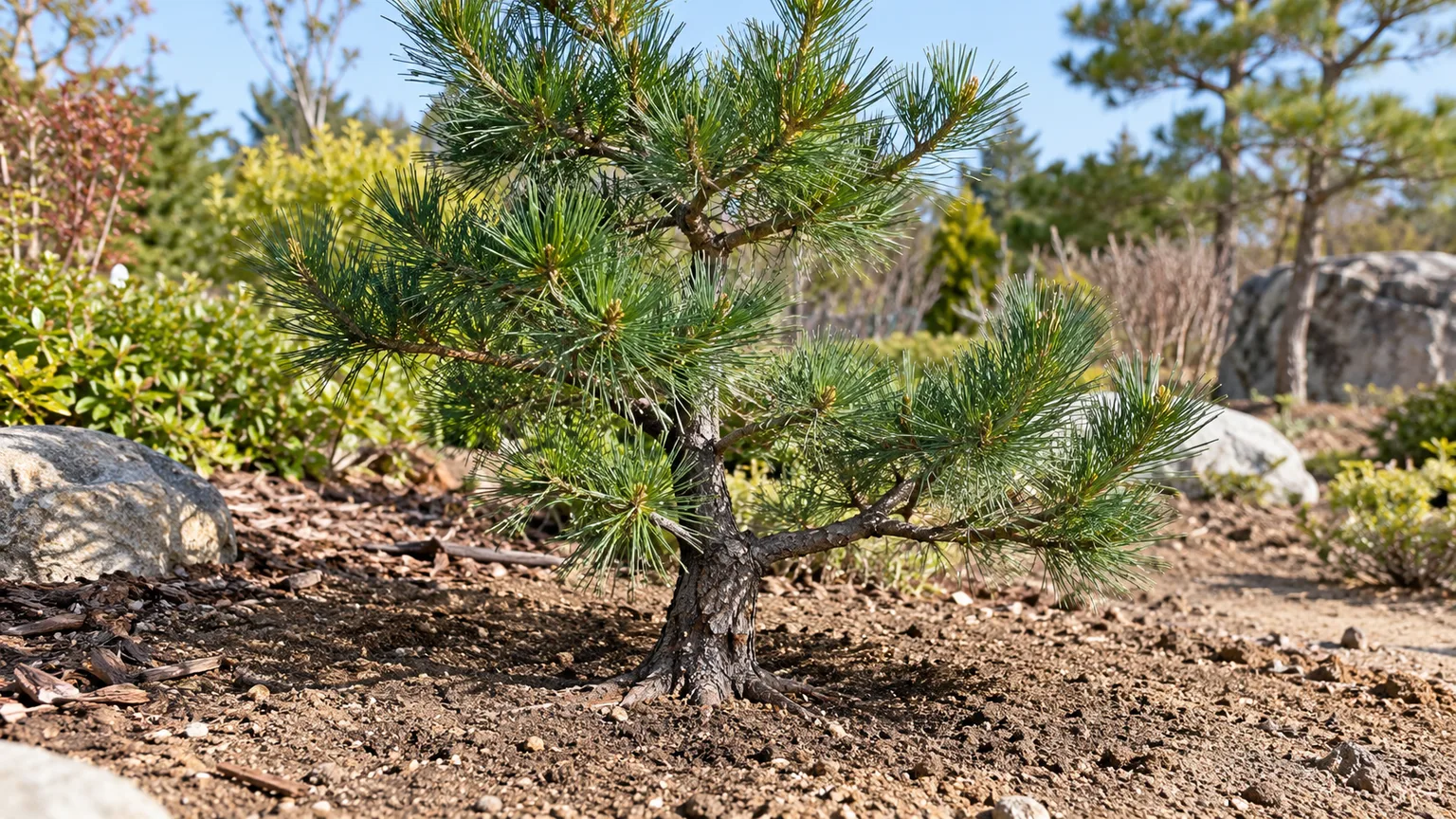
A healthy nursery-grown tree is the quickest and most reliable way to establish Japanese black pine. Plant when the weather is mild and the soil can be worked, avoiding frozen ground, heat waves, and periods when you cannot keep the root ball from drying. Before digging, confirm the cultivar, expected mature size, hardiness for your location, and any local restrictions.
Set the root ball in a hole no deeper than its actual root depth and several times wider than the container. Find the root flare—the point where the trunk broadens into the first major roots—and keep it at or slightly above the finished soil level; remove excess potting mix from the top if the flare is buried. Backfill with the native soil you removed, firm gently to remove large air gaps, then water slowly so the root ball and adjacent soil are both wetted.
Keep mulch in a broad, shallow ring to reduce surface drying, but leave a clear gap around the trunk so bark stays dry and visible. Stake only if the root ball rocks or the site is exceptionally exposed, and remove or adjust supports once the roots hold the tree in place. The USDA NRCS Japanese black pine fact sheet specifically notes that protection from strong winds during the first years may improve survival in exposed settings.
Newly planted trees often fail from inconsistent root-ball moisture, not from a need for a complicated fertilizer program. Check the soil a few inches down near the original root ball; water deeply when it is drying, then allow excess water to drain. Keep doing that through the first growing seasons, adjusting after rain and during heat or wind rather than following a fixed weekly amount that ignores your soil.
Water during establishment, then adjust to weather
Give a newly planted pine a thorough soak that reaches the full depth of the root ball and the surrounding backfill. During the first season, inspect it more often in hot, windy weather and less often after rain or in cool conditions; sandy soil dries faster than loam, while clay can remain wet long after its surface looks dry. The goal is an evenly moist root zone while roots spread outward, never a constantly soggy one.
Once established, Japanese black pine can tolerate short dry periods, but drought tolerance is not a reason to let a young tree wilt repeatedly. In prolonged heat or drought, water slowly at the root zone so moisture penetrates rather than running off; avoid frequent shallow sprinkling that wets the surface but leaves deeper roots dry. A tree growing in a container needs more frequent checks because wind and sun can dry a small volume of mix quickly.
Avoid diagnosing a brown branch as thirst without checking the soil first. If the root zone is wet, adding more water can make stress worse; if it is dry several inches down and the tree is newly planted, a slow deep watering is a sensible first correction. Adjust irrigation after observing the response over several days instead of swinging between drought and saturation.
Fertilize only when the tree needs it
A healthy Japanese black pine growing steadily in decent soil usually does not need routine feeding. If the tree is weak, pale, or has unusually short annual growth, first rule out poor drainage, transplant stress, root damage, shade, pests, and disease; fertilizer cannot repair those conditions. A soil test through your local extension service can help distinguish a nutrient shortage from a problem that only looks like one.
If a test or reliable diagnosis points to a deficiency, follow the recommended product and rate for the site and apply at the appropriate season. Avoid heavy nitrogen applications, especially around mature pines with a history of tip blight; Penn State Extension’s Diplodia guidance reports that high nitrogen can predispose pines to tip blight. Do not use lawn fertilizer near the tree as a substitute for diagnosing what its roots need.
Prune for clearance or a deliberate shape
An untrained landscape tree does not need annual pruning to stay alive. Remove dead, broken, rubbing, or diseased branches and make selective clearance cuts only where people, vehicles, or structures need space. If you want an open, windswept specimen, preserve the natural branches that create its silhouette rather than shearing the whole crown into a dense ball.
Make cuts in dry weather with sharp tools, cutting just outside the branch collar instead of leaving a long stub or cutting flush against the trunk. Do not top the pine to control height; topping removes the natural structure and leaves large wounds that are difficult to hide. If a mature tree is now too large for its site, consult a qualified arborist about whether selective reduction is possible or whether replacement with a more suitable species is the better long-term plan.
Understand spring candles before cutting them
A candle is the tender, pale upright shoot that extends from a pine branch in spring. On a landscape Japanese black pine, candles are a seasonal growth stage—not a signal that the tree needs pinching. Removing them changes the year’s extension and future branching, so use candle work only when you have a clear shaping goal and know how the tree responds in your climate.
For a niwaki-style specimen, timing depends on the candle’s stage, local growing season, and the vigor of the branch. The North American Japanese Garden Association’s Japanese black pine pruning guide explains that gardeners may shorten or remove a dominant candle while leaving smaller side growth, but advises adjusting the cut to the climate and the tree’s future form. Start conservatively on a vigorous tree, preserve healthy foliage below the cut, and avoid copying a bonsai calendar from another region.
Choose a cultivar by its mature dimensions
The straight species can become a substantial tree, so a cultivar is often a better fit when you want a smaller footprint or a particular habit. ‘Majestic Beauty’ is a full-sized selection with a dense crown and dark needles; the Morton Arboretum lists it at roughly 40 to 50 feet tall. ‘Thunderhead’ is commonly sold as a compact, broadly upright form with dense foliage and conspicuous pale candles, but published ten-year dimensions differ sharply between horticultural references.
That disagreement is a practical reason to identify the exact clone and ask a local grower how it performs in your region. A plant called “dwarf Japanese black pine” may still exceed a small foundation space with time, and pruning cannot safely hold a large tree at any size indefinitely. The American Conifer Society’s ‘Thunderhead’ profile describes a vigorous specimen that can reach a broad spread, while the Morton Arboretum’s cultivar notes list a smaller ten-year height; treat both as context, not a guarantee for every plant carrying that label.
Grow Japanese black pine from seed
Seed is useful when you want to raise several trees, but seedlings will not reliably reproduce a named cultivar’s shape or needle traits. Cones take time to mature; collect only mature, dry cones from a known Japanese black pine, then let them dry in a paper bag or ventilated container until the scales open and release seed. Seed-grown trees are a patient project, while a nursery plant gives you a known starting size and cultivar much sooner.
Japanese black pine seed is generally straightforward to germinate, though the response can vary with freshness and storage. UF/IFAS describes propagation by seed and notes that the seeds germinate readily; experienced growers report that a short moist chill can improve or synchronize germination of stored seed. If you do stratify, use a damp—not waterlogged—medium in a refrigerator, not a freezer, and follow the seed supplier’s directions for that seed lot.
Sow the seed shallowly in a clean, free-draining seed-starting mix and keep it lightly moist in bright conditions. Once seedlings emerge, provide strong outdoor light gradually, protect them from drying wind, and keep the mix from staying saturated. Transplant young seedlings carefully as they outgrow their containers; pines can be set back by rough root handling, so avoid repeatedly disturbing the root ball just to inspect it.
Treat bonsai as outdoor tree care, not indoor care
Japanese black pine is a temperate outdoor tree even when trained as bonsai. A warm living room lacks the direct light, seasonal temperature cycle, and airflow the species needs for long-term health, so keep the tree outdoors in full sun rather than treating it like a tropical houseplant. The Bonsai Empire pine care guide likewise places pines outdoors and notes that container roots need winter protection.
A bonsai’s shallow pot dries and heats faster than garden soil, so check moisture frequently and water thoroughly when the mix begins to dry. Use an open, fast-draining bonsai medium and a pot with unobstructed drainage; do not use a fixed watering calendar or let the root mass remain waterlogged. Repotting, root pruning, wiring, needle reduction, and decandling are separate techniques that depend on the tree’s vigor and development stage, not routine steps for every spring.
If you are new to bonsai, learn the tree’s current health and growth pattern before you remove candles or old needles. The two-flush technique used by experienced growers depends on a long enough season for the replacement growth to mature, and an unhealthy tree may not recover from aggressive work. Keep a simple record of bud timing, watering, feeding, and response; local bonsai clubs can help you match the technique to your climate and the tree’s stage.
Protect young trees and bonsai from winter stress
Hardiness references place Japanese black pine across a range that commonly includes zones 5 to 8, but zone alone does not predict how a particular cultivar handles cold, drying wind, or rapid temperature swings. In colder regions, plant a hardy, locally grown specimen in a sheltered site, water it before the ground freezes if autumn has been dry, and mulch the root zone without piling mulch against the trunk. Avoid late-season heavy nitrogen that pushes tender growth before winter.
Container-grown bonsai roots are more exposed than roots in the ground. During severe cold, move the pot to an unheated sheltered space or protect it outdoors with an appropriate cold frame or insulating setup while keeping the tree dormant and ventilated. Do not bring a temperate pine into a heated room for the winter; warmth can interrupt dormancy while the dim light weakens the tree.
Troubleshoot browning, pests, and disease
A few older needles turning yellow or brown near the interior can be normal, especially when the outer crown remains green and new growth is healthy. Browning at branch tips, blackened spring shoots, resin at the base of new shoots, or a whole crown that changes color quickly deserves closer attention. Check whether symptoms are limited to one branch, one side exposed to winter wind, the current year’s growth, or the entire tree.
Inspect for clustered sawfly larvae, scale, aphids, or other visible insects before applying anything. Remove only clearly dead material, avoid wet-weather pruning, and improve airflow if the crown is crowded. For severe or spreading symptoms, photograph the whole tree and close-up affected shoots, then contact your county extension plant clinic or a certified arborist; several pine diseases and environmental injuries look similar from a distance.
Tell tip blight from rapid pine wilt
Diplodia tip blight often attacks new shoots: needles may brown before they reach normal length, tips can die back, and resin may ooze from the base of a shoot. Penn State Extension notes that lower branches are often affected first, dead shoots and old cones can carry black fruiting structures, and stress or excess nitrogen can make damage worse. Improve tree vigor and sanitation, but do not assume that a fungicide will cure an established infection; treatment timing and suitability depend on diagnosis and local guidance.
Pine wilt can look different because decline may spread quickly through the whole tree: needles fade yellow, then reddish brown, and may remain attached after death. The pinewood nematode is moved by pine sawyer beetles, but browning alone does not prove that nematode is present; drought, borers, root injury, and Diplodia can produce overlapping signs. Penn State’s pine wilt guidance recommends diagnostic testing when the disease is suspected and prompt handling of confirmed affected trees to limit further spread.
Japanese black pine’s disease history is regional. University of Arkansas Cooperative Extension describes Diplodia-related decline and pinewood nematode as serious constraints in some American landscape plantings, while other areas report fewer problems. Use that evidence as a reason to ask about local performance before planting a long row—not as a promise that every tree will die at a fixed age or a reason to remove a healthy specimen preemptively.
Know when seasonal needle drop is normal
Pines keep older needles for multiple years, then shed them as new growth takes over. If the browning is mostly on older needles close to the trunk and the branch tips still have healthy green needles and normal new candles, watch the pattern before treating the tree. A sudden drop of several years’ foliage, weak new shoots, or widespread browning is not ordinary seasonal turnover.
After a storm or winter cold snap, check whether damage is concentrated on the windward side or on exposed young branches. Water stress can also cause browning, but confirm the root zone is dry before irrigating; saturated roots need drainage correction, not more water. Marking affected branches or taking dated photos makes gradual decline easier to distinguish from a brief seasonal change.
Avoid the care mistakes that shorten a pine’s life
The common failures are preventable: choosing the wrong size for the site, planting too deeply, leaving the root zone saturated, watering a bonsai by calendar, and cutting every spring candle without a training plan. Routine high-nitrogen feeding and indiscriminate fungicide spraying can add stress or expose the garden to unnecessary chemicals without solving the underlying issue. Start by correcting the growing conditions and getting a reliable diagnosis before using a treatment.
Also check regional ecology before planting. Salt tolerance made Japanese black pine attractive for exposed coastal landscapes, but the ability to thrive in sandy coastal habitat can also let it spread outside cultivation in some places. If your property borders dunes, conservation land, or natural shoreline, choose a locally appropriate alternative whenever your state or regional invasive-plant guidance advises against this species.
Conclusion
Japanese black pine care is straightforward when the tree has room, full sun, and well-drained soil, but its eventual size and local disease behavior deserve more attention than a generic watering schedule. Select a known cultivar only after checking its mature dimensions; plant the root flare high enough, water the root ball deeply while it establishes, and feed only when a soil test or clear need supports it.
Let a landscape pine grow naturally unless you have a specific reason to shape it, and treat candle pruning as a deliberate technique rather than routine grooming. Keep bonsai outdoors, protect container roots during severe winter weather, and investigate browning by pattern and timing before you reach for fertilizer or fungicide. If local extension specialists confirm that Japanese black pine is a poor long-term choice in your region, choose another conifer before investing years in the wrong tree.



