How to Grow and Care for Lobelia
Lobelia erinus brings sky-blue cascades to baskets and borders. Learn light, watering, seed timing, Laguna cultivars, heat recovery, and pet toxicity.
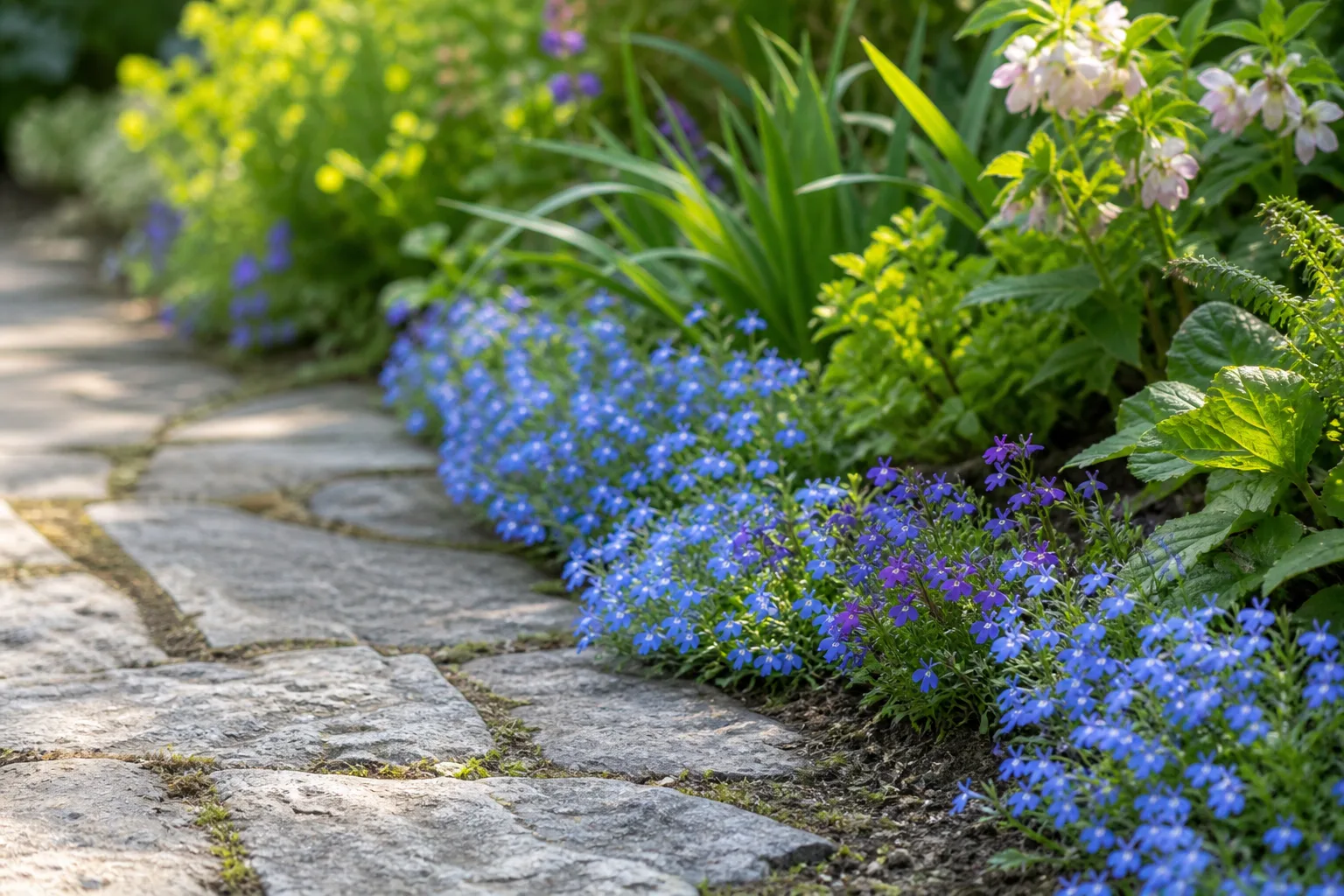
Lobelia is the electric-blue filler that makes hanging baskets and front-of-border edges look finished—but only if you match the plant to your climate and accept one awkward truth: Lobelia erinus often pauses or collapses when summer heat arrives. Treat that pause as a management problem, not a dead plant, and you can shear, shade, and water your way back to a second wave of blooms.
This guide starts with which lobelia you actually have (the 6-inch trailing annual is not the same as the 4-foot cardinal flower), then covers light, water, fertilizer, seed timing, cultivar picks, heat recovery, pests, and the toxicity facts extension services flag as medium severity.
Why Lobelia Belongs in Cool-Season Borders and Baskets
Garden lobelia (Lobelia erinus) earns its place because it flowers heavily in spots many summer annuals refuse: partial shade, cool spring edges, and the front row of mixed containers where height would block everything behind it. The tubular blooms—blue, purple, pink, white, and cherry red, often with a contrasting white or yellow “eye”—pack along stems in racemes from late spring through summer and often into fall where nights stay mild.
Pollinators notice. NC State Extension lists lobelia as butterfly-friendly and notes deer resistance—a practical advantage in suburban gardens where pansies get browsed but edging lobelia often survives untouched. The plant self-cleans spent flowers, so you skip deadheading on annual types. What you do not skip is consistent moisture and afternoon shade once temperatures climb past the comfort zone this South African native prefers.
Pair lobelia with other shade-tolerant annuals in a shade annuals bed, or tuck it along the lip of a perennial flower garden layout where low cool-season color precedes taller summer performers.
Lobelia at a Glance
| Feature | Details |
|---|---|
| Common names | Lobelia, edging lobelia, garden lobelia, trailing lobelia, laguna flower |
| Botanical name | Lobelia erinus (Campanulaceae) |
| Plant type | Tender perennial; grown as annual north of zone 10 |
| Native range | Southern Africa |
| Height / spread | 6–9 in. tall, 9–12 in. wide (NC State) |
| Sun | Full sun to partial shade; afternoon shade in hot climates |
| Soil | Organically rich, moist, well-drained |
| Soil pH | Acidic to neutral (roughly 6.0–7.0) |
| Bloom time | Late spring through summer; often into fall in mild zones |
| Flower colors | Blue, purple, pink, white, red |
| Hardiness | USDA zones 10a–11b as perennial; annual elsewhere |
| Toxicity | Medium severity poison to humans; all parts toxic (NC State) |
| Wildlife | Attracts butterflies and pollinators; deer-resistant |
| Maintenance | Medium; needs regular water and biweekly feed in bloom |
One label warning: seed packets and nursery tags often say “annual” because L. erinus dies or looks miserable after freezing nights almost everywhere except the warmest coastal zones. In zones 10–11 it can persist, but most gardeners still replace it yearly for peak bloom density.
Annual Lobelia Versus Hardy Lobelias — Know What You Bought
“Lobelia” on a tag is not enough information. The genus spans a trailing 6-inch annual and upright native perennials that hummingbirds mob. Buying or planting the wrong type produces years of confusion about hardiness and height.
Lobelia erinus (Edging Lobelia)
Lobelia erinus is the bedding and basket workhorse. It offers two commercial growth habits: trailing forms that spill over container rims and upright compact types for edging. Flowers are small—about half an inch—but produced in quantities that read as a solid sheet of color. NC State Extension describes blooms as tubular, two-lipped, with fan-shaped lower petals and yellow-to-white throats.
This species wants cool roots and steady moisture. It is drought intolerant and struggles in sustained heat without intervention. Outside zones 10–11, plan on growing it as an annual or buying fresh plants each spring.
Cardinal Flower and Great Lobelia
Hardy lobelias solve a different design job:
- Cardinal flower (Lobelia cardinalis) — upright perennial with scarlet spikes, 2–4 feet tall, native to moist woodland edges in eastern North America. Hummingbird magnet. Hardy in zones 3–9 depending on cultivar. Reseeds readily.
- Great lobelia (Lobelia siphilitica) — upright blue-flowered perennial for moist partial shade, often 2–3 feet tall. Also native. Better for rain gardens and back-of-border moisture than baskets.
If your goal is a cascading blue basket, do not buy cardinal flower. If your goal is a wetland perennial, do not buy L. erinus. The rest of this guide focuses on annual-type L. erinus because that is what most “how to grow lobelia” searches intend—though the distinction above prevents the most common buyer mistake.
Light, Heat, and Where Lobelia Actually Thrives
Lobelia is not a full-shade plant, but it is not a blazing-sun succulent either. Think bright morning sun plus protection from peak afternoon heat in warm climates. In cool-summer regions (Pacific Northwest coast, northern New England, parts of the upper Midwest), full sun with regular watering produces the densest bloom if soil stays moist.
Decision rule by climate:
| Your summer pattern | Best placement |
|---|---|
| Hot, humid (Southeast, lower Midwest) | Morning sun, afternoon shade; east-facing baskets |
| Mild marine (coastal PNW, northern California coast) | Full sun if watered daily in containers |
| Dry desert heat | Partial shade mandatory; expect mid-summer pause |
| Short cool spring, fast heat spike | Plant early; move containers to shade by June |
When lobelia overheats, foliage bronzes or browns and flowering stops—not because the plant hates sun globally, but because root zone temperature and air dryness exceeded what this species evolved for. Gardener’s Path notes that lobelia’s strength is filling cool or shady spots other annuals skip—use that trait instead of forcing it into a south-facing brick wall in Atlanta.
Full shade caveat: Lobelia may survive in deep shade but blooms thinly and stems stretch. Four to six hours of direct morning light—or bright dappled shade all day—is the practical minimum for basket-quality flower density.
Soil, Water, and Fertilizer Rhythm
Soil and Drainage Requirements
Lobelia prefers organically rich, moist, well-drained soil. Sandy loam amended with compost works; heavy clay needs compost and perhaps fine pine bark to keep roots oxygenated. NC State lists good drainage as essential and warns that wet, stagnant conditions invite damping-off, stem rot, and root rot—especially on young seedlings.
Container mix should be peat- or coir-based potting soil with perlite, not garden soil alone. Raised beds and hanging baskets both need drainage holes; lobelia in a sealed pot without exit routes fails fast in rainy weeks.
pH tolerance is wide—acidic through neutral—but extremely alkaline soils can stress micronutrient uptake. If municipal water is hard and leaves show pale mottling despite good care, test soil pH before chasing pests.
Watering Schedule Through Summer
The operative phrase is evenly moist, never soggy. Lobelia has shallow roots; a hot afternoon can desiccate a basket in one missed day. In containers, check daily when temperatures exceed 85°F. In ground plantings, mulch lightly with compost to slow evaporation but keep mulch off the crown.
Signs you are underwatering: leaf margins brown and curl inward. Signs you are overwatering: uniform browning, mushy stems at soil line, and collapse despite wet soil. If overwatering is the issue, improve drainage and reduce frequency before adding more water “to revive” the plant.
Rain alone rarely sustains container lobelia through July. Drip irrigation on a morning timer beats hand-watering for baskets hung under eaves where rain never reaches.
Fertilizing for Continuous Blooms
Lobelia is a heavy feeder during bloom. NC State Extension recommends fertilizer every two weeks during the growing season. Use a balanced liquid feed or one slightly higher in phosphorus (middle NPK number) to support flowering rather than leafy growth.
Apply diluted liquid fertilizer to moist soil at the base, not as a foliar spray on hot afternoons. Burned leaf tips after feeding usually mean concentration was too high or soil was dry when you applied. Pause feeding when the plant is heat-stressed and not flowering—resume after shear-and-recovery when new growth appears.
Organic options (compost tea, fish emulsion) work at half the label rate for containers; synthetic liquids give more predictable results in peak bloom weeks when you are pushing a second flush.
Popular Cultivars: Trailing, Upright, and Heat-Tolerant Picks
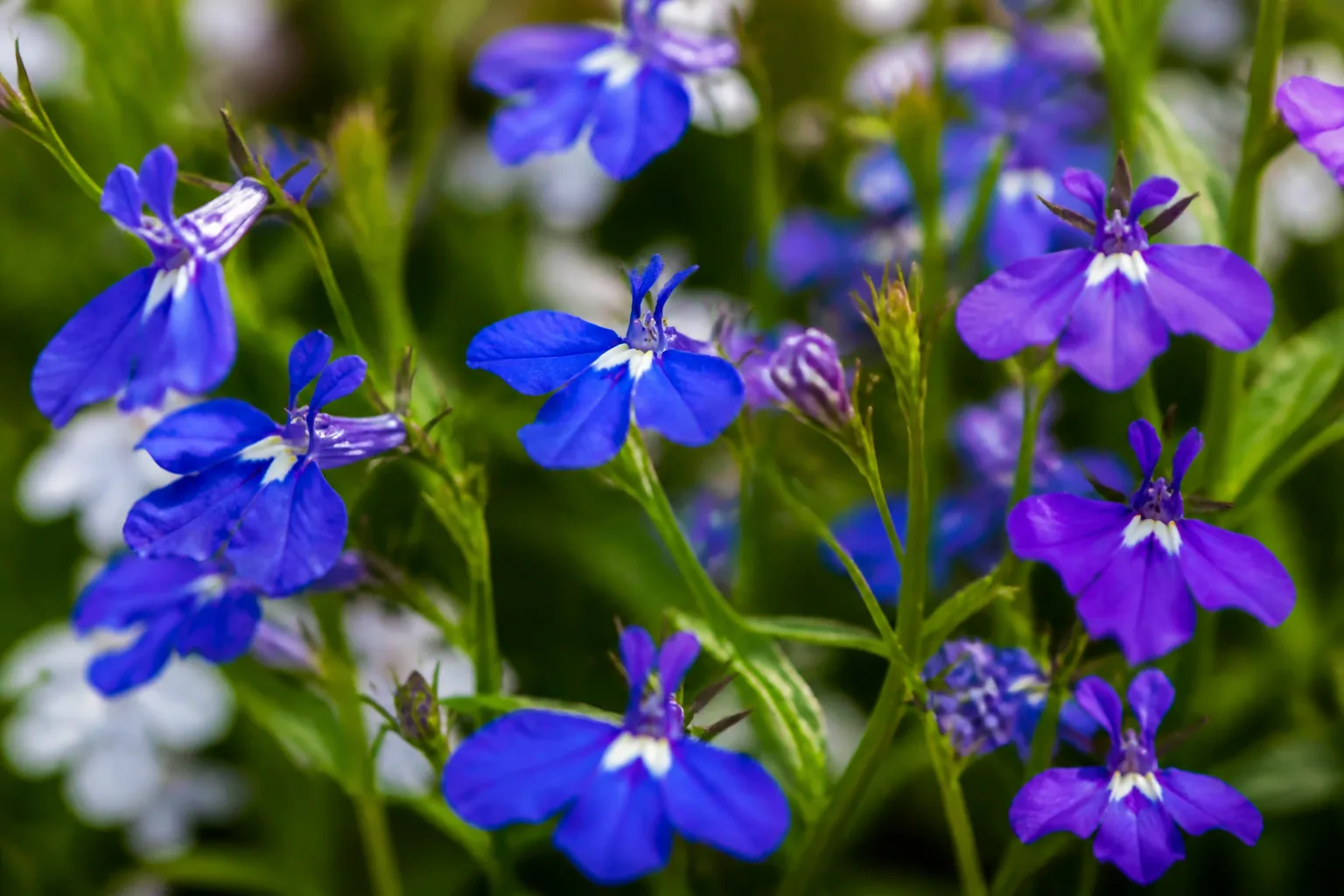
Seed racks and nursery benches mix old heirlooms with modern heat-tolerant series. Match cultivar habit to container or bed role:
| Cultivar / series | Habit | Flower notes | Best use |
|---|---|---|---|
| ’Crystal Palace’ | Compact upright | Dark blue on bronze-green foliage | Edging, small pots |
| ’Cambridge Blue’ | Compact upright | Soft clear blue | Front border |
| ’Sapphire’ | Trailing | Purple with white eye | Hanging baskets |
| ’Hamburgia’ | Trailing | Mixed colors | Window boxes |
| Laguna series | Trailing | Blues, lilacs; improved heat tolerance | Baskets in warm climates |
| ’Rosamunde’ | Upright to mounding | Cherry red with white eye | Accent color |
| ’Snowball’ / ‘Paper Moon’ | Various | Pure white | Mixed combos, moon gardens |
The Laguna line—developed for better summer performance—is the cultivar to try if classic trailing lobelia quit on you in July. It is not immune to heat, but it tolerates more sun and rebounds faster after shearing than older trailing types. NC State lists Laguna Heavenly Lilac among documented cultivars alongside Crystal Palace and Sapphire.
Buy plants with buds, not only open flowers, so you see true color and verify habit (trailing stems should already be leaning; upright types should stand stiff at center).
How to Grow Lobelia From Seed
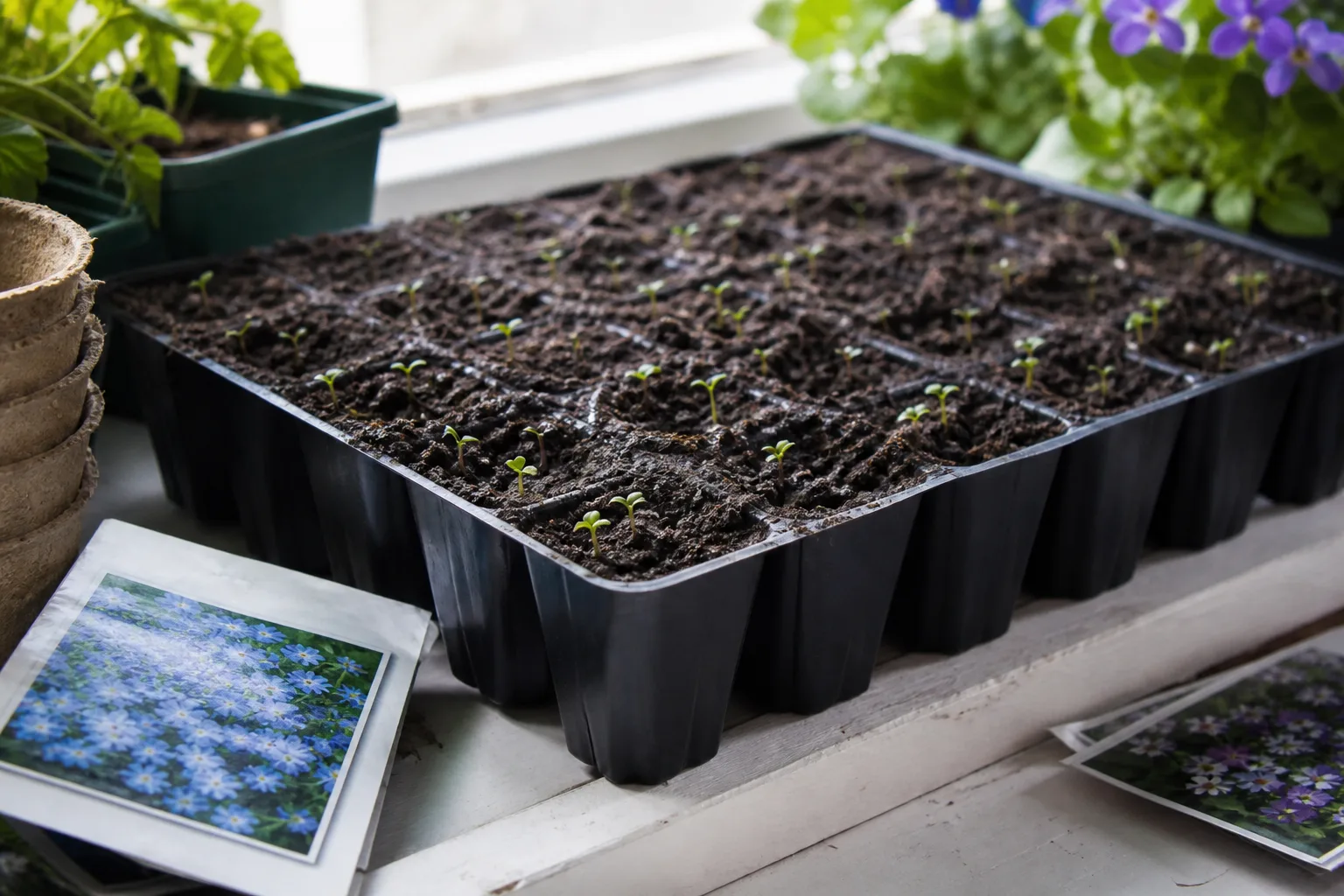
Lobelia seed is tiny—almost dust—and slow enough that many gardeners buy nursery packs instead. Seed starting still saves money on large baskets and gives access to cultivars local stores skip.
Timeline: Start indoors 6 to 8 weeks before your average last frost date in cold-winter climates. In mild zones where nights stay above 50°F reliably, you can sow outdoors in early spring.
Step-by-step:
- Fill a shallow tray with sterile seed-starting mix. Do not bury seeds; press them onto the surface or scatter lightly.
- Mist the surface until evenly moist. Cover with plastic or a dome to hold humidity.
- Place under bright light—grow lights 4–6 inches above the tray beat a dim windowsill. Ideal germination temperature is roughly 65–70°F.
- Mist daily so the surface never dries. Seeds typically germinate in 14 to 21 days—patience matters.
- Remove the dome once seedlings show true leaves. Thin or transplant when they have two sets of leaves.
- Harden off for 7–10 days before planting out: gradually increase outdoor hours, starting in shade.
Common seed failures: burying seeds too deep (they need light), letting the surface dry for one afternoon (death), and planting outdoors too early when nights are still cold. Lobelia seedlings are also vulnerable to damping-off if trays stay waterlogged—reduce cover humidity once green appears.
Purchased plants are the better first attempt if you need instant color or lack grow lights. Sow seed once you have succeeded with easier annuals like marigolds or zinnias.
Planting in Beds, Containers, and Hanging Baskets
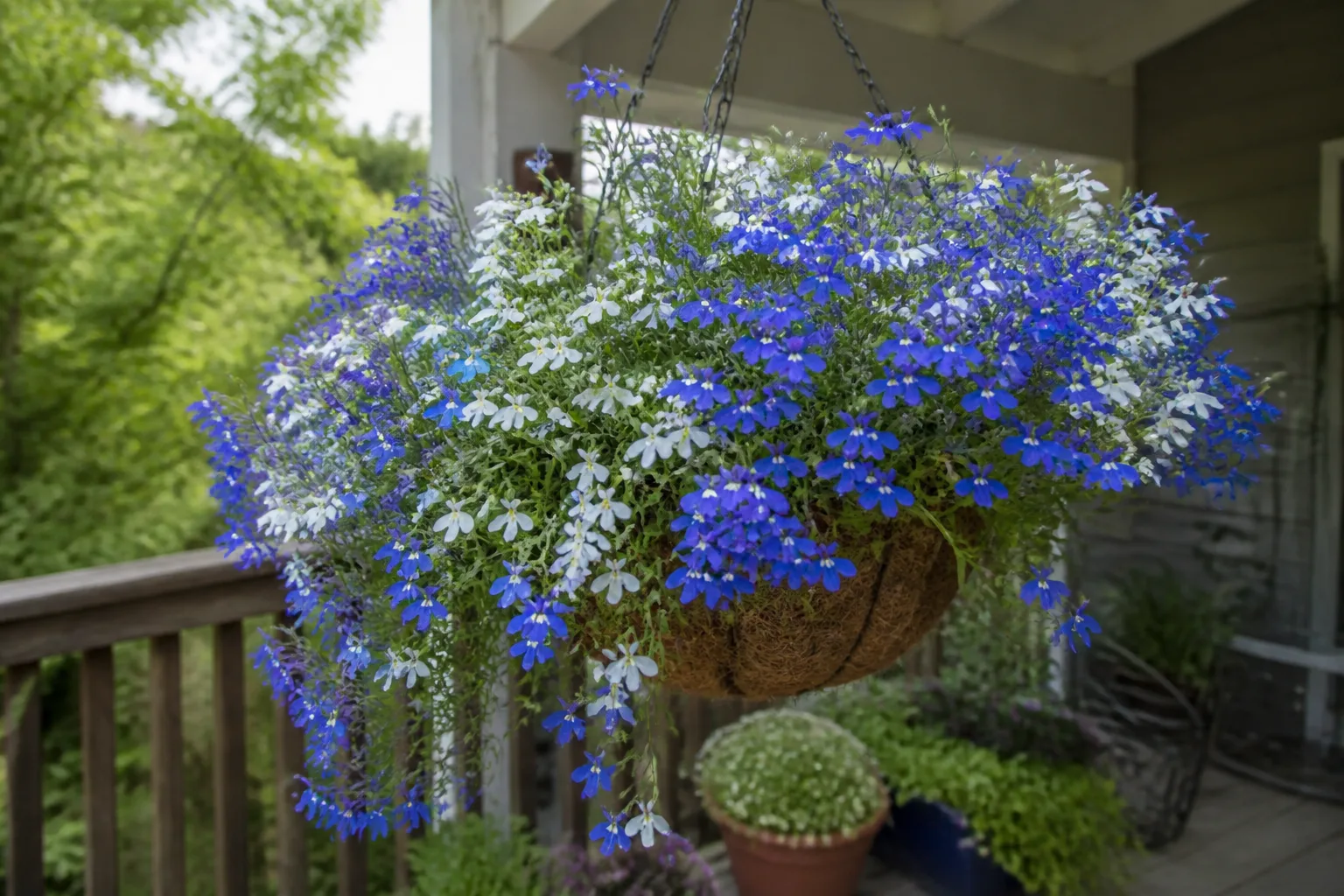
Spacing: Set plants 4 to 6 inches apart in containers for a full look. In open beds, 6 to 8 inches prevents overcrowding that traps humidity and encourages rot. Trailing types need rim space to cascade; do not plant them centered in a shallow pot with no overhang.
Depth: Plant at the same depth as the nursery pot—deeper planting suffocates the crown. Tease roots gently if they are circling the plug.
Containers: Plastic and resin pots retain moisture better than unglazed terra-cotta in hot weather. Whatever material you choose, drainage holes are non-negotiable. For hanging baskets, line with coco fiber or moss, use light potting mix, and expect daily watering in heat.
In-ground edging: Work compost into the top 6 inches before planting. Lobelia excels at the front edge where taller perennials will later hide it as summer progresses—exactly the sequencing strategy a layered border layout uses.
Window boxes: Combine trailing lobelia with upright fillers (geraniums, salvia) and a tall spiller alternative if lobelia fails mid-season. Having a backup plan beats a bare box in August.
Getting Lobelia to Rebloom After a Mid-Summer Pause
When July heat hits, L. erinus often stops flowering even if foliage looks mostly green. Some plants bronze and collapse. Both responses are heat stress—not necessarily root death.
Recovery protocol:
- Move containers to morning-sun or shaded afternoon positions. In-ground plants: erect temporary shade cloth for the worst weeks.
- Water deeply in the morning; avoid scalding leaves with midday splashes on hot metal baskets.
- Shear stems back by roughly one-third to one-half once the first flush fades or browns. Clean shears reduce disease entry.
- Feed with diluted liquid fertilizer after cutting. New buds typically appear within 7 to 14 days if nights cool slightly or shade reduces stress.
- If no regrowth appears after two weeks and stems are brittle dry, discard and replant with fresh plants or a heat-tolerant Laguna cultivar.
Fall often brings a second natural flush when temperatures drop into the 60s at night. In mild zones, lobelia may bloom until nights stay below 50°F consistently—then pull plants or compost them unless you are experimenting in zone 10+.
Do not deadhead individual flowers on annual lobelia; the plant drops spent blooms itself. Shearing whole stems is the correct “reset” move.
Common Pests and Diseases
Spider mites are the primary pest on stressed lobelia—especially hot, dry baskets. Fine webbing on undersides and stippled yellow leaves are telltales. First response: blast plants with a strong cool water spray every few days. Persistent infestations may need insecticidal soap applied to leaf undersides in early morning.
Corn earworms occasionally chew holes in leaves, weakening plants and opening fungal entry points. Hand-pick worms at dusk; Bt (Bacillus thuringiensis) works on caterpillars if damage is widespread.
Diseases: Damping-off on seedlings, stem rot, and root rot under wet conditions. Prevention beats cure: sterile seed mix, drainage, and avoiding overhead watering late in the day. Remove collapsed plants rather than letting fungal spores spread to neighbors.
Deer resistance is good but not absolute in drought years when hungry deer sample everything. Rabbits may nibble young plants—temporary fencing for the first two weeks after transplant helps.
Troubleshooting Brown, Curled, or Spotty Foliage
| Symptom | Likely cause | First action |
|---|---|---|
| Brown leaf margins, curling inward | Underwatering / heat | Water deeply; add afternoon shade |
| Uniform brown, mushy base | Overwatering / rot | Improve drainage; reduce watering |
| Bronze foliage in full sun | Heat + light stress | Move to morning sun; shear and recover |
| Stippled yellow leaves, fine webbing | Spider mites | Cool water spray; soap if needed |
| Holes in leaves, brown base | Corn earworm | Inspect at dusk; remove larvae |
| Spotty leaves, no holes | Mite or fungal spotting | Confirm pest; improve airflow |
Work the table top to bottom. Most “my lobelia died” stories are underwatering during a heat wave or baking a basket on a south wall—not mysterious disease.
If foliage browns but stems are still green and pliable near the crown, cut back, shade, and water—recovery is likely. If the crown is black and stems snap dry, start over.
Toxicity, Pets, and Safe Placement
Lobelia erinus carries medium-severity poison characteristics per NC State Extension. All parts—flowers, leaves, roots, seeds, and sap—contain alkaloids including lobeline and related compounds plus a volatile oil. Ingesting large quantities can cause nausea, vomiting, diarrhea, salivation, weakness, dilated pupils, convulsions, and coma in humans.
Pets should be treated with the same caution. While small nibbles may cause mild GI upset, do not assume lobelia is pet-safe. Place hanging baskets above dog reach; avoid edging lobelia along paths where curious puppies graze. Wear gloves if you have sensitive skin and handle many plants at once, though contact dermatitis is not commonly reported for this species.
Lobelia is not a good indoor houseplant candidate for pet owners—outdoor seasonal use with awareness is the safer framing.
Conclusion
Lobelia erinus is a cool-season color machine in the right slot: moist soil, morning sun, afternoon shade when heat spikes, and biweekly feed while blooming. Know that it is a tender perennial masquerading as an annual across most of the U.S., distinct from towering cardinal flower, and prone to a mid-summer pause that shearing and shade can reverse.
Choose Laguna or other heat-tolerant trailing cultivars if classic types failed you before. Buy nursery packs for instant baskets; sow seed if you want volume and rare colors. When nights cool in fall—or after a successful summer shear—you get the blue waterfall effect that keeps this old-fashioned annual on nursery benches every spring. Pull plants after hard frost or when recovery fails, and replant next year without guilt: that yearly refresh is how most successful lobelia displays are built.