6 Ways to Stop Wasps Building Nests
Learn six practical ways to stop wasps from building nests near your home, from sealing entry points and managing food to safer nest decisions.
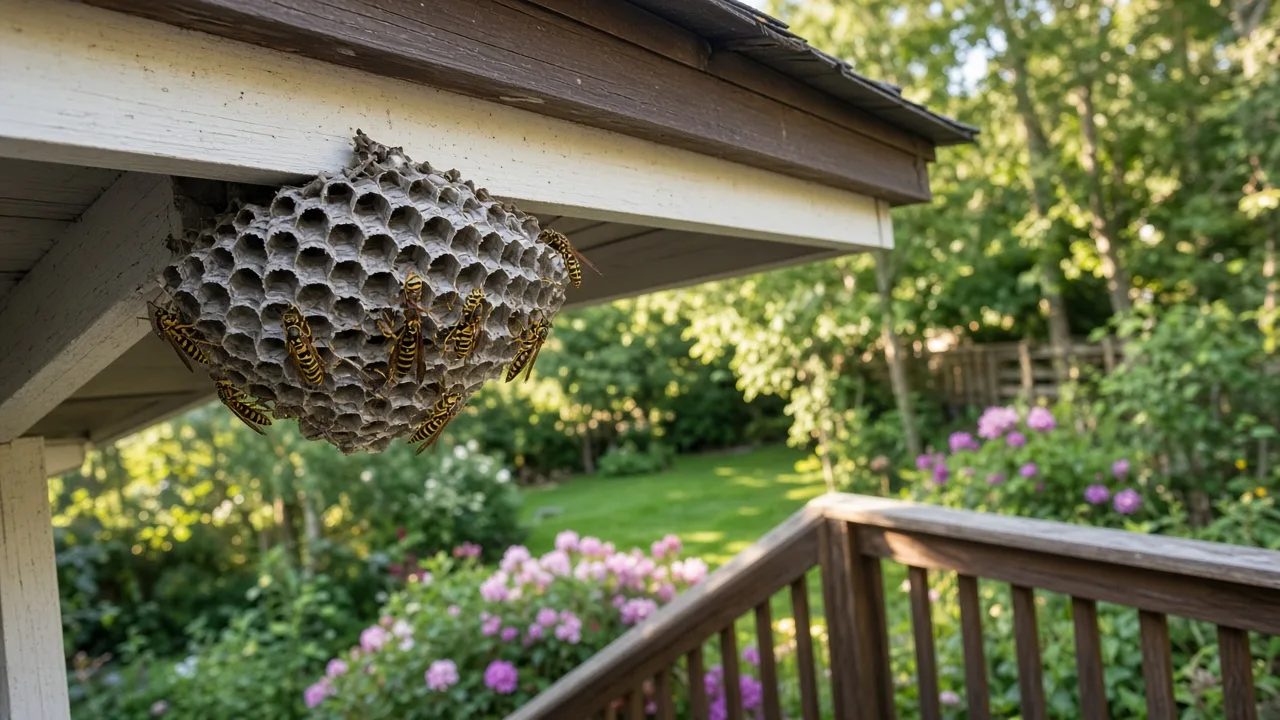
The most effective way to keep wasps from nesting beside your house is to make the exact spot less useful before a queen or foundress commits to it. That means removing easy food, closing sheltered gaps at the right time, limiting ground-level nesting sites, and watching for early activity rather than waiting for a large colony.
There is one important qualification: a wasp flying through the garden is not proof that a nest is nearby. Wasps may be hunting caterpillars, visiting flowers, collecting water, or scavenging a sweet drink while nesting somewhere else. Penn State Extension recommends assessing whether a nest is present, identifying the insect, and considering the nest’s size and location before choosing control. Read the extension’s decision guidance here.
The six prevention moves below are most useful for paper wasps, yellowjackets, and bald-faced hornets—the social wasps that build and defend colonies. They will not create a wasp-proof yard, and they are not a substitute for safe removal when a nest is hidden, large, or directly beside a doorway. Used together, though, they reduce the combination of food, water, shelter, and nest-building material that makes a property attractive.
Start by Telling a Passing Wasp From a Nesting Colony
Begin with behavior, not the insect’s color. A single wasp visiting several flowers, hovering over a fruit tree, or moving between leaves may simply be foraging. A more meaningful warning sign is repeated traffic to one fixed point: insects disappearing beneath an eave, entering a siding gap, flying low into a ground hole, or returning to the same shed corner.
Social wasps defend a colony, not every patch of garden they visit. Paper wasps usually make an exposed, umbrella-like comb beneath a protected surface. Yellowjackets often use underground burrows or enclosed cavities, while bald-faced hornets build an enclosed aerial nest. Dallas County Master Gardeners notes that wasps can forage as far as half a mile from a nest, so activity in a flower bed alone does not tell you where the colony is. Their identification and safety guide explains the clues.
Do not poke a suspected nest, shine a light directly into it, mow over a hole, or stand beneath an active aerial colony to get a closer look. Observe from a distance and note the entry point, time of day, approximate nest size, and whether people or pets must pass nearby. That information is more useful to a pest professional than a blurry photograph taken at arm’s length.
The Six Prevention Moves at a Glance
Use the actions in this order so that you address the biggest attractants first:
- Remove accessible food. Seal trash and recycling, clean spills, harvest ripe fruit, and keep pet food out of the wasp traffic zone.
- Close sheltered openings. Repair loose trim, screen vents, cap open pipe ends, and caulk cracks—but only after you know the entrance is inactive or the colony has been handled.
- Reduce ground-level shelter. Fill confirmed abandoned rodent burrows and repair voids around edging or retaining walls during the dormant season.
- Manage water. Fix leaks, empty water-holding debris, and move a deliberate water source away from doors and play areas.
- Use a decoy only as an experiment. A fake nest may be worth trying before the nesting season, but evidence does not support it as a dependable barrier.
- Use scents and plants cautiously. Herbs can make a pleasant buffer, and some essential oils repel wasps in research settings, but neither is a guaranteed nest-prevention system.
Think of this as site management, not extermination. You are changing the reasons a wasp would choose one corner over another while leaving room for harmless solitary wasps and useful predators in less troublesome parts of the property.
1. Remove the Food That Keeps Wasps Returning
Food control is the first place to spend your effort because it can reduce wasp traffic even when the nest is far away. Yellowjackets are especially persistent around meat, soda, ripe fruit, garbage, recycling residue, and other sugary or protein-rich scraps. Adults also feed on nectar and aphid honeydew, while many wasps hunt caterpillars, flies, aphids, and beetles for their larvae.
That last point matters: removing every flowering plant or treating every insect is counterproductive. A wasp in a flower bed may be performing useful pest control rather than scouting your porch. The target is human food and waste in high-traffic areas, not the entire food web.
Manage Trash, Drinks, Pet Food, and Fallen Fruit
Keep outdoor garbage, recycling, and compost containers closed with lids that actually fit. Rinse sticky cans and bottles, clean spills as soon as they happen, and avoid allowing bags or food scraps to sit beside the back door. If collection day is flexible, place bins away from entrances and move them back after pickup rather than creating a permanent food station beside the patio.
During late summer and fall, inspect fruit trees daily. Pick ripe fruit promptly, gather fallen apples, figs, plums, or grapes, and use fruit bags or fine netting where practical. A single overripe fruit can keep foragers circling a walkway, and a person who brushes against a wasp while harvesting is more likely to be stung than someone who leaves the tree alone.
Serve drinks and food outdoors in covered containers, especially sweet beverages and meat. Check the rim of a can or cup before drinking, and do not swat at a wasp crawling on a plate. Penn State Extension likewise recommends tightly covering food and food waste, cleaning spills promptly, and recognizing that traps only thin foraging workers rather than eliminating an established colony. See its current stinging-insect guidance.
2. Seal Sheltered Entry Points After the Nest Is Inactive
Wasps choose places that are dry, protected from wind, and easy to reach. Common candidates include the underside of eaves, porch ceilings, loose siding, soffit gaps, shed roofs, attic vents, hollow fence pipes, the space beneath decks, and openings around utility or pool equipment.
Walk around the exterior in spring and again after repairs or storms. Look for lifted trim, torn vent screens, gaps around cables and pipes, and cracks that lead into a wall or roof void. Repair loose boards, fit fine mesh over appropriate vents, add door sweeps where they belong, cap open pipe ends, and use exterior caulk on small cracks. Larger structural gaps may require a building repair rather than a blob of expanding foam.
Timing is the safety rule. Never seal an active wasp entrance just because you found it. Blocking the outside opening can trap defenders, force them into the living space, or leave a colony inside a wall where it becomes harder to locate. Penn State’s guidance specifically warns that structural colonies require identifying the entrances and avoiding actions that push the insects indoors; hidden cavities are a strong reason to use a professional.
Once the colony is gone or the site has been inactive through the appropriate season, remove loose nest material if it is safe to reach and then close the opening. Sealing afterward is preventive exclusion. Sealing first is an unpredictable experiment with stinging insects on the other side.
3. Close Abandoned Burrows and Ground-Level Harborage
If yellowjackets are your concern, do not ignore the ground. Watch from a distance for a low, steady flight line in and out of one hole, often beneath shrubs, boards, leaf litter, or other cover. The hole may be an old rodent burrow, a cavity beside a retaining wall, or an opening under a shed—not a mound of soil with an obvious paper nest.
Fill confirmed abandoned burrows with soil and correct the condition that created the opening. Repair gaps beneath edging, remove boards that bridge a void, and keep dense debris from creating a concealed entrance next to a path. Perform this work in late fall or winter only when there is no active traffic and local weather has ended the colony’s active period. In warm, frost-free regions, do not assume a colony has died just because the calendar says winter.
Do not fill every hole in a naturalized yard. Solitary digger wasps and mud daubers do not form a cooperative colony that launches a mass defense, and many prey on insects that damage plants. Oklahoma State University Extension advises that solitary wasps are generally best left alone unless they damage structures or equipment, while screening and sealing building openings can reduce unwanted activity. Use its species and avoidance guide for identification context.
Also avoid disturbing a hole that you cannot identify. Bare feet, lawn mowers, string trimmers, and children’s play are the risk factors here. If activity is concentrated beside a path or play set, block access and arrange an assessment instead of digging to find the nest.
4. Fix Water Sources and Redirect Traffic
Water is easy to overlook because it does not look like a food attractant. In hot, dry weather, wasps may visit swimming pools, birdbaths, dripping faucets, leaky irrigation, damp soil, and gutters holding water. A water source may draw insects into the place where people sit even if it is not the reason they chose a nesting site.
Repair dripping hose bibs and sprinkler heads, clean clogged gutters, empty overturned containers, and correct drainage that keeps a foundation edge wet. Cover pools when they are not in use and keep people’s seating away from the busiest edge. If you intentionally provide water for wildlife, place it in a quiet area away from doors, paths, and children’s play spaces, refresh it regularly, and do not create a second problem with stagnant water.
This move is mainly about redirecting foraging traffic, not promising that a dry porch will prevent a nest. Penn State Extension describes alternative water as a possible way to shift activity away from a problem area, especially during hot, dry weather. The practical test is simple: if wasps keep arriving at a leak or pool edge, move the human activity or correct the water source and see whether traffic falls over the next several days.
5. Try a Decoy Nest With Realistic Expectations
A paper or molded decoy nest is inexpensive, quick to hang, and biologically plausible: some social wasps avoid a site that appears to be occupied. That makes it a reasonable low-cost experiment before local nest-building begins, particularly under a porch roof or on a shed where a real colony has appeared in past seasons.
It is not a force field. Current Penn State Extension guidance says there is no clear evidence that fake nests reliably stop paper wasps or yellowjackets, and established colonies can occur near one another. A brown paper bag stuffed and hung as a “nest” may also be mistaken for a source of paper fiber or simply ignored.
If you try one, hang it early, keep it dry and secure, and judge it against a specific observation: did repeated scouting at that exact location decrease compared with the previous season? Do not hang a decoy beside an active nest, do not use it to approach or redirect a colony, and do not keep adding more decoys while ignoring food, gaps, or a ground entrance. Treat it as a prevention trial with a low cost and a low expectation of certainty.
6. Treat Plants and Scents as a Small Supporting Measure
Mint, basil, lemon balm, rosemary, and other aromatic herbs are useful garden plants, but planting them will not form an invisible barrier around a house. A flowering herb may attract beneficial wasps and other pollinators, while a crushed leaf or concentrated scent may briefly change where a forager lands. Location, species, weather, and the presence of food usually matter more than a single plant label.
There is some research behind the scent idea. A PubMed-indexed field study tested 21 essential oils against yellowjackets and paper wasps; 17 showed repellency in the study, and mixtures containing clove, geranium, and lemongrass blocked worker attraction under the tested conditions. That is useful evidence that volatile compounds can influence wasp behavior, not proof that a homemade spray will stop nest construction on a house. Read the study abstract and its limits.
Use plants as part of a broader landscape plan: place aromatic herbs near seating if they suit the light and soil, keep flowering plants that support beneficial insects away from narrow walkways, and avoid spraying a nest with an oil mixture. Essential oils can irritate skin, affect pets, damage foliage, and contaminate water; never apply them where children or animals contact treated surfaces, and follow a product label whenever a commercial pesticide or repellent is involved.
The useful distinction is between making a sitting area less attractive and relocating a colony. Scent may help with the first for a short time. It should never be the only plan for the second.
Inspect Early and Track the Exact Flight Line
Prevention works best before a small start-up nest becomes a defended colony. In late spring and early summer, inspect eaves, porch ceilings, sheds, the undersides of play equipment, fence and deck joints, and quiet corners around outbuildings. Use a flashlight only from a safe distance and do not touch a comb to determine whether it is occupied.
Look for a single foundress repeatedly carrying wood fibers, a tiny open comb under a horizontal surface, or workers entering a gap. For a possible ground nest, watch from well back and look for repeated low flights instead of poking a stick into the hole. A monthly exterior check during the active season is reasonable where wasps regularly cause problems; increase the frequency around the time local colonies usually begin.
Keep notes on the location and level of activity. “Wasps by the porch” is less actionable than “three to five insects enter a crack under the left soffit between 10 and 11 a.m.” If the pattern points to a nest, stop repair and yard work in that zone until you decide whether to tolerate it or arrange removal.
Decide Whether the Best Move Is Coexistence or Removal
Wasps are not interchangeable. Many solitary species are non-aggressive toward people and provide biological control by hunting caterpillars or other insects. Social species also pollinate and prey on garden pests, but a colony that must defend a nest beside a doorway, path, pool, or children’s play area creates a different risk.
The right question is not “Are wasps good or bad?” It is “How likely is a person or pet to disturb this nest?” A paper-wasp comb high under a second-story eave that no one needs to touch may be a reasonable candidate for coexistence. A yellowjacket entrance beside the only path to the mailbox, a colony inside a wall, or an aerial nest over a swing is not.
Consider four factors together: species or nest type, distance from routine activity, colony size, and the people using the space. Someone with a known sting allergy should not attempt removal. The same is true for a nest that requires a ladder, entry into an attic or crawlspace, excavation, opening a wall, or treatment near electrical equipment.
Joe Gardener’s interview with biologist and pollinator conservationist Heather Holm is a helpful reminder that wasps include a wide range of solitary and social species, with different nesting behaviors and ecological roles. Explore that practical natural-history perspective here. Coexistence becomes easier when the useful insects have a quiet part of the yard and the high-traffic parts are managed deliberately.
What to Do if a Nest Has Already Started
Once you see a nest, switch from prevention to assessment. Do not spray, knock down, flood, burn, or seal it casually. A small paper-wasp start-up may contain only a foundress, but size and accessibility are difficult to judge from below, and a nest can become much more active as workers emerge.
Keep children and pets indoors or behind a physical barrier, reroute foot traffic, and postpone mowing, pruning, pressure washing, and roof work nearby. Do not stand in the flight path, swat at individual insects, or run toward the nest while waving your arms. If you disturb it, move calmly and directly away; once you are at a safe distance, reassess rather than returning immediately.
In most colder regions, social colonies decline and die after the active season, while new queens or foundresses overwinter elsewhere. Penn State Extension notes that a nest discovered in fall may naturally perish soon, but a nest found in May or June can grow into a much bigger issue by late summer. That seasonal difference can change whether monitoring is sensible, but it does not make a nest beside a door safe to ignore.
Know When a Pest Professional Is the Safer Choice
Call a qualified pest professional when the nest is large, hidden in a wall or attic, underground beside a path, high above ground, attached to a structure you cannot safely access, or close to someone with a sting allergy. Professional help is also the right call when repeated activity continues after you have removed food and water attractants, because the nest may be in a neighboring property or a concealed void.
If pesticide treatment is necessary, the product must be labeled for the target insect and the application site. Do not pour gasoline or another fuel into a ground hole, light a nest on fire, or improvise a sealed-space treatment. These shortcuts add fire, soil, property, and exposure hazards without giving you reliable control. Extension guidance from Penn State emphasizes planning, protective behavior, label compliance, and professional help when the location or colony makes the job dangerous.
Before hiring someone, ask what they will inspect, whether they will locate and address the colony rather than only spray visible workers, how they will handle a wall void or ground nest, and what exclusion repair is included afterward. A prevention visit is more valuable when it ends with the entry point or attractant corrected.
Prevention Mistakes That Make Wasp Problems Worse
Sealing an active hole is the most common well-intended mistake. It may redirect the colony into a wall or room, and it removes the visible clue that told you where the insects were entering. Wait until the nest is inactive or has been professionally handled, then close the opening.
Hanging traps beside a patio can increase the number of wasps around the place you are trying to protect. Traps may reduce some foraging workers or provide monitoring information, but they do not eliminate a colony and should be positioned away from people, children, and pets according to the product directions. Do not treat a trap catch as evidence that the nest is gone.
Relying on a paper bag, mint, or essential-oil spray alone creates false confidence. These methods may be low-cost experiments, but the evidence is limited or context-dependent. Use them only after food, water, access points, and high-traffic decisions are addressed.
Removing every insect you see can increase pest pressure and eliminate harmless species that never intended to sting you. Instead, protect the places where people gather, preserve quiet habitat elsewhere, and act on repeated nest-site behavior. That approach is safer and more useful than trying to sterilize the entire garden.
A Simple Seasonal Wasp-Prevention Checklist
In spring, inspect eaves, vents, sheds, deck edges, play equipment, and ground-level openings before colonies become busy. Repair loose trim and screens, but postpone sealing any opening that shows active traffic until you have a safe plan.
In summer, keep bins closed, clean drink and food spills immediately, harvest ripe fruit, fix leaks, and watch for repeated flights to one location. Keep people away from suspected nests and note whether the activity is at a flower, a food source, or a fixed entrance.
In late summer and fall, be especially careful around fallen fruit, outdoor meals, and garbage. Yellowjacket foraging can be more noticeable as colonies are large and seasonal food becomes scarce. Evaluate nests based on traffic and sting risk rather than assuming every colony needs immediate action.
In late fall or winter, only when local conditions show that the colony is inactive, remove safe-to-reach abandoned nest material, fill confirmed abandoned burrows, clean and repair nesting surfaces, and seal structural gaps. Mild-climate homeowners should verify inactivity instead of applying a hard calendar rule.
Conclusion
The dependable way to stop wasps from building nests near your home is a sequence: identify whether there is a nest, remove accessible food and water, repair sheltered openings at the right time, reduce confirmed ground harborage, and monitor the same spots early each season. Decoys, aromatic plants, and scents can be supporting experiments, but none should be treated as a guarantee or used to manage an active colony.
Leave low-risk solitary wasps and distant colonies alone when you can do so safely. When the nest is hidden, large, high, underground beside a path, or within reach of children, pets, or someone with a sting allergy, the best prevention decision is to restrict access and call a qualified professional before the problem becomes an emergency.



