How to Kill Crabgrass in Your Lawn
Pull small patches, choose a labeled post-emergent for visible plants, or apply pre-emergent before germination. Fix thin turf so crabgrass stays away.
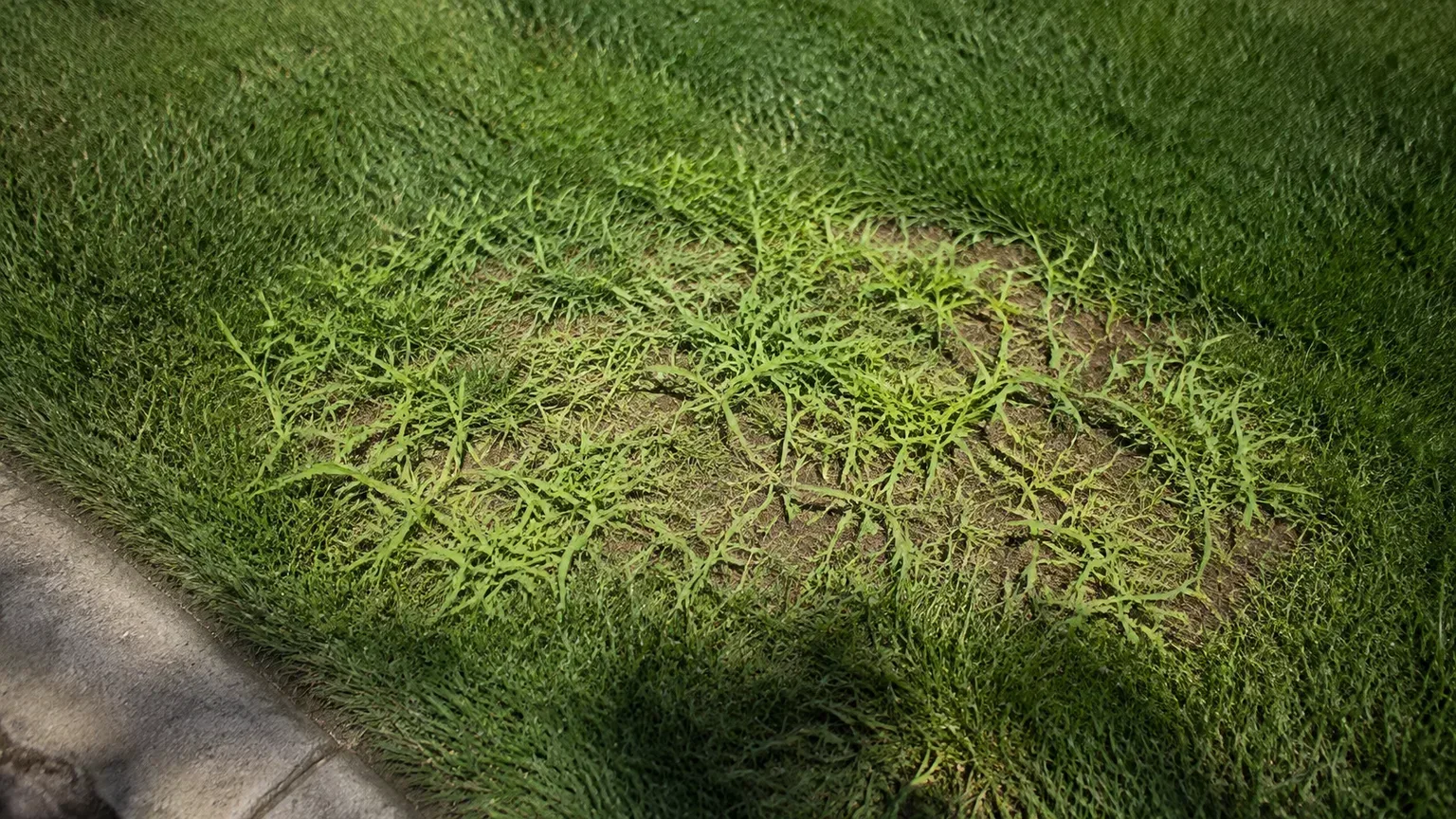
The right way to kill crabgrass depends on whether you are looking at a few young plants, a mature patch, or next year’s seedlings waiting in the soil. Pull small patches, use a crabgrass-labeled post-emergent only on visible plants, and reserve pre-emergent for the period before germination. Then repair the thin or compacted turf that gave the weed an opening.
Crabgrass is a summer annual in the genus Digitaria. The plants die after frost, but they can set seed before then, so a brown lawn in fall is not proof that the problem is solved. Penn State Extension notes that a viable seed supply can keep crabgrass pressure high for several seasons; the goal is to prevent new seed production while building turf dense enough to shade the soil (Penn State Extension’s turfgrass guidance).
The fastest route to control
Use this quick triage before you buy anything:
| What you see | Best first move | Why |
|---|---|---|
| A few young plants in lawn or beds | Loosen moist soil and pull the crown out | It is precise and leaves desirable plants untouched. |
| Many visible plants, but turf is worth saving | Spot-treat with a product labeled for crabgrass and your grass type | Post-emergent treatment works on emerged weeds; a broadleaf-only product will not. |
| A wide, thin, or mostly crabgrass-covered area | Decide whether to renovate the patch, then treat only as the label permits | Trying to save every blade can cost more than rebuilding weak turf. |
| No crabgrass yet, but it was a problem last year | Apply a labeled pre-emergent before germination | It prevents the next generation; it does not kill established plants. |
The timing distinction matters more than the brand on the shelf. A pre-emergent cannot rescue a lawn that is already full of mature crabgrass, and a post-emergent cannot prevent every seed from germinating later. A useful plan may include hand removal now, a selective spot treatment for survivors, and pre-emergent next spring.
Confirm it is crabgrass before you treat
Crabgrass is usually lighter green and coarser than the surrounding turf. Young plants can look like ordinary grass, but they soon form a low, spreading clump from a central crown. The stems radiate outward and may root at nodes, allowing one plant to occupy a surprisingly large patch in a sunny, thin lawn.
The seed head is a helpful late-season clue: several narrow spikes spread like fingers from the top of a stem. Do not wait for this stage if you intend to pull or spray; seed heads mean the plant is already close to completing the part of its life cycle that matters most for next year’s infestation.
Large versus smooth crabgrass
Large, or hairy, crabgrass (Digitaria sanguinalis) often has hairs on the stems and leaves. Smooth crabgrass (Digitaria ischaemum) is generally less hairy and may form a neater low clump. You do not need to identify the species to choose the first control step, but the distinction explains why two patches can look slightly different while responding to the same broad control principles.
Both species are warm-season annuals. Purdue Turfgrass Science describes them as opportunistic weeds that take advantage of bare soil and thin turf, especially when hot weather weakens cool-season grass (Purdue’s crabgrass identification and control notes).
Crabgrass look-alikes need a different plan
The most important look-alike is goosegrass. It often has a pale or silvery center and a very flattened base, with a zipper-like seed head. Goosegrass germinates later than crabgrass and may need a different herbicide timing, so do not assume a product labeled for one automatically controls the other.
Nutsedge has a triangular stem and a different, upright habit; it is a sedge, not a grass. Quackgrass is a cool-season perennial that stays green when summer annual crabgrass begins to fade. If the plant is upright, remains vigorous through cool weather, or has a distinctive clasping leaf base, take a close photograph or ask a local extension office before treating a whole lawn.
Why crabgrass keeps finding your lawn
Crabgrass is rarely the original cause of a weak lawn. It is a symptom of openings that other turf could not fill. Penn State Extension identifies dense, vigorous turf as the foundation of cultural control: shade from a thick canopy makes it harder for crabgrass seedlings to establish.
Look at the pattern rather than the weed alone. A strip along a sidewalk points to heat, shallow soil, traffic, or reflected light. A circular thin area may follow disease or insect damage. A lawn that is thin everywhere may have the wrong grass for the site, insufficient light, poor fertility, or repeated scalping. Compaction is another clue: if water runs off instead of soaking into the root zone, crabgrass has an advantage.
Frequent, light irrigation is particularly unhelpful. It keeps the surface damp enough for shallow-rooted weeds while encouraging desirable turf to root near the surface. Penn State recommends watering deeply into roughly the 4- to 6-inch root zone, just before turf begins to wilt, rather than applying small amounts every day. Adjust that principle for rainfall, soil type, local restrictions, and the needs of your specific grass.
Choose a control method by patch size and timing
Small patches in a flower bed, along a path, or in a young lawn are usually best handled with a hand weeder. You can see exactly what you are removing and avoid herbicide drift. A large, mature infestation in established turf may justify a labeled post-emergent, while a lawn with widespread bare soil may be better served by a planned renovation.
Do not choose a method just because it is described as natural or strong. Boiling water, concentrated vinegar, salt, and broad-spectrum herbicides can kill surrounding grass, ornamentals, soil organisms, or anything else in the spray path. In a lawn, a selective product that is legal and labeled for the turf may be less destructive than a homemade spray; in a vegetable or perennial bed, physical removal and mulch are often more controllable.
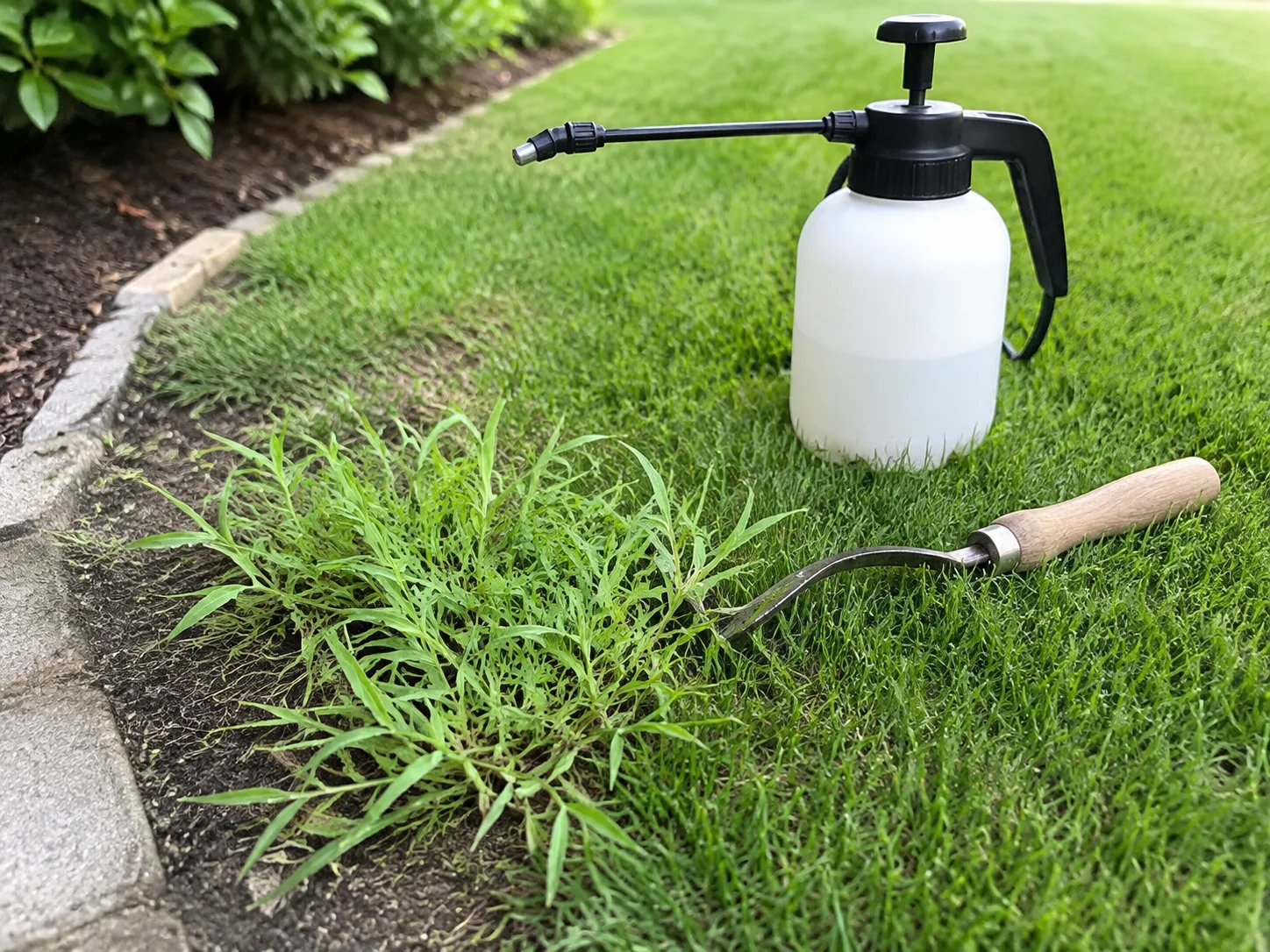
Hand-pull small patches before seed heads form
Hand-pulling is effective when the plants are young and the soil is workable. Water the area slowly if the ground is hard, then wait long enough for moisture to move into the root zone without turning the surface into mud. Grip the plant close to its crown and pull steadily upward; yanking only the leaves can leave the crown behind.
For a clump that will not release, slide a hand weeder or narrow fork beneath the crown and lift. Shake loose soil back into the hole, inspect the removed plant, and check around it for runners or neighboring seedlings. The aim is not to excavate half the lawn; it is to remove the growing point and close the opening afterward.
Bag plants that have developed seed heads instead of putting them in home compost. If you pull before seed production, composting may be reasonable when your system reaches temperatures high enough for reliable decomposition, but disposal is the simpler choice when you are trying to stop a seed-bearing weed from spreading. Sweep loose seed heads from paths before mowing.
Treat established plants with post-emergent herbicide
A post-emergent herbicide is a rescue tool for crabgrass you can see. Read the product label before purchase and confirm three things: crabgrass is listed as a target, your turf species is listed as tolerant, and the application timing fits the plant’s size. Penn State explains that post-emergent materials must be applied to visible plants and that effectiveness depends on coverage and growth stage (Penn State’s post-emergence guidance).
Products may contain active ingredients such as quinclorac, dithiopyr, fenoxaprop, or mesotrione, but the active ingredient name is not a complete recommendation. Formulation, rate, surfactant instructions, turf species, temperature, drought stress, and re-treatment interval all matter. A product that is appropriate for tall fescue may injure another grass, and the label can change by country or state.
Selective products have grass-type limits
Selective does not mean harmless. Some warm-season grasses, including certain St. Augustine and centipede lawns, are sensitive to products that are tolerated by cool-season turf. Newly seeded grass can also be vulnerable. Never infer safety from a neighbor’s success, a product’s broad marketing name, or the fact that the bottle says “lawn.”
Avoid treating drought-stressed, heat-stressed, or newly mowed turf unless the label specifically permits it. Research indexed through PubMed Central also shows that crabgrass growth stage affects the control achieved by glyphosate, reinforcing a practical point: mature plants are harder to kill reliably than young plants (peer-reviewed crabgrass control study).
Spray for coverage, not runoff
Mix and measure exactly as directed. Wear the protective clothing and eye or skin protection listed on the label, keep children and pets away for the stated re-entry period, and do not spray before rain unless the label says rainfall is acceptable. Choose a calm day so droplets do not drift onto ornamentals, vegetable plants, neighboring lawns, drains, ponds, or streams.
Spot-spray the foliage until it is evenly contacted, not dripping. A coarse, controlled spray is easier to keep on the target than a fine mist. Do not mow immediately before or after treatment unless the label instructs you to do so; the plant needs enough leaf area and time for the product to work. If a second application is allowed, follow the exact interval rather than repeating whenever the patch still looks green.
Expect slow or uneven results on large, old plants. Pulling survivors after they decline can be safer than escalating the rate. Never combine products or add dish soap, vinegar, salt, or another “booster” unless the label specifically directs that combination.
Prevent the next flush with pre-emergent
Pre-emergent products create a treatment zone near the soil surface that disrupts germinating seedlings. They are primarily a prevention measure. If crabgrass is already tall and spreading, applying more pre-emergent will not kill it; switch to physical removal or an appropriate post-emergent strategy, then plan for the next season.
Time it by soil temperature and local conditions
Penn State Extension reports that crabgrass begins germinating when the upper inch of soil reaches about 55 to 58°F at daybreak for four to five days. Use that as a biological signal, not a rigid calendar date. Cold snaps, rainfall, sun exposure, and soil color can make a south-facing strip warm before a shaded backyard does.
A soil thermometer is useful if crabgrass has been a recurring problem. Check representative sunny and shaded areas several mornings in a row. Apply the product early enough to become active before the germination window, then water it in exactly as the label requires; Penn State says many pre-emergents perform better when watered within two to three days. Some products may need a second application for season-long control, but only if the label permits it and the total seasonal amount is not exceeded.
Forsythia bloom can be a rough regional reminder, but it should not replace local soil observations. The most useful timing decision is “before the first sustained warm-soil window in this lawn,” not “the first weekend of April.” If crabgrass has already emerged in a hot microclimate, you may be too late for a pure pre-emergent approach.
Protect future grass seed
The same barrier that suppresses crabgrass seedlings can suppress desirable grass seed. This is the central trade-off in spring lawn repair. If you plan to overseed, compare the product’s seeding restrictions with the grass species and follow the label’s waiting period; do not assume that a bag’s fertilizer content makes it safe for new seed.
For cool-season lawns, late summer to early fall is often the better repair window because the new grass can establish before winter. For warm-season lawns, repair timing follows active growth and local frost conditions. A product such as mesotrione may have special seeding uses on certain turf species, but that is a label-specific exception, not permission to use any pre-emergent with seed.
Rebuild the turf that crabgrass exploits
The chemical part of crabgrass control is temporary. Purdue Turfgrass Science recommends improving mowing, fertilization, and future pre-emergent timing, and notes that cool-season grass can lose its competitive edge during hot weather. Think of the lawn as a living mulch: the denser and healthier it is, the less exposed soil crabgrass gets.
Mow, water, feed, and relieve compaction
Set the mower high enough for the grass species and site. The exact height varies, but removing more than one-third of the blade at once or repeatedly scalping the lawn weakens the canopy and exposes soil. Keep the blade sharp so mowing does not shred stressed turf. If crabgrass is bearing seed heads, bag clippings from that area when practical; do not rely on bagging alone after seed has already fallen.
Water deeply and less frequently once the lawn is established. Let the surface dry between irrigation events while avoiding prolonged drought stress. Use a tuna can or rain gauge to learn how long your sprinkler takes to deliver a meaningful amount, and change the schedule for rainfall, slope, shade, and soil texture rather than watering by the clock.
Fertilize from a soil test and the needs of your turf, not the color of the crabgrass patch. Excess spring or summer nitrogen can create lush top growth without solving compaction or bare soil. For many cool-season lawns, fall feeding and overseeding do more for long-term density than pushing weak grass during the hottest part of summer. If you suspect disease or insects caused the thinning, diagnose that problem before adding more fertilizer.
Relieve compaction with core aeration when the grass is actively growing and the timing fits your lawn type. Aeration is not a universal spring chore: it can disturb a pre-emergent barrier and can stress turf during heat or drought. Address traffic patterns too, because a compacted path will reopen even after one aeration.
Repair bare spots after removal
Every crabgrass removal leaves a decision: leave the soil exposed, or replace the turf quickly. Bare soil invites another flush of crabgrass and other weeds. Gardening Know How highlights thin patches, compacted soil, short mowing, and excess fertilizer as conditions that help crabgrass take hold, so seed repair should be paired with a diagnosis rather than treated as a cosmetic patch (Gardening Know How’s crabgrass lawn guidance).
Rake out dead debris and loosen only the top layer enough for seed-to-soil contact. Correct the cause if possible: redirect foot traffic, improve drainage, choose a shade-tolerant turf, or amend soil according to a test. Use seed that matches the existing lawn’s species, climate, light, and mowing height. Spread it evenly, press it into contact with the soil, and apply a thin, weed-free mulch or straw layer if the site dries quickly.
Keep the seedbed consistently damp with light irrigation until seedlings emerge, then gradually lengthen the intervals and water more deeply. Do not let a hose wash seed downhill. Delay mowing until the new grass is established enough for the mower height recommended for that turf, and avoid a crabgrass pre-emergent that would block the seed unless its label specifically allows use during establishment.
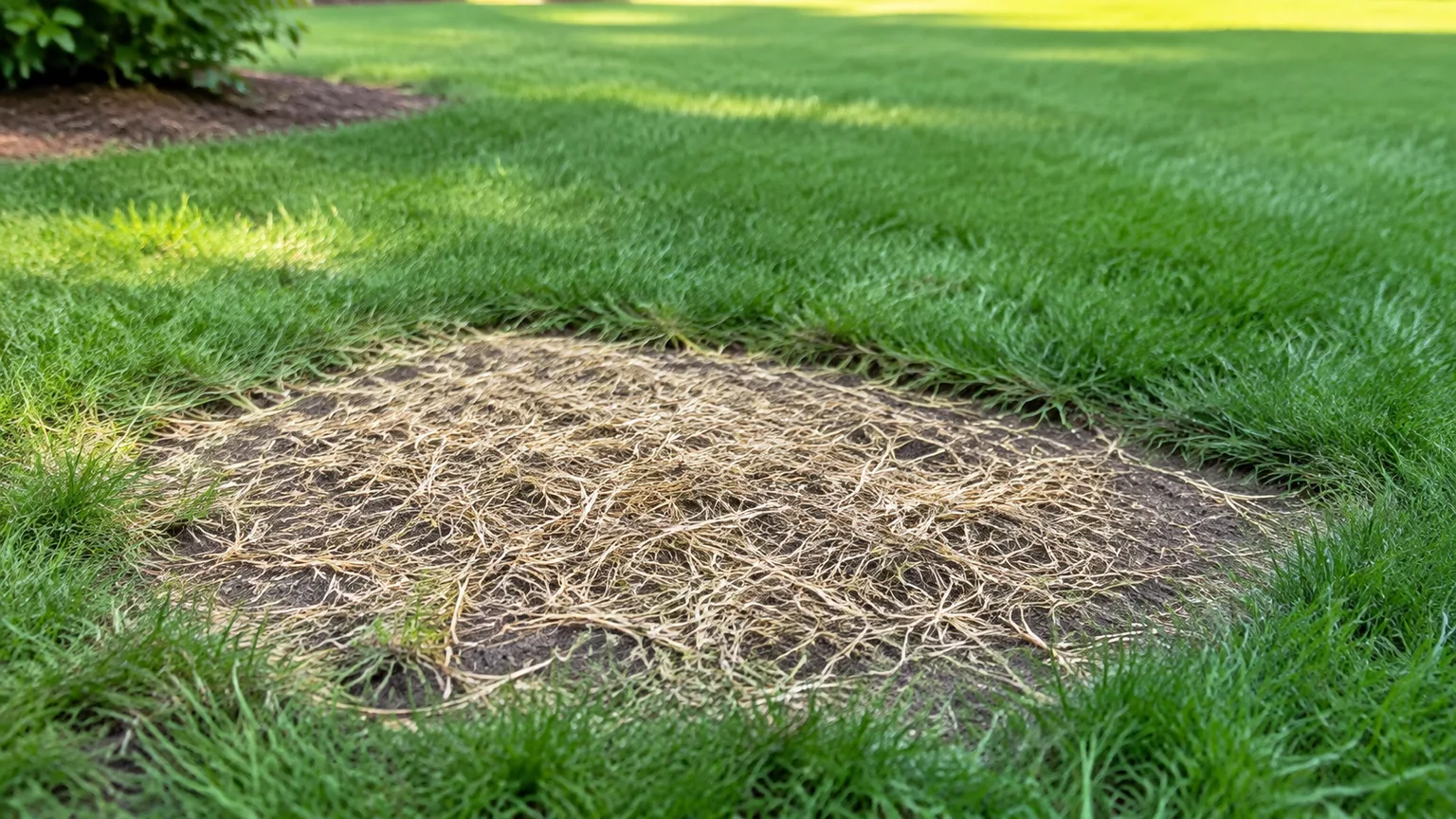
What to do if crabgrass is already seeding
If finger-like seed heads are visible, make seed prevention the priority even if the plants are too mature for reliable chemical control. Remove individual plants where possible. On a larger patch, mow at the correct height and bag the clippings from the infested area if your equipment and local disposal rules allow it; this may reduce movement of seed on the mower, but it cannot recover seed that has already dropped.
Do not scalp the lawn to expose and dry out crabgrass. Scalping weakens desirable turf and can create the bare, sunny conditions that favor the next seedlings. If the plant is near the end of its annual life cycle and the lawn is heat-stressed, a late herbicide application may cause more injury than benefit. Remove seed heads, let the annual die with frost, and focus on fall repair and next spring’s pre-emergent window.
The Lawn Almanac makes the same seasonal point in practical terms: crabgrass may die in fall, but the seed left behind is the reason next year’s plan matters (The Lawn Almanac’s crabgrass identification and control guide). A noticeable reduction usually takes repeated seasons of preventing new seed while correcting thin turf.
Common mistakes that waste a season
Applying pre-emergent after emergence. A visible plant has already passed the stage the barrier is designed to stop. Treat the plant you can see and save prevention for the next germination window.
Using a broadleaf weed killer on a grassy weed. Crabgrass is a grass. A product designed only for dandelions and clover may leave it untouched while stressing your lawn.
Choosing a product without checking turf compatibility. Warm-season and cool-season grasses do not tolerate every active ingredient or rate. Newly seeded turf has additional restrictions.
Spraying in heat, drought, or wind. Stress makes desirable grass more vulnerable, and wind moves droplets. Wait for the label-approved weather window.
Seeding into a pre-emergent barrier. If you need new grass, check the reseeding interval before application. A failed overseed can look like a seed-quality problem when the real issue is residual herbicide.
Mowing too short to “shade out” weeds. Short mowing removes the canopy that shades the soil. Follow the one-third rule and maintain a height appropriate for your turf.
Treating the symptom but not the opening. Crabgrass will return to the same bare strip if compaction, traffic, shade, disease, or drought keeps thinning the turf. Record where it appears and fix the pattern during the lawn’s best recovery season.
Conclusion
To kill crabgrass successfully, match the method to the plant’s stage. Pull young plants in small patches, use a properly labeled post-emergent only when visible crabgrass and compatible turf make that choice worthwhile, and apply pre-emergent before the upper soil warms into the germination window. Then repair bare spots, mow high enough to preserve a canopy, water deeply, and correct compaction or other causes of thin turf.
You may still see a few plants next year because the soil contains old seed. That is normal. Each season in which you prevent seed production and fill the openings reduces the advantage crabgrass has until a dense, well-matched lawn does most of the work for you.



